Overview
A salt bridge is a critical component of electrochemical cells that maintains electrical neutrality in the half-cells by allowing the flow of ions between them without allowing the solutions to mix directly. In electrochemistry, the salt bridge serves as the ionic conductor that completes the circuit, enabling continuous electron flow through the external wire while preventing the buildup of charge that would otherwise halt the electrochemical reaction. Typically constructed from a U-shaped tube filled with an inert electrolyte solution (such as KCl, KNO₃, or Na₂SO₄) suspended in agar gel, the salt bridge represents a fundamental concept that bridges theoretical understanding and practical application of galvanic cells.
Understanding the salt bridge is essential for the MCAT because it appears frequently in both discrete questions and passage-based items within the General Chemistry section, particularly in electrochemistry contexts. The MCAT tests not only the structural knowledge of what a salt bridge is, but more importantly, the functional understanding of why electrochemical cells cannot operate without one. Questions often present scenarios where students must predict what happens when a salt bridge is removed, damaged, or replaced with different electrolytes, requiring deep conceptual understanding rather than mere memorization.
The salt bridge concept integrates multiple foundational principles in General Chemistry, including oxidation-reduction reactions, ion migration, electrical neutrality, and thermodynamics of spontaneous processes. It connects directly to topics such as standard reduction potentials, the Nernst equation, concentration cells, and electrolytic cells. Mastery of salt bridge function provides the conceptual framework necessary to understand how chemical energy converts to electrical energy in galvanic cells and how electrical energy drives non-spontaneous reactions in electrolytic cells. This topic serves as a cornerstone for understanding biological electron transport chains, membrane potentials, and various analytical chemistry techniques that appear in MCAT passages.
Learning Objectives
- [ ] Define salt bridge using accurate General Chemistry terminology
- [ ] Explain why salt bridge matters for the MCAT
- [ ] Apply salt bridge to exam-style questions
- [ ] Identify common mistakes related to salt bridge
- [ ] Connect salt bridge to related General Chemistry concepts
- [ ] Predict the consequences of salt bridge removal or malfunction in electrochemical cells
- [ ] Evaluate the suitability of different electrolytes for use in salt bridges
- [ ] Analyze the direction of ion migration through salt bridges based on electrode reactions
- [ ] Distinguish between the roles of salt bridges in galvanic versus electrolytic cells
Prerequisites
- Oxidation-reduction (redox) reactions: Understanding electron transfer is essential because salt bridges function within systems where oxidation and reduction occur at separate electrodes
- Electrochemical cell components: Knowledge of anodes, cathodes, and half-cells provides the structural context in which salt bridges operate
- Ion behavior in solution: Familiarity with cation and anion movement in aqueous solutions explains the mechanism of charge transport through salt bridges
- Electrical neutrality principle: Understanding that solutions must maintain charge balance explains why salt bridges are necessary
- Spontaneous reactions and thermodynamics: Recognizing that galvanic cells operate spontaneously helps explain the driving force for ion migration through salt bridges
Why This Topic Matters
Salt bridges appear in approximately 3-5% of MCAT General Chemistry questions, making them a high-yield topic with excellent return on study investment. Beyond their direct testing frequency, salt bridges appear as components in passage-based questions about batteries, corrosion, biological electron transport, and analytical techniques like potentiometry. The MCAT frequently tests salt bridge concepts through questions that require students to predict cell behavior when conditions change, making this a favorite topic for assessing conceptual understanding rather than rote memorization.
In real-world and clinical contexts, salt bridge principles underlie numerous applications. Biological membranes function analogously to salt bridges, maintaining charge separation while allowing selective ion flow—a principle central to nerve impulse transmission and muscle contraction. Clinical pH meters and ion-selective electrodes used in blood gas analysis employ salt bridge technology. Pacemakers and other implantable medical devices rely on electrochemical principles that include controlled ion migration. Understanding salt bridges provides the foundation for comprehending how the body maintains electrochemical gradients across membranes, which is essential for cellular respiration, neurotransmission, and kidney function.
On the MCAT, salt bridge questions typically appear in three formats: (1) discrete questions asking about the function or composition of salt bridges, (2) passage-based questions requiring analysis of experimental electrochemical setups, and (3) questions asking students to predict outcomes when salt bridge conditions are altered. The exam particularly favors questions that test whether students understand that salt bridges maintain electrical neutrality rather than simply "completing the circuit"—a subtle but important distinction that separates high-scoring students from average performers.
Core Concepts
Definition and Structure of Salt Bridges
A salt bridge is an inverted U-shaped tube containing an electrolyte solution that connects the two half-cells of an electrochemical cell, allowing ion migration while preventing direct mixing of the electrode solutions. The electrolyte within the salt bridge typically consists of an inert salt—one whose ions do not participate in the electrode reactions—dissolved in water and often suspended in a gel medium such as agar or held in place by porous plugs at each end. Common electrolytes include potassium chloride (KCl), potassium nitrate (KNO₃), and sodium sulfate (Na₂SO₄), chosen because their ions have similar migration rates and do not interfere with electrode reactions.
The physical structure ensures that while ions can migrate between half-cells, the bulk solutions remain separated. The gel or porous plugs prevent convective mixing while allowing ionic conduction. The salt bridge must remain in contact with both half-cell solutions throughout the experiment, as any break in this contact immediately stops the electrochemical cell from functioning.
Function: Maintaining Electrical Neutrality
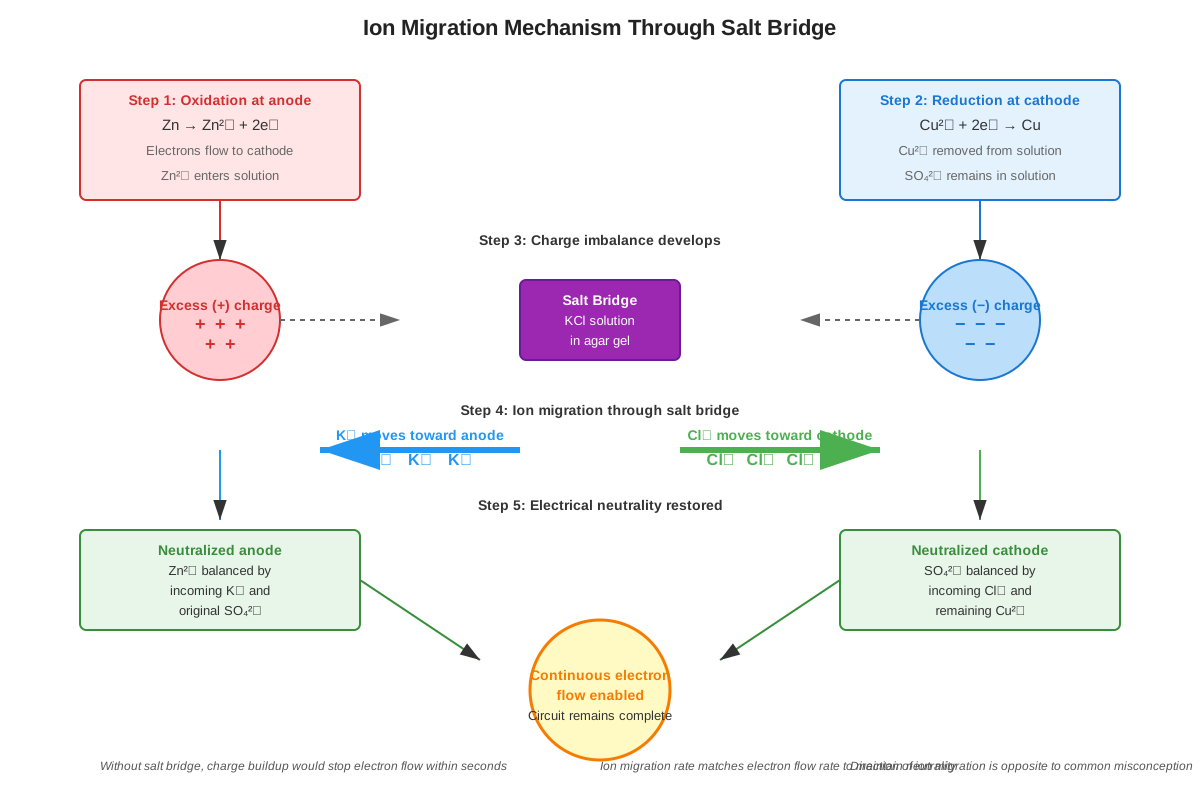
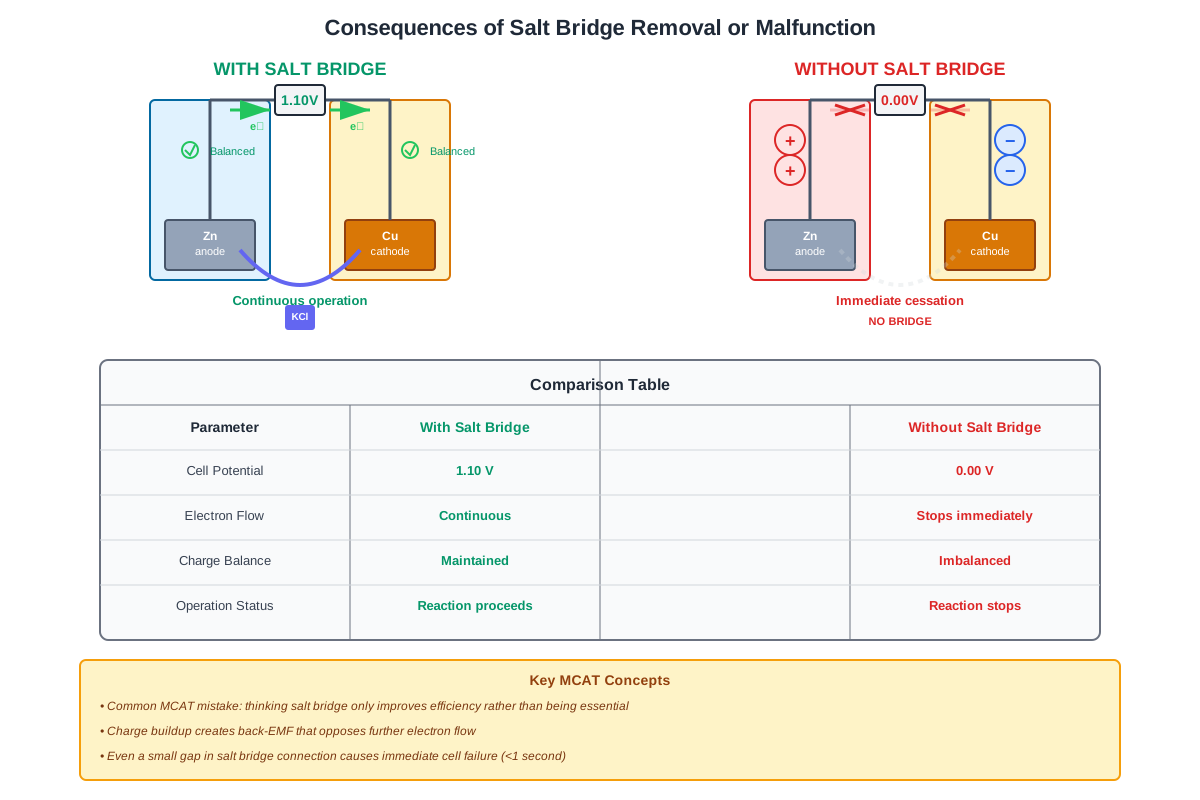
The primary function of the salt bridge is to maintain electrical neutrality in both half-cells as the electrochemical reaction proceeds. When a galvanic cell operates, oxidation occurs at the anode (releasing electrons and producing cations), while reduction occurs at the cathode (consuming electrons and removing cations from solution or producing anions). Without a salt bridge, the anode solution would accumulate positive charge (from the cations produced by oxidation), while the cathode solution would accumulate negative charge (from the anions left behind when cations are reduced). This charge buildup would create an electric field opposing further electron flow, rapidly stopping the cell reaction.
The salt bridge prevents this charge accumulation through ion migration. Anions from the salt bridge migrate toward the anode compartment to neutralize the excess positive charge from oxidation products. Simultaneously, cations from the salt bridge migrate toward the cathode compartment to replace the cations removed by reduction or to neutralize excess negative charge. This bidirectional ion flow maintains charge balance in both half-cells, allowing continuous electron flow through the external circuit.
Mechanism of Ion Migration
Ion migration through the salt bridge follows specific patterns determined by the electrode reactions. Consider a typical zinc-copper galvanic cell:
Anode (oxidation): Zn(s) → Zn²⁺(aq) + 2e⁻
Cathode (reduction): Cu²⁺(aq) + 2e⁻ → Cu(s)
At the anode, zinc metal oxidizes to produce Zn²⁺ ions, increasing positive charge in the solution. To maintain neutrality, anions (such as Cl⁻ or NO₃⁻) migrate from the salt bridge into the anode compartment. At the cathode, Cu²⁺ ions are removed from solution as they deposit as copper metal, decreasing positive charge. To maintain neutrality, cations (such as K⁺ or Na⁺) migrate from the salt bridge into the cathode compartment.
The rate of ion migration through the salt bridge must match the rate of electron flow through the external circuit. If the salt bridge becomes blocked or depleted, ion migration stops, charge imbalance develops, and the cell voltage drops to zero even though the electrode materials remain capable of reaction.
Selection of Salt Bridge Electrolytes
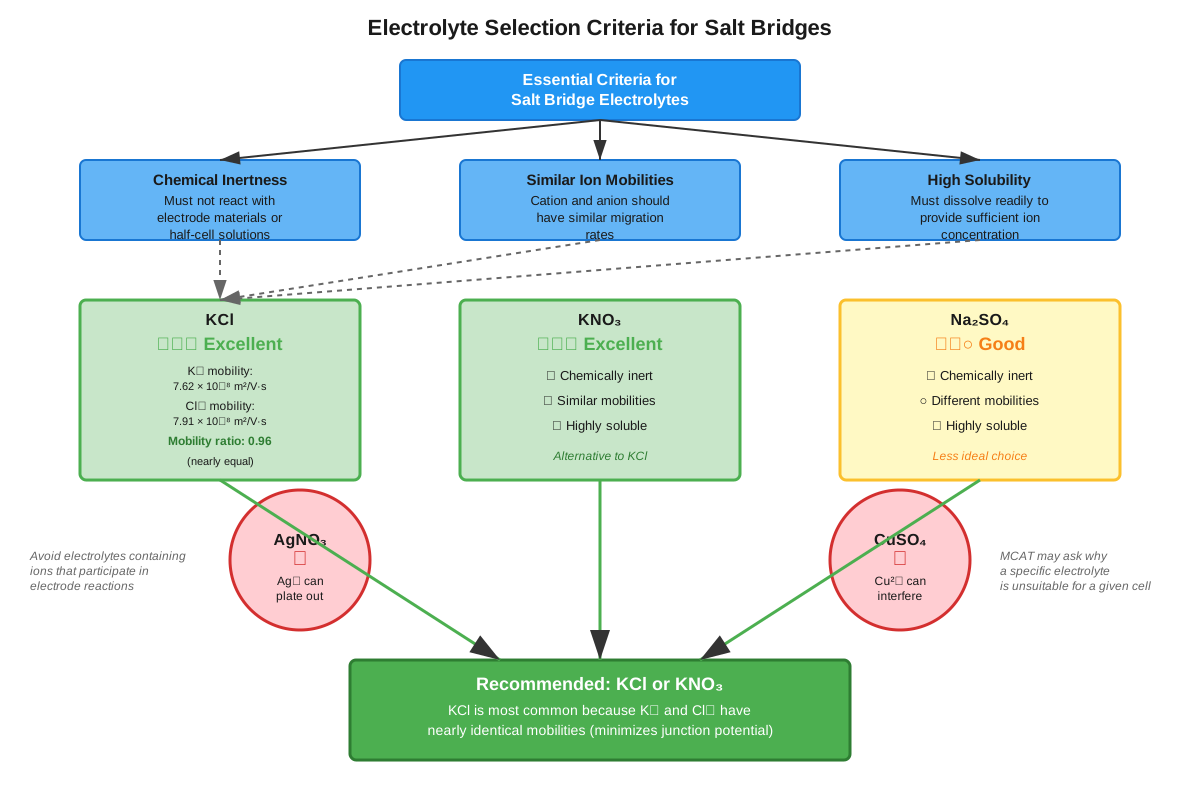
Not all electrolytes function equally well in salt bridges. The ideal salt bridge electrolyte possesses several characteristics:
| Property | Requirement | Reason |
|---|---|---|
| Inertness | Ions must not react with electrode solutions | Prevents interference with intended redox reactions |
| Similar mobility | Cation and anion should have comparable migration rates | Prevents liquid junction potentials and maintains uniform conductivity |
| High solubility | Salt must dissolve readily in water | Ensures adequate ionic strength for conductivity |
| Non-interfering | Ions should not form precipitates with electrode solutions | Prevents clogging and maintains ion flow |
Potassium chloride (KCl) is the most commonly used salt bridge electrolyte because K⁺ and Cl⁻ have nearly identical ionic mobilities (approximately 7.6 × 10⁻⁸ m²/V·s for K⁺ and 7.9 × 10⁻⁸ m²/V·s for Cl⁻), minimizing liquid junction potentials. Potassium nitrate (KNO₃) serves as an alternative when chloride ions might interfere with electrode reactions, such as in cells involving silver electrodes where AgCl precipitation would be problematic.
Salt Bridges vs. Porous Barriers
While salt bridges represent the most common method for connecting half-cells, porous barriers (such as porous ceramic disks or sintered glass frits) can also serve this function. Porous barriers allow ion migration through microscopic channels while preventing bulk solution mixing. However, porous barriers differ from salt bridges in that they do not provide additional ions—they only allow existing ions in the half-cell solutions to migrate between compartments.
Salt bridges offer advantages over porous barriers: they provide a reservoir of inert ions that can migrate as needed without depleting the half-cell solutions, they prevent contamination between half-cells more effectively, and they minimize liquid junction potentials. However, porous barriers are simpler to construct and maintain, making them suitable for certain applications.
Role in Different Cell Types
In galvanic (voltaic) cells, which operate spontaneously, the salt bridge enables the spontaneous reaction to continue by preventing charge buildup. The cell generates electrical energy, and the salt bridge is essential for sustained operation.
In electrolytic cells, which require external electrical energy to drive non-spontaneous reactions, the salt bridge still maintains electrical neutrality in the half-cells, though the direction of the overall reaction is reversed compared to galvanic operation. The same principles of ion migration apply, but the anode and cathode identities switch (anode becomes the site of oxidation regardless of whether the cell is galvanic or electrolytic).
In concentration cells, where both electrodes consist of the same material but are immersed in solutions of different concentrations, the salt bridge is particularly critical. The cell operates based solely on the concentration difference, and the salt bridge must not significantly alter these concentrations while still maintaining electrical neutrality.
Concept Relationships
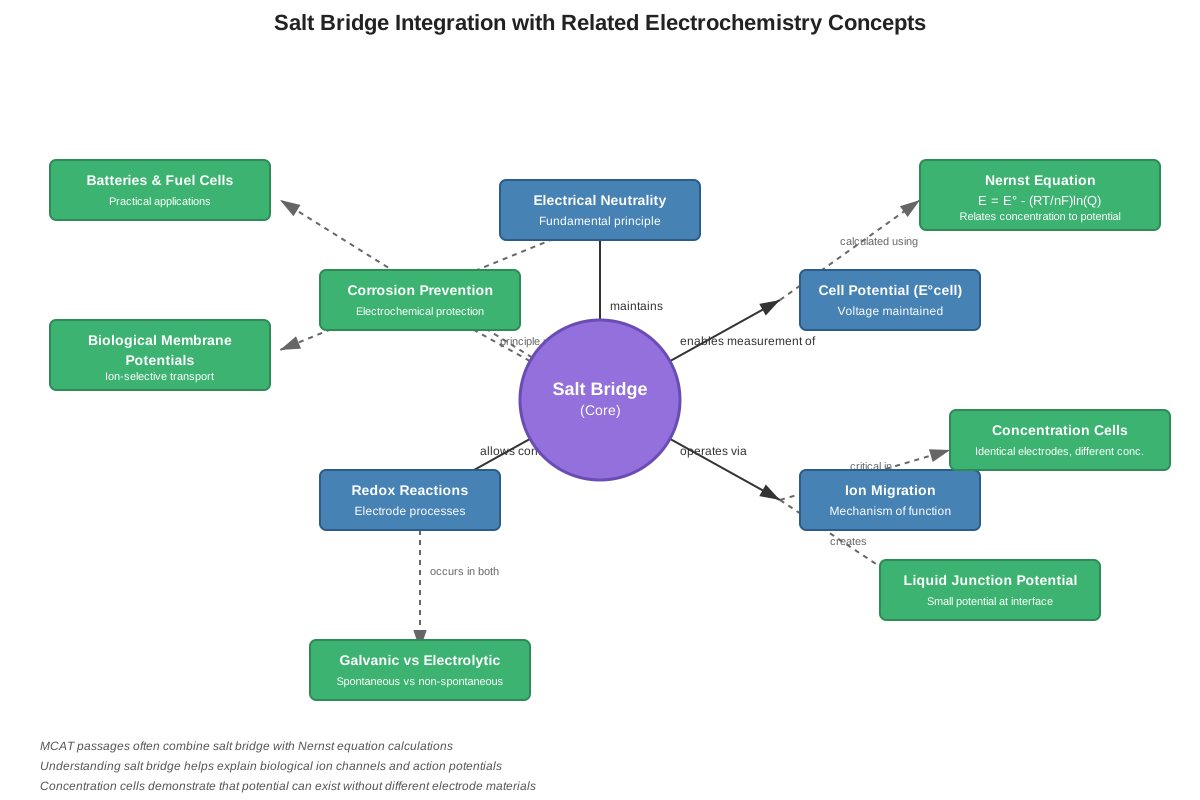
The salt bridge concept integrates multiple electrochemistry principles into a cohesive understanding of cell function. Redox reactions provide the fundamental electron transfer that the salt bridge supports—without oxidation and reduction occurring at separate electrodes, no charge imbalance would develop and no salt bridge would be necessary. The anode (site of oxidation) produces cations or consumes anions, creating a positive charge excess that attracts anions from the salt bridge. The cathode (site of reduction) consumes cations or produces anions, creating a negative charge excess that attracts cations from the salt bridge.
Cell potential (voltage) depends on maintaining concentration gradients and electrical neutrality. The Nernst equation shows how cell potential varies with ion concentrations; if the salt bridge fails and concentrations change due to charge buildup, the cell potential deviates from predicted values and eventually drops to zero. Standard reduction potentials determine which electrode serves as anode versus cathode, which in turn determines the direction of ion migration through the salt bridge.
The relationship map flows as follows: Redox reactions → generate charge separation → requires salt bridge → enables ion migration → maintains electrical neutrality → allows sustained electron flow → produces measurable cell potential → can be calculated using Nernst equation → depends on concentration gradients → protected by salt bridge function.
Salt bridges also connect to broader chemistry concepts: ionic conductivity explains how ions carry charge through the salt bridge, diffusion drives ion movement down concentration gradients, electrostatic attraction pulls ions toward regions of opposite charge, and thermodynamics governs the spontaneity of the overall cell reaction that the salt bridge enables.
Quick check — test yourself on Salt bridge so far.
Try Flashcards →High-Yield Facts
⭐ The primary function of a salt bridge is to maintain electrical neutrality in both half-cells, not simply to "complete the circuit"
⭐ Anions migrate from the salt bridge toward the anode; cations migrate from the salt bridge toward the cathode
⭐ Without a functioning salt bridge, charge buildup stops electron flow and the cell voltage drops to zero
⭐ KCl is the most common salt bridge electrolyte because K⁺ and Cl⁻ have similar ionic mobilities
⭐ Salt bridge ions must be inert—they cannot participate in the electrode reactions
- The salt bridge allows ion flow while preventing direct mixing of electrode solutions
- Removing the salt bridge immediately stops the electrochemical cell from functioning
- Salt bridges can be replaced by porous barriers, though salt bridges generally perform better
- The rate of ion migration through the salt bridge equals the rate of electron flow through the external circuit
- In a concentration cell, the salt bridge must not significantly alter the concentration difference driving the cell
- Gel-filled salt bridges prevent convective mixing while allowing ionic conduction
- If salt bridge ions react with electrode solutions (forming precipitates), the salt bridge becomes clogged and non-functional
- The salt bridge does not directly participate in the redox reactions occurring at the electrodes
Common Misconceptions
Misconception: The salt bridge completes the circuit by allowing electrons to flow between half-cells.
Correction: The salt bridge allows ions (not electrons) to migrate between half-cells. Electrons flow through the external wire connecting the electrodes. The salt bridge completes the circuit by providing an ionic conduction path, while the wire provides an electronic conduction path. Electrons cannot travel through aqueous solutions in electrochemical cells.
Misconception: Cations always flow from anode to cathode through the salt bridge.
Correction: Cations from the salt bridge flow toward the cathode, but this is not "from anode to cathode"—they originate in the salt bridge itself. Similarly, anions from the salt bridge flow toward the anode. The direction of ion migration depends on where charge imbalance develops, not on a simple anode-to-cathode flow pattern.
Misconception: Any electrolyte can serve as a salt bridge.
Correction: Only inert electrolytes that do not react with the electrode solutions or participate in the redox reactions can function as salt bridges. For example, using a salt bridge containing Ag⁺ ions in a cell with chloride-containing solutions would cause AgCl precipitation, clogging the salt bridge. The electrolyte must be carefully selected based on the specific cell chemistry.
Misconception: The salt bridge prevents all mixing between half-cells.
Correction: The salt bridge prevents bulk convective mixing and rapid diffusion, but some minimal mixing does occur over time through diffusion. The salt bridge slows mixing to a rate that doesn't significantly affect cell operation during typical experimental timeframes. Complete prevention of mixing would also prevent the necessary ion migration.
Misconception: Salt bridges are only necessary in galvanic cells, not electrolytic cells.
Correction: Both galvanic and electrolytic cells require salt bridges (or equivalent ionic connections) to maintain electrical neutrality. The fundamental issue—charge buildup in half-cells as reactions proceed—occurs in both cell types. The difference lies in whether the reaction is spontaneous (galvanic) or driven by external voltage (electrolytic), not in whether charge balance must be maintained.
Misconception: The salt bridge provides ions that get reduced or oxidized at the electrodes.
Correction: Salt bridge ions are specifically chosen to be inert—they do not participate in the electrode reactions. They serve only to maintain charge balance. The ions that undergo redox reactions come from the electrode solutions themselves or from the electrode materials, not from the salt bridge.
Worked Examples
Example 1: Predicting Ion Migration Direction
Question: In a galvanic cell, zinc metal is oxidized at the anode (Zn → Zn²⁺ + 2e⁻) and silver ions are reduced at the cathode (Ag⁺ + e⁻ → Ag). The salt bridge contains KNO₃. Describe the direction of ion migration through the salt bridge and explain why this migration is necessary.
Solution:
Step 1: Identify what happens at each electrode.
- At the anode: Zn oxidizes to Zn²⁺, adding positive charge to the solution
- At the cathode: Ag⁺ reduces to Ag, removing positive charge from the solution
Step 2: Determine the charge imbalance that develops.
- Anode compartment: Accumulates excess positive charge (from Zn²⁺ production)
- Cathode compartment: Develops excess negative charge (from Ag⁺ removal, leaving NO₃⁻ behind)
Step 3: Predict ion migration to neutralize these imbalances.
- To neutralize excess positive charge at the anode: NO₃⁻ (anions) migrate from the salt bridge into the anode compartment
- To neutralize excess negative charge at the cathode: K⁺ (cations) migrate from the salt bridge into the cathode compartment
Step 4: Explain the necessity.
Without this ion migration, the positive charge buildup at the anode would electrostatically repel further Zn²⁺ formation, while the negative charge buildup at the cathode would repel electrons trying to enter the cathode. These electrostatic forces would oppose the redox reactions, rapidly stopping electron flow and dropping the cell voltage to zero. The salt bridge maintains electrical neutrality, allowing the spontaneous reaction to continue.
Connection to learning objectives: This example demonstrates applying salt bridge concepts to predict ion behavior and connects to the broader electrochemistry principle that spontaneous reactions can only continue when charge balance is maintained.
Example 2: Evaluating Salt Bridge Electrolyte Suitability
Question: A student wants to construct a galvanic cell with a copper electrode in Cu(NO₃)₂ solution and a silver electrode in AgNO₃ solution. Evaluate whether each of the following would be suitable as a salt bridge electrolyte: (a) NaCl, (b) KNO₃, (c) AgNO₃, (d) Na₂SO₄.
Solution:
(a) NaCl - UNSUITABLE
Reasoning: While Na⁺ is inert and won't interfere, Cl⁻ will react with Ag⁺ in the cathode compartment to form AgCl precipitate (Ksp = 1.8 × 10⁻¹⁰). This precipitation would:
- Remove Ag⁺ from solution, altering the cathode reaction
- Clog the salt bridge with solid AgCl
- Change the cell potential unpredictably
Verdict: Unsuitable due to precipitation reaction.
(b) KNO₃ - SUITABLE
Reasoning:
- K⁺ is inert and won't react with Cu²⁺, Cu, Ag⁺, or Ag
- NO₃⁻ is already present in both half-cell solutions, so adding more won't interfere
- K⁺ and NO₃⁻ have similar ionic mobilities
- No precipitation reactions will occur
Verdict: Excellent choice—this is the best option.
(c) AgNO₃ - UNSUITABLE
Reasoning: While NO₃⁻ is fine, Ag⁺ is not inert in this system:
- Ag⁺ from the salt bridge could migrate to the copper electrode and undergo reduction (Ag⁺ + e⁻ → Ag), interfering with the intended cell reaction
- This would deposit silver on the copper electrode, changing the electrode composition
- The cell would no longer function as designed
Verdict: Unsuitable because Ag⁺ participates in electrode reactions.
(d) Na₂SO₄ - SUITABLE
Reasoning:
- Na⁺ is inert and won't react with any cell components
- SO₄²⁻ is inert and won't form precipitates with Cu²⁺ or Ag⁺ (both copper and silver sulfates are soluble)
- Both ions can migrate freely to maintain charge balance
Verdict: Suitable, though not as ideal as KNO₃ because the 2:1 stoichiometry and different ionic mobilities of Na⁺ and SO₄²⁻ could create small liquid junction potentials.
Connection to learning objectives: This example demonstrates evaluating salt bridge electrolyte suitability and identifying common mistakes (using electrolytes that precipitate or participate in reactions).
Exam Strategy
When approaching MCAT questions about salt bridges, first identify whether the question asks about structure, function, or consequences of malfunction. Structure questions typically require knowing that salt bridges contain inert electrolytes and prevent bulk mixing. Function questions require understanding that the primary role is maintaining electrical neutrality through ion migration. Malfunction questions require predicting that charge buildup stops the cell.
Trigger words and phrases to watch for:
- "What is the purpose of the salt bridge?" → Answer focuses on maintaining electrical neutrality, not just "completing the circuit"
- "Which direction do ions migrate?" → Anions toward anode, cations toward cathode
- "What happens if the salt bridge is removed?" → Cell voltage drops to zero due to charge buildup
- "Which electrolyte would be suitable?" → Must be inert and not form precipitates
- "Why does the cell stop functioning?" → Look for salt bridge failure or depletion
Process-of-elimination strategies:
- Eliminate any answer suggesting electrons flow through the salt bridge (they flow through the wire)
- Eliminate answers suggesting salt bridge ions undergo redox reactions (they must be inert)
- Eliminate answers suggesting ion migration is optional or only improves efficiency (it's absolutely required)
- When choosing salt bridge electrolytes, eliminate any that would precipitate with electrode solutions
Time allocation: Salt bridge questions typically require 60-90 seconds. Spend 20 seconds identifying what the question asks (structure, function, or consequence), 30-40 seconds analyzing the specific scenario, and 20-30 seconds selecting and confirming your answer. Don't overthink these questions—the MCAT tests fundamental understanding, not obscure exceptions.
Exam Tip: If a passage describes an electrochemical cell and doesn't explicitly mention a salt bridge, assume one is present unless the question specifically asks about its absence. The MCAT often tests whether students recognize that salt bridges are necessary components even when not explicitly shown in diagrams.
Memory Techniques
Mnemonic for ion migration direction: "ANIONS to ANODE, CATIONS to CATHODE" (both pairs start with the same letter). Remember that these ions come FROM the salt bridge, not from the other electrode.
Visualization strategy: Picture the salt bridge as a "charge balance scale." When the anode side gets too positive (from oxidation producing cations), negative ions (anions) flow from the salt bridge to balance it. When the cathode side gets too negative (from reduction removing cations), positive ions (cations) flow from the salt bridge to balance it. The salt bridge constantly adjusts to keep both sides electrically neutral.
Acronym for salt bridge electrolyte requirements: "SINS"
- Soluble (must dissolve well in water)
- Inert (cannot react with electrode solutions)
- Non-precipitating (won't form solids with electrode ions)
- Similar mobilities (cation and anion should migrate at comparable rates)
Memory aid for function: Think "salt bridge = charge bridge." Its job is to bridge the charge gap that develops between half-cells, not to bridge electrons (that's the wire's job).
Conceptual anchor: Remember that electrochemical cells are like a water wheel—water (electrons) flows through the wheel (external circuit) to do work, but you need a return path for the water to complete the cycle. The salt bridge is that return path, but for charge (ions) rather than water. Without it, the system backs up and stops.
Summary
The salt bridge is an essential component of electrochemical cells that maintains electrical neutrality in both half-cells by allowing bidirectional ion migration while preventing direct solution mixing. Constructed from inert electrolytes like KCl or KNO₃ suspended in gel within a U-shaped tube, the salt bridge enables continuous cell operation by preventing charge buildup that would otherwise halt redox reactions. Anions from the salt bridge migrate toward the anode to neutralize positive charge from oxidation, while cations migrate toward the cathode to neutralize negative charge from reduction. The salt bridge does not transport electrons (which flow through the external wire) and its ions do not participate in electrode reactions—they serve solely to maintain charge balance. Without a functioning salt bridge, electrochemical cells immediately stop operating as charge imbalance creates an opposing electric field. Understanding salt bridge function is crucial for MCAT success because questions frequently test whether students recognize that maintaining electrical neutrality, not simply "completing the circuit," is the primary function, and whether students can predict consequences of salt bridge failure or evaluate electrolyte suitability.
Key Takeaways
- The salt bridge maintains electrical neutrality in both half-cells by allowing ion migration, which is absolutely required for continuous electrochemical cell operation
- Anions migrate from the salt bridge toward the anode; cations migrate from the salt bridge toward the cathode—both originate in the salt bridge, not from the opposite electrode
- Salt bridge electrolytes must be inert (not participating in electrode reactions), soluble, non-precipitating with electrode solutions, and ideally have similar cation and anion mobilities
- Electrons flow through the external wire, not through the salt bridge; the salt bridge provides ionic conduction while the wire provides electronic conduction
- Removing or blocking the salt bridge causes immediate cell failure as charge buildup creates an opposing electric field that stops the redox reactions
- KCl and KNO₃ are the most common salt bridge electrolytes due to their inertness and the similar mobilities of their constituent ions
- Salt bridges are necessary in both galvanic (spontaneous) and electrolytic (non-spontaneous) cells because both require maintenance of electrical neutrality
Related Topics
Nernst Equation: Understanding how salt bridge function maintains the concentration gradients that the Nernst equation uses to calculate non-standard cell potentials builds directly on salt bridge concepts and explains quantitatively why salt bridge failure affects cell voltage.
Concentration Cells: These cells depend entirely on concentration differences rather than different electrode materials, making salt bridge function even more critical since the salt bridge must not significantly alter the concentrations driving the cell.
Electrolytic Cells and Electrolysis: While galvanic cells operate spontaneously, electrolytic cells require external voltage to drive non-spontaneous reactions, but both require salt bridges to maintain electrical neutrality—understanding this similarity deepens comprehension of fundamental electrochemical principles.
Membrane Potentials in Biology: Biological membranes function analogously to salt bridges, maintaining charge separation while allowing selective ion flow, making salt bridge principles directly applicable to understanding nerve impulses, muscle contraction, and cellular respiration.
Liquid Junction Potentials: Advanced understanding of how different ion mobilities create small voltage differences at solution interfaces builds on salt bridge concepts and explains why K⁺ and Cl⁻ are preferred (their similar mobilities minimize these potentials).
Practice CTA
Now that you've mastered the fundamental concepts of salt bridges, it's time to solidify your understanding through active practice. Attempt the practice questions and work through the flashcards to reinforce the key principles of ion migration, electrical neutrality, and salt bridge function. Focus particularly on questions that ask you to predict consequences of salt bridge failure or evaluate electrolyte suitability—these question types frequently appear on the MCAT and separate high-scoring students from average performers. Remember, understanding why salt bridges maintain electrical neutrality rather than simply "completing the circuit" demonstrates the conceptual depth that the MCAT rewards. You've built a strong foundation—now apply it!
Sign up free to keep reading
Create a free AnvayaPrep account to finish this MCAT guide on Salt bridge — plus flashcards and practice questions.