Overview
Dynamic equilibrium is a foundational concept in General Chemistry that describes a state in which forward and reverse processes occur simultaneously at equal rates, resulting in no net change in the concentrations of reactants and products over time. This concept is central to understanding chemical reactions that do not proceed to completion, and it bridges the disciplines of kinetics (the study of reaction rates) and equilibrium (the study of the final state of reversible reactions). On the MCAT, dynamic equilibrium appears frequently in questions involving acid-base chemistry, solubility, biochemical pathways, and physiological systems, making it an essential topic for achieving a competitive score.
Understanding dynamic equilibrium requires recognizing that "equilibrium" does not mean "static" or "stopped." Rather, it describes a dynamic state where molecular-level processes continue unabated, but macroscopic properties remain constant. This distinction is critical for interpreting experimental data, predicting the behavior of chemical systems under stress, and understanding how biological systems maintain homeostasis. The MCAT tests this concept both directly through standalone questions and indirectly through passage-based questions that require application of equilibrium principles to complex scenarios.
Dynamic equilibrium connects intimately with other General Chemistry topics including Le Chatelier's principle, equilibrium constants (K_eq, K_a, K_b, K_sp), reaction kinetics, thermodynamics, and buffer systems. Mastery of this topic enables students to predict how changes in concentration, temperature, or pressure affect chemical systems—a skill tested extensively in both the Chemical and Physical Foundations of Biological Systems section and the Biological and Biochemical Foundations of Living Systems section of the MCAT. The concept also extends beyond chemistry into physiology, where dynamic equilibria govern processes such as oxygen transport, acid-base balance, and membrane transport.
Learning Objectives
- [ ] Define Dynamic equilibrium using accurate General Chemistry terminology
- [ ] Explain why Dynamic equilibrium matters for the MCAT
- [ ] Apply Dynamic equilibrium to exam-style questions
- [ ] Identify common mistakes related to Dynamic equilibrium
- [ ] Connect Dynamic equilibrium to related General Chemistry concepts
- [ ] Distinguish between dynamic equilibrium and static equilibrium in chemical systems
- [ ] Calculate and interpret equilibrium constants from concentration data
- [ ] Predict the direction of net reaction given initial concentrations and K_eq
- [ ] Analyze how changes in reaction conditions affect the position of equilibrium
Prerequisites
- Chemical kinetics fundamentals: Understanding reaction rates and rate laws is essential because dynamic equilibrium occurs when forward and reverse reaction rates become equal
- Stoichiometry and balanced equations: Required to write equilibrium expressions correctly and perform calculations involving molar relationships
- Concentration units (molarity): Equilibrium expressions use molar concentrations, and interpreting equilibrium problems requires facility with molarity calculations
- Basic thermodynamics concepts: The relationship between Gibbs free energy and equilibrium constants provides the thermodynamic foundation for understanding why equilibria exist
- Reversible reactions: Recognition that many chemical reactions can proceed in both forward and reverse directions is fundamental to the concept of dynamic equilibrium
Why This Topic Matters
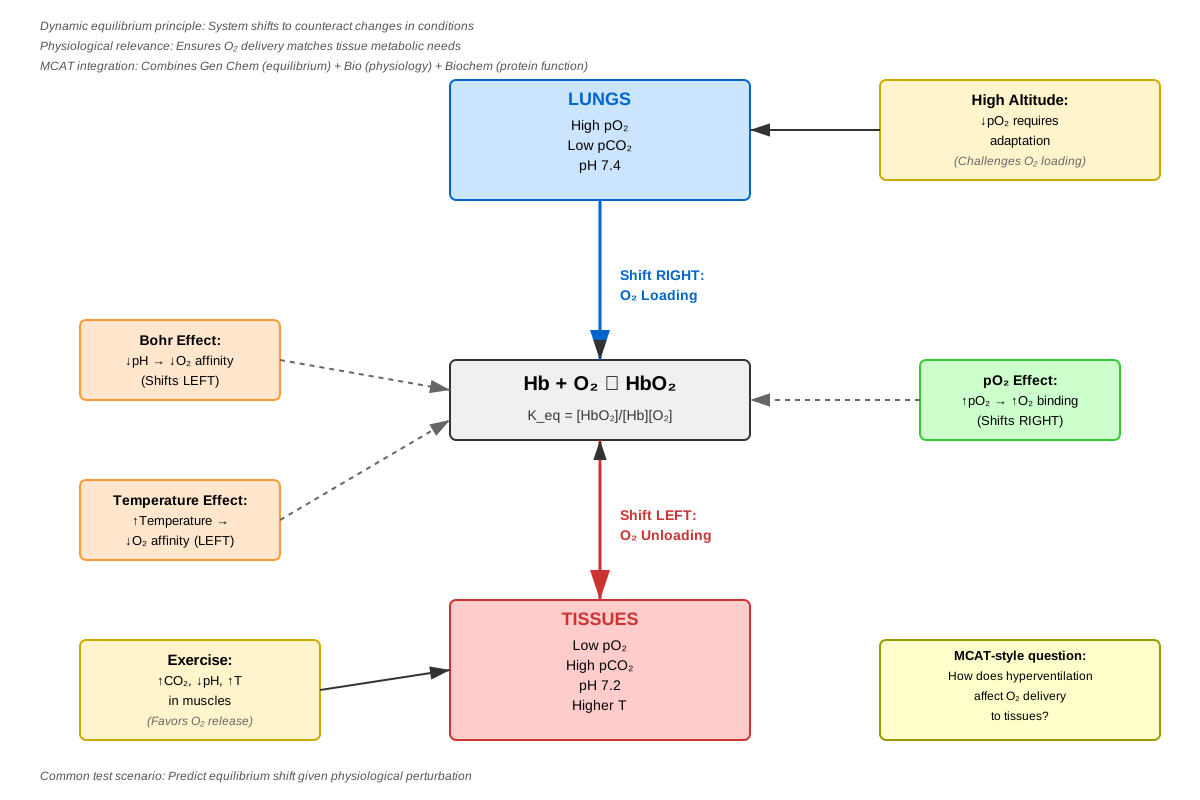
Dynamic equilibrium is clinically and physiologically relevant across multiple organ systems. The oxygen-hemoglobin dissociation curve, which describes how hemoglobin binds and releases oxygen in response to changing partial pressures, is a classic example of dynamic equilibrium in action. Acid-base homeostasis in blood relies on the carbonic acid-bicarbonate buffer system, which maintains pH through dynamic equilibrium between CO₂, H₂CO₃, HCO₃⁻, and H⁺. Drug distribution between plasma and tissues, receptor-ligand binding, and enzyme-substrate interactions all involve dynamic equilibria that determine therapeutic efficacy and physiological responses.
On the MCAT, dynamic equilibrium appears in approximately 8-12% of General Chemistry questions and features prominently in integrated passages that combine chemistry with biology or physiology. Questions may present experimental data showing concentration changes over time, ask students to predict the effect of perturbations on equilibrium systems, or require calculation of equilibrium constants from given data. The topic appears in multiple question formats: discrete questions testing conceptual understanding, passage-based questions requiring data interpretation, and pseudo-discrete questions embedded within biological contexts.
Common MCAT passage scenarios involving dynamic equilibrium include: buffer system analysis in physiological contexts, solubility equilibria in kidney stone formation or drug precipitation, acid-base equilibria in metabolic or respiratory disorders, and enzyme kinetics passages that require understanding of substrate-product equilibria. The ability to quickly recognize when a system is at equilibrium, determine whether it will shift in response to changes, and calculate relevant equilibrium parameters is essential for efficient problem-solving under timed conditions.
Core Concepts
Definition and Characteristics of Dynamic Equilibrium
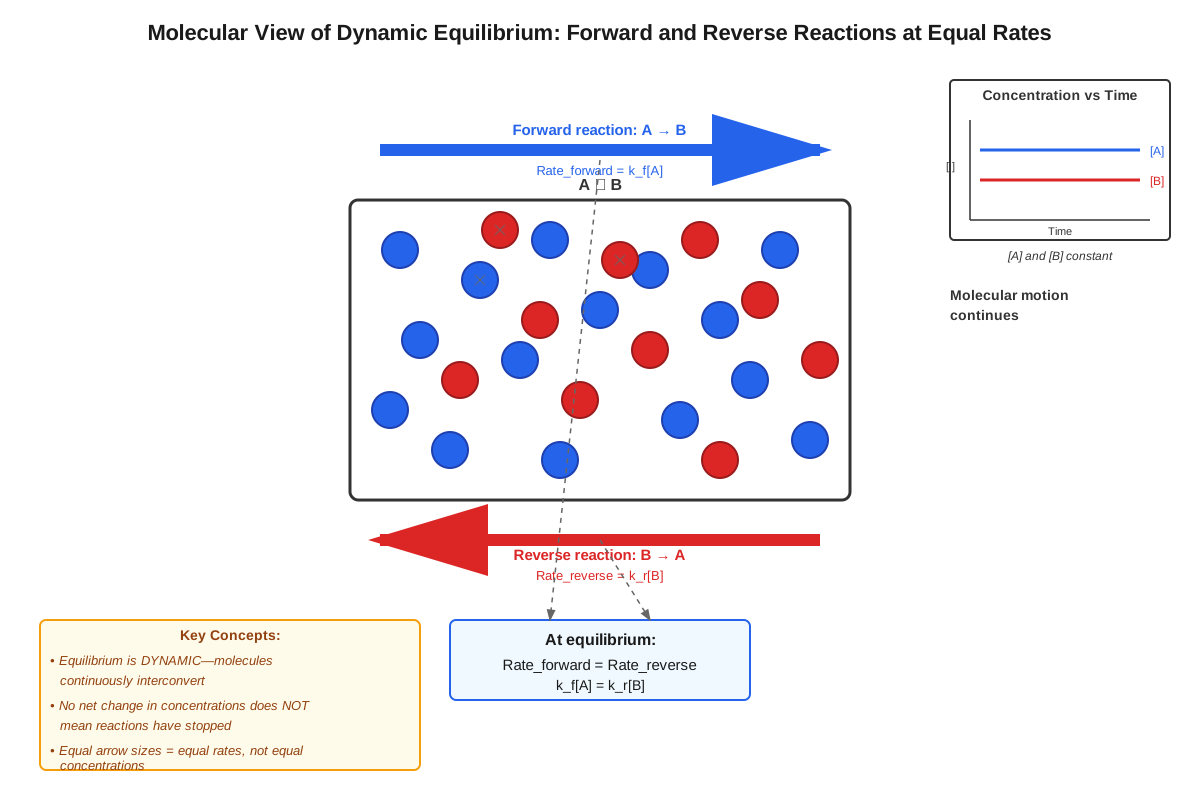
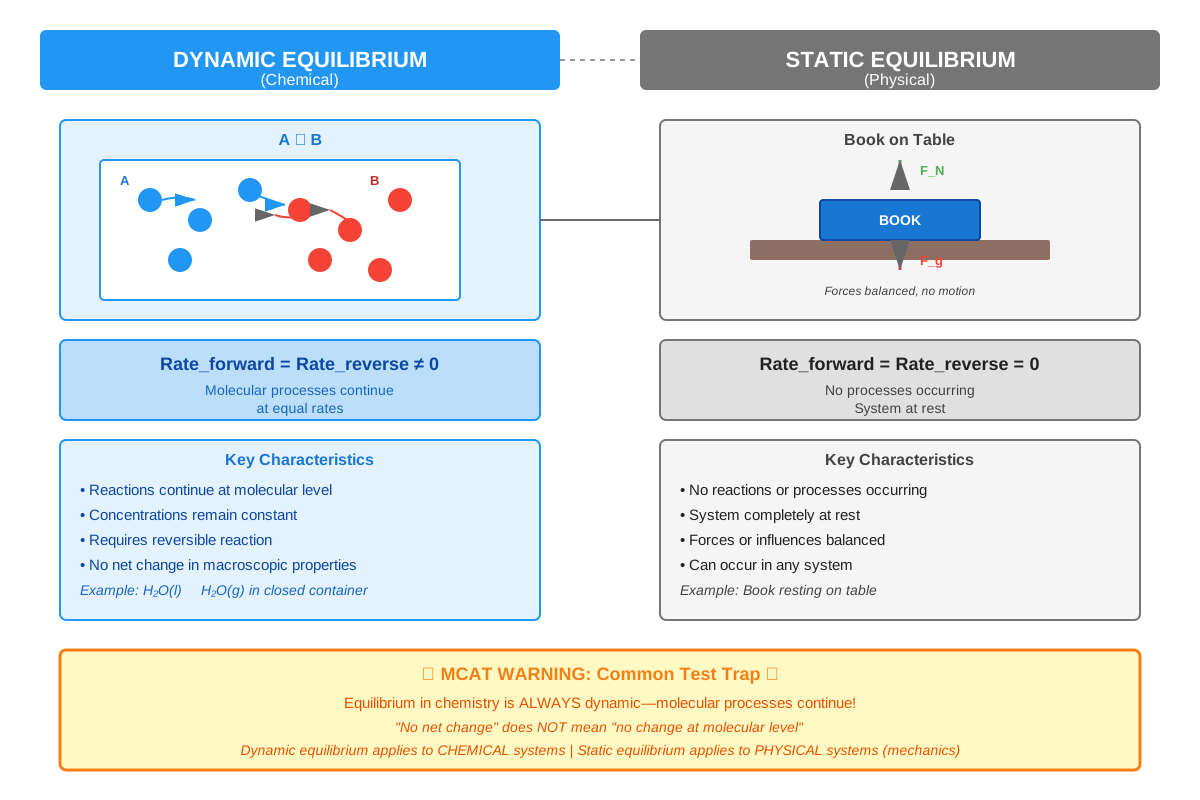
Dynamic equilibrium is the state of a reversible reaction in which the rate of the forward reaction equals the rate of the reverse reaction, resulting in constant concentrations of all reactants and products over time. The term "dynamic" emphasizes that molecular-level processes continue—molecules constantly convert between reactants and products—but the macroscopic properties (concentrations, color, pressure, etc.) remain unchanged. This contrasts with a static equilibrium, where no processes occur at all.
For a general reversible reaction:
aA + bB ⇌ cC + dDAt dynamic equilibrium:
- Rate_forward = Rate_reverse
- [A], [B], [C], and [D] remain constant (but not necessarily equal to each other)
- The reaction has not stopped; molecules continue to interconvert
- The system is closed (no material enters or leaves)
- Macroscopic properties (temperature, pressure, color, pH) are constant
The Equilibrium Constant (K_eq)
The equilibrium constant (K_eq) is a quantitative measure of the position of equilibrium. For the general reaction above, the equilibrium constant expression is:
K_eq = [C]^c[D]^d / [A]^a[B]^bKey properties of K_eq:
- K_eq is temperature-dependent but independent of initial concentrations
- K_eq > 1 indicates products are favored at equilibrium (equilibrium lies to the right)
- K_eq < 1 indicates reactants are favored at equilibrium (equilibrium lies to the left)
- K_eq = 1 indicates roughly equal amounts of reactants and products at equilibrium
- Pure solids and pure liquids do not appear in the equilibrium expression
- K_eq is unitless when properly expressed (though units may be tracked in calculations)
The magnitude of K_eq provides immediate insight into the composition of the equilibrium mixture. A very large K_eq (>10³) suggests the reaction proceeds nearly to completion, while a very small K_eq (<10⁻³) indicates minimal product formation under standard conditions.
Establishing Dynamic Equilibrium
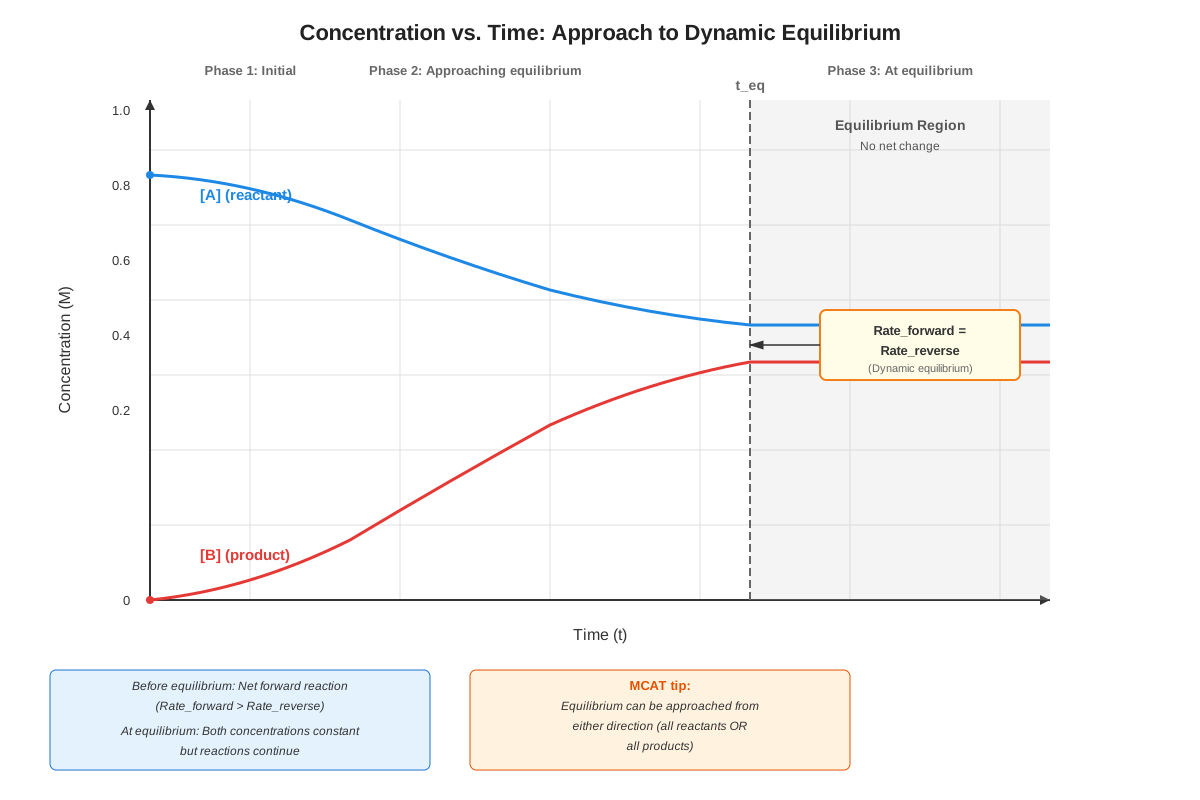
Dynamic equilibrium can be approached from either direction—starting with pure reactants, pure products, or any mixture. Regardless of initial conditions, a closed system at constant temperature will reach the same equilibrium position (same ratio of product to reactant concentrations).
Pathway to equilibrium starting with reactants:
- Initially, only forward reaction occurs (no products present for reverse reaction)
- As products form, reverse reaction begins and accelerates
- Forward reaction slows as reactant concentrations decrease
- Eventually, forward rate equals reverse rate → equilibrium established
- Concentrations become constant (though reactions continue)
Pathway to equilibrium starting with products:
- Initially, only reverse reaction occurs
- As reactants form, forward reaction begins and accelerates
- Reverse reaction slows as product concentrations decrease
- Eventually, reverse rate equals forward rate → equilibrium established
- Same equilibrium concentrations are reached as when starting with reactants
The Reaction Quotient (Q)
The reaction quotient (Q) has the same mathematical form as K_eq but is calculated using concentrations at any point in time, not just at equilibrium:
Q = [C]^c[D]^d / [A]^a[B]^b (at any time)Comparing Q to K_eq predicts the direction of net reaction:
| Relationship | Meaning | Direction of Net Reaction |
|---|---|---|
| Q < K_eq | Too few products relative to equilibrium | Forward (→) to produce more products |
| Q = K_eq | System is at equilibrium | No net reaction (⇌) |
| Q > K_eq | Too many products relative to equilibrium | Reverse (←) to produce more reactants |
This comparison is essential for MCAT problem-solving, as it allows rapid prediction of system behavior without detailed calculations.
Factors Affecting Equilibrium Position
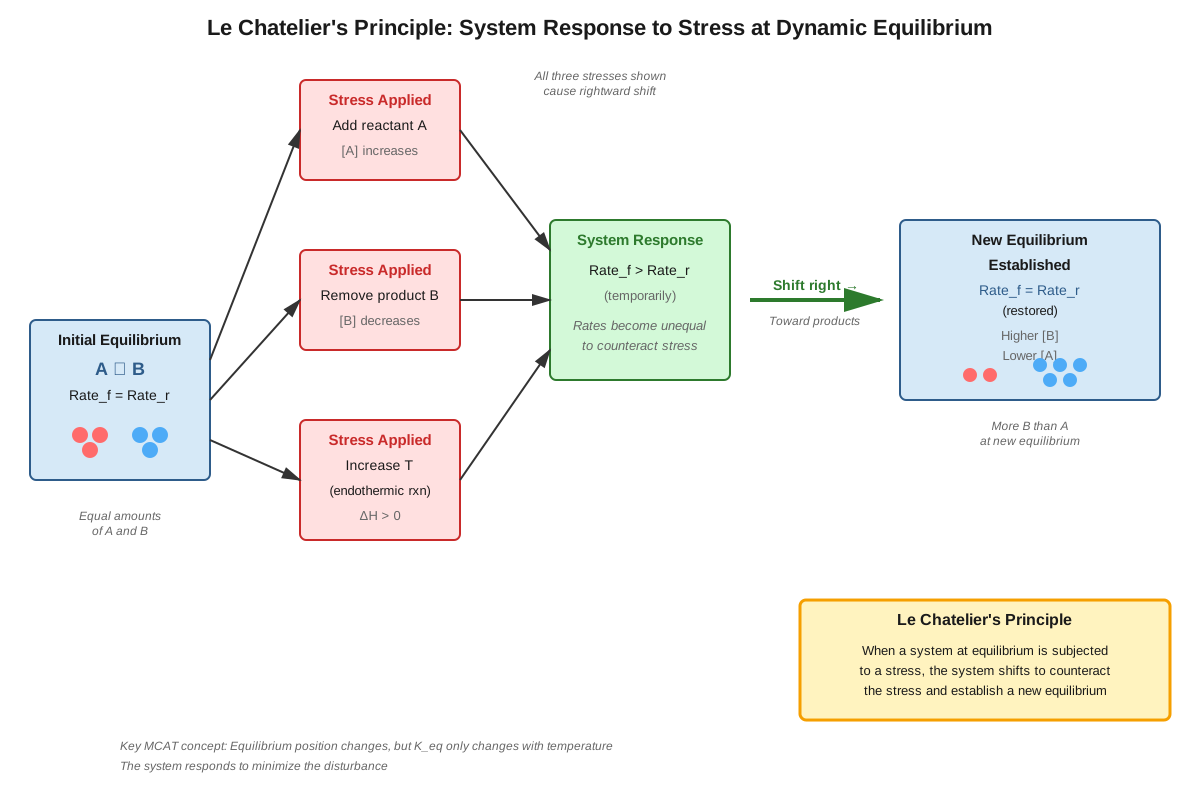
While K_eq itself only changes with temperature, the position of equilibrium (the actual concentrations at equilibrium) can be shifted by various perturbations. Le Chatelier's principle states that when a system at equilibrium is disturbed, it responds by shifting in the direction that partially counteracts the disturbance.
Concentration changes:
- Adding reactant → shifts equilibrium toward products (forward)
- Removing reactant → shifts equilibrium toward reactants (reverse)
- Adding product → shifts equilibrium toward reactants (reverse)
- Removing product → shifts equilibrium toward products (forward)
Pressure/volume changes (for gas-phase reactions):
- Decreasing volume (increasing pressure) → shifts toward side with fewer moles of gas
- Increasing volume (decreasing pressure) → shifts toward side with more moles of gas
- No shift if equal moles of gas on both sides
Temperature changes:
- Increasing temperature → shifts equilibrium in endothermic direction (absorbs added heat)
- Decreasing temperature → shifts equilibrium in exothermic direction (releases heat)
- Temperature changes actually alter K_eq value (unlike concentration or pressure changes)
Catalysts:
- Catalysts increase both forward and reverse reaction rates equally
- Catalysts do NOT shift equilibrium position or change K_eq
- Catalysts allow equilibrium to be reached more quickly
Relationship Between Kinetics and Equilibrium
At dynamic equilibrium, the forward and reverse rate constants (k_f and k_r) are related to the equilibrium constant:
K_eq = k_f / k_rThis relationship reveals that:
- A large K_eq means k_f >> k_r (forward reaction much faster)
- A small K_eq means k_r >> k_f (reverse reaction much faster)
- Equilibrium is a kinetic phenomenon—it results from equal rates, not equal rate constants
This connection between Kinetics and Equilibrium is conceptually important for the MCAT, as it unifies two major topics in General Chemistry and explains why equilibrium is dynamic rather than static.
Concept Relationships
Dynamic equilibrium serves as the conceptual bridge between kinetics (how fast reactions proceed) and thermodynamics (whether reactions are favorable). The establishment of equilibrium depends on kinetic factors—specifically, the rates of forward and reverse reactions must become equal. However, the position of equilibrium (the value of K_eq) is determined by thermodynamic factors, particularly the Gibbs free energy change (ΔG°) of the reaction.
Kinetics → Dynamic Equilibrium: Reaction rates determine how quickly equilibrium is established. Fast reactions reach equilibrium rapidly; slow reactions may take hours, days, or longer. Catalysts affect the time to reach equilibrium but not the equilibrium position itself.
Dynamic Equilibrium → Thermodynamics: The equilibrium constant relates directly to the standard Gibbs free energy change: ΔG° = -RT ln(K_eq). This relationship shows that thermodynamically favorable reactions (negative ΔG°) have K_eq > 1, while unfavorable reactions have K_eq < 1.
Dynamic Equilibrium → Le Chatelier's Principle: Understanding that equilibrium is dynamic explains why systems respond to stress. When a perturbation occurs, the rates temporarily become unequal, causing a shift until a new equilibrium is established.
Dynamic Equilibrium → Acid-Base Chemistry: All weak acid and weak base equilibria are examples of dynamic equilibrium. The K_a and K_b values are specific types of equilibrium constants, and buffer action depends on the dynamic equilibrium between conjugate acid-base pairs.
Dynamic Equilibrium → Solubility Equilibria: The dissolution and precipitation of sparingly soluble salts represents a dynamic equilibrium between solid and dissolved ions. The solubility product constant (K_sp) is another specialized equilibrium constant.
Reaction Quotient (Q) → Predicting Direction: Q serves as the diagnostic tool that connects current conditions to equilibrium. By comparing Q to K_eq, one can predict whether the system will shift forward or reverse to reach equilibrium.
Quick check — test yourself on Dynamic equilibrium so far.
Try Flashcards →High-Yield Facts
⭐ Dynamic equilibrium occurs when the forward and reverse reaction rates are equal, not when concentrations are equal—concentrations remain constant but are typically unequal.
⭐ The equilibrium constant K_eq is temperature-dependent but independent of initial concentrations, pressure changes, or the presence of catalysts.
⭐ When Q < K_eq, the reaction proceeds forward (toward products); when Q > K_eq, the reaction proceeds in reverse (toward reactants).
⭐ Le Chatelier's principle: A system at equilibrium responds to stress by shifting in the direction that partially relieves the stress.
⭐ Catalysts speed up the attainment of equilibrium but do not change the equilibrium position or the value of K_eq.
- Pure solids and pure liquids do not appear in equilibrium constant expressions because their activities are defined as 1.
- Increasing temperature shifts equilibrium in the endothermic direction; decreasing temperature shifts it in the exothermic direction.
- For gas-phase reactions, increasing pressure (decreasing volume) shifts equilibrium toward the side with fewer moles of gas.
- The relationship K_eq = k_f / k_r connects kinetics to equilibrium and shows that equilibrium is achieved through equal rates, not equal rate constants.
- A very large K_eq (>10³) indicates the reaction goes essentially to completion; a very small K_eq (<10⁻³) indicates negligible product formation.
- At equilibrium, ΔG = 0 (not ΔG°), meaning the system has no driving force for net change in either direction.
- The same equilibrium position is reached regardless of whether you start with reactants, products, or a mixture—the path doesn't matter, only the final state.
Common Misconceptions
Misconception: At equilibrium, the concentrations of reactants and products are equal.
Correction: At equilibrium, the rates of forward and reverse reactions are equal, but concentrations are constant and typically unequal. The ratio of concentrations is determined by K_eq, which is rarely equal to 1.
Misconception: Equilibrium means the reaction has stopped.
Correction: Equilibrium is dynamic—forward and reverse reactions continue to occur at the molecular level at equal rates. Macroscopic properties remain constant because the rates of formation and consumption are balanced, not because reactions have ceased.
Misconception: Adding a catalyst shifts the equilibrium position toward products.
Correction: Catalysts increase both forward and reverse reaction rates equally, allowing equilibrium to be reached faster but not changing the equilibrium position or K_eq value. The final concentrations at equilibrium are identical with or without a catalyst.
Misconception: K_eq changes when you add more reactant or product to a system at equilibrium.
Correction: K_eq is constant at a given temperature. Adding reactant or product temporarily disturbs the equilibrium (changes Q), causing the system to shift to re-establish equilibrium, but K_eq itself remains unchanged. Only temperature changes alter K_eq.
Misconception: If K_eq is large, the reaction reaches equilibrium quickly.
Correction: K_eq indicates the position of equilibrium (how far the reaction proceeds), not the rate at which equilibrium is reached. A reaction with a large K_eq might be very slow (kinetically unfavorable) even though it is thermodynamically favorable. The rate depends on activation energy and rate constants, not on K_eq.
Misconception: Increasing pressure always shifts equilibrium toward products.
Correction: For gas-phase reactions, increasing pressure shifts equilibrium toward the side with fewer moles of gas, which may be reactants or products depending on the stoichiometry. If both sides have equal moles of gas, pressure changes do not shift the equilibrium. Pressure changes do not affect equilibria involving only liquids and solids.
Worked Examples
Example 1: Predicting Direction of Reaction Using Q and K_eq
Problem: Consider the reaction: N₂(g) + 3H₂(g) ⇌ 2NH₃(g), with K_eq = 0.50 at 400°C. A reaction vessel contains 0.20 M N₂, 0.30 M H₂, and 0.40 M NH₃. Is the system at equilibrium? If not, in which direction will the reaction proceed?
Solution:
Step 1: Calculate the reaction quotient Q using current concentrations.
Q = [NH₃]² / ([N₂][H₂]³)
Q = (0.40)² / [(0.20)(0.30)³]
Q = 0.16 / [(0.20)(0.027)]
Q = 0.16 / 0.0054
Q = 29.6
Step 2: Compare Q to K_eq.
- Q = 29.6
- K_eq = 0.50
- Q > K_eq
Step 3: Interpret the result.
Since Q > K_eq, the system has too much product (NH₃) relative to equilibrium. The reaction will proceed in the reverse direction (toward reactants) to decrease [NH₃] and increase [N₂] and [H₂] until Q = K_eq.
Key takeaway: This problem demonstrates the practical application of Q vs. K_eq comparison, a high-yield skill for MCAT questions involving Dynamic equilibrium General Chemistry.
Example 2: Applying Le Chatelier's Principle to a Physiological System
Problem: The carbonic acid-bicarbonate buffer system in blood is represented by:
CO₂(g) + H₂O(l) ⇌ H₂CO₃(aq) ⇌ H⁺(aq) + HCO₃⁻(aq)
During hyperventilation, a person exhales excessive CO₂. Predict the effect on blood pH and explain using dynamic equilibrium principles.
Solution:
Step 1: Identify the perturbation.
Hyperventilation removes CO₂ from the system (decreases [CO₂]).
Step 2: Apply Le Chatelier's principle.
Removing CO₂ (a reactant) shifts the equilibrium to the left (reverse direction) to partially replace the lost CO₂. This shift consumes H⁺ and HCO₃⁻ to produce more CO₂ and H₂O.
Step 3: Predict the effect on pH.
As H⁺ is consumed, [H⁺] decreases, causing pH to increase (blood becomes more alkaline). This condition is called respiratory alkalosis.
Step 4: Connect to dynamic equilibrium.
Even though the equilibrium shifts, the system remains dynamic—forward and reverse reactions continue. The new equilibrium position has lower [CO₂], lower [H⁺], and lower [HCO₃⁻] compared to normal, but the ratio of these concentrations still satisfies the equilibrium constant expression at body temperature.
Key takeaway: This example illustrates how Dynamic equilibrium MCAT questions often appear in physiological contexts, requiring integration of chemistry principles with biological systems. Understanding that removing a component shifts equilibrium away from that component is essential for predicting physiological responses.
Exam Strategy
When approaching Dynamic equilibrium questions on the MCAT, first identify whether the question asks about (1) the definition/characteristics of equilibrium, (2) calculations involving K_eq or Q, (3) predictions using Le Chatelier's principle, or (4) connections to biological systems. This categorization guides your problem-solving approach.
Trigger words and phrases to watch for:
- "At equilibrium" → concentrations are constant; forward rate = reverse rate
- "Initially" or "before equilibrium" → calculate Q and compare to K_eq
- "Adding," "removing," "increasing pressure," "heating" → apply Le Chatelier's principle
- "Catalyst added" → equilibrium reached faster, but position unchanged
- "Shift to the right/left" → direction of net reaction to re-establish equilibrium
- "Favors products/reactants" → interpretation of K_eq magnitude
Process-of-elimination strategies:
- Eliminate answers suggesting equilibrium means "stopped" or "static"
- Eliminate answers claiming catalysts change K_eq or shift equilibrium position
- Eliminate answers confusing K_eq magnitude with reaction rate
- For Le Chatelier questions, eliminate answers predicting shifts in the wrong direction
- For Q vs. K_eq questions, eliminate answers that reverse the direction (if Q < K_eq, reaction must go forward)
Time allocation advice:
Conceptual questions about dynamic equilibrium (definition, characteristics, Le Chatelier predictions) should take 30-45 seconds. Calculation questions involving Q or K_eq may require 60-90 seconds, but can often be estimated rather than calculated precisely. For passage-based questions, spend 15-20 seconds identifying which equilibrium principle applies before attempting detailed analysis. If a calculation appears complex, check whether the question asks for a qualitative prediction (direction of shift) rather than a numerical answer—many MCAT questions can be answered conceptually without completing calculations.
Memory Techniques
Mnemonic for Q vs. K_eq predictions: "Question: Less or More?"
- If Q < K_eq: Less product than equilibrium → go Left to right (forward)
- If Q > K_eq: More product than equilibrium → go More toward reactants (reverse)
Visualization for dynamic equilibrium: Picture a crowded dance floor where people constantly move between the dance floor (products) and the sidelines (reactants). At equilibrium, the number of people dancing stays constant, but individuals continuously switch between dancing and resting—the population is stable, but the system is dynamic.
Acronym for Le Chatelier's Principle: "STRESS"
- Shift occurs
- To relieve
- Reaction
- Equilibrium
- System
- Stress
Memory aid for factors affecting equilibrium: "CaT PeTS"
- Concentration changes → shift equilibrium
- Temperature changes → shift equilibrium AND change K_eq
- Pressure changes → shift equilibrium (gases only)
- Time (catalysts) → reach equilibrium faster
- Solids/liquids → don't appear in K_eq expression
Visualization for K_eq magnitude: Imagine a seesaw:
- K_eq >> 1: seesaw tilted heavily toward products (right side down)
- K_eq << 1: seesaw tilted heavily toward reactants (left side down)
- K_eq ≈ 1: seesaw balanced (roughly equal amounts)
Summary
Dynamic equilibrium represents a fundamental state in reversible chemical reactions where forward and reverse processes occur simultaneously at equal rates, maintaining constant macroscopic properties while molecular-level changes continue. The equilibrium constant (K_eq) quantifies the position of equilibrium and depends only on temperature, while the reaction quotient (Q) predicts the direction of net reaction by comparison to K_eq. Le Chatelier's principle explains how equilibrium systems respond to perturbations—shifts occur to partially counteract stresses from concentration changes, pressure changes, or temperature changes, though catalysts only affect the rate of reaching equilibrium without altering its position. For MCAT success, students must distinguish between the dynamic nature of equilibrium (ongoing molecular processes) and its macroscopic constancy (unchanging concentrations), apply Q vs. K_eq comparisons to predict reaction direction, and recognize how equilibrium principles govern physiological systems including acid-base balance, oxygen transport, and drug distribution. Mastery requires both conceptual understanding of why equilibrium is dynamic and quantitative facility with equilibrium expressions and calculations.
Key Takeaways
- Dynamic equilibrium occurs when forward and reverse reaction rates are equal, resulting in constant (but typically unequal) concentrations of reactants and products while molecular-level interconversion continues
- The equilibrium constant K_eq is temperature-dependent but independent of initial concentrations, catalysts, or pressure; K_eq > 1 favors products, K_eq < 1 favors reactants
- Comparing the reaction quotient Q to K_eq predicts reaction direction: Q < K_eq means forward reaction, Q > K_eq means reverse reaction, Q = K_eq means equilibrium
- Le Chatelier's principle states that systems at equilibrium respond to stress by shifting in the direction that partially relieves the stress, but only temperature changes alter K_eq itself
- Catalysts accelerate both forward and reverse reactions equally, allowing faster attainment of equilibrium without changing the equilibrium position or K_eq value
- Dynamic equilibrium principles apply broadly to physiological systems including buffer action, gas exchange, and drug-receptor binding, making this concept essential for integrated MCAT passages
- Pure solids and pure liquids do not appear in equilibrium constant expressions, and pressure changes only affect gas-phase equilibria by shifting toward the side with fewer moles of gas
Related Topics
Le Chatelier's Principle: A detailed exploration of how equilibrium systems respond to various perturbations, building directly on the foundation of dynamic equilibrium to predict quantitative and qualitative changes in equilibrium position.
Equilibrium Constants (K_a, K_b, K_sp, K_w): Specialized applications of equilibrium principles to acid-base chemistry and solubility, where dynamic equilibrium governs weak acid dissociation, weak base protonation, and salt dissolution.
Thermodynamics and Gibbs Free Energy: The relationship ΔG° = -RT ln(K_eq) connects equilibrium constants to thermodynamic favorability, explaining why certain equilibrium positions are preferred and how temperature affects K_eq.
Chemical Kinetics and Reaction Mechanisms: Understanding how reaction rates depend on concentration, temperature, and catalysts provides the mechanistic basis for why equilibrium is dynamic and how quickly equilibrium is established.
Buffer Systems: The practical application of dynamic equilibrium to maintain pH in biological systems, where conjugate acid-base pairs exist in dynamic equilibrium to resist pH changes.
Solubility Equilibria and the Common Ion Effect: Extension of dynamic equilibrium principles to heterogeneous equilibria involving solid-liquid phase transitions and the effect of common ions on solubility.
Practice CTA
Now that you have mastered the core concepts of dynamic equilibrium, challenge yourself with practice questions and flashcards to reinforce your understanding. Focus on questions that require you to distinguish between kinetic and equilibrium concepts, apply Le Chatelier's principle to novel scenarios, and calculate or estimate Q and K_eq values. The more you practice recognizing equilibrium principles in diverse contexts—from pure chemistry problems to integrated biological passages—the more confident and efficient you will become on test day. Remember: dynamic equilibrium is not just a chemistry topic; it is a fundamental principle that governs countless physiological processes you will encounter throughout the MCAT. Your investment in mastering this concept will pay dividends across multiple sections of the exam!
Sign up free to keep reading
Create a free AnvayaPrep account to finish this MCAT guide on Dynamic equilibrium — plus flashcards and practice questions.