Overview
Half-life is a fundamental concept in General Chemistry that describes the time required for half of a substance to undergo a transformation, most commonly encountered in the context of radioactive decay and first-order chemical reactions. For the MCAT, understanding half-life is essential because it bridges multiple disciplines: it appears in General Chemistry when discussing reaction kinetics, in Physics when analyzing radioactive decay, and even in Biological Sciences when considering drug metabolism and clearance. The mathematical simplicity of half-life calculations makes them frequent targets for quantitative reasoning questions, while the conceptual depth allows for integration into passage-based questions involving pharmacokinetics, carbon dating, or nuclear medicine.
The beauty of half-life lies in its independence from initial concentration in first-order processes—a characteristic that distinguishes it from other kinetic parameters. This property makes half-life an invaluable tool for predicting how long a substance will remain active in a system, whether that system is a patient's bloodstream, a geological sample, or a chemical reactor. The MCAT frequently tests not just the ability to calculate half-life values, but also the conceptual understanding of what half-life represents and how it relates to rate constants, reaction orders, and exponential decay patterns.
Within the broader context of Kinetics and Equilibrium, half-life serves as a practical application of rate laws and integrated rate equations. It connects directly to reaction mechanisms, rate-determining steps, and the factors that influence reaction rates such as temperature, catalysts, and concentration. Mastering half-life requires understanding both the mathematical relationships governing time-dependent concentration changes and the conceptual framework that explains why certain processes follow predictable decay patterns. This topic represents a high-yield area where computational skills and conceptual reasoning intersect, making it an efficient focus for MCAT preparation.
Learning Objectives
- [ ] Define Half-life using accurate General Chemistry terminology
- [ ] Explain why Half-life matters for the MCAT
- [ ] Apply Half-life to exam-style questions
- [ ] Identify common mistakes related to Half-life
- [ ] Connect Half-life to related General Chemistry concepts
- [ ] Derive the mathematical relationship between half-life and the rate constant for first-order reactions
- [ ] Distinguish between half-life behavior in zero-order, first-order, and second-order reactions
- [ ] Calculate the remaining quantity of a substance after multiple half-lives without using a calculator
Prerequisites
- Rate laws and reaction orders: Understanding how reaction rate depends on reactant concentrations is essential because half-life equations differ based on reaction order
- Integrated rate equations: Half-life formulas are derived from integrated rate laws, so familiarity with these equations provides the mathematical foundation
- Exponential functions and logarithms: First-order processes involve exponential decay, requiring comfort with ln and e^x operations
- Basic algebra: Manipulating equations to solve for time, concentration, or rate constants is necessary for quantitative problems
- Concentration units: Molarity and other concentration expressions must be understood to interpret initial and final amounts correctly
Why This Topic Matters
Half-life concepts have profound real-world applications that extend far beyond the chemistry laboratory. In medicine, understanding drug half-life is critical for determining dosing intervals—medications with short half-lives require frequent administration, while those with long half-lives may accumulate to toxic levels if given too frequently. Radioactive isotopes used in diagnostic imaging (like Technetium-99m) and cancer treatment are selected based on their half-lives to balance therapeutic effectiveness with radiation safety. Carbon-14 dating, which relies on the 5,730-year half-life of this isotope, has revolutionized archaeology and geology by providing a method to determine the age of organic materials.
On the MCAT, half-life appears with moderate frequency but high predictability. Approximately 2-4 questions per exam either directly test half-life calculations or incorporate half-life concepts into broader kinetics passages. The Chemical and Physical Foundations of Biological Systems section most commonly features these questions, though they can appear in interdisciplinary passages that combine chemistry with biology (pharmacokinetics) or physics (nuclear decay). Question formats include straightforward calculations asking for remaining quantity after a given time, conceptual questions about how changing conditions affects half-life, and data interpretation questions requiring students to extract half-life from graphs or tables.
Common exam presentations include: passage-based questions describing a drug's pharmacokinetic profile and asking about plasma concentration over time; discrete questions providing a rate constant and asking for half-life; graphical analysis where students must determine half-life from a semi-log plot; and comparison questions asking how half-life differs between reaction orders. The MCAT particularly favors questions that test whether students understand that first-order half-life is concentration-independent, a conceptual distinction that separates superficial memorization from true comprehension.
Core Concepts
Definition and Mathematical Foundation
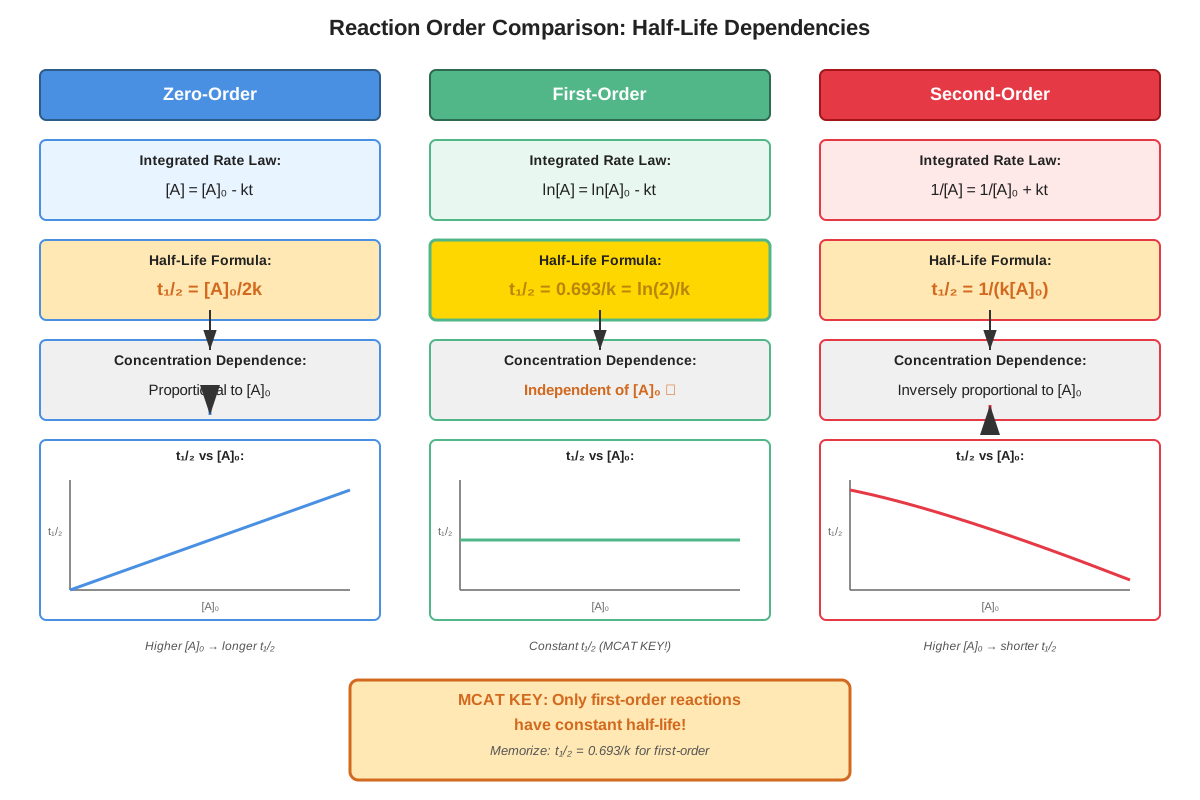
Half-life (symbolized as t₁/₂) is defined as the time required for the concentration of a reactant to decrease to exactly one-half of its initial value. This definition applies universally across chemistry, physics, and biology, though the underlying mechanisms may differ. The mathematical expression for half-life depends critically on the reaction order, which describes how the rate depends on reactant concentration.
For first-order reactions—the most important category for the MCAT—the half-life equation is:
t₁/₂ = 0.693/k = ln(2)/kwhere k is the first-order rate constant (units: s⁻¹, min⁻¹, hr⁻¹, etc.). The value 0.693 is the natural logarithm of 2, and this relationship derives from the integrated first-order rate law. The remarkable feature of first-order half-life is its concentration independence—regardless of whether you start with 100 mg or 100 g of substance, the time to reach half that amount remains constant.
For zero-order reactions, where rate is independent of concentration, the half-life equation is:
t₁/₂ = [A]₀/(2k)where [A]₀ is the initial concentration and k is the zero-order rate constant (units: M/s, M/min, etc.). Notice that zero-order half-life is directly proportional to initial concentration—doubling the starting amount doubles the half-life.
For second-order reactions, the half-life equation is:
t₁/₂ = 1/(k[A]₀)where k is the second-order rate constant (units: M⁻¹s⁻¹, M⁻¹min⁻¹, etc.). Second-order half-life is inversely proportional to initial concentration—higher starting concentrations lead to shorter half-lives.
Exponential Decay and Multiple Half-Lives
First-order processes follow exponential decay, meaning the concentration decreases by the same fraction during each successive half-life period. After one half-life, 50% remains; after two half-lives, 25% remains; after three half-lives, 12.5% remains. This pattern continues indefinitely, with the general formula:
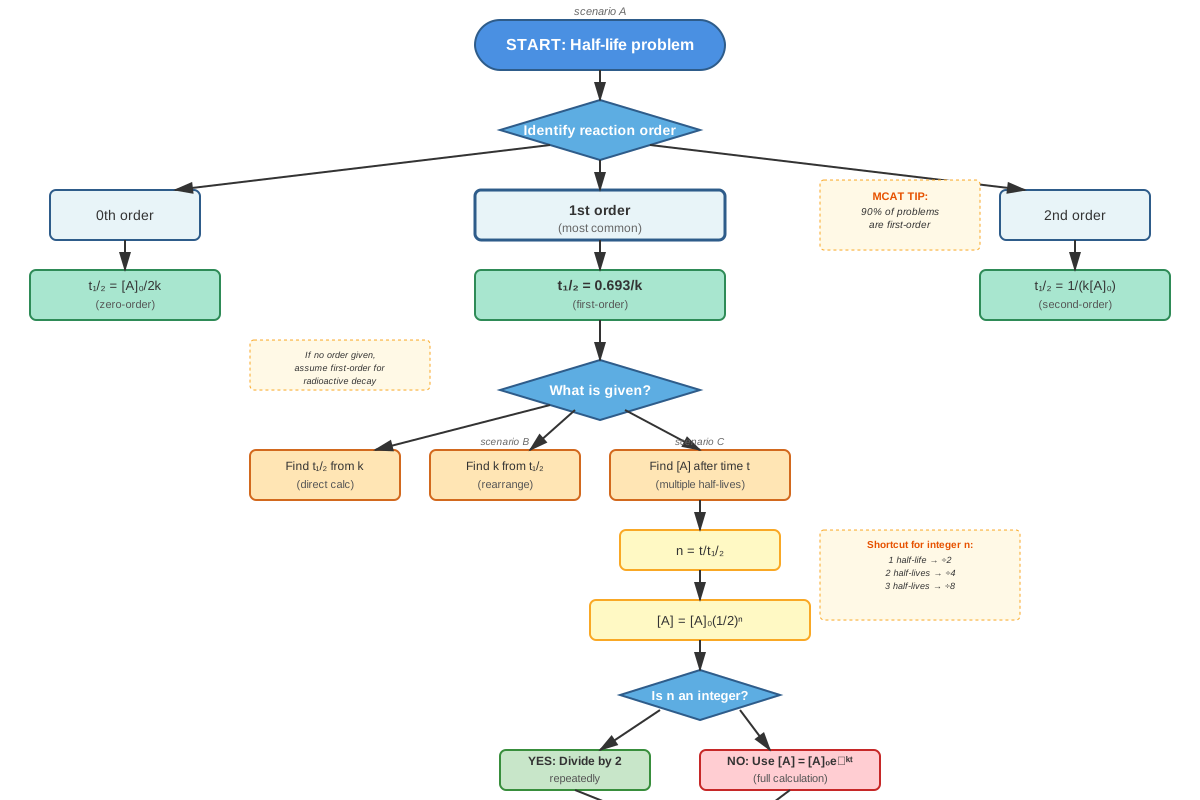
Remaining fraction = (1/2)ⁿwhere n is the number of half-lives elapsed. This relationship is extraordinarily useful for rapid mental calculations on the MCAT. For example, if a drug has a half-life of 4 hours and you want to know how much remains after 12 hours, you recognize that 12 hours = 3 half-lives, so (1/2)³ = 1/8 or 12.5% remains.
The exponential nature of first-order decay means the substance never completely disappears—mathematically, it approaches zero asymptotically. Practically, after about 7 half-lives, less than 1% remains (specifically, 0.78%), which is often considered negligible for clinical and experimental purposes.
Relationship to Rate Constants
The rate constant (k) and half-life are inversely related for first-order reactions. A large rate constant indicates a fast reaction and therefore a short half-life; a small rate constant indicates a slow reaction and a long half-life. This inverse relationship is quantified by the equation t₁/₂ = 0.693/k.
Understanding this relationship allows bidirectional calculations: given half-life, you can calculate the rate constant, and vice versa. For MCAT purposes, memorizing that 0.693 ≈ 0.7 allows for rapid estimation. If k = 0.14 min⁻¹, then t₁/₂ ≈ 0.7/0.14 = 5 minutes.
The rate constant itself depends on temperature according to the Arrhenius equation, meaning half-life is temperature-dependent for most chemical reactions (though not for radioactive decay, which is a nuclear process unaffected by chemical conditions). Increasing temperature increases k, which decreases t₁/₂, making reactions proceed faster.
Radioactive Decay
Radioactive decay is the quintessential first-order process and a common MCAT topic. Each radioactive nucleus has a fixed probability of decaying per unit time, independent of how many other nuclei are present. This makes radioactive decay inherently first-order, with half-lives ranging from fractions of a second to billions of years depending on the isotope.
Common radioactive isotopes and their half-lives that appear on the MCAT include:
- Carbon-14: 5,730 years (used in radiocarbon dating)
- Iodine-131: 8 days (used in thyroid treatment)
- Technetium-99m: 6 hours (used in medical imaging)
- Uranium-238: 4.5 billion years (geological dating)
The activity of a radioactive sample (measured in Becquerels or Curies) represents the number of decay events per unit time and is directly proportional to the number of radioactive atoms present. As the sample decays, both the number of atoms and the activity decrease with the same half-life.
Pharmacokinetics and Drug Half-Life
In biological systems, drug half-life describes how quickly a medication is eliminated from the body through metabolism and excretion. Most drugs follow first-order elimination kinetics, meaning a constant fraction (not a constant amount) is removed per unit time. This has critical implications for dosing:
- Loading dose: A larger initial dose may be given to quickly achieve therapeutic concentration
- Maintenance dose: Subsequent doses maintain steady-state concentration
- Steady state: Achieved after approximately 4-5 half-lives of regular dosing, when input rate equals elimination rate
- Washout period: Time for drug to be eliminated, typically 4-5 half-lives
Drugs with very short half-lives (minutes to hours) require frequent dosing or continuous infusion. Drugs with very long half-lives (days to weeks) may require loading doses and have prolonged effects even after discontinuation.
Graphical Representation
Half-life can be determined graphically from concentration versus time plots. For first-order reactions, plotting ln[A] versus time yields a straight line with slope = -k. The half-life can then be calculated from the slope using t₁/₂ = 0.693/k.
Alternatively, on a regular concentration versus time plot for a first-order reaction, you can identify half-life by finding the time required for concentration to drop from any value to half that value. Because first-order half-life is constant, this time interval should be the same regardless of which starting point you choose on the curve—a useful way to verify first-order kinetics from experimental data.
| Reaction Order | Half-life Equation | Concentration Dependence | Graph Linearity |
|---|---|---|---|
| Zero-order | [A]₀/(2k) | Proportional to [A]₀ | [A] vs. t is linear |
| First-order | 0.693/k | Independent of [A]₀ | ln[A] vs. t is linear |
| Second-order | 1/(k[A]₀) | Inversely proportional to [A]₀ | 1/[A] vs. t is linear |
Quick check — test yourself on Half life so far.
Try Flashcards →Concept Relationships
The concept of half-life emerges directly from integrated rate laws, which themselves derive from differential rate laws through calculus. The rate law (differential form) describes instantaneous rate as a function of concentration, while the integrated rate law describes concentration as a function of time. Half-life is a specific application of the integrated rate law—the time when [A]ₜ = [A]₀/2.
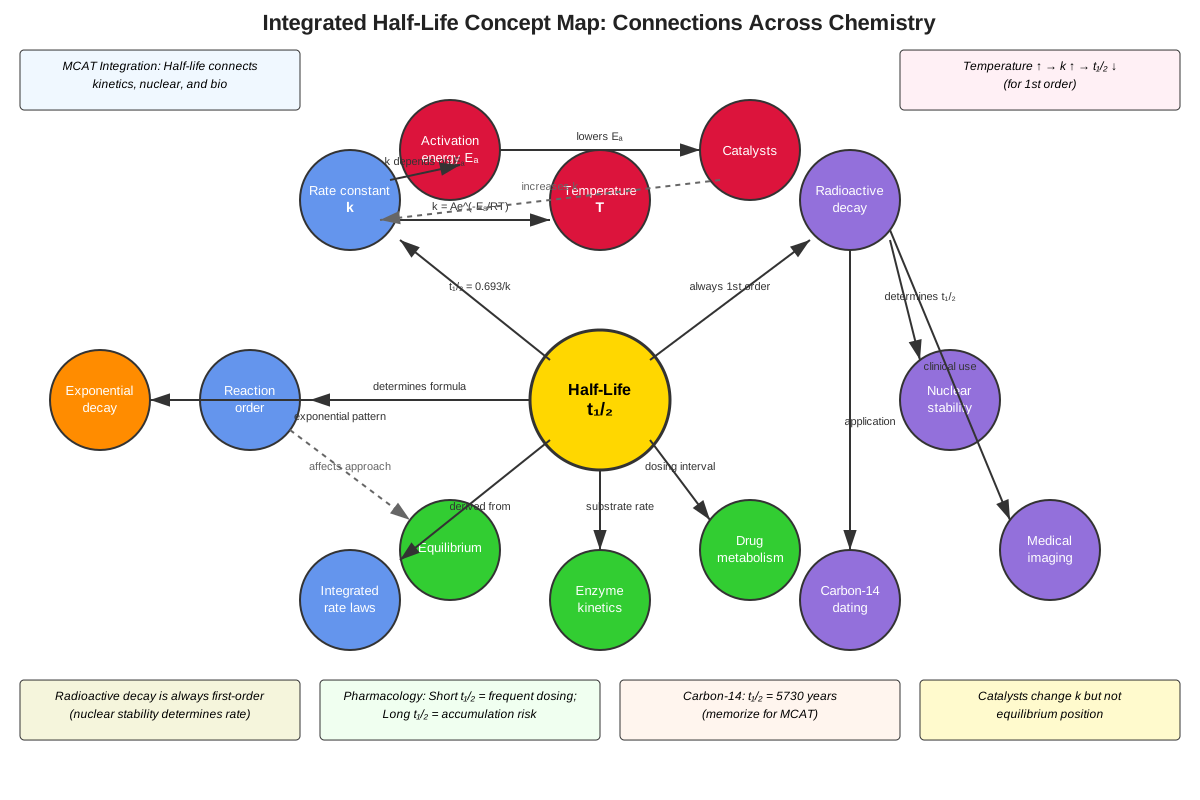
Within Kinetics and Equilibrium, half-life connects to several related concepts:
Rate laws → Integrated rate equations → Half-life formulas: This progression shows how the mathematical description of reaction rates leads to predictive tools for concentration changes over time.
Reaction order → Half-life behavior: The order of a reaction fundamentally determines whether half-life is constant (first-order), increases over time (zero-order), or decreases over time (second-order).
Rate constant (k) → Half-life (t₁/₂): These are inversely related for first-order reactions, providing two complementary ways to characterize reaction speed.
Temperature → Rate constant → Half-life: Through the Arrhenius equation, temperature affects k, which in turn affects half-life for chemical (but not nuclear) processes.
Half-life also connects to topics beyond kinetics:
Equilibrium: While half-life describes approach to completion, equilibrium describes the final state where forward and reverse rates balance. For reversible reactions, the observed half-life may be affected by the reverse reaction.
Thermodynamics: Although half-life is a kinetic parameter (how fast), it relates to thermodynamic stability (how favorable). Unstable compounds often have short half-lives.
Nuclear chemistry: Radioactive decay half-lives connect to nuclear stability, binding energy, and the band of stability on the chart of nuclides.
Biochemistry: Enzyme kinetics, protein degradation, and metabolic pathways all involve first-order processes with characteristic half-lives.
High-Yield Facts
⭐ First-order half-life is independent of initial concentration: t₁/₂ = 0.693/k, with no [A]₀ term
⭐ After n half-lives, the remaining fraction is (1/2)ⁿ: This allows rapid mental calculation without logarithms
⭐ Radioactive decay is always first-order: Nuclear processes are unaffected by temperature, pressure, or chemical environment
⭐ The value 0.693 equals ln(2): This appears in all first-order half-life calculations and should be memorized
⭐ Steady-state drug concentration is reached after 4-5 half-lives: This principle governs dosing regimens
- Zero-order half-life increases as the reaction proceeds because it depends on current concentration
- Second-order half-life decreases as the reaction proceeds, also due to concentration dependence
- A substance is considered essentially eliminated after 7 half-lives (less than 1% remains)
- The units of the rate constant indicate reaction order: s⁻¹ for first-order, M/s for zero-order, M⁻¹s⁻¹ for second-order
- Half-life can be determined graphically from the time required for any concentration to decrease by 50%
- For first-order reactions, the time to go from 100% to 50% equals the time to go from 50% to 25%
- Carbon-14 dating is effective for samples up to about 50,000 years old (approximately 9 half-lives)
Common Misconceptions
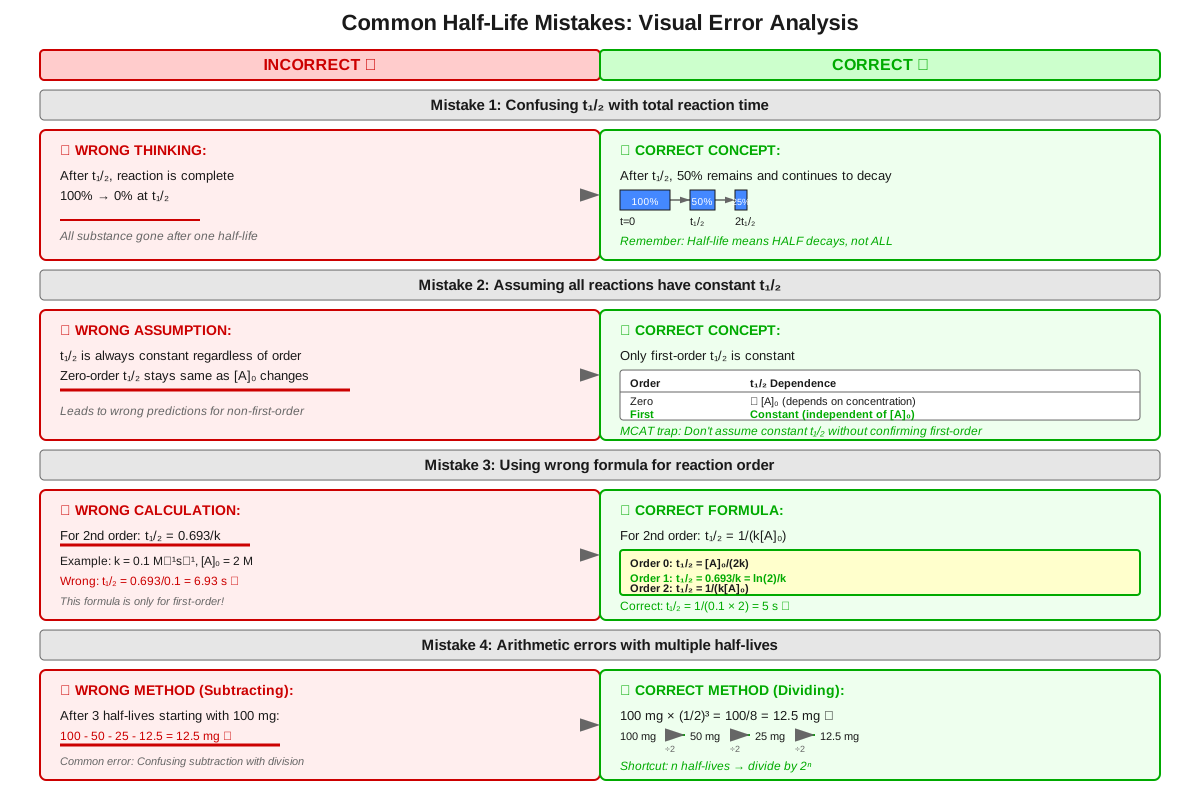
Misconception: Half-life means the substance is completely gone after two half-lives.
Correction: After two half-lives, 25% remains; after three half-lives, 12.5% remains. The substance never completely disappears in exponential decay—it approaches zero asymptotically. Complete elimination is conventionally defined as 7 half-lives when less than 1% remains.
Misconception: All reactions have constant half-lives regardless of initial concentration.
Correction: Only first-order reactions have concentration-independent half-lives. Zero-order half-lives are directly proportional to initial concentration, and second-order half-lives are inversely proportional to initial concentration. This distinction is frequently tested on the MCAT.
Misconception: Doubling the rate constant doubles the half-life.
Correction: For first-order reactions, half-life and rate constant are inversely related (t₁/₂ = 0.693/k), so doubling k actually halves the half-life. A larger rate constant means faster reaction and shorter half-life.
Misconception: Temperature changes affect radioactive decay half-lives.
Correction: Radioactive decay is a nuclear process that is completely independent of chemical conditions including temperature, pressure, and chemical bonding. Chemical reaction half-lives are temperature-dependent through the Arrhenius equation, but nuclear decay half-lives are immutable constants for each isotope.
Misconception: After one half-life, you can use the same time interval again to find when 25% remains.
Correction: This is actually correct for first-order reactions! However, students sometimes think this only works once. In reality, for first-order processes, each successive half-life period is the same duration, so you can repeatedly apply the same time interval. The misconception is thinking this pattern breaks down after the first interval.
Misconception: The half-life formula t₁/₂ = 0.693/k applies to all reaction orders.
Correction: This formula is specific to first-order reactions. Zero-order reactions use t₁/₂ = [A]₀/(2k), and second-order reactions use t₁/₂ = 1/(k[A]₀). Using the wrong formula is a common source of calculation errors.
Misconception: If 75% of a substance has decayed, three half-lives have passed.
Correction: If 75% has decayed, then 25% remains. Since 25% = (1/2)², exactly two half-lives have passed, not three. Students sometimes confuse "percent decayed" with "number of half-lives."
Worked Examples
Example 1: Multi-Step Half-Life Calculation
Question: A radioactive isotope has a half-life of 15 minutes. If a sample initially contains 80 mg of the isotope, how much will remain after 1 hour and 15 minutes?
Solution:
Step 1: Determine the number of half-lives that have elapsed.
- Total time = 1 hour 15 minutes = 75 minutes
- Number of half-lives = 75 minutes ÷ 15 minutes/half-life = 5 half-lives
Step 2: Apply the exponential decay formula.
- Remaining fraction = (1/2)ⁿ where n = 5
- Remaining fraction = (1/2)⁵ = 1/32
Step 3: Calculate the remaining mass.
- Remaining mass = Initial mass × Remaining fraction
- Remaining mass = 80 mg × (1/32) = 2.5 mg
Answer: 2.5 mg remains after 75 minutes.
Key concepts demonstrated: This problem tests the ability to convert time into number of half-lives and apply exponential decay. Notice that we didn't need to know the rate constant or use logarithms—the half-life approach provides a shortcut for these calculations. This exemplifies why half-life is such a powerful concept for the MCAT.
Example 2: Determining Reaction Order from Half-Life Data
Question: A chemical reaction is monitored, and the following data are collected:
| Initial Concentration [A]₀ (M) | Half-life (seconds) |
|---|---|
| 0.10 | 20 |
| 0.20 | 20 |
| 0.40 | 20 |
What is the order of this reaction, and what is the rate constant?
Solution:
Step 1: Analyze the relationship between initial concentration and half-life.
- As [A]₀ doubles from 0.10 to 0.20 M, half-life remains constant at 20 seconds
- As [A]₀ doubles again from 0.20 to 0.40 M, half-life still remains 20 seconds
- Conclusion: Half-life is independent of initial concentration
Step 2: Identify the reaction order.
- Only first-order reactions have concentration-independent half-lives
- Therefore, this is a first-order reaction
Step 3: Calculate the rate constant using the first-order half-life equation.
- t₁/₂ = 0.693/k
- 20 s = 0.693/k
- k = 0.693/20 s = 0.0347 s⁻¹ ≈ 0.035 s⁻¹
Answer: The reaction is first-order with a rate constant of approximately 0.035 s⁻¹.
Key concepts demonstrated: This problem tests the conceptual understanding that distinguishes reaction orders based on half-life behavior. The MCAT frequently presents data tables and asks students to extract kinetic information. Recognizing that constant half-life indicates first-order kinetics is a high-yield skill. Additionally, this problem shows how to work backward from half-life to determine the rate constant.
Exam Strategy
When approaching MCAT questions on half-life, begin by identifying the reaction order, as this determines which formula to use. Look for explicit statements like "first-order kinetics" or "radioactive decay" (always first-order), or examine whether half-life changes with concentration in provided data. If the problem involves drugs or biological elimination, assume first-order unless stated otherwise.
Trigger words and phrases that signal half-life questions include:
- "How much remains after..."
- "Time required for concentration to decrease to..."
- "Radioactive decay"
- "Drug elimination"
- "Plasma concentration over time"
- "Carbon dating"
- "Steady-state concentration"
For calculation questions, determine whether you can use the shortcut method (counting half-lives) or need the full exponential equation. If the time given is an exact multiple of the half-life, use the (1/2)ⁿ approach for speed. If the time is not a clean multiple, you'll need to use the integrated rate law or logarithmic equations, but these are less common on the MCAT.
Process-of-elimination strategies:
- Eliminate answer choices that show complete disappearance after a finite time (exponential decay never reaches exactly zero)
- Eliminate choices that show linear decay for first-order processes (should be exponential)
- For drug dosing questions, eliminate choices suggesting steady-state before 4-5 half-lives
- If a question asks about factors affecting half-life, eliminate choices mentioning temperature for radioactive decay
Time allocation: Straightforward half-life calculations should take 30-45 seconds once you've identified the approach. Passage-based questions requiring data extraction may take 60-90 seconds. If you find yourself doing complex logarithmic calculations, double-check whether there's a simpler approach—the MCAT rarely requires extensive computation.
Exam Tip: When in doubt about whether a process is first-order, remember that most biological elimination processes, all radioactive decay, and many decomposition reactions follow first-order kinetics. This assumption is correct more often than not on the MCAT.
Memory Techniques
Mnemonic for first-order half-life formula: "Seven Dwarfs Need Kisses" → t₁/₂ = 0.693/k (Seven ≈ 0.7, Dwarfs = decimal, Need = numerator, Kisses = k in denominator)
Mnemonic for remaining fractions: "Half Past Quarters" → After 1 half-life: 1/2 remains; after 2 half-lives: 1/4 remains; after 3 half-lives: 1/8 remains (each is half of the previous)
Visualization strategy: Picture a glass of water being repeatedly poured out by half. After the first pour, the glass is half full. After the second pour (removing half of what remains), it's one-quarter full. This physical analogy helps internalize exponential decay.
Acronym for reaction order and half-life dependence: "ZINC"
- Zero-order: Increases with concentration
- No dependence for first-order
- Concentration inversely affects second-order
Memory anchor for 0.693: Remember that ln(2) = 0.693, and 2 is central to the concept of "half" (dividing by 2). The number 0.693 is approximately 0.7, which is easier to use for mental math on the MCAT.
Steady-state rule: "Four or Five to Stay Alive" → Steady-state drug concentration is reached after 4-5 half-lives, which is also when the drug is essentially eliminated after stopping.
Summary
Half-life represents the time required for a substance to decrease to half its initial amount and is a cornerstone concept in General Chemistry kinetics, particularly for the MCAT. First-order half-life, given by t₁/₂ = 0.693/k, is concentration-independent and applies to radioactive decay, most drug elimination, and many chemical decomposition reactions. The exponential nature of first-order decay means that after n half-lives, the remaining fraction is (1/2)ⁿ, allowing rapid mental calculations without complex mathematics. Zero-order and second-order reactions have concentration-dependent half-lives, with formulas t₁/₂ = [A]₀/(2k) and t₁/₂ = 1/(k[A]₀) respectively. Understanding these distinctions is essential for correctly applying half-life concepts to diverse MCAT questions spanning chemistry, physics, and biological sciences. The practical applications—from determining drug dosing intervals to dating archaeological samples—make half-life a high-yield topic that bridges theoretical kinetics with real-world problem-solving.
Key Takeaways
- First-order half-life (t₁/₂ = 0.693/k) is independent of initial concentration, while zero-order and second-order half-lives depend on concentration
- After n half-lives, the remaining fraction is (1/2)ⁿ, enabling quick calculations for any first-order process
- Radioactive decay is always first-order and unaffected by temperature, pressure, or chemical environment
- Steady-state drug concentration is achieved after 4-5 half-lives of regular dosing
- The inverse relationship between rate constant and half-life means faster reactions have shorter half-lives
- Graphical analysis can determine half-life and verify reaction order from concentration versus time data
- Recognizing whether a process is zero-, first-, or second-order is the critical first step in solving half-life problems
Related Topics
Integrated Rate Laws: The mathematical foundation from which half-life equations are derived; mastering these equations enables deeper understanding of concentration changes over time and provides alternative approaches to kinetics problems.
Reaction Mechanisms: Understanding elementary steps and rate-determining steps explains why certain reactions follow first-order kinetics and connects microscopic molecular events to macroscopic half-life observations.
Arrhenius Equation: Describes how temperature affects rate constants, which in turn affects half-life for chemical (but not nuclear) reactions; essential for understanding temperature dependence of kinetic processes.
Pharmacokinetics: Applies half-life concepts to drug absorption, distribution, metabolism, and excretion; builds on chemical kinetics to explain therapeutic drug monitoring and dosing strategies.
Nuclear Chemistry: Expands on radioactive decay half-lives to include decay series, nuclear stability, and applications in medicine and dating techniques; integrates chemistry with physics concepts.
Enzyme Kinetics: Michaelis-Menten kinetics and enzyme inhibition involve rate concepts related to half-life; understanding substrate depletion over time connects biochemistry to chemical kinetics.
Practice CTA
Now that you've mastered the core concepts of half-life, it's time to solidify your understanding through active practice. Attempt the practice questions to test your ability to apply these principles under exam-like conditions, and use the flashcards to reinforce the high-yield facts and formulas. Remember, the MCAT rewards not just knowledge but the ability to quickly recognize patterns and apply concepts efficiently. Each practice problem you solve builds the pattern recognition and confidence needed to excel on test day. You've built a strong foundation—now strengthen it through deliberate practice!
Sign up free to keep reading
Create a free AnvayaPrep account to finish this MCAT guide on Half life — plus flashcards and practice questions.