Overview
Reaction order is a fundamental concept in chemical kinetics that describes the mathematical relationship between the concentration of reactants and the rate at which a chemical reaction proceeds. In General Chemistry, understanding reaction order enables students to predict how changes in reactant concentrations will affect reaction rates, interpret experimental kinetic data, and determine rate laws from experimental observations. This topic forms a critical bridge between theoretical chemistry and practical laboratory applications, making it essential for both conceptual understanding and quantitative problem-solving on the MCAT.
For the MCAT, reaction order appears frequently in both the Chemical and Physical Foundations of Biological Systems section and in passage-based questions that present experimental kinetic data. The exam tests not only the ability to define and calculate reaction orders but also the capacity to interpret graphs, analyze data tables, and apply kinetic principles to biological systems such as enzyme catalysis and drug metabolism. Mastery of this topic requires both conceptual understanding and computational fluency, as questions may range from straightforward rate law determinations to complex multi-step reasoning problems involving integrated rate laws and half-lives.
Within the broader context of Kinetics and Equilibrium, reaction order connects directly to rate laws, rate constants, collision theory, and activation energy. It provides the quantitative framework for understanding how reactions proceed over time and serves as the foundation for more advanced topics including enzyme kinetics (Michaelis-Menten kinetics) and equilibrium dynamics. The principles learned here apply throughout biochemistry, pharmacology, and physiological processes, making reaction order one of the most practically relevant topics in general chemistry for future medical professionals.
Learning Objectives
- [ ] Define reaction order using accurate General Chemistry terminology
- [ ] Explain why reaction order matters for the MCAT
- [ ] Apply reaction order to exam-style questions
- [ ] Identify common mistakes related to reaction order
- [ ] Connect reaction order to related General Chemistry concepts
- [ ] Determine reaction order from experimental data including concentration-time graphs and initial rate data
- [ ] Calculate rate constants and predict concentration changes using integrated rate laws for zero, first, and second-order reactions
- [ ] Distinguish between reaction order with respect to individual reactants and overall reaction order
Prerequisites
- Rate of reaction: Understanding that reaction rate measures how quickly reactant concentrations decrease or product concentrations increase over time; essential for interpreting how concentration affects rate
- Concentration units (molarity): Familiarity with expressing concentration as moles per liter; necessary for all rate law calculations and understanding concentration-dependent behavior
- Basic algebra and logarithms: Ability to manipulate equations and work with natural logarithms; required for deriving and applying integrated rate laws
- Graphing and data interpretation: Skills in plotting data and determining linear relationships; critical for determining reaction order from experimental data
- Stoichiometry: Understanding molar relationships in balanced chemical equations; needed to relate rates of different species in a reaction
Why This Topic Matters
Reaction order has profound clinical and real-world significance that extends far beyond the chemistry laboratory. In pharmacology, the order of drug metabolism reactions determines how quickly medications are cleared from the body, directly affecting dosing schedules and therapeutic efficacy. First-order elimination kinetics governs most drug metabolism, meaning that a constant fraction of the drug is eliminated per unit time regardless of concentration. Zero-order kinetics applies when metabolic pathways become saturated, as occurs with alcohol metabolism and certain medications like phenytoin, requiring careful dose adjustments to avoid toxicity. Understanding these principles is essential for future physicians who must make informed decisions about medication management.
On the MCAT, reaction order appears in approximately 2-4 questions per exam, representing a medium-yield topic that frequently integrates with other concepts. Questions typically fall into three categories: (1) data interpretation problems where students must determine reaction order from tables or graphs of experimental data, (2) calculation problems requiring use of rate laws or integrated rate laws to predict concentrations or times, and (3) conceptual questions about how changing conditions affects reaction rates. The topic appears both as discrete questions and within passages describing enzyme kinetics, radioactive decay, or experimental kinetic studies.
Common exam presentations include passages with multiple trials showing how initial rates change with varying reactant concentrations, graphs of concentration versus time or ln(concentration) versus time requiring identification of reaction order, and scenarios involving biological processes like enzyme saturation or drug clearance. The MCAT particularly favors questions that test whether students can distinguish between reaction order (determined experimentally) and stoichiometric coefficients (from balanced equations), as this distinction frequently confuses test-takers. Additionally, the exam often integrates reaction order with equilibrium concepts, asking students to reason about how kinetic factors influence the approach to equilibrium.
Core Concepts
Definition and Fundamental Principles
Reaction order is the exponent to which the concentration of a reactant is raised in the experimentally determined rate law equation. For a general reaction where reactants A and B form products, the rate law takes the form:
Rate = k[A]^m[B]^nIn this equation, m represents the order with respect to reactant A, n represents the order with respect to reactant B, and k is the rate constant. The overall reaction order equals the sum of all individual orders (m + n). Critically, reaction orders must be determined experimentally—they cannot be deduced from the stoichiometric coefficients in the balanced chemical equation. This experimental nature distinguishes kinetics from thermodynamics and represents a key conceptual point tested on the MCAT.
Reaction orders can be integers (0, 1, 2, 3) or, less commonly, fractions or negative values. Each order type produces characteristic mathematical relationships between concentration and rate, leading to distinct graphical signatures and half-life behaviors. The order reflects the molecular mechanism by which the reaction proceeds, with higher orders generally indicating that multiple molecules must collide simultaneously for reaction to occur.
Zero-Order Reactions
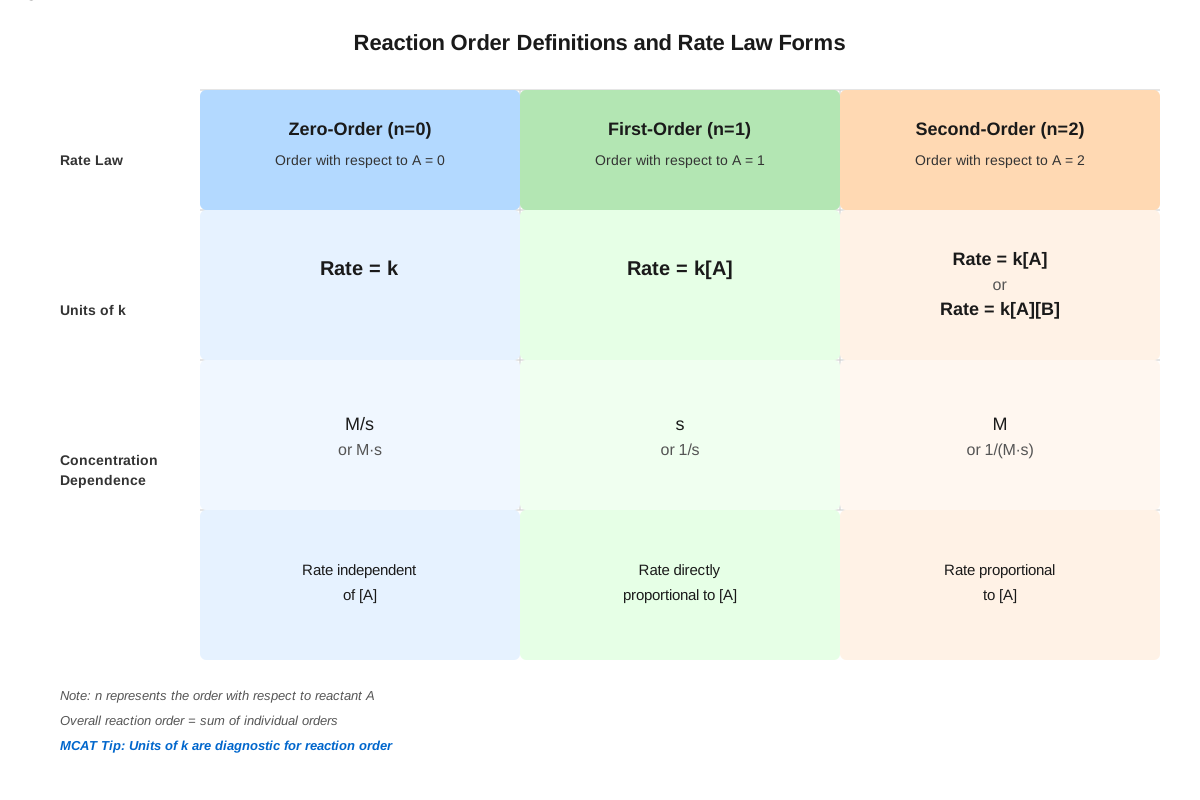
A zero-order reaction exhibits a rate that is independent of reactant concentration. The rate law for a zero-order reaction with respect to reactant A is:
Rate = k[A]^0 = kSince any number raised to the zero power equals one, the rate remains constant throughout the reaction until the reactant is nearly depleted. This behavior typically occurs when a reaction is limited by factors other than reactant concentration, such as surface area in heterogeneous catalysis or enzyme saturation in biochemical systems.
The integrated rate law for zero-order reactions is:
[A]_t = [A]_0 - ktwhere [A]_t is the concentration at time t, [A]_0 is the initial concentration, and k is the rate constant with units of M/s (or M·s^-1). This linear relationship means that plotting [A] versus time yields a straight line with slope -k and y-intercept [A]_0.
The half-life for a zero-order reaction depends on initial concentration:
t_{1/2} = [A]_0 / (2k)This concentration-dependent half-life distinguishes zero-order from first-order kinetics. As the reaction proceeds and concentration decreases, subsequent half-lives become shorter. Common examples include alcohol metabolism (when alcohol dehydrogenase is saturated), surface-catalyzed reactions, and photochemical reactions where light intensity limits the rate.
First-Order Reactions
A first-order reaction has a rate directly proportional to the concentration of one reactant. The rate law is:
Rate = k[A]^1 = k[A]First-order kinetics is the most common reaction order in nature, governing radioactive decay, many decomposition reactions, and most drug elimination processes. The rate constant k has units of s^-1 (or time^-1).
The integrated rate law for first-order reactions involves natural logarithms:
ln[A]_t = ln[A]_0 - ktor equivalently:
[A]_t = [A]_0 e^{-kt}The logarithmic form reveals that plotting ln[A] versus time produces a straight line with slope -k and y-intercept ln[A]_0. This graphical test provides the primary method for identifying first-order reactions from experimental data.
The half-life for first-order reactions is constant and independent of concentration:
t_{1/2} = 0.693 / k = ln(2) / kThis constant half-life is the signature characteristic of first-order kinetics. Whether starting with 1 M or 0.001 M of reactant, the time required for the concentration to decrease by half remains identical. This property makes first-order kinetics particularly important in pharmacology and nuclear medicine, where predictable half-lives enable precise dosing and decay calculations.
Second-Order Reactions
A second-order reaction can occur in two scenarios: (1) the rate depends on the concentration of one reactant squared, or (2) the rate depends on the product of concentrations of two different reactants. For the simpler case of one reactant:
Rate = k[A]^2The rate constant k has units of M^-1·s^-1 (or L·mol^-1·s^-1). Second-order reactions typically involve bimolecular collisions where two molecules must encounter each other for reaction to occur.
The integrated rate law for second-order reactions (one reactant) is:
1/[A]_t = 1/[A]_0 + ktPlotting 1/[A] (the reciprocal of concentration) versus time yields a straight line with slope k and y-intercept 1/[A]_0. This reciprocal relationship produces characteristic curved concentration-time plots that decrease more slowly than first-order reactions at low concentrations.
The half-life for second-order reactions depends inversely on initial concentration:
t_{1/2} = 1 / (k[A]_0)As the reaction proceeds and concentration decreases, subsequent half-lives become progressively longer. This behavior contrasts sharply with first-order kinetics and provides a diagnostic test for reaction order. Examples include many gas-phase reactions, dimerization reactions, and some nucleophilic substitution reactions.
Determining Reaction Order from Experimental Data
The MCAT frequently tests the ability to determine reaction order from experimental data using several methods:
Method 1: Initial Rates Method
Compare how the initial rate changes when initial concentrations are varied while holding other factors constant. If doubling [A] causes the rate to:
- Remain unchanged → zero-order in A
- Double → first-order in A
- Quadruple → second-order in A
- Increase by a factor of 2^n → nth-order in A
Method 2: Graphical Analysis
Plot the data in three ways and determine which produces a straight line:
- [A] vs. time → straight line indicates zero-order
- ln[A] vs. time → straight line indicates first-order
- 1/[A] vs. time → straight line indicates second-order
Method 3: Half-Life Analysis
Examine how half-life changes as concentration decreases:
- Half-life increases as concentration decreases → zero-order
- Half-life remains constant → first-order
- Half-life decreases as concentration decreases → second-order
Summary Table of Reaction Orders
| Property | Zero-Order | First-Order | Second-Order |
|---|---|---|---|
| Rate Law | Rate = k | Rate = k[A] | Rate = k[A]² |
| Integrated Rate Law | [A] = [A]₀ - kt | ln[A] = ln[A]₀ - kt | 1/[A] = 1/[A]₀ + kt |
| Linear Plot | [A] vs. t | ln[A] vs. t | 1/[A] vs. t |
| Slope of Linear Plot | -k | -k | k |
| Half-Life | [A]₀/(2k) | 0.693/k | 1/(k[A]₀) |
| Half-Life Dependence | Decreases with time | Constant | Increases with time |
| Units of k | M·s⁻¹ | s⁻¹ | M⁻¹·s⁻¹ |
| Common Examples | Enzyme saturation, surface reactions | Radioactive decay, drug elimination | Bimolecular collisions, dimerization |
Concept Relationships
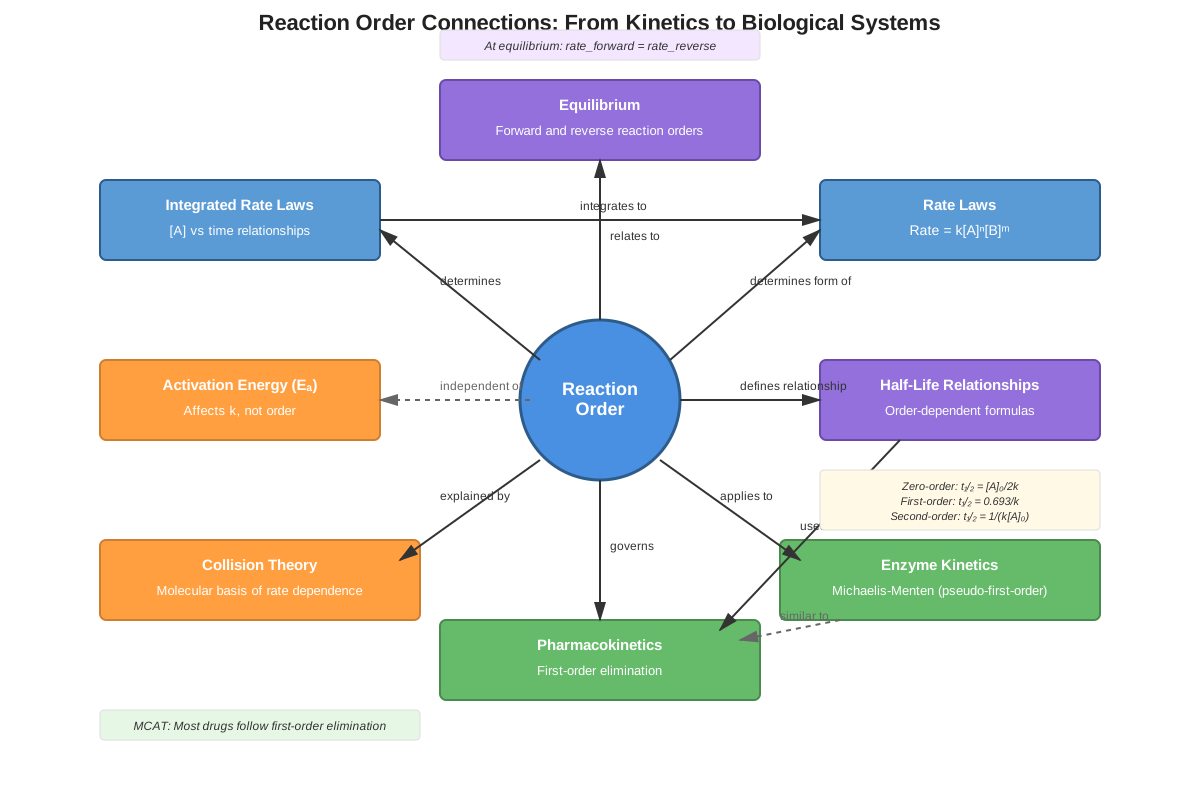
The concepts within reaction order form a hierarchical and interconnected framework. At the foundation lies the rate law, which mathematically expresses how concentration affects rate. The reaction order emerges from the exponents in this rate law, determining which integrated rate law applies. Each integrated rate law produces a characteristic linear plot that serves as the experimental signature for identifying reaction order. The half-life expressions derive directly from the integrated rate laws, providing an alternative method for order determination and practical applications in pharmacology and nuclear chemistry.
Reaction order connects backward to prerequisite concepts through its dependence on concentration measurements and rate calculations. The mathematical manipulations required to derive and apply integrated rate laws rely on algebra and logarithms. Moving forward, reaction order provides the foundation for understanding enzyme kinetics, where Michaelis-Menten kinetics represents a special case transitioning from first-order (low substrate concentration) to zero-order (high substrate concentration, enzyme saturation) behavior.
The relationship map flows as follows:
Experimental Data → Initial Rates or Concentration-Time Data → Determination of Reaction Order → Selection of Appropriate Integrated Rate Law → Calculation of Rate Constant → Prediction of Future Concentrations or Times → Application to Half-Life Problems → Extension to Complex Systems (Enzyme Kinetics, Drug Metabolism)
Laterally, reaction order connects to collision theory and transition state theory, which explain why certain reactions exhibit particular orders based on molecular mechanisms. The activation energy influences the magnitude of the rate constant k but not the reaction order itself. Understanding that stoichiometric coefficients do not determine reaction order prevents confusion and connects to the broader principle that kinetics (how fast) and thermodynamics (how far) represent independent properties of chemical reactions.
Quick check — test yourself on Reaction order so far.
Try Flashcards →High-Yield Facts
⭐ Reaction order must be determined experimentally and cannot be deduced from stoichiometric coefficients in the balanced equation
⭐ First-order reactions have constant half-lives independent of concentration; this property governs most drug elimination kinetics
⭐ The units of the rate constant k change with reaction order: M·s⁻¹ (zero-order), s⁻¹ (first-order), M⁻¹·s⁻¹ (second-order)
⭐ Plotting ln[A] vs. time yields a straight line for first-order reactions with slope = -k
⭐ Zero-order kinetics occurs when a reaction is limited by factors other than reactant concentration, such as enzyme saturation
- The overall reaction order equals the sum of individual orders with respect to each reactant
- Doubling the concentration of a reactant doubles the rate for first-order, quadruples the rate for second-order, and has no effect for zero-order
- Half-life for zero-order reactions decreases over time; half-life for second-order reactions increases over time
- The integrated rate law for first-order reactions can be written as [A]ₜ = [A]₀e⁻ᵏᵗ, showing exponential decay
- Reaction order can be fractional or negative in complex mechanisms, though integer orders (0, 1, 2) are most common on the MCAT
- The method of initial rates requires multiple experimental trials with systematically varied concentrations
- Pseudo-first-order conditions occur when one reactant is in large excess, simplifying the kinetic analysis
Common Misconceptions
Misconception: The reaction order equals the stoichiometric coefficient from the balanced equation.
Correction: Reaction order must be determined experimentally and often differs from stoichiometric coefficients. The balanced equation describes the overall stoichiometry but reveals nothing about the mechanism or rate law. For example, the reaction 2NO₂ → 2NO + O₂ might be first-order in NO₂ despite the coefficient of 2.
Misconception: All reactions follow simple integer orders (0, 1, or 2).
Correction: While integer orders are most common and emphasized on the MCAT, reactions can exhibit fractional orders (e.g., 1.5) or negative orders when complex mechanisms or inhibition are involved. However, for MCAT purposes, focus on zero, first, and second-order reactions.
Misconception: A larger rate constant k always means a faster reaction regardless of reaction order.
Correction: While a larger k generally indicates faster kinetics within the same reaction order, comparing k values across different reaction orders is meaningless because the units differ. A zero-order k of 0.1 M·s⁻¹ cannot be directly compared to a first-order k of 0.1 s⁻¹ without considering concentrations.
Misconception: Half-life is always constant for any reaction.
Correction: Only first-order reactions have constant half-lives independent of concentration. Zero-order half-lives decrease as concentration decreases, while second-order half-lives increase as concentration decreases. This distinction is frequently tested on the MCAT.
Misconception: If a reaction is second-order overall, it must be second-order with respect to a single reactant.
Correction: A reaction can be second-order overall through multiple combinations: second-order in one reactant (Rate = k[A]²), first-order in each of two reactants (Rate = k[A][B]), or other combinations. The overall order is simply the sum of individual orders.
Misconception: The rate constant k changes as the reaction proceeds and concentration changes.
Correction: The rate constant k is truly constant at a given temperature and does not change as concentrations change during the reaction. What changes is the rate itself, which depends on both k and the current concentrations according to the rate law. Temperature changes do affect k through the Arrhenius equation.
Misconception: Zero-order reactions have zero rate.
Correction: Zero-order means the rate is independent of concentration (raised to the zero power), not that the rate is zero. Zero-order reactions proceed at a constant rate until reactant is depleted, making them particularly important in saturated enzyme systems.
Worked Examples
Example 1: Determining Reaction Order from Initial Rates Data
Problem: The following data were collected for the reaction A + B → C at 25°C:
| Trial | [A]₀ (M) | [B]₀ (M) | Initial Rate (M/s) |
|---|---|---|---|
| 1 | 0.10 | 0.10 | 2.0 × 10⁻³ |
| 2 | 0.20 | 0.10 | 4.0 × 10⁻³ |
| 3 | 0.10 | 0.20 | 8.0 × 10⁻³ |
Determine the order with respect to A, the order with respect to B, the overall reaction order, and calculate the rate constant k.
Solution:
Step 1: Determine order with respect to A by comparing trials where only [A] changes.
Compare Trial 1 and Trial 2 (where [B] is constant):
- [A] doubles from 0.10 to 0.20 M
- Rate doubles from 2.0 × 10⁻³ to 4.0 × 10⁻³ M/s
- Since rate doubles when [A] doubles, the reaction is first-order in A (m = 1)
Step 2: Determine order with respect to B by comparing trials where only [B] changes.
Compare Trial 1 and Trial 3 (where [A] is constant):
- [B] doubles from 0.10 to 0.20 M
- Rate quadruples from 2.0 × 10⁻³ to 8.0 × 10⁻³ M/s
- Since rate quadruples (2²) when [B] doubles, the reaction is second-order in B (n = 2)
Step 3: Determine overall reaction order.
Overall order = m + n = 1 + 2 = 3 (third-order overall)
Step 4: Write the rate law and calculate k.
Rate = k[A]¹[B]²
Using data from Trial 1:
2.0 × 10⁻³ M/s = k(0.10 M)(0.10 M)²
2.0 × 10⁻³ = k(1.0 × 10⁻³)
k = 2.0 M⁻²·s⁻¹
Verification: Check with Trial 2:
Rate = (2.0 M⁻²·s⁻¹)(0.20)(0.10)² = 4.0 × 10⁻³ M/s ✓
Connection to Learning Objectives: This problem demonstrates the experimental determination of reaction order using the initial rates method, a high-yield MCAT skill. Notice that the stoichiometric coefficients (all 1 in the balanced equation) do not match the reaction orders, reinforcing the key principle that kinetics must be determined experimentally.
Example 2: Using Integrated Rate Laws and Half-Life
Problem: A first-order decomposition reaction has a rate constant of 0.0462 min⁻¹ at 25°C. If the initial concentration of reactant is 0.800 M:
(a) What is the half-life of the reaction?
(b) What concentration remains after 30.0 minutes?
(c) How long will it take for the concentration to decrease to 0.100 M?
Solution:
(a) Calculate half-life:
For first-order reactions: t₁/₂ = 0.693/k
t₁/₂ = 0.693 / 0.0462 min⁻¹ = 15.0 minutes
Note that this half-life is independent of the initial concentration—a characteristic feature of first-order kinetics.
(b) Calculate concentration after 30.0 minutes:
Use the first-order integrated rate law:
ln[A]ₜ = ln[A]₀ - kt
ln[A]₃₀ = ln(0.800) - (0.0462 min⁻¹)(30.0 min)
ln[A]₃₀ = -0.223 - 1.386
ln[A]₃₀ = -1.609
[A]₃₀ = e⁻¹·⁶⁰⁹ = 0.200 M
Alternative approach using half-lives:
30.0 minutes = 2 half-lives (since t₁/₂ = 15.0 min)
After 1 half-life: 0.800 M → 0.400 M
After 2 half-lives: 0.400 M → 0.200 M ✓
(c) Calculate time to reach 0.100 M:
Rearrange the integrated rate law to solve for time:
ln[A]ₜ = ln[A]₀ - kt
kt = ln[A]₀ - ln[A]ₜ = ln([A]₀/[A]ₜ)
t = (1/k) × ln([A]₀/[A]ₜ)
t = (1/0.0462 min⁻¹) × ln(0.800/0.100)
t = 21.6 min⁻¹ × ln(8.00)
t = 21.6 × 2.08
t = 45.0 minutes
Alternative approach using half-lives:
0.800 M → 0.400 M → 0.200 M → 0.100 M requires 3 half-lives
t = 3 × 15.0 min = 45.0 min ✓
Connection to Learning Objectives: This problem illustrates the practical application of first-order kinetics, which governs most drug elimination in the body. The constant half-life property enables physicians to predict drug concentrations and design dosing schedules. The problem also demonstrates multiple solution approaches—using the integrated rate law directly or reasoning through half-lives—both valuable strategies for MCAT questions.
Exam Strategy
When approaching reaction order questions on the MCAT, begin by identifying the question type: data interpretation (determining order from experimental results), calculation (using rate laws or integrated rate laws), or conceptual (understanding kinetic principles). Each type requires a different strategic approach.
Trigger words and phrases that signal reaction order questions include:
- "Determine the order of the reaction" or "What is the order with respect to..."
- "Initial rate" or "rate of reaction" combined with concentration data
- "Half-life" especially when asking how it changes or remains constant
- "Plot of [A] vs. time" or "ln[A] vs. time" or "1/[A] vs. time"
- "Rate constant" with units provided (use units to identify reaction order)
- "Enzyme saturation" or "zero-order kinetics" in biochemical contexts
For data interpretation questions, systematically compare trials:
- Identify which concentrations change between trials
- Calculate the factor by which concentration changes (usually 2× or 3×)
- Calculate the factor by which rate changes
- Apply the relationship: if concentration changes by factor x and rate changes by factor x^n, then n is the order
- Write the complete rate law before calculating k
For graphical questions, remember the diagnostic plots:
- Straight line for [A] vs. t → zero-order
- Straight line for ln[A] vs. t → first-order
- Straight line for 1/[A] vs. t → second-order
- If given a curved plot, mentally test which transformation would linearize it
Process-of-elimination tips:
- Eliminate any answer choice that confuses stoichiometric coefficients with reaction order
- If half-life is described as constant, eliminate zero-order and second-order options
- Check units of rate constant k; they must match the reaction order (this eliminates wrong answers in ~30% of questions)
- If a biological system shows saturation behavior, favor zero-order kinetics
- For drug elimination questions, first-order is the default unless saturation is mentioned
Time allocation: Allocate 60-90 seconds for straightforward order determination from initial rates, 90-120 seconds for integrated rate law calculations, and up to 2 minutes for complex passage-based questions requiring multiple steps. If a calculation becomes algebraically complex, check whether the question can be answered using half-life reasoning or proportional relationships instead.
Common trap answers include:
- Using stoichiometric coefficients as reaction orders
- Confusing the order with respect to one reactant with overall order
- Selecting the wrong integrated rate law based on misidentifying reaction order
- Forgetting that zero-order means rate is independent of concentration, not that rate is zero
- Assuming all half-lives are constant (only true for first-order)
Memory Techniques
Mnemonic for Linear Plots: "Z-F-S Needs L-L-R"
- Zero-order: plot [A] vs. t
- First-order: plot Ln[A] vs. t
- Second-order: plot 1/[A] (Reciprocal) vs. t
Mnemonic for Half-Life Behavior: "DISC"
- Decreases: Zero-order half-life decreases as reaction proceeds
- Independent/Invariant: First-order half-life is constant
- Stretches/Swells: Second-order half-life increases as reaction proceeds
- Constant only for first-order
Mnemonic for Rate Constant Units: "More Orders, More M's in the Denominator"
- Zero-order: M·s⁻¹ (M in numerator, no M in denominator)
- First-order: s⁻¹ (no M anywhere)
- Second-order: M⁻¹·s⁻¹ (M in denominator)
- Pattern: units of k = M^(1-n)·s⁻¹ where n is the order
Visualization Strategy for First-Order Decay:
Picture a radioactive sample or drug concentration decreasing by half repeatedly at regular intervals. Visualize a staircase descending: 100% → 50% → 25% → 12.5% → 6.25%, with each step taking the same amount of time (one half-life). This constant-interval pattern is unique to first-order kinetics.
Acronym for Initial Rates Method: "CROW"
- Compare trials with one variable changed
- Ratio the rates
- Order determined by exponent
- Write the complete rate law
Memory aid for Zero-Order: Think "Zero-Order = Zero Dependence" on concentration. The rate doesn't care about concentration—it's like a factory assembly line running at constant speed regardless of how much raw material is in the warehouse.
Summary
Reaction order represents the experimentally determined exponent in the rate law that describes how reactant concentration affects reaction rate. The three most important orders for the MCAT are zero-order (rate independent of concentration), first-order (rate proportional to concentration), and second-order (rate proportional to concentration squared). Each order produces characteristic integrated rate laws, linear plots, and half-life behaviors that serve as diagnostic signatures. Zero-order reactions maintain constant rates and have decreasing half-lives, commonly occurring in enzyme-saturated systems. First-order reactions exhibit exponential decay with constant half-lives independent of concentration, governing radioactive decay and most drug elimination. Second-order reactions show reciprocal concentration-time relationships with increasing half-lives. Reaction order must always be determined experimentally through initial rates methods or graphical analysis—it cannot be deduced from stoichiometric coefficients. The rate constant k has units that depend on reaction order: M·s⁻¹ for zero-order, s⁻¹ for first-order, and M⁻¹·s⁻¹ for second-order. Mastery requires both conceptual understanding of how concentration affects rate and computational facility with integrated rate laws and half-life calculations.
Key Takeaways
- Reaction order is determined experimentally, never from stoichiometric coefficients—this distinction appears on virtually every MCAT exam
- First-order reactions have constant half-lives (t₁/₂ = 0.693/k), making them predictable for drug dosing and radioactive decay applications
- The units of the rate constant k identify the reaction order: M·s⁻¹ (zero), s⁻¹ (first), M⁻¹·s⁻¹ (second)
- Linear plots diagnose reaction order: [A] vs. t (zero), ln[A] vs. t (first), 1/[A] vs. t (second)
- Zero-order kinetics occurs when reactions are limited by factors other than reactant concentration, particularly in enzyme saturation and surface-catalyzed reactions
- The initial rates method determines order by comparing how rate changes when concentration changes between experimental trials
- Overall reaction order equals the sum of individual orders with respect to each reactant in the rate law
Related Topics
Integrated Rate Laws and Half-Life Calculations: Building directly on reaction order, this topic explores the mathematical derivations of integrated rate laws and their applications to predicting concentrations over time. Mastering reaction order enables confident use of these equations in complex scenarios.
Enzyme Kinetics (Michaelis-Menten): Enzyme-catalyzed reactions exhibit concentration-dependent behavior that transitions from first-order (low substrate) to zero-order (saturated enzyme) kinetics. Understanding reaction order provides the foundation for interpreting Km, Vmax, and Lineweaver-Burk plots.
Arrhenius Equation and Activation Energy: While reaction order describes how concentration affects rate, the Arrhenius equation describes how temperature affects the rate constant k. Together, these concepts provide complete control over predicting reaction rates.
Reaction Mechanisms and Rate-Determining Steps: The reaction order reflects the molecularity of the rate-determining step in a multi-step mechanism. Advanced kinetics connects microscopic mechanisms to macroscopic rate laws.
Pharmacokinetics and Drug Metabolism: First-order elimination kinetics governs most drug clearance, while zero-order kinetics applies to saturated metabolic pathways. Clinical applications of reaction order principles are essential for medical practice.
Practice CTA
Now that you've mastered the core concepts of reaction order, it's time to solidify your understanding through active practice. Attempt the practice questions to test your ability to determine reaction order from experimental data, apply integrated rate laws to calculations, and reason through conceptual scenarios. Use the flashcards to reinforce high-yield facts, particularly the diagnostic features of each reaction order and common MCAT traps. Remember that kinetics questions reward systematic approaches—develop your problem-solving process now, and you'll execute confidently under exam pressure. Every practice problem you work through builds the pattern recognition and computational fluency that separates good MCAT scores from great ones. You've got this!
Sign up free to keep reading
Create a free AnvayaPrep account to finish this MCAT guide on Reaction order — plus flashcards and practice questions.