Overview
Reaction rate is a foundational concept in General Chemistry that quantifies how quickly reactants are converted into products during a chemical reaction. Understanding reaction rate is essential for mastering Kinetics and Equilibrium, as it provides the mathematical and conceptual framework for predicting how fast reactions proceed under various conditions. On the MCAT, reaction rate appears frequently in both passage-based and discrete questions, often integrated with enzyme kinetics, thermodynamics, and experimental design scenarios. Students must be comfortable calculating rates from experimental data, interpreting rate laws, and understanding the factors that influence reaction speed.
The study of reaction rate bridges multiple areas of General Chemistry and biochemistry. While thermodynamics tells us whether a reaction is favorable (the destination), kinetics tells us how quickly we'll arrive there (the journey). This distinction is critical for the MCAT, where passages may present reactions that are thermodynamically favorable but kinetically slow, or vice versa. Reaction rate concepts directly connect to collision theory, activation energy, catalysis, and equilibrium dynamics—all high-yield topics that appear across the Chemical and Physical Foundations of Biological Systems section.
Mastering reaction rate requires both conceptual understanding and quantitative problem-solving skills. Students must interpret graphs showing concentration changes over time, calculate average and instantaneous rates, understand the relationship between stoichiometry and relative rates, and recognize how experimental conditions affect reaction speed. This topic serves as the gateway to more complex kinetics concepts including rate laws, reaction orders, and mechanisms, making it an essential foundation for MCAT success.
Learning Objectives
- [ ] Define Reaction rate using accurate General Chemistry terminology
- [ ] Explain why Reaction rate matters for the MCAT
- [ ] Apply Reaction rate to exam-style questions
- [ ] Identify common mistakes related to Reaction rate
- [ ] Connect Reaction rate to related General Chemistry concepts
- [ ] Calculate average and instantaneous reaction rates from concentration-time data
- [ ] Determine relative rates of reactant consumption and product formation using stoichiometric coefficients
- [ ] Interpret graphical representations of concentration changes and extract rate information
- [ ] Predict qualitatively how changes in conditions affect reaction rate
Prerequisites
- Stoichiometry and balanced chemical equations: Reaction rates for different species in the same reaction are related through stoichiometric coefficients
- Molarity and concentration units: Reaction rates are typically expressed as changes in concentration per unit time
- Basic calculus concepts (slopes and derivatives): Instantaneous rates correspond to the slope of a tangent line on a concentration-time graph
- Graphing and data interpretation: Much of reaction rate analysis involves extracting information from concentration vs. time plots
- Basic thermodynamics: Understanding the distinction between thermodynamic favorability and kinetic feasibility
Why This Topic Matters
Clinical and Real-World Significance
Reaction rate principles govern countless biological and pharmaceutical processes. Enzyme-catalyzed reactions in metabolism must proceed at rates compatible with life—too slow and essential processes fail, too fast and regulation becomes impossible. Drug efficacy depends on reaction rates: medications must be absorbed, distributed, metabolized, and eliminated at appropriate speeds. Understanding reaction rates helps explain why some drugs require loading doses, why certain medications must be taken with food, and how drug interactions can accelerate or slow metabolic pathways. In emergency medicine, the rate of antidote administration can mean the difference between life and death, as healthcare providers race against the rate of toxin-induced damage.
MCAT Exam Statistics
Reaction rate appears in approximately 3-5% of Chemical and Physical Foundations questions, with kinetics as a broader topic comprising 8-12% of this section. Questions typically appear as:
- Passage-based scenarios involving experimental kinetics data requiring rate calculations
- Discrete questions testing conceptual understanding of factors affecting rate
- Integrated questions combining kinetics with enzyme function, equilibrium, or thermodynamics
- Graph interpretation questions requiring students to extract rate information from concentration-time plots
Common Exam Contexts
The MCAT frequently presents reaction rate within these frameworks:
- Enzyme kinetics passages describing Michaelis-Menten kinetics and inhibition
- Experimental design passages where students must interpret rate data from tables or graphs
- Biochemical pathways where reaction rates determine metabolic flux
- Pharmaceutical scenarios involving drug metabolism and clearance rates
- Laboratory technique passages involving reaction monitoring methods
Core Concepts
Definition of Reaction Rate
Reaction rate is defined as the change in concentration of a reactant or product per unit time. For a general reaction, the rate quantifies how quickly the chemical system evolves from reactants toward products. Mathematically, reaction rate is expressed as:
Rate = -Δ[Reactant]/Δt = +Δ[Product]/ΔtThe negative sign for reactants indicates that their concentration decreases over time, while the positive sign for products reflects their increasing concentration. The standard units for reaction rate are molarity per second (M/s or mol·L⁻¹·s⁻¹), though other time units (minutes, hours) may appear depending on the reaction timescale.
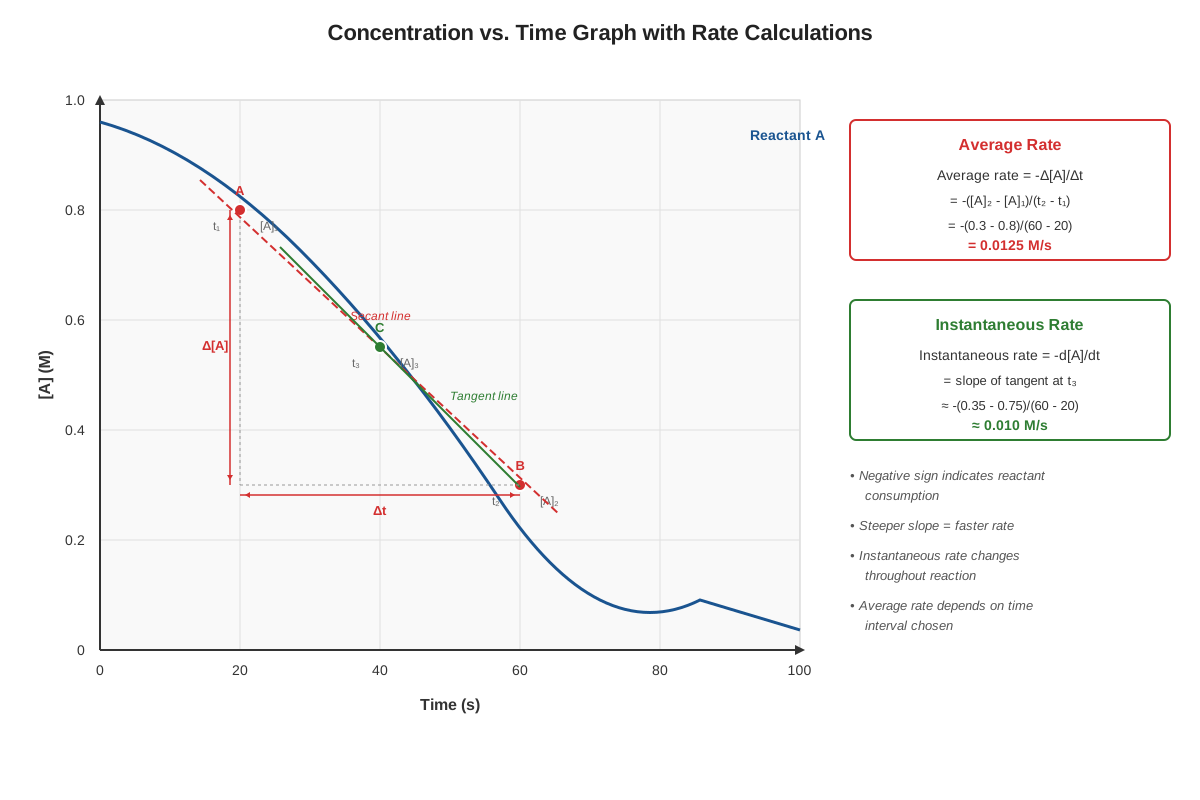
It's crucial to distinguish between average rate and instantaneous rate. The average rate is calculated over a finite time interval and represents the overall rate during that period. The instantaneous rate is the rate at a specific moment in time, corresponding mathematically to the derivative of concentration with respect to time (the slope of the tangent line on a concentration-time curve). On the MCAT, students must be prepared to calculate both types from experimental data.
Stoichiometric Relationships in Reaction Rates
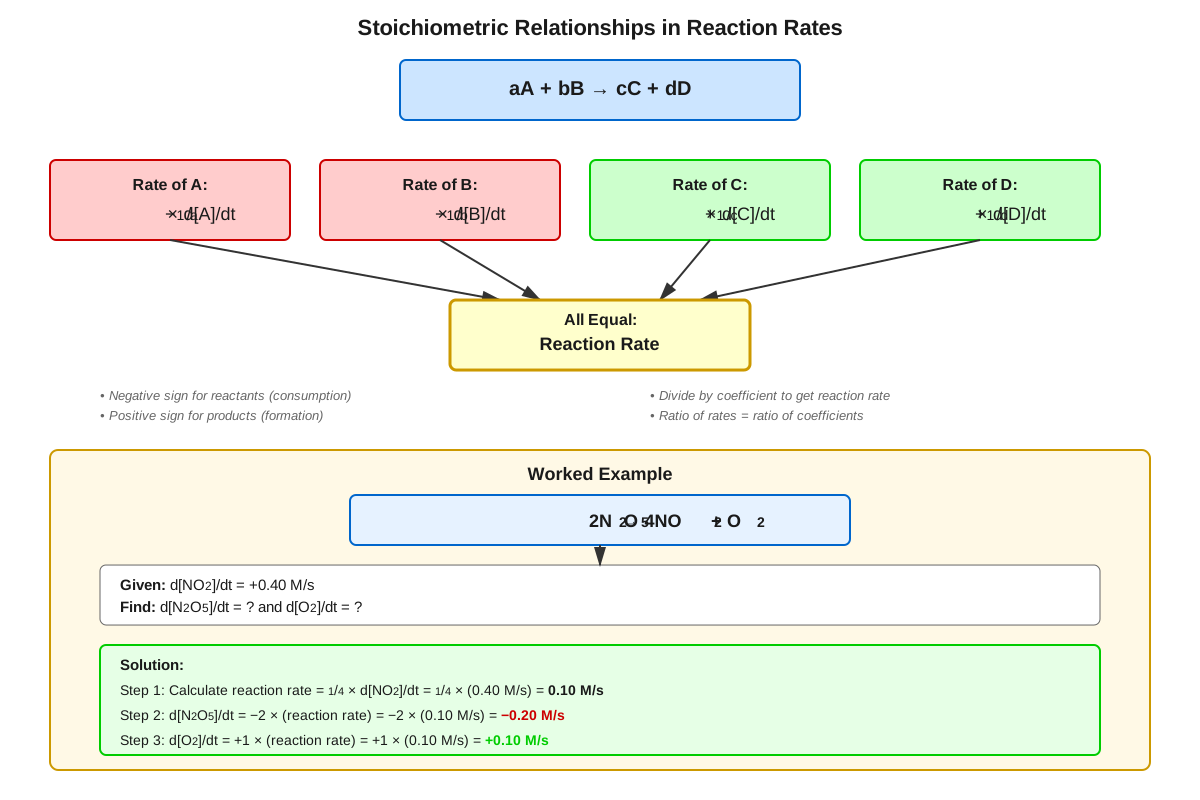
For reactions with stoichiometric coefficients other than one, the rates of consumption and formation for different species are related through these coefficients. Consider the general reaction:
aA + bB → cC + dDThe relationship between rates is:
Rate = -(1/a)(Δ[A]/Δt) = -(1/b)(Δ[B]/Δt) = +(1/c)(Δ[C]/Δt) = +(1/d)(Δ[D]/Δt)This relationship ensures that the overall reaction rate is consistent regardless of which species is monitored. For example, if two moles of reactant A are consumed for every mole of product C formed, then A disappears twice as fast as C appears, but when divided by their respective stoichiometric coefficients, both give the same reaction rate.
Factors Affecting Reaction Rate
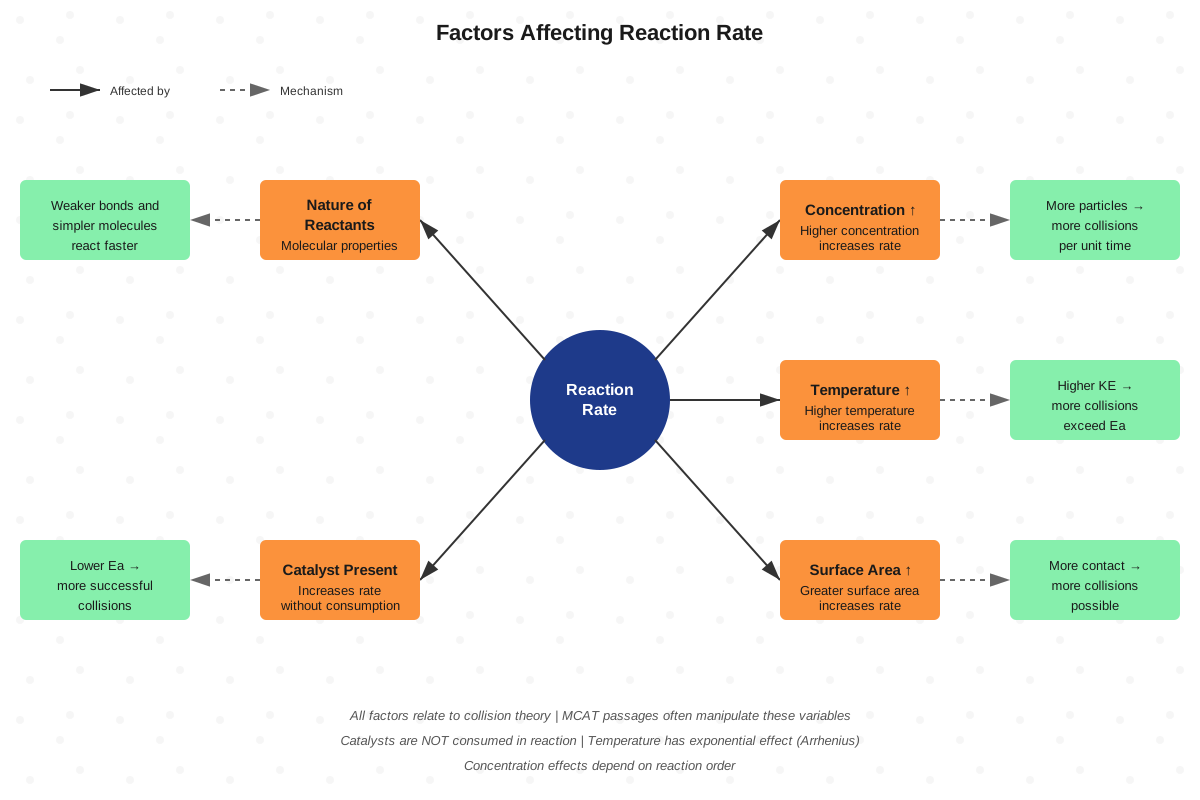
Several factors influence how quickly reactions proceed, all of which connect to collision theory and activation energy concepts:
Concentration: Higher reactant concentrations generally increase reaction rate by increasing the frequency of molecular collisions. More molecules in a given volume means more opportunities for productive collisions per unit time. This relationship forms the basis for rate laws, though the exact mathematical relationship depends on the reaction mechanism.
Temperature: Increasing temperature increases reaction rate by providing reactant molecules with greater kinetic energy. This has two effects: molecules collide more frequently (higher collision rate) and a larger fraction of collisions possess sufficient energy to overcome the activation energy barrier. The Arrhenius equation quantifies this temperature dependence, showing that rate constants increase exponentially with temperature.
Catalysts: Catalysts increase reaction rate without being consumed by providing an alternative reaction pathway with lower activation energy. Biological catalysts (enzymes) are particularly important for the MCAT, as they enable reactions to proceed at biologically relevant rates under physiological conditions. Catalysts do not affect the thermodynamic favorability of a reaction—they only affect how quickly equilibrium is reached.
Surface Area: For heterogeneous reactions involving solids, increased surface area increases reaction rate by providing more sites for reaction to occur. This explains why powdered solids react faster than large chunks of the same material.
Pressure (for gases): Increasing pressure effectively increases concentration for gaseous reactants, thereby increasing collision frequency and reaction rate.
Graphical Representation of Reaction Rate
Concentration-time graphs are essential tools for visualizing and analyzing reaction rates. For a typical reaction where reactant A converts to product P:
- The reactant concentration curve starts high and decreases over time, with the slope becoming less steep as the reaction progresses (for most reactions)
- The product concentration curve starts at zero and increases over time, with the slope decreasing as reactants are depleted
- The instantaneous rate at any point equals the magnitude of the slope of the tangent line at that point
- The average rate over an interval equals the magnitude of the slope of the secant line connecting two points
The shape of these curves provides information about reaction order. Zero-order reactions show linear concentration-time plots, first-order reactions show exponential decay, and second-order reactions show characteristic hyperbolic curves. While detailed rate law analysis extends beyond basic reaction rate concepts, recognizing these patterns helps with MCAT passage interpretation.
Measuring Reaction Rate Experimentally
The MCAT may present passages describing various methods for monitoring reaction progress:
| Method | What's Measured | Best For |
|---|---|---|
| Spectrophotometry | Absorbance changes | Colored reactants/products |
| Pressure monitoring | Gas pressure changes | Reactions producing/consuming gases |
| pH monitoring | Hydrogen ion concentration | Acid-base reactions |
| Titration | Concentration at intervals | Any reaction with titratable species |
| Conductivity | Ion concentration changes | Ionic reactions |
| Gas collection | Volume of gas produced | Reactions generating gases |
Understanding these methods helps interpret experimental passages where students must extract rate information from data collected using these techniques.
Concept Relationships
The concept of reaction rate serves as the foundation for understanding chemical kinetics. Reaction rate → directly leads to → rate laws, which mathematically describe how rate depends on reactant concentrations. Rate laws in turn connect to reaction order, which characterizes the mathematical relationship between concentration and rate. Understanding reaction rate is essential for grasping reaction mechanisms, as the overall rate is determined by the slowest (rate-determining) step in a multi-step mechanism.
Reaction rate concepts connect intimately with collision theory and activation energy. The rate at which reactions proceed depends on the frequency of collisions between reactant molecules and the fraction of those collisions with sufficient energy to overcome the activation barrier. This relationship explains why temperature and catalysts affect reaction rate—temperature increases the fraction of high-energy collisions, while catalysts lower the activation energy requirement.
The distinction between kinetics and thermodynamics is crucial: thermodynamics (ΔG, equilibrium constants) tells us the final equilibrium position, while kinetics (reaction rate) tells us how quickly that equilibrium is reached. A reaction can be thermodynamically favorable (negative ΔG) but kinetically slow, requiring a catalyst to proceed at a useful rate. This concept is particularly important for understanding enzyme function in biological systems.
Reaction rate also connects to equilibrium concepts. At equilibrium, the forward and reverse reaction rates are equal (not zero), resulting in no net change in concentrations. Understanding this dynamic equilibrium requires first understanding how to quantify and compare reaction rates in both directions.
Quick check — test yourself on Reaction rate so far.
Try Flashcards →High-Yield Facts
⭐ Reaction rate is defined as the change in concentration of a reactant or product per unit time, with units typically in M/s
⭐ The rate of disappearance of reactants is related to the rate of appearance of products through stoichiometric coefficients
⭐ Instantaneous rate (slope of tangent) differs from average rate (slope of secant) and typically decreases as the reaction progresses
⭐ Increasing temperature increases reaction rate by increasing both collision frequency and the fraction of collisions exceeding activation energy
⭐ Catalysts increase reaction rate by lowering activation energy but do not affect the thermodynamic favorability (ΔG) or equilibrium position
- Reaction rate is independent of whether a reaction is thermodynamically favorable; kinetics and thermodynamics are separate considerations
- For the reaction aA + bB → cC + dD, the relationship is: Rate = -(1/a)(Δ[A]/Δt) = -(1/b)(Δ[B]/Δt) = +(1/c)(Δ[C]/Δt) = +(1/d)(Δ[D]/Δt)
- Concentration-time graphs for reactants show negative slopes (decreasing concentration), while product graphs show positive slopes (increasing concentration)
- Higher reactant concentrations generally increase reaction rate by increasing collision frequency
- Surface area affects reaction rate for heterogeneous reactions involving solids
- The initial rate (rate at t=0) is often the easiest to determine experimentally and is commonly used in rate law determination
- Reaction rate typically decreases over time as reactants are consumed, unless the reaction is zero-order
Common Misconceptions
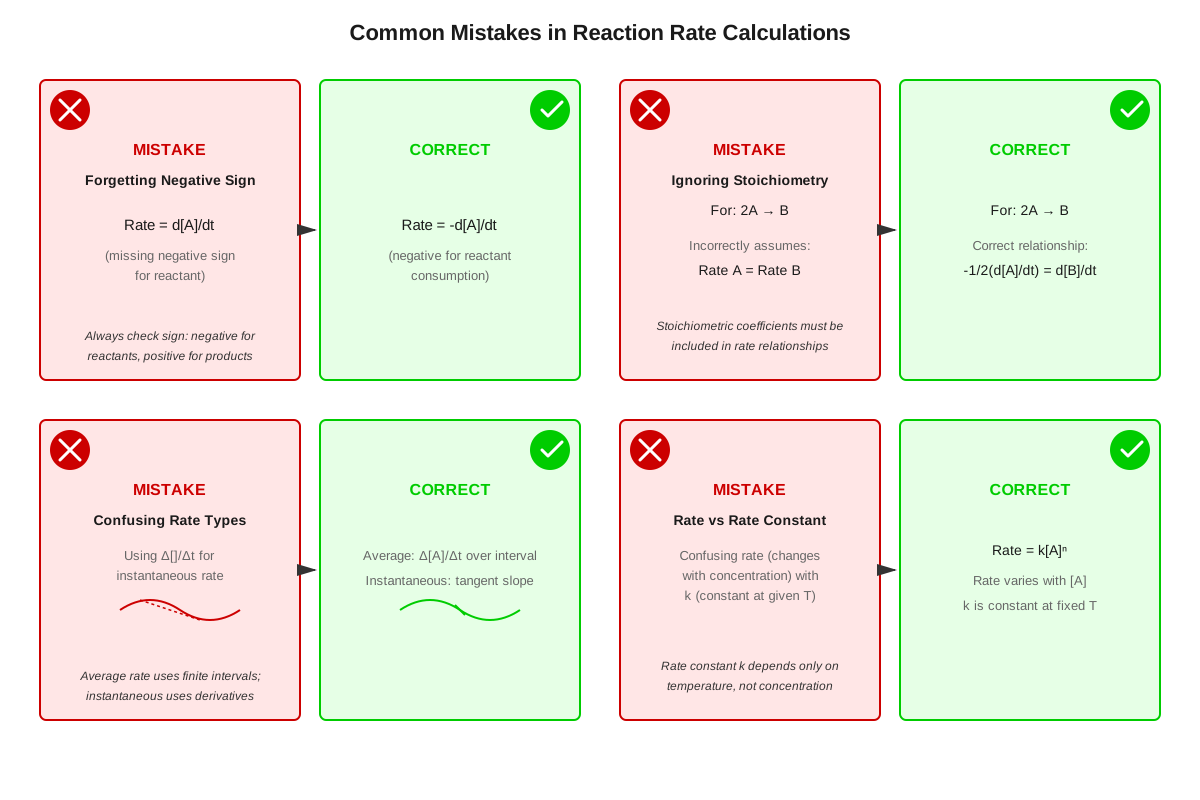
Misconception: Reaction rate is the same for all species in a reaction.
Correction: The rate of change of concentration differs for species with different stoichiometric coefficients. If 2 moles of A react to form 1 mole of B, then [A] decreases twice as fast as [B] increases. However, when divided by stoichiometric coefficients, these give the same overall reaction rate.
Misconception: A thermodynamically favorable reaction (negative ΔG) always proceeds quickly.
Correction: Thermodynamics and kinetics are independent. A reaction can be highly favorable thermodynamically but kinetically slow due to high activation energy. Diamond converting to graphite is thermodynamically favorable but kinetically negligible at room temperature.
Misconception: Catalysts increase the amount of product formed at equilibrium.
Correction: Catalysts increase the rate at which equilibrium is reached but do not shift the equilibrium position or change the final product yield. They affect kinetics, not thermodynamics.
Misconception: Reaction rate is always constant throughout a reaction.
Correction: For most reactions, the rate decreases over time as reactants are consumed. Only zero-order reactions maintain constant rate regardless of concentration. The rate typically depends on reactant concentration, so as concentration decreases, rate decreases.
Misconception: The negative sign in rate expressions means the rate is negative.
Correction: The negative sign in -Δ[Reactant]/Δt is a mathematical convention to make the rate positive, since Δ[Reactant] is negative (concentration decreases). Reaction rates themselves are always reported as positive values.
Misconception: Average rate and instantaneous rate are the same thing.
Correction: Average rate is calculated over a time interval and represents the overall rate during that period. Instantaneous rate is the rate at a specific moment (the derivative or tangent slope) and typically changes throughout the reaction.
Worked Examples
Example 1: Calculating Rates from Concentration Data
Problem: For the reaction 2NO₂(g) → 2NO(g) + O₂(g), the concentration of NO₂ decreases from 0.500 M to 0.320 M over 40.0 seconds. Calculate: (a) the average rate of disappearance of NO₂, (b) the average rate of appearance of O₂, and (c) the overall reaction rate.
Solution:
(a) Average rate of NO₂ disappearance:
Rate of NO₂ disappearance = -Δ[NO₂]/Δt = -(0.320 M - 0.500 M)/(40.0 s)
= -(-0.180 M)/(40.0 s) = 0.00450 M/s
(b) To find the rate of O₂ appearance, we use stoichiometry. For every 2 moles of NO₂ consumed, 1 mole of O₂ is produced:
Rate of O₂ appearance = (1/2) × Rate of NO₂ disappearance
= (1/2) × 0.00450 M/s = 0.00225 M/s
(c) The overall reaction rate uses the stoichiometric coefficients:
Rate = -(1/2)(Δ[NO₂]/Δt) = +(1/1)(Δ[O₂]/Δt)
Rate = (1/2) × 0.00450 M/s = 0.00225 M/s
Key Insight: This problem demonstrates that different species in the same reaction have different rates of concentration change, but when divided by stoichiometric coefficients, they yield the same overall reaction rate. This is a common MCAT question type.
Example 2: Interpreting Graphical Data
Problem: A student monitors the concentration of reactant A over time and obtains the following data:
| Time (s) | [A] (M) |
|---|---|
| 0 | 1.00 |
| 10 | 0.75 |
| 20 | 0.56 |
| 30 | 0.42 |
| 40 | 0.32 |
Calculate (a) the average rate between t=0 and t=20 s, (b) the average rate between t=20 and t=40 s, and (c) explain why these rates differ.
Solution:
(a) Average rate from t=0 to t=20 s:
Rate = -Δ[A]/Δt = -(0.56 M - 1.00 M)/(20 s - 0 s)
= -(-0.44 M)/(20 s) = 0.022 M/s
(b) Average rate from t=20 to t=40 s:
Rate = -Δ[A]/Δt = -(0.32 M - 0.56 M)/(40 s - 20 s)
= -(-0.24 M)/(20 s) = 0.012 M/s
(c) The rate decreases over time (0.022 M/s → 0.012 M/s) because as reactant A is consumed, its concentration decreases. For most reactions, rate depends on reactant concentration, so lower concentration leads to slower rate. This is consistent with collision theory: fewer reactant molecules mean fewer collisions per unit time.
Key Insight: This problem illustrates that reaction rate typically decreases as the reaction progresses. Recognizing this pattern helps interpret kinetics passages and predict concentration-time curve shapes. The MCAT often tests whether students understand that rate is not constant throughout a reaction.
Exam Strategy
Approaching MCAT Questions on Reaction Rate
When encountering reaction rate questions, follow this systematic approach:
- Identify what's being asked: Are you calculating average rate, instantaneous rate, or comparing rates of different species?
- Check stoichiometry: Always note the stoichiometric coefficients—they're essential for relating rates of different species
- Watch your signs: Remember that reactant rates use negative signs (decreasing concentration) while product rates use positive signs
- Units matter: Verify that concentration units and time units are consistent; convert if necessary
- Graph interpretation: For concentration-time graphs, steep slopes indicate fast rates, while flattening curves show decreasing rates
Trigger Words and Phrases
Watch for these key phrases that signal reaction rate questions:
- "How fast does the reaction proceed?"
- "Rate of disappearance/consumption" (reactants)
- "Rate of appearance/formation" (products)
- "Initial rate" (rate at t=0)
- "Instantaneous rate at time t" (requires tangent slope)
- "Average rate over the interval" (requires secant slope)
- "How does [factor] affect the reaction rate?" (qualitative prediction)
Process of Elimination Tips
When facing multiple-choice questions on reaction rate:
- Eliminate answers with wrong units: Rate must have concentration/time units (M/s, M/min, etc.)
- Check stoichiometric consistency: If the question asks about multiple species, their rates must be related by stoichiometric coefficients
- Verify sign conventions: Rates are reported as positive values; answers showing negative rates are typically incorrect
- Look for magnitude reasonableness: If concentration changes by 0.1 M over 10 seconds, the rate should be around 0.01 M/s, not 10 M/s or 0.00001 M/s
- Eliminate thermodynamic answers to kinetic questions: If asked about rate, answers discussing ΔG, equilibrium constants, or spontaneity are likely distractors
Time Allocation Advice
For discrete reaction rate questions: allocate 60-90 seconds. These typically involve straightforward calculations or conceptual understanding.
For passage-based questions: allocate 90-120 seconds per question. You'll need time to extract data from tables or graphs, identify relevant information, and perform calculations. Practice extracting rate information quickly from graphical data, as this is a common time sink.
Exam Tip: If a passage presents a concentration-time graph, immediately identify where the rate is fastest (steepest slope, usually at t=0) and where it's slowest (flattest slope, usually as the reaction approaches completion). This qualitative understanding can help eliminate wrong answers quickly.
Memory Techniques
Mnemonic for Rate Expression Signs
"Reactants Run Down, Products Pop Up" - Reactants have negative Δ (concentration decreases/runs down), while products have positive Δ (concentration increases/pops up). The negative sign in the rate expression for reactants makes the overall rate positive.
Visualization Strategy for Stoichiometric Relationships
Picture a balanced chemical equation as a recipe ratio. If a recipe requires 2 eggs for every 1 cake, eggs are consumed twice as fast as cakes are produced. Similarly, if 2A → B, then A disappears twice as fast as B appears. The stoichiometric coefficient is the "recipe ratio" that relates the rates.
Acronym for Factors Affecting Rate
"CCTSP" (pronounced "see-tee-sp"):
- Concentration
- Catalysts
- Temperature
- Surface area
- Pressure (for gases)
Memory Aid for Average vs. Instantaneous Rate
"Average = Across, Instant = At"
- Average rate is calculated across a time interval (secant line)
- Instantaneous rate is calculated at a specific moment (tangent line)
Summary
Reaction rate quantifies the speed at which chemical reactions proceed, expressed as the change in concentration per unit time. Understanding reaction rate requires mastering both conceptual and quantitative aspects: calculating average and instantaneous rates from concentration-time data, relating rates of different species through stoichiometric coefficients, and recognizing factors that influence reaction speed. The MCAT tests reaction rate through calculations, graph interpretation, and conceptual questions about factors affecting rate. Key distinctions include average versus instantaneous rate, the relationship between stoichiometry and relative rates, and the independence of kinetics (how fast) from thermodynamics (how favorable). Factors affecting reaction rate—concentration, temperature, catalysts, surface area, and pressure—all connect to collision theory and activation energy. Mastering reaction rate provides the foundation for understanding rate laws, reaction mechanisms, and enzyme kinetics, making it an essential topic for MCAT success in General Chemistry and biochemistry passages.
Key Takeaways
- Reaction rate measures the change in concentration per unit time, with standard units of M/s, and can be expressed for any reactant or product in a reaction
- Rates of different species in the same reaction are related through stoichiometric coefficients: Rate = -(1/a)(Δ[A]/Δt) = +(1/c)(Δ[C]/Δt)
- Instantaneous rate (tangent slope) differs from average rate (secant slope) and typically decreases as reactions progress due to decreasing reactant concentration
- Kinetics (reaction rate) and thermodynamics (ΔG, equilibrium) are independent—favorable reactions can be slow, and unfavorable reactions can be fast
- Factors increasing reaction rate include higher concentration, higher temperature, presence of catalysts, greater surface area (for heterogeneous reactions), and higher pressure (for gases)
- Catalysts increase reaction rate by lowering activation energy but do not affect equilibrium position or thermodynamic favorability
- Concentration-time graphs provide visual representation of reaction progress, with slope magnitude indicating reaction rate at any point
Related Topics
Rate Laws and Reaction Order: Building on reaction rate fundamentals, rate laws mathematically describe how rate depends on reactant concentrations, introducing concepts of reaction order and rate constants. Mastering reaction rate is essential before tackling rate law determination.
Reaction Mechanisms: Understanding how elementary steps combine to produce overall reactions, with the slowest step determining the overall rate. Reaction rate concepts provide the foundation for analyzing multi-step mechanisms.
Activation Energy and the Arrhenius Equation: Quantifying the temperature dependence of reaction rate through the relationship between rate constants and activation energy. This extends the qualitative understanding of how temperature affects rate.
Enzyme Kinetics: Applying reaction rate principles to biological catalysts, including Michaelis-Menten kinetics, enzyme inhibition, and factors affecting enzyme activity. This is a high-yield MCAT topic that directly builds on reaction rate fundamentals.
Chemical Equilibrium: Understanding the dynamic balance where forward and reverse reaction rates are equal, connecting kinetics to thermodynamics and equilibrium constants.
Practice CTA
Now that you've mastered the fundamentals of reaction rate, it's time to solidify your understanding through active practice. Work through the practice questions to apply these concepts to MCAT-style scenarios, and use the flashcards to reinforce key definitions and relationships. Remember, kinetics questions often integrate multiple concepts, so practice identifying the relevant information and applying systematic problem-solving approaches. The more you practice extracting rate information from graphs and tables, the more confident you'll become on test day. You've built a strong foundation—now strengthen it through deliberate practice!
Sign up free to keep reading
Create a free AnvayaPrep account to finish this MCAT guide on Reaction rate — plus flashcards and practice questions.