Overview
Henry's law is a fundamental principle in General Chemistry that describes the relationship between the partial pressure of a gas above a liquid and the concentration of that gas dissolved in the liquid. This quantitative relationship states that at constant temperature, the amount of gas that dissolves in a liquid is directly proportional to the partial pressure of that gas in equilibrium with the liquid. Understanding Henry's law is essential for the MCAT because it bridges concepts in Solutions and Phase Behavior with practical applications in physiology, environmental science, and clinical medicine.
For MCAT preparation, Henry's law General Chemistry questions frequently appear in passages involving gas exchange in the lungs, decompression sickness in divers, carbonated beverages, and environmental chemistry scenarios. The law provides a mathematical framework for predicting how gases behave when they interact with liquid phases, making it indispensable for solving quantitative problems and understanding qualitative trends. Students must be comfortable manipulating the Henry's law equation, interpreting graphs showing gas solubility relationships, and applying the principle to novel scenarios presented in passage-based questions.
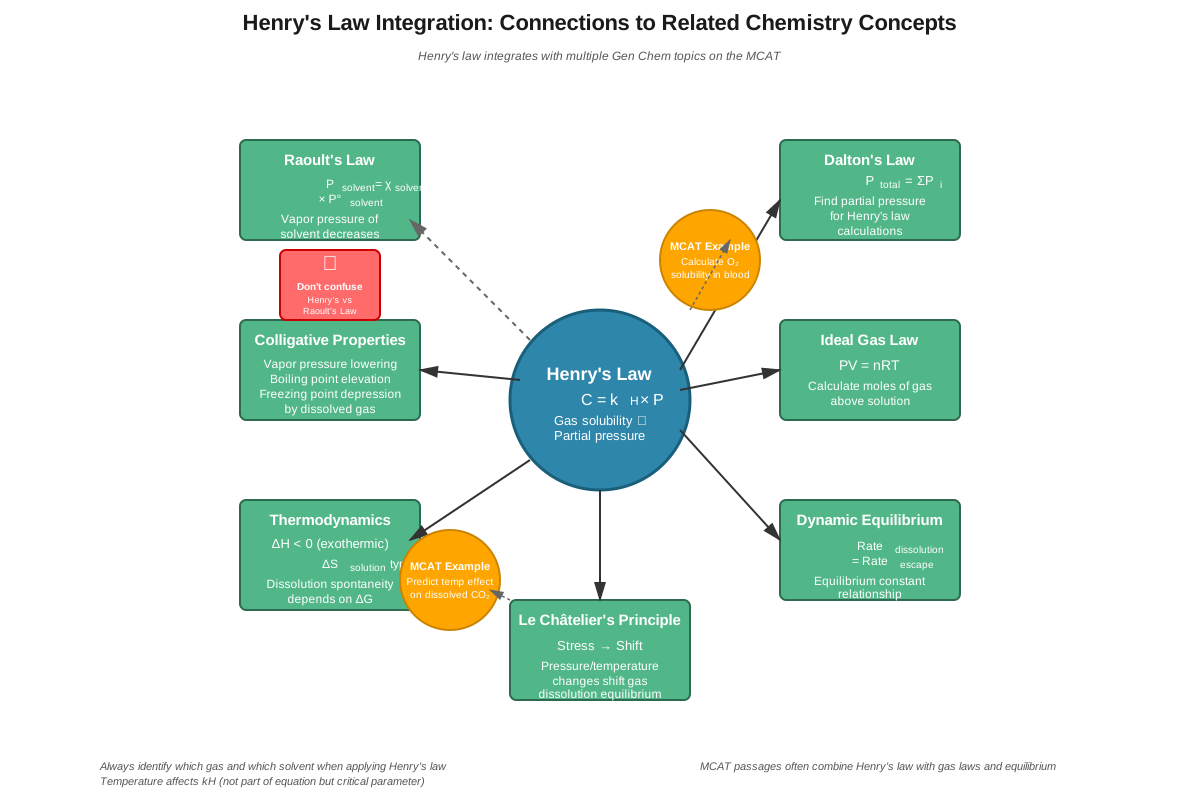
The significance of Henry's law MCAT content extends beyond isolated calculations. This topic integrates with partial pressure concepts from gas laws, colligative properties of solutions, Le Châtelier's principle, and thermodynamic equilibrium. Mastery of Henry's law enables students to tackle interdisciplinary questions that span general chemistry, organic chemistry, and biological sciences, particularly in passages discussing respiratory physiology, blood gas analysis, and aquatic ecosystems. The medium difficulty rating reflects that while the core equation is straightforward, MCAT questions often require multi-step reasoning and integration with other chemical principles.
Learning Objectives
- [ ] Define Henry's law using accurate General Chemistry terminology
- [ ] Explain why Henry's law matters for the MCAT
- [ ] Apply Henry's law to exam-style questions
- [ ] Identify common mistakes related to Henry's law
- [ ] Connect Henry's law to related General Chemistry concepts
- [ ] Calculate gas solubility given partial pressure and Henry's law constant
- [ ] Predict how temperature changes affect gas solubility in liquids
- [ ] Analyze physiological scenarios involving gas dissolution using Henry's law principles
Prerequisites
- Partial pressure and Dalton's law: Understanding that each gas in a mixture exerts its own pressure is essential for applying Henry's law, which relates partial pressure to solubility
- Molarity and concentration units: Henry's law calculations require facility with expressing dissolved gas concentrations in various units
- Equilibrium concepts: Henry's law describes an equilibrium state between dissolved and gaseous phases, requiring understanding of dynamic equilibrium
- Gas laws (ideal gas law): The behavior of gases above the liquid surface follows gas law principles that complement Henry's law applications
- Solution terminology: Familiarity with solute, solvent, and solution properties provides the foundation for understanding gas dissolution
Why This Topic Matters
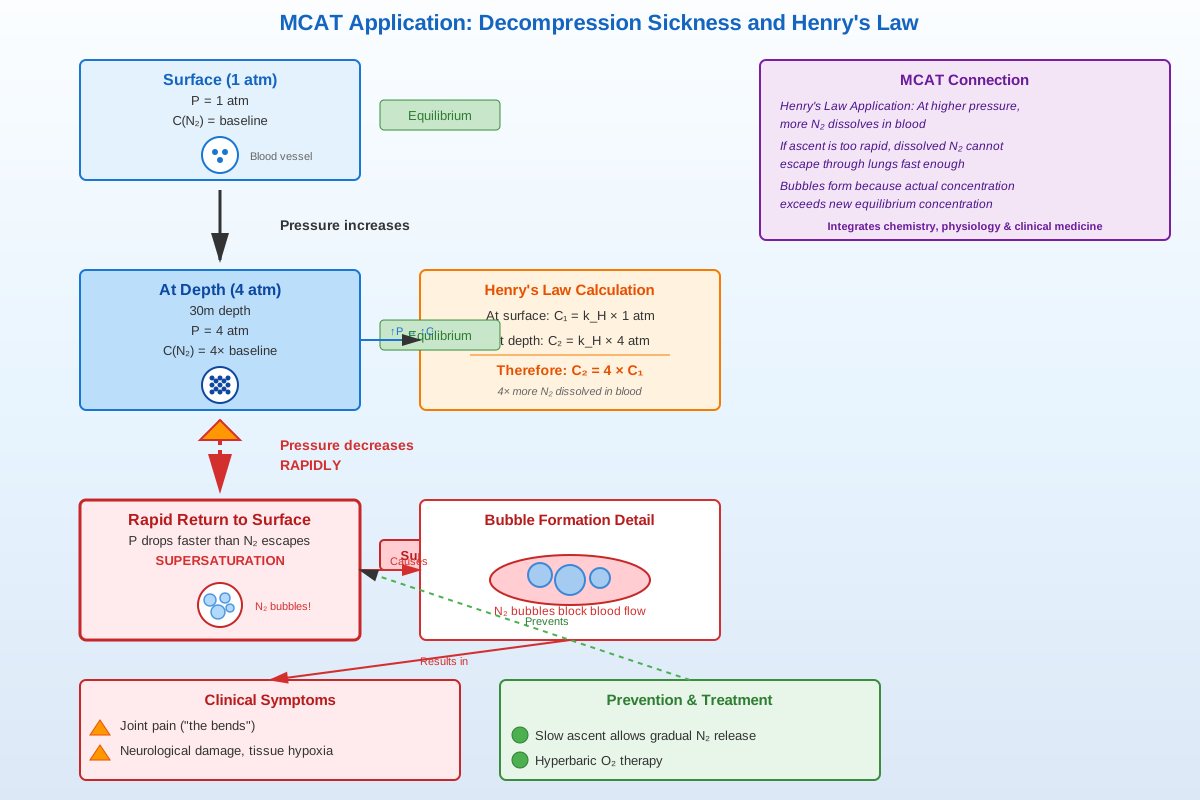
Henry's law has profound clinical and real-world significance that makes it a favorite topic for MCAT test writers. In respiratory physiology, Henry's law governs how oxygen and carbon dioxide dissolve in blood plasma, directly affecting gas exchange efficiency in the lungs and tissues. Decompression sickness ("the bends") in scuba divers results from nitrogen gas coming out of solution when pressure decreases too rapidly—a direct application of Henry's law. Hyperbaric oxygen therapy for carbon monoxide poisoning relies on increasing oxygen partial pressure to force more oxygen into solution in blood plasma.
On the MCAT, Henry's law appears in approximately 2-4% of General Chemistry questions and frequently in interdisciplinary passages combining chemistry with biology. Questions typically present as either standalone calculations requiring direct application of the Henry's law equation or as passage-based questions embedded in physiological or environmental contexts. Common question formats include: calculating dissolved gas concentration given pressure changes, predicting solubility trends with temperature variations, explaining why carbonated beverages fizz when opened, and analyzing blood gas data in clinical scenarios.
Exam passages frequently integrate Henry's law with topics such as acid-base chemistry (carbonic acid formation from dissolved CO₂), hemoglobin binding curves, altitude physiology, and aquatic ecosystem oxygen levels. The interdisciplinary nature means students must recognize when Henry's law applies even when not explicitly mentioned. Test makers favor scenarios requiring students to connect multiple concepts—for example, explaining how hyperventilation affects blood CO₂ levels requires understanding both Henry's law and Le Châtelier's principle applied to the bicarbonate buffer system.
Core Concepts
Mathematical Statement of Henry's Law
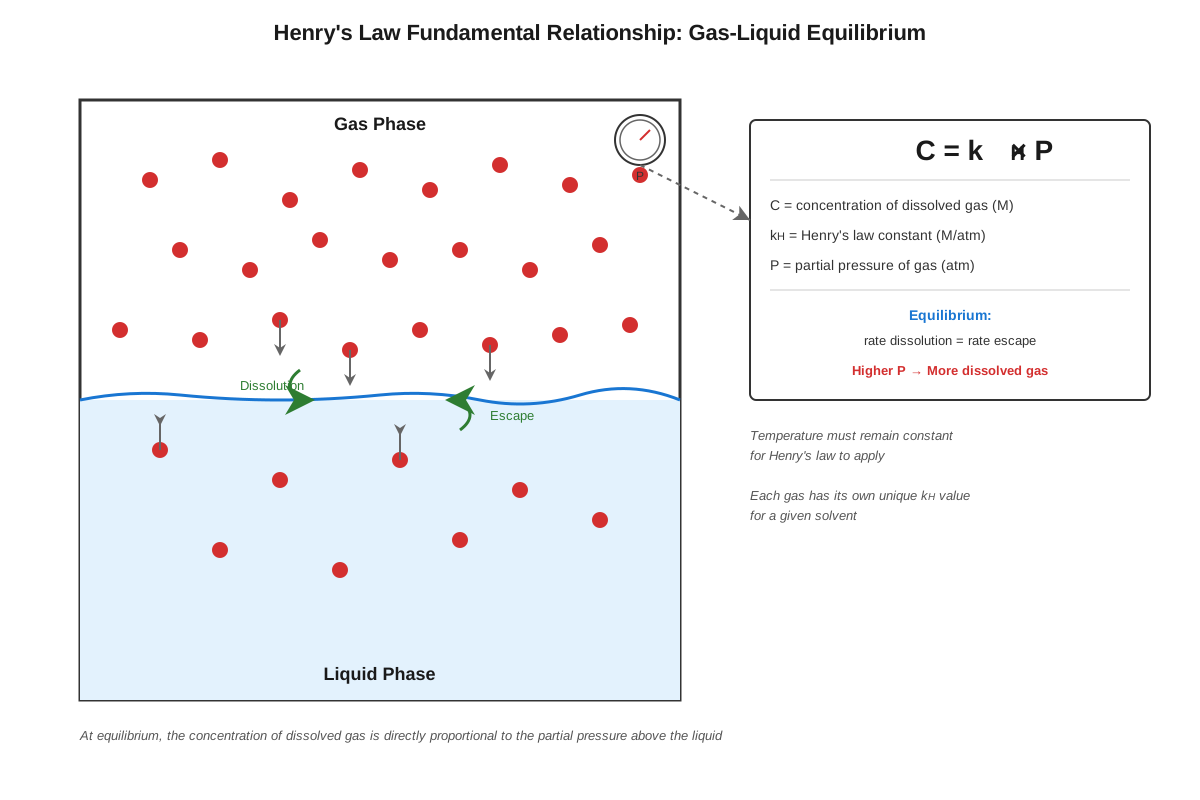
Henry's law is mathematically expressed as:
C = k_H × PWhere:
- C = concentration of dissolved gas (typically in mol/L or M)
- k_H = Henry's law constant (units vary, commonly mol/(L·atm) or M/atm)
- P = partial pressure of the gas above the solution (typically in atm)
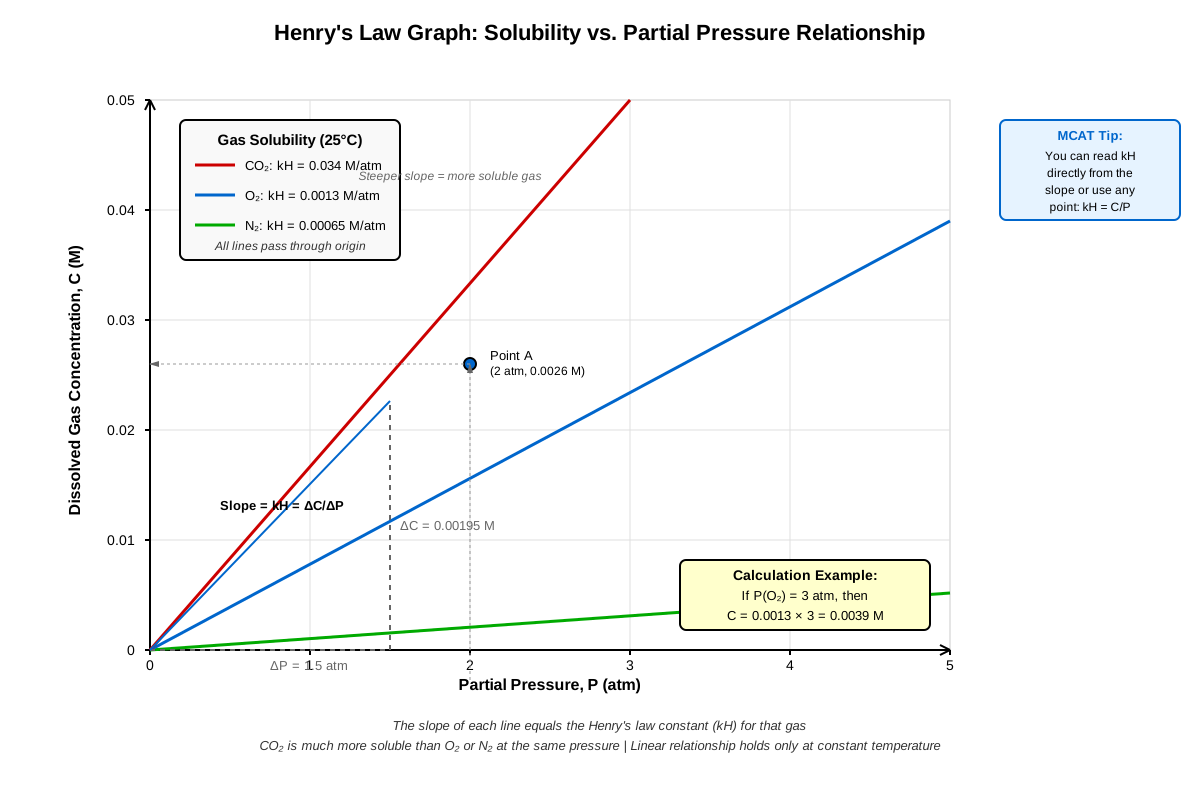
The Henry's law constant is specific to each gas-solvent pair and varies with temperature. Higher k_H values indicate greater gas solubility. For example, CO₂ has a much higher k_H in water than O₂, meaning CO₂ is more soluble than oxygen at the same partial pressure. This equation reveals the direct proportionality: doubling the partial pressure doubles the dissolved gas concentration.
An alternative formulation sometimes encountered is:
P = k_H' × XWhere X is the mole fraction of dissolved gas and k_H' has different units (typically atm). Students must be careful to identify which form is being used and ensure unit consistency.
Physical Basis and Molecular Interpretation
At the molecular level, gas dissolution represents an equilibrium between gas molecules in the vapor phase and those dissolved in the liquid phase. Gas molecules constantly collide with the liquid surface; some enter the solution while dissolved molecules escape back to the gas phase. At equilibrium, the rates of dissolution and escape are equal, establishing a stable concentration of dissolved gas.
The direct relationship between pressure and solubility arises because increasing partial pressure increases the collision frequency of gas molecules with the liquid surface. More collisions mean more molecules enter the solution per unit time, shifting the equilibrium toward greater dissolved concentration. This is fundamentally a Le Châtelier's principle application: increasing the concentration of gaseous reactant (by increasing pressure) shifts equilibrium toward the product (dissolved gas).
The molecular interactions between gas molecules and solvent molecules determine the magnitude of k_H. Gases that can form favorable intermolecular forces with the solvent (like CO₂ forming dipole interactions with water) have higher solubility constants. Nonpolar gases like N₂ and O₂ have relatively low solubility in polar solvents like water because they cannot form strong intermolecular attractions.
Temperature Dependence
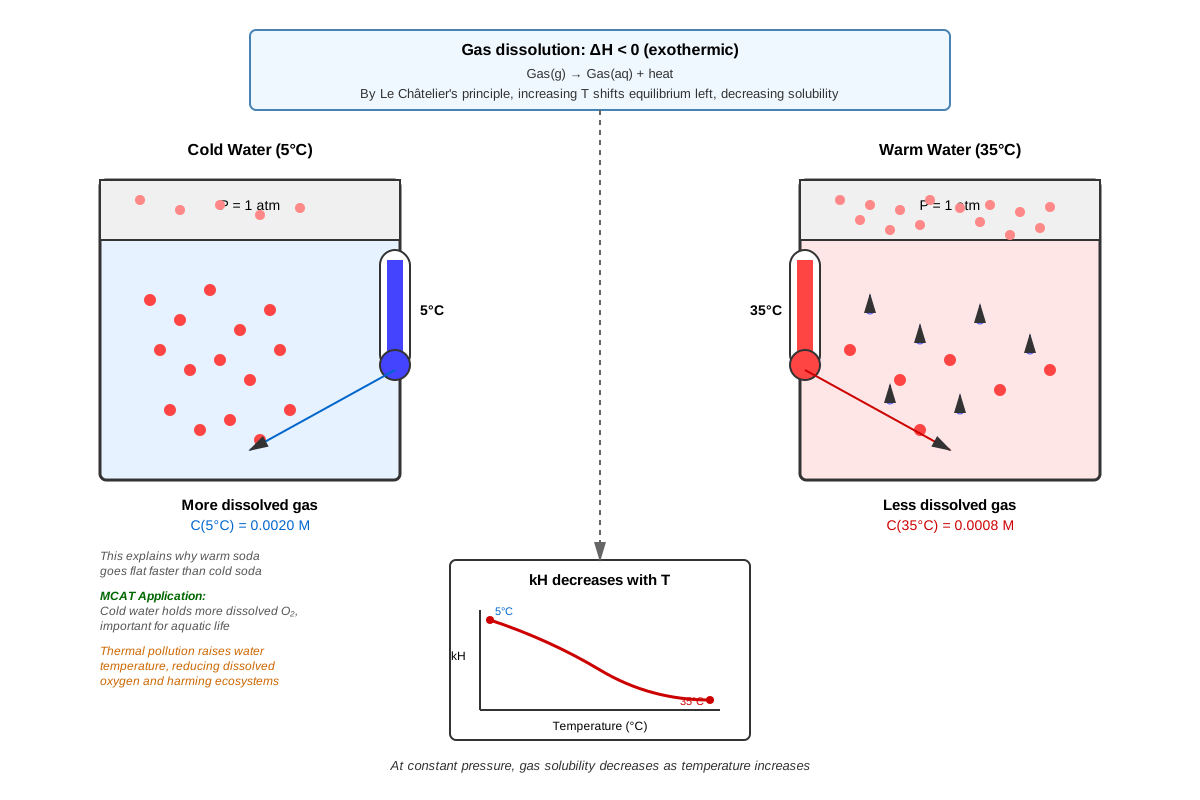
Unlike most solid solutes, gas solubility in liquids decreases with increasing temperature. This inverse relationship is not explicitly part of the basic Henry's law equation but is crucial for MCAT applications. The Henry's law constant k_H decreases as temperature increases, meaning less gas dissolves at higher temperatures for the same partial pressure.
The temperature dependence can be understood thermodynamically: gas dissolution is typically an exothermic process (releases heat). According to Le Châtelier's principle, adding heat to an exothermic equilibrium shifts it toward reactants (the gaseous state), reducing dissolved gas concentration. This explains why carbonated beverages fizz more vigorously when warm and why aquatic organisms face oxygen depletion in warm water.
The quantitative temperature relationship follows the van't Hoff equation:
ln(k_H(T₂)/k_H(T₁)) = -ΔH_sol/R × (1/T₂ - 1/T₁)Where ΔH_sol is the enthalpy of solution (negative for exothermic dissolution) and R is the gas constant. While MCAT questions rarely require this calculation, understanding the qualitative trend is essential.
Limitations and Applicability
Henry's law applies accurately under specific conditions:
- Dilute solutions: The law works best when gas concentration is relatively low
- No chemical reaction: The dissolved gas must not react with the solvent (CO₂ in water is an exception that requires modification)
- Moderate pressures: At very high pressures, deviations occur due to non-ideal behavior
- Equilibrium conditions: The system must have reached equilibrium
For gases that react with water, like CO₂ forming carbonic acid (H₂CO₃), an apparent Henry's law constant is used that accounts for both physically dissolved gas and chemically reacted species. This is particularly relevant for MCAT questions involving blood CO₂ transport.
Comparison with Raoult's Law
Students often confuse Henry's law with Raoult's law, but they describe different phenomena:
| Feature | Henry's Law | Raoult's Law |
|---|---|---|
| Applies to | Gases dissolving in liquids | Volatile liquid components in solution |
| Relationship | Gas concentration ∝ partial pressure | Vapor pressure ∝ mole fraction |
| Equation | C = k_H × P | P = X × P° |
| Phase change | Gas → dissolved in liquid | Liquid → vapor |
| Typical use | Gas solubility problems | Vapor pressure of solutions |
Both laws describe equilibrium between phases, but Henry's law specifically addresses gas-liquid equilibria while Raoult's law addresses liquid-vapor equilibria for solutions.
Concept Relationships
Henry's law serves as a conceptual bridge connecting multiple areas within General Chemistry and extending into biological applications. The law fundamentally depends on partial pressure, which itself derives from Dalton's law of partial pressures. Understanding that each gas in a mixture behaves independently allows application of Henry's law to individual gases in air (O₂, N₂, CO₂) dissolving in blood or water.
The equilibrium nature of gas dissolution connects Henry's law to Le Châtelier's principle and chemical equilibrium concepts. Changes in pressure, temperature, or concentration shift the dissolution equilibrium predictably. This relationship becomes particularly important when analyzing how the body responds to altitude changes (decreased O₂ partial pressure) or how hyperventilation affects blood CO₂ levels.
Within Solutions and Phase Behavior, Henry's law complements colligative properties by explaining how dissolved gases contribute to solution composition. While colligative properties focus on vapor pressure depression and boiling point elevation caused by nonvolatile solutes, Henry's law addresses the reverse scenario: gases entering solution from the vapor phase.
The temperature dependence of Henry's law connects to thermodynamics and enthalpy of solution concepts. The exothermic nature of gas dissolution explains the inverse temperature-solubility relationship, linking Henry's law to broader thermodynamic principles governing spontaneity and equilibrium.
Relationship map:
Gas Laws (Ideal Gas Law, Dalton's Law) → Partial Pressure → Henry's Law → Gas Solubility → Physiological Applications (O₂/CO₂ transport) → Acid-Base Chemistry (CO₂ + H₂O ⇌ H₂CO₃)
Temperature → Henry's Law Constant → Solubility Changes → Environmental Effects (aquatic oxygen levels)
Equilibrium Principles → Le Châtelier's Principle → Henry's Law Applications → Predicting Solubility Changes
Quick check — test yourself on Henry law so far.
Try Flashcards →High-Yield Facts
⭐ Henry's law states that gas solubility is directly proportional to partial pressure at constant temperature: C = k_H × P
⭐ Gas solubility decreases with increasing temperature, opposite to most solid solutes
⭐ The Henry's law constant (k_H) is specific to each gas-solvent pair and must be provided or looked up for calculations
⭐ Doubling the partial pressure of a gas doubles its dissolved concentration in the liquid phase
⭐ CO₂ is approximately 20-25 times more soluble in water than O₂ at the same temperature and pressure
- Henry's law applies best to dilute solutions and gases that don't react with the solvent
- Decompression sickness occurs when dissolved nitrogen comes out of solution as bubbles when pressure decreases rapidly
- At sea level, atmospheric pressure is 1 atm, but at altitude, decreased pressure reduces gas solubility in blood
- Opening a carbonated beverage decreases CO₂ partial pressure above the liquid, causing dissolved CO₂ to escape (fizzing)
- Hyperbaric oxygen therapy increases O₂ partial pressure to force more oxygen into solution in blood plasma
- The solubility of O₂ in water at 25°C is approximately 1.3 × 10⁻³ M at 1 atm partial pressure
- Fish kills in warm water often result from decreased oxygen solubility at elevated temperatures
Common Misconceptions
Misconception: Henry's law applies to all solutes dissolving in liquids
Correction: Henry's law specifically describes gases dissolving in liquids, not solid or liquid solutes. Solid solubility generally increases with temperature, opposite to gas behavior.
Misconception: Increasing temperature increases gas solubility because molecules move faster
Correction: While increased molecular motion does occur at higher temperatures, gas solubility decreases because the dissolution process is exothermic. Higher temperature favors the endothermic reverse process (gas escaping from solution).
Misconception: The Henry's law constant is the same for all gases
Correction: Each gas-solvent pair has a unique k_H value that depends on the specific intermolecular interactions between gas and solvent molecules. CO₂ has a much higher k_H in water than N₂ or O₂.
Misconception: Henry's law and Raoult's law are interchangeable
Correction: Henry's law describes gases dissolving into liquids (gas → dissolved), while Raoult's law describes volatile liquids evaporating from solutions (liquid → vapor). They address different phase equilibria.
Misconception: Pressure changes only affect gas solubility, not liquid or solid solubility
Correction: This is generally correct—pressure has negligible effect on solid and liquid solubility because these phases are incompressible. However, the reasoning matters: gases are compressible, so pressure changes significantly affect their concentration and thus their dissolution equilibrium.
Misconception: When a carbonated drink is opened, all dissolved CO₂ immediately escapes
Correction: Opening the container reduces CO₂ partial pressure above the liquid, shifting equilibrium toward gas escape, but this process takes time to reach the new equilibrium. The rate depends on surface area, agitation, and temperature.
Misconception: Henry's law can be used to calculate the total amount of CO₂ in blood
Correction: CO₂ in blood exists in multiple forms (dissolved, as carbonic acid, as bicarbonate, and bound to hemoglobin). Simple Henry's law only accounts for physically dissolved CO₂; an apparent constant is needed for total CO₂.
Worked Examples
Example 1: Calculating Dissolved Oxygen Concentration
Problem: A lake at 25°C is in equilibrium with air, where oxygen has a partial pressure of 0.21 atm (21% of atmospheric pressure). The Henry's law constant for O₂ in water at 25°C is 1.3 × 10⁻³ M/atm. Calculate the concentration of dissolved oxygen in the lake water.
Solution:
Step 1: Identify the given information
- P(O₂) = 0.21 atm
- k_H = 1.3 × 10⁻³ M/atm
- Temperature = 25°C (constant)
Step 2: Write Henry's law equation
C = k_H × PStep 3: Substitute values and solve
C = (1.3 × 10⁻³ M/atm) × (0.21 atm)
C = 2.73 × 10⁻⁴ M
C = 0.273 mM
Step 4: Interpret the result
The dissolved oxygen concentration is approximately 2.7 × 10⁻⁴ M or 0.27 mM. This relatively low concentration explains why aquatic organisms require efficient oxygen extraction mechanisms and why oxygen depletion can quickly become problematic in warm or stagnant water.
Connection to learning objectives: This problem directly applies Henry's law to calculate gas solubility (LO: Apply Henry's law to exam-style questions) and demonstrates the low solubility of oxygen in water, which has physiological implications for aquatic life.
Example 2: Decompression Sickness Scenario
Problem: A scuba diver breathes compressed air at a depth where the total pressure is 4.0 atm. The partial pressure of nitrogen in air is 0.78 atm at sea level. When the diver ascends to the surface (1.0 atm total pressure), explain using Henry's law why nitrogen bubbles may form in the blood if ascent is too rapid. The Henry's law constant for N₂ is 6.1 × 10⁻⁴ M/atm.
Solution:
Step 1: Calculate nitrogen partial pressure at depth
At 4.0 atm total pressure, nitrogen comprises 78% of the gas mixture:
P(N₂) at depth = 0.78 × 4.0 atm = 3.12 atmStep 2: Calculate dissolved nitrogen concentration at depth
C(depth) = k_H × P = (6.1 × 10⁻⁴ M/atm) × (3.12 atm) = 1.90 × 10⁻³ MStep 3: Calculate nitrogen partial pressure at surface
P(N₂) at surface = 0.78 × 1.0 atm = 0.78 atmStep 4: Calculate dissolved nitrogen concentration at surface equilibrium
C(surface) = k_H × P = (6.1 × 10⁻⁴ M/atm) × (0.78 atm) = 4.76 × 10⁻⁴ MStep 5: Analyze the difference
The dissolved nitrogen concentration must decrease from 1.90 × 10⁻³ M to 4.76 × 10⁻⁴ M—a reduction of approximately 75%. This excess nitrogen (1.42 × 10⁻³ M) must leave the blood.
Step 6: Explain bubble formation
If ascent is gradual, excess nitrogen diffuses from blood into the lungs and is exhaled. However, rapid ascent doesn't allow sufficient time for this diffusion. The blood becomes supersaturated with nitrogen relative to the new lower pressure. This supersaturation is unstable, and nitrogen comes out of solution as gas bubbles (similar to opening a carbonated beverage). These bubbles can block blood vessels, causing decompression sickness.
Connection to learning objectives: This example connects Henry's law to physiological applications (LO: Connect Henry's law to related concepts), demonstrates calculation skills (LO: Apply to exam-style questions), and illustrates the clinical significance of understanding gas solubility (LO: Explain why Henry's law matters for MCAT).
Exam Strategy
When approaching Henry's law MCAT questions, first identify whether the question requires quantitative calculation or qualitative reasoning. Look for trigger phrases such as "gas solubility," "dissolved oxygen," "partial pressure," "decompression," "carbonated," or "altitude effects." These signal that Henry's law principles likely apply.
For calculation questions, immediately write down the Henry's law equation (C = k_H × P) and identify which variable you're solving for. Check that units are consistent—if pressure is given in mmHg but k_H uses atm, convert first (1 atm = 760 mmHg). The MCAT typically provides the Henry's law constant when needed, so don't waste time trying to memorize specific k_H values for different gases.
For qualitative questions, focus on the direct proportionality between pressure and solubility, and the inverse relationship between temperature and solubility. Process-of-elimination strategies work well: eliminate answer choices that suggest gas solubility increases with temperature (incorrect) or that pressure doesn't affect gas solubility (incorrect). Watch for answer choices that confuse Henry's law with Raoult's law—if the question involves a gas dissolving in liquid, it's Henry's law; if it involves vapor pressure of a liquid solution, it's Raoult's law.
Passage-based questions often embed Henry's law within physiological contexts. Look for scenarios involving:
- Respiratory gas exchange (O₂ and CO₂ in blood)
- Altitude physiology (reduced partial pressures)
- Diving physiology (increased pressures, decompression)
- Aquatic ecosystems (dissolved oxygen levels)
- Carbonated beverages (CO₂ dissolution)
Time allocation: Straightforward Henry's law calculations should take 30-45 seconds. More complex multi-step problems involving unit conversions or additional concepts may require 60-90 seconds. Don't get bogged down in complex calculations—if a problem seems to require extensive computation, look for a conceptual shortcut or proportional reasoning approach.
Exam Tip: If a question asks about gas solubility changes with temperature but doesn't provide specific k_H values at different temperatures, the question is testing qualitative understanding: gas solubility decreases with increasing temperature. Don't overthink it.
Memory Techniques
Mnemonic for Henry's Law equation: "Cats Hate Pressure" → C = k_H × P (Concentration equals Henry's constant times Pressure)
Mnemonic for temperature effect: "Hot Gases Go" → Hot temperatures make gases go (escape from solution), decreasing solubility
Visualization strategy: Picture opening a warm soda versus a cold soda. The warm soda fizzes vigorously (gas escaping due to low solubility at high temperature), while the cold soda fizzes less (gas stays dissolved due to higher solubility at low temperature). This concrete image reinforces the inverse temperature-solubility relationship.
Acronym for Henry's Law applications: "SCAD"
- Scuba diving (decompression sickness)
- Carbonated beverages
- Altitude effects on blood gases
- Dissolved oxygen in aquatic systems
Proportionality memory aid: "Direct P, Inverse T" → Pressure has a direct relationship with solubility (increase P → increase C), while Temperature has an inverse relationship (increase T → decrease C)
Conceptual anchor: Link Henry's law to Le Châtelier's principle. Increasing pressure is like adding more reactant (gas molecules), shifting equilibrium toward product (dissolved gas). Increasing temperature adds energy to an exothermic process, shifting equilibrium toward reactant (gas escaping).
Summary
Henry's law establishes the fundamental relationship between gas partial pressure and solubility in liquids, expressed mathematically as C = k_H × P. This principle is essential for MCAT success because it bridges general chemistry concepts with physiological applications, particularly respiratory gas exchange, diving physiology, and environmental chemistry. The direct proportionality between pressure and dissolved gas concentration explains phenomena ranging from carbonated beverage behavior to decompression sickness in divers. Critically, gas solubility decreases with increasing temperature, opposite to most solid solutes, due to the exothermic nature of gas dissolution. The Henry's law constant is specific to each gas-solvent pair and must be provided for quantitative calculations. MCAT questions test both computational skills (calculating dissolved gas concentrations) and conceptual understanding (predicting solubility trends, explaining physiological scenarios). Success requires recognizing when Henry's law applies, distinguishing it from Raoult's law, and connecting it to equilibrium principles and Le Châtelier's principle.
Key Takeaways
- Henry's law (C = k_H × P) states that dissolved gas concentration is directly proportional to the gas's partial pressure at constant temperature
- Gas solubility decreases with increasing temperature, opposite to most solid solutes, because gas dissolution is typically exothermic
- The Henry's law constant (k_H) is unique for each gas-solvent pair and determines how soluble a particular gas is in a given liquid
- MCAT applications frequently involve respiratory physiology (O₂/CO₂ in blood), diving scenarios (decompression sickness), and environmental contexts (aquatic dissolved oxygen)
- Doubling partial pressure doubles dissolved gas concentration—this direct proportionality is the core of Henry's law
- Henry's law applies to gases dissolving in liquids, while Raoult's law applies to vapor pressure of liquid solutions—don't confuse them
- Understanding Henry's law requires integrating concepts from gas laws, equilibrium, Le Châtelier's principle, and thermodynamics
Related Topics
Raoult's Law and Vapor Pressure: Understanding how volatile liquid components affect solution vapor pressure complements Henry's law knowledge and completes the picture of phase equilibria in solutions.
Colligative Properties: Boiling point elevation, freezing point depression, and osmotic pressure all relate to solution composition, building on the foundation of how solutes (including dissolved gases) affect solution behavior.
Acid-Base Chemistry and Buffer Systems: CO₂ dissolution in blood connects directly to carbonic acid formation and the bicarbonate buffer system, requiring integration of Henry's law with acid-base equilibria.
Hemoglobin and Oxygen Transport: While Henry's law describes dissolved O₂ in plasma, most oxygen transport involves hemoglobin binding, requiring understanding of both dissolution and cooperative binding.
Le Châtelier's Principle and Chemical Equilibrium: Mastering Henry's law provides concrete examples of equilibrium shifts with pressure and temperature changes, reinforcing broader equilibrium concepts.
Practice CTA
Now that you've mastered the core concepts of Henry's law, it's time to solidify your understanding through active practice. Attempt the practice questions and work through the flashcards to reinforce the direct relationship between partial pressure and gas solubility, the inverse temperature effect, and the physiological applications that make this topic high-yield for the MCAT. Remember, understanding Henry's law isn't just about memorizing an equation—it's about developing the conceptual framework to tackle novel scenarios on test day. You've built a strong foundation; now apply it with confidence!
Sign up free to keep reading
Create a free AnvayaPrep account to finish this MCAT guide on Henry law — plus flashcards and practice questions.