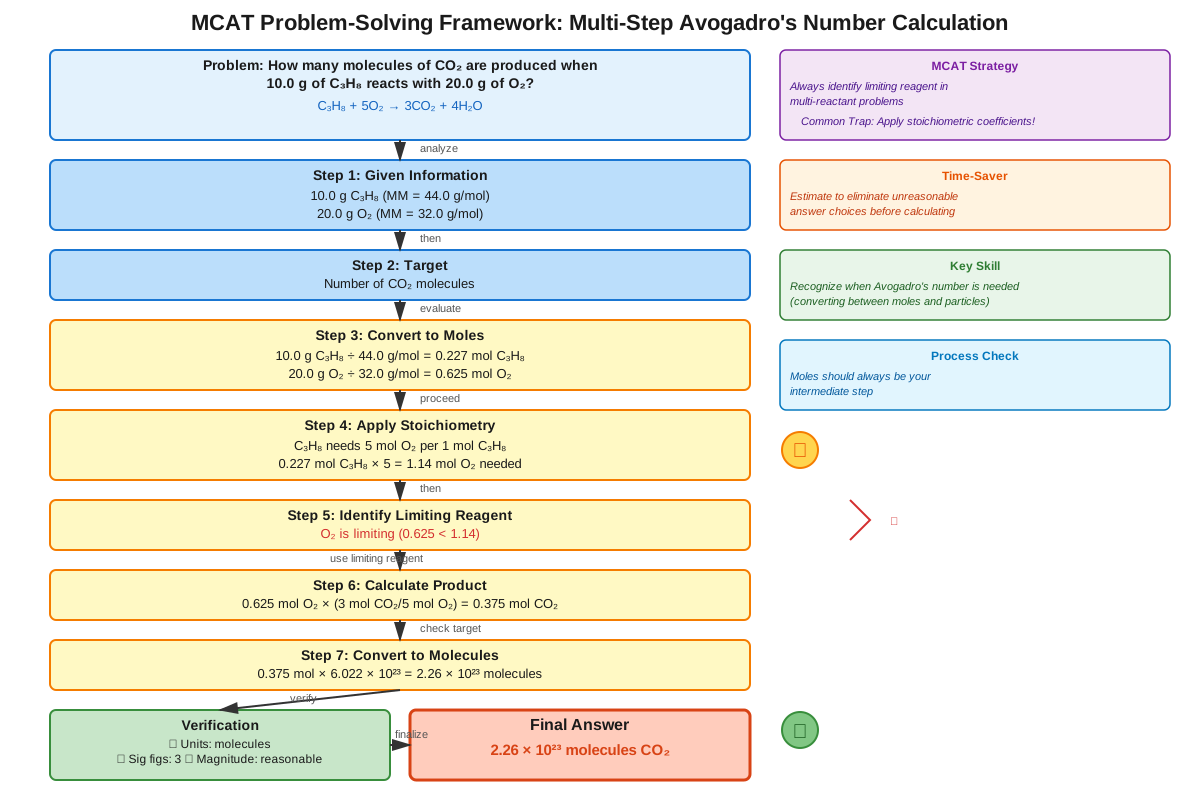
Overview
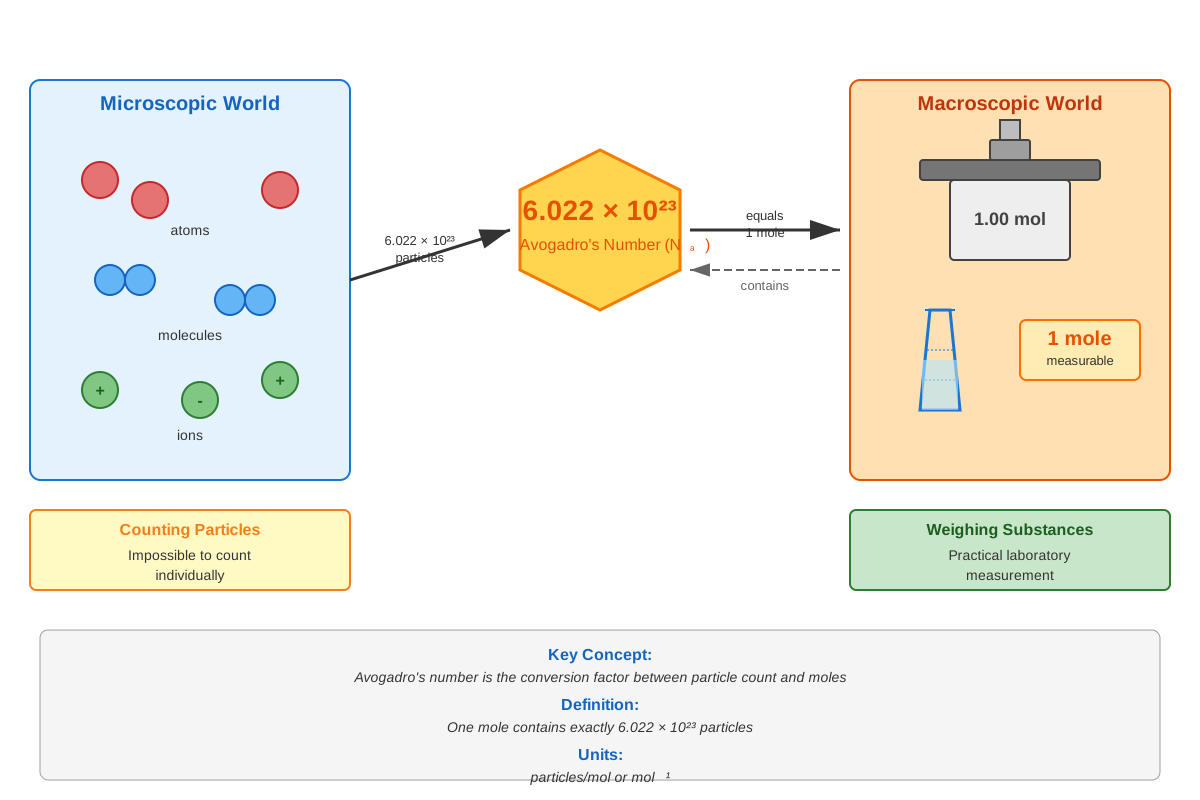
The Avogadro number (also known as Avogadro's constant) represents one of the most fundamental constants in General Chemistry and serves as the bridge between the microscopic world of atoms and molecules and the macroscopic world of laboratory measurements. Defined as approximately 6.022 × 10²³, this constant specifies the number of particles (atoms, molecules, ions, or other entities) contained in one mole of substance. Understanding this concept is absolutely essential for success on the MCAT, as it forms the foundation for virtually all quantitative chemistry calculations, from determining molecular masses to solving complex stoichiometric problems involving chemical reactions.
For the MCAT, the Avogadro number appears frequently in both the Chemical and Physical Foundations of Biological Systems section and occasionally in passages involving biochemical processes. Test-makers expect students not only to recall the numerical value but also to apply it fluently in multi-step calculations involving molar conversions, gas laws, solution chemistry, and reaction stoichiometry. The concept integrates seamlessly with other high-yield topics such as molarity, empirical formulas, limiting reagents, and percent composition, making it a cornerstone of Stoichiometry and Reactions.
Beyond its computational utility, Avogadro's number represents a conceptual breakthrough in chemistry—it allows chemists to count particles by weighing them, transforming chemistry from a qualitative science into a quantitative one. This principle underlies everything from drug dosing calculations in pharmacology to understanding enzyme kinetics in biochemistry, making it not just an abstract mathematical constant but a practical tool that connects chemical theory to biological and medical applications that MCAT test-takers will encounter throughout their medical careers.
Learning Objectives
- [ ] Define Avogadro number using accurate General Chemistry terminology
- [ ] Explain why Avogadro number matters for the MCAT
- [ ] Apply Avogadro number to exam-style questions
- [ ] Identify common mistakes related to Avogadro number
- [ ] Connect Avogadro number to related General Chemistry concepts
- [ ] Convert between moles, number of particles, and mass using Avogadro's number with 95%+ accuracy
- [ ] Distinguish between Avogadro's number and the mole concept in problem-solving contexts
- [ ] Integrate Avogadro's number with gas law calculations and solution stoichiometry
Prerequisites
- Basic algebra and scientific notation: Essential for manipulating expressions involving 10²³ and performing dimensional analysis
- Understanding of atoms and molecules: Required to comprehend what entities Avogadro's number is counting
- Concept of the mole: Avogadro's number defines the mole, so familiarity with molar quantities is necessary
- Dimensional analysis: Critical skill for setting up conversion factors correctly in multi-step calculations
- Periodic table navigation: Needed to obtain molar masses for conversion problems
Why This Topic Matters
Clinical and Real-World Significance
Avogadro's number enables precise dosing calculations in medicine—when a physician prescribes 500 mg of a medication, understanding the relationship between mass and number of molecules allows pharmacologists to predict how many drug molecules will interact with receptors in the body. In biochemistry, enzyme kinetics and metabolic pathways depend on understanding molecular concentrations, which ultimately trace back to Avogadro's number. Clinical laboratory values, such as blood glucose levels measured in mg/dL or mmol/L, require conversions that fundamentally rely on this constant.
MCAT Exam Statistics
Avogadro's number appears in approximately 15-20% of General Chemistry questions on the MCAT, either directly or as a necessary component of multi-step calculations. The concept most frequently appears in:
- Standalone questions testing direct conversions between moles and particles
- Passage-based questions involving experimental data requiring stoichiometric analysis
- Gas law problems where molar quantities must be converted to particle counts
- Solution chemistry questions involving molarity and dilution calculations
Common Exam Contexts
Test-makers typically embed Avogadro's number in passages about:
- Experimental determination of molecular formulas
- Titration experiments requiring stoichiometric calculations
- Gas collection experiments (often combined with ideal gas law)
- Biochemical pathways where substrate and product quantities are specified
- Analytical chemistry techniques like mass spectrometry
Core Concepts
Definition and Magnitude of Avogadro's Number
The Avogadro number (symbolized as N_A or L) equals exactly 6.02214076 × 10²³ mol⁻¹, though for MCAT purposes, 6.022 × 10²³ is the standard approximation. This constant represents the number of constituent particles (atoms, molecules, ions, electrons, or other specified entities) present in one mole of substance. The magnitude of this number is extraordinarily large—if you could count one particle per second, it would take approximately 1.9 × 10¹⁶ years to count one mole, far longer than the age of the universe.
The mole itself is defined as the amount of substance containing exactly 6.02214076 × 10²³ specified elementary entities. This definition, adopted in 2019, fixed Avogadro's number as an exact value rather than a measured quantity. For practical MCAT calculations, understanding that 1 mole = 6.022 × 10²³ particles is the fundamental relationship.
The Mole-Mass-Particle Triangle
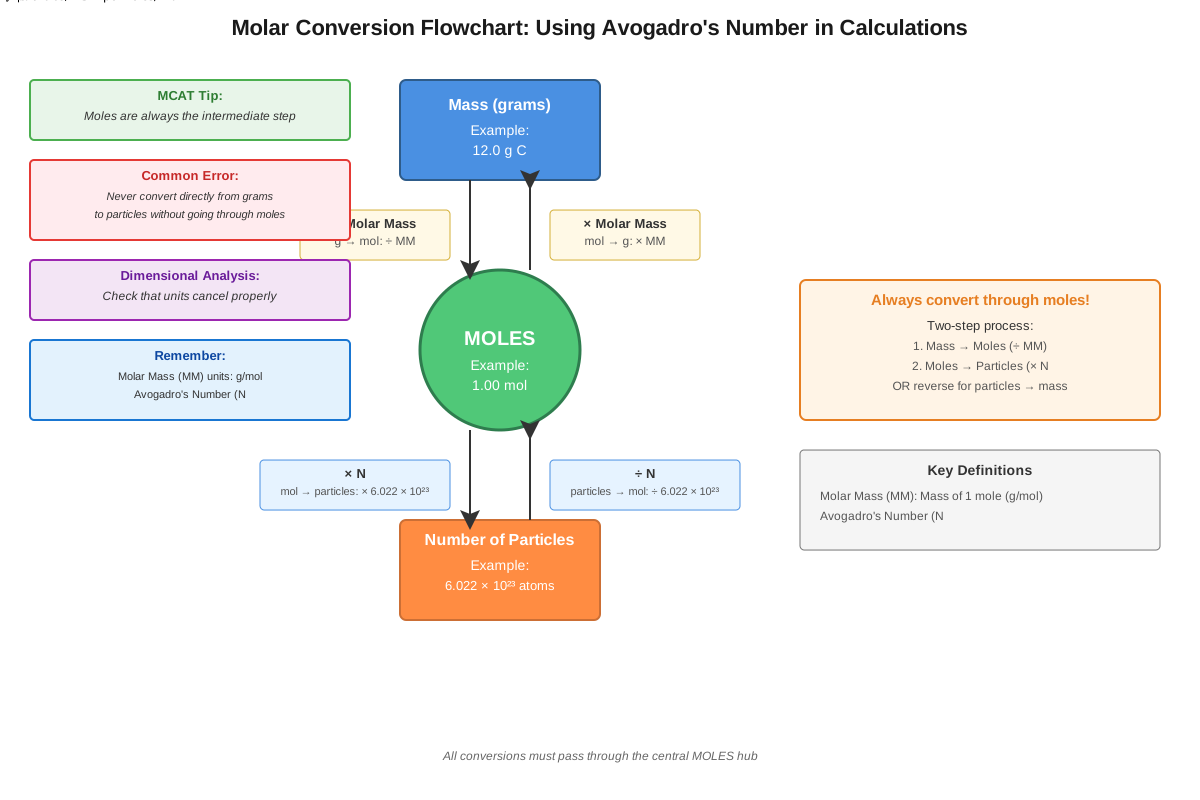
The relationship between moles, mass, and number of particles forms a conceptual triangle that underlies most Stoichiometry and Reactions problems:
                    MOLES
                   /     \
                  /       \
         (÷ or × NA)    (÷ or × MM)
                /           \
               /             \
        PARTICLES -------- MASS (g)
                (no direct conversion)
Key conversion relationships:
- Moles to particles: multiply by Avogadro's number (6.022 × 10²³)
- Particles to moles: divide by Avogadro's number
- Moles to mass: multiply by molar mass (g/mol)
- Mass to moles: divide by molar mass
- Note: There is no direct conversion between particles and mass—you must go through moles
Dimensional Analysis with Avogadro's Number
Proper dimensional analysis ensures correct setup of conversion problems. Avogadro's number should always be written with units:
N_A = 6.022 × 10²³ particles/molor more specifically:
N_A = 6.022 × 10²³ molecules/mol (for molecular compounds)
N_A = 6.022 × 10²³ atoms/mol (for elements)
N_A = 6.022 × 10²³ formula units/mol (for ionic compounds)
When setting up conversions, the unit you want to eliminate should appear in both numerator and denominator:
Example: Converting 2.5 moles of H₂O to molecules:
2.5 mol H₂O × (6.022 × 10²³ molecules/1 mol) = 1.51 × 10²⁴ moleculesApplications in Different Contexts
Elemental Substances
For elements, Avogadro's number counts individual atoms. One mole of carbon-12 contains exactly 6.022 × 10²³ carbon atoms and has a mass of exactly 12 grams (by definition of the atomic mass unit).
Molecular Compounds
For molecular substances like H₂O or CO₂, Avogadro's number counts molecules. One mole of water contains 6.022 × 10²³ H₂O molecules, but this represents 2 × 6.022 × 10²³ hydrogen atoms and 1 × 6.022 × 10²³ oxygen atoms.
Ionic Compounds
For ionic compounds like NaCl, Avogadro's number counts formula units. One mole of NaCl contains 6.022 × 10²³ formula units, which means 6.022 × 10²³ Na⁺ ions and 6.022 × 10²³ Cl⁻ ions.
Integration with Molar Mass
The molar mass (molecular weight) of a substance is the mass in grams of one mole of that substance. This creates a powerful relationship:
| Substance | Molar Mass | Mass of 6.022 × 10²³ particles |
|---|---|---|
| H₂O | 18.0 g/mol | 18.0 g |
| NaCl | 58.5 g/mol | 58.5 g |
| C₆H₁₂O₆ | 180.0 g/mol | 180.0 g |
This relationship allows conversion between the microscopic (number of particles) and macroscopic (measurable mass) scales.
Avogadro's Number in Gas Law Calculations
In the ideal gas law (PV = nRT), n represents moles. When problems require calculating the number of gas molecules, Avogadro's number provides the conversion:
Number of molecules = n × N_A = (PV/RT) × N_AAt standard temperature and pressure (STP): 273 K and 1 atm, one mole of any ideal gas occupies 22.4 L. Therefore, 22.4 L of gas at STP contains 6.022 × 10²³ molecules.
Concentration and Avogadro's Number
Molarity (M) is defined as moles of solute per liter of solution. To find the number of particles in a solution:
Number of particles = Molarity × Volume (L) × N_AFor example, 1.0 L of 0.5 M NaCl solution contains:
- 0.5 mol NaCl
- 0.5 × 6.022 × 10²³ = 3.01 × 10²³ formula units
- 3.01 × 10²³ Na⁺ ions and 3.01 × 10²³ Cl⁻ ions (total: 6.02 × 10²³ ions)
Concept Relationships
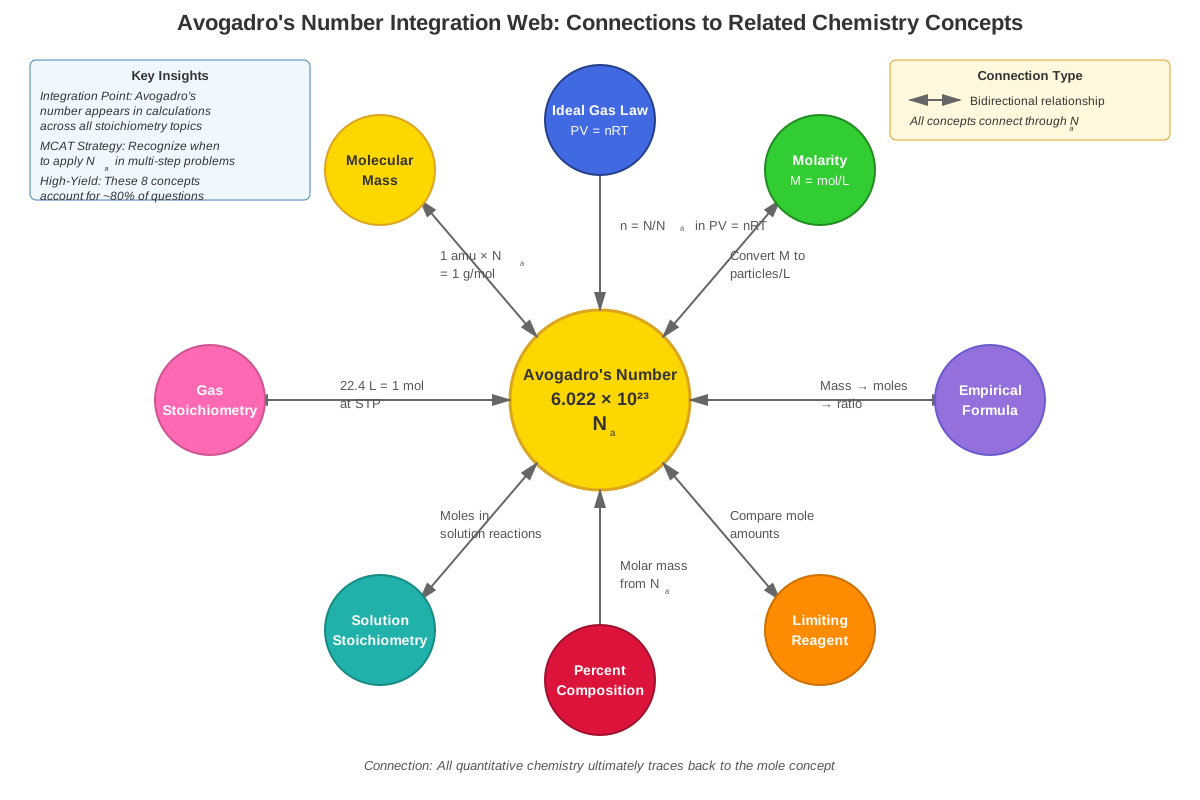
The Avogadro number serves as the central hub connecting multiple General Chemistry concepts. It directly defines the mole, which is the fundamental unit for expressing amounts of chemical substances. This relationship flows into molar mass calculations, where the periodic table's atomic masses (in amu) numerically equal the mass in grams of one mole of atoms.
From the mole concept, connections branch to stoichiometry: balanced chemical equations express molar ratios, which can be converted to particle ratios using Avogadro's number. This enables limiting reagent problems and percent yield calculations. The pathway continues to solution chemistry, where molarity links volume, moles, and ultimately particle numbers through Avogadro's constant.
Another major connection extends to gas laws: the ideal gas law uses moles (n), which can be converted to molecular counts via N_A. This relationship is crucial for understanding partial pressures and gas mixtures at the molecular level. Additionally, Avogadro's number connects to empirical and molecular formulas—determining these formulas often requires converting mass data to moles and then to atom ratios.
Relationship map:
Atomic Mass (amu) → Molar Mass (g/mol) → Moles ↔ Avogadro's Number ↔ Number of Particles
↓
Stoichiometry → Limiting Reagents
↓
Molarity → Solution Chemistry
↓
Ideal Gas Law → Gas Stoichiometry
Quick check — test yourself on Avogadro number so far.
Try Flashcards →High-Yield Facts
⭐ Avogadro's number equals 6.022 × 10²³ particles per mole (most fundamental relationship)
⭐ One mole of any substance contains the same number of particles regardless of the substance's identity
⭐ The molar mass in grams numerically equals the atomic/molecular mass in amu (e.g., 12C has atomic mass 12 amu and molar mass 12 g/mol)
⭐ At STP (273 K, 1 atm), one mole of any ideal gas occupies 22.4 L and contains 6.022 × 10²³ molecules
⭐ For ionic compounds, multiply Avogadro's number by the number of ions per formula unit to get total ion count (e.g., 1 mol CaCl₂ yields 3 mol ions)
- Avogadro's number has units of mol⁻¹ (per mole), not a dimensionless constant
- The number of atoms in a molecule differs from the number of molecules; always identify what entity is being counted
- Avogadro's number applies to any specified particle: atoms, molecules, ions, electrons, photons, etc.
- Converting from particles to grams always requires two steps: particles → moles → grams
- One mole of a diatomic element (H₂, O₂, N₂) contains 6.022 × 10²³ molecules but 2 × 6.022 × 10²³ atoms
- The reciprocal of Avogadro's number (1/N_A ≈ 1.66 × 10⁻²⁴ mol) converts particles to moles
Common Misconceptions
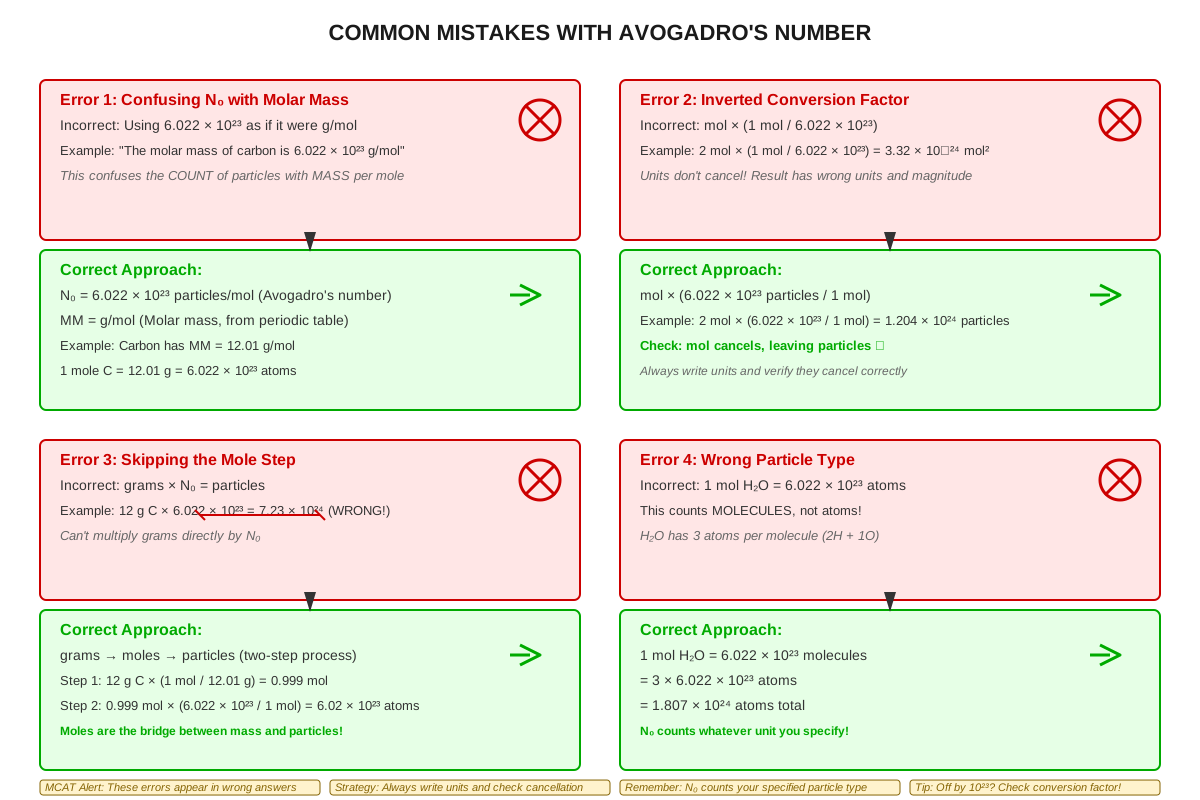
Misconception: Avogadro's number changes depending on the substance being measured.
Correction: Avogadro's number is a universal constant—6.022 × 10²³ particles per mole applies to all substances. What changes is the molar mass (grams per mole), not the number of particles per mole.
Misconception: One mole of NaCl contains 6.022 × 10²³ ions.
Correction: One mole of NaCl contains 6.022 × 10²³ formula units, which dissociate into 6.022 × 10²³ Na⁺ ions AND 6.022 × 10²³ Cl⁻ ions, for a total of 2 × 6.022 × 10²³ ions. Always account for the number of ions per formula unit.
Misconception: Avogadro's number and the mole are the same thing.
Correction: The mole is a unit of amount (like "dozen"), while Avogadro's number is the specific quantity that defines one mole (like "12" defines one dozen). The mole is the unit; Avogadro's number is the numerical value.
Misconception: You can directly convert between grams and number of particles using a single conversion factor.
Correction: Conversion between mass and particle count always requires going through moles as an intermediate step. The conversion path is: grams → (÷ molar mass) → moles → (× Avogadro's number) → particles.
Misconception: One mole of H₂ contains 6.022 × 10²³ hydrogen atoms.
Correction: One mole of H₂ contains 6.022 × 10²³ H₂ molecules, which equals 2 × 6.022 × 10²³ = 1.204 × 10²⁴ hydrogen atoms. Always distinguish between molecules and atoms for molecular substances.
Misconception: Avogadro's number is approximately 6 × 10²³, so using this value is acceptable for MCAT calculations.
Correction: While 6 × 10²³ is close, using 6.022 × 10²³ is essential for accuracy. The MCAT answer choices are often close enough that the 0.022 difference matters, potentially leading to selecting an incorrect answer.
Worked Examples
Example 1: Multi-Step Conversion with Molecular Compound
Question: How many oxygen atoms are present in 9.0 grams of glucose (C₆H₁₂O₆)? (Molar mass of glucose = 180 g/mol)
Solution:
Step 1: Identify what is being asked. We need oxygen atoms, not molecules of glucose.
Step 2: Convert grams to moles of glucose.
9.0 g glucose × (1 mol glucose / 180 g glucose) = 0.050 mol glucoseStep 3: Determine moles of oxygen atoms. Each glucose molecule contains 6 oxygen atoms, so:
0.050 mol glucose × (6 mol O atoms / 1 mol glucose) = 0.30 mol O atomsStep 4: Convert moles of oxygen atoms to number of atoms using Avogadro's number.
0.30 mol O atoms × (6.022 × 10²³ atoms / 1 mol) = 1.8 × 10²³ O atomsAnswer: 1.8 × 10²³ oxygen atoms
Key takeaway: This problem demonstrates the importance of tracking what entity you're counting (molecules vs. atoms) and using the molecular formula to convert between them. This connects to Learning Objective: Apply Avogadro number to exam-style questions.
Example 2: Gas Law Integration
Question: A container holds 11.2 L of nitrogen gas (N₂) at STP. How many nitrogen atoms are present?
Solution:
Step 1: Recall that at STP, 1 mole of any ideal gas occupies 22.4 L.
Step 2: Convert volume to moles.
11.2 L N₂ × (1 mol N₂ / 22.4 L) = 0.50 mol N₂Step 3: Convert moles of N₂ molecules to number of molecules.
0.50 mol N₂ × (6.022 × 10²³ molecules / 1 mol) = 3.01 × 10²³ molecules N₂Step 4: Convert molecules to atoms. Each N₂ molecule contains 2 nitrogen atoms.
3.01 × 10²³ molecules N₂ × (2 atoms / 1 molecule) = 6.02 × 10²³ N atomsAnswer: 6.02 × 10²³ nitrogen atoms (equivalent to 1 mole of nitrogen atoms)
Alternative approach: Recognize that 11.2 L is exactly half of 22.4 L, so we have 0.5 mol N₂ = 1.0 mol N atoms = 6.022 × 10²³ atoms.
Key takeaway: This problem integrates gas laws with Avogadro's number and demonstrates the importance of distinguishing between diatomic molecules and individual atoms. This addresses Learning Objective: Connect Avogadro number to related General Chemistry concepts.
Exam Strategy
Approaching MCAT Questions
When encountering Avogadro number problems on the MCAT, follow this systematic approach:
- Identify the starting unit (grams, moles, particles, volume, molarity)
- Identify the target unit (what the question asks for)
- Map the conversion pathway through moles if necessary
- Set up dimensional analysis ensuring units cancel properly
- Check your answer's magnitude using scientific notation sense-checking
Trigger Words and Phrases
Watch for these key phrases that signal Avogadro's number is needed:
- "How many molecules/atoms/ions..."
- "Number of particles..."
- "Calculate the number of..."
- "How many moles are in X particles..."
- Any question giving you a number like "3.01 × 10²³" or similar magnitude
Process of Elimination Tips
- Eliminate answers with wrong magnitude: If you're converting 1 mole to particles, answers around 10²⁰ or 10²⁶ are likely wrong (should be ~10²³)
- Check for unit consistency: If the question asks for atoms but an answer choice would give molecules, eliminate it
- Watch for ion multiplication: If the question involves ionic compounds, answers that don't account for multiple ions per formula unit are likely incorrect
- Verify intermediate steps: If answer choices differ by factors of 2, 3, or 6, you likely need to account for atoms per molecule or ions per formula unit
Time Allocation
For straightforward Avogadro's number conversions (1-2 steps): allocate 30-45 seconds. For complex multi-step problems integrating stoichiometry or gas laws: allocate 90-120 seconds. If a problem requires more than 3 conversion steps, consider whether you're overcomplicating it—look for shortcuts like recognizing standard conditions or using molar ratios directly.
Exam Tip: If you forget Avogadro's number during the exam, remember that 1 mole of carbon-12 has a mass of exactly 12 grams and contains N_A atoms. This relationship can help you reconstruct the constant if needed.
Memory Techniques
Mnemonic for Avogadro's Number Value
"Avogadro Ordered 6 Nachos, 0 Tacos, 2 Burritos, 2 Enchiladas (× 10²³)"
- 6.022 × 10²³
The Mole Triangle Visualization
Visualize a triangle with "MOLES" at the top vertex and "MASS" and "PARTICLES" at the bottom vertices. The top connects to bottom-left via molar mass (MM) and to bottom-right via Avogadro's number (NA). There's no direct path along the bottom—you must go through the top (moles).
Acronym for Conversion Pathway
"Many People Make Mistakes" = Mass → (÷MM) → Moles → (×NA) → Particles
Or reversed: "Please Make More Money" = Particles → (÷NA) → Moles → (×MM) → Mass
Remembering STP Values
"Standard Silly Temperature: 273 K, Pressure: 1 atm, Volume: 22.4 L"
At these conditions, 1 mole = 6.022 × 10²³ molecules = 22.4 L
Ionic Compound Reminder
"Ionic compounds SPLIT" - Remember to multiply by the number of ions when calculating total ion count from formula units.
Summary
The Avogadro number (6.022 × 10²³ mol⁻¹) serves as the fundamental bridge between the microscopic world of atoms and molecules and the macroscopic world of measurable quantities in General Chemistry. This constant defines the mole and enables all quantitative chemical calculations by establishing that one mole of any substance contains exactly 6.022 × 10²³ specified particles. For MCAT success, students must master three core skills: converting between moles and particle counts using Avogadro's number, integrating this constant with molar mass to convert between mass and particle number through moles as an intermediate, and applying these conversions in complex contexts including gas laws, solution chemistry, and Stoichiometry and Reactions. Common pitfalls include confusing molecules with atoms, forgetting to account for multiple ions in ionic compounds, and attempting direct conversions between mass and particles without going through moles. The concept appears frequently on the MCAT in both standalone questions and passage-based problems, making it essential for achieving a competitive score in the Chemical and Physical Foundations section.
Key Takeaways
- Avogadro's number (6.022 × 10²³ mol⁻¹) is the number of particles in exactly one mole of any substance
- All conversions between mass and particle count must pass through moles—there is no direct conversion factor
- Distinguish carefully between molecules and atoms, especially for diatomic elements and molecular compounds
- For ionic compounds, multiply by the number of ions per formula unit to calculate total ion count
- Integrate Avogadro's number with molar mass, gas laws, and molarity for comprehensive problem-solving
- Use dimensional analysis rigorously to ensure units cancel correctly and prevent calculation errors
- At STP, one mole of ideal gas = 22.4 L = 6.022 × 10²³ molecules, a high-yield relationship for gas problems
Related Topics
Molar Mass and Molecular Weight: Understanding how to calculate and use molar mass is essential for converting between moles and grams, which then connects to Avogadro's number for particle calculations. Mastering Avogadro's number provides the foundation for all molar mass applications.
Stoichiometry and Limiting Reagents: Balanced chemical equations express molar ratios between reactants and products. Avogadro's number allows conversion of these molar relationships to actual particle counts, enabling prediction of reaction outcomes.
Ideal Gas Law and Gas Stoichiometry: The ideal gas law (PV = nRT) uses moles, which connect to particle counts via Avogadro's number. This relationship is crucial for problems involving gas collection, partial pressures, and gas-phase reactions.
Molarity and Solution Concentration: Molarity (moles per liter) combined with Avogadro's number allows calculation of particle concentrations in solutions, essential for understanding reaction rates, equilibrium, and colligative properties.
Empirical and Molecular Formulas: Determining chemical formulas requires converting mass data to moles and then to atom ratios. Avogadro's number provides the conceptual foundation for understanding these molar relationships.
Practice CTA
Now that you've mastered the fundamental concepts of Avogadro's number and its applications in General Chemistry, it's time to solidify your understanding through active practice. Challenge yourself with the practice questions and flashcards designed specifically for this topic—these resources will help you identify any remaining gaps in your knowledge and build the speed and confidence needed for MCAT success. Remember, the difference between knowing a concept and being able to apply it under exam pressure comes from deliberate practice. You've built a strong foundation; now transform that knowledge into points on test day!
Sign up free to keep reading
Create a free AnvayaPrep account to finish this MCAT guide on Avogadro number — plus flashcards and practice questions.