Overview
Dilution is a fundamental concept in General Chemistry that describes the process of decreasing the concentration of a solute in a solution by adding more solvent. This seemingly simple operation underpins countless laboratory procedures, clinical applications, and experimental designs that appear throughout the MCAT. Understanding dilution requires mastery of concentration units, stoichiometric relationships, and the conservation of mass—all critical skills for success on the MCAT's Chemical and Physical Foundations of Biological Systems section.
The Dilution MCAT questions test not only computational proficiency with the dilution equation but also conceptual understanding of how concentration changes affect chemical equilibria, reaction rates, and biological processes. Students must recognize that while the amount of solute remains constant during dilution, the volume increases and concentration decreases proportionally. This principle connects directly to Stoichiometry and Reactions, as dilution calculations are essential for determining reactant quantities, preparing solutions for titrations, and understanding concentration-dependent phenomena in both laboratory and physiological contexts.
Mastery of dilution concepts provides the foundation for understanding buffer systems, osmotic pressure, colligative properties, and pharmacokinetics—all high-yield topics for the MCAT. The ability to rapidly manipulate the dilution equation and conceptualize concentration changes will save valuable time on exam day and prevent common calculation errors that can cascade through multi-step problems. This topic represents a critical intersection between mathematical problem-solving and chemical reasoning that the MCAT frequently exploits to differentiate high-performing students.
Learning Objectives
- [ ] Define Dilution using accurate General Chemistry terminology
- [ ] Explain why Dilution matters for the MCAT
- [ ] Apply Dilution to exam-style questions
- [ ] Identify common mistakes related to Dilution
- [ ] Connect Dilution to related General Chemistry concepts
- [ ] Derive and manipulate the dilution equation (M₁V₁ = M₂V₂) for various concentration units
- [ ] Calculate final concentrations, volumes, or initial conditions given partial information
- [ ] Predict the effects of serial dilutions on solution concentration
- [ ] Analyze how dilution affects reaction rates and equilibrium positions
Prerequisites
- Molarity and concentration units: Essential for understanding what changes and what remains constant during dilution; molarity (M) is the most common concentration unit in dilution problems
- Stoichiometric calculations: Required to track the amount of solute through dilution processes and connect dilution to reaction stoichiometry
- Solution chemistry fundamentals: Understanding solute-solvent interactions provides context for why adding solvent decreases concentration without changing solute quantity
- Unit conversions: Critical for converting between mL and L, or between different concentration units when solving dilution problems
- Basic algebra: Necessary for rearranging the dilution equation and solving for unknown variables
Why This Topic Matters
Dilution appears in clinical medicine whenever medications are prepared, blood samples are analyzed, or intravenous solutions are administered. Pharmacists routinely dilute stock solutions to achieve therapeutic concentrations, while laboratory technicians dilute patient samples to bring analyte concentrations within detectable ranges. Understanding dilution is essential for interpreting drug dosing, recognizing concentration-dependent toxicity, and comprehending how the body maintains homeostasis through fluid balance mechanisms.
On the MCAT, dilution questions appear with moderate frequency (approximately 2-4 questions per exam) across multiple contexts. These questions may appear as standalone calculations in discrete items, embedded within experimental passages describing solution preparation, or integrated into biological scenarios involving osmotic balance or drug administration. The MCAT particularly favors questions that combine dilution with other concepts such as acid-base chemistry, spectrophotometry (Beer's Law), or enzyme kinetics, testing students' ability to integrate multiple principles simultaneously.
Common MCAT passage contexts include: experimental procedures requiring solution preparation, serial dilution protocols in microbiology or biochemistry experiments, pharmacological scenarios involving drug concentration calculations, and physiological situations describing blood volume changes or renal function. The exam frequently presents dilution problems with distractors that result from common calculation errors, making conceptual understanding and systematic problem-solving approaches essential for success.
Core Concepts
The Dilution Equation
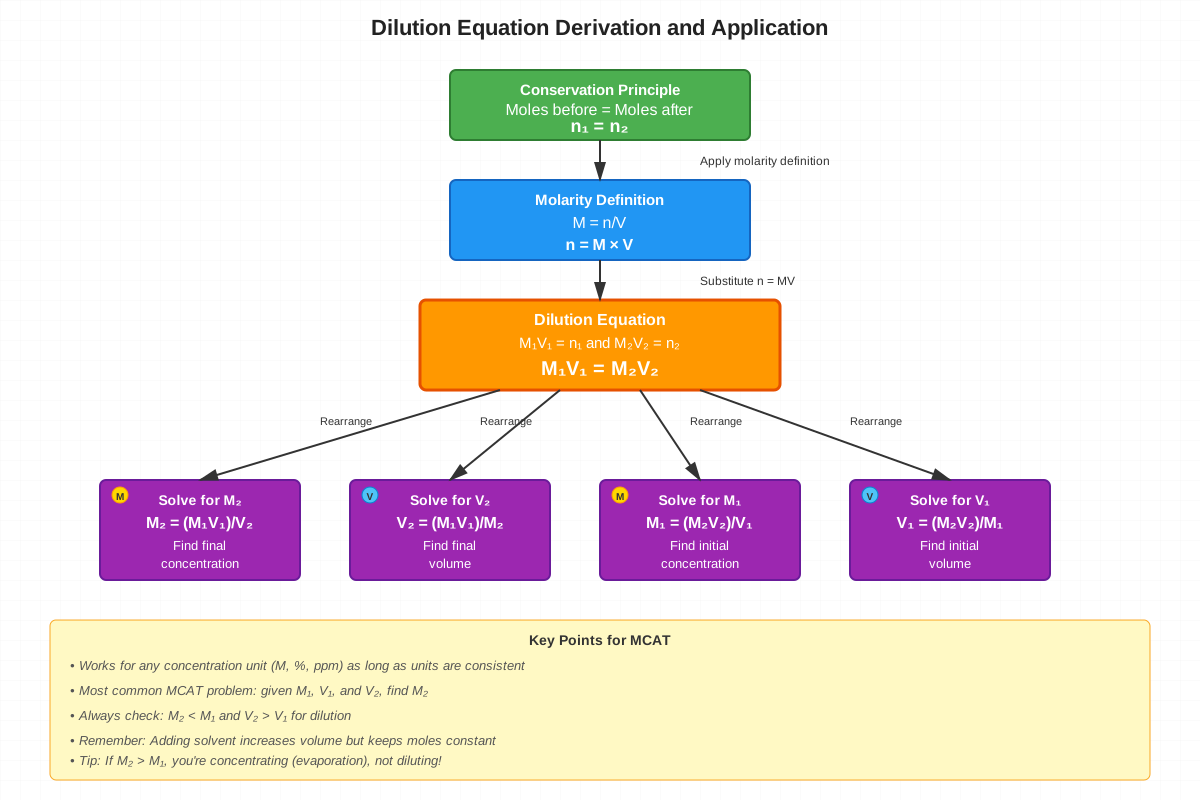
The fundamental principle of dilution states that the number of moles of solute remains constant when solvent is added to a solution. This conservation of solute leads directly to the dilution equation:
M₁V₁ = M₂V₂Where:
- M₁ = initial molarity (concentration)
- V₁ = initial volume
- M₂ = final molarity (concentration)
- V₂ = final volume
This equation works because molarity equals moles per liter (M = n/V), so M × V = n (moles of solute). Since the number of moles remains constant during dilution, M₁V₁ (initial moles) must equal M₂V₂ (final moles). The equation applies to any concentration unit that expresses amount per volume, including molarity (M), normality (N), or mass/volume percentages, as long as consistent units are used on both sides.
Understanding Concentration Changes
When a solution undergoes dilution, three key relationships hold:
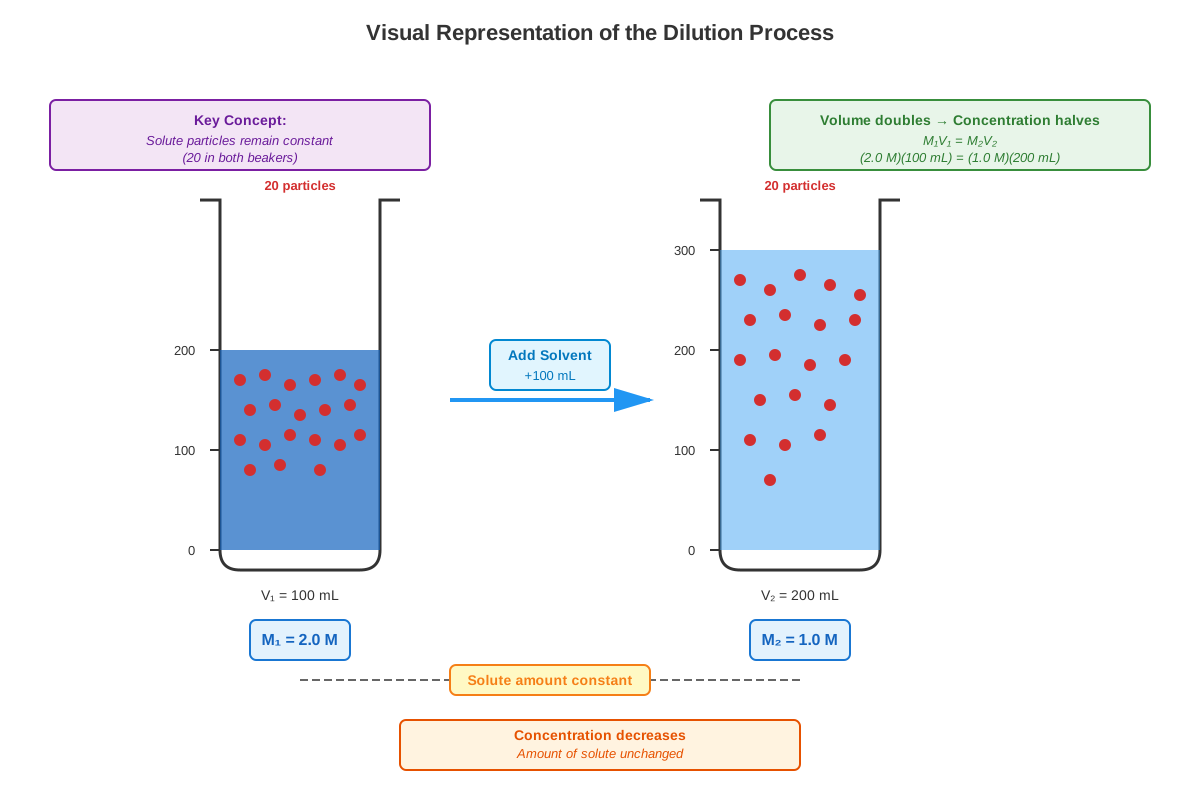
- Solute amount remains constant: The actual number of moles (or grams) of dissolved substance does not change
- Volume increases: Additional solvent increases the total solution volume
- Concentration decreases: The same amount of solute distributed through a larger volume results in lower concentration
The relationship between initial and final concentrations follows an inverse proportion with volume:
M₂ = M₁ × (V₁/V₂)This form makes explicit that the final concentration equals the initial concentration multiplied by a fraction less than one (since V₂ > V₁), confirming that dilution always decreases concentration. The dilution factor (V₂/V₁) indicates how many times the solution has been diluted; for example, a dilution factor of 10 means the final volume is 10 times the initial volume, and the final concentration is 1/10 the initial concentration.
Types of Dilution Problems
Type 1: Simple Dilution Calculations
Given three of the four variables (M₁, V₁, M₂, V₂), calculate the fourth. These straightforward problems test basic equation manipulation and unit consistency.
Type 2: Volume of Solvent Added
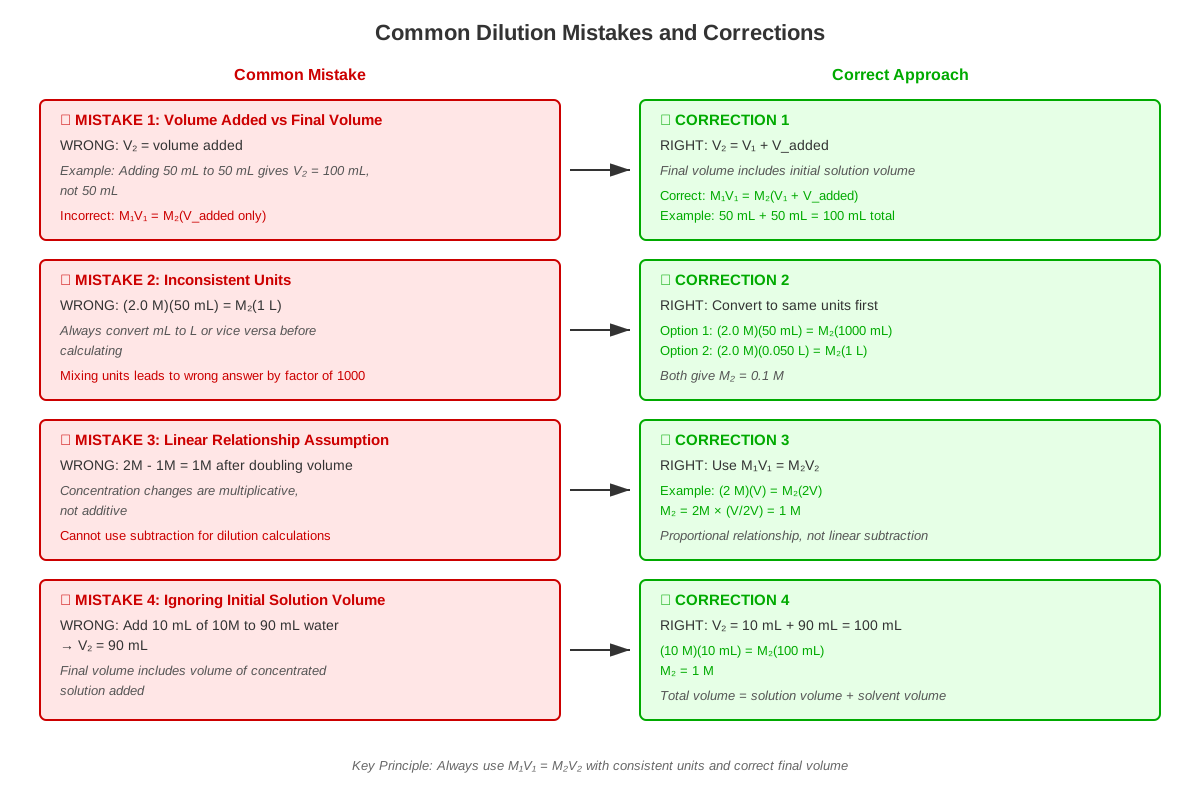
Calculate how much solvent must be added to achieve a target concentration. The key insight is that the volume of solvent added equals (V₂ - V₁), not V₂ itself. This distinction is a common source of errors.
Type 3: Serial Dilutions
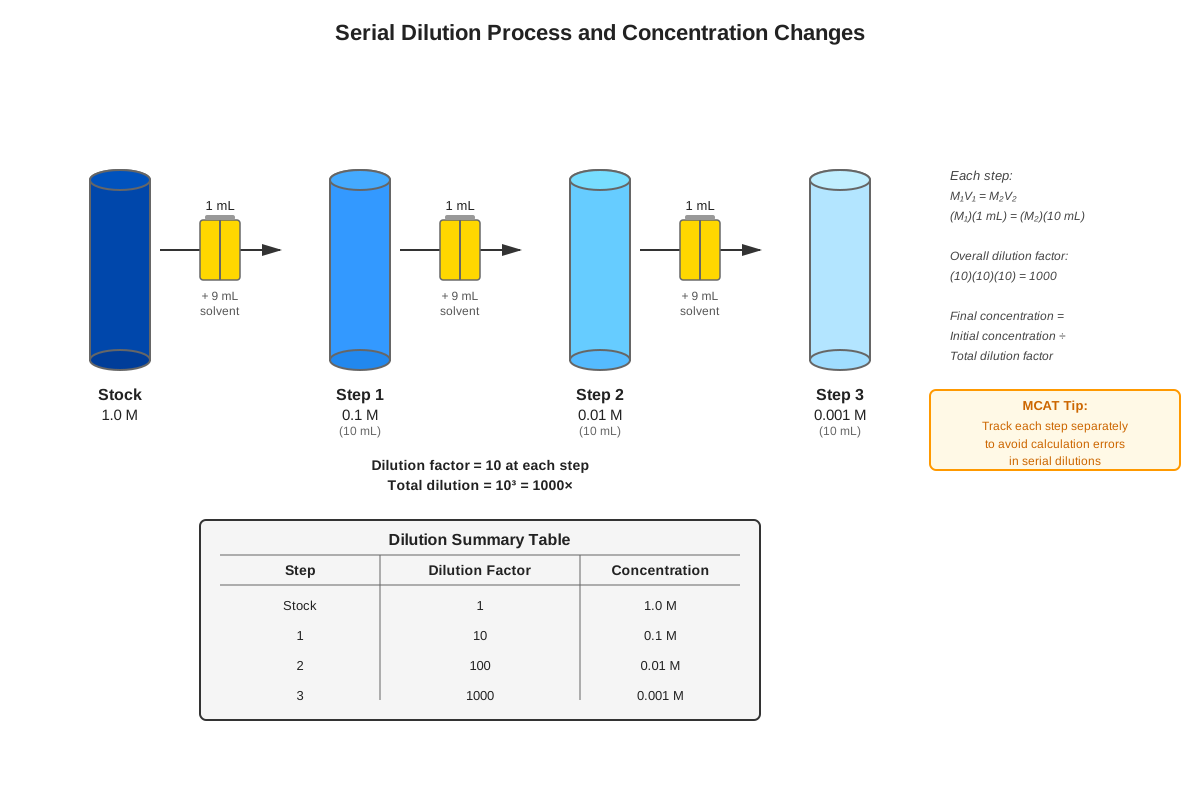
Multiple sequential dilutions where the product of each dilution becomes the starting material for the next. The overall dilution factor equals the product of individual dilution factors. For example, three successive 1:10 dilutions produce an overall dilution of 1:1000.
Type 4: Mixing Solutions
When two solutions of different concentrations are mixed, the final concentration depends on both the concentrations and volumes of the original solutions:
M_final = (M₁V₁ + M₂V₂)/(V₁ + V₂)This represents a weighted average of the two concentrations, weighted by their respective volumes.
Concentration Units in Dilution
While molarity is the most common concentration unit for dilution problems, the dilution equation applies to other units:
| Concentration Unit | Symbol | Definition | Dilution Applicability |
|---|---|---|---|
| Molarity | M | moles solute/L solution | Direct application of M₁V₁ = M₂V₂ |
| Molality | m | moles solute/kg solvent | Does NOT use dilution equation (mass of solvent changes) |
| Normality | N | equivalents/L solution | Direct application of N₁V₁ = N₂V₂ |
| Mass percent | % w/w | (g solute/g solution) × 100 | Requires density for volume calculations |
| Mass/volume percent | % w/v | (g solute/mL solution) × 100 | Can use dilution equation with appropriate units |
| Parts per million | ppm | mg solute/L solution | Direct application for dilute aqueous solutions |
Exam Tip: The MCAT may present concentration in units other than molarity to test unit awareness. Always verify that units are consistent on both sides of the equation before calculating.
Practical Considerations
Stock Solutions: Concentrated solutions kept in the laboratory for dilution to working concentrations. Stock solutions save storage space and maintain stability. The MCAT often presents scenarios where students must calculate how to prepare a desired solution from a stock solution.
Dilution Notation: The notation "1:10 dilution" can be ambiguous. In most scientific contexts, it means 1 part original solution to 9 parts solvent (final volume = 10 parts), resulting in a 10-fold dilution. However, some sources interpret it as 1 part solution to 10 parts solvent (11-fold dilution). The MCAT typically provides sufficient context to avoid ambiguity, but students should carefully read the problem statement.
Density Considerations: When diluting with water, the assumption that volumes are additive (V₁ + V_solvent = V₂) is generally valid. However, for concentrated solutions or non-aqueous solvents, volumes may not be strictly additive due to intermolecular interactions. The MCAT typically assumes ideal behavior unless otherwise stated.
Concept Relationships
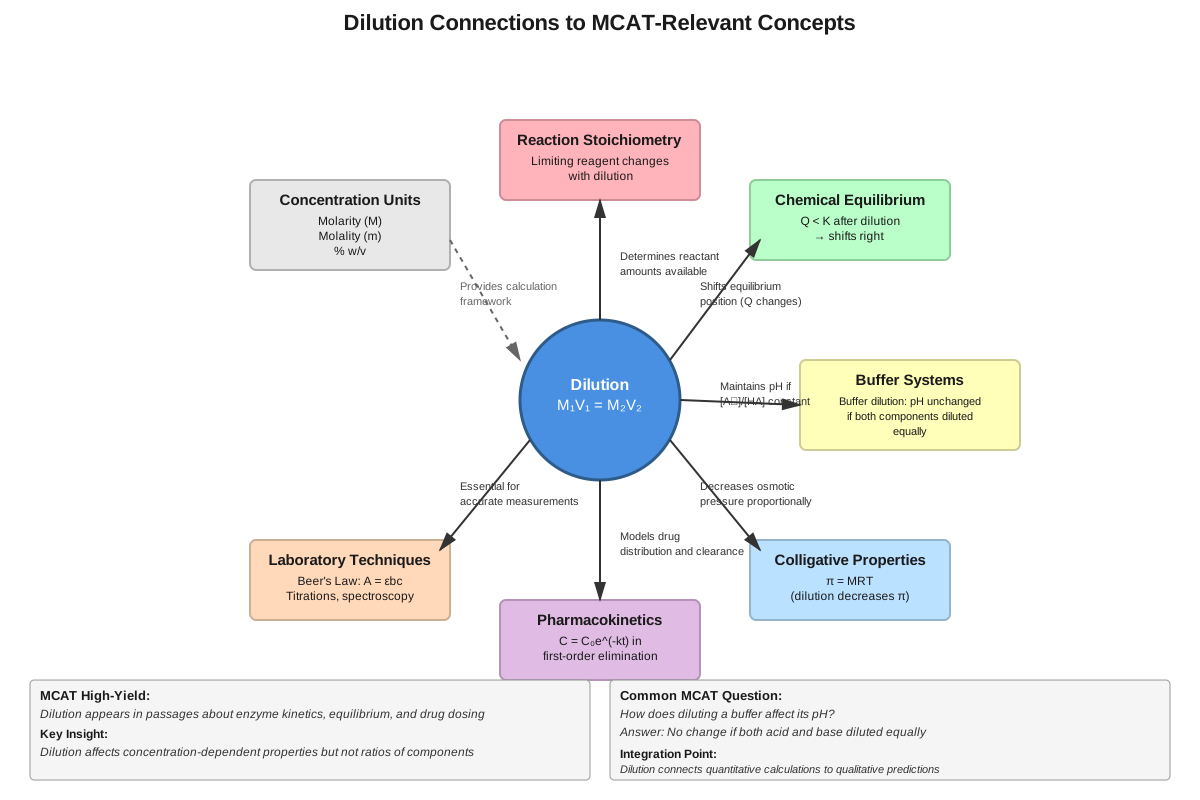
The dilution concept serves as a central hub connecting multiple areas of General Chemistry and biochemistry. At its foundation, dilution relies on stoichiometric principles—specifically, the conservation of mass and the mole concept. The dilution equation (M₁V₁ = M₂V₂) is essentially a stoichiometric statement that moles of solute remain constant.
Dilution → Affects Reaction Rates: Decreasing reactant concentration through dilution directly impacts reaction rate according to rate laws. For a reaction with rate = k[A]ⁿ, diluting reactant A decreases the reaction rate proportionally to the concentration change raised to the reaction order.
Dilution → Shifts Chemical Equilibria: Le Chatelier's principle predicts that diluting a system at equilibrium shifts the equilibrium toward the side with more dissolved particles. This connection is crucial for understanding buffer behavior and acid-base equilibria.
Dilution → Modifies Colligative Properties: Since colligative properties depend on solute particle concentration, dilution decreases effects such as boiling point elevation, freezing point depression, and osmotic pressure proportionally.
Dilution ← Requires Solution Chemistry: Understanding what happens during dilution requires knowledge of solution formation, solubility, and the distinction between solute and solvent. The concept that solute amount remains constant while concentration changes only makes sense with a firm grasp of concentration definitions.
Dilution ↔ Titration Calculations: Titrations often require dilution of stock solutions to appropriate concentrations. Additionally, analyzing titration data may involve accounting for dilution effects when samples are prepared.
Dilution → Enables Spectrophotometry: Beer's Law (A = εbc) relates absorbance to concentration. Dilution is routinely used to bring sample concentrations within the linear range of spectrophotometric detection, and students must account for dilution factors when calculating original concentrations.
The relationship map: Molarity → Dilution Equation → Concentration Changes → Effects on Equilibria, Rates, and Properties → Experimental Design and Data Analysis
High-Yield Facts
⭐ The dilution equation M₁V₁ = M₂V₂ applies only when the number of moles of solute remains constant—it does not apply to chemical reactions that consume or produce solute.
⭐ During dilution, the volume of solvent added equals (V₂ - V₁), not V₂—this is the most common calculation error on the MCAT.
⭐ Serial dilutions multiply: Three successive 1:10 dilutions produce a final concentration that is 1/1000 of the original, not 1/30.
⭐ The dilution equation works with any concentration unit that expresses amount per volume, including molarity, normality, and mass/volume percent, but NOT molality (which uses mass of solvent, not volume of solution).
⭐ Dilution always decreases concentration but never changes the amount of solute—if a problem suggests otherwise, check for a chemical reaction or evaporation.
- When mixing two solutions of the same solute at different concentrations, the final concentration is a volume-weighted average: M_final = (M₁V₁ + M₂V₂)/(V₁ + V₂).
- A "1:10 dilution" typically means 1 part solution + 9 parts solvent = 10 parts total, resulting in a 10-fold decrease in concentration.
- Diluting a solution by a factor of n means the final volume is n times the initial volume, and the final concentration is 1/n times the initial concentration.
- The dilution equation assumes ideal behavior where volumes are additive; this is valid for dilute aqueous solutions but may not hold for concentrated or non-aqueous solutions.
- In biological contexts, dilution of blood or extracellular fluid affects osmotic balance and can cause cells to swell (hypotonic dilution) or shrink (hypertonic concentration).
- Dilution affects reaction rates but does not change equilibrium constants (K values), though it does shift equilibrium positions.
- When preparing solutions from solid solutes, calculate the mass needed based on the final desired concentration and volume, not intermediate dilution steps.
Quick check — test yourself on Dilution so far.
Try Flashcards →Common Misconceptions
Misconception: The dilution equation can be used for any mixing problem, including chemical reactions.
Correction: M₁V₁ = M₂V₂ only applies when the number of moles of solute remains constant. If a chemical reaction occurs (such as neutralization or precipitation), the amount of solute changes, and stoichiometric calculations must be used instead of the dilution equation.
Misconception: V₂ in the dilution equation represents the volume of solvent added.
Correction: V₂ represents the final total volume of the solution, not the volume of solvent added. The volume of solvent added equals (V₂ - V₁). For example, diluting 10 mL of solution to a final volume of 100 mL requires adding 90 mL of solvent, not 100 mL.
Misconception: A "1:10 dilution" means mixing 1 part solution with 10 parts solvent.
Correction: In standard scientific notation, a "1:10 dilution" means the final volume is 10 times the initial volume, achieved by mixing 1 part solution with 9 parts solvent. This results in a 10-fold decrease in concentration. However, always read the problem carefully, as some contexts may define dilution ratios differently.
Misconception: Dilution changes the number of moles of solute in the solution.
Correction: Dilution only adds solvent; it does not add or remove solute. The number of moles (or grams) of solute remains absolutely constant during dilution. Only the concentration (amount per unit volume) changes because the volume increases.
Misconception: The dilution equation works for molality (m) just like it does for molarity (M).
Correction: Molality is defined as moles of solute per kilogram of solvent, not per liter of solution. When you add solvent during dilution, you change the mass of solvent in the denominator of the molality expression, so the simple M₁V₁ = M₂V₂ relationship does not apply. Molality requires different calculations that account for the changing mass of solvent.
Misconception: When performing serial dilutions, the overall dilution factor is the sum of individual dilution factors.
Correction: Serial dilution factors multiply, not add. If you perform three successive 1:10 dilutions, the overall dilution is 1:1000 (10 × 10 × 10), not 1:30 (10 + 10 + 10). Each dilution step reduces the concentration by the dilution factor, and these reductions compound multiplicatively.
Misconception: Dilution affects the equilibrium constant (K) of a reaction.
Correction: Dilution changes the concentrations of reactants and products, which shifts the equilibrium position according to Le Chatelier's principle, but it does not change the equilibrium constant K, which depends only on temperature. The ratio of products to reactants at equilibrium (as defined by K) remains constant at a given temperature.
Worked Examples
Example 1: Basic Dilution Calculation
Problem: A laboratory technician needs to prepare 500 mL of a 0.15 M NaCl solution from a 3.0 M stock solution. What volume of stock solution is required, and how much water should be added?
Solution:
Step 1: Identify the known and unknown variables.
- M₁ = 3.0 M (stock concentration)
- V₁ = ? (volume of stock needed)
- M₂ = 0.15 M (desired final concentration)
- V₂ = 500 mL (desired final volume)
Step 2: Apply the dilution equation M₁V₁ = M₂V₂.
(3.0 M)(V₁) = (0.15 M)(500 mL)Step 3: Solve for V₁.
V₁ = (0.15 M × 500 mL) / 3.0 M
V₁ = 75 mL / 3.0
V₁ = 25 mL
Step 4: Calculate the volume of water to add.
Volume of water = V₂ - V₁ = 500 mL - 25 mL = 475 mL
Answer: The technician should measure 25 mL of the 3.0 M stock solution and add 475 mL of water to achieve a final volume of 500 mL at 0.15 M concentration.
Key Insight: This problem directly tests the learning objective of applying the dilution equation to exam-style questions. Note that the volume of water added (475 mL) is not the same as the final volume (500 mL)—a common trap on the MCAT.
Example 2: Serial Dilution with Biological Context
Problem: A microbiologist performs a serial dilution of a bacterial culture to estimate cell density. She takes 1.0 mL of the original culture and adds it to 9.0 mL of sterile broth (first dilution). She then takes 1.0 mL of this diluted culture and adds it to 9.0 mL of sterile broth (second dilution). Finally, she takes 1.0 mL of the second dilution and adds it to 9.0 mL of sterile broth (third dilution). If the original culture contained 5.0 × 10⁸ cells/mL, what is the cell density in the final dilution?
Solution:
Step 1: Analyze each dilution step.
- First dilution: 1.0 mL culture + 9.0 mL broth = 10.0 mL total
- Dilution factor = V₂/V₁ = 10.0 mL / 1.0 mL = 10
- This is a 1:10 dilution
- Second dilution: 1.0 mL of first dilution + 9.0 mL broth = 10.0 mL total
- Dilution factor = 10
- Third dilution: 1.0 mL of second dilution + 9.0 mL broth = 10.0 mL total
- Dilution factor = 10
Step 2: Calculate the overall dilution factor.
Overall dilution factor = 10 × 10 × 10 = 1000
Step 3: Calculate the final cell density.
Final concentration = Original concentration / Overall dilution factor
Final concentration = (5.0 × 10⁸ cells/mL) / 1000
Final concentration = 5.0 × 10⁵ cells/mL
Alternative approach using the dilution equation:
For each step, M₁V₁ = M₂V₂
After first dilution:
C₁ = (5.0 × 10⁸ cells/mL)(1.0 mL) / (10.0 mL) = 5.0 × 10⁷ cells/mLAfter second dilution:
C₂ = (5.0 × 10⁷ cells/mL)(1.0 mL) / (10.0 mL) = 5.0 × 10⁶ cells/mLAfter third dilution:
C₃ = (5.0 × 10⁶ cells/mL)(1.0 mL) / (10.0 mL) = 5.0 × 10⁵ cells/mLAnswer: The final cell density is 5.0 × 10⁵ cells/mL.
Key Insight: This problem illustrates serial dilutions in a biological context, connecting dilution to microbiology and experimental design. Serial dilutions are commonly used when the original concentration is too high to count or measure directly. The overall dilution factor is the product of individual dilution factors, not their sum—a critical concept for MCAT success.
Exam Strategy
Approaching Dilution Questions on the MCAT:
- Identify whether the problem involves dilution or a chemical reaction: If solute is consumed or produced, use stoichiometry, not the dilution equation. Dilution only applies when solute amount remains constant.
- Write down the dilution equation immediately: M₁V₁ = M₂V₂ serves as your roadmap. Label each variable with the information given in the problem.
- Check unit consistency: Ensure both volumes use the same units (both mL or both L). Convert if necessary before calculating. Molarity is moles/L, so if volumes are in mL, either convert to L or keep in mL (the units will cancel appropriately).
- Watch for the "volume added" trap: When asked how much solvent to add, remember to calculate (V₂ - V₁), not just V₂. This is one of the most common wrong answer choices.
- For serial dilutions, multiply dilution factors: Don't add them. Each successive dilution compounds the previous one multiplicatively.
Trigger Words and Phrases:
- "Dilute to a final volume of..." → V₂ is given
- "Add [volume] of solvent..." → Calculate V₂ = V₁ + volume added
- "Prepare from stock solution..." → M₁ is the stock concentration
- "Serial dilution" or "successive dilutions" → Multiply dilution factors
- "What volume of water should be added..." → Answer is (V₂ - V₁), not V₂
- "Mix two solutions..." → Use weighted average formula, not simple dilution equation
Process of Elimination Tips:
- Eliminate answers where the final concentration is higher than the initial concentration (dilution always decreases concentration)
- Eliminate answers where the final volume is less than the initial volume (dilution always increases volume)
- For "volume of solvent added" questions, eliminate any answer equal to the final volume
- Check if answer choices differ by factors of 10 or 1000—this often indicates serial dilution or unit conversion errors
- If an answer seems too simple, verify you haven't fallen for the V₂ vs. (V₂ - V₁) trap
Time Allocation:
Straightforward dilution calculations should take 30-45 seconds. If you find yourself spending more than one minute on a dilution problem, you may be overcomplicating it. Set up the equation, solve for the unknown, and move on. Save time for more complex passage-based questions. For serial dilution problems, allow up to 60-90 seconds to carefully track multiple steps.
Memory Techniques
Mnemonic for the Dilution Equation: "My Very Mean Viper" → M₁V₁ = M₂V₂
Conceptual Visualization: Picture a drop of food coloring in water. As you add more water, the color becomes lighter (concentration decreases), but the total amount of dye remains the same. The color intensity represents concentration, while the actual dye molecules represent the constant amount of solute.
The "Pizza Slice" Analogy: If you have 8 slices of pizza (solute) in a small box (initial volume) and transfer them to a large box (final volume), you still have 8 slices (amount constant), but they're more spread out (concentration decreased). The number of slices per unit area decreases, just as moles per liter decreases during dilution.
Serial Dilution Memory Aid: "Serial dilutions Multiply" (SM) → Remember that serial dilutions involve multiplication of dilution factors, not addition.
Volume Added Reminder: "Don't Forget to Subtract" (DFS) → When calculating volume of solvent added, Don't Forget to Subtract the initial volume from the final volume.
Acronym for Dilution Problem Steps: WISE
- Write the equation (M₁V₁ = M₂V₂)
- Identify known and unknown variables
- Solve algebraically
- Evaluate units and reasonableness
Summary
Dilution is the process of decreasing solute concentration by adding solvent while keeping the amount of solute constant. The fundamental relationship M₁V₁ = M₂V₂ expresses the conservation of moles during dilution and applies to any concentration unit expressing amount per volume. Mastery of dilution requires understanding that concentration and volume change inversely while solute amount remains fixed. Common MCAT applications include preparing solutions from stock concentrations, analyzing serial dilutions in biological experiments, and connecting dilution to reaction rates, equilibria, and colligative properties. Critical skills include distinguishing between final volume and volume of solvent added, recognizing that serial dilutions multiply rather than add, and identifying when the dilution equation applies versus when stoichiometric calculations are needed. Success on dilution questions requires systematic problem-solving: write the equation, identify variables, check unit consistency, solve algebraically, and verify that the answer makes physical sense (dilution decreases concentration and increases volume).
Key Takeaways
- The dilution equation M₁V₁ = M₂V₂ applies only when the number of moles of solute remains constant; it does not apply to chemical reactions
- During dilution, solute amount stays constant, volume increases, and concentration decreases proportionally
- The volume of solvent added equals (V₂ - V₁), not V₂—this distinction is frequently tested on the MCAT
- Serial dilutions multiply: three 1:10 dilutions produce a 1:1000 overall dilution
- The dilution equation works for molarity, normality, and mass/volume concentrations, but NOT for molality
- Always verify unit consistency before calculating, and ensure your answer makes physical sense (concentration should decrease)
- Dilution affects reaction rates and equilibrium positions but does not change equilibrium constants
Related Topics
Molarity and Concentration Units: Understanding different ways to express solution concentration (molarity, molality, normality, percent composition) provides the foundation for dilution calculations and enables conversion between units.
Stoichiometry: Dilution is essentially a stoichiometric calculation based on conservation of moles. Mastering stoichiometry enables students to handle more complex problems involving dilution followed by chemical reactions.
Beer's Law and Spectrophotometry: Dilution is routinely used to bring sample concentrations within the linear range of spectrophotometric detection. Understanding how dilution factors affect absorbance measurements is essential for analyzing experimental data.
Acid-Base Chemistry and Buffers: Dilution affects the pH of acidic and basic solutions and can impact buffer capacity. Understanding dilution enables prediction of pH changes when solutions are diluted.
Chemical Kinetics: Reaction rates depend on reactant concentrations, so dilution directly affects how fast reactions proceed. This connection is crucial for understanding rate laws and experimental design.
Colligative Properties: Since colligative properties depend on solute particle concentration, dilution proportionally affects boiling point elevation, freezing point depression, vapor pressure lowering, and osmotic pressure.
Practice CTA
Now that you've mastered the core concepts of dilution, it's time to solidify your understanding through active practice. Work through the practice questions to test your ability to apply the dilution equation in various contexts, identify common traps, and integrate dilution with other General Chemistry concepts. Use the flashcards to reinforce high-yield facts and ensure rapid recall of key relationships. Remember: understanding the theory is just the first step—MCAT success requires the ability to quickly and accurately apply these concepts under timed conditions. Challenge yourself with progressively difficult problems, and don't just solve them—analyze why wrong answers are tempting and how to avoid those traps on test day. Your investment in deliberate practice now will pay dividends in confidence and performance when it matters most!
Sign up free to keep reading
Create a free AnvayaPrep account to finish this MCAT guide on Dilution — plus flashcards and practice questions.