Overview
Molarity is one of the most fundamental concepts in General Chemistry and serves as a cornerstone for understanding solution chemistry, chemical reactions, and quantitative analysis. As a measure of concentration, molarity expresses the number of moles of solute dissolved per liter of solution, providing a standardized way to describe how much of a substance is present in a given volume. This seemingly simple concept underpins countless calculations in chemistry, from dilution problems to titration analyses, and appears frequently throughout the MCAT in both standalone questions and passage-based contexts.
For MCAT preparation, mastery of Molarity is non-negotiable. The exam tests not only the ability to perform straightforward calculations but also the capacity to apply molarity concepts in complex scenarios involving Stoichiometry and Reactions, acid-base chemistry, electrochemistry, and even biological systems. Questions may require students to convert between different concentration units, determine the molarity of solutions after dilution or mixing, or use molarity in stoichiometric calculations to predict reaction outcomes. The Molarity MCAT questions often appear disguised within experimental passages describing laboratory procedures, requiring quick recognition and application of concentration principles.
Understanding molarity creates a foundation for more advanced topics in General Chemistry and biochemistry. It connects directly to concepts such as solution preparation, reaction yields, limiting reagents, and equilibrium calculations. The ability to work fluently with molarity enables students to tackle problems involving colligative properties, buffer systems, and enzyme kinetics—all high-yield topics for the MCAT. Moreover, molarity serves as the bridge between the microscopic world of molecules and atoms and the macroscopic world of laboratory measurements, making it essential for interpreting experimental data and understanding chemical behavior in biological contexts.
Learning Objectives
- [ ] Define Molarity using accurate General Chemistry terminology
- [ ] Explain why Molarity matters for the MCAT
- [ ] Apply Molarity to exam-style questions
- [ ] Identify common mistakes related to Molarity
- [ ] Connect Molarity to related General Chemistry concepts
- [ ] Calculate molarity from mass, moles, and volume data with precision
- [ ] Perform dilution calculations using the M₁V₁ = M₂V₂ relationship
- [ ] Interconvert between molarity and other concentration units (molality, percent composition, mole fraction)
- [ ] Apply molarity in stoichiometric calculations involving solution-phase reactions
Prerequisites
- Mole concept and Avogadro's number: Essential for understanding that molarity measures moles per liter, requiring facility with converting between mass, moles, and number of particles
- Dimensional analysis: Critical for setting up and solving molarity calculations correctly, ensuring proper unit cancellation
- Basic stoichiometry: Necessary for applying molarity to reaction calculations and determining limiting reagents in solution
- Significant figures and scientific notation: Required for expressing molarity values with appropriate precision in calculations
- Volume units and conversions: Important because molarity specifically uses liters, requiring conversion from mL, μL, or other volume units
Why This Topic Matters
Clinical and Real-World Significance
Molarity is the universal language of concentration in medical and research settings. Intravenous fluids administered to patients are prepared at specific molarities to maintain physiological osmotic balance. Pharmaceutical formulations depend on precise molarity calculations to ensure therapeutic efficacy and safety. Laboratory diagnostics measure blood glucose, electrolytes, and other analytes in molar concentrations. Understanding molarity enables healthcare professionals to interpret lab values, prepare medications correctly, and understand the chemical basis of treatments ranging from dialysis to chemotherapy.
MCAT Exam Statistics
Molarity appears in approximately 5-8% of General Chemistry questions on the MCAT, making it a medium-yield topic that cannot be ignored. Questions involving molarity typically appear in several formats: standalone calculation problems testing direct application of the molarity formula, passage-based questions requiring interpretation of experimental procedures involving solution preparation, and integrated questions combining molarity with stoichiometry, equilibrium, or kinetics. The Chemical and Physical Foundations of Biological Systems section frequently includes passages describing biochemical assays or laboratory techniques where understanding molarity is essential for answering associated questions.
Common Exam Contexts
The MCAT presents molarity in diverse contexts that mirror real scientific scenarios. Experimental passages may describe preparing stock solutions, performing serial dilutions, or conducting titrations—all requiring molarity calculations. Biochemistry passages often discuss enzyme assays where substrate concentrations are given in molarity, requiring students to calculate reaction rates or determine Michaelis-Menten parameters. Passages on acid-base chemistry routinely involve molarity when describing buffer preparation or pH calculations. Additionally, molarity appears in questions about colligative properties, where concentration directly affects boiling point elevation, freezing point depression, and osmotic pressure—concepts with direct physiological relevance.
Core Concepts
Definition and Formula
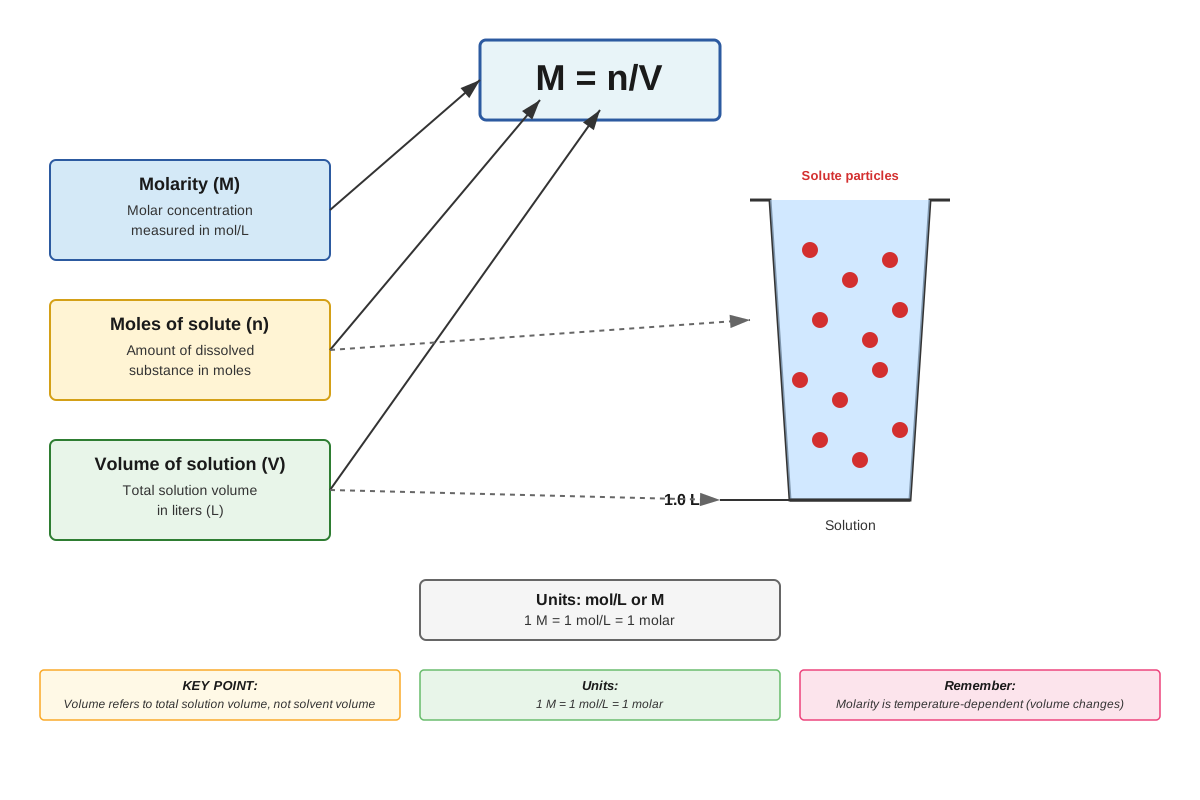
Molarity (symbolized as M) is defined as the number of moles of solute per liter of solution. The mathematical expression is:
Molarity (M) = moles of solute / liters of solutionIt is crucial to recognize that molarity uses the total volume of the solution (solute plus solvent), not just the volume of solvent added. This distinction becomes important when dissolving solids in liquids, as the final solution volume may differ from the initial solvent volume due to volume changes upon mixing.
The units of molarity are moles per liter (mol/L), though it is commonly expressed simply as "M" (molar). For example, a 0.5 M solution contains 0.5 moles of solute per liter of solution. This standardization makes molarity particularly useful for stoichiometric calculations because it directly relates the volume of solution used to the number of moles of reactant or product involved.
Calculating Molarity from Mass
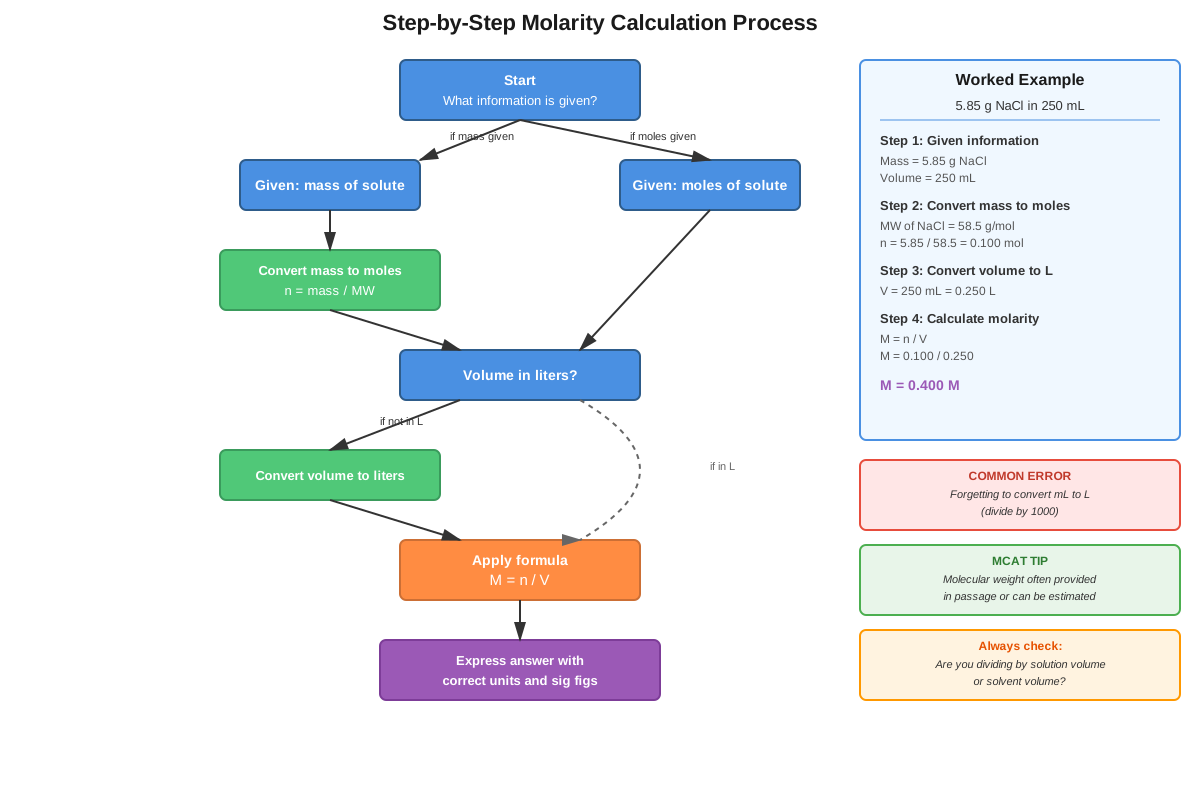
Many MCAT problems provide the mass of solute and require calculation of molarity. This requires a two-step process:
- Convert mass of solute to moles using the molar mass
- Divide moles by the volume of solution in liters
Molarity = (mass of solute in grams / molar mass in g/mol) / volume in litersFor example, to find the molarity of a solution prepared by dissolving 58.5 g of NaCl (molar mass = 58.5 g/mol) in enough water to make 2.0 L of solution:
- Moles of NaCl = 58.5 g ÷ 58.5 g/mol = 1.0 mol
- Molarity = 1.0 mol ÷ 2.0 L = 0.50 M
Dilution Calculations
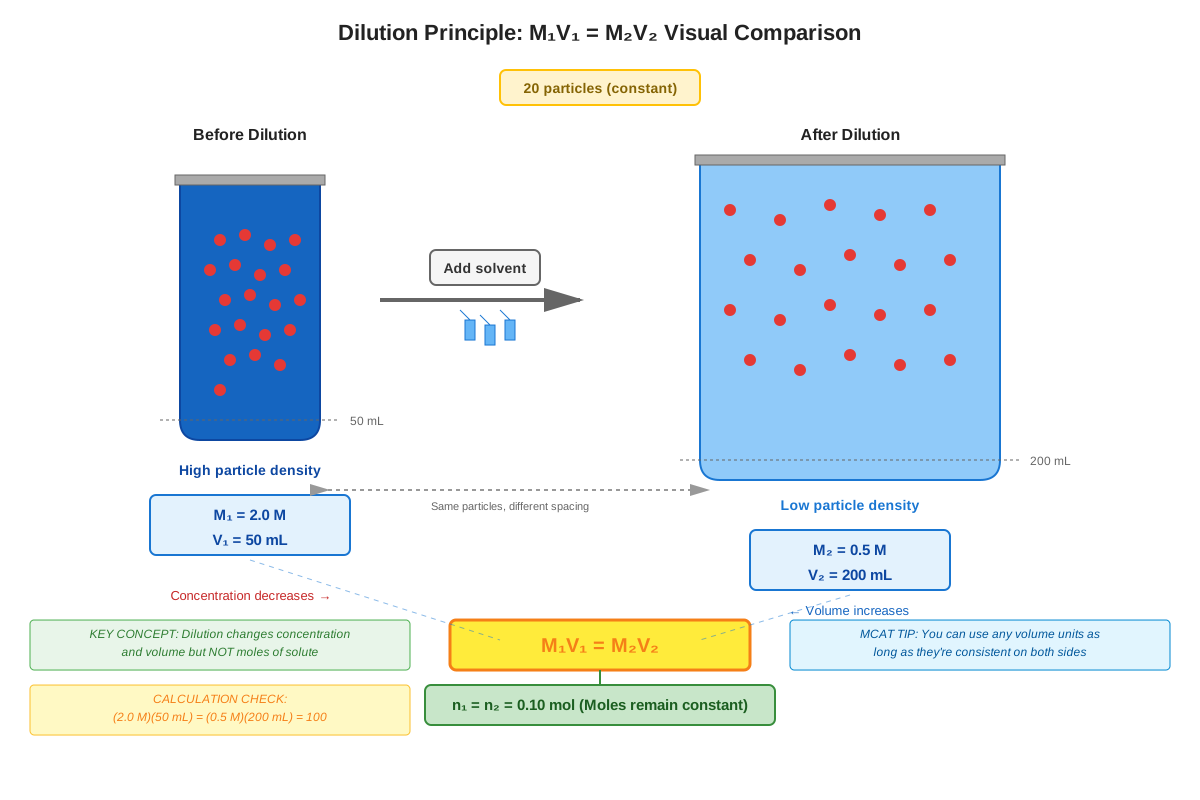
Dilution is the process of decreasing the concentration of a solution by adding more solvent. The fundamental principle is that the number of moles of solute remains constant during dilution—only the volume changes. This leads to the dilution equation:
M₁V₁ = M₂V₂Where:
- M₁ = initial molarity
- V₁ = initial volume
- M₂ = final molarity
- V₂ = final volume
This equation is one of the most high-yield formulas for the MCAT. The volumes can be in any unit (mL, L, μL) as long as both sides use the same unit. When solving dilution problems, three of the four variables are typically given, and the fourth must be calculated.
Exam Tip: The dilution equation assumes that volumes are additive, which is approximately true for dilute aqueous solutions but may not hold for concentrated solutions or non-aqueous systems. The MCAT typically uses ideal conditions unless otherwise specified.
Molarity in Stoichiometric Calculations
Molarity serves as a conversion factor between volume and moles in solution-phase reactions. For a reaction in solution:
moles = Molarity × Volume (in liters)This relationship allows stoichiometric calculations to proceed using volumes of solutions rather than masses of pure substances. For example, in a neutralization reaction:
HCl(aq) + NaOH(aq) → NaCl(aq) + H₂O(l)If 25.0 mL of 0.100 M HCl reacts with NaOH, the moles of HCl involved are:
moles HCl = 0.100 M × 0.0250 L = 0.00250 molFrom stoichiometry, 0.00250 mol of NaOH is required for complete neutralization.
Molarity vs. Other Concentration Units
Understanding how molarity differs from other concentration measures is essential for the MCAT:
| Concentration Unit | Definition | Key Characteristic |
|---|---|---|
| Molarity (M) | moles solute / liters solution | Temperature-dependent (volume changes with temperature) |
| Molality (m) | moles solute / kg solvent | Temperature-independent (mass doesn't change) |
| Mole fraction (χ) | moles component / total moles | Dimensionless; useful for gas mixtures and Raoult's Law |
| Percent by mass | (mass solute / mass solution) × 100% | Common in commercial preparations |
| Parts per million (ppm) | (mass solute / mass solution) × 10⁶ | Used for very dilute solutions |
Molarity is preferred for most laboratory work because it allows easy measurement using volumetric glassware. However, its temperature dependence means that a solution's molarity changes slightly as temperature changes (because volume expands or contracts). Molality is preferred for colligative property calculations and situations where temperature varies.
Preparing Solutions of Specific Molarity
Solution preparation is a practical skill frequently tested on the MCAT. Two common scenarios exist:
Scenario 1: Dissolving a solid solute
- Calculate the mass of solute needed using: mass = Molarity × Volume × Molar mass
- Weigh out the calculated mass
- Dissolve in less than the final volume of solvent
- Add solvent to reach the exact final volume in a volumetric flask
Scenario 2: Diluting a stock solution
- Use M₁V₁ = M₂V₂ to calculate the volume of stock solution needed
- Measure that volume using a pipette
- Transfer to a volumetric flask
- Add solvent to reach the final volume
High-Yield Point: Always add solute to solvent (or concentrated solution to water), never the reverse, especially with acids. This prevents dangerous exothermic reactions and ensures proper mixing.
Molarity in Titrations
Titration is an analytical technique where a solution of known concentration (the titrant) is added to a solution of unknown concentration until the reaction reaches completion (the equivalence point). Molarity calculations are central to determining unknown concentrations:
At the equivalence point:
moles of acid = moles of base (for monoprotic acid-base reactions)
M_acid × V_acid = M_base × V_base
For polyprotic acids or bases, stoichiometric coefficients must be included:
M_acid × V_acid × n_acid = M_base × V_base × n_baseWhere n represents the number of acidic protons or basic hydroxides.
Concept Relationships
Molarity serves as a central hub connecting multiple areas of General Chemistry. The concept builds directly on the mole concept, which itself depends on understanding atomic mass and Avogadro's number. Once molarity is mastered, it enables progression to solution stoichiometry, where volumes of solutions replace masses in reaction calculations.
The relationship flow can be visualized as:
Atomic/Molecular Mass → Mole Concept → Molarity → Solution Stoichiometry → Titrations and Analysis
Molarity also connects laterally to other concentration units. Converting between molarity and molality requires knowing solution density, linking concentration concepts to physical properties. The relationship between molarity and mole fraction becomes important in Raoult's Law calculations for vapor pressure and in understanding colligative properties.
In acid-base chemistry, molarity directly determines pH calculations for strong acids and bases (pH = -log[H⁺], where [H⁺] is molarity). For weak acids and bases, molarity appears in equilibrium expressions and ICE tables. In electrochemistry, molarity affects cell potential through the Nernst equation, connecting concentration to electrical work.
The dilution equation (M₁V₁ = M₂V₂) represents a special application of the conservation of mass principle, demonstrating that while concentration and volume change, the amount of solute (moles) remains constant. This principle extends to mixing problems where solutions of different concentrations combine.
Quick check — test yourself on Molarity so far.
Try Flashcards →High-Yield Facts
⭐ Molarity is defined as moles of solute per liter of solution (not solvent), with units of mol/L or M
⭐ The dilution equation M₁V₁ = M₂V₂ is based on the principle that moles of solute remain constant during dilution
⭐ To calculate molarity from mass: M = (mass in g / molar mass in g/mol) / volume in L
⭐ In stoichiometric calculations, moles = Molarity × Volume (in liters) converts between solution volume and amount of substance
⭐ Molarity is temperature-dependent because solution volume changes with temperature, unlike molality which uses mass
- At the equivalence point of a titration between monoprotic acid and base: M_acid × V_acid = M_base × V_base
- When preparing a solution from solid solute, always dissolve in less than the final volume, then dilute to the mark
- Molarity can be converted to molality if solution density is known: m = (M × 1000) / (density × 1000 - M × molar mass)
- For dilute aqueous solutions, molarity and molality are approximately equal because water density ≈ 1 g/mL
- Serial dilutions follow the pattern: final concentration = initial concentration × (dilution factor)^n, where n is the number of dilution steps
- The molarity of water in aqueous solutions is approximately 55.5 M (1000 g/L ÷ 18 g/mol)
- When solutions of different molarities are mixed, the final molarity is NOT simply the average; use: M_final = (M₁V₁ + M₂V₂) / (V₁ + V₂)
Common Misconceptions
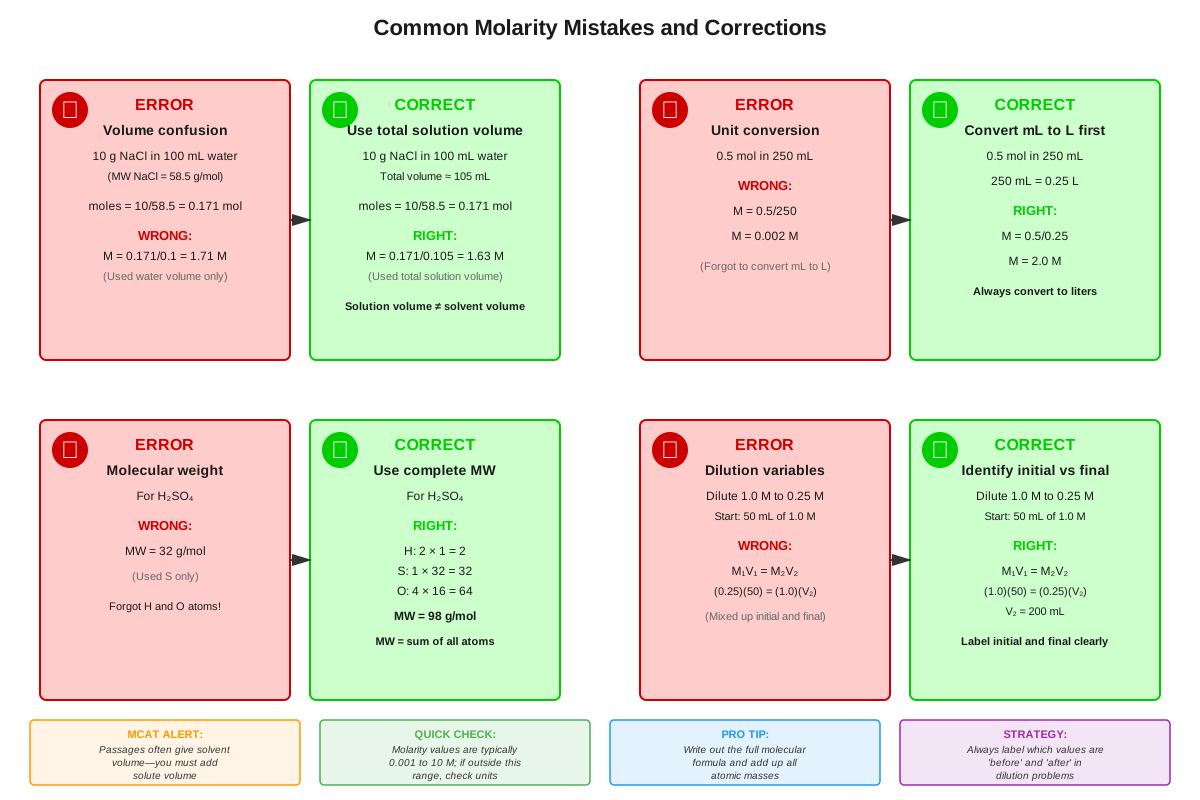
Misconception: Molarity is calculated using the volume of solvent added, not the final solution volume.
Correction: Molarity specifically uses the total volume of the solution after the solute is dissolved. When a solid dissolves, it occupies space, so the final solution volume may be greater than the initial solvent volume. Always use volumetric flasks and dilute to the mark for accurate molarity.
Misconception: In the dilution equation M₁V₁ = M₂V₂, V₂ represents the volume of solvent added.
Correction: V₂ represents the final total volume of the diluted solution, not the volume of solvent added. If you start with 10 mL of stock solution and dilute to a final volume of 100 mL, then V₂ = 100 mL, even though you only added 90 mL of solvent.
Misconception: Molarity and molality are interchangeable terms for concentration.
Correction: Molarity (M) uses liters of solution in the denominator and is temperature-dependent. Molality (m) uses kilograms of solvent in the denominator and is temperature-independent. They have different units and are used in different contexts—molality for colligative properties, molarity for most laboratory work.
Misconception: When two solutions are mixed, their volumes always add exactly (V_total = V₁ + V₂).
Correction: While the MCAT typically assumes ideal behavior where volumes are additive, in reality, mixing solutions can result in volume contraction or expansion due to intermolecular interactions. For exam purposes, assume volumes are additive unless told otherwise, but be aware this is an approximation.
Misconception: A 1 M solution means 1 mole of solute dissolved in 1 liter of water.
Correction: A 1 M solution means 1 mole of solute dissolved in enough water to make 1 liter of total solution. The volume of water needed will be slightly less than 1 liter because the solute occupies space. This is why solution preparation requires diluting to a final volume mark, not adding a specific volume of solvent.
Misconception: Molarity remains constant when temperature changes.
Correction: Because molarity depends on volume and volume changes with temperature (thermal expansion/contraction), molarity is temperature-dependent. A solution that is 1.00 M at 20°C will have a slightly different molarity at 40°C. This is why molality is preferred for precise work involving temperature changes.
Worked Examples
Example 1: Calculating Molarity from Mass
Question: A student dissolves 10.6 g of sodium carbonate (Na₂CO₃) in water to prepare 500 mL of solution. What is the molarity of the solution? (Molar mass of Na₂CO₃ = 106 g/mol)
Solution:
Step 1: Identify what is given and what is needed.
- Mass of Na₂CO₃ = 10.6 g
- Molar mass of Na₂CO₃ = 106 g/mol
- Volume of solution = 500 mL = 0.500 L
- Need to find: Molarity
Step 2: Convert mass to moles.
moles of Na₂CO₃ = 10.6 g ÷ 106 g/mol = 0.100 molStep 3: Calculate molarity using the definition.
Molarity = moles / liters = 0.100 mol / 0.500 L = 0.200 MAnswer: The molarity of the sodium carbonate solution is 0.200 M or 0.20 M (with appropriate significant figures).
Connection to Learning Objectives: This problem directly applies the definition of molarity and demonstrates the calculation process from mass data, addressing the objective to "calculate molarity from mass, moles, and volume data with precision."
Example 2: Dilution and Stoichiometry Combined
Question: A laboratory procedure requires 250 mL of 0.150 M HCl for a titration. The stockroom has 6.0 M HCl available. (a) What volume of stock solution is needed? (b) If this diluted HCl is used to titrate 25.0 mL of NaOH solution to the equivalence point, what is the molarity of the NaOH?
Solution:
Part (a): Dilution calculation
Step 1: Identify the dilution variables.
- M₁ = 6.0 M (stock solution)
- V₁ = ? (volume of stock needed)
- M₂ = 0.150 M (desired concentration)
- V₂ = 250 mL (final volume)
Step 2: Apply the dilution equation.
M₁V₁ = M₂V₂
6.0 M × V₁ = 0.150 M × 250 mL
V₁ = (0.150 M × 250 mL) / 6.0 M
V₁ = 6.25 mL ≈ 6.3 mL
Answer (a): Measure 6.3 mL of 6.0 M HCl stock solution and dilute to 250 mL total volume.
Part (b): Titration stoichiometry
Step 3: Write the balanced equation.
HCl(aq) + NaOH(aq) → NaCl(aq) + H₂O(l)The stoichiometry is 1:1 for this monoprotic acid-base reaction.
Step 4: Calculate moles of HCl used in titration.
moles HCl = M × V = 0.150 M × 0.0250 L = 0.00375 molStep 5: Use stoichiometry to find moles of NaOH.
From the 1:1 ratio: moles NaOH = 0.00375 mol
Step 6: Calculate molarity of NaOH.
M_NaOH = moles / volume = 0.00375 mol / 0.0250 L = 0.150 MAnswer (b): The molarity of the NaOH solution is 0.150 M.
Connection to Learning Objectives: This multi-step problem integrates dilution calculations with stoichiometric applications of molarity, demonstrating how molarity connects to reaction chemistry and analytical techniques—key skills for MCAT success.
Exam Strategy
Approaching MCAT Molarity Questions
When encountering molarity problems on the MCAT, follow this systematic approach:
- Identify the type of problem: Is it a straightforward calculation, a dilution, a stoichiometry problem, or a conceptual question?
- Write down the molarity formula or relevant equation: M = n/V or M₁V₁ = M₂V₂
- Extract all numerical values and convert units: Always convert volumes to liters unless the problem allows otherwise
- Check what the question is asking: Molarity? Volume? Mass? Moles?
- Solve systematically: Show each step mentally or on scratch paper
- Verify units and significant figures: Ensure your answer makes physical sense
Trigger Words and Phrases
Recognize these key phrases that signal molarity calculations:
- "Concentration of the solution" → likely asking for or giving molarity
- "Dilute to a final volume of" → use M₁V₁ = M₂V₂
- "Stock solution" → indicates a dilution problem
- "Dissolved in enough water to make" → final solution volume, not solvent volume
- "At the equivalence point" → stoichiometry with molarity
- "Prepare a solution" → may require calculating mass from desired molarity
- "Molar concentration" → synonym for molarity
Process of Elimination Tips
When facing multiple-choice molarity questions:
- Eliminate answers with wrong units: Molarity must be in mol/L or M
- Check magnitude: A dilution must result in lower molarity; if an answer shows higher molarity, eliminate it
- Use estimation: Round numbers to check if an answer is in the right ballpark before detailed calculation
- Watch for the solvent vs. solution trap: Eliminate answers that clearly used solvent volume instead of solution volume
- Verify stoichiometry: If the problem involves a reaction, ensure the answer respects mole ratios
Time Allocation
For standalone molarity questions, allocate 60-90 seconds. These are typically straightforward calculations that shouldn't consume excessive time. For passage-based questions involving molarity:
- Spend 30-45 seconds identifying where molarity appears in the passage
- Allocate 60-90 seconds per question that requires calculation
- If a question requires multiple steps (dilution + stoichiometry), allow up to 2 minutes but flag for review if it's taking longer
Exam Tip: If a molarity calculation seems to require extensive computation, look for a shortcut or estimation method. The MCAT rarely requires tedious arithmetic—there's usually a conceptual approach or simplification available.
Memory Techniques
Molarity Mnemonic
"Molarity Measures Moles Liter-ally" - Remember that molarity (M) measures moles per liter of solution.
Dilution Equation Memory Aid
"M-V-M-V: My Very Magnificent Victory" - Helps recall the order of the dilution equation M₁V₁ = M₂V₂, where subscript 1 is initial and subscript 2 is final.
Solution vs. Solvent Distinction
"Solution is TOTAL, Solvent is PARTIAL" - The solution volume (used in molarity) is the total final volume, while solvent is only part of what makes up the solution.
Molarity vs. Molality
"Molarity has an 'i' for 'in solution' (volume); Molality has an 'a' for 'amount of solvent' (mass)" - Helps distinguish which uses volume (molarity) and which uses mass (molality).
Visualization Strategy
Picture a 1-liter volumetric flask with a line marking exactly 1 L. Imagine dissolving 1 mole of solute (visualize 6.02 × 10²³ particles) and adding water until the bottom of the meniscus touches the line. This is exactly 1 M. For 0.5 M, imagine half as many particles in the same volume. For 2 M, imagine two flasks' worth of particles squeezed into one flask. This mental image reinforces that molarity is about particles per unit volume.
Calculation Shortcut
For quick estimation: "Molarity times Liters gives Moles" (M × L = mol). This simple relationship can be rearranged to solve for any of the three variables and serves as a quick check for whether your calculation makes sense.
Summary
Molarity is the fundamental measure of solution concentration in chemistry, defined as moles of solute per liter of solution. This concept is essential for the MCAT because it appears across multiple chemistry topics and enables quantitative analysis of chemical reactions in solution. The key formula M = n/V connects the microscopic world of moles to the macroscopic world of measurable volumes. Dilution calculations using M₁V₁ = M₂V₂ are among the most frequently tested applications, requiring recognition that moles remain constant while concentration and volume change inversely. Molarity serves as the bridge between solution volumes and stoichiometric calculations, allowing determination of reactant amounts and product yields in solution-phase reactions. Understanding the distinction between molarity (volume-based, temperature-dependent) and other concentration units like molality (mass-based, temperature-independent) is crucial for selecting appropriate methods for different scenarios. Success with molarity questions requires careful attention to whether volumes represent solution or solvent, proper unit conversions, and systematic application of dimensional analysis. Mastery of molarity enables progression to more complex topics including acid-base equilibria, electrochemistry, and colligative properties—all high-yield areas for MCAT preparation.
Key Takeaways
- Molarity (M) = moles of solute / liters of solution, always using total solution volume, not just solvent volume
- The dilution equation M₁V₁ = M₂V₂ is based on conservation of moles and is essential for preparing solutions of desired concentration
- In stoichiometric calculations, moles = Molarity × Volume (L) converts between solution measurements and reaction quantities
- Molarity is temperature-dependent because volume changes with temperature, unlike molality which uses mass
- Always convert volumes to liters and masses to moles before calculating molarity to ensure dimensional consistency
- At titration equivalence points, moles of acid = moles of base (adjusted for stoichiometry), enabling unknown concentration determination
- Common errors include confusing solution volume with solvent volume, misapplying the dilution equation, and confusing molarity with molality
Related Topics
Molality and Other Concentration Units: Understanding molality (moles/kg solvent), mole fraction, and percent composition enables solving colligative property problems and converting between concentration expressions—essential for thermodynamics and solution chemistry.
Solution Stoichiometry: Building on molarity, this topic covers limiting reagent problems, percent yield calculations, and reaction analysis in solution phase—frequently tested in MCAT passages describing experimental procedures.
Acid-Base Chemistry and pH: Molarity directly determines pH for strong acids and bases and appears in equilibrium expressions for weak acids and bases, connecting concentration to acidity and buffer capacity.
Titration and Analytical Chemistry: Molarity calculations are central to determining unknown concentrations through titration, a common experimental technique in MCAT passages.
Colligative Properties: Molality (related to molarity through density) determines boiling point elevation, freezing point depression, and osmotic pressure—concepts with direct physiological relevance.
Electrochemistry and the Nernst Equation: Molarity affects cell potential through concentration-dependent terms in the Nernst equation, linking solution concentration to electrical work.
Practice CTA
Now that you've mastered the fundamentals of molarity, it's time to solidify your understanding through active practice. Attempt the practice questions and work through the flashcards to reinforce key concepts and calculations. Remember, molarity appears throughout the MCAT in various disguises—from straightforward calculations to complex passage-based applications. The more you practice recognizing and applying these concepts, the more automatic your responses will become on test day. Focus especially on dilution problems and stoichiometric applications, as these represent the highest-yield question types. You've built a strong foundation—now strengthen it through deliberate practice and watch your confidence soar!
Sign up free to keep reading
Create a free AnvayaPrep account to finish this MCAT guide on Molarity — plus flashcards and practice questions.