Overview
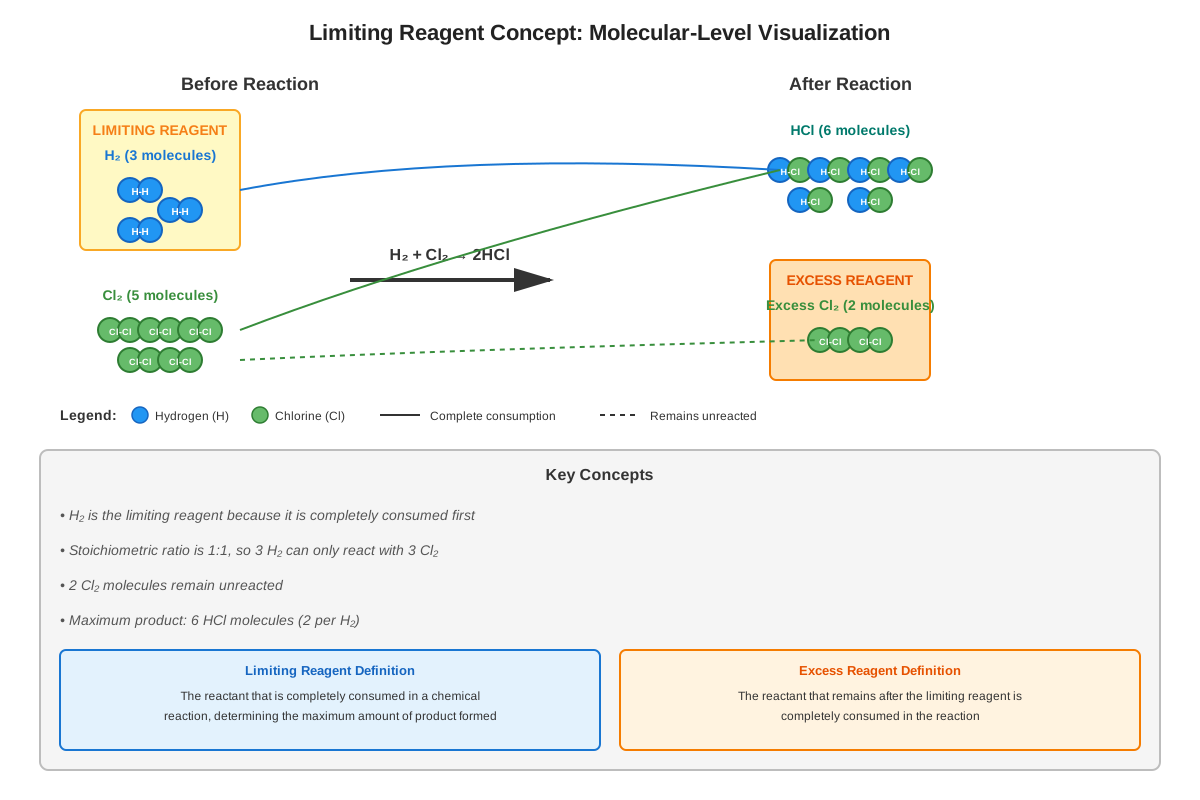
The limiting reagent (also called the limiting reactant) is a foundational concept in General Chemistry that determines the maximum amount of product that can be formed in a chemical reaction. When two or more reactants combine, they rarely do so in perfectly stoichiometric proportions. The limiting reagent is the reactant that is completely consumed first, thereby stopping the reaction and limiting the amount of product that can be generated. Understanding this concept is essential for solving quantitative problems in Stoichiometry and Reactions, as it bridges theoretical chemical equations with real-world laboratory scenarios where reactants are present in non-ideal ratios.
For the MCAT, limiting reagent problems appear regularly in the Chemical and Physical Foundations of Biological Systems section, often embedded within experimental passages or as discrete questions testing quantitative reasoning. These questions assess not only computational skills but also conceptual understanding of reaction stoichiometry, percent yield, and resource efficiency. The ability to quickly identify which reactant limits product formation is crucial for time management on test day, as these problems can be solved systematically using a step-wise approach.
The limiting reagent MCAT concept connects intimately with other General Chemistry topics including balanced chemical equations, molar relationships, percent yield, theoretical yield, and reaction efficiency. It also appears in biochemistry contexts when analyzing metabolic pathways, enzyme kinetics, and cellular respiration scenarios where substrate availability determines reaction outcomes. Mastering limiting reagent calculations provides the quantitative foundation for understanding more complex topics such as titrations, buffer systems, and thermochemical calculations that frequently appear on the MCAT.
Learning Objectives
- [ ] Define limiting reagent using accurate General Chemistry terminology
- [ ] Explain why limiting reagent matters for the MCAT
- [ ] Apply limiting reagent to exam-style questions
- [ ] Identify common mistakes related to limiting reagent
- [ ] Connect limiting reagent to related General Chemistry concepts
- [ ] Calculate theoretical yield based on the limiting reagent in multi-step reactions
- [ ] Determine the amount of excess reagent remaining after a reaction goes to completion
- [ ] Analyze experimental data to identify limiting reagents in laboratory scenarios
Prerequisites
- Balanced chemical equations: Essential for determining molar ratios between reactants and products, which form the basis of all limiting reagent calculations
- Mole concept and molar mass: Required to convert between grams and moles, the fundamental unit for stoichiometric calculations
- Stoichiometric coefficients: Understanding how coefficients represent molar ratios is necessary to compare reactant quantities
- Dimensional analysis: The problem-solving framework used to systematically convert units and apply stoichiometric ratios
- Basic algebra: Needed to set up and solve proportional relationships between reactants and products
Why This Topic Matters
In clinical and research settings, limiting reagent concepts govern everything from pharmaceutical synthesis to diagnostic testing. When manufacturing medications, chemists must identify which starting material limits production to optimize costs and minimize waste. In diagnostic assays, reagent availability determines test sensitivity—for example, in ELISA tests, the limiting antibody concentration dictates how many antigen molecules can be detected. Understanding limiting reagents also explains why certain metabolic pathways become rate-limited when specific substrates are depleted, such as oxygen limitation during anaerobic respiration.
On the MCAT, limiting reagent questions appear in approximately 3-5% of Chemical and Physical Foundations questions, making them medium-yield but highly predictable. These questions typically present in three formats: (1) discrete questions asking for direct calculation of theoretical yield, (2) passage-based questions embedded in experimental descriptions where students must interpret data tables showing reactant quantities, and (3) conceptual questions testing understanding of how changing reactant ratios affects product formation. The MCAT particularly favors questions that combine limiting reagent calculations with percent yield or require students to determine excess reagent amounts.
Passages commonly present limiting reagent scenarios in the context of organic synthesis experiments, biochemical pathway analysis, or industrial chemistry applications. Students might encounter a passage describing a multi-step synthesis where they must identify which reagent limits the overall yield, or a metabolism passage where substrate availability determines ATP production. The ability to quickly recognize limiting reagent scenarios and apply systematic problem-solving approaches can save valuable time and improve accuracy on test day.
Core Concepts
Definition and Fundamental Principle
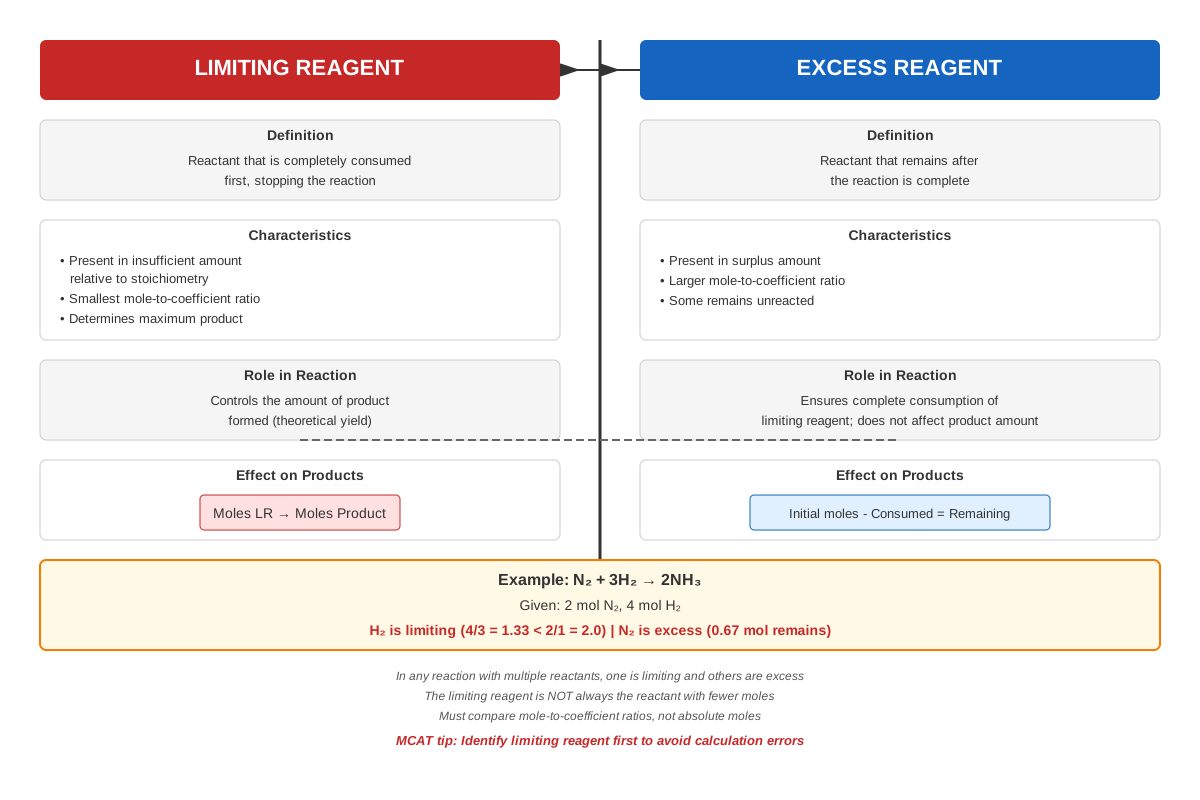
The limiting reagent is the reactant in a chemical reaction that is completely consumed first, thereby determining the maximum amount of product that can be formed. Once the limiting reagent is exhausted, the reaction stops, even if other reactants (called excess reagents) remain. This concept arises because chemical reactions proceed according to fixed stoichiometric ratios defined by the balanced chemical equation, but real-world reaction mixtures rarely contain reactants in these exact proportions.
Consider the general reaction: aA + bB → cC + dD, where lowercase letters represent stoichiometric coefficients and uppercase letters represent chemical species. For every 'a' moles of A that react, exactly 'b' moles of B are required. If the actual molar ratio of A to B in the reaction mixture differs from a:b, one reactant will be completely consumed before the other, making it the limiting reagent.
Identifying the Limiting Reagent
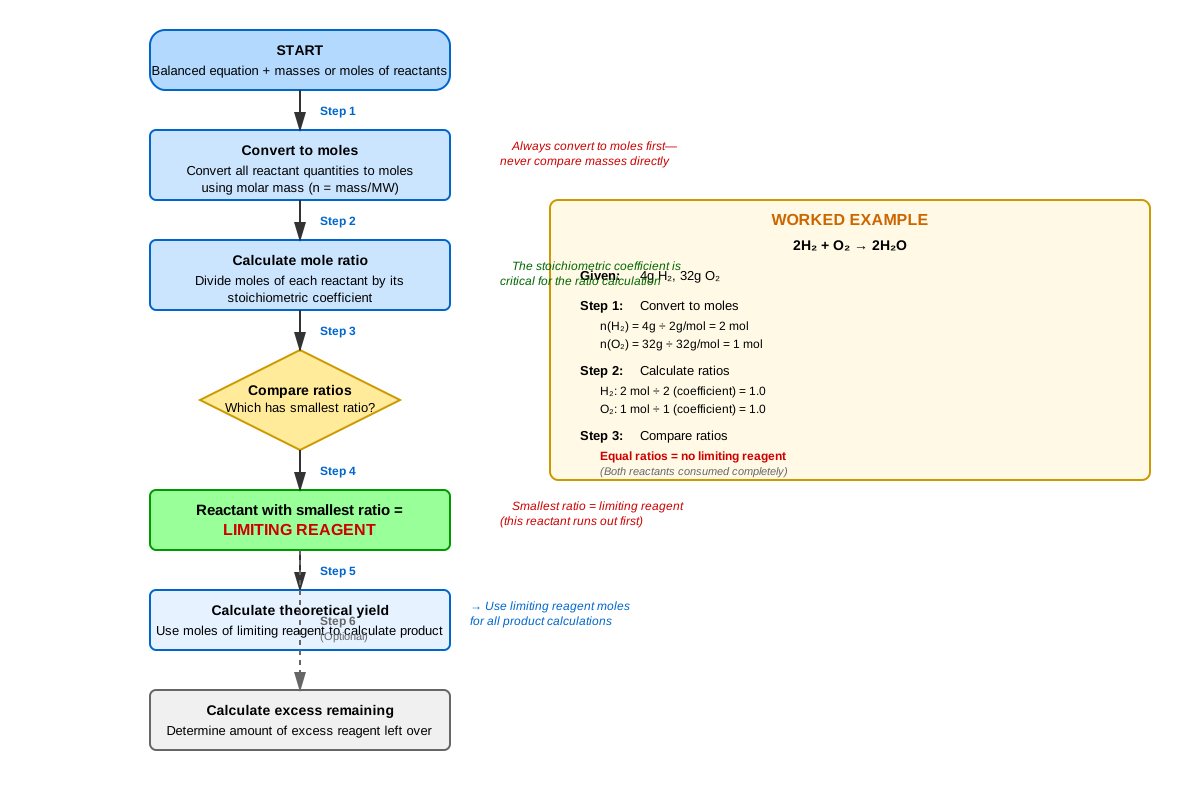
The systematic approach to identifying the limiting reagent involves three key steps:
- Write and balance the chemical equation to establish the stoichiometric molar ratios between all reactants and products
- Convert all given quantities to moles using molar masses (if given in grams) or other appropriate conversion factors
- Calculate the mole ratio of available reactants and compare to the required stoichiometric ratio
The comparison can be performed using two equivalent methods:
Method 1: Moles of Product Approach
Calculate how many moles of product each reactant could theoretically produce if it were completely consumed. The reactant that produces the least amount of product is the limiting reagent.
Method 2: Required vs. Available Approach
For each reactant, calculate how many moles would be required to completely consume another reactant. Compare required amounts to available amounts. The reactant that would be consumed first is the limiting reagent.
Quantitative Calculations
Once the limiting reagent is identified, it determines the theoretical yield—the maximum amount of product that can be formed based on stoichiometric calculations. The calculation follows this sequence:
Moles of limiting reagent → Moles of product (using stoichiometric ratio) → Mass of product (using molar mass)The amount of excess reagent remaining after the reaction can be calculated by:
- Determining how much excess reagent actually reacted (based on the limiting reagent)
- Subtracting the amount that reacted from the initial amount available
Stoichiometric Relationships Table
| Concept | Definition | Calculation Basis |
|---|---|---|
| Limiting Reagent | Reactant completely consumed first | Produces least product when fully reacted |
| Excess Reagent | Reactant(s) remaining after reaction stops | Present in greater than stoichiometric amounts |
| Theoretical Yield | Maximum product possible | Based on limiting reagent only |
| Actual Yield | Product actually obtained experimentally | Measured in laboratory |
| Percent Yield | Efficiency of reaction | (Actual/Theoretical) × 100% |
Practical Considerations
In laboratory and industrial settings, chemists often deliberately use one reactant in excess to ensure complete consumption of a more expensive or critical reagent. This strategy maximizes the conversion of the valuable limiting reagent into product. For example, in pharmaceutical synthesis, an expensive active pharmaceutical ingredient might be the limiting reagent, while cheaper solvents or reagents are used in excess to drive the reaction to completion.
The limiting reagent concept also explains why reactions may not proceed to 100% completion even when excess reagents are present. Factors such as equilibrium position, side reactions, and product inhibition can prevent complete consumption of the limiting reagent, resulting in actual yields lower than theoretical yields.
Multi-Step Reactions
In multi-step synthesis reactions, the limiting reagent from one step becomes a reactant in subsequent steps. The overall yield of a multi-step process depends on the limiting reagent at each individual step. Students must track how the product of one reaction becomes the limiting or excess reagent in the next reaction, requiring careful attention to stoichiometric relationships across multiple transformations.
Concept Relationships
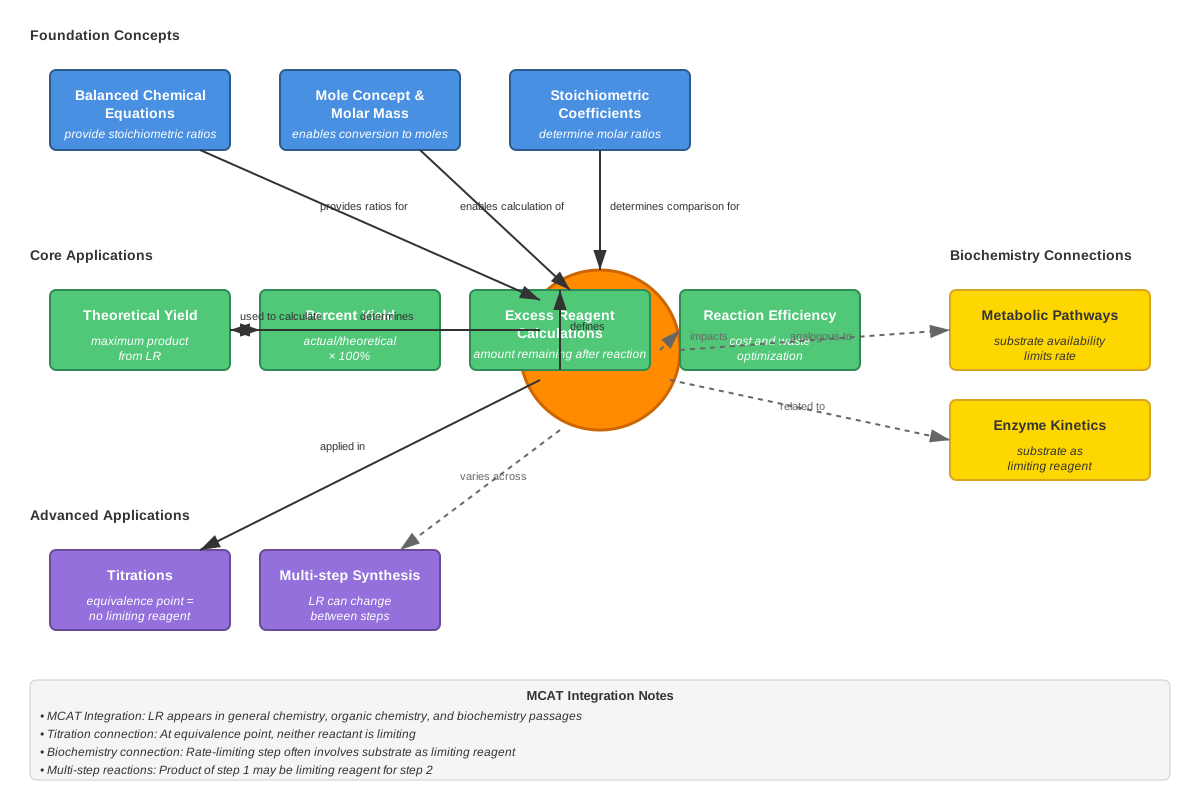
The limiting reagent concept serves as a central hub connecting multiple stoichiometric principles. The relationship begins with balanced chemical equations, which provide the stoichiometric coefficients that define molar ratios. These ratios, combined with the mole concept, enable conversion between masses and moles of reactants and products.
Limiting reagent → determines → Theoretical yield → compared with → Actual yield → calculates → Percent yield
This sequence represents the typical problem-solving pathway. Once the limiting reagent is identified, it directly determines the theoretical yield through stoichiometric calculations. The theoretical yield then serves as the denominator in percent yield calculations, connecting limiting reagent concepts to reaction efficiency analysis.
The concept also connects to reaction kinetics and chemical equilibrium. While limiting reagent calculations assume reactions go to completion, real reactions may reach equilibrium before the limiting reagent is fully consumed. In such cases, the limiting reagent concept must be modified to account for equilibrium constants and reversible reactions.
In biochemical contexts, limiting reagent principles explain rate-limiting steps in metabolic pathways. The substrate present in the smallest stoichiometric amount relative to its requirement becomes the limiting factor for pathway flux, directly connecting stoichiometry to enzyme kinetics and cellular metabolism—topics frequently tested together on the MCAT.
The relationship extends to solution stoichiometry and titrations, where the limiting reagent concept determines equivalence points. In acid-base titrations, the titrant becomes the limiting reagent at the equivalence point, having exactly neutralized all available analyte.
Quick check — test yourself on Limiting reagent so far.
Try Flashcards →High-Yield Facts
⭐ The limiting reagent is always completely consumed in a reaction, while excess reagents remain partially unreacted
⭐ To identify the limiting reagent, calculate moles of product each reactant could produce; the reactant producing the least product is limiting
⭐ Theoretical yield must always be calculated based on the limiting reagent, never the excess reagent
⭐ The limiting reagent determines the maximum amount of all products formed, not just one specific product
⭐ In a balanced equation, stoichiometric coefficients represent the molar ratio in which reactants combine, not mass ratios
- Percent yield = (Actual yield / Theoretical yield) × 100%, where theoretical yield comes from the limiting reagent
- Excess reagent remaining = Initial moles of excess reagent - Moles consumed (calculated from limiting reagent)
- When reactants are present in exactly stoichiometric proportions, there is no excess reagent; all reactants are limiting
- Limiting reagent problems require unit consistency—always convert to moles before comparing reactant quantities
- In multi-step reactions, the product of one step may become the limiting reagent for the next step
- Industrial processes often use expensive reagents as limiting reagents and cheaper reagents in excess to maximize product formation
- The limiting reagent concept applies to all reaction types: synthesis, decomposition, single replacement, double replacement, and combustion
Common Misconceptions
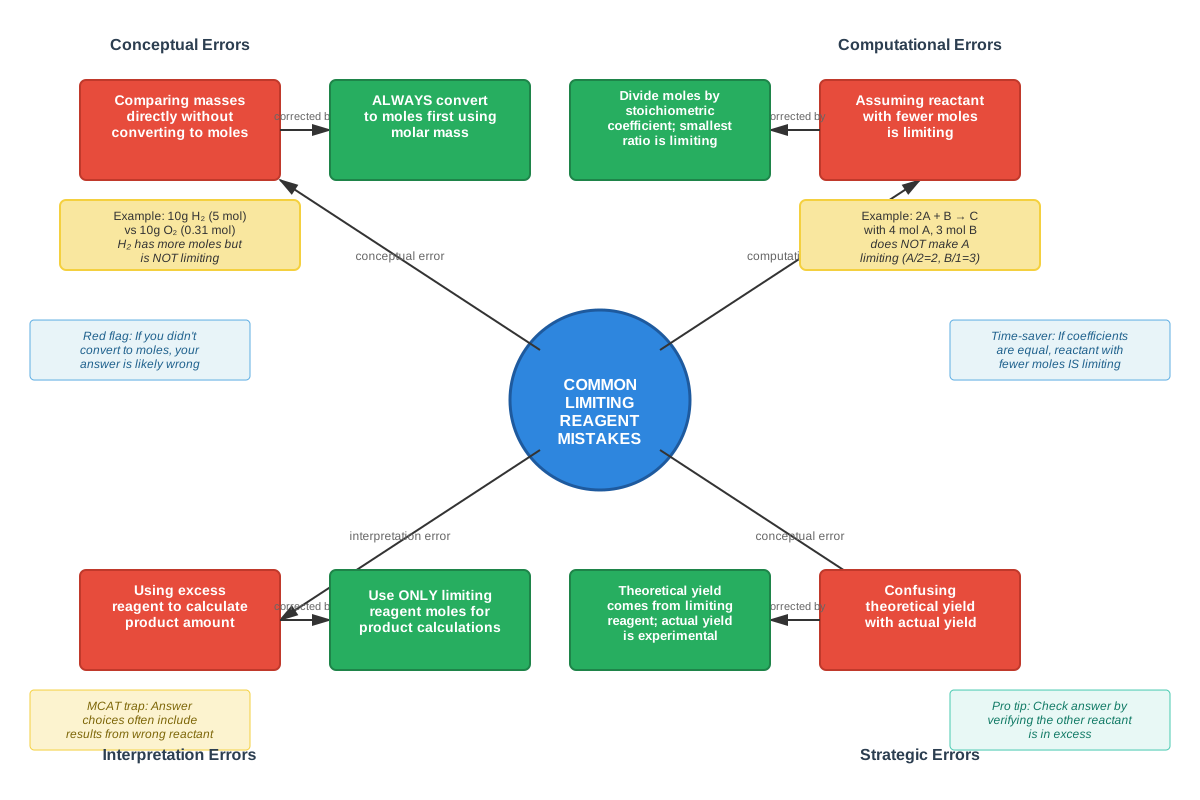
Misconception: The reactant present in the smallest mass is always the limiting reagent.
Correction: The limiting reagent is determined by molar ratios relative to stoichiometric coefficients, not absolute mass. A reactant with smaller mass but lower molar mass might actually be present in excess on a molar basis.
Misconception: The limiting reagent is always the reactant with the smallest stoichiometric coefficient.
Correction: Stoichiometric coefficients indicate required ratios, not which reactant is limiting. The limiting reagent depends on the actual amounts present compared to these required ratios.
Misconception: If one reactant is in excess, the other must be limiting.
Correction: While true for reactions with only two reactants, reactions with three or more reactants require systematic comparison of all reactants to identify which one is limiting.
Misconception: Theoretical yield can be calculated using either reactant.
Correction: Theoretical yield must be calculated exclusively from the limiting reagent. Using the excess reagent will produce an erroneously high theoretical yield that doesn't reflect the actual reaction constraints.
Misconception: The limiting reagent always produces the least amount of product by mass.
Correction: The limiting reagent produces the least amount of product by moles. When converted to mass, this may or may not be the smallest mass depending on the molar mass of the product.
Misconception: Adding more excess reagent will increase product yield.
Correction: Once a reagent is in excess, adding more of it cannot increase yield. Only adding more of the limiting reagent will increase product formation.
Misconception: In a reaction at equilibrium, the limiting reagent is completely consumed.
Correction: Limiting reagent calculations assume reactions go to completion. At equilibrium, some limiting reagent may remain unreacted, and the concept must be modified to account for the equilibrium constant.
Worked Examples
Example 1: Basic Limiting Reagent Calculation
Problem: Consider the reaction: N₂(g) + 3H₂(g) → 2NH₃(g). If 5.0 moles of N₂ react with 12.0 moles of H₂, identify the limiting reagent and calculate the theoretical yield of NH₃ in moles.
Solution:
Step 1: Identify the stoichiometric ratios from the balanced equation.
- 1 mole N₂ requires 3 moles H₂
- 1 mole N₂ produces 2 moles NH₃
- 3 moles H₂ produce 2 moles NH₃
Step 2: Calculate moles of NH₃ each reactant could produce if completely consumed.
From N₂:
5.0 mol N₂ × (2 mol NH₃ / 1 mol N₂) = 10.0 mol NH₃From H₂:
12.0 mol H₂ × (2 mol NH₃ / 3 mol H₂) = 8.0 mol NH₃Step 3: Identify the limiting reagent.
H₂ produces less NH₃ (8.0 mol vs. 10.0 mol), so H₂ is the limiting reagent.
Step 4: Calculate theoretical yield.
The theoretical yield is 8.0 moles NH₃ (based on the limiting reagent, H₂).
Step 5: Calculate excess reagent remaining.
How much N₂ actually reacted?
12.0 mol H₂ × (1 mol N₂ / 3 mol H₂) = 4.0 mol N₂ reactedExcess N₂ remaining = 5.0 mol - 4.0 mol = 1.0 mol N₂
Connection to Learning Objectives: This example demonstrates the systematic approach to identifying limiting reagents (Objective 3) and calculating theoretical yield (Objective 6), while also showing how to determine excess reagent amounts (Objective 7).
Example 2: Mass-Based Limiting Reagent Problem
Problem: Aluminum reacts with iron(III) oxide in a thermite reaction: 2Al(s) + Fe₂O₃(s) → Al₂O₃(s) + 2Fe(s). If 54.0 g of Al reacts with 160.0 g of Fe₂O₃, determine the limiting reagent and calculate the mass of iron produced. (Molar masses: Al = 27.0 g/mol, Fe₂O₃ = 160.0 g/mol, Fe = 55.8 g/mol)
Solution:
Step 1: Convert masses to moles.
Moles of Al = 54.0 g / 27.0 g/mol = 2.0 mol Al
Moles of Fe₂O₃ = 160.0 g / 160.0 g/mol = 1.0 mol Fe₂O₃
Step 2: Calculate moles of Fe each reactant could produce.
From Al:
2.0 mol Al × (2 mol Fe / 2 mol Al) = 2.0 mol FeFrom Fe₂O₃:
1.0 mol Fe₂O₃ × (2 mol Fe / 1 mol Fe₂O₃) = 2.0 mol FeStep 3: Identify the limiting reagent.
Both reactants produce the same amount of Fe (2.0 mol), indicating they are present in exactly stoichiometric proportions. Neither reactant is in excess; both are completely consumed. Either can be considered the limiting reagent, or more accurately, there is no excess reagent.
Step 4: Calculate theoretical yield of Fe.
2.0 mol Fe × 55.8 g/mol = 111.6 g FeConnection to Learning Objectives: This example illustrates the special case where reactants are present in stoichiometric proportions (addressing Objective 4 on common mistakes) and demonstrates the complete problem-solving process from mass to moles to product mass (Objective 3).
Exam Strategy
Trigger Words: Watch for phrases like "which reactant is in excess," "maximum amount of product," "theoretical yield," "completely consumed," or "limiting reactant." These signal limiting reagent problems.
Systematic Approach for MCAT Questions:
- Immediately write the balanced equation if not provided, or verify the given equation is balanced
- Convert all quantities to moles first—never compare masses or volumes directly
- Use the "moles of product" method for speed: calculate how much product each reactant makes, and the smallest value identifies the limiting reagent
- Double-check stoichiometric ratios—the most common error is misapplying coefficients
Process of Elimination Tips:
- Eliminate answer choices that calculate theoretical yield from the excess reagent
- If a question asks for "maximum product," eliminate choices that don't use the limiting reagent
- For "excess reagent remaining" questions, eliminate choices that show zero remaining for the limiting reagent
- Watch for answer choices that confuse mass ratios with mole ratios
Time Management:
Limiting reagent calculations typically require 60-90 seconds for discrete questions and up to 2 minutes for passage-based questions. If a problem seems to require extensive calculation, look for shortcuts:
- Check if reactants are in stoichiometric proportions (coefficients match mole ratios)
- Use dimensional analysis in one continuous calculation rather than multiple steps
- Round numbers strategically to simplify mental math
Common Question Formats:
- Direct calculation: "What is the theoretical yield of product X?"
- Identification: "Which reactant is the limiting reagent?"
- Excess reagent: "How many grams of reactant Y remain after the reaction?"
- Percent yield: "If 15.0 g of product was obtained, what is the percent yield?" (requires limiting reagent calculation first)
- Conceptual: "If more of reactant Z is added, will the yield increase?" (tests understanding of limiting vs. excess)
Memory Techniques
"LIMB" Method for Limiting Reagent Problems:
- List the balanced equation
- Identify moles of each reactant
- Multiply by stoichiometric ratios to find product moles
- Bottleneck (smallest product amount) identifies the limiting reagent
Visualization Strategy:
Picture a factory assembly line where one component runs out first, stopping production even though other parts remain. The depleted component is the "limiting reagent" of the assembly process.
"LESS Product = Limiting":
The reactant that produces LESS product (when each is assumed to react completely) is the LIMITING reagent.
Mnemonic for Calculation Sequence:
"My Teacher Produces Answers"
- Moles of limiting reagent
- Times stoichiometric ratio
- Produces moles of product
- Apply molar mass for grams
Excess Reagent Reminder:
"Excess Equals Everything minus Employed"
(Excess remaining = Everything you started with - Employed in reaction)
Summary
The limiting reagent is the reactant that is completely consumed first in a chemical reaction, thereby determining the maximum theoretical yield of products. This fundamental concept in Stoichiometry and Reactions requires students to compare the available molar quantities of reactants to the stoichiometric ratios defined by the balanced chemical equation. The systematic approach involves converting all quantities to moles, calculating how much product each reactant could theoretically produce, and identifying the reactant that produces the least product as the limiting reagent. All theoretical yield calculations must be based exclusively on the limiting reagent, while excess reagents remain partially unreacted. For the MCAT, mastering limiting reagent problems requires both computational proficiency and conceptual understanding of how stoichiometric relationships govern reaction outcomes. This topic connects to broader General Chemistry concepts including percent yield, reaction efficiency, and solution stoichiometry, and frequently appears in experimental passages requiring quantitative analysis. Success on limiting reagent MCAT questions depends on recognizing trigger words, applying dimensional analysis systematically, and avoiding common errors such as confusing mass ratios with mole ratios or calculating theoretical yield from excess reagents.
Key Takeaways
- The limiting reagent is completely consumed first and determines the maximum theoretical yield of all products
- Always convert to moles before comparing reactant quantities; never compare masses directly
- Calculate moles of product from each reactant separately; the reactant producing the least product is limiting
- Theoretical yield must be calculated using only the limiting reagent, never the excess reagent
- Excess reagent remaining equals initial amount minus the amount that actually reacted (calculated from limiting reagent stoichiometry)
- Stoichiometric coefficients represent molar ratios, not mass ratios—this is the most common source of errors
- When reactants are present in exactly stoichiometric proportions, all reactants are completely consumed with no excess
Related Topics
Percent Yield and Reaction Efficiency: Building on limiting reagent calculations, percent yield compares actual laboratory results to theoretical predictions, introducing concepts of reaction efficiency and side reactions.
Solution Stoichiometry and Molarity: Extends limiting reagent concepts to reactions in solution, requiring integration of molarity calculations with stoichiometric principles.
Titrations and Equivalence Points: Applies limiting reagent logic to acid-base neutralization reactions, where the equivalence point represents the moment when the titrant becomes the limiting reagent.
Thermochemistry and Enthalpy Calculations: Uses limiting reagent identification to determine the correct amount of heat released or absorbed in chemical reactions.
Enzyme Kinetics and Michaelis-Menten: Translates limiting reagent concepts to biochemical contexts where substrate concentration limits reaction rate.
Practice CTA
Now that you've mastered the core concepts of limiting reagents, it's time to solidify your understanding through active practice. Work through the practice questions to test your ability to identify limiting reagents quickly and accurately under timed conditions. Use the flashcards to reinforce high-yield facts and common calculation patterns. Remember, limiting reagent problems are highly predictable on the MCAT—consistent practice will build the speed and confidence you need to excel on test day. Every problem you solve strengthens your stoichiometric reasoning and brings you closer to your target score!
Sign up free to keep reading
Create a free AnvayaPrep account to finish this MCAT guide on Limiting reagent — plus flashcards and practice questions.