Overview
Bond enthalpy (also called bond dissociation energy) represents the energy required to break one mole of a particular type of bond in gaseous molecules under standard conditions. This fundamental concept in General Chemistry bridges the gap between molecular structure and energy changes in chemical reactions, making it an essential tool for understanding thermodynamics on the MCAT. When students grasp bond enthalpy, they gain the ability to predict whether reactions will release or absorb energy, estimate reaction enthalpies without calorimetry, and understand why certain molecules are more stable than others.
For the MCAT, bond enthalpy serves as a critical link between the Chemical and Physical Foundations of Biological Systems section and real-world biochemical processes. The exam frequently tests this concept through calculation-based questions, passage analysis involving reaction energetics, and conceptual questions about molecular stability. Understanding bond enthalpy enables students to tackle questions about metabolism, drug interactions, and physiological processes where energy transformations are central. The ability to quickly estimate reaction enthalpies using bond energies can save valuable time on test day and provide a sanity check for more complex thermodynamic calculations.
Bond enthalpy General Chemistry concepts extend beyond isolated calculations to encompass broader themes in chemical reactivity, molecular stability, and energy conservation. This topic integrates seamlessly with Hess's Law, enthalpy of formation, reaction spontaneity, and kinetics. Mastering bond enthalpy provides students with a molecular-level understanding of why certain reactions occur spontaneously while others require energy input, and why some bonds are easier to break than others—knowledge that proves invaluable when analyzing biochemical pathways and pharmacological mechanisms on the MCAT.
Learning Objectives
- [ ] Define Bond enthalpy using accurate General Chemistry terminology
- [ ] Explain why Bond enthalpy matters for the MCAT
- [ ] Apply Bond enthalpy to exam-style questions
- [ ] Identify common mistakes related to Bond enthalpy
- [ ] Connect Bond enthalpy to related General Chemistry concepts
- [ ] Calculate reaction enthalpy changes using tabulated bond enthalpy values
- [ ] Predict relative bond strengths based on molecular structure and bonding characteristics
- [ ] Distinguish between average bond enthalpies and specific bond dissociation energies
- [ ] Analyze the relationship between bond enthalpy, bond length, and bond order
Prerequisites
- Basic thermodynamic principles: Understanding of enthalpy, exothermic and endothermic processes, and the first law of thermodynamics is essential for interpreting energy changes during bond breaking and formation
- Chemical bonding fundamentals: Knowledge of covalent bonds, ionic bonds, and intermolecular forces provides the structural foundation for understanding what bond enthalpy measures
- Stoichiometry and mole concept: Ability to work with molar quantities is necessary since bond enthalpy is defined per mole of bonds
- Lewis structures and molecular geometry: Skill in drawing molecular structures allows identification of specific bonds whose enthalpies contribute to overall reaction energetics
- Sign conventions in thermodynamics: Understanding that energy absorbed is positive and energy released is negative prevents calculation errors
Why This Topic Matters
Bond enthalpy MCAT questions appear regularly across multiple contexts within the Chemical and Physical Foundations of Biological Systems section. Approximately 3-5% of chemistry questions directly or indirectly involve bond enthalpy concepts, making this a medium-yield but strategically important topic. The MCAT particularly favors questions that require students to estimate reaction enthalpies, compare molecular stabilities, or explain why certain biochemical reactions require ATP coupling while others proceed spontaneously.
In clinical and biological contexts, bond enthalpy principles explain fundamental processes such as why ATP hydrolysis releases energy for cellular work, how enzymes lower activation energy without changing reaction thermodynamics, and why certain drug molecules are metabolized more readily than others. Understanding bond strengths helps explain why carbon-carbon bonds form the stable backbone of biological molecules, why oxygen is such an effective oxidizing agent in cellular respiration, and why nitrogen fixation requires substantial energy input despite the thermodynamic favorability of ammonia formation.
The MCAT presents bond enthalpy through several question formats: discrete questions requiring calculation of ΔH°rxn from bond enthalpies, passage-based questions analyzing experimental data about bond strengths, and conceptual questions linking molecular structure to reactivity. Students may encounter passages about combustion reactions, polymerization processes, photosynthesis energetics, or pharmaceutical synthesis where bond enthalpy calculations provide insight into reaction feasibility. The ability to quickly estimate whether a reaction is exothermic or endothermic by comparing bonds broken versus bonds formed represents a high-yield skill that distinguishes top-scoring students.
Core Concepts
Definition and Fundamental Principles
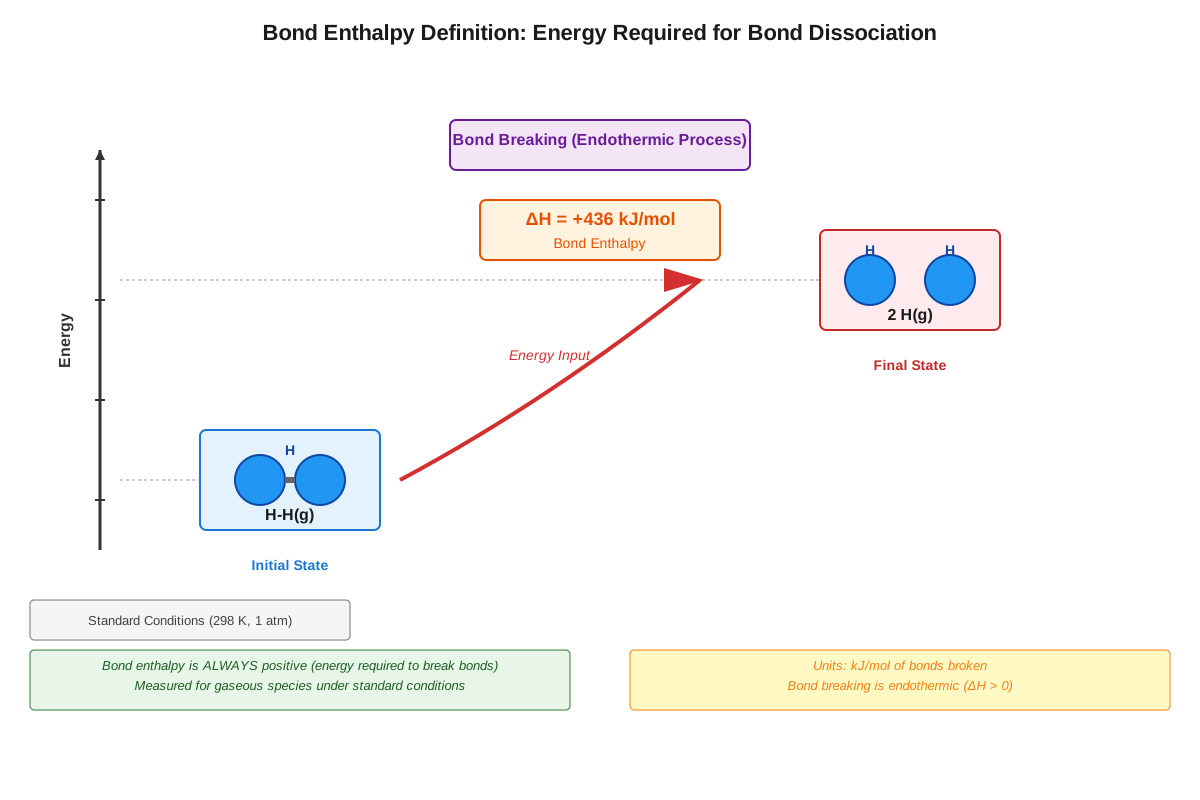
Bond enthalpy (ΔH°bond) is defined as the standard enthalpy change when one mole of covalent bonds in gaseous molecules is broken to produce gaseous atoms or radicals. The standard conditions specify 298 K (25°C) and 1 atm pressure. For example, the bond enthalpy of H-H refers to the energy required for the process: H₂(g) → 2H(g), which equals +436 kJ/mol. The positive sign indicates that bond breaking is always an endothermic process requiring energy input.
Conversely, bond formation releases energy and is always exothermic. When two hydrogen atoms combine to form H₂, the process releases 436 kJ/mol. This reciprocal relationship is fundamental: the energy required to break a bond equals the energy released when that bond forms. This principle stems from the conservation of energy and allows us to use the same tabulated values for both bond-breaking and bond-forming calculations, adjusting only the sign.
The magnitude of bond enthalpy reflects bond strength—stronger bonds require more energy to break and release more energy when formed. Bond strength correlates with several molecular properties: shorter bonds are generally stronger, bonds between smaller atoms are stronger than those between larger atoms (due to more effective orbital overlap), and multiple bonds are stronger than single bonds between the same atoms.
Average Bond Enthalpies vs. Specific Bond Dissociation Energies
An important distinction exists between average bond enthalpies and specific bond dissociation energies. A specific bond dissociation energy refers to breaking a particular bond in a specific molecule. For example, breaking the first O-H bond in water (H₂O → HO• + H•) requires 499 kJ/mol, while breaking the second O-H bond (HO• → O• + H•) requires 428 kJ/mol. These values differ because the electronic environment changes after the first bond breaks.
Average bond enthalpy values, typically provided in MCAT reference tables, represent the mean energy required to break a particular type of bond across many different molecules. The average O-H bond enthalpy (~463 kJ/mol) represents an average across water, alcohols, carboxylic acids, and other molecules containing O-H bonds. This averaging is necessary because the exact bond strength varies depending on the molecular environment—the O-H bond in methanol differs slightly from that in ethanol or phenol.
For MCAT purposes, calculations use average bond enthalpies, and students should understand that results represent estimates rather than exact values. This approximation works well for comparing reactions or determining whether a process is exothermic or endothermic, but may differ from experimentally measured values by 5-10%.
Calculating Reaction Enthalpy from Bond Enthalpies
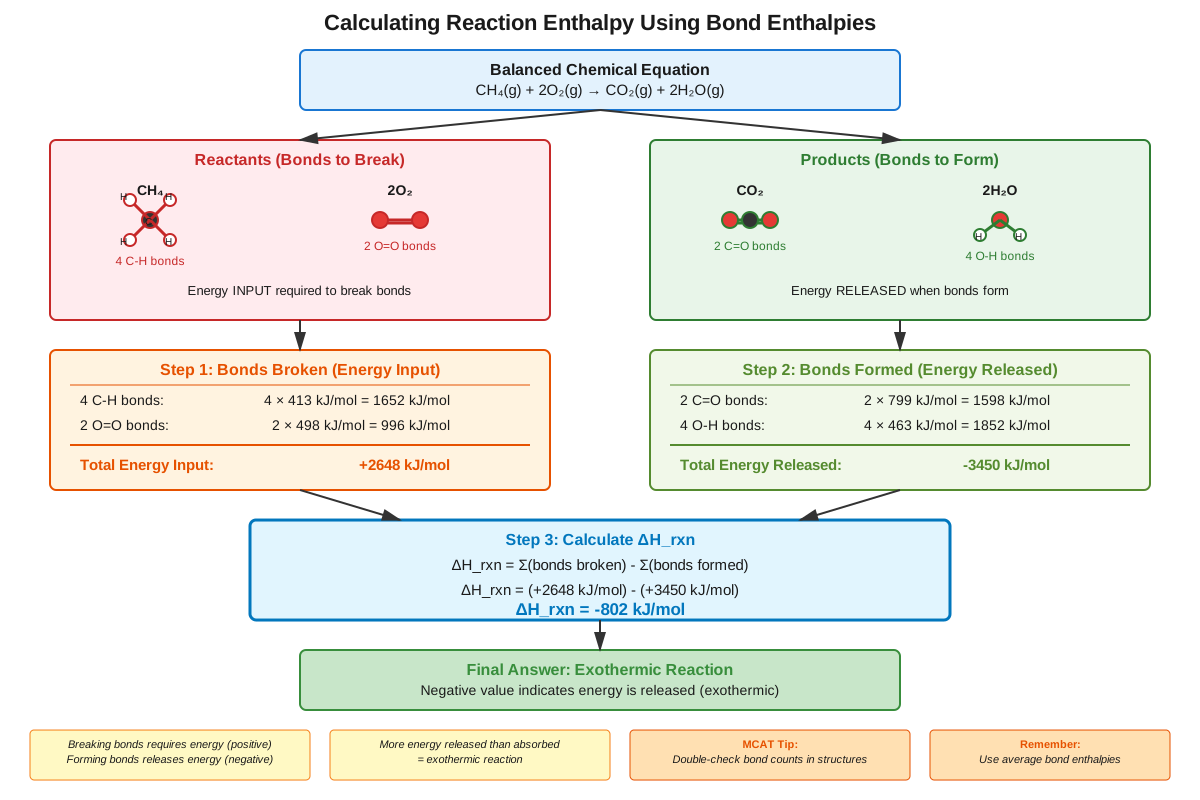
The most common MCAT application involves calculating ΔH°rxn (reaction enthalpy) using bond enthalpies. The fundamental equation is:
ΔH°rxn = Σ(bonds broken) - Σ(bonds formed)Or equivalently:
ΔH°rxn = Σ(bond enthalpies of reactants) - Σ(bond enthalpies of products)The logic behind this equation: breaking bonds requires energy input (positive contribution), while forming bonds releases energy (negative contribution). A negative ΔH°rxn indicates an exothermic reaction (more energy released in bond formation than consumed in bond breaking), while a positive value indicates an endothermic reaction.
Step-by-step calculation process:
- Draw complete Lewis structures for all reactants and products
- Count each type of bond in reactants and products
- Multiply the number of each bond type by its bond enthalpy
- Sum all bond enthalpies for bonds broken (reactants)
- Sum all bond enthalpies for bonds formed (products)
- Subtract bonds formed from bonds broken
Bond Enthalpy Trends and Patterns
Several predictable trends govern bond enthalpy values:
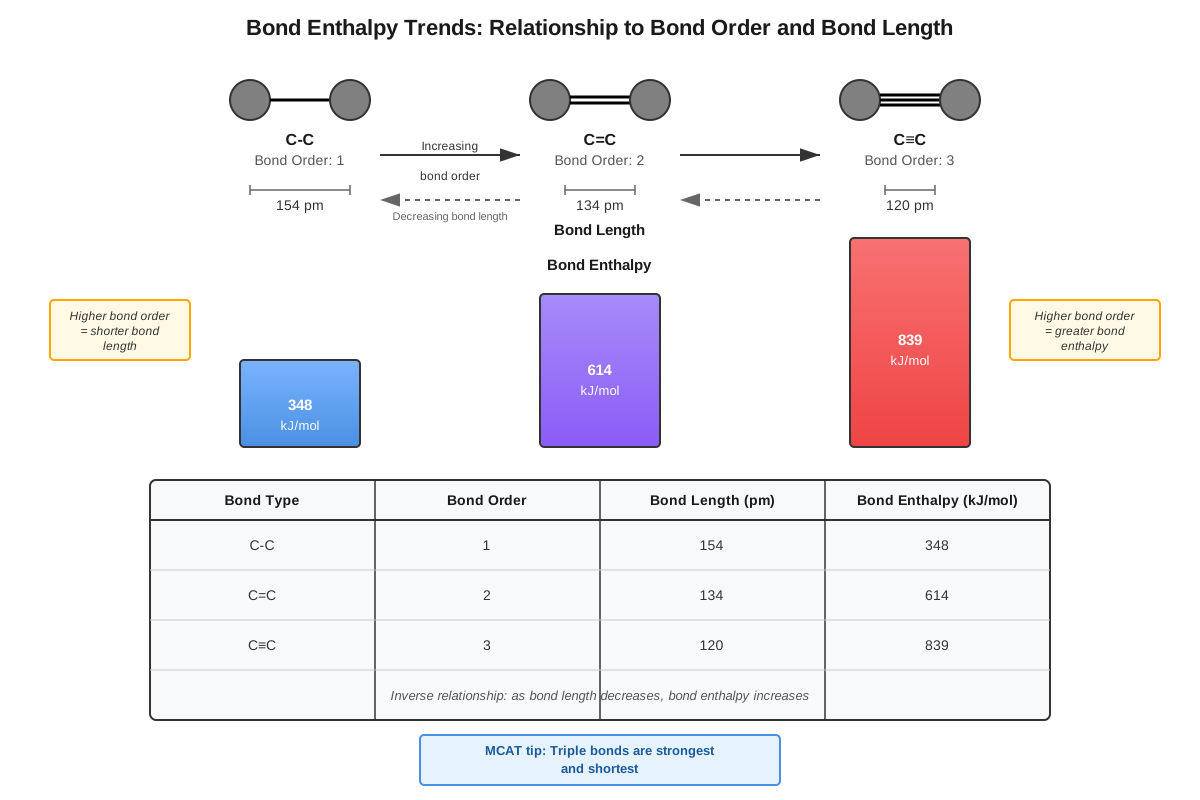
Bond order correlation: Triple bonds > Double bonds > Single bonds. For carbon-carbon bonds: C≡C (~839 kJ/mol) > C=C (~614 kJ/mol) > C-C (~348 kJ/mol). However, note that a triple bond is not three times as strong as a single bond—the second and third bonds (π bonds) are weaker than the first σ bond.
Atomic size effects: Bond enthalpy generally decreases as atomic size increases down a group. For hydrogen halides: H-F (567 kJ/mol) > H-Cl (431 kJ/mol) > H-Br (366 kJ/mol) > H-I (299 kJ/mol). Larger atoms have more diffuse orbitals, resulting in less effective overlap and weaker bonds.
Electronegativity differences: Bonds between atoms with large electronegativity differences often have higher bond enthalpies than predicted from size alone, due to partial ionic character. The H-F bond is exceptionally strong partly because of the large electronegativity difference between H and F.
Resonance stabilization: Bonds in resonance-stabilized molecules may have bond enthalpies that differ from typical values. The C-O bonds in carboxylate ions have intermediate character between single and double bonds, affecting their bond enthalpies.
Relationship to Molecular Stability
Thermodynamic stability of molecules relates directly to bond enthalpies. Molecules with stronger bonds are more stable and less reactive. This explains why nitrogen gas (N₂) is relatively unreactive despite many thermodynamically favorable reactions—the N≡N triple bond (945 kJ/mol) is one of the strongest bonds in chemistry, creating a high activation energy barrier.
The concept of bond enthalpy helps explain why certain functional groups are reactive sites in organic molecules. C-H bonds (~413 kJ/mol) are relatively strong, making alkanes unreactive, while O-O bonds in peroxides (~146 kJ/mol) are weak, making peroxides unstable and reactive. This principle extends to biochemistry: the high-energy phosphate bonds in ATP are actually not unusually strong bonds, but their hydrolysis is favorable due to the stability of the products.
Limitations and Considerations
Bond enthalpy calculations have important limitations. They apply only to gas-phase reactions because bond enthalpy values are defined for gaseous species. For reactions in solution or involving phase changes, additional terms (solvation energy, vaporization enthalpy) must be considered. The MCAT typically specifies gas-phase reactions or provides all necessary information when other phases are involved.
Steric effects and ring strain are not captured by simple bond enthalpy calculations. Cyclopropane, for example, has C-C bonds that are weaker than typical C-C bonds due to angle strain, but standard bond enthalpy tables don't reflect this. Similarly, highly branched molecules may have slightly different bond strengths due to steric crowding.
Concept Relationships
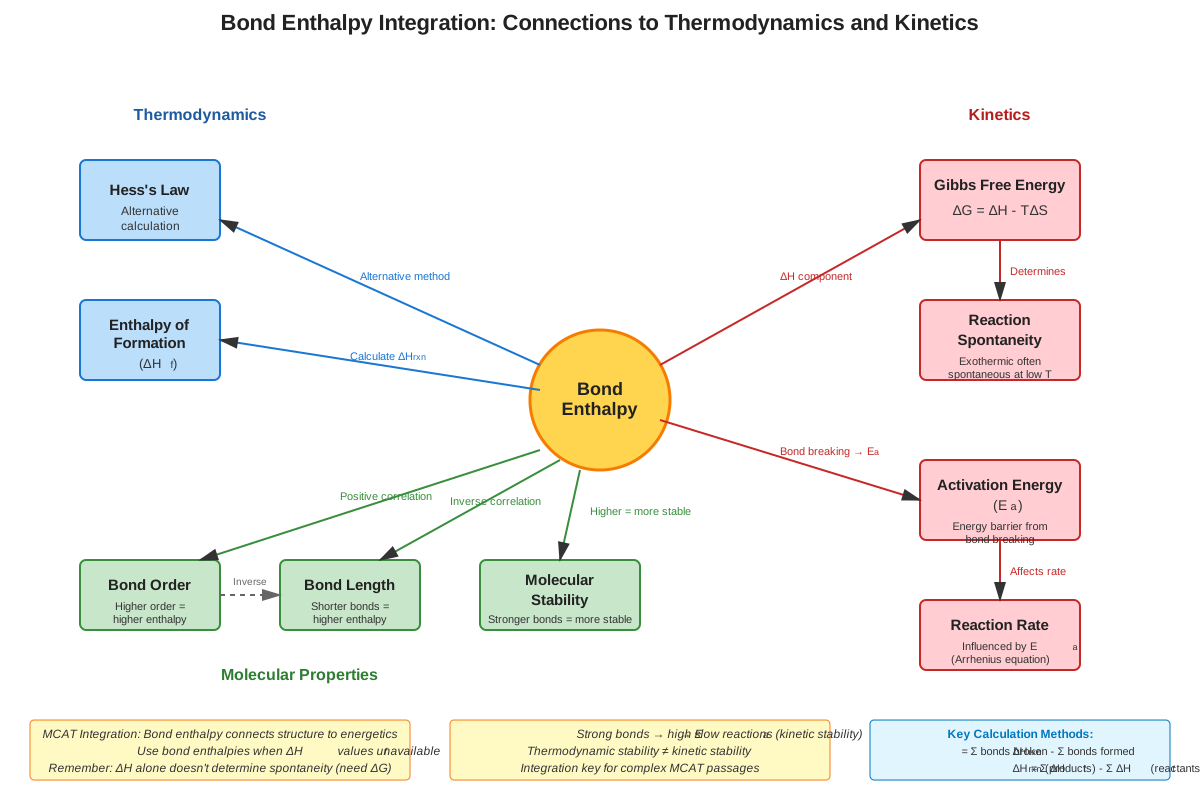
Bond enthalpy serves as a bridge between molecular structure and thermodynamic properties. At the molecular level, Lewis structures and molecular orbital theory explain why bonds have specific strengths—bond enthalpy quantifies these theoretical predictions. The relationship flows: electronic structure → bond characteristics (length, order, polarity) → bond enthalpy → reaction thermodynamics.
Within thermodynamics, bond enthalpy connects to Hess's Law as an alternative method for calculating ΔH°rxn. While Hess's Law uses enthalpies of formation (ΔH°f), bond enthalpy calculations use bond energies. Both methods should yield similar results for gas-phase reactions: ΔH°rxn (from ΔH°f) ≈ ΔH°rxn (from bond enthalpies). This relationship provides a valuable cross-check for calculations.
Bond enthalpy relates to Gibbs free energy (ΔG) and spontaneity, but the connection is indirect. While bond enthalpy determines ΔH, spontaneity depends on both ΔH and ΔS (entropy). A reaction with favorable bond enthalpies (exothermic) may still be non-spontaneous if entropy decreases significantly. Conversely, endothermic reactions can be spontaneous if entropy increases sufficiently.
The concept extends to kinetics through activation energy. While bond enthalpy tells us the energy difference between reactants and products (thermodynamics), it doesn't directly indicate the activation energy barrier (kinetics). However, stronger bonds generally require higher activation energies to break, creating a loose correlation between bond enthalpy and reaction rate.
Relationship map: Atomic properties (size, electronegativity) → Bond characteristics (length, order, polarity) → Bond enthalpy → ΔH°rxn → Combined with ΔS to determine ΔG → Predicts spontaneity. Parallel pathway: Bond enthalpy → Influences activation energy → Affects reaction rate (kinetics).
High-Yield Facts
⭐ Bond breaking always requires energy (endothermic, positive ΔH), while bond formation always releases energy (exothermic, negative ΔH)
⭐ ΔH°rxn = Σ(bonds broken) - Σ(bonds formed); negative ΔH°rxn indicates exothermic reaction
⭐ Average bond enthalpies are used for MCAT calculations and provide estimates, not exact values
⭐ Triple bonds are stronger than double bonds, which are stronger than single bonds between the same atoms
⭐ Bond enthalpy generally decreases as atomic size increases down a group (H-F > H-Cl > H-Br > H-I)
- Bond enthalpy values are defined for gas-phase species at standard conditions (298 K, 1 atm)
- Shorter bonds are generally stronger and have higher bond enthalpies than longer bonds
- The same bond type in different molecules has slightly different bond enthalpies due to varying electronic environments
- Bond enthalpy calculations assume all species are in the gas phase; phase changes require additional energy considerations
- Resonance-stabilized molecules may have bond enthalpies that differ from simple predictions
- The O-O bond in peroxides (~146 kJ/mol) is notably weak, explaining peroxide instability
- C-H bonds (~413 kJ/mol) are relatively strong, contributing to alkane stability
- The N≡N triple bond (~945 kJ/mol) is one of the strongest bonds, explaining nitrogen gas's low reactivity
- Bond polarity affects bond strength; highly polar bonds often have higher enthalpies than predicted by size alone
- Steric strain and ring strain affect actual bond strengths but aren't reflected in standard bond enthalpy tables
Quick check — test yourself on Bond enthalpy so far.
Try Flashcards →Common Misconceptions
Misconception: Bond enthalpy and bond energy are completely different concepts.
Correction: Bond enthalpy and bond energy are essentially synonymous terms, both referring to the energy required to break a bond. "Bond dissociation energy" is another equivalent term. The slight technical difference (enthalpy includes PV work) is negligible for most purposes and irrelevant for MCAT calculations.
Misconception: A triple bond is three times as strong as a single bond between the same atoms.
Correction: Triple bonds are stronger than single bonds but not by a factor of three. For C-C bonds: single (~348 kJ/mol), double (~614 kJ/mol), triple (~839 kJ/mol). The first σ bond is strongest; additional π bonds are progressively weaker due to less effective orbital overlap.
Misconception: Exothermic reactions have positive ΔH values because they release energy.
Correction: Exothermic reactions have negative ΔH values. The sign convention indicates the system's perspective: energy released by the system is negative, energy absorbed is positive. When bonds form and release energy, ΔH is negative.
Misconception: Bond enthalpy calculations give exact values for reaction enthalpies.
Correction: Bond enthalpy calculations provide estimates because they use average values across different molecular environments. Results typically agree with experimental values within 5-10% for gas-phase reactions, which is sufficient for MCAT purposes but not exact.
Misconception: Stronger bonds always make molecules more reactive.
Correction: Stronger bonds make molecules less reactive, not more. Strong bonds are harder to break, requiring more energy to initiate reactions. Weak bonds (like O-O in peroxides) make molecules unstable and reactive. Molecular stability and reactivity are inversely related.
Misconception: Bond enthalpy calculations work for all reactions regardless of phase.
Correction: Bond enthalpy values are defined for gas-phase species. For reactions involving liquids or solids, additional energy terms (vaporization, fusion, solvation) must be included. The MCAT typically specifies gas-phase reactions or provides necessary additional information.
Misconception: The bond enthalpy of O-H is the same in all molecules containing O-H bonds.
Correction: The O-H bond enthalpy varies slightly depending on the molecule (water, alcohols, carboxylic acids). Tabulated values represent averages. The first O-H bond in water (499 kJ/mol) differs from the second (428 kJ/mol) because the electronic environment changes after the first bond breaks.
Worked Examples
Example 1: Calculating Reaction Enthalpy for Methane Combustion
Question: Using the bond enthalpies provided, calculate ΔH°rxn for the complete combustion of methane: CH₄(g) + 2O₂(g) → CO₂(g) + 2H₂O(g)
Bond enthalpies: C-H = 413 kJ/mol, O=O = 495 kJ/mol, C=O = 799 kJ/mol, O-H = 463 kJ/mol
Solution:
Step 1: Draw Lewis structures and identify all bonds.
Reactants:
- CH₄ contains 4 C-H bonds
- 2O₂ contains 2 O=O bonds
Products:
- CO₂ contains 2 C=O bonds
- 2H₂O contains 4 O-H bonds (2 per water molecule)
Step 2: Calculate energy required to break bonds (reactants).
Bonds broken:
- 4 C-H bonds: 4 × 413 kJ/mol = 1,652 kJ/mol
- 2 O=O bonds: 2 × 495 kJ/mol = 990 kJ/mol
- Total bonds broken = 1,652 + 990 = 2,642 kJ/mol
Step 3: Calculate energy released when bonds form (products).
Bonds formed:
- 2 C=O bonds: 2 × 799 kJ/mol = 1,598 kJ/mol
- 4 O-H bonds: 4 × 463 kJ/mol = 1,852 kJ/mol
- Total bonds formed = 1,598 + 1,852 = 3,450 kJ/mol
Step 4: Calculate ΔH°rxn.
ΔH°rxn = Bonds broken - Bonds formed
ΔH°rxn = 2,642 kJ/mol - 3,450 kJ/mol = -808 kJ/mol
Interpretation: The negative value indicates this reaction is exothermic, releasing 808 kJ per mole of methane combusted. This makes sense—combustion reactions are highly exothermic. More energy is released forming the strong C=O and O-H bonds in products than is required to break the C-H and O=O bonds in reactants.
MCAT Connection: This type of calculation appears frequently on the MCAT. The exam might provide a table of bond enthalpies and ask you to calculate ΔH°rxn, or conversely, provide ΔH°rxn and ask you to determine an unknown bond enthalpy. Always organize your work systematically: list bonds broken, list bonds formed, then subtract.
Example 2: Comparing Molecular Stability
Question: A passage describes two isomeric compounds with the formula C₂H₆O: ethanol (CH₃CH₂OH) and dimethyl ether (CH₃OCH₃). Based on bond enthalpies, which compound would release more energy upon complete combustion to CO₂ and H₂O?
Bond enthalpies: C-H = 413 kJ/mol, C-C = 348 kJ/mol, C-O = 358 kJ/mol, O-H = 463 kJ/mol, O=O = 495 kJ/mol, C=O = 799 kJ/mol
Solution:
Step 1: Analyze the molecular structures.
Ethanol (CH₃CH₂OH):
- 5 C-H bonds
- 1 C-C bond
- 1 C-O bond
- 1 O-H bond
Dimethyl ether (CH₃OCH₃):
- 6 C-H bonds
- 2 C-O bonds
- 0 O-H bonds
Step 2: Recognize the key insight.
Both compounds have the same molecular formula, so they will produce the same products upon complete combustion: 2CO₂ + 3H₂O. Therefore, the energy released in forming product bonds is identical for both compounds.
Step 3: Calculate total bond enthalpies in reactants.
Ethanol:
- 5(413) + 1(348) + 1(358) + 1(463) = 2,065 + 348 + 358 + 463 = 3,234 kJ/mol
Dimethyl ether:
- 6(413) + 2(358) = 2,478 + 716 = 3,194 kJ/mol
Step 4: Interpret the results.
Ethanol has stronger total bonding (higher total bond enthalpy) than dimethyl ether by 40 kJ/mol. Since both produce the same products, the compound with weaker initial bonding (dimethyl ether) will release more energy upon combustion.
ΔH°combustion = (Bonds broken in reactants + Bonds broken in O₂) - (Bonds formed in products)
Since dimethyl ether has 40 kJ/mol less bonding to break, its combustion will be 40 kJ/mol less endothermic in the bond-breaking step, making the overall combustion 40 kJ/mol more exothermic.
Answer: Dimethyl ether releases more energy upon combustion because it has weaker total bonding than ethanol (specifically, the O-H bond in ethanol is stronger than a C-H bond, making ethanol more stable).
MCAT Connection: This question type requires conceptual understanding rather than extensive calculation. The MCAT often tests whether students can reason through thermodynamic comparisons without performing complete calculations. The key insight—that isomers producing identical products will differ in combustion enthalpy based on their relative stability—is high-yield for the exam.
Exam Strategy
When approaching bond enthalpy MCAT questions, first identify the question type: calculation-based (requiring ΔH°rxn determination), conceptual (comparing stabilities or predicting reaction favorability), or passage-based (interpreting experimental data about bond strengths). Each type requires a different strategic approach.
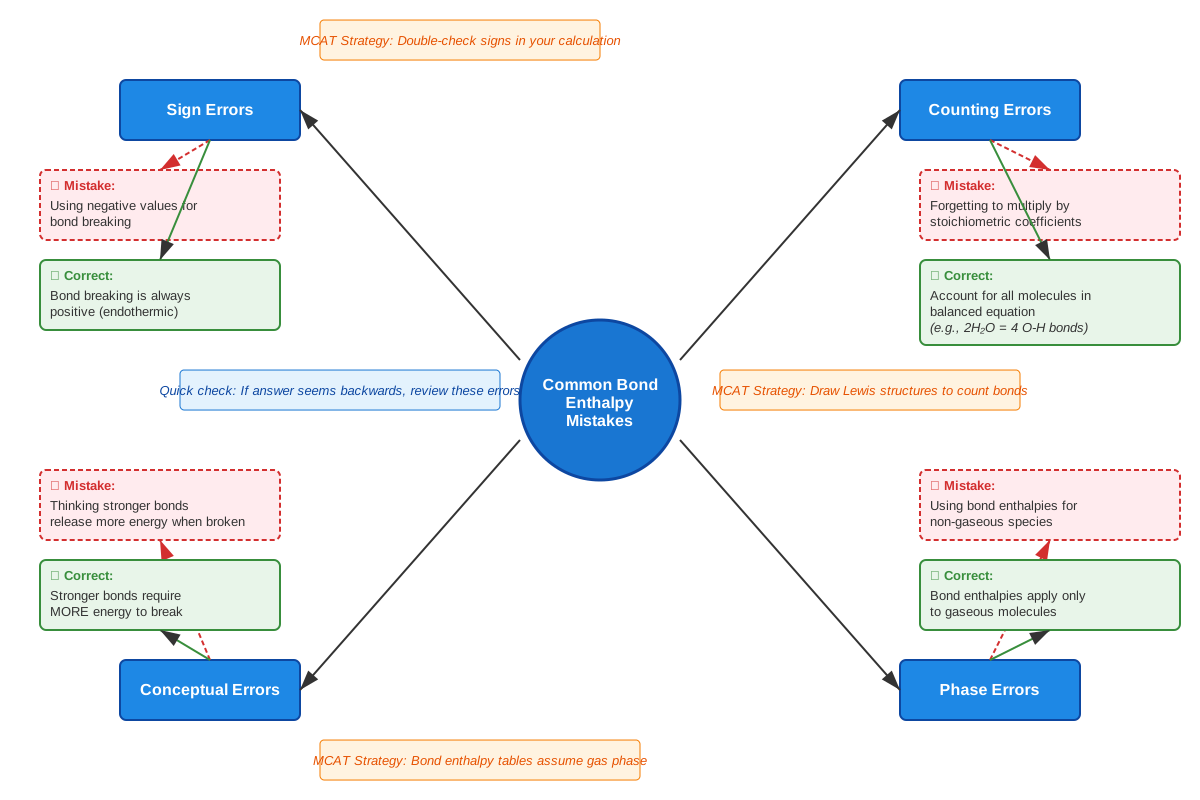
For calculation questions, immediately draw complete Lewis structures before attempting any math. Students who skip this step frequently miscount bonds, especially in molecules with multiple bonds or lone pairs. Create a systematic table with columns for "Bonds Broken" and "Bonds Formed," listing each bond type and its quantity. This organization prevents errors and makes your work easy to check. Remember that coefficients in the balanced equation multiply the number of bonds—if the equation shows 2H₂O, you must count bonds in two water molecules.
Trigger words and phrases that signal bond enthalpy questions include: "using bond energies," "estimate the enthalpy change," "based on bond strengths," "which molecule is more stable," and "energy required to break bonds." When you see these phrases, immediately think about the bonds broken vs. bonds formed framework. If a question asks about "bond dissociation energy" or "bond energy," recognize these as synonyms for bond enthalpy.
Process of elimination strategies: If asked whether a reaction is exothermic or endothermic, quickly assess whether stronger or weaker bonds are being formed. If products contain stronger bonds than reactants (common in combustion, oxidation), the reaction is likely exothermic—eliminate endothermic options. For questions comparing molecular stability, eliminate options suggesting that molecules with weaker bonds are more stable. If a calculation seems to require extensive math, check whether the question asks for an estimate or comparison rather than an exact value—you may be able to eliminate options without complete calculation.
Time allocation: Simple bond enthalpy calculations should take 60-90 seconds. If you find yourself spending more than 2 minutes, you may be overcomplicating the problem. For passage-based questions, spend 30-45 seconds identifying relevant bond enthalpy information in the passage before attempting calculations. Don't recalculate values already provided in tables or figures.
Common traps: Watch for questions that mix gas-phase and solution-phase reactions—bond enthalpy alone is insufficient for solution reactions. Be alert for questions asking about "energy released" vs. "enthalpy change"—these have opposite signs. If a question provides bond enthalpies and enthalpies of formation, recognize that you can solve using either method and choose the simpler approach.
Exam Tip: If you're running short on time and face a bond enthalpy calculation, focus on determining the sign (exothermic vs. endothermic) rather than the exact value. This alone may eliminate 2-3 answer choices, allowing an educated guess.
Memory Techniques
Mnemonic for bond breaking vs. forming: "Breaking Bonds Burns energy" (requires energy input, endothermic, positive). "Forming Frees energy" (releases energy, exothermic, negative). The alliteration helps cement the relationship.
Acronym for calculation steps - LISP:
- List all bonds in reactants
- Identify all bonds in products
- Subtract (bonds formed from bonds broken)
- Predict (negative = exothermic, positive = endothermic)
Visualization strategy: Picture bonds as springs connecting atoms. Breaking a spring (bond) requires you to pull (input energy), while allowing atoms to snap together (form bonds) releases the spring's potential energy. This mechanical analogy helps students remember that bond breaking is endothermic and bond formation is exothermic.
For bond strength trends, remember "SMALL STRONG": Smaller atoms form stronger bonds. This explains why H-F > H-Cl > H-Br > H-I and why C-C bonds are stronger than Si-Si bonds. Combine with "MULTIPLE MIGHTY": Multiple bonds are mightier (stronger) than single bonds.
For the calculation equation, use the phrase "Broken Before Formed" to remember that bonds broken come first (positive contribution) and bonds formed are subtracted: ΔH°rxn = Broken - Formed. This prevents sign errors.
Memory palace technique: Imagine walking through a house where each room represents a different bond type. The front door (strongest, hardest to break) is the N≡N triple bond. The living room has C-H bonds (stable, like a stable home life). The kitchen has O-O peroxide bonds (weak, unstable, like explosive cooking). The bedroom has O-H bonds (strong, like strong relationships). Creating vivid, personal associations with bond strengths aids recall.
Summary
Bond enthalpy represents the energy required to break one mole of bonds in gaseous molecules, serving as a fundamental tool for predicting reaction energetics in General Chemistry and biochemistry. The core principle—that bond breaking requires energy (endothermic) while bond formation releases energy (exothermic)—enables calculation of reaction enthalpies using the equation ΔH°rxn = Σ(bonds broken) - Σ(bonds formed). For the MCAT, students must master both computational skills (calculating ΔH°rxn from tabulated bond enthalpies) and conceptual understanding (predicting relative molecular stability, explaining why certain reactions are exothermic). Bond enthalpy values represent averages across different molecular environments and apply specifically to gas-phase species, providing estimates rather than exact values. Key trends include stronger bonds for smaller atoms, multiple bonds, and bonds with greater polarity. Understanding bond enthalpy connects molecular structure to thermodynamic properties, enabling prediction of reaction favorability and explanation of biochemical phenomena from ATP hydrolysis to metabolic pathway energetics. Success on MCAT questions requires systematic organization of bond counting, attention to stoichiometric coefficients, and recognition that stronger bonds correlate with greater molecular stability and lower reactivity.
Key Takeaways
- Bond breaking is always endothermic (requires energy, positive ΔH), while bond formation is always exothermic (releases energy, negative ΔH)
- Calculate reaction enthalpy using ΔH°rxn = Σ(bonds broken) - Σ(bonds formed); negative values indicate exothermic reactions
- Bond enthalpy values are averages for gas-phase species and provide estimates sufficient for MCAT purposes
- Bond strength increases with decreasing atomic size, increasing bond order (triple > double > single), and increasing electronegativity difference
- Stronger bonds indicate greater molecular stability and lower reactivity; weaker bonds make molecules more reactive
- Always draw complete Lewis structures before attempting bond enthalpy calculations to avoid miscounting bonds
- Bond enthalpy connects molecular structure to thermodynamic properties, bridging the gap between bonding theory and reaction energetics
Related Topics
Hess's Law and Enthalpy of Formation: Alternative method for calculating ΔH°rxn using standard enthalpies of formation rather than bond enthalpies. Mastering bond enthalpy provides foundation for understanding why Hess's Law works and enables cross-checking of thermodynamic calculations.
Gibbs Free Energy and Spontaneity: While bond enthalpy determines ΔH, spontaneity requires consideration of both enthalpy and entropy through ΔG = ΔH - TΔS. Understanding bond enthalpy is essential before tackling the more complex concept of free energy.
Chemical Kinetics and Activation Energy: Bond enthalpy relates to but differs from activation energy. Strong bonds generally require higher activation energies to break, connecting thermodynamics to reaction rates.
Molecular Orbital Theory: Provides theoretical foundation for why bonds have specific strengths. Bond enthalpy quantifies the predictions made by molecular orbital theory about bond order and stability.
Biochemical Energetics: ATP hydrolysis, metabolic pathways, and coupled reactions all involve bond enthalpy principles. Understanding bond enthalpy enables analysis of why certain biochemical reactions require energy coupling while others proceed spontaneously.
Practice CTA
Now that you've mastered the core concepts of bond enthalpy, it's time to solidify your understanding through active practice. Attempt the practice questions to test your ability to calculate reaction enthalpies, compare molecular stabilities, and apply bond enthalpy concepts to MCAT-style scenarios. Use the flashcards to reinforce high-yield facts and trends until they become automatic. Remember, thermodynamics questions often separate good scores from great scores on the MCAT—your investment in mastering bond enthalpy will pay dividends across multiple question types. You've built a strong foundation; now prove it through practice!
Sign up free to keep reading
Create a free AnvayaPrep account to finish this MCAT guide on Bond enthalpy — plus flashcards and practice questions.