Overview
The First law of thermodynamics stands as one of the foundational principles in General Chemistry and represents a cornerstone concept for the MCAT Chemical and Physical Foundations of Biological Systems section. This law, also known as the law of conservation of energy, states that energy cannot be created or destroyed—only converted from one form to another. In chemical and biological systems, this principle governs every energy transformation, from ATP hydrolysis in cells to the combustion of fuels, making it indispensable for understanding both chemistry and physiology.
For MCAT preparation, mastering the First law of thermodynamics is essential because it provides the mathematical and conceptual framework for analyzing energy changes in chemical reactions, phase transitions, and biological processes. The MCAT frequently tests this concept through calorimetry problems, heat transfer calculations, and passage-based questions involving metabolic pathways or experimental thermodynamic measurements. Understanding this law enables students to predict whether systems will absorb or release energy and to quantify these energy changes using the fundamental equation ΔE = q + w.
The First law of thermodynamics MCAT questions integrate seamlessly with other General Chemistry topics including enthalpy, entropy, Gibbs free energy, calorimetry, and chemical kinetics. This topic also bridges to biochemistry (metabolic energy transformations), physics (work and energy), and physiology (thermoregulation). A solid grasp of this principle provides the foundation for understanding spontaneity, equilibrium, and the energetics of biological systems—all high-yield topics for exam success.
Learning Objectives
- [ ] Define First law of thermodynamics using accurate General Chemistry terminology
- [ ] Explain why First law of thermodynamics matters for the MCAT
- [ ] Apply First law of thermodynamics to exam-style questions
- [ ] Identify common mistakes related to First law of thermodynamics
- [ ] Connect First law of thermodynamics to related General Chemistry concepts
- [ ] Calculate internal energy changes using heat and work values with correct sign conventions
- [ ] Distinguish between state functions and path functions in thermodynamic processes
- [ ] Analyze pressure-volume work in various thermodynamic processes (isothermal, adiabatic, isochoric, isobaric)
Prerequisites
- Basic algebra and unit conversions: Required for manipulating thermodynamic equations and converting between energy units (joules, calories, liters·atmospheres)
- Understanding of energy concepts: Foundation for recognizing kinetic and potential energy transformations in chemical systems
- Familiarity with the gas laws: Necessary for calculating work done by expanding or compressing gases
- Knowledge of system vs. surroundings: Essential for applying correct sign conventions when energy crosses system boundaries
- Basic chemistry stoichiometry: Needed to relate energy changes to molar quantities in chemical reactions
Why This Topic Matters
The First law of thermodynamics appears in approximately 3-5% of MCAT Chemical and Physical Foundations questions, making it a medium-yield but foundational topic. Questions typically present experimental scenarios involving calorimetry, bomb calorimeters, or biological energy transformations where students must calculate internal energy changes, heat flow, or work done. The MCAT particularly favors questions that require students to apply sign conventions correctly and to distinguish between different types of thermodynamic processes.
Clinically, this principle underlies human metabolism and energy balance. The body's ability to maintain homeostasis depends on precise energy accounting—calories consumed must equal calories expended plus energy stored, a direct application of energy conservation. Medical conditions like hypothyroidism, hyperthyroidism, and metabolic syndrome all involve disruptions in energy balance. Understanding thermodynamics also explains how fever increases metabolic rate, how brown adipose tissue generates heat, and why certain drugs affect basal metabolic rate.
In MCAT passages, the First law commonly appears in contexts involving: experimental determination of heat capacities, analysis of metabolic pathways and ATP yield, bomb calorimetry experiments measuring heat of combustion, phase transitions and latent heat, and coupled reactions in biochemical systems. Discrete questions often test direct calculation skills, while passage-based questions require applying the First law to interpret experimental data or predict outcomes of thermodynamic processes.
Core Concepts
The First Law Statement and Mathematical Expression
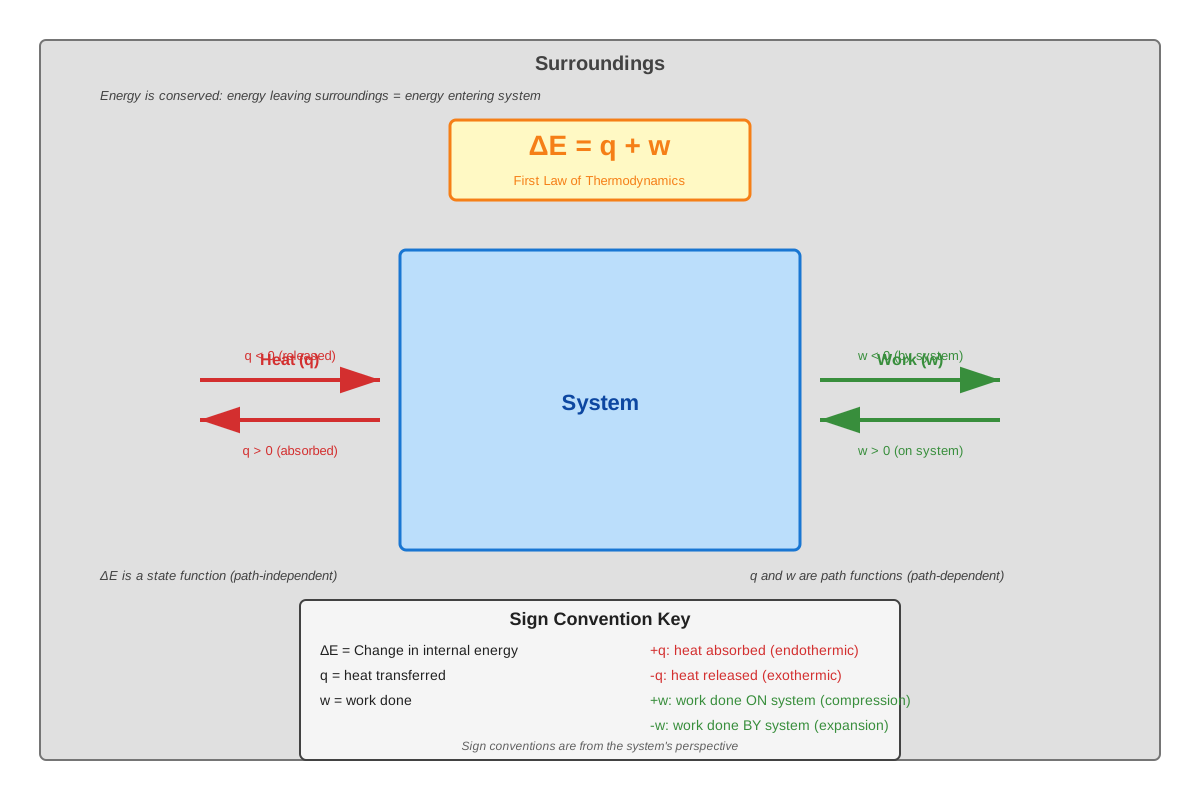
The First law of thermodynamics formally states that the total energy of an isolated system remains constant. For a closed system that can exchange energy but not matter with its surroundings, this principle is expressed mathematically as:
ΔE = q + wWhere:
- ΔE (or ΔU) represents the change in internal energy of the system
- q represents heat transferred to or from the system
- w represents work done on or by the system
Internal energy encompasses all forms of energy within a system, including kinetic energy of molecular motion (translational, rotational, vibrational) and potential energy from intermolecular forces and chemical bonds. Internal energy is a state function, meaning its value depends only on the current state of the system, not on the path taken to reach that state.
Sign Conventions in Thermodynamics
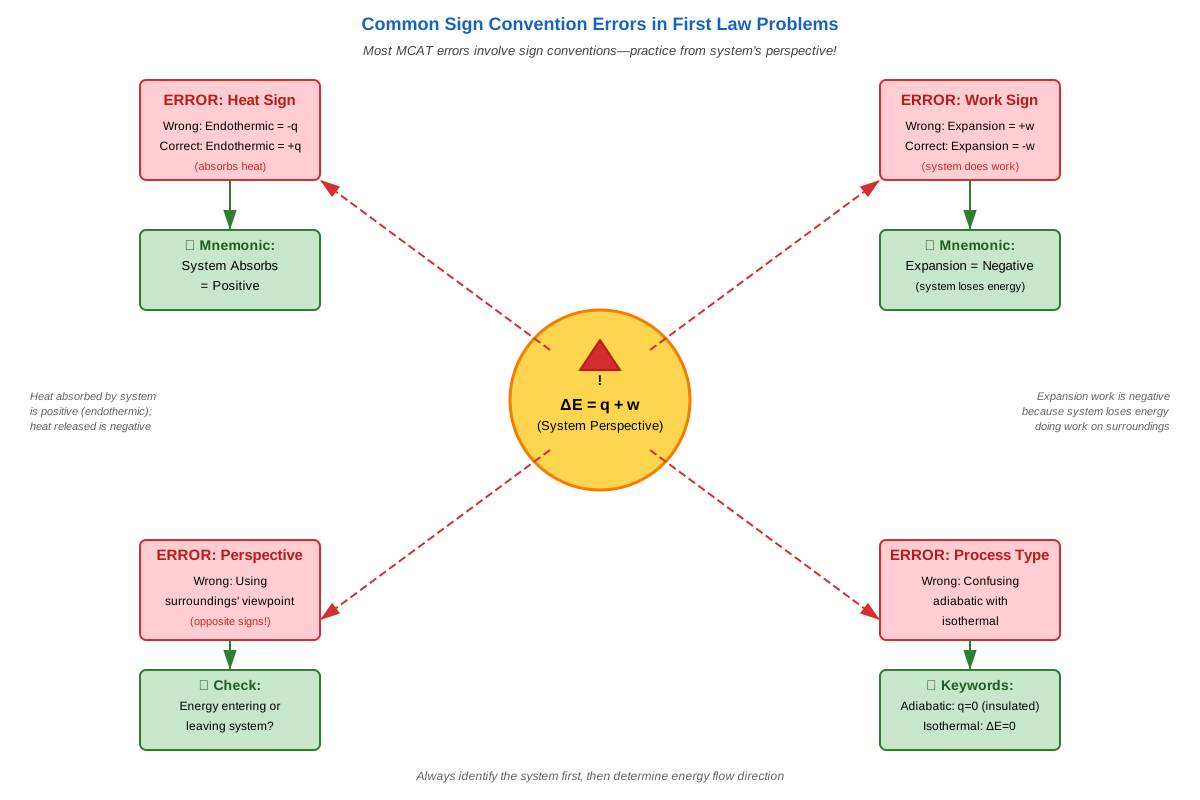
Proper application of sign conventions is critical for MCAT success and represents one of the most common sources of errors. The standard convention used in chemistry (and on the MCAT) is:
| Quantity | Positive (+) | Negative (−) |
|---|---|---|
| Heat (q) | Heat absorbed by system (endothermic) | Heat released by system (exothermic) |
| Work (w) | Work done on system (compression) | Work done by system (expansion) |
| ΔE | Internal energy increases | Internal energy decreases |
MCAT Exam Tip: Always define your system clearly before assigning signs. What enters the system is positive; what leaves the system is negative.
Types of Work: Pressure-Volume Work
While work can take many forms (electrical, mechanical, surface), the MCAT focuses primarily on pressure-volume (PV) work associated with gas expansion or compression. The work done by a gas expanding against external pressure is:
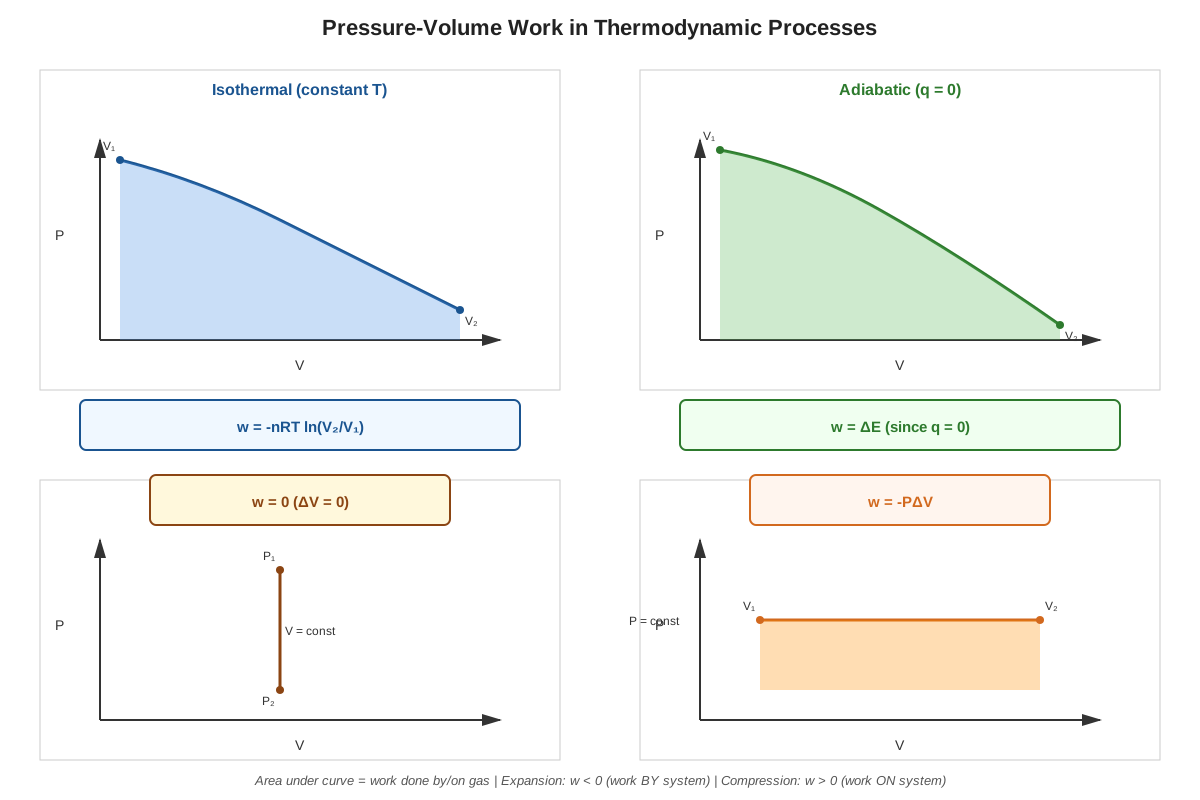
w = -PₑₓₜΔV = -Pₑₓₜ(V_final - V_initial)The negative sign reflects that when a gas expands (ΔV > 0), it does work on the surroundings, so energy leaves the system (w < 0). Conversely, when a gas is compressed (ΔV < 0), work is done on the system (w > 0).
For processes at constant external pressure, this equation applies directly. The units must be consistent: pressure in atmospheres and volume in liters yields work in liter·atmospheres (L·atm), which can be converted to joules using the conversion factor 1 L·atm = 101.325 J.
Thermodynamic Processes and the First Law
Different types of thermodynamic processes impose specific constraints on the First law equation:
Isothermal Process (constant temperature, ΔT = 0):
- For an ideal gas, internal energy depends only on temperature, so ΔE = 0
- Therefore: q = −w (heat absorbed equals work done by the system)
- Common in biological systems with efficient heat exchange
Adiabatic Process (no heat transfer, q = 0):
- The system is thermally isolated
- Therefore: ΔE = w
- All internal energy change comes from work
- Temperature changes occur during adiabatic expansion or compression
Isochoric Process (constant volume, ΔV = 0):
- No PV work is done (w = 0)
- Therefore: ΔE = q_v (heat at constant volume)
- Occurs in rigid containers like bomb calorimeters
Isobaric Process (constant pressure):
- Work equals w = −PΔV
- Heat transferred relates to enthalpy change: q_p = ΔH
- Most common in open systems exposed to atmospheric pressure
Relationship Between Internal Energy and Enthalpy
While internal energy (E) is the fundamental quantity in the First law, enthalpy (H) is often more practical for processes at constant pressure. Enthalpy is defined as:
H = E + PVFor a process at constant pressure:
ΔH = ΔE + PΔVSince PΔV = −w for constant pressure processes:
ΔH = q_p (heat at constant pressure)This relationship explains why enthalpy changes are commonly tabulated for chemical reactions—most laboratory reactions occur at constant atmospheric pressure where ΔH equals the heat transferred.
State Functions vs. Path Functions
Understanding the distinction between state functions and path functions is crucial for thermodynamic reasoning:
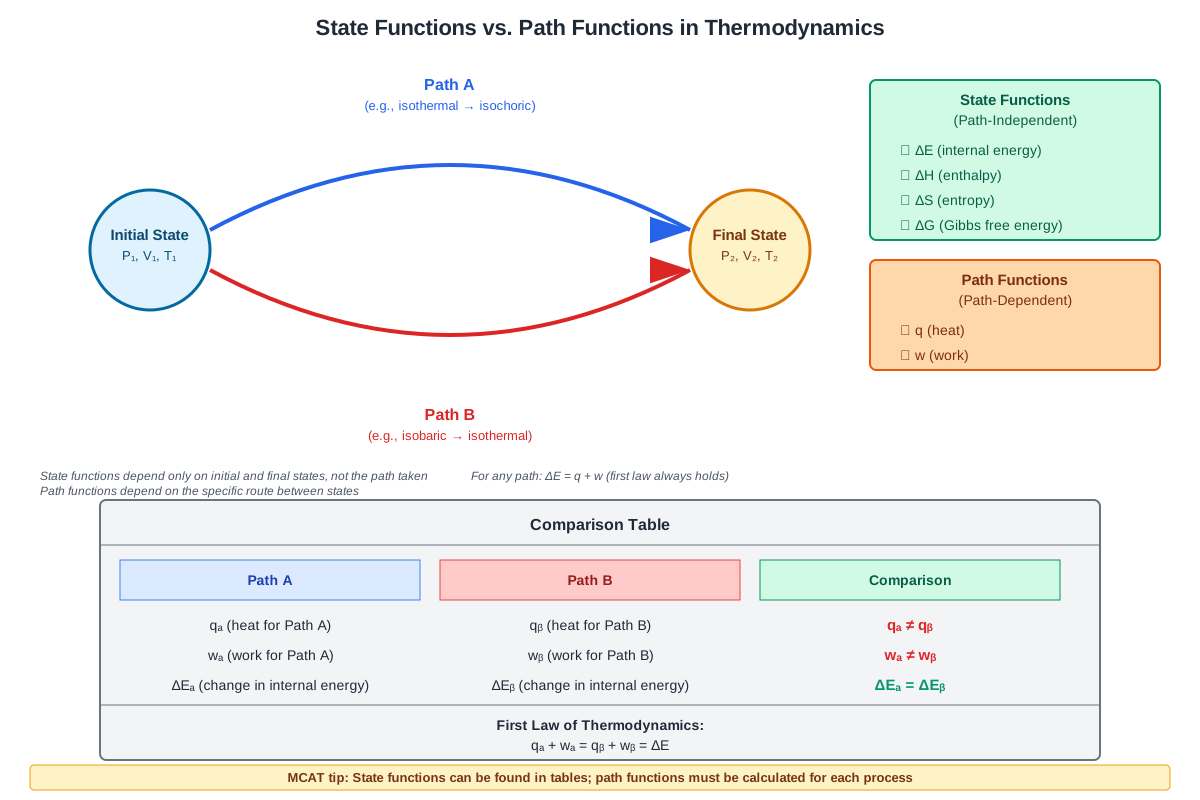
State Functions (path-independent):
- Internal energy (E)
- Enthalpy (H)
- Temperature (T)
- Pressure (P)
- Volume (V)
Path Functions (path-dependent):
- Heat (q)
- Work (w)
The change in a state function depends only on initial and final states, regardless of the process pathway. In contrast, heat and work depend on the specific process connecting two states. Multiple pathways between the same two states will have the same ΔE but different combinations of q and w.
Energy Conservation in Chemical Reactions
For chemical reactions, the First law governs energy transformations between chemical potential energy and thermal energy. When bonds break and form:
- Exothermic reactions: Chemical potential energy converts to thermal energy (q < 0, heat released)
- Endothermic reactions: Thermal energy converts to chemical potential energy (q > 0, heat absorbed)
The internal energy change for a reaction equals the difference between energy required to break bonds and energy released when new bonds form. This principle underlies calorimetry experiments that measure heats of reaction, combustion, and formation.
Concept Relationships
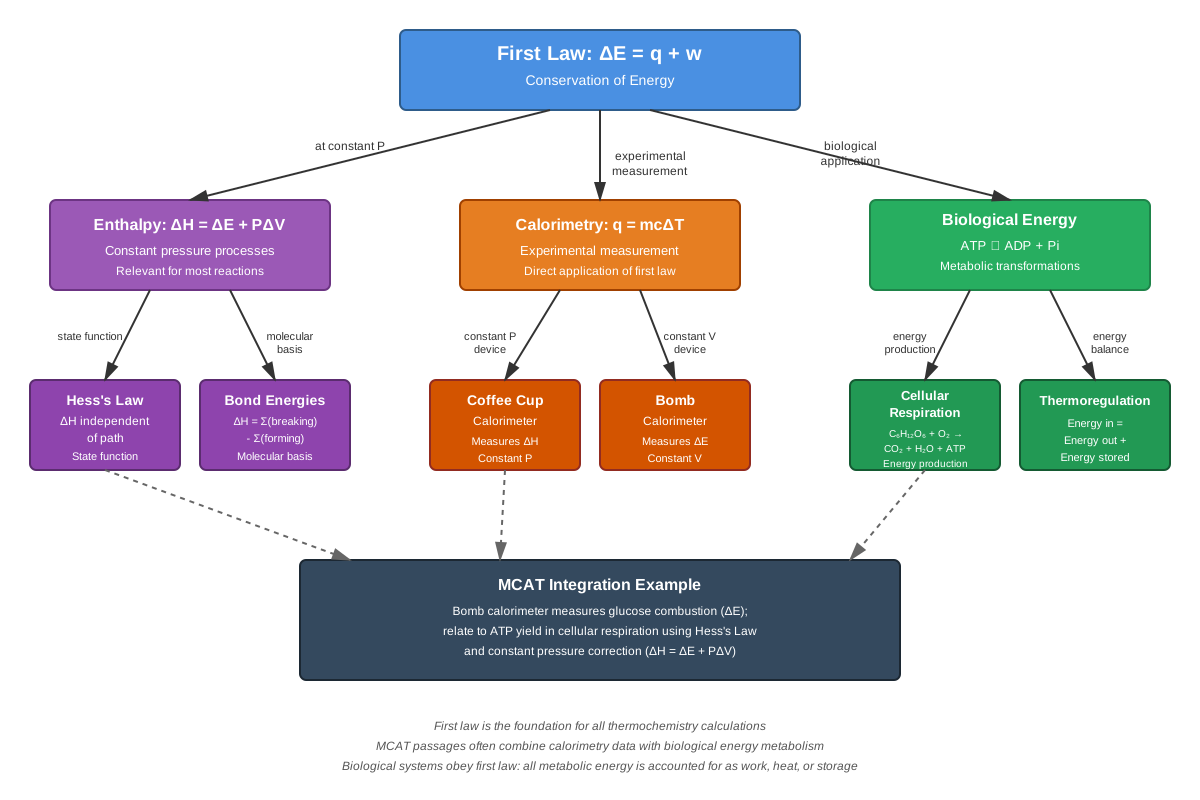
The First law of thermodynamics serves as the central organizing principle connecting multiple thermodynamic concepts. Internal energy (ΔE) → combines with → heat (q) and work (w) → through the fundamental equation ΔE = q + w. This relationship branches into specialized applications: when volume is constant → isochoric processes → where ΔE = q_v directly, and when pressure is constant → isobaric processes → leading to the concept of enthalpy (ΔH = q_p).
The distinction between state functions (E, H, T, P, V) and path functions (q, w) emerges directly from the First law. While ΔE is path-independent, the individual contributions of heat and work depend on the process pathway. This concept connects forward to the Second law of thermodynamics and entropy, where path-dependence becomes crucial for understanding spontaneity.
Calorimetry represents the experimental application of the First law, measuring heat changes to determine thermodynamic properties. Bomb calorimetry (constant volume) measures ΔE directly, while coffee cup calorimetry (constant pressure) measures ΔH. These techniques connect to Hess's law and standard enthalpies of formation, which use the First law's state function property to calculate reaction energies.
The First law also bridges to biochemistry through metabolic energy accounting. ATP hydrolysis, cellular respiration, and photosynthesis all obey energy conservation, with chemical energy interconverting with heat and work. Understanding ΔE and ΔH for these processes enables calculation of metabolic efficiency and energy yield—topics frequently tested in MCAT biochemistry passages.
High-Yield Facts
⭐ The First law equation ΔE = q + w applies to all thermodynamic processes; energy is always conserved in closed systems
⭐ Sign convention: heat absorbed and work done ON the system are positive; heat released and work done BY the system are negative
⭐ For an ideal gas at constant temperature (isothermal process), ΔE = 0, so q = −w
⭐ At constant volume (isochoric), no PV work is done (w = 0), so ΔE = q_v
⭐ At constant pressure (isobaric), q_p = ΔH and w = −PΔV
- Internal energy (E) is a state function; its change depends only on initial and final states, not the path taken
- Heat (q) and work (w) are path functions; their values depend on the specific process connecting two states
- For adiabatic processes (q = 0), all internal energy change results from work: ΔE = w
- The relationship between enthalpy and internal energy is ΔH = ΔE + PΔV for constant pressure processes
- Bomb calorimeters measure ΔE (constant volume), while coffee cup calorimeters measure ΔH (constant pressure)
- Exothermic reactions release heat (q < 0, ΔH < 0); endothermic reactions absorb heat (q > 0, ΔH > 0)
- Work done by an expanding gas is negative (w = −PΔV where ΔV > 0), decreasing internal energy if no heat is added
- The conversion factor between L·atm and joules is 1 L·atm = 101.325 J ≈ 101 J for MCAT calculations
- In biological systems, the First law explains energy balance: energy intake = energy expenditure + energy stored
- Coupled reactions in metabolism obey the First law; energy released by one reaction drives another
Quick check — test yourself on First law of thermodynamics so far.
Try Flashcards →Common Misconceptions
Misconception: Heat and temperature are the same thing.
Correction: Heat (q) is energy transferred due to temperature difference, measured in joules or calories. Temperature (T) is a measure of average kinetic energy of particles, measured in Kelvin or Celsius. A large object at low temperature can contain more heat than a small object at high temperature.
Misconception: In the equation ΔE = q + w, work is always positive when a gas expands.
Correction: When a gas expands, it does work ON the surroundings, so energy leaves the system and w is NEGATIVE (w = −PΔV where ΔV > 0). Work is positive only when work is done ON the system (compression).
Misconception: If ΔE = 0 for a process, then nothing happened to the system.
Correction: ΔE = 0 means the internal energy didn't change, but this doesn't mean no energy was transferred. In isothermal expansion of an ideal gas, heat absorbed (q > 0) exactly equals work done by the gas (w < 0), so ΔE = 0 even though significant energy transfers occurred.
Misconception: Enthalpy (ΔH) and internal energy (ΔE) are always equal.
Correction: ΔH = ΔE + PΔV. They are equal only when PΔV = 0, which occurs at constant volume or when volume change is negligible (condensed phases). For gas-phase reactions with mole changes, ΔH and ΔE differ significantly.
Misconception: The First law tells us whether a process will occur spontaneously.
Correction: The First law only addresses energy conservation, not spontaneity. A process can conserve energy (obey the First law) but still not occur spontaneously. Spontaneity requires the Second law and consideration of entropy (ΔG = ΔH − TΔS).
Misconception: In an adiabatic process, temperature must remain constant.
Correction: Adiabatic means no heat transfer (q = 0), not constant temperature. In fact, adiabatic compression increases temperature (work done on system increases internal energy), while adiabatic expansion decreases temperature (work done by system decreases internal energy).
Misconception: Work and heat are properties of a system.
Correction: Work and heat are not properties but rather modes of energy transfer between system and surroundings. Only internal energy (E) is a property of the system. You cannot say "the system contains 50 J of heat"—only that "50 J of heat was transferred to the system."
Worked Examples
Example 1: Gas Expansion with Heat Transfer
Problem: A gas in a cylinder absorbs 250 J of heat from its surroundings while expanding against a constant external pressure of 1.5 atm. The volume increases from 2.0 L to 5.0 L. Calculate the change in internal energy of the gas.
Solution:
Step 1: Identify the given information and what we need to find.
- q = +250 J (heat absorbed by system, positive)
- P_ext = 1.5 atm (constant)
- V_initial = 2.0 L
- V_final = 5.0 L
- Find: ΔE
Step 2: Calculate the work done using w = −P_ext ΔV.
- ΔV = V_final − V_initial = 5.0 L − 2.0 L = 3.0 L
- w = −(1.5 atm)(3.0 L) = −4.5 L·atm
Step 3: Convert work to joules using 1 L·atm = 101.325 J.
- w = −4.5 L·atm × 101.325 J/L·atm = −456 J
Step 4: Apply the First law: ΔE = q + w.
- ΔE = 250 J + (−456 J) = −206 J
Interpretation: The internal energy of the gas decreased by 206 J. Even though the gas absorbed 250 J of heat, it did 456 J of work on the surroundings during expansion, resulting in a net decrease in internal energy. This demonstrates that heat and work can partially offset each other.
Connection to Learning Objectives: This problem applies the First law to calculate internal energy changes and reinforces correct sign conventions—heat absorbed is positive, work done by the system (expansion) is negative.
Example 2: Bomb Calorimeter Measurement
Problem: A 1.50 g sample of glucose (C₆H₁₂O₆) is combusted in a bomb calorimeter. The temperature of the calorimeter increases by 3.20°C. The heat capacity of the calorimeter is 9.50 kJ/°C. (a) Calculate the heat released by the combustion. (b) Explain why this measurement gives ΔE rather than ΔH. (c) Calculate the molar internal energy of combustion for glucose.
Solution:
Part (a): Calculate heat released.
Step 1: Use q_calorimeter = C × ΔT where C is heat capacity.
- q_calorimeter = (9.50 kJ/°C)(3.20°C) = 30.4 kJ
Step 2: Apply energy conservation. Heat released by combustion equals heat absorbed by calorimeter.
- q_combustion = −30.4 kJ (negative because heat is released by the system)
Part (b): Why this measures ΔE, not ΔH.
A bomb calorimeter is a rigid, sealed container, so volume is constant (ΔV = 0). At constant volume, no PV work is done (w = 0). Applying the First law:
- ΔE = q + w = q_v + 0 = q_v
Therefore, the heat measured at constant volume equals the change in internal energy directly. In contrast, ΔH = q_p applies only at constant pressure.
Part (c): Calculate molar ΔE.
Step 1: Calculate moles of glucose combusted.
- Molar mass of C₆H₁₂O₆ = 6(12) + 12(1) + 6(16) = 180 g/mol
- Moles = 1.50 g ÷ 180 g/mol = 0.00833 mol
Step 2: Calculate ΔE per mole.
- ΔE = −30.4 kJ ÷ 0.00833 mol = −3650 kJ/mol = −3.65 × 10³ kJ/mol
Interpretation: The molar internal energy of combustion for glucose is −3650 kJ/mol, indicating that combustion releases 3650 kJ per mole of glucose. This value is slightly different from the molar enthalpy of combustion (ΔH) because the bomb calorimeter measures at constant volume.
Connection to Learning Objectives: This example demonstrates the practical application of the First law in calorimetry, distinguishes between ΔE and ΔH based on experimental conditions, and connects thermodynamics to biochemistry (glucose metabolism).
Exam Strategy
When approaching First law of thermodynamics MCAT questions, begin by clearly identifying the system and surroundings. Draw a simple diagram if needed, marking energy flows with arrows. This visualization prevents sign convention errors, which account for the majority of mistakes on thermodynamics questions.
Trigger words and phrases to recognize:
- "Absorbs heat" or "heat flows into" → q is positive
- "Releases heat" or "exothermic" → q is negative
- "Expands" or "volume increases" → w is negative (work done BY system)
- "Compressed" or "volume decreases" → w is positive (work done ON system)
- "Constant volume" or "rigid container" → w = 0, so ΔE = q
- "Constant pressure" or "open to atmosphere" → q = ΔH
- "Adiabatic" or "thermally isolated" → q = 0, so ΔE = w
- "Isothermal" (for ideal gas) → ΔE = 0, so q = −w
Process-of-elimination strategies:
- Check sign consistency: If a question states a gas expands and does work, eliminate any answer showing positive work
- Verify units: Work in L·atm must be converted to joules; eliminate answers that ignore this conversion
- Test extreme cases: If ΔV = 0, work must be zero; eliminate answers that don't reflect this
- Apply state function logic: If two pathways connect the same states, ΔE must be identical even if q and w differ
Time allocation: Straightforward First law calculations should take 60-90 seconds. If a problem requires more than 2 minutes, you may be overcomplicating it—look for a conceptual shortcut. For passage-based questions, spend 30 seconds identifying which thermodynamic process applies before attempting calculations.
High-Yield Strategy: When stuck between two answers, check whether the question asks for a state function (ΔE, ΔH) or describes a process (q, w). State functions depend only on initial and final states; processes depend on the pathway.
Memory Techniques
Mnemonic for Sign Conventions - "PAWN":
- Positive when energy Added to system
- Work done oN system is positive
Visualization for Work Sign: Picture a piston in a cylinder. When the gas pushes the piston OUT (expansion), energy leaves the gas to move the piston—work is negative. When you push the piston IN (compression), you add energy to the gas—work is positive. The gas "pays" energy to expand.
Acronym for Thermodynamic Processes - "I ATE":
- Isothermal (constant T): ΔE = 0 for ideal gas
- Adiabatic (q = 0): ΔE = w
- Temperature constant volume (isochoric, w = 0): ΔE = q
- Equal pressure (isobaric): q = ΔH
State Function Memory Device: "State functions are like elevation—only the starting and ending heights matter, not which trail you hiked." Internal energy, enthalpy, and temperature are state functions (like elevation). Heat and work are path functions (like the distance you walked).
First Law Equation Recall: Think "Energy = Heat + Work" or "ΔE = q + w". The delta (Δ) reminds you this is a change, not an absolute value. Energy change equals what flows in as heat plus what's pushed in as work.
Summary
The First law of thermodynamics establishes that energy is conserved in all processes—it can transform between different forms but cannot be created or destroyed. Mathematically expressed as ΔE = q + w, this principle quantifies how heat transfer and work combine to change a system's internal energy. Mastering sign conventions is essential: energy entering the system (heat absorbed, work done on system) is positive, while energy leaving (heat released, work done by system) is negative. Different thermodynamic processes impose specific constraints—isothermal processes maintain constant temperature, adiabatic processes involve no heat transfer, isochoric processes occur at constant volume with no PV work, and isobaric processes occur at constant pressure where heat equals enthalpy change. Internal energy is a state function depending only on initial and final states, while heat and work are path functions depending on the process pathway. For MCAT success, students must apply the First law to calculate energy changes, distinguish between ΔE and ΔH based on experimental conditions, and recognize how this principle governs chemical reactions, calorimetry experiments, and biological energy transformations.
Key Takeaways
- The First law of thermodynamics (ΔE = q + w) states that energy is conserved; internal energy change equals heat transferred plus work done
- Sign conventions are critical: heat absorbed and work done ON the system are positive; heat released and work done BY the system are negative
- Internal energy (E) is a state function (path-independent), while heat (q) and work (w) are path functions (path-dependent)
- At constant volume (isochoric), w = 0 so ΔE = q_v; at constant pressure (isobaric), q_p = ΔH
- For isothermal processes with ideal gases, ΔE = 0 so q = −w; for adiabatic processes, q = 0 so ΔE = w
- Bomb calorimeters measure ΔE (constant volume); coffee cup calorimeters measure ΔH (constant pressure)
- The First law applies universally to chemical reactions, phase transitions, and biological processes, making it foundational for understanding all thermodynamic phenomena on the MCAT
Related Topics
Enthalpy and Hess's Law: Building on the First law's state function concept, enthalpy changes can be calculated using multiple pathways, enabling determination of reaction energies from tabulated formation data. Mastering the First law provides the foundation for understanding why Hess's law works.
Second Law of Thermodynamics and Entropy: While the First law addresses energy conservation, the Second law introduces entropy to predict spontaneity. Together, these laws lead to Gibbs free energy, the ultimate predictor of reaction favorability.
Calorimetry and Heat Capacity: Experimental applications of the First law involve measuring heat changes to determine specific heats, heat capacities, and enthalpies of reaction—practical skills frequently tested on the MCAT.
Thermochemistry and Bond Energies: The First law governs how breaking and forming chemical bonds changes internal energy, connecting to reaction energetics and the calculation of enthalpies from bond energies.
Biochemical Energetics: Metabolic pathways, ATP synthesis, and cellular respiration all obey the First law. Understanding energy conservation enables calculation of metabolic efficiency and energy yield from nutrients.
Practice CTA
Now that you've mastered the foundational concepts of the First law of thermodynamics, it's time to solidify your understanding through active practice. Attempt the practice questions to test your ability to apply sign conventions, calculate internal energy changes, and distinguish between different thermodynamic processes. Use the flashcards to reinforce high-yield facts and commit key equations to memory. Remember, thermodynamics questions on the MCAT reward systematic thinking and careful attention to detail—skills that improve dramatically with deliberate practice. You've built a strong conceptual foundation; now transform that knowledge into exam-day confidence through repeated application!
Sign up free to keep reading
Create a free AnvayaPrep account to finish this MCAT guide on First law of thermodynamics — plus flashcards and practice questions.