Overview
Hess's law is a cornerstone principle in thermodynamics and General Chemistry that states the total enthalpy change of a chemical reaction is independent of the pathway taken between the initial and final states. Named after Swiss-Russian chemist Germain Hess, this law allows chemists and students to calculate enthalpy changes for reactions that are difficult or impossible to measure directly by using algebraic combinations of other known reactions. For the MCAT, Hess's law represents a critical bridge between theoretical thermodynamic principles and practical problem-solving, appearing regularly in both discrete questions and passage-based scenarios.
Understanding Hess's law is essential for MCAT success because it tests multiple competencies simultaneously: mathematical reasoning, conceptual understanding of state functions, and the ability to manipulate chemical equations. The law emerges directly from the first law of thermodynamics and the concept that enthalpy (H) is a state function—meaning its value depends only on the current state of the system, not on how that state was achieved. This principle allows test-takers to approach complex thermochemical problems systematically, breaking them into manageable steps using known thermodynamic data.
Within the broader landscape of General Chemistry, Hess's law connects intimately with bond energies, standard enthalpies of formation, calorimetry, and Gibbs free energy calculations. Mastery of this topic enables students to predict reaction spontaneity, understand energy flow in biological systems, and solve multi-step thermodynamic problems that frequently appear on the MCAT. The law's applications extend beyond pure chemistry into biochemistry and physiology, where metabolic pathways can be analyzed as series of coupled reactions with calculable overall energy changes.
Learning Objectives
- [ ] Define Hess's law using accurate General Chemistry terminology
- [ ] Explain why Hess's law matters for the MCAT
- [ ] Apply Hess's law to exam-style questions involving manipulation of thermochemical equations
- [ ] Identify common mistakes related to Hess's law, including sign errors and coefficient handling
- [ ] Connect Hess's law to related General Chemistry concepts including state functions and enthalpy
- [ ] Calculate overall enthalpy changes by algebraically combining multiple chemical equations
- [ ] Determine which given reactions must be reversed or multiplied to achieve a target equation
- [ ] Explain the relationship between Hess's law and standard enthalpies of formation
Prerequisites
- Enthalpy and enthalpy change (ΔH): Understanding that enthalpy represents heat content at constant pressure is essential for interpreting what Hess's law calculations actually mean
- Balancing chemical equations: Hess's law requires manipulating equations algebraically, which depends on understanding stoichiometric coefficients
- State functions vs. path functions: Recognizing that enthalpy is a state function provides the theoretical foundation for why Hess's law works
- Exothermic vs. endothermic reactions: Interpreting signs of ΔH values (negative for exothermic, positive for endothermic) is crucial for correct application
- Basic thermodynamic principles: Familiarity with the first law of thermodynamics and conservation of energy underpins the validity of Hess's law
Why This Topic Matters
Hess's law appears with moderate frequency on the MCAT, typically in 2-4 questions per exam either as discrete items or embedded within Chemical and Physical Foundations passages. The topic holds particular importance because it assesses quantitative reasoning skills while testing conceptual understanding—a combination highly valued by medical schools. Questions often present students with multiple thermochemical equations and ask them to determine the enthalpy change for a target reaction, testing both mathematical manipulation skills and chemical intuition.
In real-world and clinical contexts, Hess's law principles underlie our understanding of metabolic energy production. The human body cannot directly convert glucose to CO₂ and water in a single step; instead, cellular respiration proceeds through glycolysis, the citric acid cycle, and oxidative phosphorylation. The total energy released remains constant regardless of this multi-step pathway—a direct application of Hess's law. This same principle allows biochemists to calculate the energy yield of various nutrients and understand how the body efficiently captures chemical energy in ATP bonds.
On the MCAT, Hess's law commonly appears in passages discussing: (1) combustion reactions and fuel efficiency, (2) biochemical pathways and ATP synthesis, (3) industrial chemical processes, and (4) environmental chemistry topics like carbon cycling. Questions may present thermochemical data in tables, require students to construct energy diagrams, or ask them to identify which combination of reactions yields a specific overall process. The ability to quickly recognize when Hess's law applies and systematically manipulate equations distinguishes high-scoring students from those who struggle with thermodynamics.
Core Concepts
Definition and Theoretical Foundation
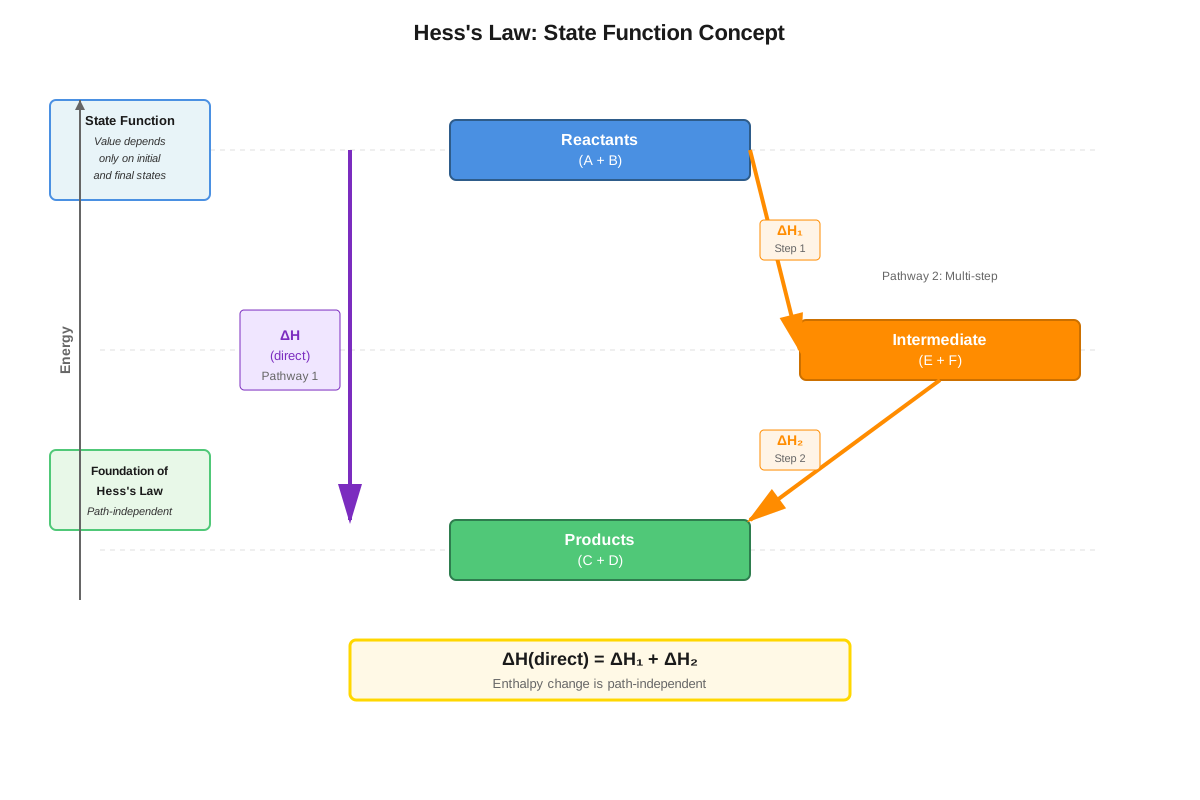
Hess's law states that the total enthalpy change for a chemical reaction is the same regardless of the number of steps or the specific pathway taken from reactants to products. Mathematically, if a reaction can be expressed as the sum of two or more other reactions, the enthalpy change for the overall reaction equals the sum of the enthalpy changes for the individual steps:
ΔH_total = ΔH₁ + ΔH₂ + ΔH₃ + ... + ΔHₙThis law exists because enthalpy is a state function—a property that depends only on the current state of a system (temperature, pressure, composition) and not on the history of how that state was reached. In contrast, heat and work are path functions that do depend on the specific process. The state function nature of enthalpy means that whether a reaction occurs in one step or multiple steps, the total energy change between identical initial and final states must be identical.
The theoretical basis for Hess's law derives from the first law of thermodynamics, which states that energy cannot be created or destroyed, only converted between forms. If we could obtain different total enthalpy changes by taking different pathways between the same reactants and products, we would violate energy conservation—we could theoretically create a perpetual motion machine by cycling through different pathways.
Manipulating Thermochemical Equations
Applying Hess's law requires treating chemical equations like algebraic expressions. Three fundamental operations allow us to manipulate thermochemical equations:
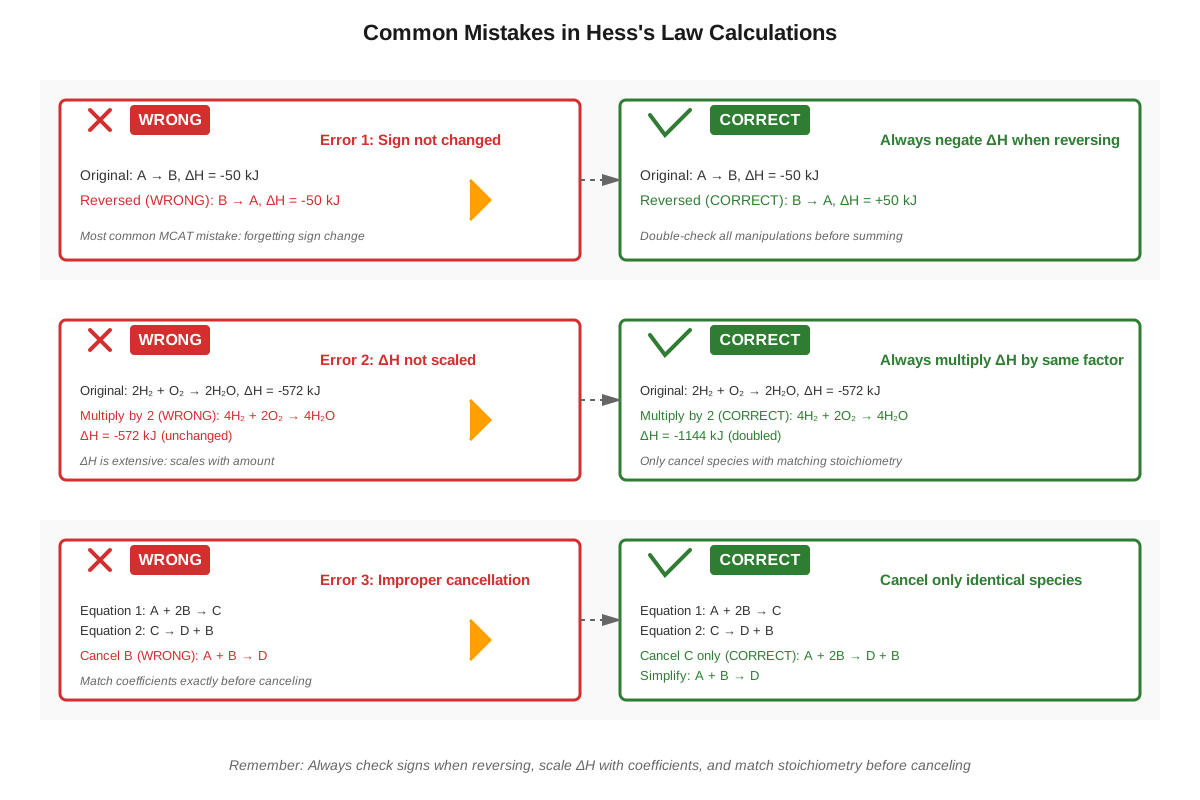
- Reversing a reaction: When a chemical equation is reversed (products become reactants and vice versa), the sign of ΔH changes but the magnitude remains the same. If the forward reaction is exothermic (ΔH < 0), the reverse reaction is endothermic (ΔH > 0) by the same amount.
- Multiplying by a coefficient: When all stoichiometric coefficients in an equation are multiplied by a factor, the enthalpy change must be multiplied by the same factor. If doubling a reaction, the enthalpy change doubles; if halving, the enthalpy change is halved.
- Adding equations: When two or more equations are added together, their enthalpy changes are also added. Species appearing on both sides of the combined equation cancel out, just like in algebraic addition.
These operations allow students to manipulate given equations until they sum to produce the desired target equation. The corresponding enthalpy changes are manipulated identically, yielding the enthalpy change for the target reaction.
Systematic Problem-Solving Approach
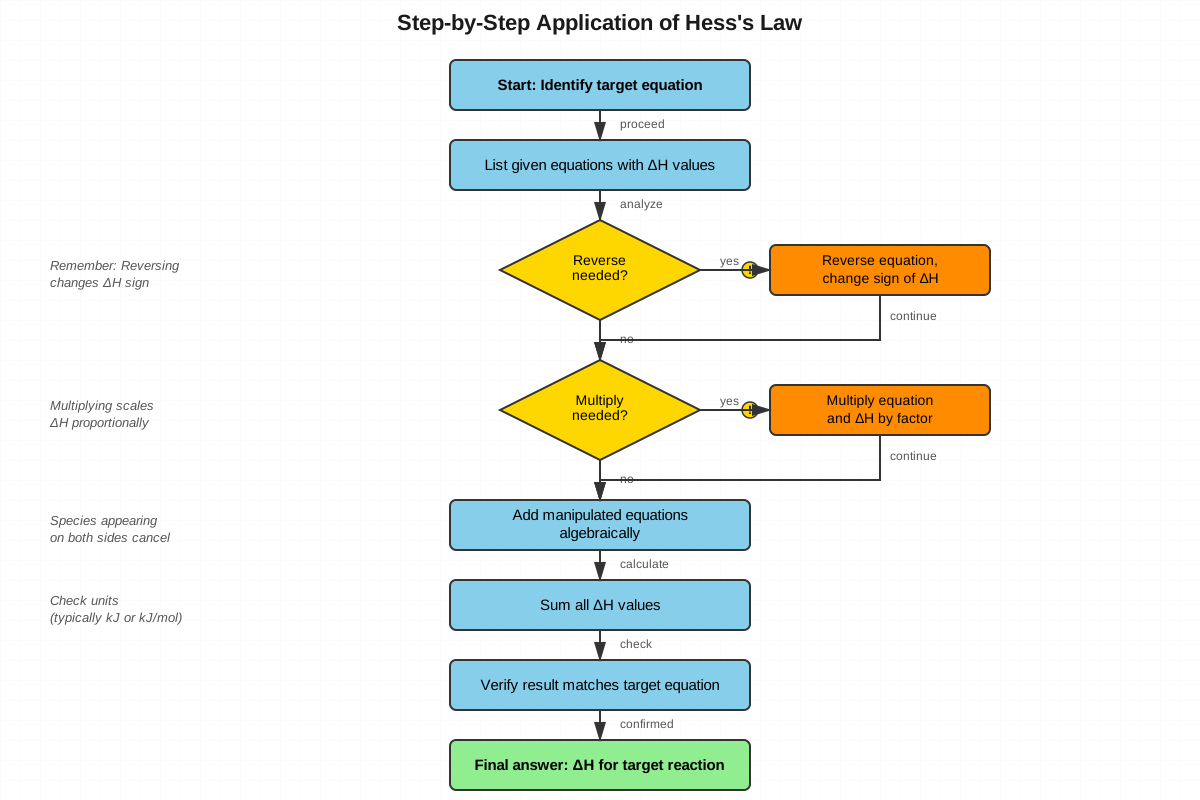
Solving Hess's law problems systematically involves these steps:
- Identify the target equation: Clearly write out the reaction for which you need to find ΔH
- Inventory available equations: List all given thermochemical equations and their ΔH values
- Plan manipulations: Determine which equations need to be reversed, multiplied, or used as-is
- Execute manipulations: Perform the necessary operations on both equations and ΔH values
- Add equations: Sum the manipulated equations, canceling species that appear on both sides
- Calculate total ΔH: Sum the manipulated ΔH values to obtain the final answer
- Verify: Check that the final equation matches the target and that units are consistent
MCAT Tip: Always write out each manipulation step explicitly during practice. On test day, this systematic approach prevents sign errors and ensures you can track your work if you need to double-check an answer.
Connection to Standard Enthalpies of Formation
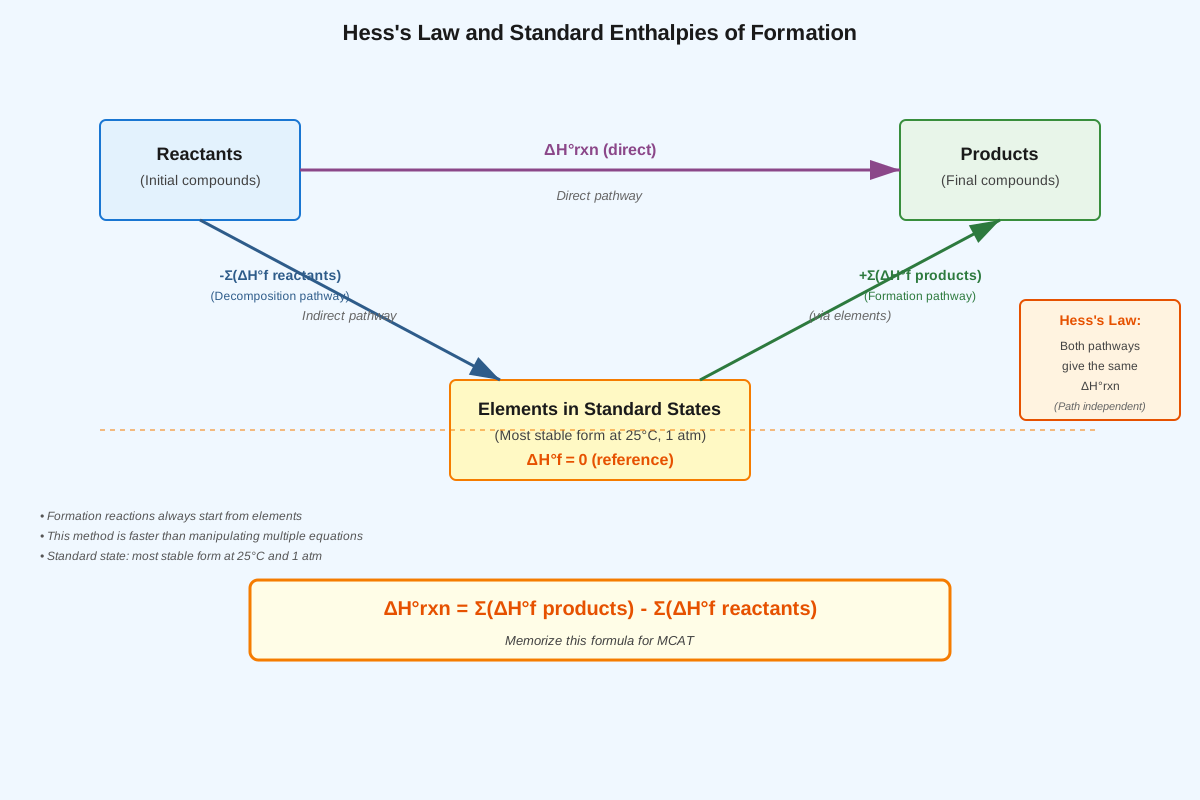
Standard enthalpy of formation (ΔH°f) represents the enthalpy change when one mole of a compound is formed from its constituent elements in their standard states (25°C, 1 atm). By definition, the standard enthalpy of formation for any element in its standard state is zero. This concept represents a special application of Hess's law.
The standard enthalpy change for any reaction can be calculated using:
ΔH°_reaction = Σ(ΔH°f products) - Σ(ΔH°f reactants)This formula is actually Hess's law in disguise. We're imagining a pathway where: (1) all reactants decompose into their constituent elements, (2) those elements recombine to form products. The enthalpy change for this imaginary pathway equals the enthalpy change for the direct reaction—a direct consequence of Hess's law.
Energy Diagrams and Reaction Coordinates
Reaction coordinate diagrams visually represent Hess's law by showing that different pathways between the same initial and final states have the same overall energy change, even if they pass through different intermediate states. In such diagrams:
- The y-axis represents enthalpy (H)
- The x-axis represents the reaction coordinate (progress of reaction)
- Reactants and products have fixed enthalpy values
- Different pathways may have different activation energies and intermediates
- The vertical distance between reactants and products (ΔH) remains constant regardless of pathway
These diagrams help visualize why Hess's law works: the overall "height change" in climbing a mountain is the same whether you take a direct steep path or a winding gentle path with multiple rest stops.
Practical Applications in Thermochemistry
Hess's law proves invaluable when direct measurement of enthalpy changes is impractical. For example:
- Combustion reactions: Many formation reactions cannot be performed directly, but combustion data allows calculation of formation enthalpies
- Slow reactions: Reactions that proceed too slowly for calorimetric measurement can be analyzed through alternative pathways
- Dangerous reactions: Highly exothermic or explosive reactions can be characterized without direct measurement
- Biochemical pathways: Multi-step metabolic processes can be analyzed by summing individual step enthalpies
| Scenario | Direct Measurement Challenge | Hess's Law Solution |
|---|---|---|
| Formation of CO from elements | Incomplete combustion produces CO₂ mixture | Use combustion data for C, CO, and CO₂ |
| Diamond formation from graphite | Extremely slow at standard conditions | Calculate from combustion enthalpies of both forms |
| Protein folding | Multiple intermediate states | Sum individual conformational changes |
| ATP hydrolysis in vivo | Coupled to many cellular processes | Calculate from formation data of ATP, ADP, and Pi |
Concept Relationships
Hess's law serves as a central hub connecting multiple thermodynamic concepts. At its foundation lies the principle of state functions, which explains why path-independent calculations are valid. This state function concept extends beyond enthalpy to other thermodynamic quantities like internal energy (U), entropy (S), and Gibbs free energy (G)—all of which can be manipulated using Hess's law-type reasoning.
The law connects directly to enthalpy of formation concepts through the relationship: ΔH°reaction = Σ(ΔH°f products) - Σ(ΔH°f reactants). This formula represents a standardized application of Hess's law where all reactions are conceptually broken down into formation reactions from elements. Understanding this connection allows students to solve problems using either direct Hess's law manipulation or formation enthalpy tables—whichever is more efficient for a given question.
Bond energies relate to Hess's law through an alternative calculation method: ΔHreaction = Σ(bonds broken) - Σ(bonds formed). This approach imagines a pathway where all reactant bonds break (endothermic) and all product bonds form (exothermic). The net energy change equals the direct reaction enthalpy—another manifestation of Hess's law.
The connection to calorimetry is practical: experimental measurements of heat changes provide the ΔH values that Hess's law then combines. Without calorimetric data, Hess's law would have no input values; without Hess's law, calorimetric measurements would be limited to directly measurable reactions.
Looking forward, Hess's law principles extend to Gibbs free energy calculations (ΔG° = ΣΔG°f products - ΣΔG°f reactants) and entropy calculations (ΔS° = ΣS° products - ΣS° reactants), creating a unified framework for analyzing all thermodynamic state functions. This conceptual unity makes thermodynamics more manageable: master the logic once, apply it to multiple properties.
Relationship map: State Functions → Enthalpy as State Function → Hess's Law → Applications (Formation Enthalpies, Bond Energies, Biochemical Pathways) → Extended to Other State Functions (ΔG, ΔS) → Prediction of Reaction Spontaneity
Quick check — test yourself on Hess law so far.
Try Flashcards →High-Yield Facts
⭐ Hess's law states that total enthalpy change is independent of the pathway taken between reactants and products
⭐ When a reaction is reversed, the sign of ΔH changes but the magnitude remains the same
⭐ When stoichiometric coefficients are multiplied by a factor, ΔH must be multiplied by the same factor
⭐ Enthalpy is a state function; heat and work are path functions
⭐ Standard enthalpy of formation for elements in their standard states equals zero by definition
- The formula ΔH°reaction = Σ(ΔH°f products) - Σ(ΔH°f reactants) is a direct application of Hess's law
- Species appearing on both sides of combined equations cancel out when applying Hess's law
- Hess's law derives from the first law of thermodynamics and conservation of energy
- Reaction coordinate diagrams show different pathways with the same overall ΔH between fixed initial and final states
- Hess's law allows calculation of enthalpy changes for reactions that cannot be measured directly
- The same mathematical approach used for enthalpy applies to other state functions like Gibbs free energy and entropy
Common Misconceptions
Misconception: Hess's law only applies to reactions that actually occur in multiple steps in nature.
Correction: Hess's law applies to all reactions regardless of their actual mechanism. The "pathways" used in calculations are mathematical constructs that need not correspond to real reaction mechanisms. Even single-step reactions can have their enthalpies calculated using Hess's law with hypothetical alternative pathways.
Misconception: When reversing a reaction, you must also reverse the sign of the stoichiometric coefficients.
Correction: Reversing a reaction means swapping reactants and products (what was on the left goes to the right and vice versa), but the coefficients themselves remain positive numbers. Only the sign of ΔH changes. For example, if 2H₂ + O₂ → 2H₂O has ΔH = -572 kJ, the reverse is 2H₂O → 2H₂ + O₂ with ΔH = +572 kJ.
Misconception: Hess's law can be used to determine reaction rates or mechanisms.
Correction: Hess's law relates only to thermodynamic quantities (enthalpy changes) and provides no information about kinetics (reaction rates) or mechanisms (reaction pathways). A reaction with favorable thermodynamics (negative ΔH) might still be extremely slow, and Hess's law cannot predict this.
Misconception: The intermediate steps in a Hess's law calculation must be physically possible reactions.
Correction: The intermediate reactions used in Hess's law calculations are purely mathematical tools. They can represent impossible or highly unfavorable processes. What matters is that the equations sum correctly to give the target equation; the individual steps need not be realistic.
Misconception: You must always use all the given equations when solving a Hess's law problem.
Correction: MCAT questions sometimes provide extra equations as distractors. You should use only the equations necessary to construct your target reaction. Including unnecessary equations or failing to recognize which ones are needed is a common source of errors.
Misconception: Hess's law only works at standard conditions (25°C, 1 atm).
Correction: While standard enthalpies (ΔH°) are commonly used, Hess's law applies at any consistent set of conditions. The key requirement is that all reactions in a calculation must be at the same temperature and pressure. The law itself is condition-independent; it's the specific ΔH values that depend on conditions.
Worked Examples
Example 1: Classic Hess's Law Manipulation
Problem: Given the following thermochemical equations, calculate ΔH for the reaction: C(s) + ½O₂(g) → CO(g)
Given equations:
- C(s) + O₂(g) → CO₂(g) ΔH₁ = -394 kJ
- CO(g) + ½O₂(g) → CO₂(g) ΔH₂ = -283 kJ
Solution:
Step 1: Identify the target equation
We need: C(s) + ½O₂(g) → CO(g)
Step 2: Analyze what we have
- Equation 1 has C(s) as a reactant (correct position) and CO₂(g) as a product
- Equation 2 has CO(g) as a reactant (wrong position—we need it as a product) and CO₂(g) as a product
Step 3: Plan manipulations
- Keep equation 1 as written
- Reverse equation 2 to get CO(g) on the product side
Step 4: Execute manipulations
Equation 1 (unchanged): C(s) + O₂(g) → CO₂(g) ΔH₁ = -394 kJ
Equation 2 (reversed): CO₂(g) → CO(g) + ½O₂(g) ΔH₂' = +283 kJ
(Note: sign changed when reversed)
Step 5: Add equations
C(s) + O₂(g) → CO₂(g)
CO₂(g) → CO(g) + ½O₂(g)
_________________________________
C(s) + O₂(g) + CO₂(g) → CO₂(g) + CO(g) + ½O₂(g)
Cancel CO₂(g) from both sides and cancel ½O₂(g) from the O₂(g) on the left:
C(s) + ½O₂(g) → CO(g)Step 6: Calculate total ΔH
ΔH_target = ΔH₁ + ΔH₂' = (-394 kJ) + (+283 kJ) = -111 kJ
Step 7: Verify
The final equation matches our target, and the answer is negative (exothermic), which makes sense for a combustion reaction.
Connection to learning objectives: This problem demonstrates the core application of Hess's law, requiring equation reversal and proper sign handling—two of the most commonly tested skills.
Example 2: Using Standard Enthalpies of Formation
Problem: Calculate ΔH°reaction for: 2NO₂(g) → N₂O₄(g)
Given standard enthalpies of formation:
- ΔH°f[NO₂(g)] = +33.2 kJ/mol
- ΔH°f[N₂O₄(g)] = +9.16 kJ/mol
Solution:
Step 1: Apply the formation enthalpy formula
ΔH°reaction = Σ(ΔH°f products) - Σ(ΔH°f reactants)
Step 2: Identify products and reactants with their coefficients
- Products: 1 mol N₂O₄(g)
- Reactants: 2 mol NO₂(g)
Step 3: Calculate sum for products
Σ(ΔH°f products) = 1 mol × (+9.16 kJ/mol) = +9.16 kJ
Step 4: Calculate sum for reactants
Σ(ΔH°f reactants) = 2 mol × (+33.2 kJ/mol) = +66.4 kJ
Step 5: Calculate ΔH°reaction
ΔH°reaction = (+9.16 kJ) - (+66.4 kJ) = -57.2 kJ
Step 6: Interpret
The negative value indicates this dimerization reaction is exothermic, which explains why NO₂ spontaneously forms N₂O₄ at lower temperatures.
Understanding through Hess's law: This calculation actually represents a Hess's law pathway:
- Decompose 2 NO₂ into elements: 2NO₂ → N₂ + 2O₂ (ΔH = -2 × 33.2 = -66.4 kJ)
- Form N₂O₄ from elements: N₂ + 2O₂ → N₂O₄ (ΔH = +9.16 kJ)
- Sum: 2NO₂ → N₂O₄ (ΔH = -66.4 + 9.16 = -57.2 kJ)
Connection to learning objectives: This example shows how standard formation enthalpies represent a standardized application of Hess's law, connecting the abstract principle to a practical calculation method frequently used on the MCAT.
Exam Strategy
When approaching Hess's law questions on the MCAT, begin by quickly scanning for trigger phrases: "calculate ΔH," "enthalpy change," "given the following reactions," or "thermochemical equations." These signal that Hess's law likely applies. Immediately write down the target equation clearly—many students lose points by manipulating equations toward the wrong goal.
Time management: Allocate approximately 90-120 seconds for straightforward Hess's law calculations and up to 2 minutes for complex problems requiring multiple manipulations. If a problem requires more than three equation manipulations, double-check that you haven't missed a simpler approach using formation enthalpies.
Systematic approach for equation manipulation:
- Circle or highlight the target compound in each given equation
- Determine if each target compound is on the correct side (reactant vs. product)
- Check if the coefficient matches what you need (may require multiplication)
- Mark equations that need reversal with a "REV" notation
- Mark equations that need multiplication with the factor needed
Process of elimination strategies:
- If answer choices differ in sign, first determine whether the reaction should be exothermic (negative ΔH) or endothermic (positive ΔH) based on chemical intuition
- If answer choices differ in magnitude by factors of 2, 3, etc., check whether you correctly multiplied coefficients and corresponding ΔH values
- Eliminate answers that would violate energy conservation (impossibly large energy changes)
- For formation enthalpy problems, quickly estimate: if products are more stable than reactants, ΔH should be negative
Common trigger words and what they mean:
- "Standard conditions" → use ΔH° values and formation enthalpies
- "Overall reaction" → sum multiple steps
- "Net enthalpy change" → apply Hess's law
- "Cannot be measured directly" → use Hess's law with alternative pathways
- "Stepwise process" → add individual step enthalpies
Critical exam tip: Always check your final equation against the target before calculating ΔH. Catching an equation error takes 5 seconds; catching a calculation error after computing ΔH wastes 30+ seconds and may lead to selecting a wrong answer that matches your incorrect calculation.
When stuck: If you cannot see how to manipulate equations to reach the target, try working backward—write the target equation and identify which species need to appear or disappear, then systematically look for equations containing those species.
Memory Techniques
Mnemonic for equation manipulation rules: "RSM" = Reverse (changes sign), Same (keep as is), Multiply (scales ΔH)
Visualization for state functions: Picture enthalpy as altitude on a mountain. Whether you hike straight up, take a winding path, or use a cable car, the elevation change from base to summit is identical. The path doesn't matter—only the starting and ending points.
Sign convention memory aid: "Reverse the Reaction, Reverse the Sign" (both start with R). When you flip an equation, flip the sign of ΔH.
Acronym for problem-solving steps: "I-I-P-E-A-C-V" = Identify target, Inventory equations, Plan manipulations, Execute changes, Add equations, Calculate ΔH, Verify result
Formation enthalpy formula memory: "Products Pay, Reactants Receive" → Products are positive (added), Reactants are subtracted (negative sign in formula): ΔH° = Σ(products) - Σ(reactants)
Coefficient multiplication rule: "Double the Reaction, Double the Heat" → Reminds you that scaling coefficients requires scaling ΔH by the same factor
Visual for cancellation: Imagine chemical species as debits and credits in accounting—species on opposite sides of the equation cancel just like positive and negative numbers sum to zero.
Summary
Hess's law represents a fundamental principle in thermodynamics stating that the total enthalpy change for a chemical reaction is independent of the pathway taken between reactants and products. This path-independence exists because enthalpy is a state function, depending only on initial and final states rather than the process connecting them. For MCAT success, students must master three key manipulations: reversing equations (which changes the sign of ΔH), multiplying equations by coefficients (which scales ΔH proportionally), and adding equations (which sums their ΔH values). The law enables calculation of enthalpy changes for reactions that cannot be measured directly and provides the theoretical foundation for using standard enthalpies of formation. Systematic problem-solving—clearly identifying the target equation, planning necessary manipulations, executing them carefully, and verifying the result—prevents common errors involving signs and coefficients. Understanding Hess's law connects students to broader thermodynamic concepts including state functions, bond energies, and Gibbs free energy, while providing practical tools for analyzing everything from combustion reactions to biochemical pathways.
Key Takeaways
- Hess's law states that total enthalpy change is path-independent because enthalpy is a state function
- Reversing a reaction changes the sign of ΔH; multiplying coefficients scales ΔH by the same factor
- Systematic manipulation of thermochemical equations—reverse, multiply, add—yields the target reaction's ΔH
- The formula ΔH°reaction = Σ(ΔH°f products) - Σ(ΔH°f reactants) is a standardized application of Hess's law
- Common errors include incorrect sign handling when reversing equations and forgetting to scale ΔH when multiplying coefficients
- Hess's law enables calculation of enthalpy changes for reactions that cannot be measured directly
- The principle extends to other state functions (ΔG, ΔS), creating a unified framework for thermodynamic calculations
Related Topics
Bond Energies and Enthalpies: Understanding how breaking and forming chemical bonds relates to enthalpy changes provides an alternative method for calculating ΔH that complements Hess's law. Bond energy calculations represent another application of path-independent reasoning.
Gibbs Free Energy and Spontaneity: The same mathematical framework used for Hess's law applies to calculating ΔG° using formation free energies. Mastering Hess's law makes learning Gibbs free energy calculations significantly easier.
Calorimetry: Experimental measurement of heat changes provides the ΔH values that Hess's law combines. Understanding calorimetry shows where thermochemical data originates and how it's measured.
Entropy and the Second Law: While enthalpy addresses energy changes, entropy addresses disorder changes. Together, these state functions determine reaction spontaneity through ΔG = ΔH - TΔS.
Biochemical Energetics: Metabolic pathways like glycolysis and the citric acid cycle represent real-world applications of Hess's law, where multi-step processes have calculable overall energy changes critical for understanding cellular metabolism.
Practice CTA
Now that you've mastered the core concepts of Hess's law, it's time to solidify your understanding through active practice. Work through the practice questions to test your ability to manipulate thermochemical equations and calculate enthalpy changes under exam conditions. Use the flashcards to reinforce high-yield facts and ensure rapid recall of key principles. Remember: thermodynamics rewards systematic thinking and careful attention to signs and coefficients. Each practice problem you solve builds the pattern recognition and confidence needed to excel on test day. You've got this!
Sign up free to keep reading
Create a free AnvayaPrep account to finish this MCAT guide on Hess law — plus flashcards and practice questions.