Overview
Standard free energy is one of the most powerful and frequently tested concepts in General Chemistry on the MCAT. It represents the change in Gibbs free energy (ΔG°) under standard conditions (298 K, 1 atm pressure, 1 M concentrations for all species), serving as a universal predictor of reaction spontaneity and equilibrium position. Understanding standard free energy allows students to determine whether a chemical reaction will proceed forward spontaneously, reach equilibrium, or require energy input to occur. This concept bridges multiple areas of thermodynamics, connecting enthalpy, entropy, equilibrium constants, and electrochemistry into a unified framework.
For the MCAT, standard free energy appears across multiple contexts within the Chemical and Physical Foundations of Biological Systems section. Questions may ask students to calculate ΔG° from thermodynamic tables, relate it to equilibrium constants, predict reaction spontaneity, or connect it to cell potentials in electrochemistry. The topic frequently appears in passage-based questions involving biochemical pathways, where understanding the energetics of coupled reactions becomes essential. Approximately 3-5 questions per exam directly or indirectly test standard free energy concepts, making it a high-yield topic that demands thorough mastery.
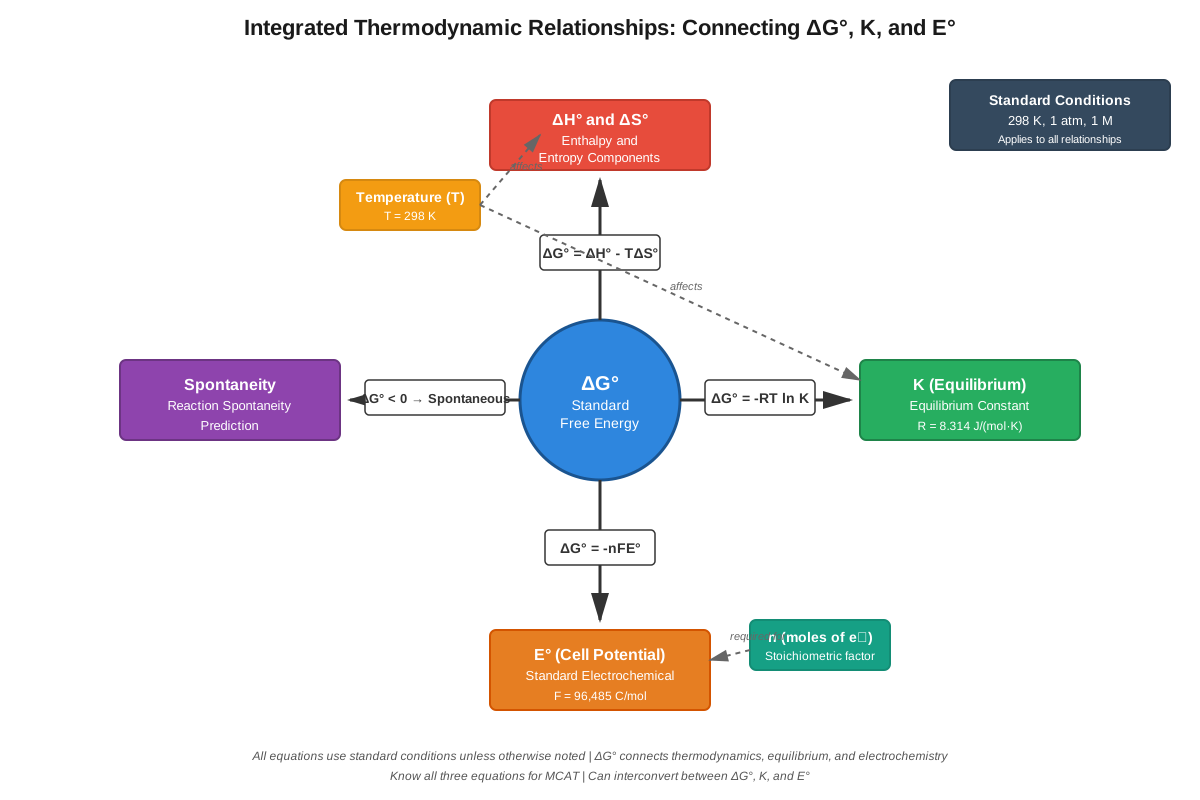
The relationship between standard free energy and other General Chemistry concepts is extensive. It directly connects to the second law of thermodynamics through entropy, incorporates enthalpy changes from the first law, determines equilibrium constants through the relationship ΔG° = -RT ln K, and provides the foundation for understanding electrochemical cell potentials via ΔG° = -nFE°. Mastering standard free energy creates a conceptual scaffold that supports understanding of bioenergetics, metabolic pathways, and the thermodynamic favorability of biochemical processes tested throughout the MCAT.
Learning Objectives
- [ ] Define Standard free energy using accurate General Chemistry terminology
- [ ] Explain why Standard free energy matters for the MCAT
- [ ] Apply Standard free energy to exam-style questions
- [ ] Identify common mistakes related to Standard free energy
- [ ] Connect Standard free energy to related General Chemistry concepts
- [ ] Calculate standard free energy changes using the Gibbs free energy equation and thermodynamic data
- [ ] Predict reaction spontaneity under standard and non-standard conditions using ΔG° and ΔG
- [ ] Interconvert between standard free energy, equilibrium constants, and standard cell potentials
- [ ] Analyze coupled reactions and determine overall spontaneity using standard free energy values
Prerequisites
- Enthalpy (ΔH): Understanding heat changes in reactions is essential because enthalpy is one of two components in the Gibbs free energy equation
- Entropy (ΔS): Knowledge of disorder and spontaneity from entropy provides the second component needed to calculate free energy changes
- Thermodynamic systems and surroundings: Distinguishing between system and surroundings helps interpret the meaning of negative versus positive free energy values
- Standard conditions: Familiarity with 298 K (25°C), 1 atm, and 1 M concentrations defines when standard free energy applies
- Equilibrium concepts: Understanding equilibrium constants (K) is necessary to connect standard free energy to equilibrium position
- Basic logarithms: Computational facility with natural logarithms (ln) is required for equations relating ΔG° to K
Why This Topic Matters
Standard free energy has profound clinical and real-world significance. Every biochemical reaction in the human body—from ATP hydrolysis powering muscle contraction to the electron transport chain generating cellular energy—operates according to free energy principles. Pharmaceutical development relies on understanding the thermodynamic favorability of drug-receptor binding. Metabolic disorders often involve disruptions in normally spontaneous biochemical pathways, and understanding ΔG° helps clinicians comprehend why certain enzymatic deficiencies cause disease.
On the MCAT, standard free energy appears with remarkable frequency. Statistical analysis of recent exams shows that 4-6% of Chemical and Physical Foundations questions directly test thermodynamics, with standard free energy being the most commonly assessed thermodynamic concept. Questions typically appear in three formats: (1) discrete questions asking for calculations or conceptual predictions, (2) passage-based questions involving experimental data about reaction energetics, and (3) biochemistry passages requiring analysis of metabolic pathway spontaneity. The topic bridges general chemistry and biochemistry, making it doubly important for comprehensive MCAT preparation.
Common exam presentations include passages describing coupled reactions in metabolism (such as ATP hydrolysis driving unfavorable biosynthetic reactions), electrochemical cells requiring conversion between ΔG° and E°, and experimental scenarios where students must predict whether reactions will proceed based on thermodynamic data. The MCAT frequently tests the distinction between standard conditions (ΔG°) and non-standard conditions (ΔG), requiring students to apply the relationship ΔG = ΔG° + RT ln Q. Understanding these applications transforms standard free energy from an abstract concept into a practical tool for answering high-yield questions.
Core Concepts
Definition and Fundamental Equation
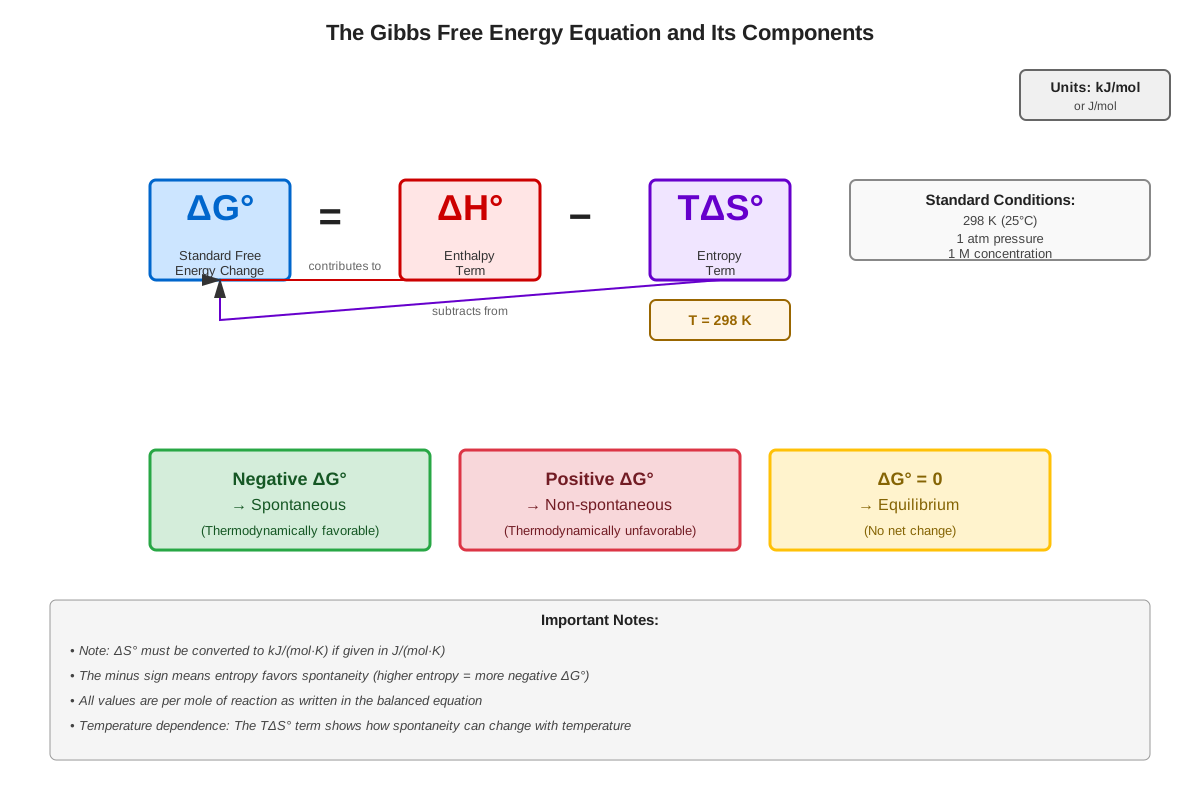
Standard free energy change (ΔG°) represents the change in Gibbs free energy when a reaction occurs under standard conditions with all reactants and products at 1 M concentration (or 1 atm for gases), at 298 K (25°C), and 1 atm pressure. The Gibbs free energy itself is a state function that combines enthalpy and entropy to predict reaction spontaneity. The fundamental equation connecting these quantities is:
ΔG° = ΔH° - TΔS°Where:
- ΔG° = standard free energy change (kJ/mol or J/mol)
- ΔH° = standard enthalpy change (kJ/mol)
- T = temperature in Kelvin (typically 298 K for standard conditions)
- ΔS° = standard entropy change (J/mol·K)
This equation reveals that spontaneity depends on both the enthalpy change (heat released or absorbed) and the entropy change (disorder created or destroyed), weighted by temperature. The temperature term is crucial: at higher temperatures, the entropy contribution (TΔS°) becomes more significant in determining spontaneity.
Interpreting ΔG° Values
The sign and magnitude of ΔG° provide immediate information about reaction spontaneity and equilibrium position:
| ΔG° Value | Meaning | Equilibrium Position | K Value |
|---|---|---|---|
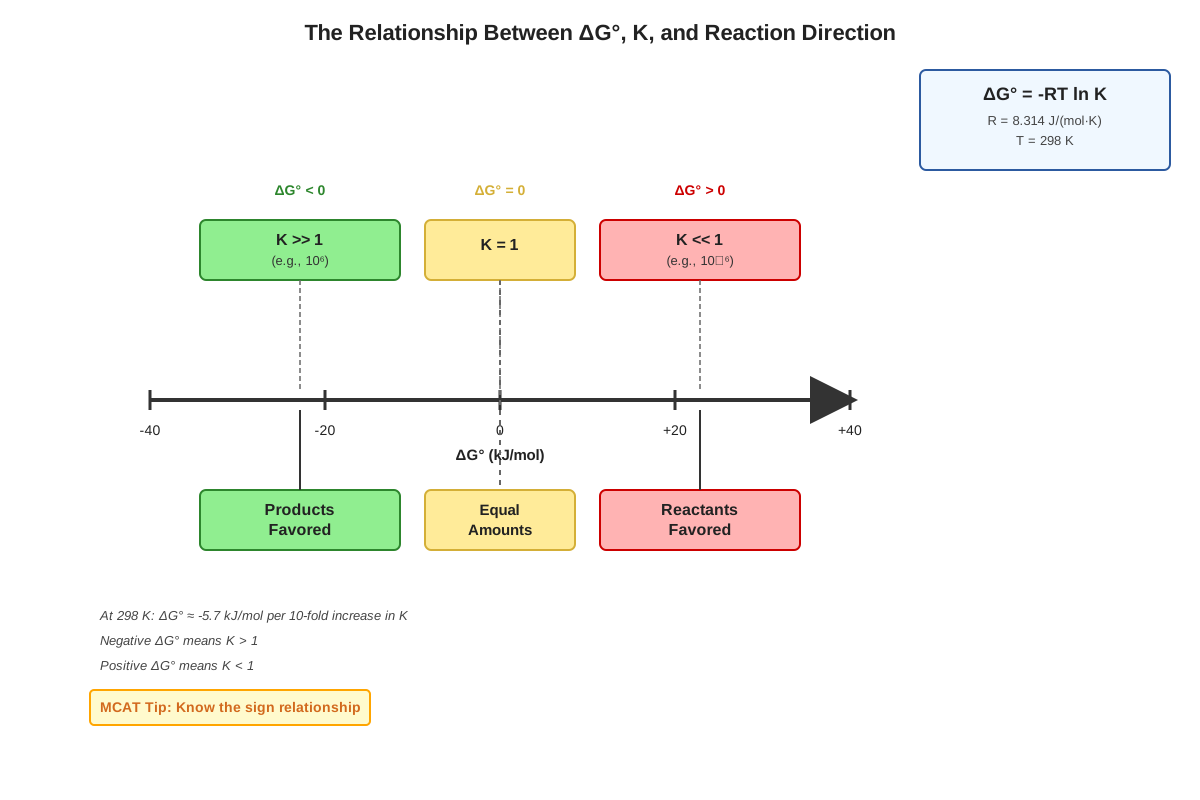
| ΔG° < 0 (negative) | Spontaneous forward reaction under standard conditions | Products favored | K > 1 |
| ΔG° = 0 | System at equilibrium under standard conditions | Neither favored | K = 1 |
| ΔG° > 0 (positive) | Non-spontaneous forward reaction; reverse reaction spontaneous | Reactants favored | K < 1 |
A critical distinction exists between thermodynamic favorability (predicted by ΔG°) and kinetic feasibility (determined by activation energy). A reaction with negative ΔG° is thermodynamically favorable but may proceed extremely slowly without a catalyst. The MCAT frequently tests this distinction, particularly in biochemistry contexts where enzymes lower activation energies for thermodynamically favorable reactions.
Relationship to Equilibrium Constant
One of the most powerful relationships in thermodynamics connects standard free energy to the equilibrium constant:
ΔG° = -RT ln KWhere:
- R = universal gas constant (8.314 J/mol·K)
- T = temperature in Kelvin (298 K for standard conditions)
- K = equilibrium constant (Kc, Kp, Ka, Kb, or Ksp depending on context)
- ln = natural logarithm
This equation reveals that ΔG° and K are inversely related through a logarithmic function. At 298 K, this simplifies to:
ΔG° = -5.71 log K (when using log base 10 and ΔG° in kJ/mol)Key implications:
- When K > 1 (products favored), ln K is positive, making ΔG° negative (spontaneous)
- When K < 1 (reactants favored), ln K is negative, making ΔG° positive (non-spontaneous)
- When K = 1 (equal amounts), ln K = 0, making ΔG° = 0 (at equilibrium)
Standard vs. Non-Standard Conditions
The distinction between ΔG° (standard conditions) and ΔG (actual conditions) is frequently tested on the MCAT. The relationship between them is:
ΔG = ΔG° + RT ln QWhere Q is the reaction quotient, calculated identically to K but using actual concentrations rather than equilibrium concentrations. This equation shows that:
- When Q < K, the reaction proceeds forward (ΔG < 0) to reach equilibrium
- When Q > K, the reaction proceeds in reverse (ΔG > 0) to reach equilibrium
- When Q = K, the system is at equilibrium (ΔG = 0)
At equilibrium, ΔG = 0, which leads back to ΔG° = -RT ln K. This relationship is crucial for understanding why reactions with positive ΔG° can still proceed forward under certain conditions—if Q is sufficiently small, the RT ln Q term can make ΔG negative even when ΔG° is positive.
Standard Free Energy of Formation
The standard free energy of formation (ΔG°f) is the free energy change when one mole of a compound forms from its constituent elements in their standard states. By convention, ΔG°f = 0 for elements in their standard states (such as O₂(g), H₂(g), C(graphite)). The standard free energy change for any reaction can be calculated using:
ΔG°rxn = Σ(ΔG°f products) - Σ(ΔG°f reactants)This Hess's Law approach allows calculation of ΔG° for reactions using tabulated formation data, similar to calculating ΔH° using enthalpies of formation. The MCAT may provide a table of ΔG°f values and ask students to calculate ΔG°rxn for a specific reaction.
Temperature Dependence
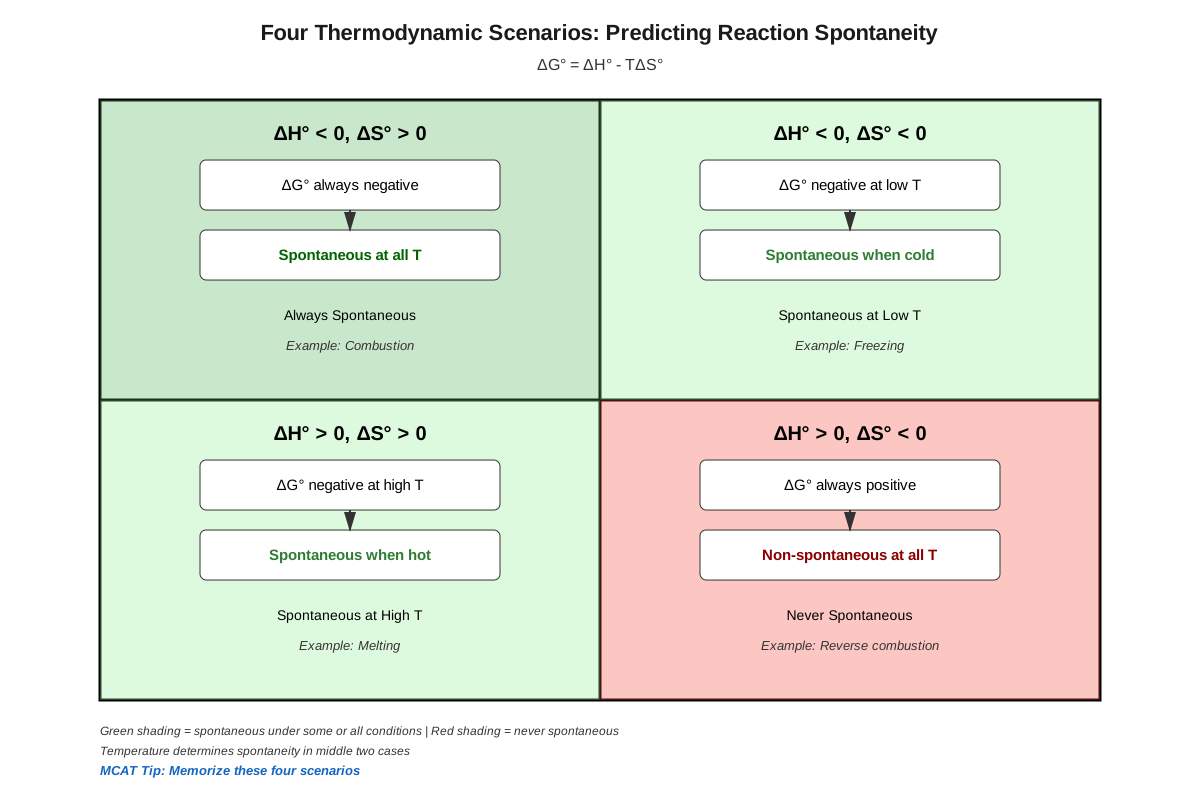
The Gibbs free energy equation ΔG° = ΔH° - TΔS° reveals how temperature affects spontaneity. Four scenarios exist based on the signs of ΔH° and ΔS°:
- ΔH° < 0, ΔS° > 0: Spontaneous at all temperatures (exothermic and entropy-increasing)
- ΔH° < 0, ΔS° < 0: Spontaneous at low temperatures (enthalpy dominates)
- ΔH° > 0, ΔS° > 0: Spontaneous at high temperatures (entropy dominates)
- ΔH° > 0, ΔS° < 0: Non-spontaneous at all temperatures (endothermic and entropy-decreasing)
The temperature at which a reaction switches from spontaneous to non-spontaneous (or vice versa) occurs when ΔG° = 0:
T = ΔH°/ΔS° (at the crossover temperature)Connection to Electrochemistry
Standard free energy directly relates to standard cell potential (E°) in electrochemical cells:
ΔG° = -nFE°Where:
- n = number of moles of electrons transferred
- F = Faraday's constant (96,485 C/mol or approximately 96,500 J/V·mol)
- E° = standard cell potential in volts
This relationship shows that spontaneous electrochemical reactions (positive E°) have negative ΔG°, reinforcing the connection between thermodynamic favorability and electrical work. The MCAT frequently tests this relationship in passages about batteries, fuel cells, or electrolytic cells.
Coupled Reactions
In biochemistry, coupled reactions involve linking a thermodynamically unfavorable reaction (positive ΔG°) with a favorable one (negative ΔG°) to drive the overall process forward. The classic example is ATP hydrolysis:
ATP + H₂O → ADP + Pi ΔG° = -30.5 kJ/molThis highly favorable reaction can be coupled to unfavorable biosynthetic reactions. For coupled reactions, the overall ΔG° is simply the sum of individual ΔG° values:
ΔG°total = ΔG°₁ + ΔG°₂If ΔG°total < 0, the coupled process is spontaneous. This principle underlies metabolism, where energy from catabolic pathways (negative ΔG°) drives anabolic pathways (positive ΔG°).
Concept Relationships
Standard free energy serves as the central hub connecting multiple thermodynamic concepts. The relationship begins with enthalpy and entropy, which combine through the Gibbs equation (ΔG° = ΔH° - TΔS°) to produce standard free energy. This equation shows that ΔG° depends on both the heat change (ΔH°) and disorder change (ΔS°), with temperature determining their relative importance.
Standard free energy then connects forward to equilibrium through ΔG° = -RT ln K, establishing that the equilibrium constant is an exponential function of free energy. This relationship means that small changes in ΔG° produce large changes in K, explaining why reactions with ΔG° = -10 kJ/mol have K ≈ 50, while those with ΔG° = -20 kJ/mol have K ≈ 3000.
The distinction between standard and non-standard conditions creates the relationship: ΔG° → ΔG through the equation ΔG = ΔG° + RT ln Q. This shows that reaction quotient Q modifies the standard free energy to predict spontaneity under actual conditions. When Q = K, the system reaches equilibrium where ΔG = 0.
In electrochemistry, standard free energy connects to cell potential via ΔG° = -nFE°, linking thermodynamics to electrical work. This relationship means that galvanic cells (spontaneous, positive E°) have negative ΔG°, while electrolytic cells (non-spontaneous, negative E°) have positive ΔG° and require external energy input.
The concept map flows: Enthalpy + Entropy → Standard Free Energy → Equilibrium Constant → Reaction Quotient → Actual Free Energy → Spontaneity Prediction. Simultaneously, Standard Free Energy → Cell Potential → Electrochemical Work. Understanding these connections allows students to navigate between different representations of the same thermodynamic information.
Quick check — test yourself on Standard free energy so far.
Try Flashcards →High-Yield Facts
⭐ ΔG° < 0 indicates a spontaneous reaction under standard conditions with products favored at equilibrium (K > 1)
⭐ The equation ΔG° = ΔH° - TΔS° shows that spontaneity depends on both enthalpy and entropy, with temperature weighting their contributions
⭐ ΔG° = -RT ln K connects standard free energy to equilibrium constant; at 298 K, ΔG° ≈ -5.71 log K (in kJ/mol)
⭐ ΔG = ΔG° + RT ln Q distinguishes between standard conditions (ΔG°) and actual conditions (ΔG); at equilibrium, ΔG = 0 and Q = K
⭐ ΔG° = -nFE° relates standard free energy to standard cell potential; spontaneous electrochemical reactions have positive E° and negative ΔG°
- Standard free energy of formation (ΔG°f) equals zero for elements in their standard states
- ΔG°rxn = Σ(ΔG°f products) - Σ(ΔG°f reactants) allows calculation of reaction free energy from formation data
- For coupled reactions, ΔG°total = ΔG°₁ + ΔG°₂; if the sum is negative, the coupled process is spontaneous
- A reaction with positive ΔG° can proceed forward if Q is sufficiently small to make ΔG negative
- Temperature affects spontaneity: reactions with ΔH° > 0 and ΔS° > 0 become spontaneous at high temperatures
- The magnitude of ΔG° indicates how far from equilibrium the standard state lies, not the reaction rate
- ATP hydrolysis (ΔG° ≈ -30.5 kJ/mol) is the primary energy currency in biological systems, driving unfavorable reactions through coupling
- A negative ΔG° does not guarantee observable reaction without sufficient activation energy or a catalyst
- Standard conditions are defined as 298 K, 1 atm pressure, and 1 M concentrations for all species
- The relationship between ΔG° and K is logarithmic, so small changes in ΔG° produce exponentially large changes in K
Common Misconceptions
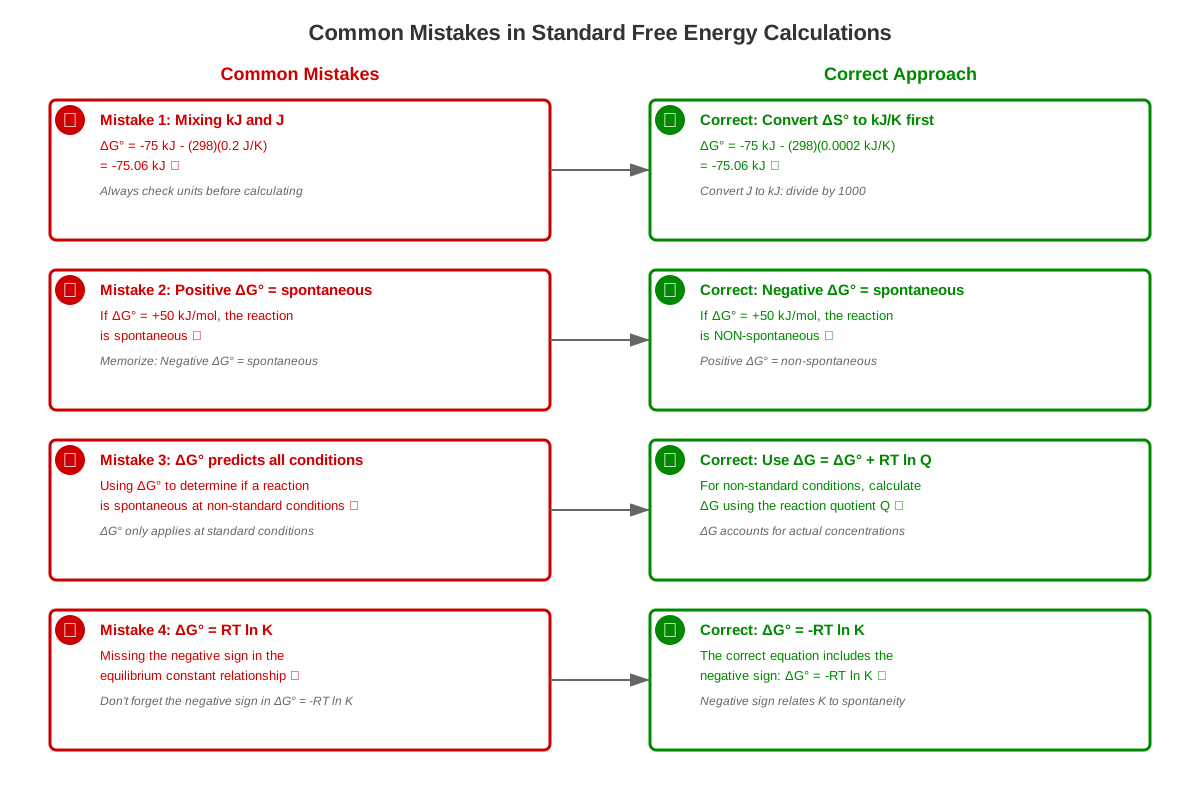
Misconception: A negative ΔG° means the reaction will proceed rapidly.
Correction: ΔG° predicts thermodynamic favorability (spontaneity) but says nothing about reaction rate. A reaction with very negative ΔG° may proceed imperceptibly slowly without a catalyst due to high activation energy. Thermodynamics determines where a reaction goes; kinetics determines how fast it gets there.
Misconception: ΔG° and ΔG are interchangeable terms.
Correction: ΔG° applies only to standard conditions (298 K, 1 atm, 1 M concentrations), while ΔG applies to actual conditions. The relationship ΔG = ΔG° + RT ln Q shows they differ by the RT ln Q term. At equilibrium, ΔG = 0 but ΔG° typically does not equal zero.
Misconception: If ΔG° is positive, the reaction cannot occur.
Correction: A positive ΔG° means the reaction is non-spontaneous under standard conditions, but it can still proceed forward if Q < K (making ΔG negative) or if coupled to a favorable reaction. Many biosynthetic reactions have positive ΔG° but occur because they're coupled to ATP hydrolysis.
Misconception: The temperature in ΔG° = ΔH° - TΔS° can be any temperature.
Correction: For standard free energy (ΔG°), the temperature must be 298 K (25°C) by definition. At other temperatures, the equation still applies but yields ΔG at that temperature, not ΔG°. The standard state always refers to 298 K.
Misconception: A larger negative ΔG° means a larger equilibrium constant by a proportional amount.
Correction: The relationship ΔG° = -RT ln K is logarithmic, not linear. This means that each additional -5.71 kJ/mol in ΔG° multiplies K by a factor of 10 (at 298 K). A reaction with ΔG° = -20 kJ/mol has K ≈ 3000, while ΔG° = -10 kJ/mol gives K ≈ 50—a 60-fold difference from a 2-fold change in ΔG°.
Misconception: Standard free energy of formation (ΔG°f) is zero for all pure elements.
Correction: ΔG°f = 0 only for elements in their standard states. For example, ΔG°f = 0 for O₂(g) and C(graphite), but not for O₃(g) or C(diamond), which are not the standard states of oxygen and carbon respectively.
Misconception: In the equation ΔG° = -nFE°, a positive ΔG° means a positive E°.
Correction: The negative sign in the equation means they have opposite signs. A positive ΔG° (non-spontaneous) corresponds to a negative E° (non-spontaneous electrochemical reaction). Conversely, negative ΔG° (spontaneous) corresponds to positive E° (spontaneous galvanic cell).
Worked Examples
Example 1: Calculating ΔG° and Predicting Spontaneity
Problem: Consider the reaction: N₂(g) + 3H₂(g) → 2NH₃(g)
Given: ΔH° = -92.4 kJ/mol, ΔS° = -198.7 J/mol·K at 298 K
(a) Calculate ΔG° at 298 K
(b) Is the reaction spontaneous under standard conditions?
(c) At what temperature does the reaction become non-spontaneous?
Solution:
(a) Using ΔG° = ΔH° - TΔS°
First, convert ΔS° to kJ/mol·K for unit consistency:
ΔS° = -198.7 J/mol·K × (1 kJ/1000 J) = -0.1987 kJ/mol·K
Now calculate:
ΔG° = -92.4 kJ/mol - (298 K)(-0.1987 kJ/mol·K)
ΔG° = -92.4 kJ/mol - (-59.2 kJ/mol)
ΔG° = -92.4 kJ/mol + 59.2 kJ/mol
ΔG° = -33.2 kJ/mol
(b) Since ΔG° < 0, the reaction is spontaneous under standard conditions at 298 K. Products (ammonia) are favored at equilibrium.
(c) The reaction becomes non-spontaneous when ΔG° = 0:
0 = ΔH° - TΔS°
TΔS° = ΔH°
T = ΔH°/ΔS° = -92.4 kJ/mol / -0.1987 kJ/mol·K = 465 K
Above 465 K (192°C), the reaction becomes non-spontaneous. This makes sense because the reaction is exothermic (ΔH° < 0) and entropy-decreasing (ΔS° < 0, as 4 moles of gas become 2 moles). At low temperatures, the favorable enthalpy dominates, but at high temperatures, the unfavorable entropy dominates.
Connection to Learning Objectives: This example demonstrates applying the fundamental Gibbs equation, interpreting ΔG° values to predict spontaneity, and understanding temperature dependence—all critical skills for MCAT success.
Example 2: Relating ΔG° to Equilibrium and Non-Standard Conditions
Problem: For the reaction A ⇌ B at 298 K, ΔG° = +5.71 kJ/mol
(a) Calculate the equilibrium constant K
(b) If [A] = 2.0 M and [B] = 0.5 M initially, calculate ΔG and determine the direction of spontaneous reaction
(c) What concentration ratio [B]/[A] would make ΔG = 0?
Solution:
(a) Using ΔG° = -RT ln K:
5.71 kJ/mol = -(8.314 J/mol·K)(298 K) ln K
5710 J/mol = -2477 J/mol × ln K
ln K = -2.305
K = e^(-2.305) = 0.10
Since K < 1, reactants are favored at equilibrium, which makes sense given the positive ΔG°.
(b) Calculate Q and then ΔG:
Q = [B]/[A] = 0.5 M / 2.0 M = 0.25
Using ΔG = ΔG° + RT ln Q:
ΔG = 5710 J/mol + (8.314 J/mol·K)(298 K) ln(0.25)
ΔG = 5710 J/mol + (2477 J/mol)(-1.386)
ΔG = 5710 J/mol - 3433 J/mol
ΔG = +2277 J/mol = +2.28 kJ/mol
Since ΔG > 0, the forward reaction (A → B) is non-spontaneous under these conditions. The reverse reaction (B → A) is spontaneous. This makes sense because Q (0.25) > K (0.10), meaning there's too much product relative to equilibrium, so the reaction shifts backward.
(c) When ΔG = 0, the system is at equilibrium, so [B]/[A] = K = 0.10
Alternatively, solving directly:
0 = ΔG° + RT ln([B]/[A])
-ΔG° = RT ln([B]/[A])
-5710 J/mol = (2477 J/mol) ln([B]/[A])
ln([B]/[A]) = -2.305
[B]/[A] = 0.10
Connection to Learning Objectives: This example integrates the relationship between ΔG°, K, Q, and ΔG—demonstrating how to predict reaction direction under non-standard conditions and reinforcing the distinction between standard and actual free energy.
Exam Strategy
When approaching MCAT questions on standard free energy, begin by identifying whether the question asks about standard conditions (ΔG°) or actual conditions (ΔG). Look for trigger phrases like "under standard conditions," "at equilibrium," or specific concentration/pressure values that indicate non-standard conditions.
Key trigger words and phrases:
- "Spontaneous" → check sign of ΔG (or ΔG° if standard conditions specified)
- "Equilibrium constant" → use ΔG° = -RT ln K
- "Cell potential" → use ΔG° = -nFE°
- "At equilibrium" → ΔG = 0 (not ΔG°)
- "Products favored" → ΔG° < 0 and K > 1
- "Coupled reaction" → add ΔG° values
For calculation questions, immediately check units. ΔH° is typically given in kJ/mol while ΔS° is in J/mol·K—unit conversion errors are common. When using ΔG° = ΔH° - TΔS°, convert ΔS° to kJ/mol·K or convert ΔH° to J/mol for consistency.
Process-of-elimination strategies:
- If a question asks about spontaneity and provides ΔH° and ΔS° values, quickly determine the sign of ΔG° without full calculation. For example, if ΔH° < 0 and ΔS° > 0, ΔG° must be negative (spontaneous) regardless of temperature.
- When comparing equilibrium constants, remember the logarithmic relationship: each -5.71 kJ/mol change in ΔG° multiplies K by 10. Use this to eliminate unreasonable answer choices.
- For questions about temperature effects, identify the signs of ΔH° and ΔS° to determine whether increasing temperature makes ΔG° more or less negative.
- If asked whether a reaction with positive ΔG° can occur, look for information about coupling to favorable reactions or non-standard conditions that might make ΔG negative.
Time allocation: Standard free energy calculations typically require 60-90 seconds. If a calculation seems to require more than 2 minutes, look for a conceptual shortcut or estimation strategy. For example, at 298 K, RT ≈ 2.5 kJ/mol, so ΔG° = -RT ln K ≈ -2.5 ln K. This approximation can quickly eliminate wrong answers.
Exam Tip: When a passage provides thermodynamic data tables, immediately scan for ΔG°f values, as questions often require calculating ΔG°rxn using Hess's Law. Mark the relevant values before reading questions to save time.
Memory Techniques
Mnemonic for spontaneity based on ΔH° and ΔS° signs: "SEAN"
- Spontaneous at all temperatures: ΔH° < 0, ΔS° > 0 (Exothermic + Entropy increase)
- Enthalpy-driven (low T): ΔH° < 0, ΔS° < 0 (Exothermic wins at low T)
- Always non-spontaneous: ΔH° > 0, ΔS° < 0 (Endothermic + Entropy decrease)
- Needs high temperature: ΔH° > 0, ΔS° > 0 (Entropy wins at high T)
Mnemonic for the relationship between ΔG°, K, and spontaneity: "Negative Goes, Positive Stays"
- Negative ΔG° → reaction Goes forward → K > 1
- Positive ΔG° → reaction Stays with reactants → K < 1
Visualization for ΔG = ΔG° + RT ln Q: Picture a thermodynamic "hill." ΔG° represents the standard height difference between reactants and products. The RT ln Q term adjusts this height based on actual concentrations—if Q < K (too many reactants), the term is negative and pushes the reaction downhill (forward). If Q > K (too many products), the term is positive and pushes the reaction uphill (backward).
Acronym for key equations: "GLEN"
- Gibbs: ΔG° = ΔH° - TΔS°
- Logarithm: ΔG° = -RT ln K
- Electrochemistry: ΔG° = -nFE°
- Non-standard: ΔG = ΔG° + RT ln Q
Memory aid for unit conversion: "Entropy Jumps" (J for Joules) - Remember that ΔS° is almost always given in J/mol·K, requiring conversion to kJ/mol·K when working with ΔH° in kJ/mol.
Visualization for coupled reactions: Imagine ATP as a "thermodynamic battery" with ΔG° ≈ -30 kJ/mol stored energy. When coupled to an unfavorable reaction (positive ΔG°), ATP "donates" its negative ΔG° to make the total negative. Visualize this as ATP pushing an uphill reaction over the energy barrier.
Summary
Standard free energy (ΔG°) is the cornerstone concept for predicting reaction spontaneity and equilibrium position under standard conditions in General Chemistry. Defined by the Gibbs equation ΔG° = ΔH° - TΔS°, it integrates enthalpy and entropy to provide a single criterion for spontaneity: negative ΔG° indicates a spontaneous forward reaction with products favored at equilibrium (K > 1), while positive ΔG° indicates non-spontaneity with reactants favored (K < 1). The relationship ΔG° = -RT ln K mathematically connects free energy to equilibrium constants, while ΔG = ΔG° + RT ln Q extends predictions to non-standard conditions. Standard free energy also bridges to electrochemistry through ΔG° = -nFE°, linking thermodynamic favorability to cell potentials. For the MCAT, mastering standard free energy requires understanding these quantitative relationships, recognizing how temperature affects spontaneity through the ΔH° - TΔS° balance, and applying coupled reaction principles to biochemical contexts. The ability to interconvert between ΔG°, K, E°, and spontaneity predictions under various conditions represents essential competency for high-yield MCAT performance in thermodynamics and related topics.
Key Takeaways
- Standard free energy (ΔG°) predicts spontaneity under standard conditions: ΔG° < 0 means spontaneous with products favored; ΔG° > 0 means non-spontaneous with reactants favored
- The Gibbs equation ΔG° = ΔH° - TΔS° shows spontaneity depends on both enthalpy and entropy, with temperature determining their relative importance
- ΔG° = -RT ln K provides the mathematical bridge between thermodynamics and equilibrium, with the logarithmic relationship meaning small ΔG° changes produce large K changes
- Distinguish between ΔG° (standard conditions) and ΔG (actual conditions) using ΔG = ΔG° + RT ln Q; at equilibrium, ΔG = 0 but ΔG° typically does not equal zero
- Standard free energy connects to electrochemistry via ΔG° = -nFE°, linking spontaneous reactions (negative ΔG°) to positive cell potentials
- Coupled reactions allow unfavorable processes (positive ΔG°) to proceed when linked to favorable ones (negative ΔG°), with ΔG°total = ΔG°₁ + ΔG°₂
- Thermodynamic favorability (ΔG°) is independent of reaction rate; negative ΔG° guarantees spontaneity but not observable reaction without sufficient kinetic energy or catalysis
Related Topics
Reaction Kinetics and Activation Energy: Understanding the distinction between thermodynamic favorability (ΔG°) and kinetic feasibility (Ea) is essential. Mastering standard free energy provides the foundation for recognizing that catalysts lower activation energy without changing ΔG°, a frequently tested concept on the MCAT.
Electrochemistry and Redox Reactions: The relationship ΔG° = -nFE° directly connects standard free energy to electrochemical cells. Proficiency with ΔG° enables deeper understanding of galvanic cells, electrolytic cells, and the Nernst equation for non-standard cell potentials.
Chemical Equilibrium and Le Chatelier's Principle: Since ΔG° = -RT ln K, mastering standard free energy provides quantitative grounding for equilibrium concepts. Understanding how ΔG changes with Q explains why Le Chatelier's principle works at the molecular level.
Biochemical Energetics and Metabolism: ATP hydrolysis, glycolysis, and the citric acid cycle all operate according to free energy principles. Standard free energy mastery is prerequisite for understanding how metabolic pathways couple favorable and unfavorable reactions.
Entropy and the Second Law of Thermodynamics: The entropy term in ΔG° = ΔH° - TΔS° connects to deeper understanding of why entropy increases in spontaneous processes and how temperature affects this contribution to spontaneity.
Practice CTA
Now that you've mastered the core concepts of standard free energy, it's time to solidify your understanding through active practice. Attempt the practice questions to test your ability to calculate ΔG° values, predict spontaneity under various conditions, and connect free energy to equilibrium constants and cell potentials. Use the flashcards to reinforce key equations and relationships until they become automatic. Remember: thermodynamics is one of the highest-yield topics on the MCAT, and standard free energy is the central concept that ties everything together. Your investment in mastering this topic will pay dividends across multiple question types and passages on test day. You've got this!
Sign up free to keep reading
Create a free AnvayaPrep account to finish this MCAT guide on Standard free energy — plus flashcards and practice questions.