Overview
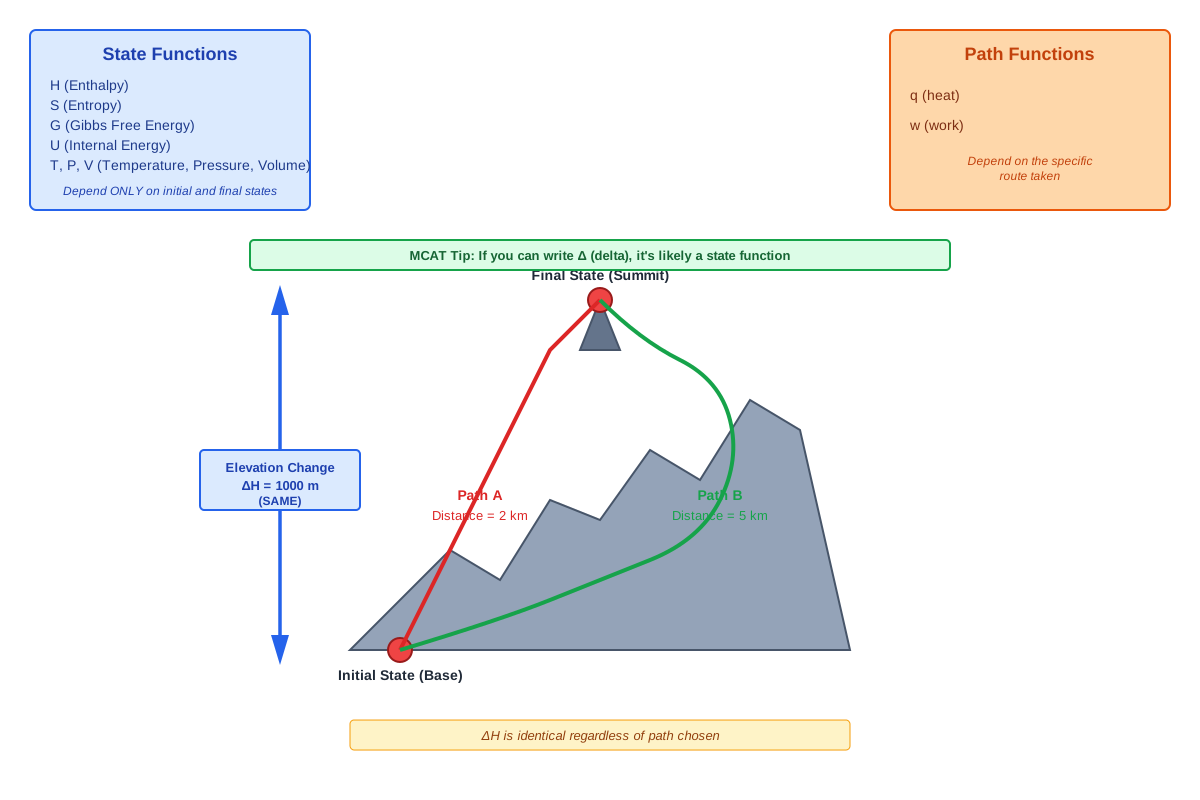
State functions are fundamental properties in thermodynamics that describe the condition of a system independent of how that system arrived at its current state. Unlike path functions, which depend on the specific route taken during a process, state functions depend only on the initial and final states of the system. This distinction is crucial for solving thermodynamic problems efficiently and forms the conceptual foundation for understanding energy transformations in chemical and biological systems.
For the MCAT, mastery of state functions is essential because they appear throughout General Chemistry passages and questions dealing with energy, enthalpy, entropy, and Gibbs free energy. The exam frequently tests whether students can distinguish between state and path functions, calculate changes in state functions, and apply these concepts to predict the spontaneity and feasibility of chemical reactions. Understanding state functions enables test-takers to quickly identify which thermodynamic quantities can be calculated directly from initial and final conditions without needing detailed information about the reaction pathway.
State functions connect intimately with other General Chemistry concepts including chemical equilibrium, electrochemistry, calorimetry, and reaction energetics. They provide the mathematical framework for the First and Second Laws of Thermodynamics, which govern all energy transformations in chemistry and biology. The MCAT particularly emphasizes how state functions like enthalpy (H), entropy (S), and Gibbs free energy (G) determine whether biochemical processes can occur spontaneously—knowledge that bridges general chemistry with biological systems and metabolism questions in the Biological and Biochemical Foundations section.
Learning Objectives
- [ ] Define state functions using accurate General Chemistry terminology
- [ ] Explain why state functions matter for the MCAT
- [ ] Apply state functions to exam-style questions
- [ ] Identify common mistakes related to state functions
- [ ] Connect state functions to related General Chemistry concepts
- [ ] Distinguish between state functions and path functions in various thermodynamic scenarios
- [ ] Calculate changes in state functions using Hess's Law and thermodynamic cycles
- [ ] Predict the spontaneity of reactions using state function relationships
Prerequisites
- Basic thermodynamic terminology: Understanding of system, surroundings, and universe is necessary to define what properties belong to the system being analyzed
- Energy conservation principles: The First Law of Thermodynamics provides the foundation for understanding why certain properties are state functions
- Chemical equations and stoichiometry: Required to perform calculations involving enthalpy changes and other state function manipulations
- Basic calculus concepts: Understanding that state functions have exact differentials helps explain their path-independent nature (though detailed calculus is not tested on the MCAT)
Why This Topic Matters
State functions represent one of the most frequently tested concepts in MCAT General Chemistry, appearing in approximately 3-5 questions per exam either directly or as foundational knowledge for more complex thermodynamics problems. The MCAT uses state functions to test critical reasoning about energy transformations, particularly in passages involving metabolism, cellular respiration, and biochemical pathways where energy efficiency and spontaneity are paramount.
Clinically, state functions underpin our understanding of how biological systems maintain homeostasis and perform work. For example, the body's use of ATP as an energy currency relies on Gibbs free energy changes (a state function) to drive non-spontaneous processes. Understanding state functions helps explain why certain metabolic pathways are irreversible under physiological conditions and why enzymes cannot change the thermodynamic favorability of reactions—only their kinetics.
On the MCAT, state functions commonly appear in several question formats: discrete questions asking students to identify which properties are state functions, passage-based questions requiring calculation of enthalpy changes using Hess's Law, and integrated questions connecting thermodynamic spontaneity to equilibrium constants. The exam particularly favors questions that test whether students understand that the change in a state function (ΔH, ΔS, ΔG) depends only on initial and final states, not on the specific mechanism or number of steps in a reaction pathway.
Core Concepts
Definition and Fundamental Properties
A state function is a property of a thermodynamic system whose value depends only on the current state of the system, not on the path or process by which the system reached that state. The mathematical consequence of this definition is that for any state function, the change in that function during a process depends only on the initial and final states:
ΔX = X_final - X_initialwhere X represents any state function. This path independence means that if a system undergoes a cyclic process (returning to its initial state), the total change in any state function equals zero:
∮ dX = 0 (for cyclic processes)The most important state functions for the MCAT include:
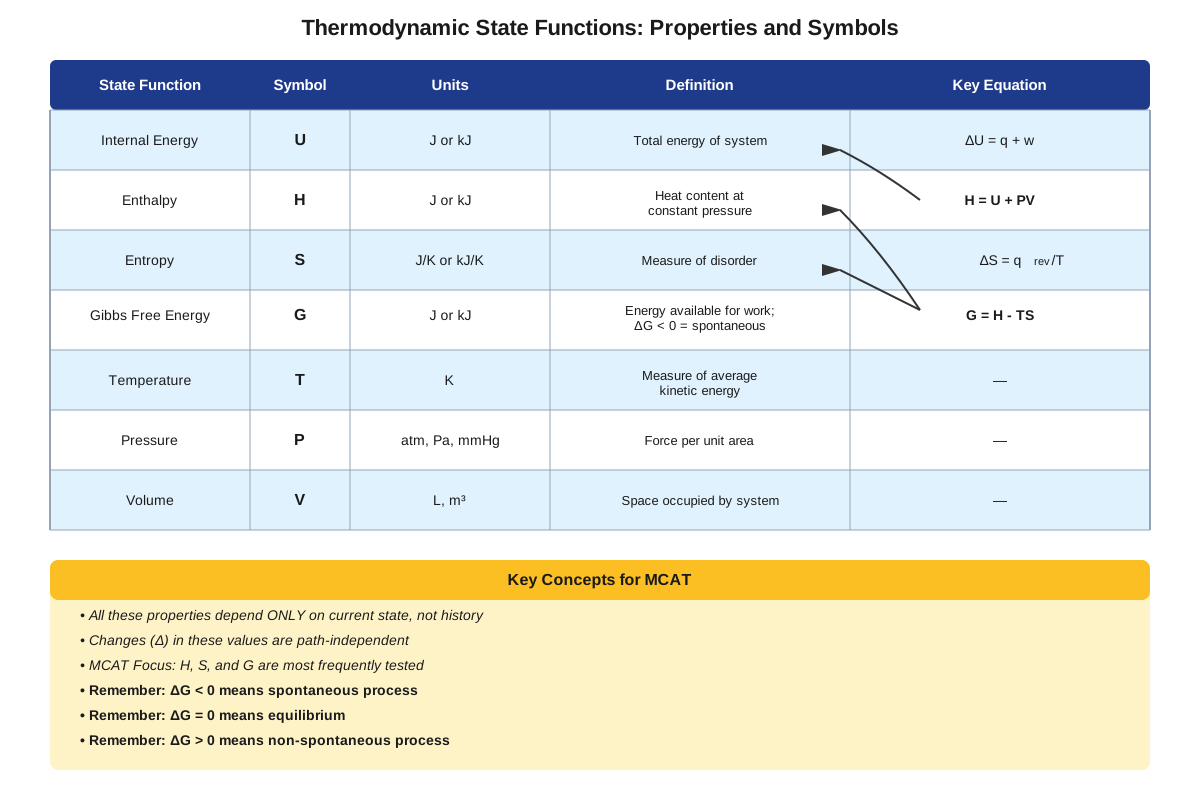
- Internal energy (U): The total energy contained within a system
- Enthalpy (H): Heat content at constant pressure (H = U + PV)
- Entropy (S): Measure of molecular disorder or energy dispersal
- Gibbs free energy (G): Energy available to do useful work (G = H - TS)
- Temperature (T): Average kinetic energy of particles
- Pressure (P): Force per unit area exerted by the system
- Volume (V): Space occupied by the system
- Number of moles (n): Amount of substance present
Path Functions vs. State Functions
Understanding the distinction between state functions and path functions is critical for MCAT success. Path functions depend on the specific route taken during a process and cannot be determined solely from initial and final states.
| Property | Type | Symbol | Path Dependent? | MCAT Relevance |
|---|---|---|---|---|
| Internal Energy | State Function | U | No | High |
| Enthalpy | State Function | H | No | Very High |
| Entropy | State Function | S | No | Very High |
| Gibbs Free Energy | State Function | G | No | Very High |
| Temperature | State Function | T | No | High |
| Pressure | State Function | P | No | Medium |
| Volume | State Function | V | No | High |
| Heat | Path Function | q | Yes | Very High |
| Work | Path Function | w | Yes | Very High |
The key distinction: heat (q) and work (w) are path functions because the amount of heat transferred or work performed depends on how a process is carried out. For example, a gas can expand isothermally (constant temperature) or adiabatically (no heat transfer), reaching the same final state but transferring different amounts of heat and work in each case.
Hess's Law and State Function Applications
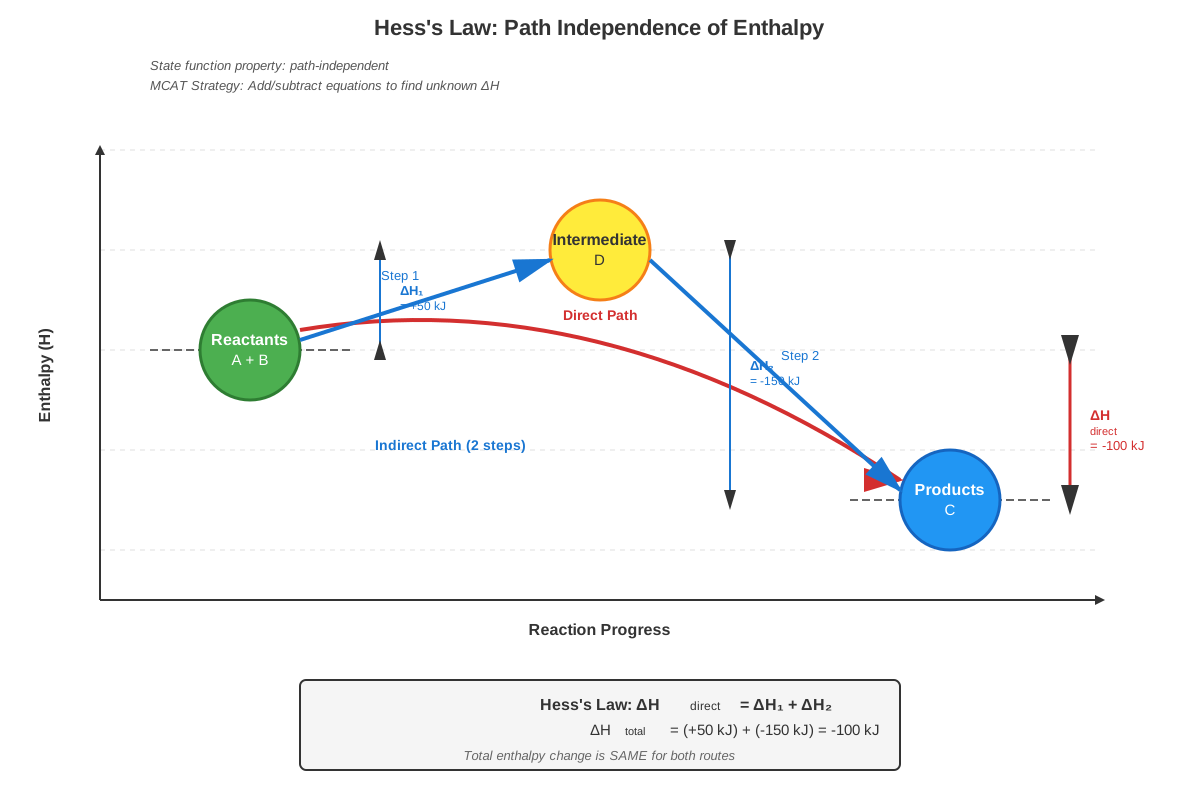
Hess's Law is a direct consequence of enthalpy being a state function. It states that the total enthalpy change for a reaction is independent of the number of steps or the specific pathway taken. Mathematically:
ΔH_total = ΔH_1 + ΔH_2 + ΔH_3 + ... + ΔH_nThis principle allows calculation of enthalpy changes for reactions that are difficult to measure directly by combining known enthalpy changes for related reactions. The MCAT frequently tests this concept by providing multiple reaction equations with their enthalpy changes and asking students to calculate the enthalpy change for a target reaction.
Example application: To find ΔH for a reaction that cannot be measured directly, manipulate known reactions (reversing them, multiplying by coefficients) until they sum to give the target reaction. The corresponding enthalpy changes are manipulated identically (reversing sign when reversing reaction, multiplying by the same coefficient).
Thermodynamic Cycles and State Functions
Because state functions are path-independent, thermodynamic cycles can be constructed where a system undergoes multiple steps and returns to its initial state. For any complete cycle:
- ΔU = 0 (change in internal energy)
- ΔH = 0 (change in enthalpy)
- ΔS_system + ΔS_surroundings ≥ 0 (Second Law)
- ΔG = 0 at equilibrium
The Born-Haber cycle exemplifies this principle, using Hess's Law to calculate lattice energies of ionic compounds by constructing a thermodynamic cycle involving sublimation, ionization, electron affinity, and formation reactions.
Mathematical Properties of State Functions
State functions possess exact differentials in mathematical terms, meaning their infinitesimal changes can be expressed as:
dX = (∂X/∂Y)_Z dY + (∂X/∂Z)_Y dZWhile the MCAT does not test calculus directly, understanding that state functions have this mathematical property explains why their changes are path-independent. This contrasts with path functions like heat and work, which have inexact differentials (denoted đq and đw).
Gibbs Free Energy as a State Function
Gibbs free energy (G) deserves special attention as the most important state function for predicting reaction spontaneity on the MCAT. The relationship:
ΔG = ΔH - TΔScombines three state functions (G, H, and S) to determine whether a process is spontaneous (ΔG < 0), at equilibrium (ΔG = 0), or non-spontaneous (ΔG > 0). Because all three quantities are state functions, ΔG depends only on initial and final states, regardless of reaction mechanism or kinetics.
The standard Gibbs free energy change (ΔG°) relates to the equilibrium constant:
ΔG° = -RT ln(K)This equation connects thermodynamics to chemical equilibrium, another high-yield MCAT topic.
Concept Relationships
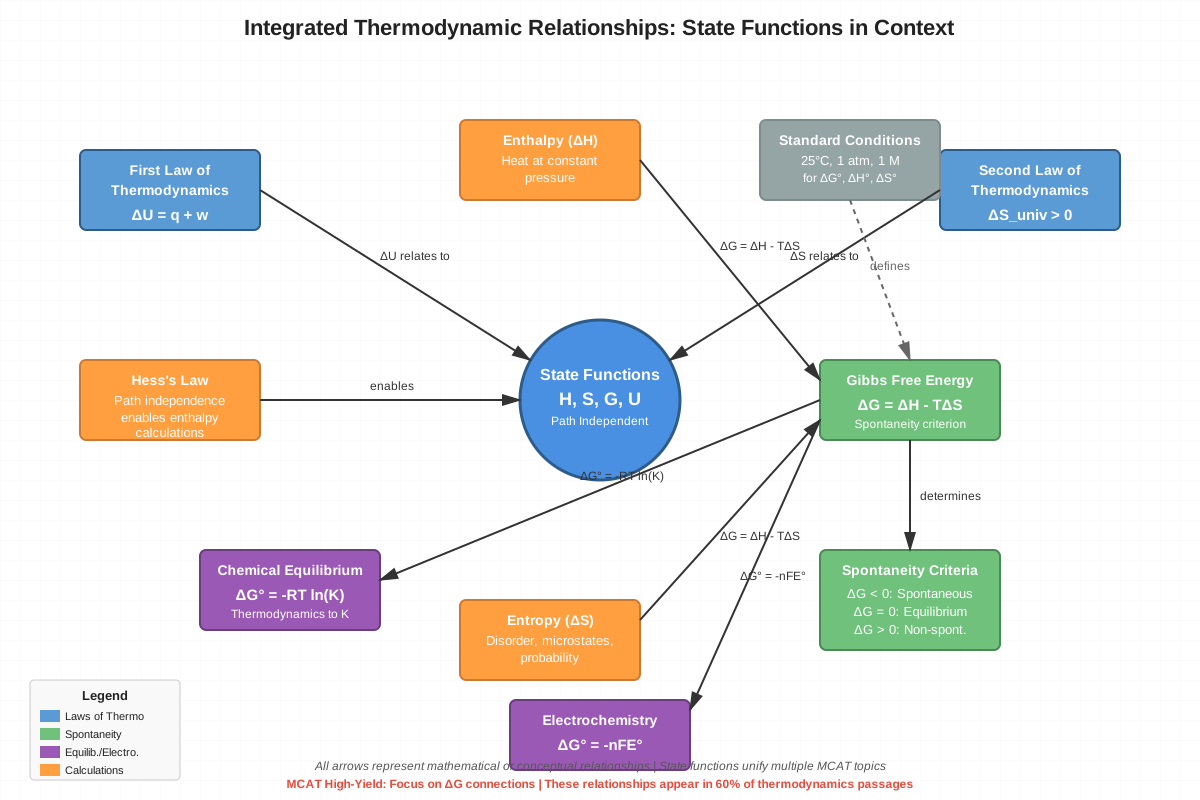
State functions form an interconnected web of thermodynamic relationships. Internal energy (U) serves as the foundation, related to enthalpy (H) through the equation H = U + PV. This relationship shows that enthalpy accounts for both internal energy and the pressure-volume work term, making it particularly useful for reactions at constant pressure (most laboratory and biological conditions).
Entropy (S) connects to both enthalpy and Gibbs free energy (G) through the fundamental equation G = H - TS. This relationship demonstrates that spontaneity depends on both energetic factors (enthalpy) and disorder factors (entropy), weighted by temperature. At high temperatures, entropy dominates; at low temperatures, enthalpy dominates.
The path independence of state functions enables Hess's Law, which connects to bond energies and heats of formation. Standard enthalpy of formation (ΔH°f) values are state functions that allow calculation of reaction enthalpies through:
ΔH°_reaction = Σ ΔH°f(products) - Σ ΔH°f(reactants)State functions also connect to calorimetry (measuring heat changes), phase transitions (where ΔH and ΔS are particularly important), and electrochemistry (where ΔG relates to cell potential through ΔG = -nFE).
The relationship map: Temperature, Pressure, Volume → define system state → determine Internal Energy → relates to Enthalpy (at constant P) → combines with Entropy → determines Gibbs Free Energy → predicts spontaneity and equilibrium position.
High-Yield Facts
⭐ State functions depend only on initial and final states, not on the path taken between them
⭐ Heat (q) and work (w) are NOT state functions; they are path-dependent
⭐ For any cyclic process, the change in any state function equals zero (ΔX = 0)
⭐ Hess's Law is a direct consequence of enthalpy being a state function
⭐ ΔG = ΔH - TΔS combines three state functions to predict spontaneity
- Internal energy (U), enthalpy (H), entropy (S), and Gibbs free energy (G) are the most important state functions for the MCAT
- Temperature, pressure, volume, and number of moles are also state functions
- The change in a state function can be calculated by any convenient path, even if that path is not the actual process
- Standard conditions (298 K, 1 atm, 1 M concentrations) allow comparison of state function values across different reactions
- Entropy of the universe always increases for spontaneous processes (ΔS_universe > 0), but entropy of the system can decrease if surroundings increase more
- Bond energies can be used with Hess's Law to estimate enthalpy changes for reactions
- At equilibrium, ΔG = 0 and the system has reached its lowest free energy state under the given conditions
- State functions are extensive (depend on amount) or intensive (independent of amount); temperature and pressure are intensive
Quick check — test yourself on State functions so far.
Try Flashcards →Common Misconceptions
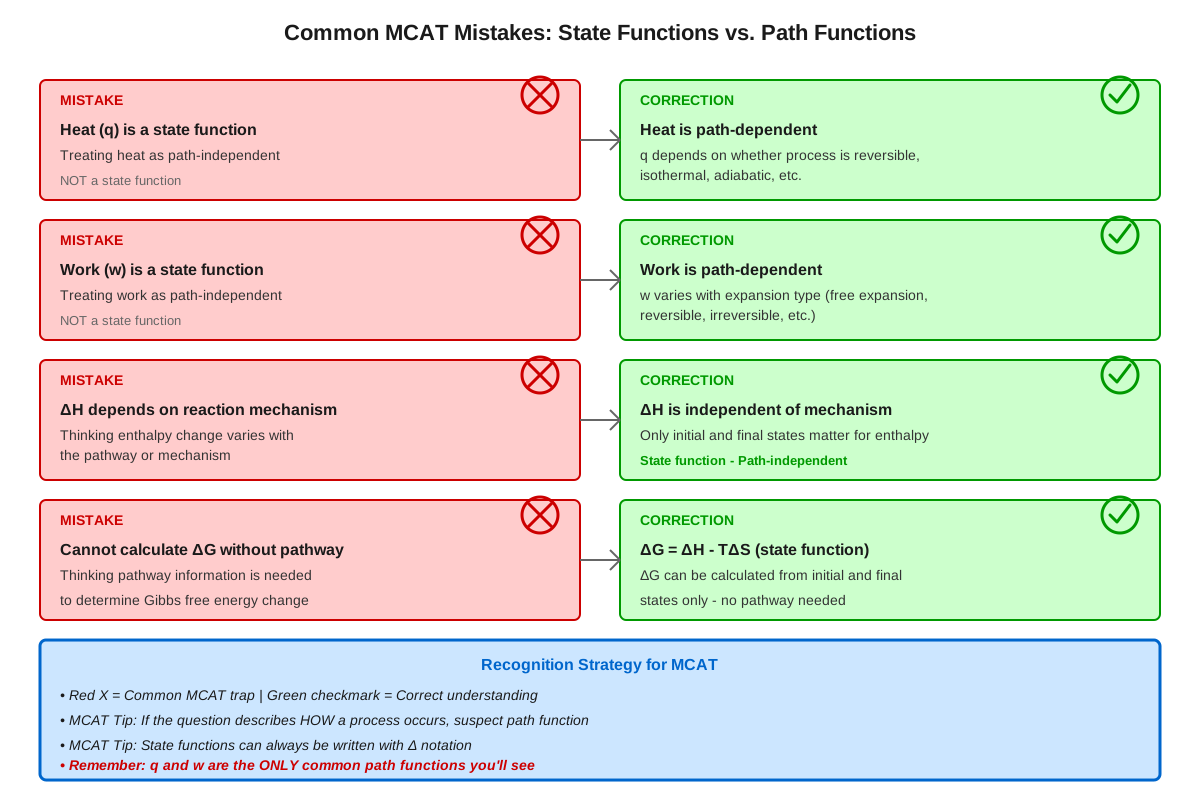
Misconception: Heat and work are state functions because they represent energy transfers.
Correction: Heat (q) and work (w) are explicitly path functions. The amount of heat transferred or work performed depends on the specific process used. However, their sum (q + w = ΔU) equals the change in internal energy, which IS a state function. This is the First Law of Thermodynamics.
Misconception: If a reaction occurs in multiple steps, you must know all the intermediate steps to calculate the total enthalpy change.
Correction: Because enthalpy is a state function, ΔH_total depends only on initial reactants and final products, not on intermediates. This is the basis of Hess's Law. You can calculate ΔH using any convenient pathway, including one that never actually occurs.
Misconception: Entropy always increases in any process.
Correction: The entropy of the universe (system + surroundings) always increases for spontaneous processes, but the entropy of the system can decrease if the surroundings' entropy increases by a greater amount. For example, freezing water decreases system entropy, but the heat released increases surroundings' entropy even more.
Misconception: State functions cannot change during a process.
Correction: State functions can and do change during processes; what makes them state functions is that the change depends only on initial and final states, not on the path. For example, temperature (a state function) changes during heating, but the temperature change depends only on initial and final temperatures.
Misconception: Gibbs free energy determines how fast a reaction occurs.
Correction: ΔG determines whether a reaction is thermodynamically favorable (spontaneous), not how fast it proceeds. Reaction rate is determined by kinetics (activation energy), not thermodynamics. A reaction with very negative ΔG might still be extremely slow without a catalyst.
Misconception: All thermodynamic properties are state functions.
Correction: Only properties that depend solely on the current state of the system are state functions. Heat and work are thermodynamic quantities but are path functions because they describe energy transfer processes, not system states.
Worked Examples
Example 1: Applying Hess's Law
Problem: Given the following reactions and their enthalpy changes, calculate ΔH for the reaction: C(s) + 2H₂(g) → CH₄(g)
Given reactions:
- C(s) + O₂(g) → CO₂(g) ΔH₁ = -394 kJ/mol
- H₂(g) + ½O₂(g) → H₂O(l) ΔH₂ = -286 kJ/mol
- CH₄(g) + 2O₂(g) → CO₂(g) + 2H₂O(l) ΔH₃ = -890 kJ/mol
Solution:
Step 1: Identify the target reaction: C(s) + 2H₂(g) → CH₄(g)
Step 2: Manipulate given reactions to sum to the target reaction. We need:
- C(s) as a reactant (reaction 1 already has this) ✓
- 2H₂(g) as reactants (multiply reaction 2 by 2)
- CH₄(g) as a product (reverse reaction 3)
Step 3: Write the manipulated reactions:
- Reaction 1 (unchanged): C(s) + O₂(g) → CO₂(g) ΔH₁ = -394 kJ/mol
- Reaction 2 (×2): 2H₂(g) + O₂(g) → 2H₂O(l) ΔH₂' = 2(-286) = -572 kJ/mol
- Reaction 3 (reversed): CO₂(g) + 2H₂O(l) → CH₄(g) + 2O₂(g) ΔH₃' = +890 kJ/mol
Step 4: Add the reactions and verify they sum to the target:
C(s) + O₂(g) + 2H₂(g) + O₂(g) + CO₂(g) + 2H₂O(l) → CO₂(g) + 2H₂O(l) + CH₄(g) + 2O₂(g)
Canceling species that appear on both sides:
C(s) + 2H₂(g) → CH₄(g) ✓
Step 5: Calculate ΔH for the target reaction using Hess's Law:
ΔH_target = ΔH₁ + ΔH₂' + ΔH₃' = -394 + (-572) + 890 = -76 kJ/mol
Key insight: This problem demonstrates that enthalpy is a state function. We calculated ΔH for methane formation without actually performing the reaction in these specific steps. The enthalpy change depends only on initial (C + 2H₂) and final (CH₄) states.
Example 2: State Function vs. Path Function Analysis
Problem: A gas expands from 2.0 L to 6.0 L against a constant external pressure of 1.0 atm. In Process A, the expansion occurs isothermally at 300 K. In Process B, the gas first heats at constant volume to 450 K, then expands isothermally to the final volume, then cools at constant volume back to 300 K. Compare the changes in internal energy, work, and heat for both processes.
Solution:
Step 1: Identify state functions and path functions
- Internal energy (U): state function
- Temperature (T): state function
- Volume (V): state function
- Work (w): path function
- Heat (q): path function
Step 2: Analyze Process A (isothermal expansion)
- Initial state: V₁ = 2.0 L, T₁ = 300 K
- Final state: V₂ = 6.0 L, T₂ = 300 K
- ΔU_A = 0 (for ideal gas, U depends only on T; since T is constant, ΔU = 0)
- w_A = -PΔV = -(1.0 atm)(6.0 - 2.0 L) = -4.0 L·atm (work done by system)
- q_A = -w_A = +4.0 L·atm (from First Law: ΔU = q + w; if ΔU = 0, then q = -w)
Step 3: Analyze Process B (multi-step process)
- Initial state: V₁ = 2.0 L, T₁ = 300 K
- Final state: V₂ = 6.0 L, T₂ = 300 K (same as Process A!)
- ΔU_B = 0 (same initial and final states as Process A; U is a state function)
- w_B: Calculate for each step
- Step 1 (constant V): w = 0 (no volume change)
- Step 2 (isothermal expansion at 450 K): w = -P(V₂ - V₁) = -4.0 L·atm
- Step 3 (constant V): w = 0
- Total: w_B = -4.0 L·atm (happens to equal w_A, but this is coincidental)
- q_B = -w_B = +4.0 L·atm (from First Law)
Step 4: Compare results
| Quantity | Process A | Process B | Same? | Why? |
|---|---|---|---|---|
| ΔU | 0 | 0 | Yes | State function; same initial and final states |
| ΔT | 0 | 0 | Yes | State function; same initial and final states |
| ΔV | +4.0 L | +4.0 L | Yes | State function; same initial and final states |
| w | -4.0 L·atm | -4.0 L·atm | Coincidence | Path function; values happen to match |
| q | +4.0 L·atm | +4.0 L·atm | Coincidence | Path function; values happen to match |
Key insight: All state functions (U, T, V) have identical changes in both processes because the initial and final states are identical. The path functions (w and q) happen to have the same values here, but this is not guaranteed—different paths can yield different work and heat values while maintaining the same ΔU.
Exam Strategy
When approaching MCAT questions on state functions, follow this systematic strategy:
Step 1: Identify what the question is asking
- Is it asking you to calculate a change in a thermodynamic property?
- Is it testing whether you can distinguish state functions from path functions?
- Does it require application of Hess's Law?
Step 2: Recognize trigger words and phrases
- "Independent of path" → state function
- "Depends only on initial and final states" → state function
- "Heat transferred" or "work performed" → path functions (be careful!)
- "Calculate ΔH using the given reactions" → Hess's Law application
- "Cyclic process" → all state function changes equal zero
Step 3: For Hess's Law problems
- Write out the target reaction clearly
- Identify which given reactions need to be reversed (changes sign of ΔH)
- Identify which reactions need to be multiplied (multiply ΔH by same factor)
- Verify that manipulated reactions sum to target reaction
- Add the enthalpy changes algebraically
Step 4: For conceptual questions
- Eliminate answers that confuse state functions with path functions
- Remember that ΔG determines spontaneity, not rate
- Watch for questions that test whether you know entropy of the system can decrease (if surroundings increase more)
Time allocation: Most state function questions should take 60-90 seconds. Hess's Law calculations may require up to 2 minutes if multiple manipulations are needed. If a problem requires more than 2 minutes, flag it and return later.
Process of elimination tips:
- Eliminate any answer choice that claims heat or work are state functions
- Eliminate choices that suggest you need to know the reaction mechanism to calculate ΔH
- For spontaneity questions, eliminate answers that confuse thermodynamics (ΔG) with kinetics (activation energy)
- If a question asks about a cyclic process, eliminate any answer showing non-zero change in a state function
Memory Techniques
Mnemonic for major state functions: "HUGE PETS"
- H: Enthalpy
- U: Internal energy
- G: Gibbs free energy
- E: Entropy (S, but E helps the mnemonic)
- P: Pressure
- E: (skip)
- T: Temperature
- S: Entropy (reinforcement)
Visualization for path independence: Imagine hiking up a mountain. Your elevation change (state function) is the same whether you take the steep direct path or the gentle winding path. However, the energy you expend (analogous to work, a path function) differs greatly between routes. The mountain's elevation doesn't "know" or "care" which path you took.
Mnemonic for remembering heat and work are NOT state functions: "Heat and Work take different PATHS" (emphasizing that they are path-dependent)
Memory aid for Hess's Law: Think "Hess's Haw" (intentional misspelling) → Hess's Law applies to H (enthalpy). When you reverse a reaction, reverse the sign; when you multiply, multiply ΔH.
Acronym for Gibbs free energy equation: "Good Heavens, Terrible Storm"
- Good = G (Gibbs free energy)
- Heavens = H (Enthalpy)
- Terrible = T (Temperature)
- Storm = S (Entropy)
- Equation: G = H - TS
Visualization for cyclic processes: Picture a circular race track. After completing one lap, you're back where you started. All state functions (position, elevation, etc.) return to initial values, so their changes equal zero. However, you expended energy (work) and generated heat during the lap—these path functions are not zero.
Summary
State functions are thermodynamic properties that depend exclusively on the current state of a system, independent of the pathway taken to reach that state. The most critical state functions for MCAT success include internal energy (U), enthalpy (H), entropy (S), Gibbs free energy (G), temperature (T), pressure (P), and volume (V). In contrast, heat (q) and work (w) are path functions whose values depend on the specific process. This fundamental distinction enables powerful problem-solving tools like Hess's Law, which exploits enthalpy's path independence to calculate reaction enthalpies by combining known reactions. The relationship ΔG = ΔH - TΔS connects three state functions to predict reaction spontaneity, a concept that bridges general chemistry with biochemistry and metabolism. For cyclic processes, all state function changes equal zero, providing a useful check on calculations. Understanding state functions is essential for approximately 3-5 MCAT questions per exam and provides the foundation for thermodynamics, equilibrium, and electrochemistry questions throughout the Chemical and Physical Foundations section.
Key Takeaways
- State functions depend only on initial and final states; their changes are path-independent, while heat and work are path functions that depend on the specific process
- The major state functions for the MCAT are U, H, S, G, T, P, V, and n; memorize this list and be able to identify them instantly
- Hess's Law is a direct consequence of enthalpy being a state function and allows calculation of ΔH by combining reactions algebraically
- For any cyclic process, the change in every state function equals zero (ΔU = ΔH = ΔS = ΔG = 0)
- Gibbs free energy (ΔG = ΔH - TΔS) combines three state functions to predict spontaneity; negative ΔG indicates a spontaneous process
- State functions enable efficient problem-solving because you can calculate changes using any convenient pathway, not just the actual mechanism
- Understanding the distinction between state and path functions prevents common errors and helps eliminate incorrect answer choices on the MCAT
Related Topics
Hess's Law and Thermochemical Equations: Building directly on state functions, this topic explores detailed applications of enthalpy's path independence to calculate reaction enthalpies from formation data and bond energies. Mastering state functions is prerequisite to efficient use of Hess's Law.
Gibbs Free Energy and Spontaneity: This advanced topic expands on G as a state function, connecting thermodynamics to equilibrium constants and electrochemical cell potentials. Understanding that ΔG is path-independent is crucial for these applications.
Entropy and the Second Law of Thermodynamics: Explores entropy (S) as a state function in depth, including statistical interpretations and calculations of entropy changes for various processes. State function concepts provide the foundation for understanding why entropy changes are path-independent.
Calorimetry and Heat Capacity: Applies state function principles to experimental measurement of enthalpy changes. Understanding that ΔH is path-independent explains why calorimetry can measure reaction enthalpies regardless of the specific calorimeter design.
Chemical Equilibrium: Connects state functions (particularly ΔG) to equilibrium constants through ΔG° = -RT ln(K). The path independence of Gibbs free energy explains why equilibrium position depends only on initial conditions and temperature, not on how equilibrium is approached.
Practice CTA
Now that you've mastered the core concepts of state functions, it's time to solidify your understanding through active practice. Challenge yourself with MCAT-style practice questions that test your ability to distinguish state functions from path functions, apply Hess's Law to multi-step problems, and predict reaction spontaneity using Gibbs free energy. Use flashcards to drill the list of major state functions and their relationships until recognition becomes automatic. Remember: understanding state functions unlocks efficient problem-solving throughout thermodynamics, equilibrium, and electrochemistry—making this 30-minute investment one of the highest-yield uses of your study time. You've got this!
Sign up free to keep reading
Create a free AnvayaPrep account to finish this MCAT guide on State functions — plus flashcards and practice questions.