Overview
Hydrohalogenation is a fundamental addition reaction in Organic Chemistry where a hydrogen halide (HX, where X = F, Cl, Br, or I) adds across a carbon-carbon double or triple bond. This reaction transforms alkenes and alkynes into alkyl halides through an electrophilic addition mechanism. The process involves breaking the π bond and forming two new σ bonds—one between carbon and hydrogen, and another between carbon and halogen. Understanding hydrohalogenation is essential for predicting reaction products, determining regiochemistry through Markovnikov's rule, and recognizing carbocation intermediates that can undergo rearrangements.
For the MCAT, hydrohalogenation represents a critical intersection of mechanistic understanding, stereochemical reasoning, and product prediction. This reaction exemplifies how electron-rich π bonds interact with electrophiles, a theme that permeates organic chemistry. The MCAT frequently tests hydrohalogenation in the context of synthetic pathways, where students must identify starting materials or predict products, and in passage-based questions that explore reaction mechanisms or compare different addition reactions. Mastery of this topic requires understanding not just the "what" but the "why"—the electronic factors that govern regioselectivity and the carbocation stability principles that explain product distributions.
Hydrohalogenation connects to broader themes in Organic Chemistry including carbocation stability, resonance effects, inductive effects, and stereochemistry. It serves as a gateway to understanding more complex addition reactions like hydration, halogenation, and hydrogenation. The mechanistic principles learned here—electrophilic attack, carbocation formation, and nucleophilic capture—apply across numerous reaction types tested on the MCAT. Additionally, hydrohalogenation provides practical context for understanding how pharmaceutical compounds are synthesized and how biological systems might interact with halogenated organic molecules.
Learning Objectives
- [ ] Define Hydrohalogenation using accurate Organic Chemistry terminology
- [ ] Explain why Hydrohalogenation matters for the MCAT
- [ ] Apply Hydrohalogenation to exam-style questions
- [ ] Identify common mistakes related to Hydrohalogenation
- [ ] Connect Hydrohalogenation to related Organic Chemistry concepts
- [ ] Predict the major and minor products of hydrohalogenation reactions using Markovnikov's rule
- [ ] Explain the mechanism of hydrohalogenation including carbocation intermediate formation
- [ ] Analyze how carbocation rearrangements affect hydrohalogenation product distributions
- [ ] Compare and contrast hydrohalogenation with other addition reactions to alkenes
Prerequisites
- Alkene and alkyne structure: Understanding π bonds and their electron density is essential for recognizing why these functional groups undergo addition reactions
- Carbocation stability: Knowledge of primary, secondary, and tertiary carbocation relative stabilities explains regioselectivity in hydrohalogenation
- Acid-base chemistry: Recognizing hydrogen halides as strong acids helps predict their reactivity and protonation patterns
- Resonance and inductive effects: These electronic effects influence carbocation stability and therefore product distribution
- Basic reaction mechanisms: Familiarity with curved arrow notation and electron movement is necessary for understanding the stepwise mechanism
Why This Topic Matters
Hydrohalogenation has significant practical applications in pharmaceutical synthesis and industrial chemistry. Many biologically active compounds contain carbon-halogen bonds introduced through hydrohalogenation or related reactions. For example, halogenated intermediates serve as precursors in the synthesis of anesthetics, anti-inflammatory drugs, and other therapeutic agents. Understanding how these bonds form helps students appreciate drug design strategies and metabolic pathways involving halogenated compounds.
On the MCAT, hydrohalogenation appears with medium frequency in the Chemical and Physical Foundations of Biological Systems section. Approximately 2-4% of organic chemistry questions directly or indirectly test this concept. Questions typically appear in three formats: (1) discrete questions asking for product prediction given specific starting materials, (2) passage-based questions embedded in synthetic schemes where hydrohalogenation is one step in a multi-step synthesis, and (3) mechanism-based questions requiring students to identify intermediates or explain regioselectivity. The MCAT particularly favors questions that combine hydrohalogenation with carbocation rearrangements or stereochemical considerations.
Common exam presentations include passages describing novel synthetic routes to pharmaceutical compounds, where students must identify which reagents accomplish specific transformations. The MCAT also tests hydrohalogenation through "compare and contrast" questions that ask students to differentiate between Markovnikov and anti-Markovnikov addition patterns, or to explain why certain alkenes produce different product ratios. Understanding hydrohalogenation provides a foundation for tackling these multifaceted questions efficiently.
Core Concepts
Definition and General Reaction
Hydrohalogenation is an addition reaction where a hydrogen halide (HF, HCl, HBr, or HI) adds across the π bond of an alkene or alkyne. The general reaction can be represented as:
R-CH=CH-R' + HX → R-CHX-CH₂-R'The reaction converts an alkene (sp² hybridized carbons) into an alkyl halide (sp³ hybridized carbons). The π bond is broken, and two new σ bonds form—one C-H bond and one C-X bond. This transformation is thermodynamically favorable because σ bonds are generally stronger than π bonds, and the overall process releases energy.
The reactivity order of hydrogen halides follows their acid strength: HI > HBr > HCl > HF. Stronger acids protonate alkenes more readily, making HI the most reactive and HF the least reactive in hydrohalogenation reactions. For MCAT purposes, HCl and HBr are most commonly encountered.
Mechanism of Hydrohalogenation
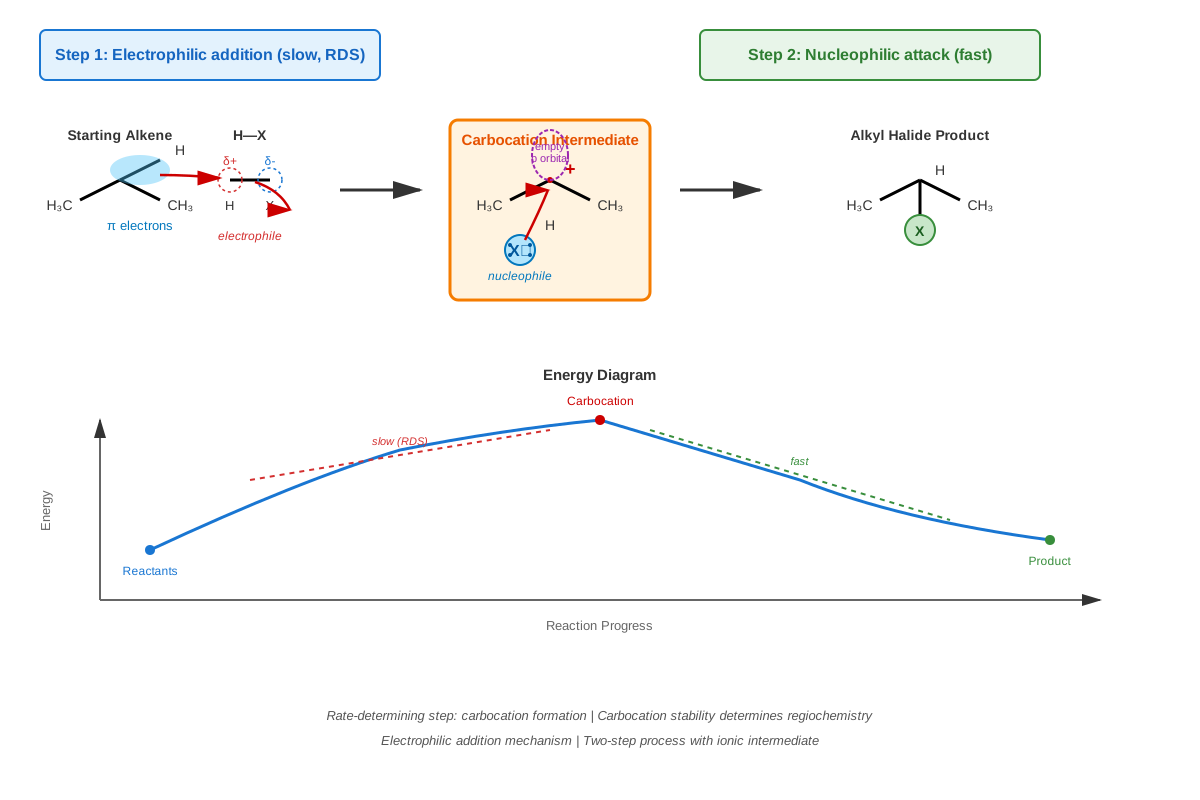
The hydrohalogenation mechanism proceeds through a two-step electrophilic addition pathway:
Step 1: Protonation of the alkene
The π electrons of the alkene act as a nucleophile and attack the electrophilic hydrogen of HX. This forms a carbocation intermediate and releases the halide ion (X⁻). The carbocation forms at the carbon that can best stabilize the positive charge, following the stability order: tertiary > secondary > primary > methyl.
Step 2: Nucleophilic attack
The halide ion (X⁻) acts as a nucleophile and attacks the carbocation, forming the C-X bond and completing the addition.
This mechanism is crucial for understanding regioselectivity. The rate-determining step is typically the first step (carbocation formation), so the reaction proceeds through the most stable carbocation intermediate possible.
Markovnikov's Rule
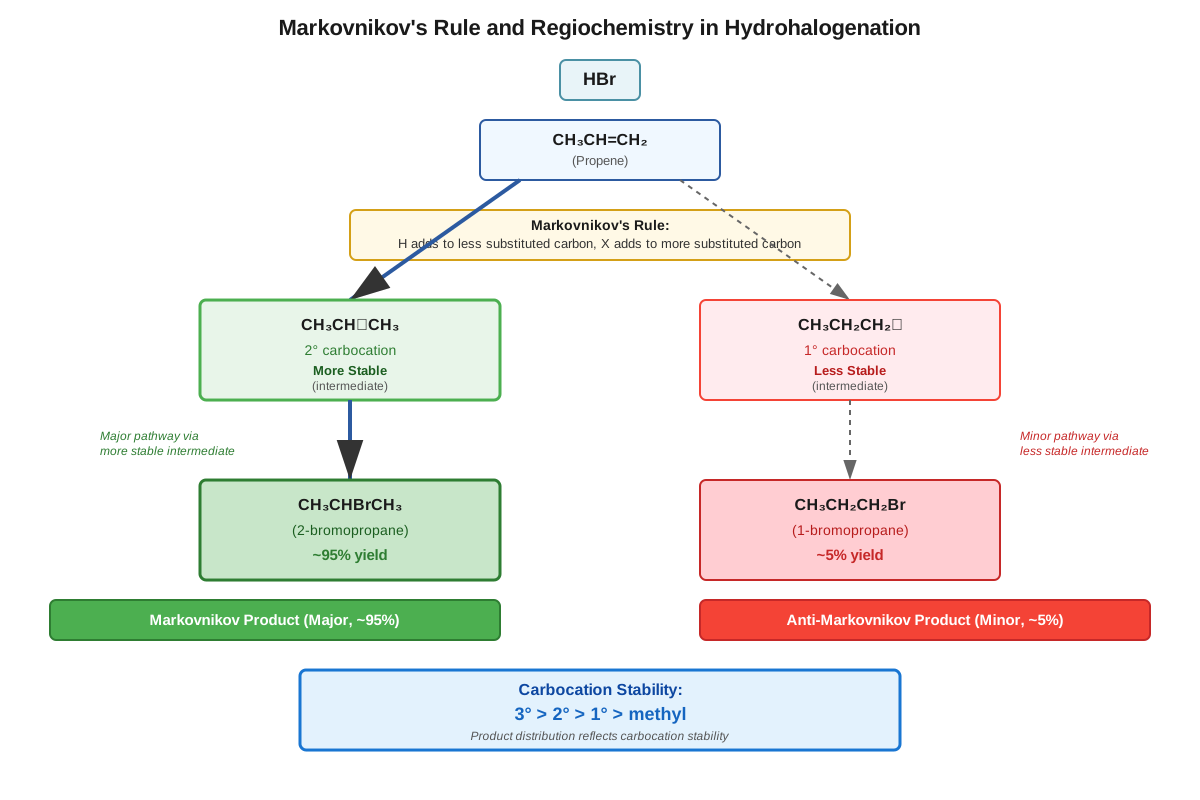
Markovnikov's rule predicts the regioselectivity of hydrohalogenation: "In the addition of HX to an unsymmetrical alkene, the hydrogen adds to the carbon with more hydrogens, and the halogen adds to the carbon with fewer hydrogens." More precisely, the halogen adds to the more substituted carbon—the one that forms the more stable carbocation.
For example, in the hydrohalogenation of propene (CH₃-CH=CH₂) with HBr:
- Hydrogen could add to C1 (forming a secondary carbocation at C2) or to C2 (forming a primary carbocation at C1)
- The secondary carbocation is more stable, so hydrogen adds to C1
- The major product is 2-bromopropane (CH₃-CHBr-CH₃)
The mechanistic basis for Markovnikov's rule lies in carbocation stability. Alkyl groups are electron-donating through hyperconjugation and inductive effects, stabilizing adjacent positive charges. Therefore, more substituted carbocations form preferentially.
Carbocation Stability and Rearrangements
Carbocation stability follows the order: tertiary (3°) > secondary (2°) > primary (1°) > methyl. This stability hierarchy results from:
- Hyperconjugation: Overlap between filled C-H σ bonds and the empty p orbital of the carbocation
- Inductive effects: Electron-donating alkyl groups partially neutralize the positive charge
- Resonance stabilization: When applicable, delocalization of the positive charge across multiple atoms
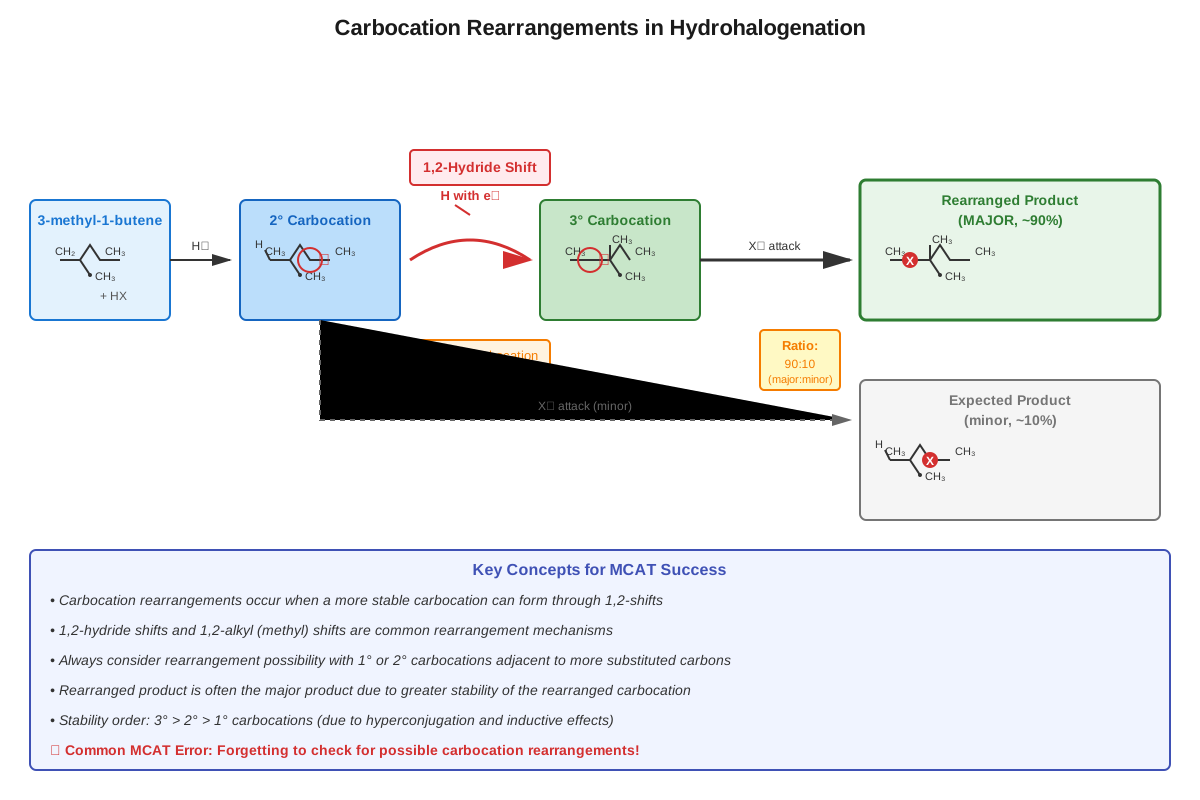
Carbocation rearrangements occur when a less stable carbocation can convert to a more stable one through hydride shifts (H⁻ movement) or alkyl shifts (R⁻ movement). These 1,2-shifts move a hydrogen or alkyl group from an adjacent carbon to the carbocation center.
For example, in the hydrohalogenation of 3-methyl-1-butene:
- Initial protonation forms a secondary carbocation at C2
- A hydride shift from C3 to C2 creates a more stable tertiary carbocation at C3
- The halide then attacks the tertiary carbocation
- The major product reflects this rearrangement
Recognizing when rearrangements occur is essential for accurate product prediction on the MCAT.
Stereochemistry of Hydrohalogenation
When hydrohalogenation creates a new stereocenter, the reaction produces a racemic mixture (equal amounts of both enantiomers). This occurs because:
- The carbocation intermediate is planar (sp² hybridized)
- The halide ion can attack from either face with equal probability
- Both enantiomers form in equal amounts
For example, hydrohalogenation of 1-butene with HCl produces 2-chlorobutane as a racemic mixture of (R) and (S) enantiomers. The MCAT may test whether students recognize that carbocation intermediates lead to racemic products, distinguishing hydrohalogenation from stereospecific reactions like syn addition.
Comparison with Other Addition Reactions
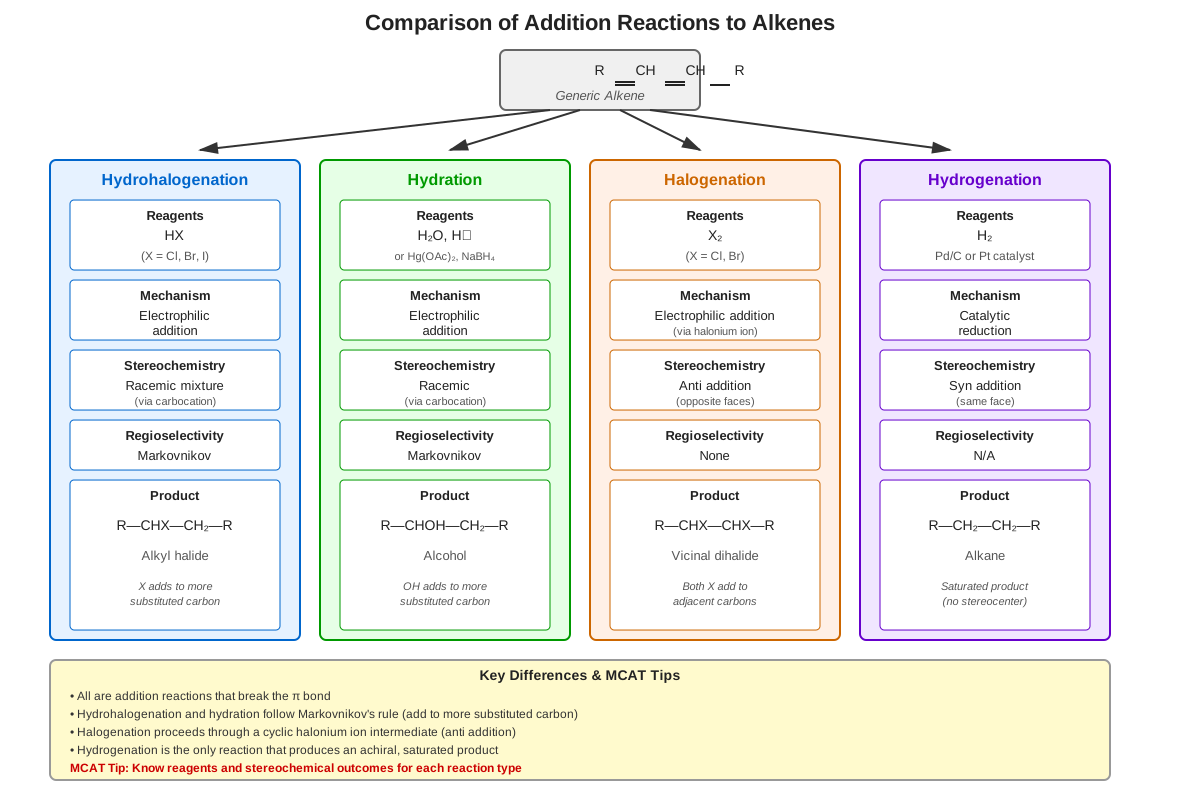
Understanding hydrohalogenation in context requires comparing it to related addition reactions:
| Reaction | Reagent | Mechanism | Stereochemistry | Regioselectivity |
|---|---|---|---|---|
| Hydrohalogenation | HX | Electrophilic addition via carbocation | Racemic (if new stereocenter) | Markovnikov |
| Hydration | H₂O/H⁺ | Electrophilic addition via carbocation | Racemic (if new stereocenter) | Markovnikov |
| Halogenation | X₂ | Electrophilic addition via halonium ion | Anti addition | N/A (both carbons get halogen) |
| Hydrogenation | H₂/catalyst | Syn addition | Syn addition | N/A (both carbons get hydrogen) |
| Hydroboration-oxidation | BH₃, then H₂O₂/OH⁻ | Concerted addition | Syn addition | Anti-Markovnikov |
This table highlights that hydrohalogenation shares its carbocation mechanism with hydration, explaining why both follow Markovnikov's rule and produce racemic mixtures. In contrast, reactions proceeding through cyclic intermediates (halogenation) or concerted mechanisms (hydrogenation, hydroboration) show different stereochemical outcomes.
Reactivity Patterns
The rate of hydrohalogenation depends on:
- Alkene substitution: More substituted alkenes react faster because they form more stable carbocations
- Hydrogen halide strength: Stronger acids (HI > HBr > HCl > HF) react faster
- Electronic effects: Electron-donating groups on the alkene accelerate the reaction; electron-withdrawing groups slow it
For MCAT purposes, recognizing that electron-rich alkenes undergo hydrohalogenation more readily helps predict relative reaction rates in comparative questions.
Concept Relationships
The concepts within hydrohalogenation form an interconnected network. The mechanism (electrophilic addition) → determines → regioselectivity (Markovnikov's rule) → which depends on → carbocation stability → which can be affected by → carbocation rearrangements → all of which influence → product distribution. Additionally, the stereochemistry (racemic mixture formation) → results from → the planar carbocation intermediate → which is a consequence of → the mechanism.
Hydrohalogenation connects to prerequisite knowledge of alkene structure because the π bond's electron density makes it nucleophilic and reactive toward electrophiles. Understanding acid-base chemistry explains why HX compounds can protonate alkenes, initiating the reaction. Carbocation stability principles, learned as prerequisite knowledge, directly predict which regioisomer predominates.
Looking forward, hydrohalogenation relates to other addition reactions through shared mechanistic principles. Both hydrohalogenation and hydration proceed through carbocation intermediates, explaining their similar regioselectivity and stereochemical outcomes. Understanding hydrohalogenation also prepares students for elimination reactions (E1 and E2), which are essentially the reverse process and involve similar carbocation intermediates in E1 mechanisms. The concept of Markovnikov addition in hydrohalogenation contrasts with anti-Markovnikov addition in hydroboration-oxidation, highlighting how different mechanisms produce different regioselectivity.
Quick check — test yourself on Hydrohalogenation so far.
Try Flashcards →High-Yield Facts
⭐ Hydrohalogenation adds HX across alkene π bonds through a two-step electrophilic addition mechanism involving carbocation intermediates
⭐ Markovnikov's rule: The halogen adds to the more substituted carbon (the one that forms the more stable carbocation)
⭐ Carbocation stability order: 3° > 2° > 1° > methyl, due to hyperconjugation and inductive effects
⭐ Hydrohalogenation produces racemic mixtures when new stereocenters form because the planar carbocation can be attacked from either face
⭐ Carbocation rearrangements (hydride or alkyl shifts) occur when they produce more stable carbocations, changing the expected product
- Hydrogen halide reactivity order: HI > HBr > HCl > HF (follows acid strength)
- More substituted alkenes react faster in hydrohalogenation because they form more stable carbocations
- The rate-determining step is carbocation formation (Step 1), not nucleophilic attack (Step 2)
- Electron-donating groups on alkenes accelerate hydrohalogenation; electron-withdrawing groups slow it
- Hydrohalogenation and hydration share the same mechanism type, explaining their similar regioselectivity
- Anti-Markovnikov addition requires different mechanisms (like hydroboration-oxidation with radical intermediates)
- Alkynes undergo hydrohalogenation twice, first forming a vinyl halide, then a geminal dihalide
Common Misconceptions
Misconception: The halogen adds to the carbon with more hydrogens because it's "attracted" to hydrogen atoms.
Correction: Markovnikov's rule reflects carbocation stability, not attraction between atoms. The halogen adds to the more substituted carbon because that's where the carbocation forms (the more stable intermediate). The hydrogen adds first, creating the carbocation at the position that best stabilizes positive charge.
Misconception: Hydrohalogenation produces a single enantiomer when a new stereocenter forms.
Correction: Hydrohalogenation produces racemic mixtures because the carbocation intermediate is planar (sp² hybridized). The halide nucleophile attacks from either face with equal probability, generating both enantiomers in equal amounts. Only reactions with stereospecific mechanisms (like syn addition in hydrogenation) produce single stereoisomers.
Misconception: Carbocation rearrangements always occur in hydrohalogenation reactions.
Correction: Rearrangements only occur when they produce more stable carbocations. If the initial carbocation is already tertiary, or if rearrangement would produce a less stable or equally stable carbocation, no rearrangement occurs. Always evaluate whether a 1,2-hydride or 1,2-alkyl shift would increase stability before predicting rearrangement.
Misconception: HF is the most reactive hydrogen halide in hydrohalogenation because fluorine is the most electronegative.
Correction: HI is the most reactive, not HF. Reactivity follows acid strength (HI > HBr > HCl > HF). Although fluorine is most electronegative, the H-F bond is very strong and difficult to break. HI has the weakest H-X bond and is the strongest acid, making it most reactive in hydrohalogenation.
Misconception: Markovnikov's rule applies to all addition reactions.
Correction: Markovnikov's rule specifically applies to reactions proceeding through carbocation intermediates (hydrohalogenation, hydration). Reactions with different mechanisms show different regioselectivity. For example, hydroboration-oxidation proceeds through a concerted mechanism and shows anti-Markovnikov regioselectivity, with the OH group adding to the less substituted carbon.
Misconception: The two steps of hydrohalogenation occur simultaneously.
Correction: Hydrohalogenation is a stepwise mechanism with distinct steps. First, the alkene is protonated to form a carbocation intermediate (which can be isolated or observed spectroscopically). Then, the halide ion attacks the carbocation. The stepwise nature is crucial—it allows time for carbocation rearrangements and explains why racemic mixtures form.
Worked Examples
Example 1: Product Prediction with Rearrangement
Question: Predict the major product when 3,3-dimethyl-1-butene reacts with HCl.
Solution:
Step 1: Identify the alkene structure
3,3-dimethyl-1-butene has the structure: (CH₃)₃C-CH₂-CH=CH₂
Step 2: Consider possible protonation sites
- Protonation at C1 (terminal carbon) would form a secondary carbocation at C2
- Protonation at C2 would form a primary carbocation at C1 (less favorable)
Step 3: Evaluate the initial carbocation
The more stable pathway forms a secondary carbocation at C2: (CH₃)₃C-CH₂-CH⁺-CH₃
Step 4: Check for possible rearrangements
A 1,2-hydride shift from C3 to C2 would create a tertiary carbocation at C3: (CH₃)₃C⁺-CH₂-CH₂-CH₃
Wait—this is incorrect. Let me reconsider the structure.
Actually, after protonation at C1, we have: (CH₃)₃C-CH₂-CH⁺-CH₃ (secondary carbocation at C2)
A 1,2-methyl shift from C3 to C2 would create: (CH₃)₂C⁺-CH(CH₃)-CH₂-CH₃ (tertiary carbocation)
Step 5: Nucleophilic attack
The chloride ion attacks the tertiary carbocation.
Major product: 2-chloro-2,3-dimethylbutane (after rearrangement)
Key insight: This problem tests recognition of carbocation rearrangements. The initial secondary carbocation rearranges to a more stable tertiary carbocation before the halide attacks. Students must systematically evaluate whether rearrangements increase stability.
Example 2: Comparing Reaction Outcomes
Question: Compare the products formed when 2-methylpropene reacts with (a) HBr and (b) HBr in the presence of peroxides (radical conditions).
Solution:
(a) HBr under normal conditions (ionic mechanism)
Step 1: Apply Markovnikov's rule
2-methylpropene structure: (CH₃)₂C=CH₂
Step 2: Determine protonation site
Protonation at the less substituted carbon (CH₂) forms a tertiary carbocation at the more substituted carbon: (CH₃)₂C⁺-CH₃
Step 3: Nucleophilic attack
Bromide attacks the tertiary carbocation.
Product (a): 2-bromo-2-methylpropane (tert-butyl bromide) - Markovnikov product
(b) HBr with peroxides (radical mechanism)
Step 1: Recognize the mechanism change
Peroxides initiate a radical chain mechanism, not a carbocation mechanism.
Step 2: Apply anti-Markovnikov regioselectivity
In radical hydrohalogenation, the bromine radical adds to form the more stable carbon radical. The more stable radical forms at the more substituted position, but then hydrogen (not bromine) ends up there.
Step 3: Determine the product
The bromine adds to the less substituted carbon.
Product (b): 1-bromo-2-methylpropane (isobutyl bromide) - anti-Markovnikov product
Key insight: This problem tests understanding that mechanism determines regioselectivity. Normal hydrohalogenation follows Markovnikov's rule (carbocation mechanism), while radical conditions with HBr produce anti-Markovnikov products. The MCAT may present this comparison to test mechanistic understanding. Note that only HBr shows this radical behavior with peroxides; HCl and HI do not undergo efficient radical hydrohalogenation.
Exam Strategy
When approaching hydrohalogenation MCAT questions, follow this systematic process:
- Identify the reaction type: Look for HX reagents (HCl, HBr, HI) reacting with alkenes or alkynes. Trigger phrases include "addition of hydrogen halide," "treatment with HBr," or "reaction with HCl."
- Draw the alkene structure carefully: Many errors stem from misidentifying which carbons are involved in the double bond. Number the carbons to track positions accurately.
- Predict the carbocation intermediate: Determine where the positive charge forms by applying carbocation stability principles. This step is crucial for correct product prediction.
- Check for rearrangements: Before predicting the final product, systematically evaluate whether 1,2-hydride or 1,2-alkyl shifts would increase carbocation stability. This is a high-yield MCAT trap.
- Apply Markovnikov's rule: Remember that the halogen adds where the carbocation forms (the more substituted position).
- Consider stereochemistry if relevant: If a new stereocenter forms, recognize that a racemic mixture results.
Process of elimination tips:
- Eliminate answer choices showing anti-Markovnikov products unless peroxides are mentioned
- Eliminate choices showing single enantiomers when racemic mixtures should form
- Eliminate products that would require less stable carbocation intermediates
- Watch for answer choices that show rearranged vs. non-rearranged products—the rearranged product is usually correct if rearrangement increases stability
Time allocation: Spend 30-45 seconds analyzing the structure and predicting the carbocation, then 15-30 seconds checking for rearrangements. Don't rush this analysis—carbocation rearrangements are a common source of errors.
Red flag phrases: "In the presence of peroxides" signals anti-Markovnikov addition; "optically active product" is incorrect for hydrohalogenation (which produces racemic mixtures); "stereospecific addition" does not describe hydrohalogenation.
Memory Techniques
Markovnikov's Rule Mnemonic: "More Makes More" - The More substituted carbon gets the halogen because it Makes the More stable carbocation.
Carbocation Stability Mnemonic: "Terrific Students Pass MCAT" - Tertiary > Secondary > Primary > Methyl
Hydrogen Halide Reactivity: "I Brought Cool Fruit" (in reverse order of reactivity) - HI > HBr > HCl > HF. Remember: Iodine is Incredibly reactive, Fluorine is Feeble.
Rearrangement Check: Use the acronym "SHIFT" - Stability Higher? If Favorable, Transfer occurs. Before finalizing your product, ask: "Would a shift create higher stability?"
Visualization Strategy: When analyzing hydrohalogenation problems, draw the carbocation intermediate explicitly, even if just mentally. Visualize it as a planar sp² carbon with an empty p orbital. This helps remember that (1) rearrangements can occur, (2) racemic mixtures form, and (3) the halide attacks this specific carbon.
Mechanism Memory: Think "Proton Attacks, Cation forms, Nucleophile Attacks" (PACNA) for the two-step mechanism: Proton attacks π bond → Carbocation forms → Nucleophile (halide) attacks carbocation.
Summary
Hydrohalogenation is a fundamental electrophilic addition reaction where hydrogen halides (HX) add across alkene π bonds through a two-step mechanism involving carbocation intermediates. The reaction follows Markovnikov's rule, with the halogen adding to the more substituted carbon because this pathway proceeds through the most stable carbocation. Carbocation stability (3° > 2° > 1° > methyl) governs regioselectivity and determines when rearrangements occur through 1,2-hydride or 1,2-alkyl shifts. When new stereocenters form, hydrohalogenation produces racemic mixtures because the planar carbocation intermediate can be attacked from either face. Understanding this reaction requires integrating mechanistic knowledge, carbocation stability principles, and stereochemical reasoning. For MCAT success, students must systematically analyze structures, predict carbocation intermediates, check for rearrangements, and apply Markovnikov's rule while recognizing that the mechanism—not memorized rules—explains all observed outcomes.
Key Takeaways
- Hydrohalogenation proceeds through a two-step electrophilic addition mechanism: protonation forms a carbocation, then halide attacks
- Markovnikov's rule predicts regioselectivity: the halogen adds to the more substituted carbon (where the more stable carbocation forms)
- Carbocation rearrangements change products: always check if 1,2-shifts would increase stability before predicting the final product
- Racemic mixtures form when new stereocenters are created: the planar carbocation allows attack from either face
- Carbocation stability (3° > 2° > 1° > methyl) is the key principle: it explains regioselectivity, rearrangements, and relative reaction rates
- Mechanism determines outcome: understanding why reactions occur (carbocation stability) is more powerful than memorizing rules
- Compare with related reactions: hydrohalogenation shares its carbocation mechanism with hydration but differs from syn additions (hydrogenation) and anti additions (halogenation)
Related Topics
Hydration of Alkenes: This reaction adds H₂O across alkenes using acid catalysis, proceeding through the same carbocation mechanism as hydrohalogenation. Mastering hydrohalogenation provides the foundation for understanding hydration's regioselectivity and stereochemistry.
Carbocation Rearrangements: A deeper study of 1,2-hydride shifts, 1,2-alkyl shifts, and ring expansions/contractions builds on the rearrangement concepts introduced in hydrohalogenation.
Elimination Reactions (E1 and E2): These reactions are mechanistically related to hydrohalogenation—E1 elimination proceeds through carbocation intermediates similar to those in hydrohalogenation, making it essentially the reverse process.
Hydroboration-Oxidation: This reaction provides anti-Markovnikov addition of water to alkenes through a different mechanism (concerted addition without carbocations), offering an important contrast to hydrohalogenation.
Halogenation of Alkenes: Understanding how X₂ adds to alkenes through halonium ion intermediates (rather than carbocations) highlights how different intermediates produce different stereochemical outcomes.
Radical Reactions: The anti-Markovnikov hydrohalogenation of alkenes with HBr and peroxides introduces radical mechanisms, expanding understanding beyond ionic pathways.
Practice CTA
Now that you've mastered the core concepts of hydrohalogenation, it's time to solidify your understanding through active practice. Attempt the practice questions to test your ability to predict products, identify mechanisms, and avoid common traps. Use the flashcards to reinforce high-yield facts and memorize key principles like carbocation stability and Markovnikov's rule. Remember: understanding the mechanism is your most powerful tool—it allows you to solve novel problems rather than relying on memorization alone. You've built a strong foundation in this essential organic chemistry topic. Keep practicing, and you'll be ready to tackle any hydrohalogenation question the MCAT presents!
Sign up free to keep reading
Create a free AnvayaPrep account to finish this MCAT guide on Hydrohalogenation — plus flashcards and practice questions.