Overview
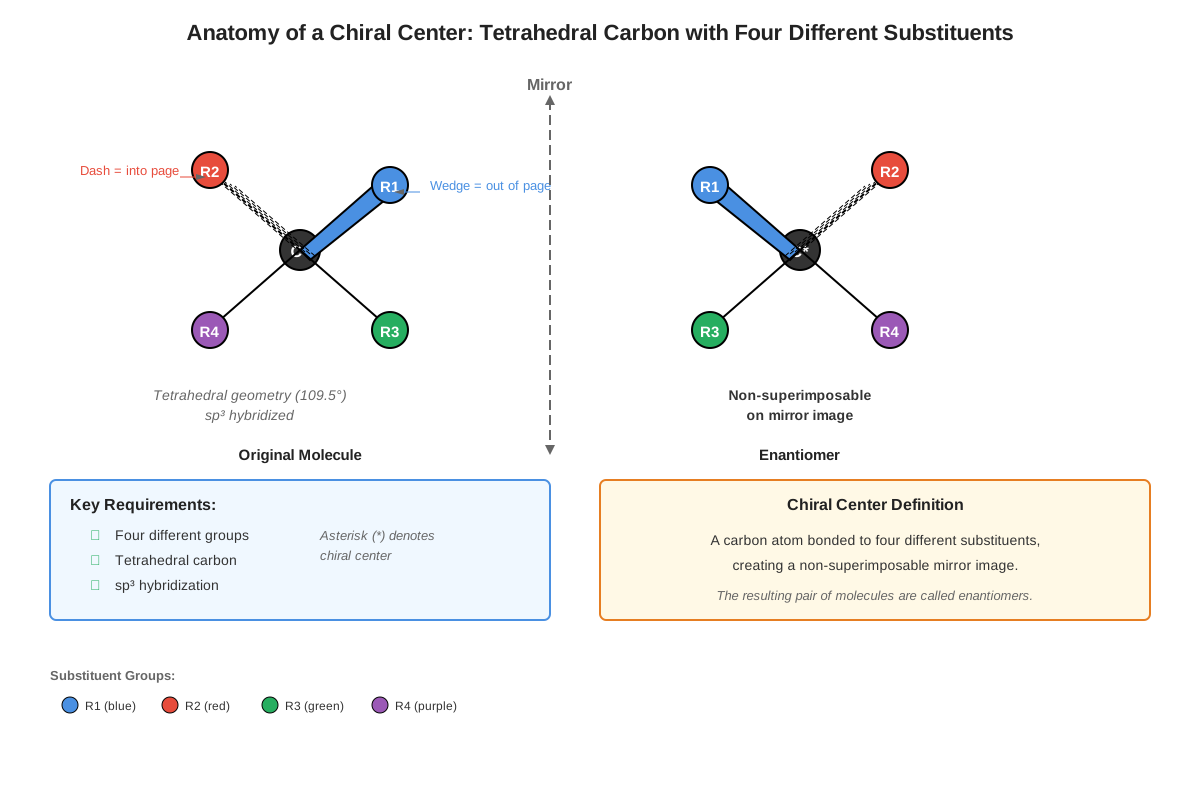
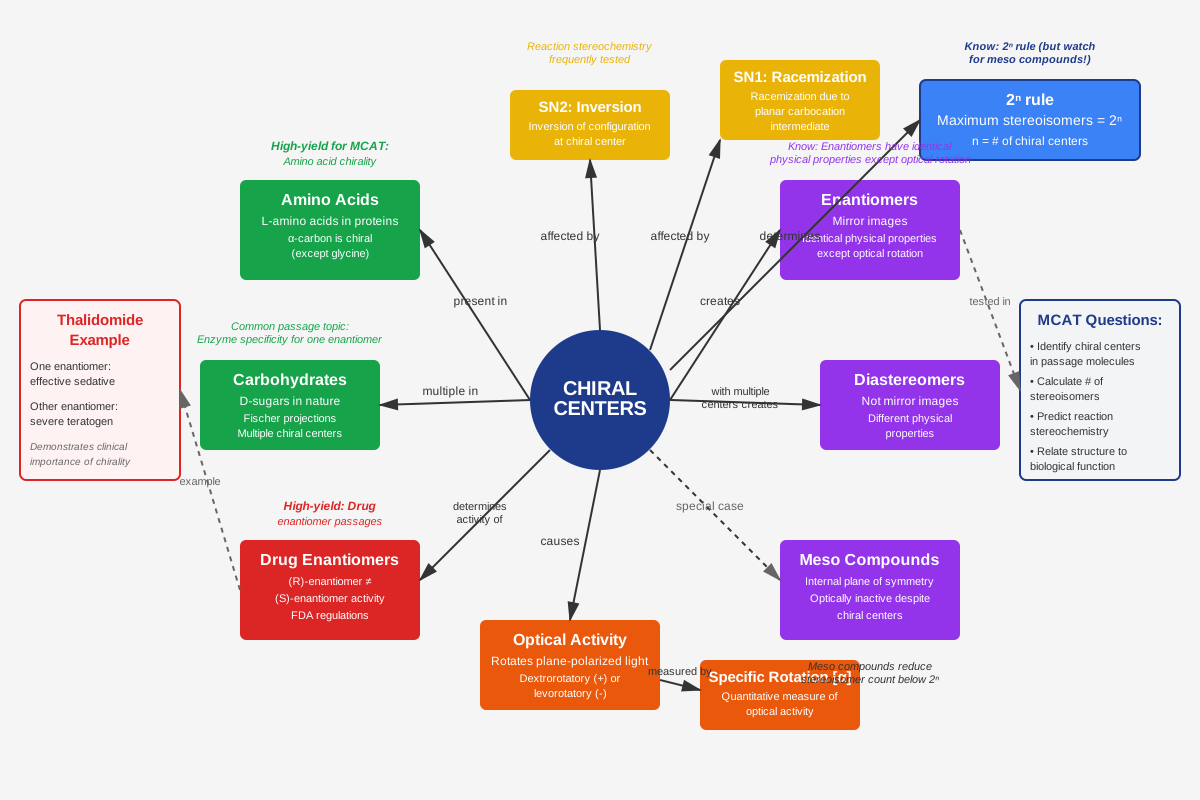
Chiral centers represent one of the most fundamental concepts in Organic Chemistry and are essential for understanding molecular three-dimensional structure and biological activity. A chiral center, also known as a stereocenter or stereogenic center, is typically a carbon atom bonded to four different substituents, creating a molecule that cannot be superimposed on its mirror image. This property of chirality is not merely an academic curiosity—it has profound implications for drug design, enzyme function, and metabolic processes that appear frequently on the MCAT.
Understanding chiral centers is critical for MCAT success because they form the foundation of Stereochemistry and Conformation, a topic that bridges organic chemistry with biochemistry and biological sciences. The MCAT regularly tests students' ability to identify chiral centers in complex molecules, predict the number of stereoisomers, assign absolute configuration using the Cahn-Ingold-Prelog priority rules, and understand how chirality affects biological activity. Questions may appear as discrete items testing pure organic chemistry knowledge or embedded within biochemistry passages discussing enzyme specificity, drug enantiomers, or amino acid structure.
The concept of chiral centers connects directly to broader themes in Organic Chemistry MCAT preparation, including stereoisomerism, optical activity, Fischer projections, and the relationship between molecular structure and function. Mastery of chiral centers enables students to tackle more advanced topics such as diastereomers, meso compounds, and the stereochemistry of reactions. This topic typically appears in 2-4 questions per MCAT exam, either directly or as prerequisite knowledge for understanding passage-based questions about pharmaceuticals, carbohydrate chemistry, or protein structure.
Learning Objectives
- [ ] Define chiral centers using accurate Organic Chemistry terminology
- [ ] Explain why chiral centers matter for the MCAT
- [ ] Apply chiral centers to exam-style questions
- [ ] Identify common mistakes related to chiral centers
- [ ] Connect chiral centers to related Organic Chemistry concepts
- [ ] Systematically identify all chiral centers in complex organic molecules and biomolecules
- [ ] Assign R/S configuration to chiral centers using Cahn-Ingold-Prelog priority rules
- [ ] Calculate the maximum number of stereoisomers for molecules with multiple chiral centers
- [ ] Distinguish between chiral centers and other types of stereocenters in various molecular contexts
Prerequisites
- Basic bonding theory and hybridization: Understanding sp³ hybridization is essential because chiral centers typically involve tetrahedral carbon atoms with four distinct substituents
- Functional group recognition: Identifying different substituents attached to potential chiral centers requires fluency with common organic functional groups
- Three-dimensional molecular visualization: The ability to mentally rotate molecules and understand wedge-dash notation is crucial for recognizing non-superimposable mirror images
- Constitutional isomers vs. stereoisomers: Distinguishing between different types of isomerism provides the framework for understanding where chiral centers fit in the broader classification scheme
- Basic nomenclature: Familiarity with IUPAC naming helps in understanding how stereochemical descriptors (R/S) integrate into complete chemical names
Why This Topic Matters
Clinical and Real-World Significance
Chirality has life-or-death implications in medicine and pharmacology. The tragic thalidomide disaster of the 1960s, where one enantiomer treated morning sickness while its mirror image caused severe birth defects, revolutionized pharmaceutical development and FDA approval processes. Today, understanding chiral centers is essential for drug design because enantiomers can have dramatically different biological activities—one may be therapeutic while the other is inactive or even toxic. The human body itself is inherently chiral; all naturally occurring amino acids (except glycine) have the L-configuration, and enzymes show exquisite stereoselectivity, often binding only one enantiomer of a chiral substrate.
MCAT Exam Statistics and Question Types
Chiral centers appear on the MCAT with medium-to-high frequency, typically in 2-4 questions per exam. These questions manifest in several formats:
- Discrete questions asking students to identify the number of chiral centers in a given structure (15-20% of stereochemistry questions)
- Passage-based questions about drug enantiomers, where understanding chirality is necessary to interpret experimental data about differential biological activity (30-40%)
- Biochemistry passages involving amino acids, sugars, or enzyme mechanisms where recognizing chiral centers helps predict molecular behavior (25-35%)
- Organic chemistry reaction passages where stereochemical outcomes depend on identifying chiral centers in reactants and products (20-25%)
Common Exam Contexts
The MCAT frequently embeds chiral center questions within passages about pharmaceutical development, where students must understand why separating enantiomers matters for drug efficacy. Biochemistry passages may discuss enzyme-substrate interactions, requiring recognition that amino acid residues contain chiral centers that determine binding specificity. Carbohydrate chemistry passages often test whether students can identify multiple chiral centers in sugar molecules and predict the number of possible stereoisomers. Understanding chiral centers also appears in questions about optical activity, where the presence of chiral centers correlates with a molecule's ability to rotate plane-polarized light.
Core Concepts
Definition and Fundamental Properties
A chiral center (also called a stereocenter or stereogenic center) is an atom in a molecule that is bonded to four different substituents, creating a non-superimposable mirror image relationship. The term "chiral" derives from the Greek word for "hand," reflecting how left and right hands are mirror images that cannot be perfectly overlaid. In organic chemistry, chiral centers most commonly involve sp³-hybridized carbon atoms with tetrahedral geometry, though other atoms (phosphorus, sulfur, nitrogen in certain contexts) can also serve as chiral centers.
The presence of a chiral center creates enantiomers—stereoisomers that are non-superimposable mirror images of each other. These molecules have identical physical properties (melting point, boiling point, density) except for their interaction with plane-polarized light and their behavior in chiral environments such as biological systems. A molecule containing one or more chiral centers and lacking an internal plane of symmetry is considered chiral and will exist as enantiomers.
Identifying Chiral Centers: The Four-Different-Groups Rule
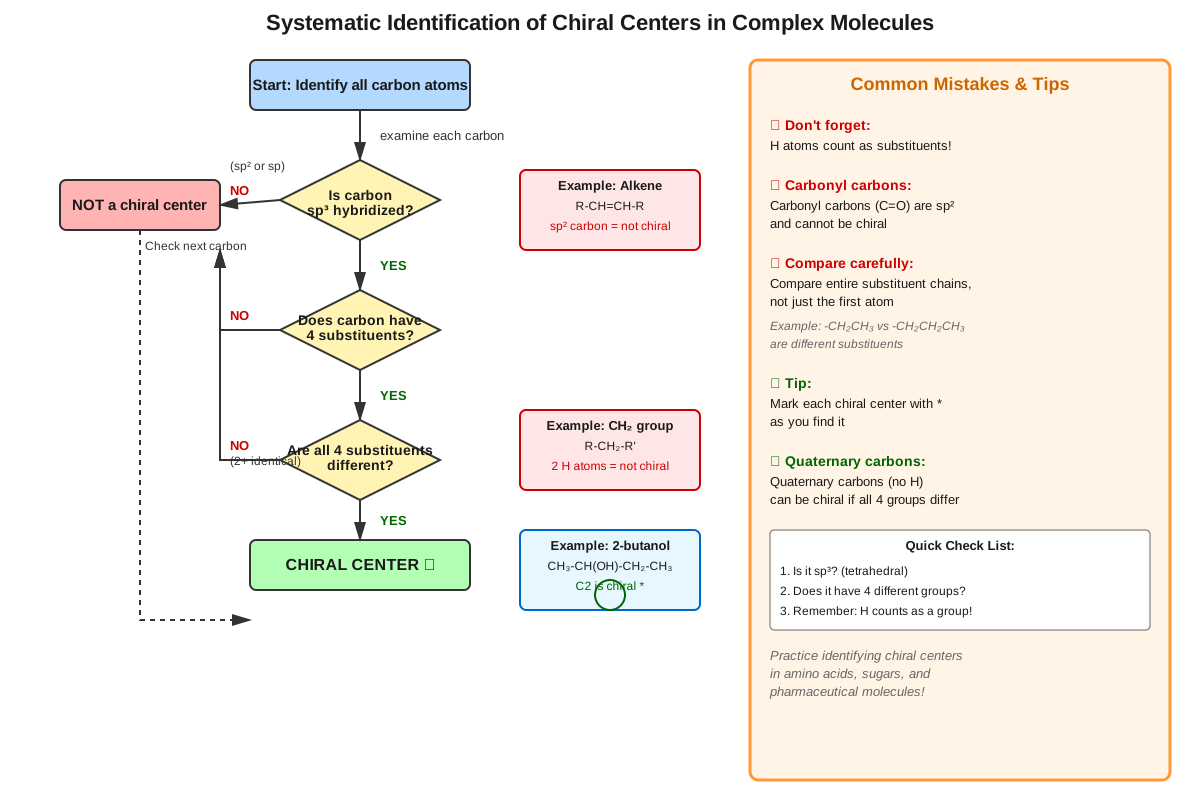
To systematically identify chiral centers in organic molecules, apply this decision tree:
- Locate all sp³-hybridized carbons (tetrahedral geometry with single bonds)
- Examine each carbon's four substituents to determine if they are all different
- Consider the entire connectivity, not just the immediate atoms—two groups may appear similar initially but differ further from the center
- Exclude carbons with any double bonds, triple bonds, or two identical groups
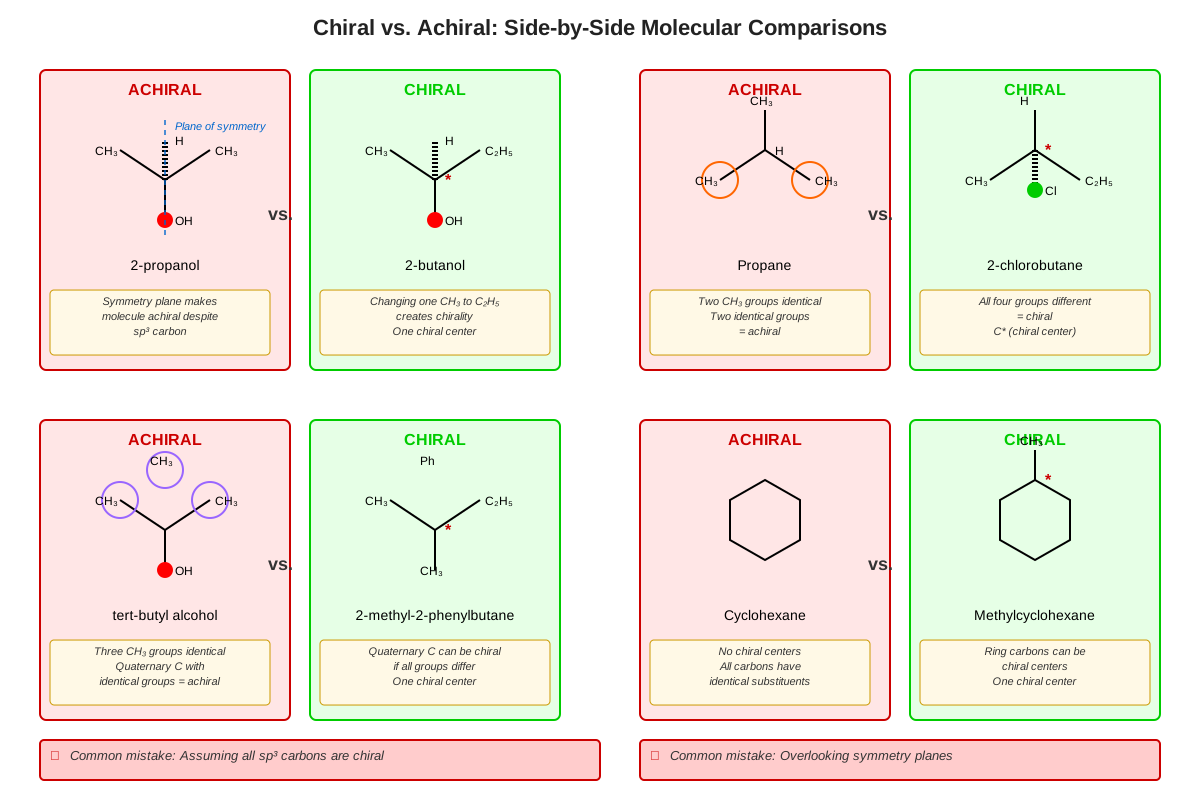
For example, in 2-butanol (CH₃-CHOH-CH₂-CH₃), the second carbon is bonded to: (1) a hydrogen atom, (2) a hydroxyl group (-OH), (3) a methyl group (-CH₃), and (4) an ethyl group (-CH₂CH₃). Since all four substituents differ, this carbon is a chiral center. In contrast, the terminal carbons in 2-butanol are not chiral centers because they are bonded to three hydrogen atoms (not four different groups).
Cahn-Ingold-Prelog Priority Rules and R/S Configuration
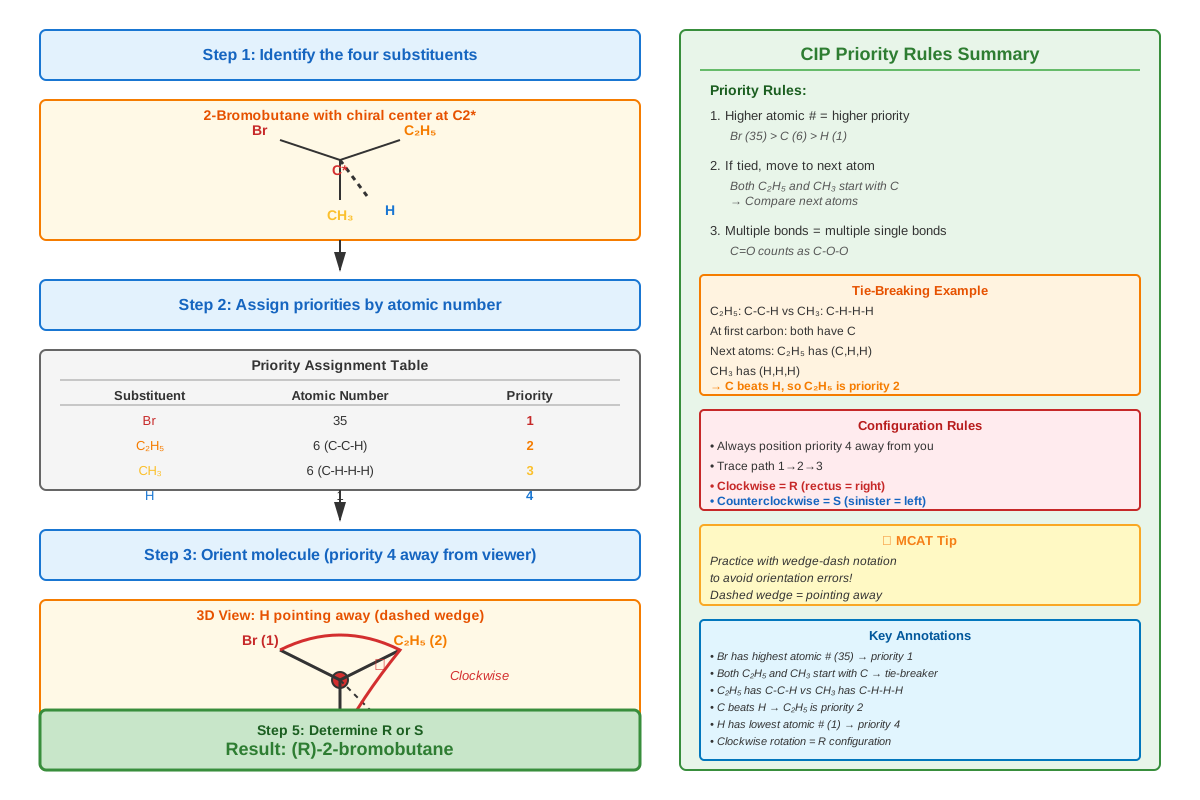
Once a chiral center is identified, its absolute configuration is designated as either R (from Latin rectus, meaning "right") or S (from Latin sinister, meaning "left") using the Cahn-Ingold-Prelog (CIP) priority system:
Step 1: Assign priorities (1-4) to the four substituents
- Higher atomic number = higher priority
- If atoms directly attached are identical, move outward along the chain until a difference is found
- Multiple bonds count as multiple single bonds to that atom (e.g., C=O counts as two C-O bonds)
Step 2: Orient the molecule
- Position the lowest priority group (usually hydrogen) pointing away from you (into the page)
- This can be visualized using wedge-dash notation where the lowest priority group is on a dashed bond
Step 3: Trace the path from priority 1 → 2 → 3
- If the path curves clockwise, the configuration is R
- If the path curves counterclockwise, the configuration is S
Example: In (R)-2-butanol, the priorities are: (1) -OH, (2) -CH₂CH₃, (3) -CH₃, (4) -H. With hydrogen pointing away, tracing from OH to ethyl to methyl proceeds clockwise, confirming R configuration.
Calculating Stereoisomer Numbers
For molecules with multiple chiral centers, the maximum number of stereoisomers follows the 2ⁿ rule, where n equals the number of chiral centers. This formula assumes no internal symmetry (meso compounds are exceptions).
| Number of Chiral Centers | Maximum Stereoisomers | Notes |
|---|---|---|
| 1 | 2 | One pair of enantiomers |
| 2 | 4 | Two pairs of enantiomers (also diastereomers) |
| 3 | 8 | Four pairs of enantiomers |
| 4 | 16 | Eight pairs of enantiomers |
Important exception: Molecules with internal planes of symmetry may have fewer stereoisomers than predicted by 2ⁿ because some configurations create meso compounds—achiral molecules despite containing chiral centers. For example, tartaric acid has two chiral centers but only three stereoisomers (not four) because one configuration is meso.
Chiral Centers in Biological Molecules
Amino acids (except glycine) contain a chiral center at the α-carbon, bonded to: (1) amino group (-NH₂), (2) carboxyl group (-COOH), (3) hydrogen, and (4) variable R-group. All naturally occurring amino acids in proteins have the L-configuration (S-configuration for most, except cysteine which is R due to sulfur's higher priority).
Carbohydrates contain multiple chiral centers. D-glucose, for instance, has four chiral centers (at carbons 2, 3, 4, and 5 in the open-chain form), theoretically allowing 2⁴ = 16 stereoisomers. These stereoisomers include different sugars like glucose, mannose, galactose, and allose, which differ in the configuration at one or more chiral centers.
Pharmaceutical compounds frequently contain chiral centers, and the FDA now requires separate testing of enantiomers. Ibuprofen contains one chiral center; the S-enantiomer is the active anti-inflammatory agent, while the R-enantiomer is less active (though the body can slowly convert R to S).
Achiral Molecules and Symmetry
Not all molecules with four different groups are chiral. A molecule is achiral (not chiral) if it possesses:
- A plane of symmetry (mirror plane dividing the molecule into two identical halves)
- A center of inversion (point through which all atoms can be reflected to equivalent positions)
- An improper rotation axis (less common in simple organic molecules)
Meso compounds exemplify achiral molecules with chiral centers. In meso-tartaric acid, the two chiral centers have opposite configurations (one R, one S), creating an internal plane of symmetry that makes the overall molecule achiral despite containing stereocenters.
Pseudochiral Centers and Special Cases
Pseudochiral centers (also called pseudoasymmetric centers) occur in molecules with multiple chiral centers where one center is bonded to four different groups, but two of those groups are enantiomeric to each other. These centers are designated as r or s (lowercase) rather than R or S. While less commonly tested on the MCAT, recognizing that not all stereocenters follow simple R/S designation demonstrates advanced understanding.
Nitrogen stereocenters can exist when nitrogen is bonded to four different groups (quaternary ammonium salts) or when nitrogen inversion is restricted (bridgehead nitrogens in rigid ring systems). However, simple amines with three different groups typically undergo rapid pyramidal inversion at room temperature, preventing isolation of enantiomers.
Concept Relationships
The concept of chiral centers serves as the foundation for understanding stereochemistry hierarchically. Constitutional isomers differ in connectivity, while stereoisomers have identical connectivity but different spatial arrangements. Stereoisomers subdivide into enantiomers (non-superimposable mirror images, requiring at least one chiral center) and diastereomers (stereoisomers that are not mirror images, requiring at least two chiral centers).
Relationship map:
- Molecular formula → Constitutional isomers (different connectivity) OR Stereoisomers (same connectivity)
- Stereoisomers → Enantiomers (mirror images, requires chiral centers) OR Diastereomers (not mirror images)
- Chiral centers → Determine maximum stereoisomers (2ⁿ rule) → Affects optical activity
- R/S configuration → Describes absolute stereochemistry → Predicts biological activity
- Multiple chiral centers → Creates diastereomers → Leads to different physical properties
Chiral centers connect to optical activity because chiral molecules rotate plane-polarized light (designated + or − for dextrorotatory or levorotatory). However, R/S configuration does not predict the direction of rotation—this must be determined experimentally. The connection to Fischer projections is crucial for MCAT biochemistry: Fischer projections represent chiral centers in a standardized two-dimensional format, with horizontal lines representing bonds coming toward the viewer and vertical lines representing bonds going away.
Understanding chiral centers enables mastery of reaction stereochemistry. SN2 reactions at chiral centers proceed with inversion of configuration (Walden inversion), while SN1 reactions produce racemic mixtures. Addition reactions to alkenes can create new chiral centers, and understanding whether reactions are stereospecific or stereoselective requires recognizing where chiral centers form.
High-Yield Facts
⭐ A chiral center is typically an sp³-hybridized carbon bonded to four different substituents, creating non-superimposable mirror images called enantiomers
⭐ The maximum number of stereoisomers for a molecule with n chiral centers is 2ⁿ, assuming no internal symmetry (meso compounds are exceptions)
⭐ R/S configuration is assigned using Cahn-Ingold-Prelog priority rules: higher atomic number = higher priority; trace 1→2→3 with lowest priority away to determine clockwise (R) or counterclockwise (S)
⭐ All naturally occurring amino acids (except glycine) have L-configuration and contain a chiral center at the α-carbon
⭐ Enantiomers have identical physical properties except for optical activity (rotation of plane-polarized light) and behavior in chiral environments
- A molecule with chiral centers but an internal plane of symmetry is a meso compound and is achiral overall
- Glycine (H₂N-CH₂-COOH) is the only achiral amino acid because its α-carbon is bonded to two hydrogen atoms
- D-glucose contains four chiral centers in its open-chain form, allowing for 16 possible stereoisomers (aldohexoses)
- Diastereomers (stereoisomers that are not mirror images) have different physical properties including melting point, boiling point, and solubility
- SN2 reactions at chiral centers proceed with inversion of configuration, while SN1 reactions produce racemic mixtures (50:50 mixture of enantiomers)
- Pharmaceutical enantiomers can have dramatically different biological activities; one may be therapeutic while the other is inactive or toxic
- Chiral centers in ring systems must be identified by examining all substituents, including ring atoms as part of the connectivity
- A carbon involved in a double bond (sp² hybridized) cannot be a chiral center because it is only bonded to three groups, not four
- Prochiral centers become chiral upon reaction; recognizing prochirality helps predict stereochemical outcomes of enzymatic reactions
Quick check — test yourself on Chiral centers so far.
Try Flashcards →Common Misconceptions
Misconception: All carbons bonded to four different atoms are chiral centers
Correction: The four substituents must be different groups considering the entire molecular connectivity, not just the immediately attached atoms. For example, in 2,2-dimethylbutane, the central carbon is bonded to four carbons, but two are identical methyl groups, so it is not a chiral center.
Misconception: R-configuration always corresponds to dextrorotatory (+) optical activity and S-configuration to levorotatory (−)
Correction: R/S designation describes absolute configuration (spatial arrangement), while (+)/(−) describes optical activity (direction of light rotation). These are independent properties that must be determined separately. For example, (R)-2-butanol is levorotatory (−), not dextrorotatory.
Misconception: A molecule with one chiral center always exists as two enantiomers
Correction: While a single chiral center creates the potential for two enantiomers, if the molecule has other symmetry elements (highly unusual with one chiral center but theoretically possible in complex structures), it might be achiral. More commonly, students confuse this with meso compounds, which require at least two chiral centers.
Misconception: Nitrogen atoms with three different substituents are always chiral centers
Correction: Simple amines undergo rapid pyramidal inversion at room temperature (flipping between mirror-image configurations), preventing isolation of enantiomers. Nitrogen can only serve as a stable chiral center when quaternized (four substituents, positive charge) or when inversion is prevented by rigid ring systems.
Misconception: The 2ⁿ rule always gives the exact number of stereoisomers
Correction: The 2ⁿ rule gives the maximum number of stereoisomers. Molecules with internal symmetry (meso compounds) have fewer stereoisomers than predicted. For example, tartaric acid has two chiral centers but only three stereoisomers (not four) because one configuration is meso.
Misconception: Chiral centers only occur at carbon atoms
Correction: While carbon is the most common atom forming chiral centers in organic molecules, phosphorus, sulfur (in sulfoxides and sulfonium salts), and nitrogen (when quaternized or in rigid systems) can also serve as chiral centers. The MCAT occasionally tests recognition of non-carbon stereocenters.
Misconception: If a molecule rotates plane-polarized light, it must contain a chiral center
Correction: While most optically active organic molecules contain chiral centers, some molecules exhibit optical activity due to axial chirality (allenes, biphenyls with restricted rotation) or helical chirality without having traditional chiral centers. However, for MCAT purposes, optical activity typically indicates the presence of chiral centers.
Worked Examples
Example 1: Identifying Chiral Centers in a Complex Molecule
Problem: Identify all chiral centers in the following molecule and determine the maximum number of stereoisomers:
3-chloro-2-methylpentanoic acid: CH₃-CHCl-CH(CH₃)-CH₂-COOH
Solution:
Step 1: Draw the complete structure and identify all sp³-hybridized carbons:
- C1: -COOH (carboxylic acid carbon, sp² hybridized due to C=O, not a chiral center)
- C2: bonded to -COOH, -CH₂-, -CH(CH₃)-, and -H
- C3: bonded to -CH₂-, -CH₃, -CHCl-, and -H
- C4: bonded to -CH(CH₃)-, -CH₃, -Cl, and -H
- C5: -CH₃ (bonded to three H atoms, not a chiral center)
- C6: -CH₃ (bonded to three H atoms, not a chiral center)
Step 2: Examine each sp³ carbon for four different substituents:
C2 analysis:
- Group 1: -COOH
- Group 2: -H
- Group 3: -CH₂-CH₃ (following the chain)
- Group 4: -CH(CH₃)-CHCl-CH₃ (following the other direction)
All four groups are different → C2 is a chiral center
C3 analysis:
- Group 1: -H
- Group 2: -CH₃
- Group 3: -CH₂-COOH (toward the carboxylic acid)
- Group 4: -CHCl-CH₃ (toward the chlorine)
All four groups are different → C3 is a chiral center
C4 analysis:
- Group 1: -H
- Group 2: -Cl
- Group 3: -CH₃
- Group 4: -CH(CH₃)-CH₂-COOH (the rest of the chain)
All four groups are different → C4 is a chiral center
Step 3: Calculate maximum stereoisomers:
- Number of chiral centers (n) = 3
- Maximum stereoisomers = 2³ = 8 stereoisomers
- This includes 4 pairs of enantiomers
Step 4: Check for meso compounds:
- The molecule lacks internal symmetry (the three chiral centers have different substituents)
- Therefore, all 8 stereoisomers are distinct (no meso compounds)
Answer: The molecule contains three chiral centers (at C2, C3, and C4) and can exist as 8 stereoisomers (4 pairs of enantiomers).
Example 2: Assigning R/S Configuration
Problem: Assign the R or S configuration to the chiral center in the following molecule:
A carbon atom with the following substituents (using wedge-dash notation):
- Wedge (coming toward you): -OH
- Dash (going away): -H
- In-plane bonds: -CH₃ (left) and -CH₂CH₃ (right)
Solution:
Step 1: Assign Cahn-Ingold-Prelog priorities:
Priority 1: -OH (oxygen has atomic number 8, highest)
Priority 2: -CH₂CH₃ (carbon attached to C, H, H vs. next option)
Priority 3: -CH₃ (carbon attached to H, H, H)
Priority 4: -H (hydrogen has atomic number 1, lowest)
Detailed priority 2 vs. 3 determination:
- Both -CH₂CH₃ and -CH₃ have carbon as the first atom
- For -CH₂CH₃: the first carbon is bonded to (C, H, H)
- For -CH₃: the first carbon is bonded to (H, H, H)
- C > H, so -CH₂CH₃ has higher priority
Step 2: Orient the molecule with lowest priority (H) pointing away:
- The hydrogen is already on a dashed bond (pointing away), so the orientation is correct
- We can view the molecule from the front with H behind the chiral center
Step 3: Trace the path from priority 1 → 2 → 3:
- Start at -OH (priority 1, on wedge, upper position)
- Move to -CH₂CH₃ (priority 2, on right)
- Move to -CH₃ (priority 3, on left)
Step 4: Determine direction:
- The path from OH → ethyl → methyl curves counterclockwise
- Counterclockwise = S configuration
Answer: The chiral center has (S) configuration.
Connection to learning objectives: This example demonstrates the systematic application of CIP rules and spatial reasoning required for MCAT questions. Understanding that the lowest priority group must point away (or mentally rotating the molecule if it doesn't) is crucial for avoiding configuration assignment errors.
Exam Strategy
Approaching MCAT Questions on Chiral Centers
For identification questions:
- Quickly scan for sp³-hybridized carbons (tetrahedral, single bonds only)
- Systematically check each candidate carbon's four substituents
- Trace connectivity at least two atoms away from the center to avoid missing subtle differences
- Eliminate carbons with double/triple bonds or two identical groups immediately
- Count carefully—missing one chiral center changes the stereoisomer calculation
Trigger words and phrases to watch for:
- "Stereoisomers" or "stereochemistry" → likely involves chiral centers
- "Optically active" → indicates presence of chiral centers (usually)
- "Enantiomers" → requires at least one chiral center
- "Racemic mixture" → equal amounts of enantiomers, implies chiral centers
- "Biological activity" or "enzyme specificity" → often relates to chirality
- "Configuration" → may require R/S assignment
- "Meso compound" → has chiral centers but internal symmetry
Process-of-Elimination Tips
When counting chiral centers:
- Eliminate answer choices that are clearly too high or too low
- If a molecule has obvious symmetry, expect fewer stereoisomers than 2ⁿ
- Terminal carbons (-CH₃) are never chiral centers
- Carbonyl carbons (C=O) are never chiral centers
- If two answer choices differ by one chiral center, carefully reexamine the most complex region of the molecule
When assigning R/S configuration:
- If the lowest priority group is on a wedge (coming toward you), the final answer is opposite what you trace
- Eliminate answers that don't match the systematic CIP priority rules
- If stuck between R and S, redraw the molecule in a clearer orientation
- Remember that R/S does not predict (+)/(−) optical rotation
For stereoisomer calculations:
- If answer choices include both 2ⁿ and 2ⁿ−1, consider whether a meso compound exists
- Meso compounds require at least two chiral centers and internal symmetry
- If the molecule is clearly asymmetric, use 2ⁿ directly
Time Allocation Advice
- Simple identification (counting chiral centers in a small molecule): 30-45 seconds
- Complex identification (multiple chiral centers, large molecule): 60-90 seconds
- R/S assignment: 60-90 seconds per chiral center
- Stereoisomer calculation: 15-30 seconds after identifying chiral centers
- Passage-based questions: Read the passage first (2-3 minutes), then allocate 60-90 seconds per question
Exam Tip: If a question asks for both the number of chiral centers AND the number of stereoisomers, answer the chiral center count first, then use 2ⁿ. This prevents calculation errors from propagating and allows partial credit thinking.
High-Yield Strategy: In biochemistry passages about amino acids or sugars, immediately recognize that amino acids (except glycine) have one chiral center and common hexoses have four. This saves time and reduces errors.
Memory Techniques
Mnemonics for Key Concepts
"Four Different Friends" - A chiral center needs four different substituents, like having four friends who are all unique individuals
"Right is Rectus, Sinister is Left" - Remember R (rectus = right/clockwise) and S (sinister = left/counterclockwise) by associating with their Latin roots
"HALO Priority" - When assigning priorities, remember: Highest Atomic number gets Lowest number (highest priority), Orient with lowest away
- H: Highest atomic number
- A: Assigned priority 1
- L: Lowest priority (usually H)
- O: Orient away from you
"Two to the N" - Maximum stereoisomers = 2ⁿ where n = number of chiral centers (sounds like "tune" to help remember the formula)
"Glycine is Tiny" - Glycine is the only achiral amino acid because its R-group is just H (tiny), giving it two identical substituents
Visualization Strategies
The "Steering Wheel" Method for R/S Assignment:
Imagine the chiral center as the center of a steering wheel. With the lowest priority group pointing away (into the dashboard), trace priorities 1→2→3 around the wheel. Clockwise = turning right = R configuration. Counterclockwise = turning left = S configuration.
The "Mirror Test" for Chirality:
Mentally place a mirror next to the molecule. If you can slide the molecule and its reflection together and they match perfectly (superimposable), it's achiral. If they're like left and right hands that won't match no matter how you turn them, it's chiral.
The "Tetrahedral Hand" Model:
Use your hand as a 3D model: thumb = lowest priority (pointing away), index finger = priority 1, middle finger = priority 2, ring finger = priority 3. Curl your fingers from index to ring—if they curl like your right hand, it's R; if like your left hand, it's S.
Acronyms
CHIRAL - Checklist for identifying chiral centers:
- Carbon must be sp³ hybridized
- Has four substituents
- Identify each group's connectivity
- Review for differences
- All four must be different
- Look for symmetry (meso possibility)
Summary
Chiral centers represent sp³-hybridized atoms (typically carbon) bonded to four different substituents, creating molecules that exist as non-superimposable mirror images called enantiomers. Identifying chiral centers requires systematic examination of molecular connectivity, recognizing that substituents must differ in their complete structure, not just immediate atoms. The Cahn-Ingold-Prelog priority system assigns R or S configuration based on atomic number priorities and the spatial arrangement of substituents. For molecules with multiple chiral centers, the maximum number of stereoisomers follows the 2ⁿ rule, though internal symmetry can create meso compounds with fewer stereoisomers. Understanding chiral centers is essential for MCAT success because chirality fundamentally affects biological activity—enzymes, receptors, and metabolic pathways show exquisite stereoselectivity. This concept bridges organic chemistry with biochemistry, appearing in questions about amino acid structure, carbohydrate chemistry, pharmaceutical enantiomers, and reaction stereochemistry. Mastery requires both conceptual understanding and practical skill in three-dimensional visualization, priority assignment, and systematic analysis of molecular structure.
Key Takeaways
- A chiral center is an sp³-hybridized atom bonded to four different substituents, creating non-superimposable mirror images (enantiomers)
- Systematic identification requires examining complete connectivity, not just immediate atoms, and excluding carbons with double bonds or identical groups
- R/S configuration is assigned using Cahn-Ingold-Prelog rules: prioritize by atomic number, orient with lowest priority away, trace 1→2→3 for clockwise (R) or counterclockwise (S)
- Maximum stereoisomers = 2ⁿ where n = number of chiral centers, except when internal symmetry creates meso compounds
- All naturally occurring amino acids except glycine contain a chiral center at the α-carbon with L-configuration
- Enantiomers have identical physical properties except optical activity and behavior in chiral environments, making chirality crucial for drug design and biological function
- MCAT questions test chiral center identification, stereoisomer counting, R/S assignment, and understanding of chirality's biological significance in passages about pharmaceuticals, enzymes, and biomolecules
Related Topics
Enantiomers and Optical Activity: Understanding how chiral centers create molecules that rotate plane-polarized light, including the relationship between R/S configuration and (+)/(−) rotation, specific rotation calculations, and racemic mixtures. Mastering chiral centers is prerequisite to understanding why enantiomers behave identically in achiral environments but differently in chiral ones.
Diastereomers and Meso Compounds: Molecules with multiple chiral centers create diastereomers (stereoisomers that aren't mirror images) and potentially meso compounds (achiral molecules with chiral centers). This topic builds directly on chiral center identification and the 2ⁿ rule.
Fischer Projections: A standardized two-dimensional representation crucial for depicting chiral centers in carbohydrates and amino acids. Understanding chiral centers enables interpretation of Fischer projections and interconversion with other representations.
Stereochemistry of Reactions: How reactions create, destroy, or alter chiral centers, including SN1 (racemization), SN2 (inversion), and addition reactions. Recognizing chiral centers in reactants and products is essential for predicting stereochemical outcomes.
Carbohydrate Stereochemistry: Monosaccharides contain multiple chiral centers, and understanding their configuration explains the difference between glucose, mannose, galactose, and other sugars. This topic heavily relies on chiral center identification and Fischer projection interpretation.
Amino Acid Stereochemistry: The L-configuration of amino acids, the unique achirality of glycine, and how stereochemistry affects protein structure and enzyme function all depend on understanding chiral centers at the α-carbon.
Practice CTA
Now that you've mastered the fundamentals of chiral centers, it's time to solidify your understanding through active practice. Attempt the practice questions to test your ability to identify chiral centers in complex molecules, assign R/S configurations under time pressure, and apply stereochemical reasoning to passage-based scenarios. Use the flashcards to drill the high-yield facts, priority rules, and common exceptions until they become automatic. Remember: stereochemistry questions reward systematic thinking and careful spatial reasoning—skills that improve dramatically with deliberate practice. The difference between a good MCAT score and a great one often comes down to mastering medium-difficulty topics like chiral centers that appear consistently across multiple sections. You've built the foundation; now reinforce it through repetition and application. Your future self on test day will thank you for the effort you invest now!
Sign up free to keep reading
Create a free AnvayaPrep account to finish this MCAT guide on Chiral centers — plus flashcards and practice questions.