Overview
Meso compounds represent a fascinating intersection of symmetry and stereochemistry in Organic Chemistry, where molecules possess chiral centers yet remain achiral overall due to internal planes of symmetry. Understanding meso compounds is essential for mastering Stereochemistry and Conformation, as these molecules challenge the common assumption that the presence of chiral centers automatically confers optical activity. On the MCAT, meso compounds frequently appear in questions testing stereoisomer counting, optical activity predictions, and the relationship between molecular structure and physical properties.
The concept of meso compounds bridges fundamental stereochemistry principles with practical applications in drug design and biochemistry. These molecules demonstrate that chirality is a property of the entire molecular structure, not merely the sum of individual stereocenters. For MCAT success, students must recognize that meso compounds Organic Chemistry questions often serve as discriminators between average and high-scoring test-takers, as they require spatial reasoning and the ability to identify subtle structural features that dramatically affect molecular properties.
Mastery of meso compounds MCAT content connects directly to broader topics including Fischer projections, optical activity, enantiomers, diastereomers, and conformational analysis. This topic appears regularly in both discrete questions and passage-based items, particularly in contexts involving carbohydrate chemistry, amino acid analysis, and pharmaceutical stereoisomer separation. The ability to quickly identify meso compounds and understand their unique properties is a high-yield skill that distinguishes well-prepared students on test day.
Learning Objectives
- [ ] Define Meso compounds using accurate Organic Chemistry terminology
- [ ] Explain why Meso compounds matters for the MCAT
- [ ] Apply Meso compounds to exam-style questions
- [ ] Identify common mistakes related to Meso compounds
- [ ] Connect Meso compounds to related Organic Chemistry concepts
- [ ] Recognize meso compounds from Fischer projections, Newman projections, and three-dimensional representations
- [ ] Calculate the maximum number of stereoisomers for molecules that may contain meso forms
- [ ] Distinguish between meso compounds and other types of diastereomers based on symmetry elements
- [ ] Predict which molecules can exist as meso compounds based on structural features
Prerequisites
- Chirality and chiral centers: Understanding what makes a carbon atom chiral (four different substituents) is essential for recognizing when meso compounds can exist
- Enantiomers and diastereomers: Distinguishing between these stereoisomer types provides the foundation for understanding where meso compounds fit in stereoisomer classification
- Optical activity: Knowledge of how chiral molecules rotate plane-polarized light is necessary to understand why meso compounds are optically inactive
- Fischer projections: Facility with this two-dimensional representation system is critical for identifying planes of symmetry in meso compounds
- Molecular symmetry: Basic understanding of planes of symmetry and mirror images enables recognition of the internal symmetry that defines meso compounds
- R/S nomenclature: The Cahn-Ingold-Prelog priority system helps assign absolute configuration to individual stereocenters in meso compounds
Why This Topic Matters
Meso compounds have significant real-world importance in pharmaceutical chemistry and biochemistry. Many biologically active molecules contain multiple stereocenters, and the presence or absence of meso forms affects drug synthesis strategies, purification methods, and regulatory requirements. For example, certain sugar molecules and cyclic diols exist as meso compounds, influencing their metabolic pathways and biological functions. Understanding meso compounds is crucial for predicting the number of stereoisomers that must be separated during drug purification, which has direct cost and safety implications in pharmaceutical manufacturing.
On the MCAT, meso compounds appear with moderate frequency but high discriminatory power. Approximately 2-4 questions per exam directly or indirectly test meso compound recognition, typically in the Chemical and Physical Foundations of Biological Systems section. These questions often appear as:
- Discrete questions asking students to count stereoisomers or identify optically inactive compounds
- Passage-based questions involving carbohydrate chemistry, where meso sugars like meso-tartaric acid appear
- Pseudo-discrete questions embedded in biochemistry passages about amino acid derivatives or cyclic compounds
- Data interpretation questions involving specific rotation measurements where meso compounds show [α] = 0°
The topic serves as an excellent discriminator because it requires both conceptual understanding and spatial visualization skills. Students who merely memorize that "chiral centers mean optical activity" will miss these questions, while those who understand the deeper principles of molecular symmetry will excel. Given the MCAT's emphasis on critical thinking over rote memorization, meso compound questions reward students who have developed true mastery of stereochemistry principles.
Core Concepts
Definition and Fundamental Properties
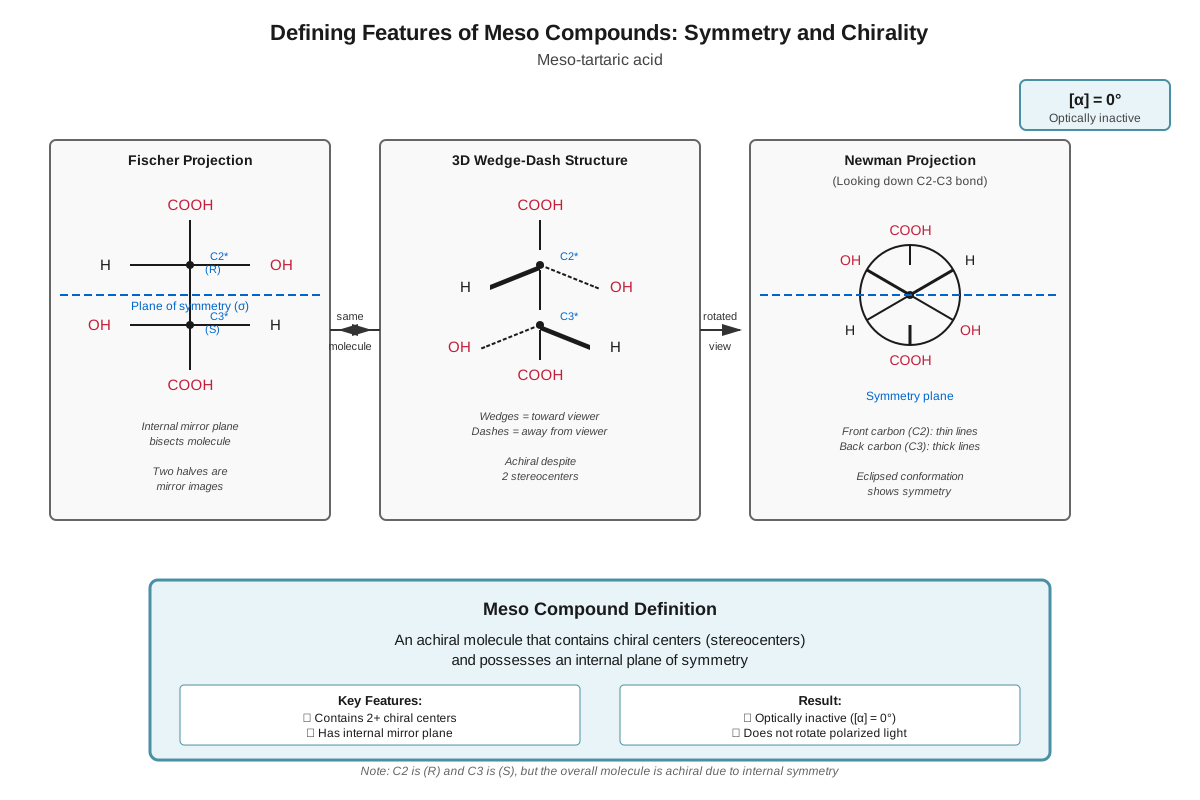
A meso compound is a molecule that contains two or more chiral centers (stereocenters) but is achiral overall due to the presence of an internal plane of symmetry. This internal symmetry element makes the molecule superimposable on its mirror image, rendering it optically inactive despite containing chiral centers. The term "meso" derives from the Greek word for "middle" or "intermediate," reflecting these compounds' intermediate status between fully chiral and achiral molecules.
The defining characteristics of meso compounds include:
- Presence of at least two chiral centers (most commonly two, but can be more)
- An internal plane of symmetry (σ plane) that divides the molecule into two mirror-image halves
- Optical inactivity: specific rotation [α] = 0° because the rotation from one half cancels the rotation from the other half
- Classification as achiral despite containing stereocenters
- Existence as diastereomers relative to other stereoisomers of the same molecular formula
Structural Requirements for Meso Compounds
For a molecule to exist as a meso compound, specific structural features must be present:
- Multiple stereocenters: At minimum, two chiral centers are required, though molecules with three or more stereocenters can also be meso
- Identical or similar substituents: The stereocenters must have the same or related substituent groups to allow for internal symmetry
- Appropriate spatial arrangement: The stereocenters must be positioned such that a plane of symmetry can bisect the molecule
- Internal compensation: The configuration at one stereocenter must be the mirror image of the configuration at another stereocenter
The classic example is 2,3-dibromobutane, which has two chiral centers at C-2 and C-3. When these carbons have opposite configurations (one R, one S), an internal plane of symmetry exists, creating the meso form. However, when both carbons have the same configuration (both R or both S), no plane of symmetry exists, and the molecule is chiral.
Identifying Planes of Symmetry
Recognizing the plane of symmetry is the key skill for identifying meso compounds. A plane of symmetry (also called a mirror plane or σ plane) divides a molecule such that one half is the mirror image of the other half. To identify this plane:
- Draw the molecule in its most symmetric conformation (often eclipsed for acyclic compounds, though the plane exists in all conformations)
- Look for a plane that bisects the molecule, typically passing through or between the stereocenters
- Verify that every atom on one side of the plane has a corresponding atom in the mirror position on the other side
- Confirm that all bond angles and distances are identical on both sides of the plane
In Fischer projections, meso compounds often appear symmetric when drawn vertically, with the top half mirroring the bottom half. The plane of symmetry runs horizontally through the middle of the molecule.
Meso Compounds vs. Other Stereoisomers
Understanding how meso compounds relate to other stereoisomer types is crucial for MCAT success:
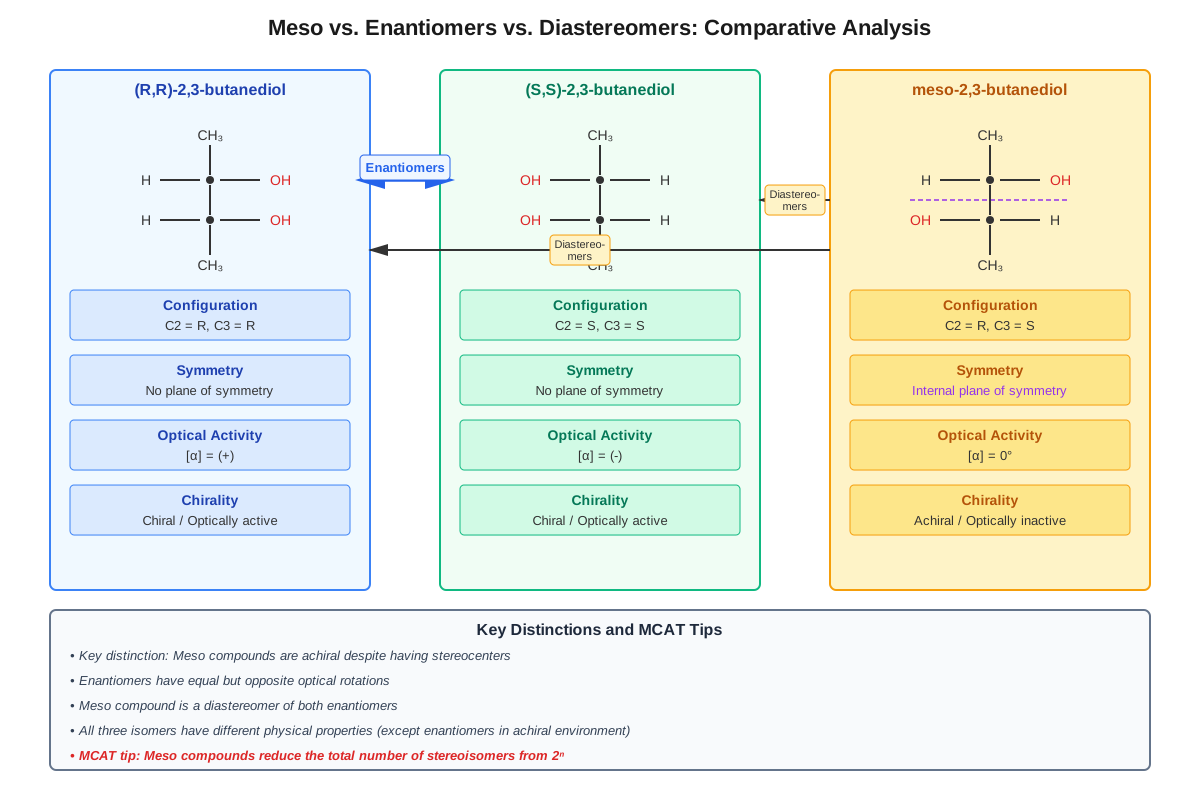
| Property | Meso Compound | Enantiomers | Diastereomers (non-meso) |
|---|---|---|---|
| Chiral centers | ≥2 | ≥1 | ≥2 |
| Plane of symmetry | Yes (internal) | No | No |
| Optical activity | Inactive ([α] = 0°) | Active (equal, opposite) | Active (different values) |
| Mirror image relationship | Superimposable on mirror image | Non-superimposable mirror images | Not mirror images |
| Relationship to each other | Diastereomer of chiral forms | Mirror images of each other | Non-mirror image stereoisomers |
Meso compounds are classified as diastereomers relative to the chiral stereoisomers of the same molecule because they are stereoisomers that are not mirror images. This classification is important for MCAT questions asking about stereoisomer relationships.
Calculating Stereoisomer Numbers with Meso Compounds
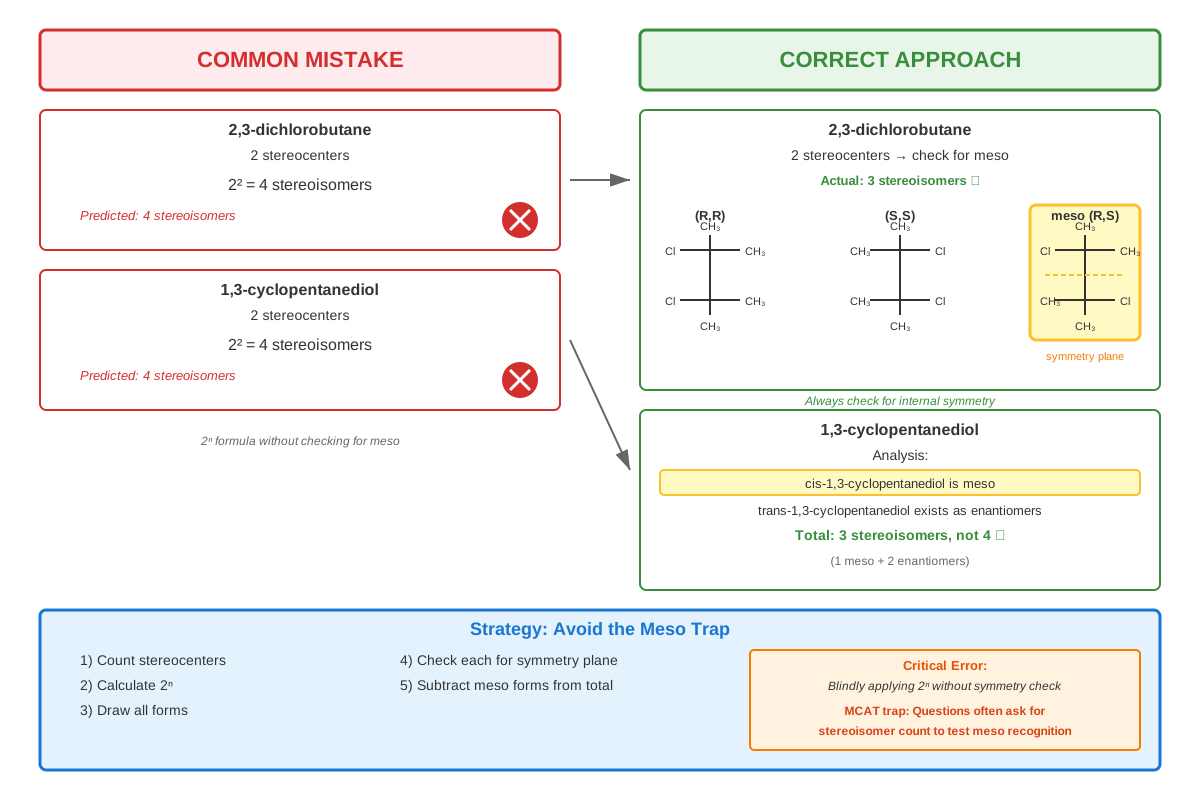
The presence of meso compounds affects stereoisomer counting. The standard formula 2^n (where n = number of chiral centers) gives the maximum possible stereoisomers, but this must be adjusted when meso forms exist.
For a molecule with n chiral centers:
- Without meso compounds: Number of stereoisomers = 2^n
- With meso compounds: Number of stereoisomers = 2^n - (number of meso forms)
For example, 2,3-dibromobutane has 2 chiral centers, suggesting 2² = 4 stereoisomers. However, one of these is meso, so the actual number is 4 - 1 = 3 stereoisomers: one meso compound and one pair of enantiomers.
The number of meso forms depends on the molecule's symmetry. For molecules with two identical stereocenters, typically one meso form exists. For molecules with more stereocenters, multiple meso forms may exist if different combinations of configurations produce internal symmetry.
Conformational Considerations
An important subtlety: the plane of symmetry in meso compounds must exist in at least one conformation, but it doesn't need to exist in all conformations. For acyclic meso compounds, the plane of symmetry is most easily visualized in the eclipsed conformation, though the molecule remains meso in all conformations because conformers are not distinct compounds.
For cyclic meso compounds, the plane of symmetry is more rigid and easier to visualize. For example, cis-1,2-dimethylcyclohexane can be meso if the methyl groups are positioned to create a plane of symmetry through the ring.
Common Meso Compound Examples
Several molecules frequently appear as meso compound examples on the MCAT:
- Meso-tartaric acid: 2,3-dihydroxybutanedioic acid with opposite configurations at C-2 and C-3
- Meso-2,3-dibromobutane: The classic teaching example with two chiral centers
- Meso-1,2-cyclopropanedicarboxylic acid: A cyclic example with a clear plane of symmetry
- Certain sugar derivatives: Some hexose configurations exist as meso forms
- Meso-2,4-pentanediol: An example with stereocenters separated by one carbon
Concept Relationships
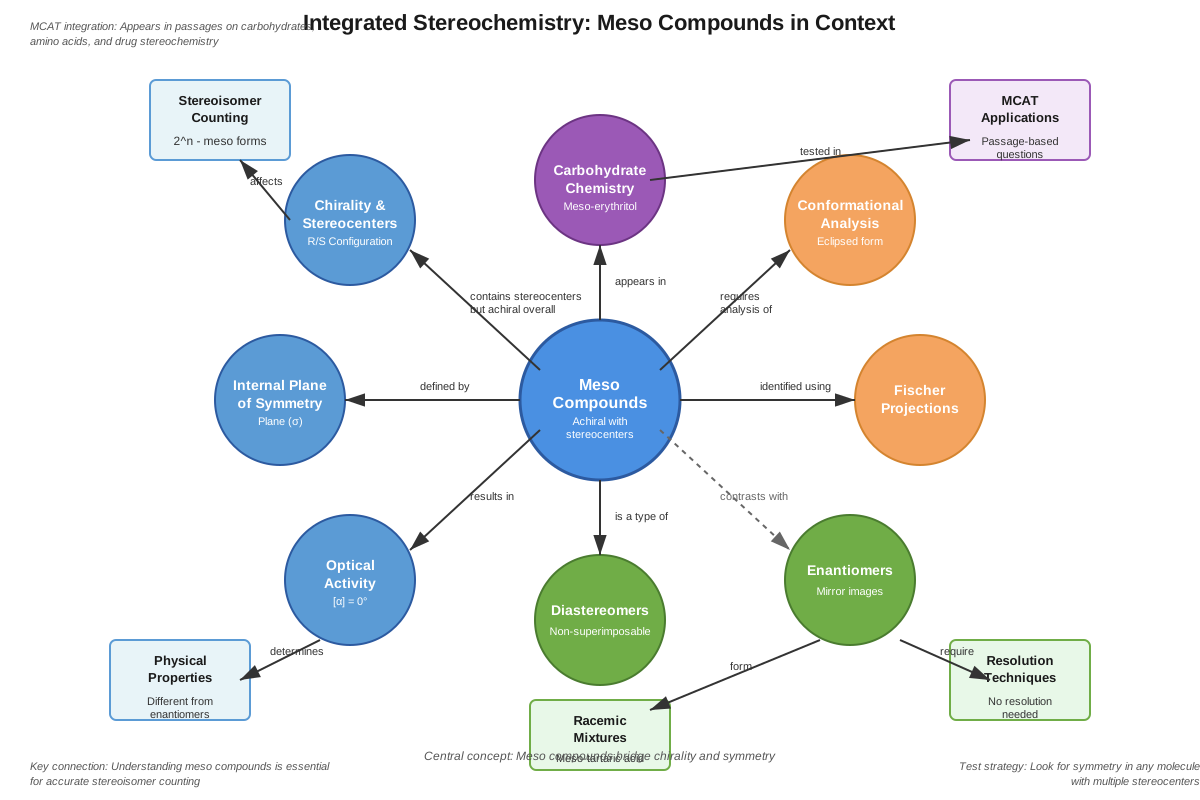
The concept of meso compounds sits at the intersection of multiple stereochemistry principles, creating a web of interconnected ideas essential for Organic Chemistry mastery.
Chirality → Stereocenters → Meso Compounds: The foundation begins with understanding chirality as a molecular property. Individual stereocenters (chiral centers) are locally chiral, but meso compounds demonstrate that molecular chirality depends on the entire structure, not just individual centers. This relationship teaches that local and global properties can differ.
Symmetry → Optical Activity → Meso Compounds: The presence of a plane of symmetry directly determines optical activity. Meso compounds connect these concepts by showing that internal symmetry cancels optical rotation, even when chiral centers are present. This leads to the principle that symmetry and chirality are mutually exclusive at the molecular level.
Stereoisomer Classification → Meso Compounds → Diastereomers: Meso compounds occupy a specific position in stereoisomer taxonomy. They are diastereomers (not enantiomers) relative to other stereoisomers of the same molecule, connecting the concept to the broader framework of stereoisomer relationships.
Fischer Projections → Meso Recognition → Stereochemistry and Conformation: The ability to recognize meso compounds from Fischer projections links two-dimensional representations to three-dimensional molecular properties. This connection is crucial for MCAT success, where Fischer projections frequently appear in questions.
Conformational Analysis → Meso Compounds → Cyclic Structures: For cyclic meso compounds, conformational analysis becomes essential. The relationship between ring conformation and symmetry planes connects meso compounds to cyclohexane chair conformations and other conformational topics.
Stereoisomer Counting → Meso Compounds → Combinatorial Chemistry: Understanding how meso forms reduce the total number of stereoisomers connects to practical applications in drug synthesis and purification, bridging theoretical stereochemistry with applied pharmaceutical chemistry.
High-Yield Facts
⭐ A meso compound must have at least two chiral centers AND an internal plane of symmetry, making it achiral overall despite containing stereocenters
⭐ Meso compounds are optically inactive with [α] = 0° because internal symmetry causes equal and opposite rotations that cancel
⭐ Meso compounds are diastereomers (not enantiomers) relative to other stereoisomers of the same molecular formula
⭐ The presence of meso forms reduces the total number of stereoisomers below the 2^n maximum predicted by the number of chiral centers
⭐ In Fischer projections, meso compounds often appear symmetric when drawn vertically, with the top half mirroring the bottom half
- Meso compounds have identical physical properties to themselves (unlike enantiomers, which have identical properties to each other but are distinct compounds)
- A molecule with two chiral centers of opposite configuration (one R, one S) may be meso if the substituents allow for a plane of symmetry
- Meso-tartaric acid is the classic example, with (2R,3S) configuration creating a plane of symmetry
- Not all molecules with multiple chiral centers can form meso compounds—the substituents must be arranged to permit internal symmetry
- Cyclic meso compounds often have cis-substituted groups positioned to create a plane of symmetry through the ring
- The plane of symmetry in a meso compound must exist in at least one conformation but doesn't need to exist in all conformations for acyclic molecules
- Meso compounds cannot be resolved into optically active components because they are already achiral
- When counting stereoisomers, each meso form counts as one stereoisomer, not two
- Meso compounds have different physical properties (melting point, solubility) compared to their chiral diastereomers
- The term "internally compensated" describes how the optical rotation from one half of a meso compound cancels the rotation from the other half
Quick check — test yourself on Meso compounds so far.
Try Flashcards →Common Misconceptions
Misconception: All molecules with chiral centers are optically active and chiral.
Correction: Meso compounds contain chiral centers but are achiral overall due to internal planes of symmetry, making them optically inactive. The presence of stereocenters is necessary but not sufficient for molecular chirality.
Misconception: Meso compounds are enantiomers of each other.
Correction: A meso compound is a single achiral molecule that is superimposable on its own mirror image. Meso compounds are diastereomers relative to the chiral stereoisomers of the same molecular formula, not enantiomers. Enantiomers must be chiral and non-superimposable mirror images.
Misconception: The formula 2^n always gives the correct number of stereoisomers for a molecule with n chiral centers.
Correction: The formula 2^n gives the maximum possible stereoisomers, but when meso forms exist, the actual number is reduced. Each meso form reduces the count by one because it represents a single achiral molecule rather than a pair of enantiomers.
Misconception: Meso compounds only exist when there are exactly two chiral centers.
Correction: While most common examples have two chiral centers, meso compounds can exist with three or more stereocenters if the molecular structure permits an internal plane of symmetry. The key requirement is symmetry, not a specific number of stereocenters.
Misconception: If a molecule has opposite configurations (R and S) at its stereocenters, it must be meso.
Correction: Having opposite configurations is necessary but not sufficient for a meso compound. The molecule must also have appropriate substituents arranged to create an internal plane of symmetry. For example, 2,3-dichlorobutane can be meso, but 2-bromo-3-chlorobutane cannot because the different halogens prevent symmetry.
Misconception: Meso compounds can be separated into optically active components through resolution.
Correction: Meso compounds are achiral molecules that cannot be resolved into optically active forms because they don't exist as enantiomeric pairs. Resolution techniques only work for separating enantiomers, which are distinct chiral molecules.
Misconception: The plane of symmetry in a meso compound must be visible in all conformations.
Correction: For acyclic meso compounds, the plane of symmetry exists as a property of the molecule but may be most easily visualized in specific conformations (often eclipsed). The molecule remains meso in all conformations because conformers are not separate compounds—they are different spatial arrangements of the same molecule.
Worked Examples
Example 1: Identifying Meso Compounds from Fischer Projections
Question: Consider 2,3,4-trihydroxybutanal (a four-carbon sugar derivative). Draw all possible stereoisomers and identify which, if any, are meso compounds.
Solution:
Step 1: Identify the chiral centers. Carbons 2, 3, and 4 each have four different substituents, giving three chiral centers.
Step 2: Calculate maximum stereoisomers: 2³ = 8 possible stereoisomers.
Step 3: Draw Fischer projections systematically. For three stereocenters, we can organize by configuration:
- RRR and SSS (enantiomeric pair)
- RRS and SSR (enantiomeric pair)
- RSR and SRS (enantiomeric pair)
- RSS and SRR (enantiomeric pair)
Step 4: Check each for internal symmetry. Draw the Fischer projection for RSS configuration:
        CHO
        |
   HO—C—H  (C-2: R)
        |
    H—C—OH (C-3: S)
        |
    H—C—OH (C-4: S)
        |
       CH₂OH
Step 5: Look for a plane of symmetry. In this case, no horizontal plane creates mirror symmetry because the top (CHO) and bottom (CH₂OH) are different.
Step 6: Check the RSR configuration:
        CHO
        |
   HO—C—H  (C-2: R)
        |
    H—C—OH (C-3: S)
        |
   HO—C—H  (C-4: R)
        |
       CH₂OH
Step 7: Examine for symmetry. The C-2 and C-4 configurations are mirror images (both have OH on the left in Fischer projection), and C-3 is in the middle. However, CHO ≠ CH₂OH, so no plane of symmetry exists.
Conclusion: This molecule has 8 stereoisomers with no meso forms because the aldehyde and primary alcohol groups at the ends prevent internal symmetry. All 8 stereoisomers exist as 4 enantiomeric pairs.
Key Learning Point: For a meso compound to exist in a chain molecule, the ends must be identical or the molecule must have sufficient symmetry. This example reinforces that not all molecules with multiple stereocenters can form meso compounds.
Example 2: Stereoisomer Counting with Meso Forms
Question: 2,4-dibromopentane has two chiral centers at C-2 and C-4. How many stereoisomers exist, and which are meso? What is the relationship between the stereoisomers?
Solution:
Step 1: Identify stereocenters. C-2 and C-4 are both chiral (each has H, Br, and two different carbon chains).
Step 2: Calculate maximum: 2² = 4 possible stereoisomers.
Step 3: Draw all configurations:
- (2R, 4R): Both bromines on the same side in Fischer projection
- (2S, 4S): Both bromines on the opposite side (enantiomer of 2R,4R)
- (2R, 4S): Bromines on opposite sides
- (2S, 4R): Bromines on opposite sides (appears to be enantiomer of 2R,4S)
Step 4: Check (2R, 4S) for symmetry:
       CH₃
        |
   Br—C—H  (C-2: R)
        |
       CH₂
        |
    H—C—Br (C-4: S)
        |
       CH₃
Step 5: Identify the plane of symmetry. A horizontal plane through C-3 (the middle CH₂) divides the molecule into mirror-image halves. The top half (C-2 with R configuration and CH₃) mirrors the bottom half (C-4 with S configuration and CH₃).
Step 6: Verify that (2S, 4R) is identical to (2R, 4S). When we draw (2S, 4R):
       CH₃
        |
    H—C—Br (C-2: S)
        |
       CH₂
        |
   Br—C—H  (C-4: R)
        |
       CH₃
This is superimposable on the (2R, 4S) structure—they are the same meso compound, not enantiomers.
Answer: 2,4-dibromopentane has 3 stereoisomers total:
- (2R, 4R) - chiral
- (2S, 4S) - chiral (enantiomer of #1)
- (2R, 4S) = (2S, 4R) - meso (achiral)
The meso compound is a diastereomer of both chiral forms. The two chiral forms are enantiomers of each other.
Key Learning Point: This example demonstrates how to systematically identify meso compounds and correctly count stereoisomers. The meso form reduces the count from 4 to 3 because (2R,4S) and (2S,4R) represent the same achiral molecule, not an enantiomeric pair.
Exam Strategy
When approaching meso compounds MCAT questions, employ these strategic approaches:
Recognition Triggers: Watch for these key phrases that signal meso compound questions:
- "How many stereoisomers..." (requires checking for meso forms)
- "Optically inactive" or "[α] = 0°" (suggests meso compound)
- "Internal plane of symmetry" (directly indicates meso)
- Questions showing Fischer projections with apparent symmetry
- Molecules with two or more identical substituents on different stereocenters
Systematic Approach for Identification:
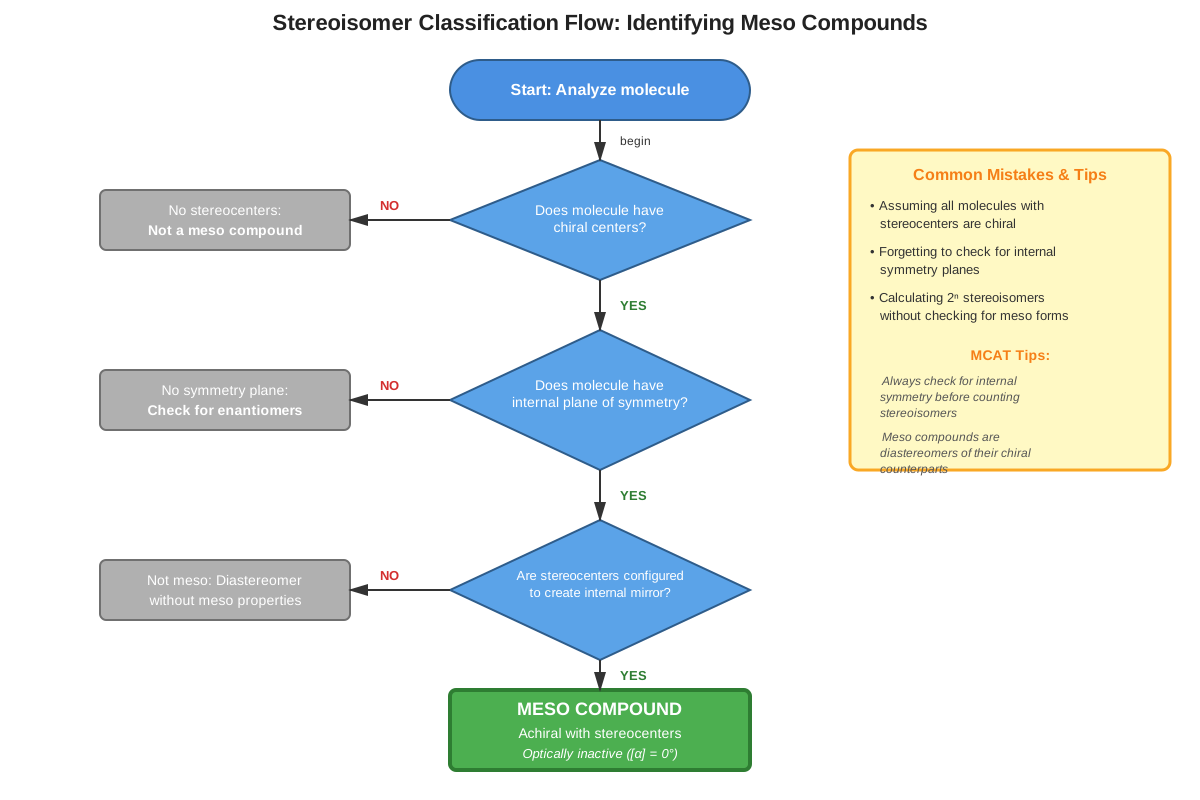
- Count stereocenters first: If fewer than two, meso is impossible
- Check for identical or similar substituents: Different substituents at each end usually prevent meso forms
- Draw or visualize the most symmetric conformation: For acyclic molecules, use eclipsed; for cyclic, use the most symmetric ring conformation
- Look for the plane of symmetry: Mentally or physically draw a line through the molecule
- Verify optical inactivity: Confirm that rotations cancel
Time-Saving Shortcuts:
- In Fischer projections, quickly scan for vertical symmetry (top half mirrors bottom half)
- For molecules with two stereocenters, check if they have opposite configurations (R,S or S,R) and identical substituents
- If asked to count stereoisomers, calculate 2^n first, then subtract meso forms rather than drawing every structure
- Remember that cyclic meso compounds usually have cis-substituents positioned symmetrically
Process of Elimination Tips:
- Eliminate answer choices claiming all molecules with chiral centers are optically active
- Eliminate stereoisomer counts that equal 2^n when the molecule structure suggests possible meso forms
- When choosing between structures, eliminate any that lack the minimum two stereocenters for meso compounds
- For "which is meso?" questions, eliminate structures without apparent symmetry first
Common Question Types and Approaches:
- Stereoisomer counting: Always check for meso before finalizing your count
- Optical activity predictions: Remember meso compounds have [α] = 0° despite having stereocenters
- Structure identification: Use symmetry as the primary criterion, not just stereocenter configuration
- Relationship questions: Classify meso compounds as diastereomers, never enantiomers
Time Allocation: Meso compound questions typically require 60-90 seconds. Spend 20-30 seconds identifying stereocenters and checking for symmetry, 20-30 seconds drawing or visualizing the structure if needed, and 20-30 seconds verifying your answer and eliminating wrong choices.
Memory Techniques
MESO Acronym for Identification:
- Multiple stereocenters (at least two)
- Equal and opposite rotations (cancel to zero)
- Symmetry plane (internal mirror)
- Optically inactive (achiral overall)
Visual Mnemonic for Fischer Projections:
Think "Mirror Middle"—in Fischer projections, meso compounds often show mirror symmetry across a horizontal line through the middle. Visualize folding the paper horizontally; if the top and bottom match, it's likely meso.
Symmetry Check Rhyme:
"Two or more chiral centers in a row, check for symmetry before you go. If mirror halves you can see, that compound is meso, optically free."
Counting Stereoisomers Memory Aid:
Use the phrase "Two to the N, Minus the Meso" to remember that actual stereoisomers = 2^n - (number of meso forms).
Configuration Pattern Recognition:
For two-stereocenter molecules, remember "Opposite Configs, Check for Meso" (R,S or S,R configurations suggest possible meso) versus "Same Configs, Chiral Pair" (R,R and S,S are always enantiomers, never meso).
Tartaric Acid Anchor:
Use meso-tartaric acid as your mental anchor example. Whenever you see a meso question, quickly recall the structure of tartaric acid with its (2R,3S) configuration and plane of symmetry. This provides a reference point for comparison.
Symmetry Plane Visualization:
Imagine a mirror slice cutting through the molecule. If you can mentally "fold" the molecule along this slice and have both halves match perfectly, it's meso. Practice this visualization with common examples until it becomes automatic.
Summary
Meso compounds represent a critical concept in Stereochemistry and Conformation where molecules containing multiple chiral centers remain achiral overall due to internal planes of symmetry. These compounds challenge the intuitive assumption that stereocenters always confer optical activity, demonstrating that molecular chirality depends on the entire structure rather than individual centers. For MCAT success, students must recognize that meso compounds are optically inactive ([α] = 0°) despite containing stereocenters, exist as diastereomers relative to chiral stereoisomers of the same molecular formula, and reduce the total stereoisomer count below the 2^n maximum. Identification requires systematic analysis: counting stereocenters (minimum two required), checking for appropriate substituent arrangements that permit symmetry, and visualizing or drawing the molecule to locate the internal mirror plane. Common examples include meso-tartaric acid and 2,3-dibromobutane, both featuring opposite configurations (R,S or S,R) at adjacent stereocenters with identical substituents. Understanding meso compounds connects to broader Organic Chemistry topics including Fischer projections, optical activity, stereoisomer classification, and conformational analysis, making this a high-yield topic that frequently appears in discriminating MCAT questions testing spatial reasoning and stereochemical principles.
Key Takeaways
- Meso compounds contain two or more chiral centers but are achiral overall due to an internal plane of symmetry, making them optically inactive despite having stereocenters
- The presence of meso forms reduces the actual number of stereoisomers below the 2^n maximum, with each meso form counting as one achiral stereoisomer rather than an enantiomeric pair
- Meso compounds are classified as diastereomers (not enantiomers) relative to other stereoisomers of the same molecular formula because they are stereoisomers that are not mirror images
- Recognition requires identifying both the presence of multiple stereocenters AND an internal plane of symmetry; opposite configurations (R,S or S,R) with identical substituents often indicate potential meso compounds
- In Fischer projections, meso compounds typically display vertical symmetry with the top half mirroring the bottom half, providing a quick visual identification method
- Meso compounds have [α] = 0° because the optical rotation from one half of the molecule exactly cancels the rotation from the other half, a phenomenon called internal compensation
- Not all molecules with multiple stereocenters can form meso compounds—the substituents must be arranged to permit an internal plane of symmetry, making structural analysis essential
Related Topics
Enantiomers and Optical Activity: Understanding the mirror-image relationship between enantiomers and their equal but opposite optical rotations provides essential context for why meso compounds, despite containing stereocenters, show no net rotation. Mastering meso compounds deepens comprehension of when and why optical activity occurs.
Diastereomers and Stereoisomer Classification: Meso compounds represent a specific type of diastereomer, and understanding their place in the broader stereoisomer taxonomy connects to questions about stereoisomer relationships, physical property differences, and separation techniques.
Fischer Projections and Stereochemical Representations: Facility with Fischer projections is essential for rapid meso compound identification on the MCAT. This representational system appears frequently in carbohydrate chemistry and amino acid questions where meso recognition is tested.
Conformational Analysis: For cyclic meso compounds and understanding how planes of symmetry exist across different conformations, conformational analysis skills become crucial. This connects meso compounds to cyclohexane conformations and ring strain concepts.
Carbohydrate Stereochemistry: Many sugar derivatives exist as meso compounds or have stereoisomers that include meso forms. Mastering meso compounds enables progression to complex carbohydrate chemistry, including aldose and ketose classification.
Resolution of Enantiomers: Understanding that meso compounds cannot be resolved (separated into optically active components) because they are already achiral connects to practical separation techniques and pharmaceutical purification strategies tested on the MCAT.
Practice CTA
Now that you've mastered the core concepts of meso compounds, it's time to solidify your understanding through active practice. Challenge yourself with the practice questions and flashcards designed specifically for this topic—these will test your ability to quickly identify meso compounds, count stereoisomers accurately, and apply symmetry principles under timed conditions. Remember, the difference between understanding a concept and mastering it for the MCAT lies in repeated application to exam-style questions. Each practice problem you work through strengthens your pattern recognition and builds the confidence you need to excel on test day. You've built a strong foundation—now transform that knowledge into points through deliberate practice!
Sign up free to keep reading
Create a free AnvayaPrep account to finish this MCAT guide on Meso compounds — plus flashcards and practice questions.