Overview
E1 reactions represent one of the four fundamental mechanistic pathways in Organic Chemistry that govern how molecules transform under specific conditions. Standing for "Elimination, Unimolecular," E1 reactions describe a two-step process where a leaving group departs first, creating a carbocation intermediate, followed by base-mediated proton removal to form a double bond. This mechanism is intimately connected to Substitution and Elimination chemistry, forming part of a quartet of reactions (SN1, SN2, E1, E2) that students must master to predict organic reaction outcomes accurately.
Understanding E1 reactions is essential for the MCAT because these reactions appear frequently in both discrete questions and passage-based scenarios within the Chemical and Physical Foundations of Biological Systems section. The MCAT tests not only mechanism recognition but also the ability to predict major products, understand stereochemical outcomes, and determine which conditions favor elimination over substitution. E1 reactions commonly occur in biological systems during metabolic transformations and are fundamental to understanding drug metabolism, particularly Phase I reactions involving alcohol dehydration.
The broader significance of E1 reactions extends beyond isolated mechanism memorization. These reactions connect directly to carbocation stability principles, acid-base chemistry, thermodynamic versus kinetic control, and stereochemistry. Mastering E1 reactions provides the foundation for understanding elimination reactions generally and enables students to make critical distinctions between competing reaction pathways—a skill the MCAT explicitly tests through comparative scenarios where multiple mechanisms could theoretically operate.
Learning Objectives
- [ ] Define E1 reactions using accurate Organic Chemistry terminology
- [ ] Explain why E1 reactions matter for the MCAT
- [ ] Apply E1 reactions to exam-style questions
- [ ] Identify common mistakes related to E1 reactions
- [ ] Connect E1 reactions to related Organic Chemistry concepts
- [ ] Predict the major product of E1 reactions using Zaitsev's rule
- [ ] Distinguish between conditions that favor E1 versus SN1, E2, or SN2 mechanisms
- [ ] Analyze the effect of substrate structure, leaving group ability, and solvent on E1 reaction rates
Prerequisites
- Carbocation stability and structure: E1 reactions proceed through carbocation intermediates, requiring understanding of hyperconjugation and inductive effects that stabilize positive charges
- Acid-base chemistry fundamentals: Proton abstraction by bases in the second step requires knowledge of pKa values and base strength
- Alkene nomenclature and structure: Products are alkenes, necessitating familiarity with double bond geometry and naming conventions
- Leaving group concepts: The first step involves leaving group departure, requiring knowledge of what makes good leaving groups
- Stereochemistry basics: Understanding three-dimensional molecular structure helps predict stereochemical outcomes
- Reaction coordinate diagrams: Energy profiles help visualize the two-step mechanism and rate-determining step
Why This Topic Matters
E1 reactions hold significant clinical and practical relevance in biochemistry and pharmacology. Alcohol dehydration reactions in metabolic pathways often proceed through E1-like mechanisms, particularly in steroid biosynthesis and terpene formation. Drug metabolism frequently involves elimination reactions, and understanding E1 mechanisms helps predict metabolite structures and potential toxic byproducts. The formation of reactive alkene intermediates through E1 pathways can lead to DNA alkylation, making this mechanism relevant to understanding chemical carcinogenesis.
From an exam perspective, E1 reactions MCAT questions appear in approximately 8-12% of Organic Chemistry passages and discrete questions on the Chemical and Physical Foundations section. The MCAT typically tests E1 reactions through three question formats: (1) mechanism identification from given conditions, (2) product prediction including regiochemistry and stereochemistry, and (3) comparative questions asking students to distinguish when E1 dominates over competing SN1, E2, or SN2 pathways. Passage-based questions often embed E1 reactions within experimental procedures or metabolic pathways, requiring students to recognize the mechanism from contextual clues.
The MCAT particularly favors questions that test the competition between E1 and SN1 mechanisms since both share the same first step and similar conditions. Students must recognize that temperature, base strength, and substrate structure tip the balance between substitution and elimination. Additionally, the exam frequently tests Zaitsev's rule application and carbocation rearrangement possibilities—both high-yield E1 concepts that distinguish strong from average test-takers.
Core Concepts
Definition and Mechanism Overview
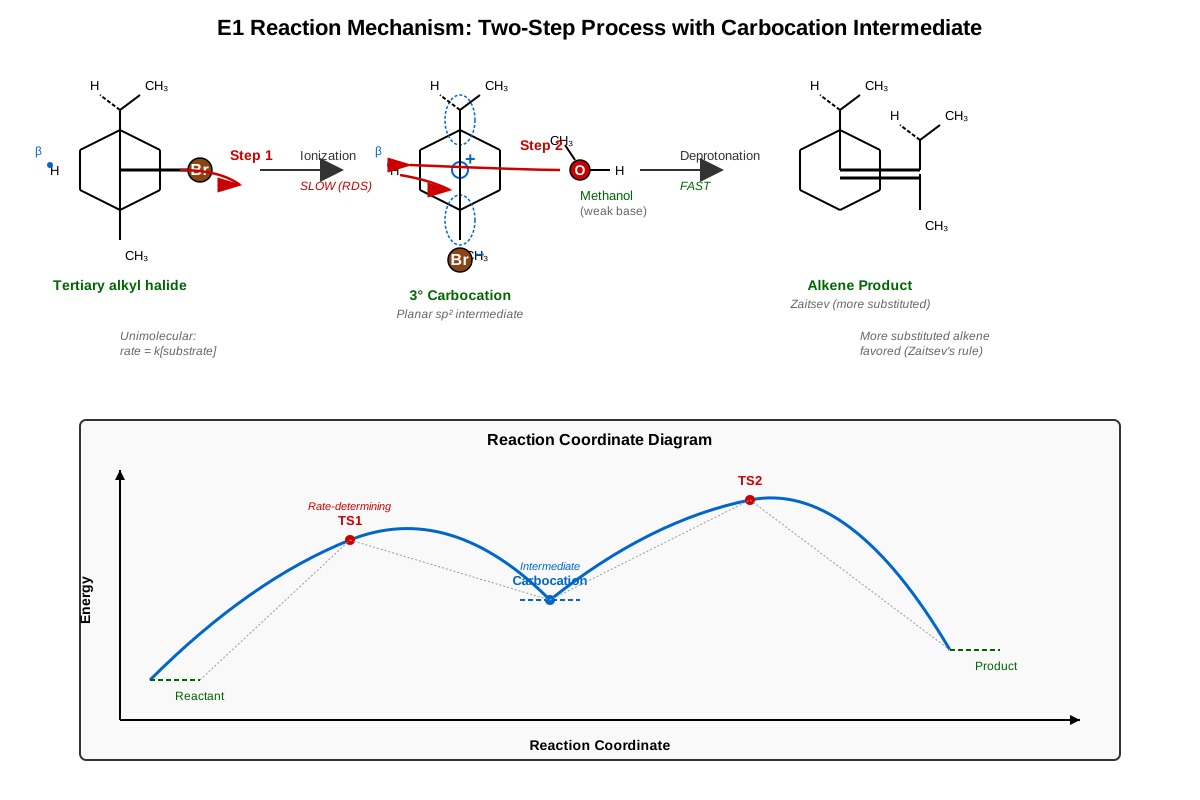
E1 reactions are elimination reactions that follow a unimolecular rate law, meaning the rate depends only on the concentration of one species—the substrate. The "E" designates elimination (loss of atoms to form a π bond), while "1" indicates first-order kinetics. The complete mechanism proceeds through two distinct steps, with the first step being rate-determining.
Step 1 (Rate-Determining): The leaving group departs spontaneously, generating a carbocation intermediate and the leaving group anion. This step is unimolecular because only the substrate molecule is involved in the transition state. The rate equation is: Rate = k[substrate].
Step 2 (Fast): A base abstracts a β-hydrogen (hydrogen on the carbon adjacent to the carbocation), and the electrons from the C-H bond form a new π bond between the α and β carbons, creating an alkene product.
The two-step nature creates an energy profile with two transition states and one intermediate (the carbocation). The first transition state has higher energy, making leaving group departure the rate-determining step. This mechanistic detail explains why E1 reactions show first-order kinetics despite involving a base in the second step—the base concentration doesn't affect the rate since it participates only after the slow step.
Reaction Conditions and Requirements
E1 reactions require specific conditions that distinguish them from other mechanisms:
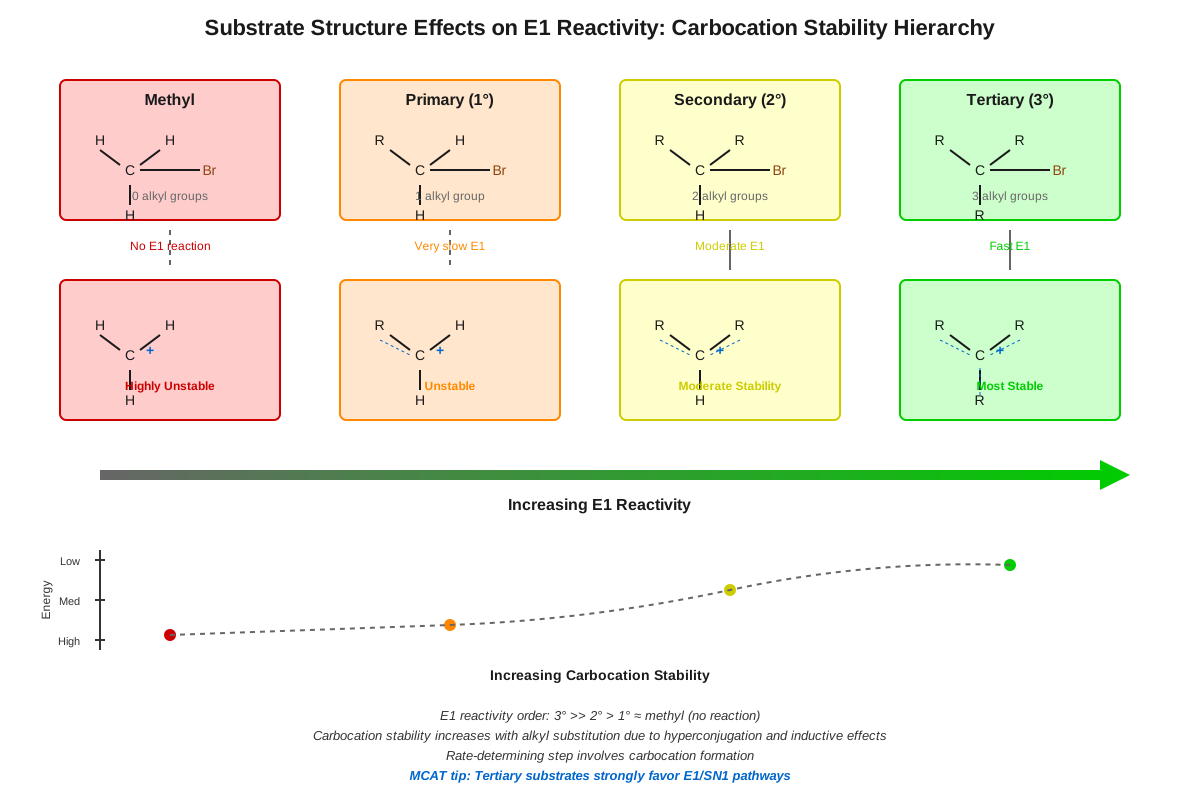
Substrate Structure: Tertiary (3°) substrates react fastest, followed by secondary (2°) substrates. Primary (1°) substrates essentially never undergo E1 reactions because primary carbocations are too unstable. The substrate must have at least one β-hydrogen for elimination to occur.
Leaving Group: Excellent leaving groups are essential since departure occurs without assistance. Common leaving groups include halides (I⁻ > Br⁻ > Cl⁻), tosylate (OTs⁻), and protonated alcohols (H₂O). Poor leaving groups like hydroxide (OH⁻) or alkoxide (OR⁻) prevent E1 reactions.
Solvent: Polar protic solvents strongly favor E1 mechanisms. Solvents like water, alcohols (methanol, ethanol), and carboxylic acids stabilize both the developing carbocation and the leaving group through solvation. The polar nature stabilizes charge separation, while protic hydrogens provide specific solvation through hydrogen bonding.
Temperature: Elevated temperatures favor elimination over substitution. Higher thermal energy provides the activation energy needed for the endothermic elimination process and shifts equilibria toward the more entropically favorable elimination products (two molecules from one).
Base/Nucleophile: Weak bases or weak nucleophiles favor E1 over E2. Since the base doesn't participate in the rate-determining step, even weak bases like water or alcohols can serve as the base in E1 reactions. Strong, bulky bases would favor E2 instead.
Carbocation Stability and Rearrangements
Since E1 reactions proceed through carbocation intermediates, carbocation stability directly influences reaction feasibility and product distribution. Carbocation stability follows the order: 3° > 2° > 1° > methyl, due to hyperconjugation and inductive effects from adjacent alkyl groups.
Carbocation rearrangements represent a critical complication in E1 reactions. If the initially formed carbocation can rearrange to a more stable carbocation through hydride shift (H⁻ migration) or alkyl shift (R⁻ migration), rearrangement will occur before the elimination step. This produces unexpected products that students must anticipate.
For example, if a secondary carbocation forms adjacent to a tertiary carbon, a hydride or methyl shift can generate a more stable tertiary carbocation. The elimination then occurs from this rearranged intermediate, producing an alkene with a different carbon skeleton than the starting material.
Regiochemistry: Zaitsev's Rule
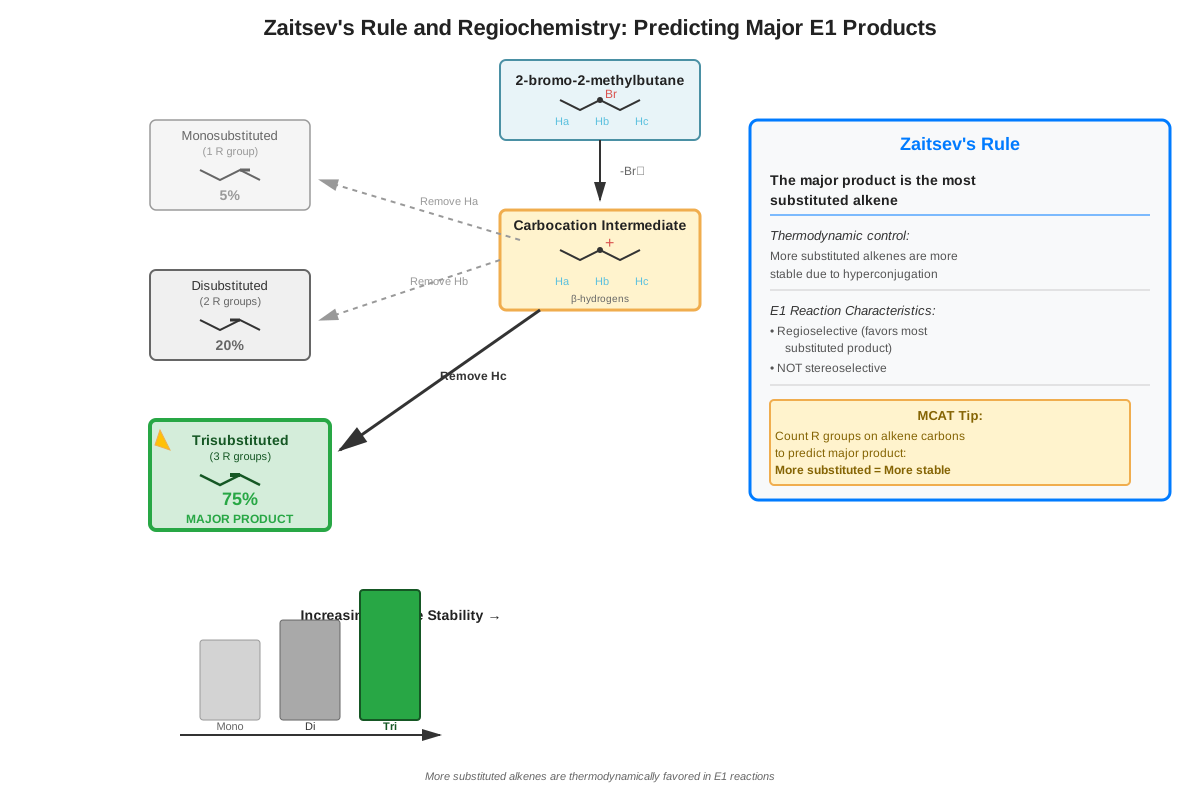
When multiple β-hydrogens exist, elimination can theoretically produce different alkene isomers. Zaitsev's rule predicts that E1 reactions preferentially form the more substituted (more stable) alkene as the major product. This occurs because the more substituted alkene is thermodynamically more stable due to hyperconjugation.
The rule states: "The major product is the alkene with the greater number of alkyl substituents on the double bond carbons." For instance, elimination from 2-bromobutane produces predominantly 2-butene (disubstituted) rather than 1-butene (monosubstituted).
Zaitsev selectivity in E1 reactions results from thermodynamic control—the carbocation intermediate can lose any β-hydrogen, but the transition state leading to the more stable alkene has lower energy, making that pathway faster despite the second step being rapid overall.
Stereochemistry
E1 reactions produce alkenes with variable stereochemistry. Since the carbocation intermediate is planar (sp² hybridized), the base can abstract a β-hydrogen from either face of the molecule. When the product is a disubstituted or trisubstituted alkene capable of geometric isomerism, both E and Z isomers typically form.
However, the more stable isomer (usually E/trans due to less steric strain) predominates. The ratio of E to Z isomers depends on the relative stability difference—larger substituents favor the E isomer more strongly. Unlike E2 reactions, which have strict stereochemical requirements (antiperiplanar geometry), E1 reactions show no such constraint because the leaving group has already departed before proton abstraction.
E1 versus SN1 Competition
E1 and SN1 reactions are intimately related—both proceed through the same carbocation intermediate formed in an identical first step. The competition between these mechanisms depends on what happens to the carbocation:
- SN1 pathway: Nucleophile attacks the carbocation
- E1 pathway: Base abstracts a β-hydrogen
Several factors determine which pathway dominates:
| Factor | Favors SN1 | Favors E1 |
|---|---|---|
| Temperature | Lower (0-25°C) | Higher (>50°C) |
| Base/Nucleophile strength | Good nucleophile, weak base | Weak nucleophile, any base |
| Base/Nucleophile size | Small, unhindered | Large, bulky |
| Substrate structure | No β-hydrogens available | β-hydrogens present |
In practice, E1 and SN1 often occur simultaneously, producing mixtures of substitution and elimination products. Increasing temperature shifts the product ratio toward elimination because elimination is entropically favored (ΔS > 0) and typically more endothermic than substitution.
Kinetics and Rate Law
The rate law for E1 reactions is: Rate = k[substrate]
This first-order dependence reflects the unimolecular rate-determining step. Doubling substrate concentration doubles the reaction rate, but changing base concentration has no effect on rate (though it affects product yield). The rate constant k depends exponentially on temperature according to the Arrhenius equation and is sensitive to leaving group ability and carbocation stability.
The activation energy (Ea) for E1 reactions is substantial because breaking the C-LG bond without assistance requires significant energy. Better leaving groups and more stable carbocations lower Ea, increasing the rate constant and accelerating the reaction.
Concept Relationships
E1 reactions connect to numerous organic chemistry concepts through a web of mechanistic and structural relationships. The carbocation intermediate serves as the central node linking E1 to SN1 reactions—both mechanisms diverge from this common intermediate, making carbocation stability the primary determinant of whether these reactions occur at all. This connection extends to carbocation rearrangements, where hydride and alkyl shifts can occur in both E1 and SN1 pathways, producing identical rearranged products.
The relationship flows as follows: Substrate structure → Leaving group departure → Carbocation formation → Potential rearrangement → Competing pathways (E1 vs SN1) → Product formation following Zaitsev's rule
E1 reactions contrast sharply with E2 reactions (elimination, bimolecular), which proceed through a single concerted step requiring antiperiplanar geometry. While E1 shows no stereochemical requirement and follows first-order kinetics, E2 requires specific geometry and follows second-order kinetics (Rate = k[substrate][base]). However, both elimination mechanisms typically follow Zaitsev's rule for regiochemistry.
The connection to acid-base chemistry manifests in the second step, where base strength influences product distribution (though not rate). Stronger bases more efficiently abstract protons, increasing elimination product yield relative to substitution products. The leaving group ability concept connects E1 to all substitution and elimination reactions—better leaving groups (weaker bases, more stable anions) facilitate the rate-determining departure step.
Alkene stability principles directly determine regiochemistry through Zaitsev's rule. More substituted alkenes are more stable due to hyperconjugation, making their formation thermodynamically favored. This connects E1 reactions to thermodynamics and the principle that reactions under thermodynamic control produce the most stable products.
Finally, solvent effects link E1 reactions to physical chemistry concepts. Polar protic solvents stabilize charged intermediates through solvation, lowering activation energy and accelerating E1 reactions. This contrasts with E2 reactions, which are less sensitive to solvent polarity since no discrete charged intermediate forms.
Quick check — test yourself on E1 reactions so far.
Try Flashcards →High-Yield Facts
⭐ E1 reactions follow first-order kinetics with Rate = k[substrate], making the rate independent of base concentration
⭐ Tertiary substrates undergo E1 reactions most readily; primary substrates essentially never form E1 products due to carbocation instability
⭐ E1 and SN1 reactions share the same rate-determining step (carbocation formation) and compete with each other under similar conditions
⭐ Zaitsev's rule predicts that the more substituted (thermodynamically stable) alkene is the major product in E1 reactions
⭐ Carbocation rearrangements through hydride or alkyl shifts can occur before elimination, producing unexpected products
- Polar protic solvents (water, alcohols) strongly favor E1 mechanisms by stabilizing carbocation intermediates
- Elevated temperatures shift the E1/SN1 competition toward elimination products due to entropic factors
- E1 reactions produce mixtures of E and Z alkene isomers when geometric isomerism is possible, with the E isomer usually predominating
- Excellent leaving groups (I⁻, Br⁻, OTs⁻, H₂O) are essential for E1 reactions since departure occurs without nucleophilic assistance
- The carbocation intermediate in E1 reactions is planar (sp² hybridized), eliminating stereochemical constraints present in E2 reactions
- Weak bases or weak nucleophiles favor E1 over E2 mechanisms because the base doesn't participate in the rate-determining step
- The activation energy for E1 reactions is typically higher than for E2 reactions due to the energetically unfavorable carbocation formation
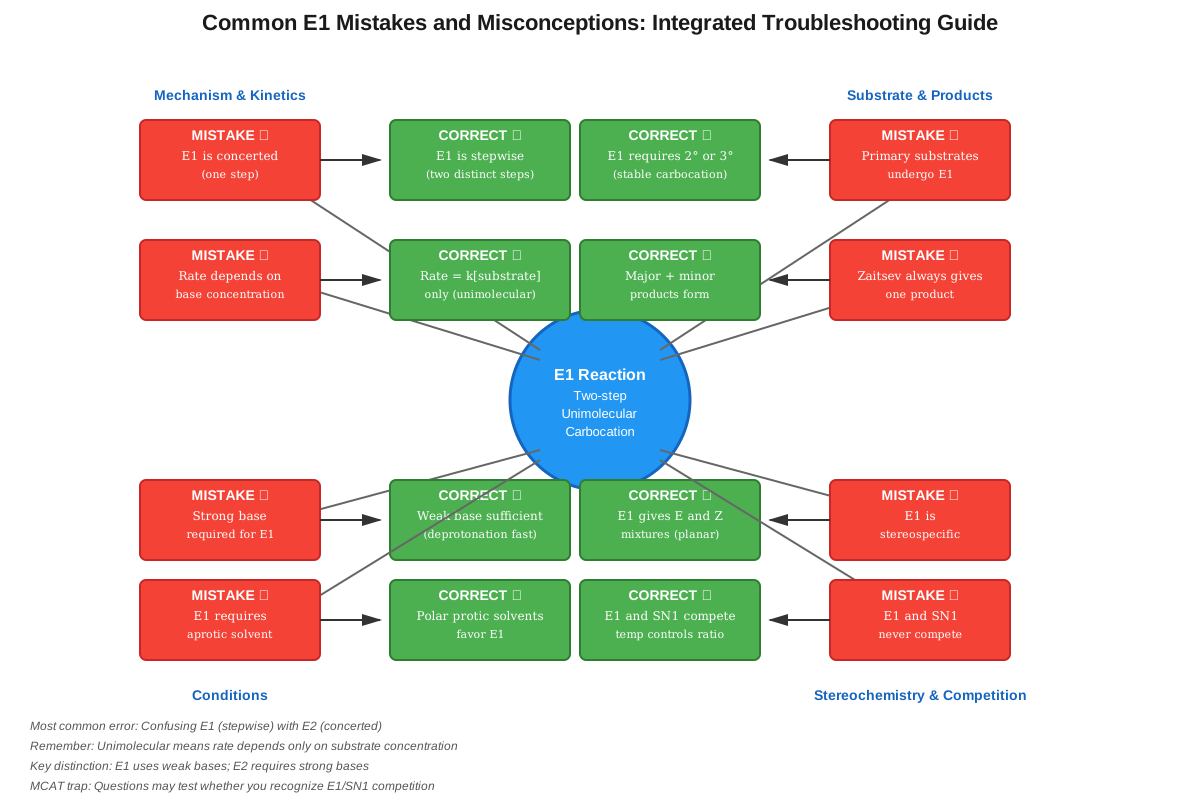
Common Misconceptions
Misconception: Base strength affects the rate of E1 reactions since a base is required for the elimination step.
Correction: Base concentration and strength do not affect E1 reaction rates because the base participates only in the fast second step, after the rate-determining carbocation formation. However, base strength does influence the product ratio between elimination and substitution products.
Misconception: E1 reactions always produce a single alkene product.
Correction: E1 reactions typically produce multiple products including both regioisomers (when multiple β-hydrogens exist) and stereoisomers (E and Z). Additionally, carbocation rearrangements can produce alkenes with different carbon skeletons. Zaitsev's rule predicts the major product, but minor products always form.
Misconception: Primary substrates can undergo E1 reactions if a strong base is used.
Correction: Primary substrates cannot undergo E1 reactions regardless of base strength because primary carbocations are far too unstable to form. The rate-determining step (carbocation formation) has prohibitively high activation energy for primary substrates. Primary substrates undergo E2 or SN2 reactions instead.
Misconception: E1 reactions require antiperiplanar geometry like E2 reactions.
Correction: E1 reactions have no stereochemical requirements because the leaving group departs completely before proton abstraction occurs. The carbocation intermediate is planar, allowing the base to approach from either face and abstract any β-hydrogen regardless of geometry.
Misconception: Increasing base concentration will increase the yield of E1 products relative to SN1 products without affecting the overall reaction rate.
Correction: While increasing base concentration doesn't affect the rate of carbocation formation (the rate-determining step), it can increase the proportion of elimination products by making proton abstraction more competitive with nucleophilic attack. However, this effect is limited because even weak bases can abstract protons from carbocations efficiently.
Misconception: E1 reactions always follow Zaitsev's rule without exception.
Correction: While E1 reactions typically follow Zaitsev's rule, exceptions occur when steric factors make the more substituted alkene difficult to form or when carbocation rearrangements create new possibilities. Additionally, if the Zaitsev product would have severe steric strain (e.g., in bridged systems), the less substituted Hofmann product may predominate.
Worked Examples
Example 1: Product Prediction with Carbocation Rearrangement
Question: Predict the major product when 3-methyl-2-butanol is heated with concentrated sulfuric acid.
Solution:
Step 1: Identify the reaction type. Heating an alcohol with concentrated H₂SO₄ suggests an E1 mechanism. The acid protonates the hydroxyl group, converting it into a good leaving group (H₂O).
Step 2: Determine the substrate structure after protonation. 3-methyl-2-butanol becomes 3-methyl-2-butanol-H⁺, with H₂O as the leaving group attached to C-2.
Step 3: Analyze carbocation formation. Water departs, forming a secondary carbocation at C-2: (CH₃)₂CH-C⁺H-CH₃
Step 4: Check for possible rearrangements. The secondary carbocation at C-2 is adjacent to a tertiary carbon (C-3). A hydride shift from C-3 to C-2 would generate a more stable tertiary carbocation at C-3: CH₃-CH₂-C⁺(CH₃)-CH₃. This rearrangement will occur.
Step 5: Identify possible elimination products from the rearranged carbocation. The tertiary carbocation at C-3 has β-hydrogens on C-2 and C-4. Elimination of a proton from C-2 produces 2-methyl-2-butene (trisubstituted). Elimination from C-4 produces 2-methyl-1-butene (disubstituted).
Step 6: Apply Zaitsev's rule. The more substituted alkene (2-methyl-2-butene) is the major product.
Answer: The major product is 2-methyl-2-butene, formed after a hydride shift rearrangement.
Key Learning Points: This example demonstrates that carbocation rearrangements must always be considered in E1 reactions. The rearrangement occurs because it produces a more stable carbocation, and Zaitsev's rule then predicts the major elimination product from the rearranged intermediate.
Example 2: Mechanism Competition Analysis
Question: When 2-bromo-2-methylpropane (tert-butyl bromide) is dissolved in ethanol at 25°C, both substitution and elimination products form. When the temperature is raised to 78°C, the product ratio changes significantly. Explain the product distribution at both temperatures and predict which mechanism (E1 or SN1) dominates at each temperature.
Solution:
Step 1: Analyze the substrate. 2-bromo-2-methylpropane is a tertiary alkyl halide with a good leaving group (Br⁻). Tertiary substrates favor unimolecular mechanisms (E1 and SN1) over bimolecular mechanisms.
Step 2: Analyze the solvent. Ethanol is a polar protic solvent that stabilizes carbocation intermediates, favoring both E1 and SN1 mechanisms. Ethanol is also a weak nucleophile and weak base, consistent with unimolecular mechanisms.
Step 3: Consider the common first step. Both E1 and SN1 proceed through the same rate-determining step: departure of Br⁻ to form a tertiary carbocation [(CH₃)₃C⁺]. This carbocation can then undergo either nucleophilic attack by ethanol (SN1) or proton abstraction by ethanol (E1).
Step 4: Analyze the temperature effect at 25°C. At lower temperature, the SN1 pathway (nucleophilic attack) predominates because it has lower activation energy than the E1 pathway. The major product is 2-ethoxy-2-methylpropane (tert-butyl ethyl ether) from SN1, with minor amounts of 2-methylpropene (isobutylene) from E1.
Step 5: Analyze the temperature effect at 78°C. Elevated temperature provides sufficient energy to overcome the higher activation barrier for elimination. More importantly, elimination is entropically favored (ΔS > 0) because two molecules form from one. The TΔS term in ΔG = ΔH - TΔS becomes more negative at higher temperature, making elimination thermodynamically favorable. The major product becomes 2-methylpropene from E1, with minor amounts of the ether from SN1.
Step 6: Predict the mechanism dominance. At 25°C, SN1 dominates (approximately 70-80% substitution). At 78°C, E1 dominates (approximately 70-80% elimination).
Answer: At 25°C, SN1 dominates producing mainly 2-ethoxy-2-methylpropane. At 78°C, E1 dominates producing mainly 2-methylpropene. Both mechanisms proceed through the same carbocation intermediate, but temperature determines which pathway the carbocation follows.
Key Learning Points: This example illustrates the intimate competition between E1 and SN1 mechanisms and demonstrates how temperature serves as a control variable to shift product distribution. Understanding that both mechanisms share the same rate-determining step but diverge at the carbocation intermediate is crucial for MCAT success.
Exam Strategy
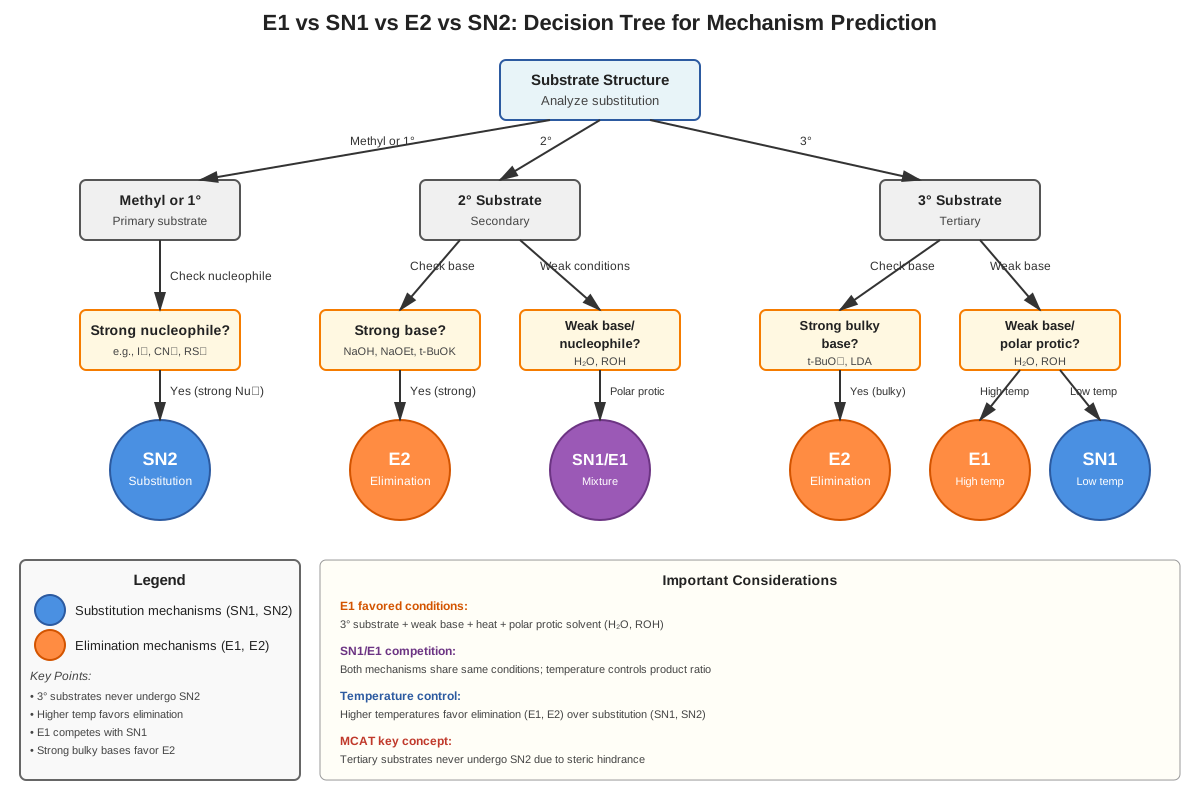
When approaching E1 reactions MCAT questions, employ a systematic decision tree strategy. First, identify whether the question asks about mechanism identification, product prediction, or mechanism comparison. For mechanism identification, look for trigger words: "tertiary substrate," "polar protic solvent," "heated," "weak base," or "carbocation intermediate." These phrases strongly suggest E1 conditions.
For product prediction questions, follow this sequence: (1) Confirm the substrate can form a stable carbocation (2° or 3°), (2) Check for possible carbocation rearrangements, (3) Identify all β-hydrogens in the final carbocation, (4) Apply Zaitsev's rule to predict the major product, (5) Remember that minor products also form. Many students lose points by forgetting to consider rearrangements—always check if a more stable carbocation can form through hydride or alkyl shift.
When distinguishing between E1 and competing mechanisms, use this elimination strategy:
- Strong base present? → Eliminate E1, consider E2
- Primary substrate? → Eliminate E1 and SN1, consider E2 or SN2
- Polar aprotic solvent? → E1 less likely, favor SN2 or E2
- Low temperature? → SN1 more likely than E1
- No β-hydrogens? → Eliminate E1 and E2, must be substitution
Exam Tip: If a question provides both temperature and base strength information, temperature usually matters more for E1/SN1 competition, while base strength matters more for E1/E2 competition.
Time allocation is critical. Mechanism identification questions should take 30-45 seconds—quickly scan for the key conditions (substrate type, solvent, temperature) and make your determination. Product prediction questions require 60-90 seconds to carefully consider rearrangements and apply Zaitsev's rule. Passage-based questions embedding E1 reactions in experimental contexts may require 90-120 seconds to extract relevant information and apply mechanism knowledge.
Watch for distractor answer choices that show: (1) Hofmann products instead of Zaitsev products, (2) products from unrearranged carbocations when rearrangement should occur, (3) single stereoisomers when both E and Z should form, or (4) products from mechanisms inconsistent with the given conditions. The MCAT frequently tests whether students can distinguish between what's theoretically possible versus what's actually favored under specific conditions.
Memory Techniques
E1 Conditions Mnemonic - "TWERP":
- Tertiary (or secondary) substrate
- Weak base/nucleophile
- Elevated temperature
- Rearrangements possible
- Polar protic solvent
Carbocation Stability Mnemonic - "3-2-1-BLAST OFF":
3° carbocations are most stable, 2° are moderate, 1° are unstable, and methyl carbocations "blast off" (never form) because they're so unstable.
E1 vs SN1 Competition - "HEAT Eliminates":
Higher temperature, Elimination Always Takes over. This reminds you that increasing temperature shifts the equilibrium toward E1 products.
Zaitsev's Rule Visualization: Picture the alkene as a "crowded subway car"—the more substituted (crowded) the alkene, the more stable it is. The major product is always the "most crowded" alkene possible.
Rearrangement Check - "SHIFT Happens":
Before predicting products, always ask: "Secondary carbocation? Hydride or alkyl nearby? Is a Favorable Tertiary carbocation possible?" If yes to all three, a shift happens.
Mechanism Decision Tree Acronym - "BEST":
- Base strength (strong → E2; weak → E1/SN1)
- Electrophile type (1° → SN2/E2; 3° → SN1/E1)
- Solvent (protic → SN1/E1; aprotic → SN2/E2)
- Temperature (high → elimination; low → substitution)
Summary
E1 reactions represent a fundamental elimination mechanism proceeding through a two-step pathway: rate-determining leaving group departure to form a carbocation intermediate, followed by rapid base-mediated proton abstraction to generate an alkene. These unimolecular reactions follow first-order kinetics dependent only on substrate concentration and require tertiary or secondary substrates, excellent leaving groups, polar protic solvents, and elevated temperatures. The carbocation intermediate makes E1 reactions susceptible to rearrangements and creates competition with SN1 substitution reactions that share the same first step. Product distribution follows Zaitsev's rule, favoring more substituted alkenes, though mixtures of regioisomers and stereoisomers typically form. For MCAT success, students must recognize E1 conditions from contextual clues, predict products considering possible rearrangements, distinguish E1 from competing mechanisms based on substrate structure and reaction conditions, and understand that temperature serves as the primary variable controlling E1/SN1 competition. Mastery requires integrating concepts of carbocation stability, leaving group ability, thermodynamic control, and stereochemistry into a unified mechanistic framework.
Key Takeaways
- E1 reactions follow first-order kinetics (Rate = k[substrate]) with a two-step mechanism involving carbocation formation followed by proton abstraction
- Tertiary substrates, excellent leaving groups, polar protic solvents, and elevated temperatures favor E1 mechanisms over competing pathways
- E1 and SN1 reactions compete directly because they share the same rate-determining step; temperature is the primary variable controlling which pathway dominates
- Carbocation rearrangements through hydride or alkyl shifts must always be considered before predicting E1 products
- Zaitsev's rule predicts that the more substituted (thermodynamically stable) alkene is the major product, though mixtures of regioisomers and stereoisomers form
- E1 reactions show no stereochemical requirements unlike E2 reactions because the leaving group departs before proton abstraction
- Recognition of E1 conditions on the MCAT requires identifying trigger words related to substrate type, solvent polarity, temperature, and base strength
Related Topics
E2 Reactions: The bimolecular elimination mechanism that contrasts with E1 through concerted single-step pathways, second-order kinetics, and strict stereochemical requirements. Mastering E1 provides the foundation for understanding how base strength and substrate geometry determine E2 versus E1 competition.
SN1 Reactions: Unimolecular substitution reactions sharing the same carbocation intermediate as E1. Understanding E1 mechanisms enables prediction of when substitution versus elimination occurs and how conditions shift product ratios.
Carbocation Rearrangements: Hydride and alkyl shifts that stabilize carbocation intermediates. This topic extends E1 knowledge to explain unexpected products and connects to SN1 and other carbocation-mediated reactions.
Zaitsev versus Hofmann Elimination: Comparative study of regiochemical outcomes in elimination reactions. E1 mastery provides context for understanding when and why Hofmann products form in E2 reactions with bulky bases.
Alkene Stability and Thermodynamics: Deeper exploration of why more substituted alkenes are more stable, connecting E1 product prediction to fundamental thermodynamic principles and molecular orbital theory.
Practice CTA
Now that you've mastered the core concepts of E1 reactions, it's time to solidify your understanding through active practice. Challenge yourself with the accompanying practice questions that test mechanism identification, product prediction with rearrangements, and E1 versus competing mechanism scenarios. Use the flashcards to drill high-yield facts until you can instantly recall carbocation stability trends, Zaitsev's rule applications, and the conditions favoring E1 mechanisms. Remember: understanding the mechanism is just the beginning—MCAT success requires rapid pattern recognition and confident application under time pressure. Every practice question you complete builds the neural pathways that will serve you on test day. You've got this!
Sign up free to keep reading
Create a free AnvayaPrep account to finish this MCAT guide on E1 reactions — plus flashcards and practice questions.