Overview
E2 reactions represent one of the fundamental elimination mechanisms in Organic Chemistry, standing alongside E1, SN1, and SN2 reactions as core transformation pathways that students must master for the MCAT. The "E2" designation refers to a bimolecular elimination reaction where a base removes a proton while simultaneously expelling a leaving group, forming a carbon-carbon double bond in a single concerted step. This mechanism is distinguished by its second-order kinetics, stereospecific requirements, and predictable regiochemical outcomes that follow Zaitsev's rule in most cases.
Understanding E2 reactions is essential for MCAT success because these transformations appear frequently in both discrete questions and passage-based scenarios within the Chemical and Physical Foundations of Biological Systems section. The MCAT tests not only recognition of when E2 reactions occur but also the ability to predict products, understand competing reaction pathways (particularly substitution and elimination competition), and apply mechanistic reasoning to novel molecular structures. E2 reactions bridge multiple high-yield topics including acid-base chemistry, stereochemistry, conformational analysis, and reaction kinetics, making them a nexus concept that integrates diverse areas of organic chemistry knowledge.
Within the broader landscape of Organic Chemistry MCAT content, E2 reactions occupy a critical position in the substitution and elimination unit. They contrast mechanistically with E1 reactions (which proceed through carbocation intermediates) and compete directly with SN2 reactions under similar conditions. Mastery of E2 reactions requires understanding how substrate structure, base strength, leaving group ability, and solvent effects collectively determine reaction outcomes—analytical skills that the MCAT consistently evaluates through comparative scenarios and multi-step synthesis problems.
Learning Objectives
- [ ] Define E2 reactions using accurate Organic Chemistry terminology
- [ ] Explain why E2 reactions matter for the MCAT
- [ ] Apply E2 reactions to exam-style questions
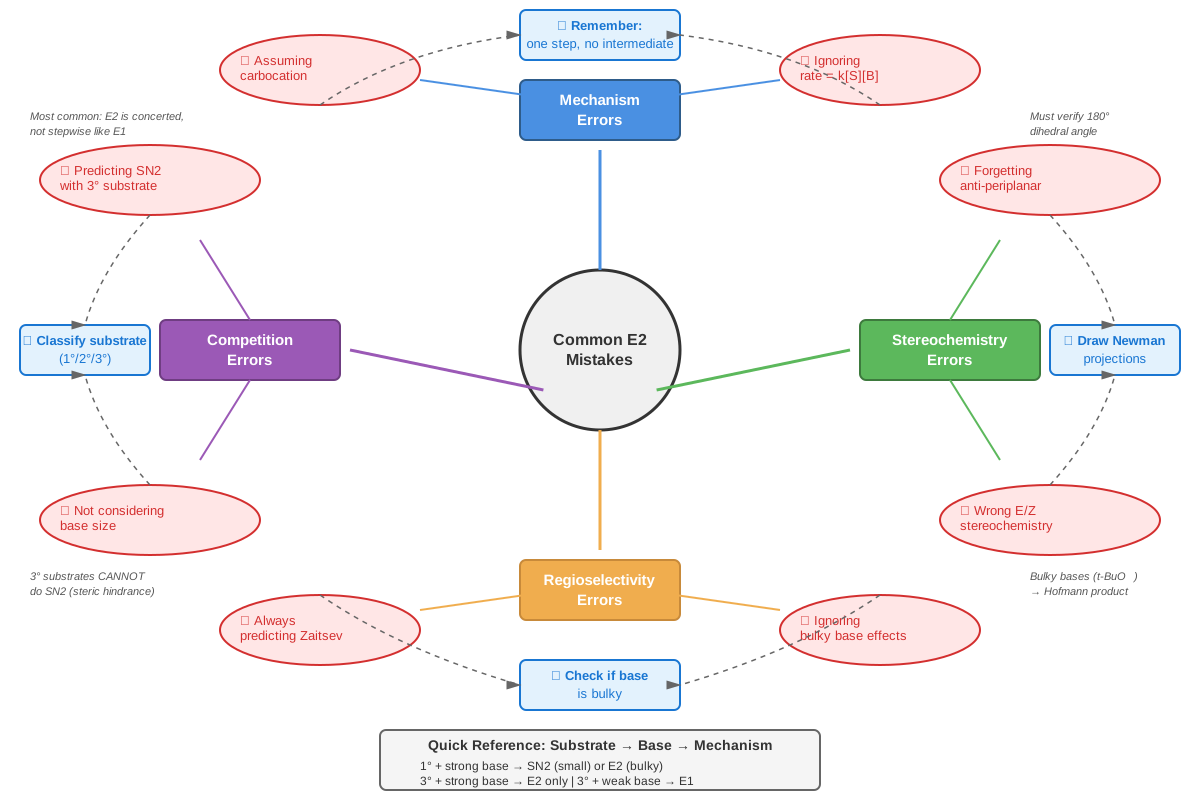
- [ ] Identify common mistakes related to E2 reactions
- [ ] Connect E2 reactions to related Organic Chemistry concepts
- [ ] Predict the major product of E2 reactions using Zaitsev's and Hofmann's rules
- [ ] Analyze the stereochemical requirements for E2 reactions and identify anti-periplanar geometry
- [ ] Evaluate competing reaction pathways and determine when E2 predominates over SN2
Prerequisites
- Acid-base chemistry fundamentals: Understanding base strength and pKa values is essential because E2 reactions are initiated by bases abstracting protons
- Alkyl halide structure and nomenclature: E2 substrates are typically alkyl halides, and substrate classification (1°, 2°, 3°) determines reaction preferences
- Basic stereochemistry concepts: Knowledge of Newman projections and conformational analysis is necessary to understand anti-periplanar geometry requirements
- Leaving group ability: Recognizing good leaving groups (weak bases) is crucial for predicting E2 reactivity
- Carbocation stability: While E2 doesn't form carbocations, understanding stability trends helps explain product distributions
- Alkene nomenclature and stability: E2 products are alkenes, requiring familiarity with double bond stability and substitution patterns
Why This Topic Matters
E2 reactions hold significant real-world and clinical relevance beyond their examination importance. Many pharmaceutical synthesis pathways employ E2 eliminations to construct alkene-containing drug molecules, and understanding elimination mechanisms helps explain drug metabolism pathways where biological bases can trigger elimination reactions in vivo. The principles governing E2 selectivity also apply to enzymatic elimination reactions catalyzed by lyases, connecting organic chemistry mechanisms to biochemical transformations.
From an MCAT perspective, E2 reactions appear with moderate to high frequency, typically in 2-4 questions per exam either as discrete items or embedded within passage-based scenarios. Questions commonly test the ability to distinguish E2 from competing mechanisms (SN2, E1, SN1), predict regiochemistry and stereochemistry of products, and identify optimal reaction conditions. The MCAT particularly favors questions that require integrating multiple factors—substrate structure, base characteristics, and temperature—to predict reaction outcomes, making E2 reactions an excellent vehicle for testing higher-order analytical skills.
Passage-based questions often present E2 reactions within synthetic schemes, drug metabolism pathways, or mechanistic investigations. Students may encounter experimental data showing product distributions under varying conditions and must apply E2 principles to explain observations. The exam also tests E2 concepts through comparative scenarios where students must explain why one substrate undergoes E2 while another favors SN2, requiring deep mechanistic understanding rather than simple memorization.
Core Concepts
Definition and Mechanism of E2 Reactions
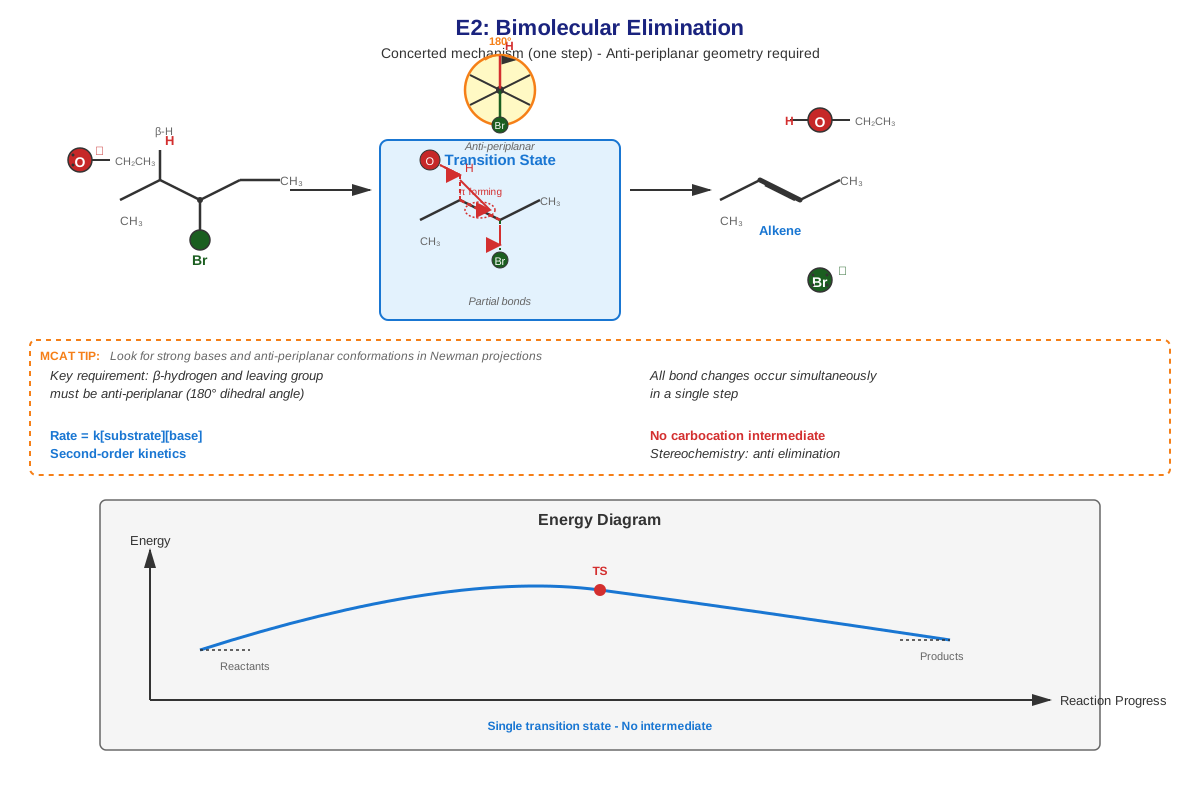
E2 reactions are bimolecular elimination reactions characterized by a single concerted step in which a base removes a β-hydrogen (proton on the carbon adjacent to the carbon bearing the leaving group) while the leaving group departs simultaneously. The "E" denotes elimination, and "2" indicates that the rate-determining step involves two molecular species—the substrate and the base—making the reaction second-order overall: Rate = k[substrate][base].
The mechanism proceeds through a single transition state without forming discrete intermediates. As the base abstracts the β-hydrogen, the C-H bond breaks, the C-C bond develops π character to form the alkene double bond, and the C-leaving group bond breaks with the leaving group departing with both bonding electrons. This concerted process requires precise orbital alignment: the C-H bond being broken and the C-leaving group bond must be anti-periplanar (180° dihedral angle) to allow proper orbital overlap for π bond formation.
Stereochemical Requirements: Anti-Periplanar Geometry
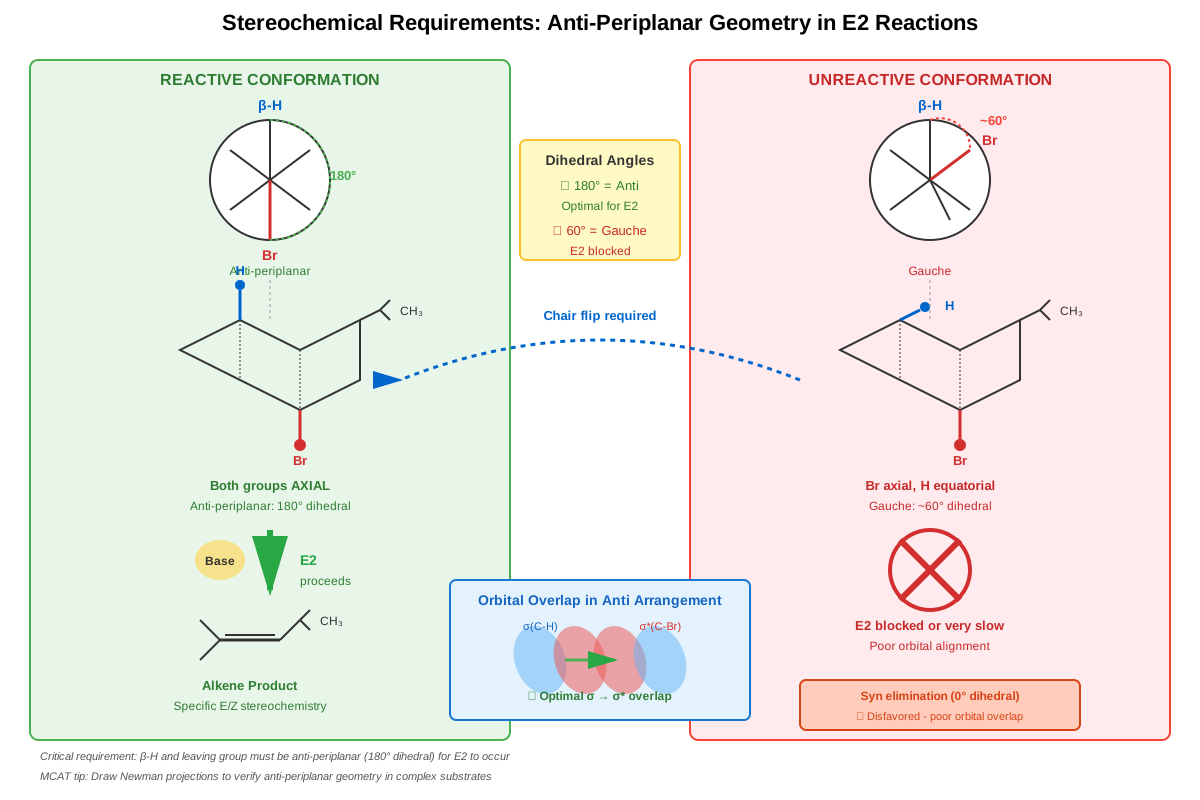
The stereochemical constraint of E2 reactions represents one of the most testable aspects on the MCAT. For the reaction to proceed efficiently, the hydrogen being abstracted and the leaving group must be positioned anti to each other—on opposite sides of the carbon-carbon bond in a staggered conformation. This geometry allows the developing p orbitals on both carbons to overlap constructively as the π bond forms.
In cyclic systems, this requirement becomes particularly important. For cyclohexane derivatives, the hydrogen and leaving group must both occupy axial positions on adjacent carbons to achieve anti-periplanar geometry. If the leaving group is equatorial, the molecule must undergo ring flip to place it axial before elimination can occur. This stereochemical constraint explains why some diastereomers react much faster than others in E2 reactions—those that can readily adopt the required anti-periplanar conformation proceed rapidly, while those that cannot react slowly or not at all.
Substrate Structure Effects
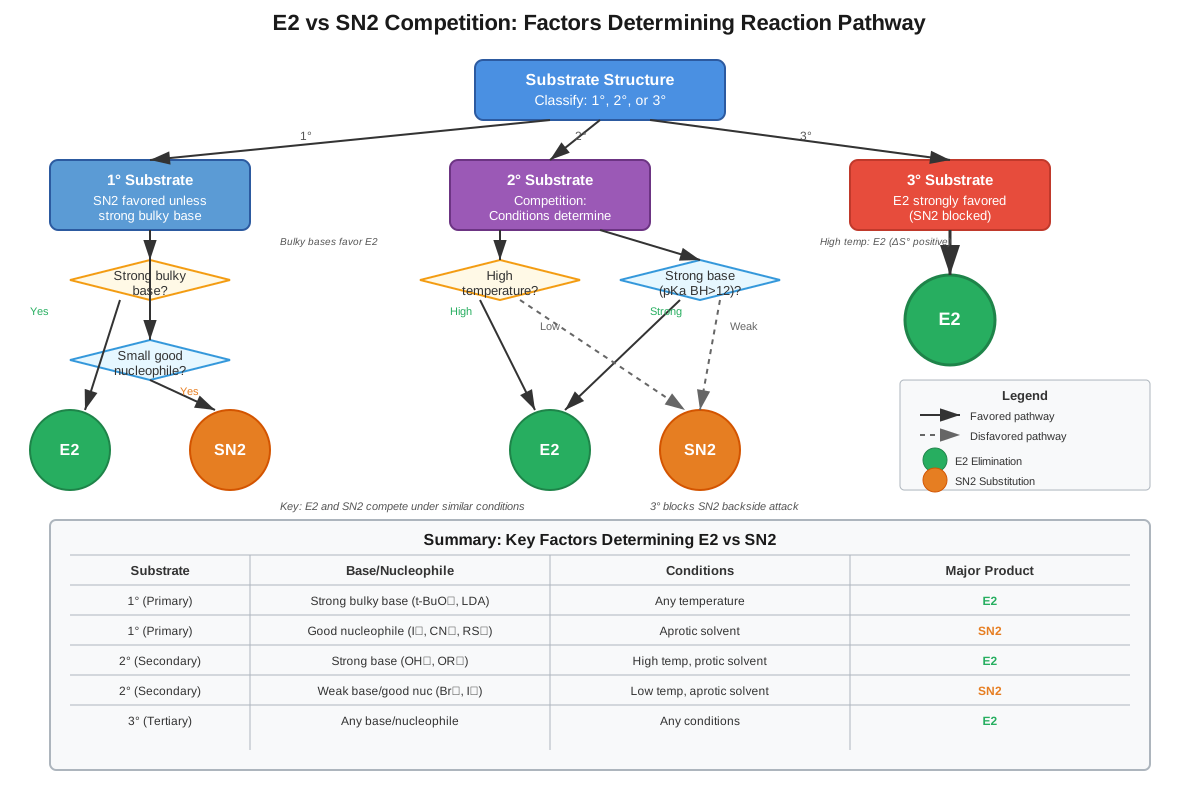
Substrate structure profoundly influences E2 reactivity and product distribution. Tertiary alkyl halides react fastest in E2 reactions because the developing double bond benefits from hyperconjugative stabilization by adjacent alkyl groups, and steric hindrance disfavors competing SN2 reactions. Secondary alkyl halides can undergo both E2 and SN2, with the outcome determined by base strength, sterics, and temperature. Primary alkyl halides generally favor SN2 over E2 unless a strong, bulky base is used or high temperatures are employed.
The number and position of β-hydrogens also affects reactivity. Substrates with more β-hydrogens have more potential elimination pathways, leading to product mixtures unless one pathway is strongly favored. Substrates lacking β-hydrogens cannot undergo E2 elimination at all, defaulting to substitution if possible.
Base Characteristics and Their Effects
Base strength and size critically determine whether E2 or SN2 predominates. Strong, bulky bases (such as tert-butoxide, LDA, or DBU) favor E2 over SN2 because their steric bulk prevents approach to the electrophilic carbon for backside attack, but they can still abstract the more accessible β-hydrogens. Strong, small bases (such as hydroxide or methoxide) can promote both E2 and SN2, with substrate structure and temperature determining the major pathway.
Weak bases generally do not promote E2 reactions effectively because they cannot readily abstract protons. However, in E1 reactions (a competing mechanism), even weak bases can capture protons from carbocation intermediates. The MCAT frequently tests the distinction between conditions favoring E2 (strong base) versus E1 (weak base, often in protic solvents).
Regiochemistry: Zaitsev's Rule and Hofmann's Rule
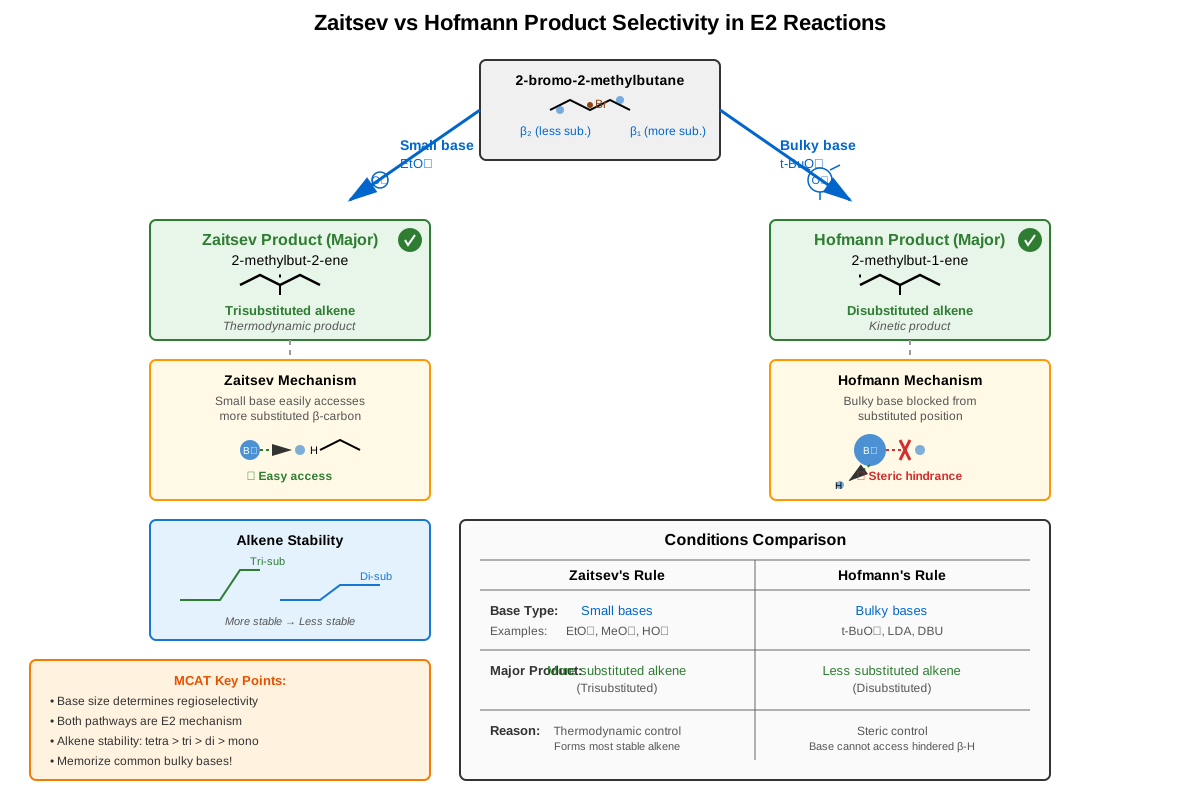
When multiple β-hydrogens are available for abstraction, regiochemistry becomes important. Zaitsev's rule states that E2 reactions typically produce the more substituted (more stable) alkene as the major product. This occurs because the transition state resembles the product, and more substituted alkenes are thermodynamically more stable due to hyperconjugation. With typical bases like ethoxide or hydroxide, Zaitsev products predominate.
However, Hofmann's rule applies when using very bulky bases (like tert-butoxide or LDA). These bases preferentially abstract the least hindered β-hydrogen, leading to the less substituted alkene as the major product. This occurs because steric factors in the transition state outweigh product stability considerations. The MCAT may test the ability to predict which rule applies based on base structure.
Leaving Group Effects
Good leaving groups are essential for E2 reactions. The best leaving groups are weak bases that can stabilize negative charge—typically halides (I⁻ > Br⁻ > Cl⁻ >> F⁻), tosylates, and mesylates. Poor leaving groups like hydroxide, alkoxide, or amines do not undergo E2 elimination directly; they must first be converted to better leaving groups (e.g., protonating an alcohol to form water as the leaving group, or converting an alcohol to a tosylate).
The leaving group ability affects reaction rate but not the fundamental mechanism or stereochemical requirements. Substrates with better leaving groups react faster under identical conditions, but the anti-periplanar requirement and regiochemical preferences remain unchanged.
Solvent Effects
E2 reactions proceed well in both polar aprotic and polar protic solvents, though solvent choice affects competing reactions. Polar aprotic solvents (like DMSO, DMF, or acetone) enhance SN2 reactivity by not solvating the nucleophile/base, making E2/SN2 competition more pronounced. Polar protic solvents (like water, alcohols) solvate bases, reducing their nucleophilicity more than their basicity, which can favor E2 over SN2 for strong bases.
Temperature also plays a role: higher temperatures favor elimination (E2 and E1) over substitution because elimination has a more positive entropy change (ΔS) due to forming two product molecules from one substrate molecule.
Comparison Table: E2 vs. Competing Mechanisms
| Feature | E2 | E1 | SN2 | SN1 |
|---|---|---|---|---|
| Molecularity | Bimolecular | Unimolecular | Bimolecular | Unimolecular |
| Steps | One (concerted) | Two (carbocation intermediate) | One (concerted) | Two (carbocation intermediate) |
| Rate Law | Rate = k[substrate][base] | Rate = k[substrate] | Rate = k[substrate][nucleophile] | Rate = k[substrate] |
| Stereochemistry | Anti-periplanar required | No specific requirement | Inversion (backside attack) | Racemization |
| Best Substrate | 3° > 2° >> 1° | 3° > 2° >> 1° | 1° > 2° >> 3° | 3° > 2° >> 1° |
| Base/Nucleophile | Strong base | Weak base | Strong nucleophile | Weak nucleophile |
| Solvent | Polar aprotic or protic | Polar protic | Polar aprotic | Polar protic |
| Carbocation | None formed | Formed as intermediate | None formed | Formed as intermediate |
Quick check — test yourself on E2 reactions so far.
Try Flashcards →Concept Relationships
E2 reactions exist within a network of interconnected organic chemistry concepts. The mechanism directly builds upon acid-base chemistry: the base's ability to abstract a proton depends on its strength relative to the β-hydrogen's acidity, and understanding pKa relationships helps predict reaction feasibility. The anti-periplanar geometry requirement connects E2 reactions to conformational analysis and stereochemistry—students must visualize three-dimensional molecular arrangements using Newman projections to identify reactive conformations.
E2 reactions compete directly with SN2 reactions because both are bimolecular processes promoted by strong bases/nucleophiles. The competition between these pathways depends on substrate structure (branching), base characteristics (size and strength), and temperature, creating a decision tree: 3° substrates → E2; 1° substrates with small bases → SN2; 2° substrates → depends on conditions. This competition also connects to nucleophilicity versus basicity concepts—species that are strong bases but poor nucleophiles (bulky bases) favor E2.
The relationship between E2 and E1 reactions is complementary rather than competitive. E1 requires carbocation formation and thus favors 3° substrates with weak bases in polar protic solvents, while E2 requires strong bases and can occur with 1°-3° substrates. Understanding both mechanisms allows prediction of elimination products under different conditions.
Product formation in E2 reactions connects to alkene stability concepts. Zaitsev's rule reflects thermodynamic stability trends (more substituted alkenes are more stable), while Hofmann's rule demonstrates how kinetic factors (steric accessibility) can override thermodynamic preferences. This connects to broader themes of kinetic versus thermodynamic control in organic reactions.
Relationship Map:
Acid-Base Chemistry → determines base strength → influences E2 vs SN2 competition → Substrate Structure → determines carbocation stability and steric hindrance → influences E2 vs E1 vs SN2 → Stereochemistry → anti-periplanar requirement → determines which β-hydrogens can be abstracted → Regiochemistry → Zaitsev's or Hofmann's rule → determines major product → Alkene Stability
High-Yield Facts
⭐ E2 reactions proceed through a single concerted step with second-order kinetics: Rate = k[substrate][base]
⭐ The β-hydrogen and leaving group must be anti-periplanar (180° dihedral angle) for E2 to occur efficiently
⭐ Strong, bulky bases favor E2 over SN2; strong, small bases can promote both depending on substrate
⭐ Tertiary substrates strongly favor E2 and E1 over substitution; primary substrates favor SN2 over E2
⭐ Zaitsev's rule: E2 typically produces the more substituted alkene with normal bases; Hofmann's rule applies with very bulky bases
- E2 reactions require a good leaving group (halides, tosylates, mesylates); poor leaving groups must be converted first
- In cyclohexane systems, both the hydrogen and leaving group must be axial to achieve anti-periplanar geometry
- Higher temperatures favor elimination over substitution due to entropy considerations (ΔS > 0 for elimination)
- E2 reactions can produce E or Z alkene stereoisomers depending on the geometry of the starting material
- Substrates without β-hydrogens cannot undergo E2 elimination and will undergo substitution if possible
- Polar aprotic solvents enhance both E2 and SN2 by not solvating the base/nucleophile
- The rate of E2 reactions increases with better leaving groups: I > Br > Cl >> F
Common Misconceptions
Misconception: E2 reactions always produce the most substituted alkene as the major product.
Correction: While Zaitsev's rule predicts the more substituted alkene with typical bases, very bulky bases (tert-butoxide, LDA) follow Hofmann's rule and produce the less substituted alkene due to steric factors favoring abstraction of the least hindered β-hydrogen.
Misconception: Any strong base will promote E2 reactions over SN2 reactions.
Correction: Base size matters as much as strength. Strong but small bases (hydroxide, methoxide) can promote both E2 and SN2, with substrate structure determining the major pathway. Only strong, bulky bases reliably favor E2 over SN2 for secondary substrates.
Misconception: E2 reactions can occur with any spatial arrangement of the β-hydrogen and leaving group.
Correction: E2 reactions have a strict stereochemical requirement—the β-hydrogen and leaving group must be anti-periplanar (180° apart). In rigid cyclic systems, this means both must be axial. Syn-periplanar arrangements (0° apart) are much less reactive and generally do not undergo E2 under normal conditions.
Misconception: Primary alkyl halides cannot undergo E2 reactions.
Correction: While primary substrates favor SN2 over E2 with typical bases, they can undergo E2 with strong, bulky bases or at elevated temperatures. The key is that steric and electronic factors make E2 less favorable for primary substrates, but not impossible.
Misconception: E2 and E1 reactions produce different products from the same substrate.
Correction: Both E2 and E1 can produce the same alkene products from a given substrate (both typically follow Zaitsev's rule), but they differ in mechanism, kinetics, and the conditions under which they occur. E2 requires strong base and proceeds in one step; E1 requires weak base, proceeds through a carbocation, and may produce rearranged products if carbocation rearrangement occurs.
Misconception: The leaving group departs before the base abstracts the proton in E2 reactions.
Correction: E2 is a concerted mechanism—proton abstraction, π bond formation, and leaving group departure occur simultaneously in a single step. There is no discrete intermediate. This distinguishes E2 from E1, where the leaving group departs first to form a carbocation before deprotonation.
Worked Examples
Example 1: Predicting E2 Products and Regiochemistry
Problem: 2-bromo-2-methylbutane is treated with sodium ethoxide (NaOEt) in ethanol at elevated temperature. Draw the major product and explain the regiochemistry.
Solution:
Step 1: Identify the substrate structure. 2-bromo-2-methylbutane is a tertiary alkyl bromide:
    CH3
     |
CH3-C-CH2-CH3
     |
    Br
Step 2: Recognize reaction conditions. Sodium ethoxide is a strong base (but not particularly bulky), and elevated temperature favors elimination. With a tertiary substrate and strong base, E2 is strongly favored over SN2.
Step 3: Identify possible β-hydrogens. There are two sets:
- Three equivalent hydrogens on the C-1 methyl group (would give 2-methylbut-1-ene, a disubstituted alkene)
- Two equivalent hydrogens on C-3 (would give 2-methylbut-2-ene, a trisubstituted alkene)
Step 4: Apply Zaitsev's rule. With ethoxide (not a bulky base), the more substituted alkene is favored. The trisubstituted alkene (2-methylbut-2-ene) is more stable and will be the major product:
    CH3
     |
CH3-C=CH-CH3
Step 5: Consider stereochemistry. This product can exist as E and Z isomers. The E isomer (methyl groups on opposite sides) is typically more stable and would predominate, though both would form.
Answer: The major product is 2-methylbut-2-ene (trisubstituted), with the E isomer predominating. This follows Zaitsev's rule because ethoxide is not bulky enough to favor Hofmann elimination.
Example 2: Stereochemical Analysis in Cyclic Systems
Problem: Consider (1R,2R)-1-bromo-2-methylcyclohexane. When treated with a strong base, which conformation must the molecule adopt for E2 elimination to occur? What product forms?
Solution:
Step 1: Draw the two chair conformations of the starting material. In one chair, the bromine is axial and the methyl is equatorial; in the other, bromine is equatorial and methyl is axial.
Step 2: Apply the anti-periplanar requirement. For E2 to occur, both the β-hydrogen and the leaving group (Br) must be axial. This means the molecule must adopt the chair conformation with bromine axial.
Step 3: Identify which β-hydrogen is anti-periplanar to the axial bromine. When bromine is axial at C-1, the hydrogen at C-2 that is also axial (on the opposite face of the ring) is anti-periplanar. However, C-2 also bears the methyl group.
Step 4: Consider the alternative β-position. The C-6 position also has β-hydrogens. When bromine at C-1 is axial, one of the C-6 hydrogens is also axial and anti-periplanar to the bromine.
Step 5: Determine the product. Elimination of the axial hydrogen at C-6 produces 1-methylcyclohexene (the double bond forms between C-1 and C-6, with the methyl substituent at C-2 remaining).
Answer: The molecule must adopt the chair conformation with bromine axial. The major product is 1-methylcyclohexene, formed by abstraction of the axial β-hydrogen at C-6 that is anti-periplanar to the axial bromine. This example illustrates how stereochemical constraints in rigid cyclic systems control E2 reactivity.
Exam Strategy
When approaching MCAT questions on E2 reactions, begin by identifying the substrate classification (1°, 2°, or 3°) and the nature of the reagent (strong/weak, bulky/small, base/nucleophile). This immediately narrows the likely mechanism. For tertiary substrates with strong bases, E2 is highly probable; for primary substrates with small strong bases, consider SN2 competition.
Trigger words and phrases to watch for include: "strong base," "elevated temperature," "elimination product," "alkene formation," "anti-periplanar," "Zaitsev product," and "bulky base." Phrases like "sodium ethoxide in ethanol" or "potassium tert-butoxide" signal E2 conditions. Conversely, "weak base," "polar protic solvent," or "carbocation intermediate" suggest E1 rather than E2.
For process-of-elimination strategies, remember that E2 requires a strong base—eliminate answer choices suggesting E2 with weak bases. E2 produces alkenes—eliminate choices showing substitution products when conditions favor elimination. When stereochemistry is relevant, eliminate choices that violate the anti-periplanar requirement. For regiochemistry questions, identify the base: normal bases → Zaitsev product; very bulky bases → Hofmann product.
Time allocation: Discrete E2 questions typically require 60-90 seconds—enough time to identify the mechanism, apply Zaitsev's or Hofmann's rule, and select the correct product. Passage-based questions may require 90-120 seconds if they involve comparing multiple substrates or analyzing experimental data. Don't spend excessive time drawing detailed mechanisms unless specifically asked; focus on applying rules to predict outcomes quickly.
When questions present competing mechanisms (E2 vs. SN2 vs. E1), use a systematic approach: (1) Classify substrate, (2) Identify base/nucleophile characteristics, (3) Note solvent and temperature, (4) Apply decision rules. This structured approach prevents errors and saves time.
Memory Techniques
"BEEP" for E2 Requirements:
- Bimolecular (second-order kinetics)
- Elimination (forms alkene)
- Energetically concerted (one step)
- Periplanar anti geometry required
"Strong and Bulky Brings E2": Remember that strong, bulky bases favor E2 over SN2. Visualize a large, aggressive base that can't squeeze in for backside attack (SN2) but can easily grab an exposed β-hydrogen.
"Zaitsev Zips to the Most Substituted": The "Z" sound helps remember that Zaitsev's rule produces the more substituted (more stable) alkene—the one with the most alkyl groups attached to the double bond.
"Hofmann Hides from Hindrance": Hofmann's rule applies with bulky bases that avoid steric hindrance by abstracting the least hindered hydrogen, producing the less substituted alkene.
"Axial-Axial for Elimination": In cyclohexane systems, visualize both the leaving group and β-hydrogen pointing straight up or straight down (both axial) to achieve the required anti-periplanar geometry.
"3-2-1 Blast Off for E2": Tertiary substrates (3°) blast off fastest in E2 reactions, secondary (2°) are moderate, and primary (1°) are slowest. This mirrors carbocation stability trends and helps remember substrate reactivity order.
Summary
E2 reactions are bimolecular elimination mechanisms that convert alkyl halides to alkenes through a single concerted step involving simultaneous proton abstraction by a strong base and leaving group departure. The reaction requires strict anti-periplanar geometry between the β-hydrogen and leaving group, making stereochemistry crucial, especially in cyclic systems where both groups must be axial. Substrate structure profoundly affects reactivity, with tertiary substrates reacting fastest and favoring E2 over competing SN2 reactions. Base characteristics determine both mechanism (E2 vs. SN2) and regiochemistry: normal strong bases produce Zaitsev products (more substituted alkenes), while very bulky bases produce Hofmann products (less substituted alkenes). Understanding E2 reactions requires integrating concepts from acid-base chemistry, stereochemistry, conformational analysis, and reaction kinetics. For MCAT success, students must rapidly identify E2 conditions, predict major products using appropriate regiochemical rules, recognize stereochemical constraints, and distinguish E2 from competing mechanisms based on substrate structure, base characteristics, and reaction conditions.
Key Takeaways
- E2 reactions are concerted, bimolecular eliminations with second-order kinetics requiring strong bases and anti-periplanar geometry between the β-hydrogen and leaving group
- Tertiary substrates strongly favor E2 over SN2; primary substrates favor SN2 unless bulky bases or high temperatures are used; secondary substrates show competition dependent on conditions
- Zaitsev's rule predicts the more substituted alkene as the major product with typical bases; Hofmann's rule applies with very bulky bases, producing less substituted alkenes
- In cyclohexane systems, both the leaving group and β-hydrogen must occupy axial positions to achieve the required anti-periplanar geometry for E2 elimination
- Strong, bulky bases (tert-butoxide, LDA) favor E2 over SN2; strong, small bases (hydroxide, methoxide) can promote both mechanisms depending on substrate structure
- E2 competes with SN2 (both bimolecular, strong base/nucleophile) but differs from E1 (unimolecular, weak base, carbocation intermediate)
- Higher temperatures and good leaving groups increase E2 reaction rates; polar aprotic solvents enhance both E2 and SN2 reactivity
Related Topics
E1 Reactions: Understanding unimolecular elimination mechanisms that proceed through carbocation intermediates helps distinguish when E1 versus E2 occurs and explains why some substrates produce rearranged products.
SN2 Reactions: Mastering bimolecular substitution mechanisms is essential because SN2 directly competes with E2 under similar conditions, and predicting which predominates requires analyzing substrate and base characteristics.
SN1 Reactions: Learning unimolecular substitution mechanisms completes the four major alkyl halide reaction pathways and enables comprehensive analysis of reaction outcome predictions.
Alkene Stability and Nomenclature: Understanding why more substituted alkenes are more stable (hyperconjugation, inductive effects) explains Zaitsev's rule and helps predict E2 product distributions.
Conformational Analysis: Deeper study of Newman projections, ring conformations, and dihedral angles strengthens the ability to identify anti-periplanar arrangements in complex molecules.
Carbocation Rearrangements: While E2 doesn't form carbocations, understanding rearrangements helps distinguish E2 from E1 when rearranged products appear.
Practice CTA
Now that you've mastered the core concepts of E2 reactions, it's time to solidify your understanding through active practice. Attempt the practice questions and flashcards designed specifically for this topic—they'll challenge you to apply Zaitsev's and Hofmann's rules, identify anti-periplanar geometry in complex molecules, and distinguish E2 from competing mechanisms under various conditions. Remember, the MCAT rewards not just knowledge but the ability to apply concepts rapidly and accurately under time pressure. Each practice question you work through builds the pattern recognition and mechanistic reasoning skills that translate directly to exam success. You've built a strong foundation—now reinforce it through deliberate practice!
Sign up free to keep reading
Create a free AnvayaPrep account to finish this MCAT guide on E2 reactions — plus flashcards and practice questions.