Overview
Alpha decay is a fundamental mode of radioactive decay in which an unstable atomic nucleus spontaneously emits an alpha particle—a helium-4 nucleus consisting of two protons and two neutrons. This process represents one of the primary mechanisms by which heavy, unstable nuclei achieve greater stability by reducing both their atomic number and mass number. Understanding alpha decay is essential for mastering Atomic and Nuclear Physics on the MCAT, as it forms the foundation for comprehending nuclear stability, radioactive decay series, and the biological effects of ionizing radiation.
For MCAT preparation, alpha decay serves as a gateway to understanding broader principles of nuclear chemistry and physics that appear regularly in both the Chemical and Physical Foundations of Biological Systems section and occasionally in passages discussing medical imaging, radiation therapy, or environmental health. The topic integrates concepts from chemistry (periodic table trends, element identification), physics (energy conservation, momentum), and biology (tissue damage, radiation exposure), making it a high-yield interdisciplinary subject. Students must be comfortable writing nuclear equations, calculating changes in atomic structure, and predicting the products of decay reactions.
Alpha decay Physics connects intimately with concepts of nuclear binding energy, mass-energy equivalence (E=mc²), and the strong nuclear force. The spontaneous nature of this decay process also introduces students to fundamental principles of quantum tunneling and probability in nuclear processes. Mastery of this topic enables deeper understanding of half-life calculations, decay chains, and the comparative biological effectiveness of different radiation types—all testable concepts on the MCAT.
Learning Objectives
- [ ] Define Alpha decay using accurate Physics terminology
- [ ] Explain why Alpha decay matters for the MCAT
- [ ] Apply Alpha decay to exam-style questions
- [ ] Identify common mistakes related to Alpha decay
- [ ] Connect Alpha decay to related Physics concepts
- [ ] Write balanced nuclear equations for alpha decay reactions
- [ ] Calculate the resulting atomic number and mass number after alpha emission
- [ ] Compare alpha decay to other forms of radioactive decay (beta, gamma)
- [ ] Explain the relationship between nuclear stability and alpha decay probability
Prerequisites
- Atomic structure: Understanding protons, neutrons, electrons, atomic number (Z), and mass number (A) is essential for tracking changes during nuclear decay
- Periodic table navigation: Ability to identify elements by atomic number and understand how element identity changes with proton number
- Basic nuclear notation: Familiarity with representing isotopes as ᴬ_Z X where X is the element symbol
- Conservation laws: Knowledge of conservation of mass number, atomic number, charge, and energy in nuclear reactions
- Isotopes and nuclear stability: Understanding that nuclei with certain neutron-to-proton ratios are more stable than others
Why This Topic Matters
Alpha decay has significant clinical and real-world applications that make it relevant beyond pure physics. Radon-222, an alpha emitter, is the second leading cause of lung cancer in the United States and frequently appears in MCAT passages discussing environmental health hazards. Alpha-emitting radioisotopes are used in targeted alpha therapy (TAT) for cancer treatment, where their high linear energy transfer and short range make them ideal for destroying cancer cells while minimizing damage to surrounding healthy tissue. Understanding alpha decay is also crucial for interpreting radiation safety protocols, as alpha particles are stopped by skin or paper but become extremely dangerous when alpha-emitting materials are ingested or inhaled.
On the MCAT, alpha decay appears in approximately 2-4 questions per exam, either as discrete questions or embedded within passages about nuclear chemistry, medical imaging, or radiation biology. Questions typically test the ability to write balanced nuclear equations, predict decay products, understand penetrating power of different radiation types, or apply concepts of half-life to alpha-emitting isotopes. The topic frequently appears in passages discussing:
- Radioactive decay series (uranium-238 to lead-206)
- Medical applications of radioisotopes
- Environmental contamination and radiation exposure
- Nuclear stability and binding energy
- Comparative biological effects of radiation types
The MCAT particularly favors questions that integrate alpha decay with other concepts, such as calculating the energy released during decay, understanding why certain heavy elements preferentially undergo alpha decay, or comparing the biological hazards of alpha, beta, and gamma radiation.
Core Concepts
Definition and Mechanism of Alpha Decay
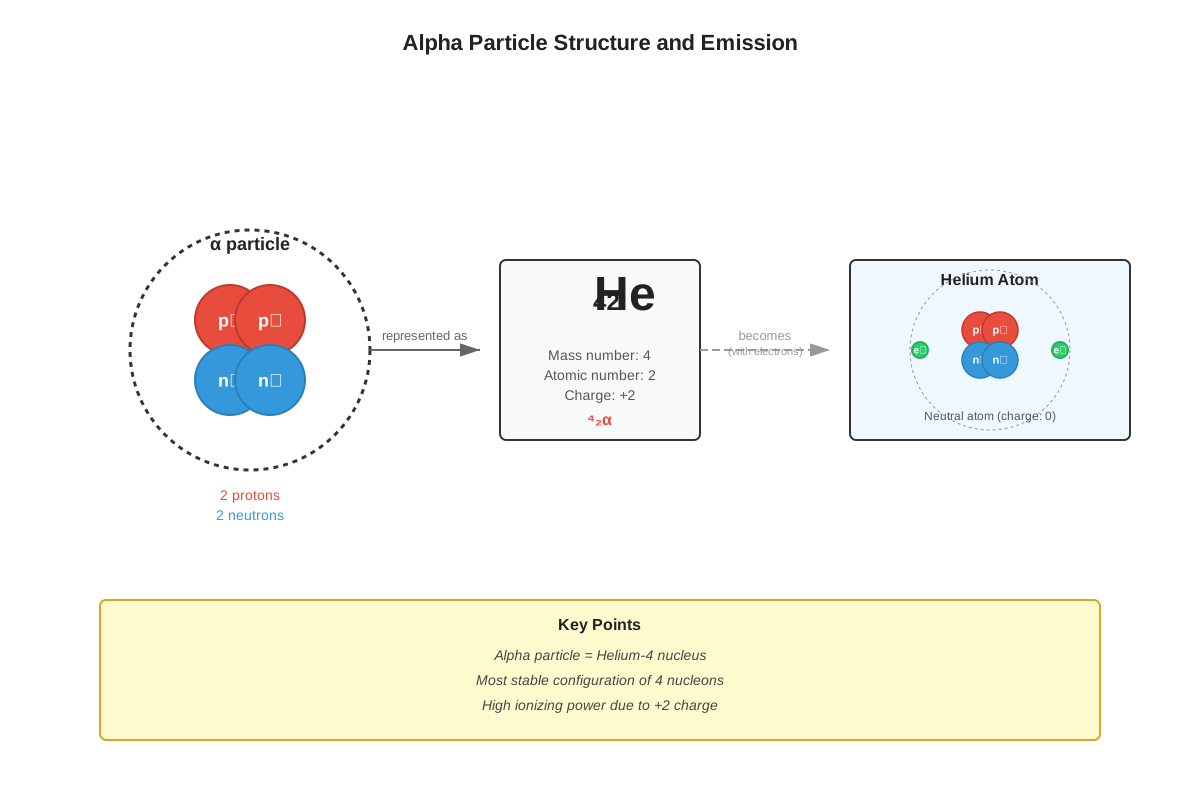
Alpha decay is a type of radioactive decay in which an unstable atomic nucleus spontaneously emits an alpha particle (α), which consists of two protons and two neutrons bound together—identical to a helium-4 nucleus (⁴₂He). This emission occurs when the nucleus has excess energy and mass, and releasing an alpha particle allows it to reach a more stable configuration. The process is spontaneous and governed by quantum mechanical principles, specifically quantum tunneling, which allows the alpha particle to escape the nuclear potential barrier even though it classically lacks sufficient energy to do so.
During alpha decay, the parent nucleus transforms into a daughter nucleus with specific, predictable changes:
- The atomic number (Z) decreases by 2 (loss of two protons)
- The mass number (A) decreases by 4 (loss of two protons and two neutrons)
- The element identity changes to one that is two positions earlier in the periodic table
The general equation for alpha decay can be written as:
ᴬ_Z X → ᴬ⁻⁴_(Z-2) Y + ⁴₂HeWhere X is the parent nucleus and Y is the daughter nucleus.
Nuclear Equation Balancing
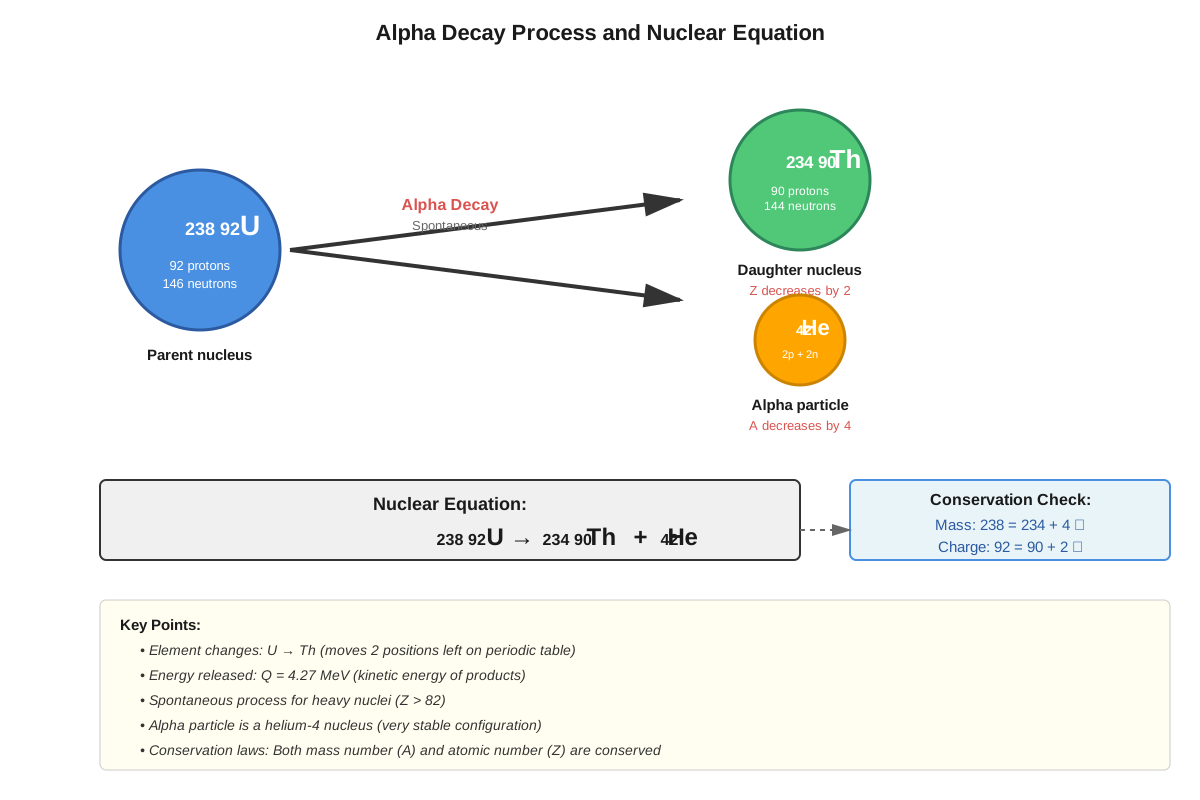
Writing balanced nuclear equations for alpha decay requires careful attention to conservation laws. Both mass number and atomic number must be conserved on both sides of the equation. Consider the alpha decay of uranium-238:
²³⁸₉₂U → ²³⁴₉₀Th + ⁴₂HeVerification of balance:
- Mass number: 238 = 234 + 4 ✓
- Atomic number: 92 = 90 + 2 ✓
The daughter nucleus (thorium-234) has an atomic number of 90, placing it two positions before uranium (92) on the periodic table. This systematic approach allows prediction of decay products without memorization.
Energy Considerations in Alpha Decay
Alpha decay is an exothermic process, meaning it releases energy. The energy released (Q-value) comes from the conversion of mass to energy according to Einstein's mass-energy equivalence principle (E = mc²). The mass of the parent nucleus is slightly greater than the combined mass of the daughter nucleus and alpha particle, and this mass difference (mass defect) is converted to kinetic energy.
The released energy is shared between the alpha particle and the recoiling daughter nucleus according to conservation of momentum. Because the alpha particle is much lighter than the daughter nucleus, it carries away most of the kinetic energy (typically 95-98%). Alpha particles from a given isotope are emitted with discrete, characteristic energies, typically in the range of 4-9 MeV.
Why Heavy Elements Undergo Alpha Decay
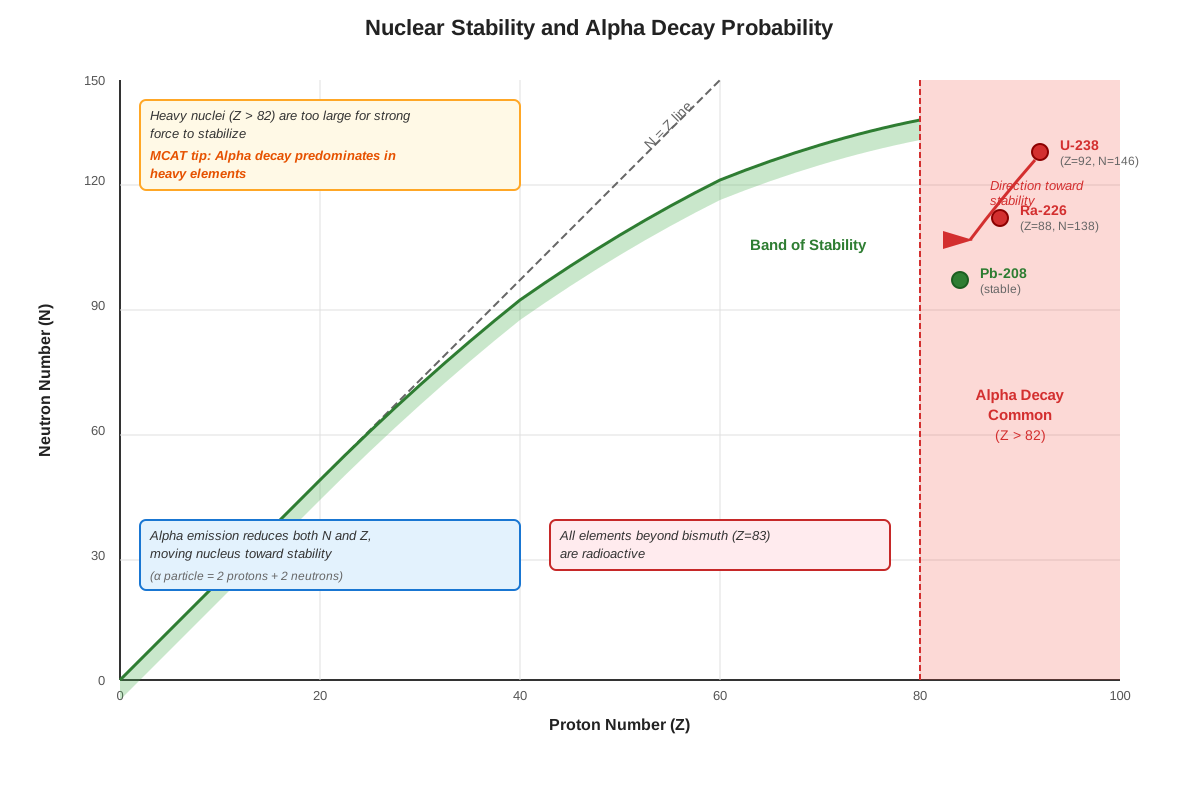
Alpha decay is predominantly observed in heavy elements (Z > 82, beyond lead) because these nuclei have unfavorable neutron-to-proton ratios and experience significant electrostatic repulsion between protons. The strong nuclear force, which binds nucleons together, has a very short range (approximately 1-3 femtometers), while the electromagnetic repulsion between protons acts over longer distances. In large nuclei, protons on opposite sides of the nucleus experience repulsion but minimal attractive strong force, making the nucleus unstable.
Emitting an alpha particle is energetically favorable for these heavy nuclei because:
- It removes four nucleons, significantly reducing the nucleus size
- It reduces the proton count, decreasing electrostatic repulsion
- The alpha particle itself is exceptionally stable (high binding energy per nucleon)
- The energy barrier for alpha emission is lower than for other decay modes
Properties of Alpha Particles
Alpha particles possess distinctive physical properties that determine their behavior and biological effects:
| Property | Characteristic | Significance |
|---|---|---|
| Charge | +2e (two protons) | Strong interaction with matter; high ionization density |
| Mass | 4 amu (6.64 × 10⁻²⁷ kg) | Relatively heavy; low penetration depth |
| Speed | ~5% speed of light | Moderate velocity; stopped by thin barriers |
| Penetrating power | Very low | Stopped by paper, skin, or few cm of air |
| Ionizing power | Very high | Dense ionization track; high biological damage if internal |
| Range in air | 2-10 cm | Limited travel distance from source |
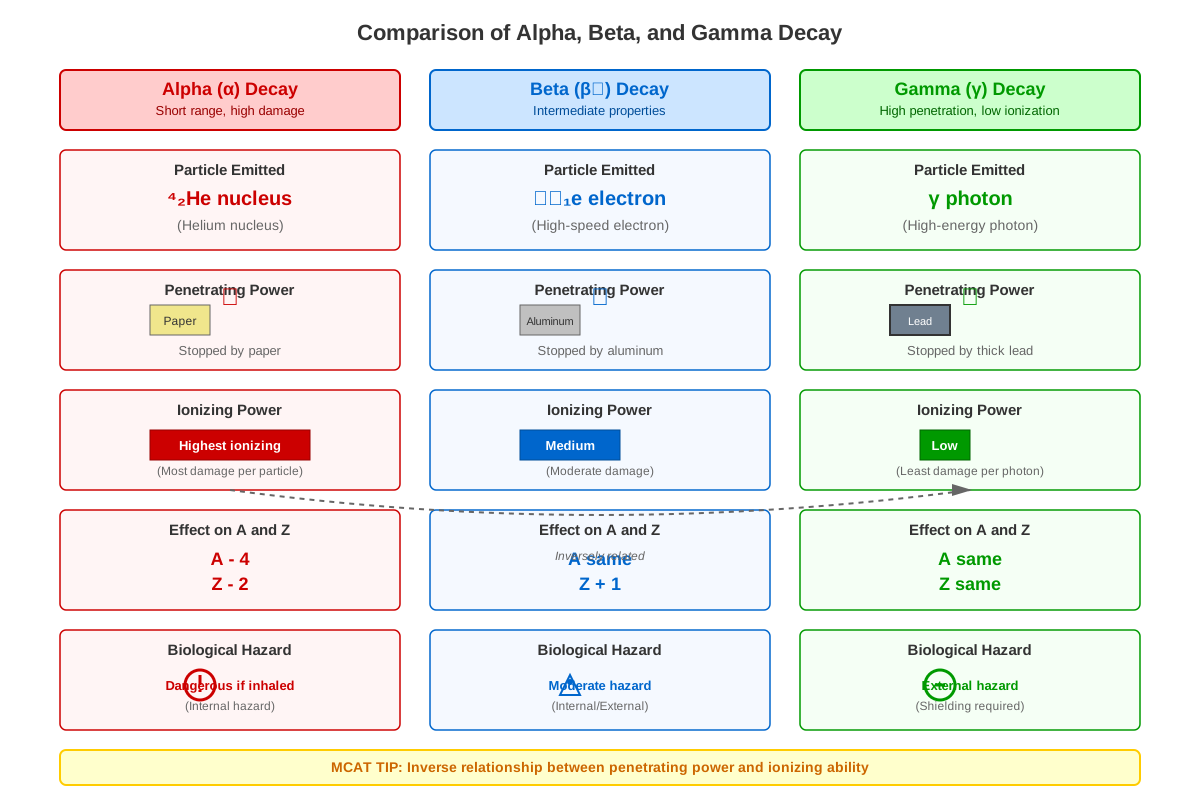
The high ionizing power of alpha particles results from their double positive charge and relatively slow speed, which allows them to interact strongly with electrons in atoms they pass. This creates a dense track of ionization, depositing large amounts of energy in a small volume. While this makes alpha particles unable to penetrate skin (external hazard minimal), they become extremely dangerous when alpha-emitting materials are inhaled, ingested, or enter the body through wounds, as they can cause severe localized tissue damage.
Alpha Decay and Nuclear Stability
The tendency of a nucleus to undergo alpha decay relates directly to its position relative to the band of stability—the region on a graph of neutron number versus proton number where stable nuclei exist. Heavy nuclei above the band of stability (too many nucleons overall) can move toward stability through alpha decay. Each alpha emission moves the nucleus closer to the band of stability by reducing both proton and neutron numbers.
The binding energy per nucleon curve shows that nuclei with mass numbers around 56 (iron) have the highest binding energy per nucleon and are most stable. Very heavy nuclei have lower binding energy per nucleon, making them less stable. Alpha decay allows these heavy nuclei to split into smaller, more tightly bound fragments, releasing the difference in binding energy as kinetic energy.
Decay Series and Sequential Alpha Decay
Many naturally occurring radioactive elements undergo a series of sequential decays, including multiple alpha decays, before reaching a stable end product. The uranium-238 decay series is a classic example, involving 8 alpha decays and 6 beta decays before reaching stable lead-206:
²³⁸U → ²³⁴Th → ²³⁴Pa → ²³⁴U → ²³⁰Th → ²²⁶Ra → ²²²Rn → ²¹⁸Po → ²¹⁴Pb → ... → ²⁰⁶Pb (stable)Each alpha decay in the series reduces the mass number by 4, which is why all members of a decay series have mass numbers that differ by multiples of 4. This creates four distinct decay series in nature, classified by their mass number modulo 4 (4n, 4n+1, 4n+2, 4n+3 series).
Concept Relationships
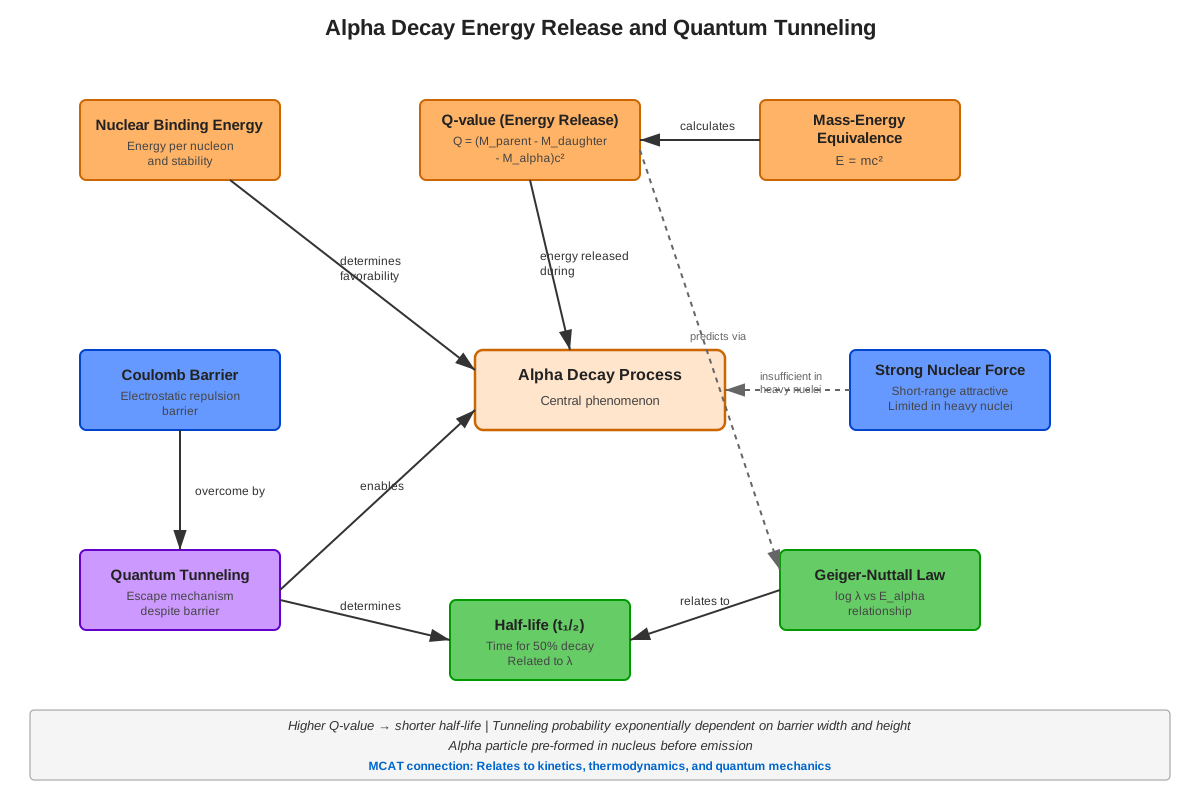
Alpha decay serves as a central concept connecting multiple areas of nuclear physics and chemistry. The process fundamentally depends on nuclear stability, which is determined by the neutron-to-proton ratio and the balance between the attractive strong nuclear force and repulsive electromagnetic force. This relationship flows as: Nuclear instability → Alpha decay → Movement toward stability.
The concept connects to conservation laws in physics, as every alpha decay must conserve mass number, atomic number, charge, energy, and momentum. These conservation principles enable prediction of decay products and calculation of energy release. The relationship can be mapped as: Conservation laws → Balanced nuclear equations → Product prediction.
Alpha decay links to quantum mechanics through the phenomenon of quantum tunneling, which explains how alpha particles escape the nucleus despite insufficient classical energy to overcome the nuclear potential barrier. This connection extends to understanding decay probability and half-life: Quantum tunneling probability → Decay constant → Half-life.
The topic also connects forward to half-life calculations and radioactive decay kinetics, as alpha-emitting isotopes follow first-order decay kinetics. Understanding alpha decay enables comprehension of: Alpha decay mechanism → Decay rate → Activity calculations → Half-life applications.
Regarding biological applications, alpha decay connects to radiation biology and dosimetry: Alpha particle properties → Ionization density → Linear energy transfer (LET) → Relative biological effectiveness (RBE) → Radiation dose calculations. This pathway is crucial for understanding why alpha emitters pose different biological risks than beta or gamma emitters.
Finally, alpha decay relates to periodic table trends and element transmutation: Parent element → Alpha emission → Daughter element (2 positions left on periodic table). This connection helps students quickly identify decay products and understand how radioactive decay creates new elements.
Quick check — test yourself on Alpha decay so far.
Try Flashcards →High-Yield Facts
⭐ Alpha particles consist of 2 protons and 2 neutrons, identical to a helium-4 nucleus (⁴₂He)
⭐ During alpha decay, atomic number decreases by 2 and mass number decreases by 4
⭐ Alpha decay is most common in heavy elements with Z > 82 (beyond lead)
⭐ Alpha particles have high ionizing power but very low penetrating power (stopped by paper or skin)
⭐ Alpha particles are dangerous primarily when alpha-emitting materials are inhaled or ingested (internal hazard)
- Alpha decay is an exothermic process that releases energy typically in the 4-9 MeV range
- The daughter nucleus recoils to conserve momentum, but the alpha particle carries ~95-98% of the kinetic energy
- Alpha particles travel only 2-10 cm in air before being stopped
- Radon-222 is a naturally occurring alpha emitter and the second leading cause of lung cancer
- All members of a radioactive decay series differ in mass number by multiples of 4
- Alpha decay occurs through quantum tunneling, allowing the alpha particle to escape the nuclear potential barrier
- The rate of alpha decay follows first-order kinetics with a characteristic half-life for each isotope
- Uranium-238 undergoes 8 alpha decays in its decay series to stable lead-206
- Alpha particles have a charge of +2e, making them interact strongly with electrons in matter
- The binding energy per nucleon is higher for the products than the parent in alpha decay, making the process energetically favorable
Common Misconceptions
Misconception: Alpha particles are helium atoms.
Correction: Alpha particles are helium-4 nuclei (⁴₂He²⁺), not neutral helium atoms. They lack the two electrons that would make them complete helium atoms. Once emitted, alpha particles quickly acquire electrons from the surrounding environment to become neutral helium atoms, but during emission and initial travel, they are doubly charged ions.
Misconception: Alpha decay changes the mass number by 2.
Correction: Alpha decay changes the mass number by 4 (not 2) because an alpha particle contains two protons AND two neutrons. The atomic number decreases by 2 (due to the two protons), but students often confuse these two values. Remember: mass number = protons + neutrons, so losing 2 of each means losing 4 total.
Misconception: Alpha particles are the most dangerous form of radiation because they have the highest ionizing power.
Correction: Alpha particles have the highest ionizing power but are only dangerous as an internal hazard. External alpha radiation cannot penetrate the dead outer layer of skin. However, if alpha-emitting materials are inhaled, ingested, or enter through wounds, they become extremely dangerous because their high ionizing power causes severe localized tissue damage. Beta and gamma radiation pose greater external hazards due to their higher penetrating power.
Misconception: All radioactive elements undergo alpha decay.
Correction: Alpha decay is predominantly observed in heavy elements (Z > 82). Lighter radioactive isotopes typically undergo beta decay, positron emission, or electron capture to achieve stability. The mode of decay depends on the specific instability of the nucleus—whether it has too many protons, too many neutrons, or is simply too large overall.
Misconception: The daughter nucleus in alpha decay is always stable.
Correction: The daughter nucleus produced by alpha decay is often still radioactive and may undergo further decay. Many alpha emitters are part of decay series involving multiple sequential decays before reaching a stable end product. For example, uranium-238 decays to thorium-234, which is itself radioactive and continues decaying through a series of transformations.
Misconception: Alpha and beta particles are the same thing with different names.
Correction: Alpha and beta particles are fundamentally different. Alpha particles are helium-4 nuclei (2 protons + 2 neutrons, charge +2), while beta particles are high-energy electrons (beta-minus) or positrons (beta-plus) with charge -1 or +1 respectively. They have different masses, charges, penetrating powers, ionizing powers, and arise from different nuclear processes.
Misconception: Energy is lost during alpha decay.
Correction: Energy is conserved during alpha decay, not lost. The mass defect (difference between parent mass and product masses) is converted to kinetic energy of the products according to E=mc². This energy appears as kinetic energy of the alpha particle and recoiling daughter nucleus. The process releases energy (exothermic), making the products more stable than the parent.
Worked Examples
Example 1: Writing and Balancing Alpha Decay Equations
Problem: Radium-226 undergoes alpha decay. Write the balanced nuclear equation and identify the daughter nucleus. Calculate the changes in atomic number and mass number.
Solution:
Step 1: Write the general form of the alpha decay equation.
²²⁶₈₈Ra → ?_? X + ⁴₂HeStep 2: Apply conservation of mass number.
- Parent mass number: 226
- Alpha particle mass number: 4
- Daughter mass number: 226 - 4 = 222
Step 3: Apply conservation of atomic number.
- Parent atomic number: 88 (radium)
- Alpha particle atomic number: 2
- Daughter atomic number: 88 - 2 = 86
Step 4: Identify the element with atomic number 86.
- Z = 86 corresponds to radon (Rn)
Step 5: Write the complete balanced equation.
²²⁶₈₈Ra → ²²²₈₆Rn + ⁴₂HeStep 6: Verify conservation.
- Mass number: 226 = 222 + 4 ✓
- Atomic number: 88 = 86 + 2 ✓
Answer: The daughter nucleus is radon-222 (²²²₈₆Rn). The atomic number decreased by 2 (from 88 to 86), and the mass number decreased by 4 (from 226 to 222).
Connection to learning objectives: This example demonstrates the application of alpha decay principles to write balanced nuclear equations and predict decay products, directly addressing the objectives of defining alpha decay and applying it to exam-style questions.
Example 2: Alpha Decay Series and Multiple Transformations
Problem: Polonium-218 undergoes three sequential alpha decays. What is the final product? How many total protons and neutrons are lost in this process?
Solution:
Step 1: Determine changes from one alpha decay.
- Each alpha decay: Z decreases by 2, A decreases by 4
Step 2: Calculate total changes from three alpha decays.
- Total change in Z: 3 × (-2) = -6
- Total change in A: 3 × (-4) = -12
Step 3: Determine the final atomic number.
- Initial Z for Po: 84
- Final Z: 84 - 6 = 78
Step 4: Determine the final mass number.
- Initial A: 218
- Final A: 218 - 12 = 206
Step 5: Identify the element with Z = 78.
- Z = 78 corresponds to platinum (Pt)
Step 6: Calculate protons and neutrons lost.
- Protons lost: 6 (from three alpha particles, each with 2 protons)
- Neutrons lost: 6 (from three alpha particles, each with 2 neutrons)
- Total nucleons lost: 12
Answer: The final product is platinum-206 (²⁰⁶₇₈Pt). A total of 6 protons and 6 neutrons are lost (12 nucleons total).
Step-by-step decay series:
²¹⁸₈₄Po → ²¹⁴₈₂Pb + ⁴₂He (first alpha decay)
²¹⁴₈₂Pb → ²¹⁰₈₀Hg + ⁴₂He (second alpha decay)
²¹⁰₈₀Hg → ²⁰⁶₇₈Pt + ⁴₂He (third alpha decay)
Connection to learning objectives: This example illustrates the application of alpha decay to sequential transformations, reinforcing the systematic changes in atomic and mass numbers. It also connects to the concept of decay series and demonstrates how to track multiple decay events—a common MCAT question type.
Exam Strategy
When approaching MCAT questions on alpha decay, begin by identifying the type of question: nuclear equation balancing, product prediction, or conceptual understanding of alpha particle properties. For equation-balancing questions, immediately write down the conservation requirements (mass number and atomic number must balance) and work systematically through the arithmetic. The MCAT rarely requires memorization of specific isotopes; instead, it tests your ability to apply principles.
Trigger words and phrases to watch for include:
- "Undergoes alpha decay" or "emits an alpha particle" → signals you need to write a nuclear equation
- "Daughter nucleus" or "decay product" → identify the element two positions left on the periodic table
- "Penetrating power" or "stopped by paper/skin" → indicates alpha particles
- "Internal hazard" or "ingested/inhaled" → suggests alpha emitter danger
- "Heavy element" or "Z > 82" → likely undergoes alpha decay
- "Helium nucleus" → another term for alpha particle
- "Recoil" → consider momentum conservation in alpha decay
For process-of-elimination strategies, remember that alpha decay:
- ONLY decreases atomic number (never increases)
- ALWAYS decreases by exactly 2 protons and 4 nucleons (not other values)
- Is most common in heavy elements (eliminate light element options)
- Produces particles with low penetrating power (eliminate answers suggesting high penetration)
- Results in a daughter nucleus two positions LEFT on the periodic table (not right)
When passages discuss radiation safety or biological effects, immediately categorize radiation types by penetrating power (alpha < beta < gamma) and ionizing power (alpha > beta > gamma). This allows quick elimination of incorrect answer choices about shielding requirements or biological hazards.
Time allocation: Discrete alpha decay questions should take 30-45 seconds if they involve simple equation balancing. Passage-based questions may require 60-90 seconds, especially if they involve multiple decay steps or integration with other concepts. If a question asks you to identify an element by atomic number, don't waste time trying to recall—use the periodic table provided or work backward from the conservation laws.
Exam Tip: If you forget whether atomic number or mass number decreases by 2 or 4, remember that an alpha particle is a helium nucleus. Helium has atomic number 2 (2 protons) and mass number 4 (2 protons + 2 neutrons). This mnemonic anchor prevents confusion under test pressure.
Memory Techniques
Mnemonic for alpha particle composition: "2 and 2 make 4"
- 2 protons + 2 neutrons = 4 nucleons total
- Atomic number decreases by 2, mass number decreases by 4
Mnemonic for penetrating power: "APB - Ascending Penetrating Barrier"
- Alpha: stopped by paper/skin (lowest penetration)
- Beta: stopped by aluminum foil/plastic (medium penetration)
- (Gamma): requires lead/concrete (highest penetration)
Mnemonic for ionizing power: Reverse the penetrating power order
- Alpha has highest ionizing power (dense ionization track)
- Beta has medium ionizing power
- Gamma has lowest ionizing power (sparse ionization)
- Remember: "What penetrates less, ionizes more"
Visualization strategy for element identification: Picture the periodic table and physically move two spaces LEFT when an alpha decay occurs. This visual movement helps prevent the common error of moving right or moving by the wrong number of spaces. For example, uranium (92) → thorium (90) → radium (88) → radon (86) → polonium (84).
Acronym for alpha particle properties: "CHIPS"
- Charge: +2
- Helium nucleus (composition)
- Ionizing power: high
- Penetrating power: low
- Stopped by skin/paper
Memory aid for when alpha decay occurs: "Heavy Hitters Heave Helium"
- Heavy elements (Z > 82) undergo alpha decay
- They "heave" (emit) helium nuclei (alpha particles)
- This reminds you that alpha decay is characteristic of heavy, unstable nuclei
Visualization for internal vs. external hazard: Imagine alpha particles as "angry bees"—harmless if they stay outside (can't penetrate skin), but extremely dangerous if they get inside (inhaled/ingested). This vivid image helps remember why alpha emitters are primarily internal hazards.
Summary
Alpha decay is a fundamental nuclear process in which unstable, heavy nuclei (typically Z > 82) spontaneously emit alpha particles—helium-4 nuclei consisting of two protons and two neutrons. This emission reduces the atomic number by 2 and the mass number by 4, transforming the parent element into a daughter element two positions earlier on the periodic table. The process is governed by conservation of mass number, atomic number, energy, and momentum, and occurs through quantum tunneling. Alpha particles possess distinctive properties: high ionizing power due to their +2 charge and relatively low velocity, but very low penetrating power, being stopped by paper, skin, or a few centimeters of air. This makes alpha emitters primarily dangerous as internal hazards when inhaled or ingested, rather than as external radiation sources. Understanding alpha decay requires mastery of nuclear equation balancing, recognition of which elements undergo this decay mode, and appreciation of the biological and clinical significance of alpha radiation. For the MCAT, students must be able to write balanced nuclear equations, predict decay products, compare alpha decay to other decay modes, and apply these concepts to questions involving radiation safety, medical applications, and nuclear stability.
Key Takeaways
- Alpha particles are helium-4 nuclei (⁴₂He) containing 2 protons and 2 neutrons with a +2 charge
- Alpha decay decreases atomic number by 2 and mass number by 4, moving the element two positions left on the periodic table
- Alpha decay is most common in heavy elements (Z > 82) that are too large to be stable
- Alpha particles have very high ionizing power but very low penetrating power (stopped by paper or skin)
- Alpha emitters are dangerous primarily as internal hazards (inhaled/ingested), not external radiation sources
- All nuclear equations must conserve both mass number and atomic number
- Alpha decay is an exothermic process releasing energy typically in the 4-9 MeV range
Related Topics
Beta Decay: After mastering alpha decay, students should study beta-minus and beta-plus decay, which involve emission of electrons or positrons. Understanding the differences between alpha and beta decay—including when each occurs, their particle properties, and their biological effects—is essential for comprehensive nuclear physics knowledge.
Gamma Decay: Gamma emission often accompanies alpha or beta decay when the daughter nucleus is left in an excited state. Learning about gamma rays completes the picture of the three major types of radioactive decay and their comparative properties.
Half-Life and Decay Kinetics: Alpha decay follows first-order kinetics with characteristic half-lives. Mastering half-life calculations, activity measurements, and decay rate equations builds directly on alpha decay fundamentals.
Nuclear Binding Energy: Understanding why alpha decay releases energy requires knowledge of binding energy curves and mass-energy equivalence. This topic explains the thermodynamic driving force behind alpha decay.
Radiation Biology and Dosimetry: The biological effects of alpha radiation, including concepts of linear energy transfer (LET), relative biological effectiveness (RBE), and radiation dose units, apply alpha decay knowledge to medical and health physics contexts.
Nuclear Stability and the Band of Stability: Deeper exploration of why certain nuclei are unstable and which decay modes they undergo based on their neutron-to-proton ratio provides context for when alpha decay occurs versus other decay modes.
Practice CTA
Now that you've mastered the core concepts of alpha decay, it's time to reinforce your understanding through active practice. Attempt the practice questions and work through the flashcards to solidify your ability to write nuclear equations, predict decay products, and apply these concepts under timed conditions. Remember, the MCAT rewards not just knowledge but the ability to apply that knowledge quickly and accurately. Each practice question you complete builds the pattern recognition and problem-solving speed essential for test day success. You've built a strong foundation—now strengthen it through deliberate practice!
Sign up free to keep reading
Create a free AnvayaPrep account to finish this MCAT guide on Alpha decay — plus flashcards and practice questions.