Overview
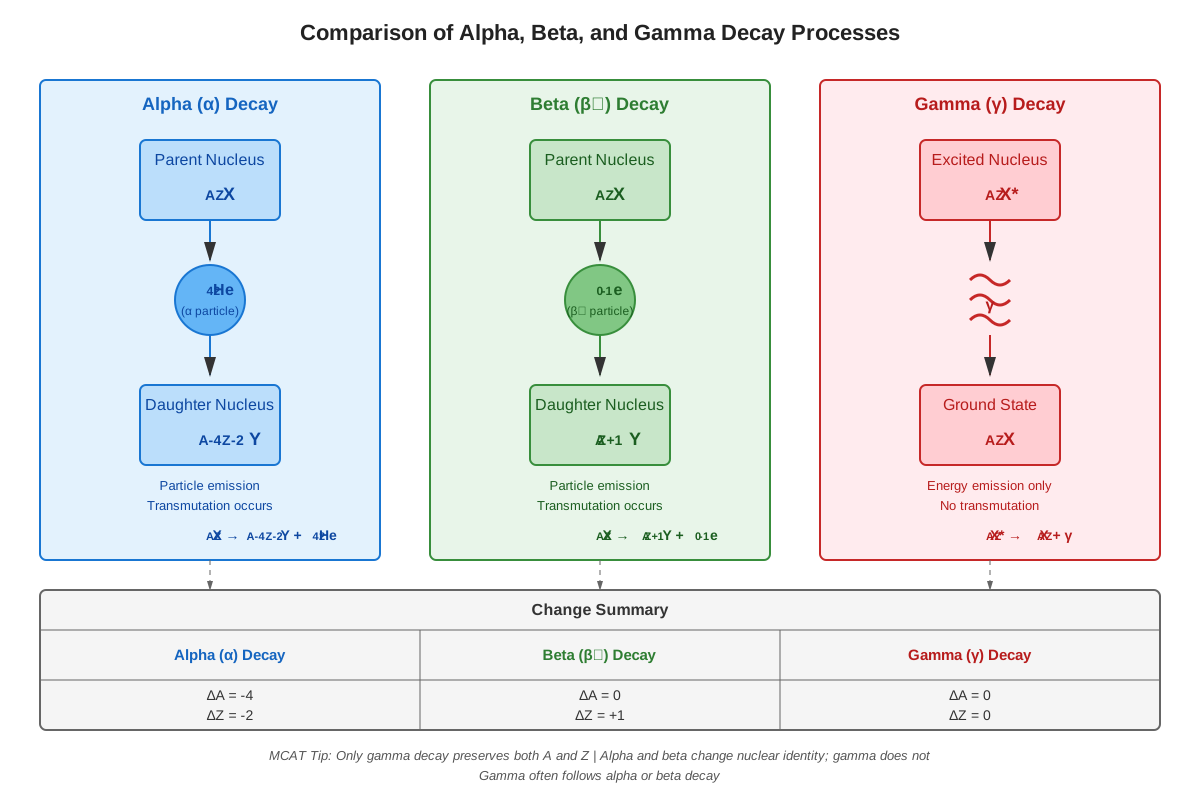
Gamma decay is a fundamental nuclear process in which an excited atomic nucleus releases excess energy in the form of high-energy electromagnetic radiation called gamma rays. Unlike alpha and beta decay, which involve the emission of particles and result in transmutation of elements, gamma decay represents a purely energetic transition where the nucleus moves from a higher energy state to a lower energy state without changing its atomic number or mass number. This process is essential for understanding nuclear stability, radioactive decay series, and the behavior of radioisotopes in both medical and research applications.
For the MCAT, gamma decay appears regularly in Atomic and Nuclear Physics questions, often integrated with alpha and beta decay in multi-step decay problems or in passages discussing medical imaging techniques like PET scans and gamma cameras. Understanding gamma decay is crucial because it connects fundamental quantum mechanical principles (discrete energy levels) with practical applications in nuclear medicine, radiation therapy, and diagnostic imaging. The MCAT frequently tests students' ability to distinguish between different types of radioactive decay, predict decay products, and understand the energetic considerations that govern nuclear transitions.
Within the broader context of Physics, gamma decay exemplifies the principle of energy quantization at the nuclear level and demonstrates the electromagnetic nature of one form of ionizing radiation. It connects directly to concepts of photon energy, the electromagnetic spectrum, nuclear binding energy, and conservation laws. Mastery of this topic enables students to tackle complex passages involving radioactive tracers, radiation safety, and the medical applications of nuclear physics that appear across both the Chemical and Physical Foundations section and the Biological and Biochemical Foundations section of the MCAT.
Learning Objectives
- [ ] Define Gamma decay using accurate Physics terminology
- [ ] Explain why Gamma decay matters for the MCAT
- [ ] Apply Gamma decay to exam-style questions
- [ ] Identify common mistakes related to Gamma decay
- [ ] Connect Gamma decay to related Physics concepts
- [ ] Distinguish gamma decay from alpha and beta decay based on nuclear changes and emission products
- [ ] Calculate the energy of emitted gamma photons using the relationship E = hf
- [ ] Predict when gamma decay will occur following other radioactive decay processes
Prerequisites
- Atomic structure and nuclear composition: Understanding protons, neutrons, and the notation for isotopes (A/Z notation) is essential for tracking nuclear changes during decay processes
- Electromagnetic radiation and photons: Knowledge of the electromagnetic spectrum, photon energy (E = hf), and the wave-particle duality of light provides the foundation for understanding gamma ray emission
- Energy conservation principles: Familiarity with conservation of energy and mass-energy equivalence (E = mc²) is necessary to understand the energetics of nuclear transitions
- Basic quantum mechanics: Recognition that energy levels are quantized helps explain why nuclei emit discrete gamma ray energies
- Alpha and beta decay: Understanding these particle-emission decay modes provides context for distinguishing gamma decay as a purely electromagnetic process
Why This Topic Matters
Gamma decay has profound clinical significance in modern medicine, making it a high-yield topic for the MCAT. Gamma-emitting radioisotopes like Technetium-99m are the workhorses of nuclear medicine, used in millions of diagnostic procedures annually. PET scans rely on detecting gamma rays produced when positrons (from beta-plus decay) annihilate with electrons. Radiation therapy for cancer treatment often employs gamma-emitting sources like Cobalt-60. Understanding gamma decay is essential for interpreting passages about medical imaging, radiation dosimetry, and radiopharmaceuticals.
On the MCAT, gamma decay appears in approximately 2-4 questions per exam administration, either as standalone discrete questions or embedded within passages about nuclear medicine, radioactive decay series, or radiation physics. The topic most commonly appears in the Chemical and Physical Foundations section but can also emerge in biological contexts when discussing radioactive tracers in metabolic studies or the effects of ionizing radiation on biological tissues. Questions typically test the ability to distinguish decay types, apply conservation laws, calculate photon energies, or interpret decay schemes.
Exam passages frequently present gamma decay in the context of decay series (where alpha or beta decay produces an excited nucleus that subsequently undergoes gamma decay), medical imaging techniques (requiring understanding of how gamma cameras detect emitted photons), or radiation safety scenarios (testing knowledge of penetration depth and shielding requirements). The MCAT particularly favors questions that integrate multiple concepts, such as combining gamma decay with half-life calculations, energy conservation, or electromagnetic radiation properties.
Core Concepts
Definition and Fundamental Nature of Gamma Decay
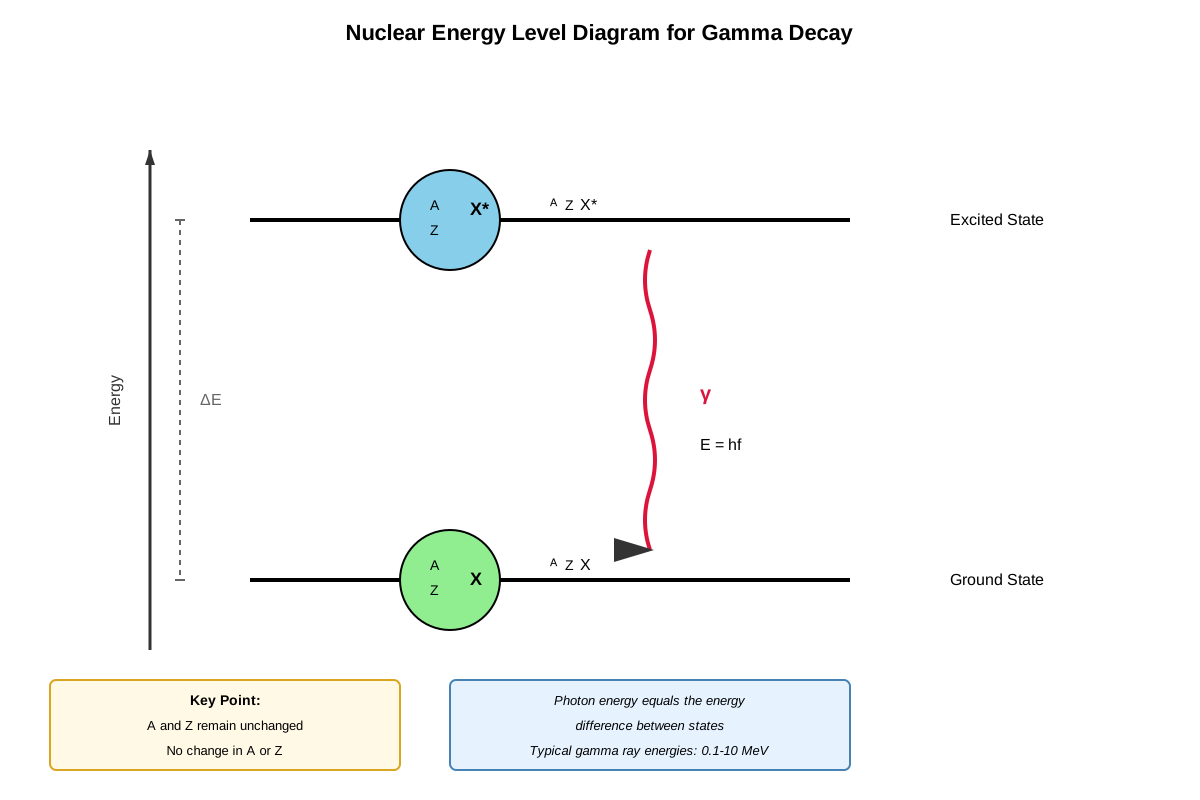
Gamma decay is a radioactive decay process in which an atomic nucleus in an excited energy state transitions to a lower energy state by emitting a gamma ray—a high-energy photon of electromagnetic radiation. The key distinguishing feature of gamma decay is that it involves no change in the number of protons (atomic number Z) or neutrons (mass number A) in the nucleus. Instead, the nucleus simply rearranges its internal energy configuration, releasing the excess energy as electromagnetic radiation.
The nuclear notation for gamma decay is written as:
A/Z X* → A/Z X + γwhere the asterisk (*) denotes an excited nuclear state, X represents the element, and γ represents the emitted gamma photon. For example, when Technetium-99m (the "m" stands for metastable, indicating an excited state) undergoes gamma decay:
99m/43 Tc → 99/43 Tc + γThe resulting nucleus is the same isotope of technetium, but in its ground (lowest energy) state.
Energy Characteristics and the Electromagnetic Spectrum
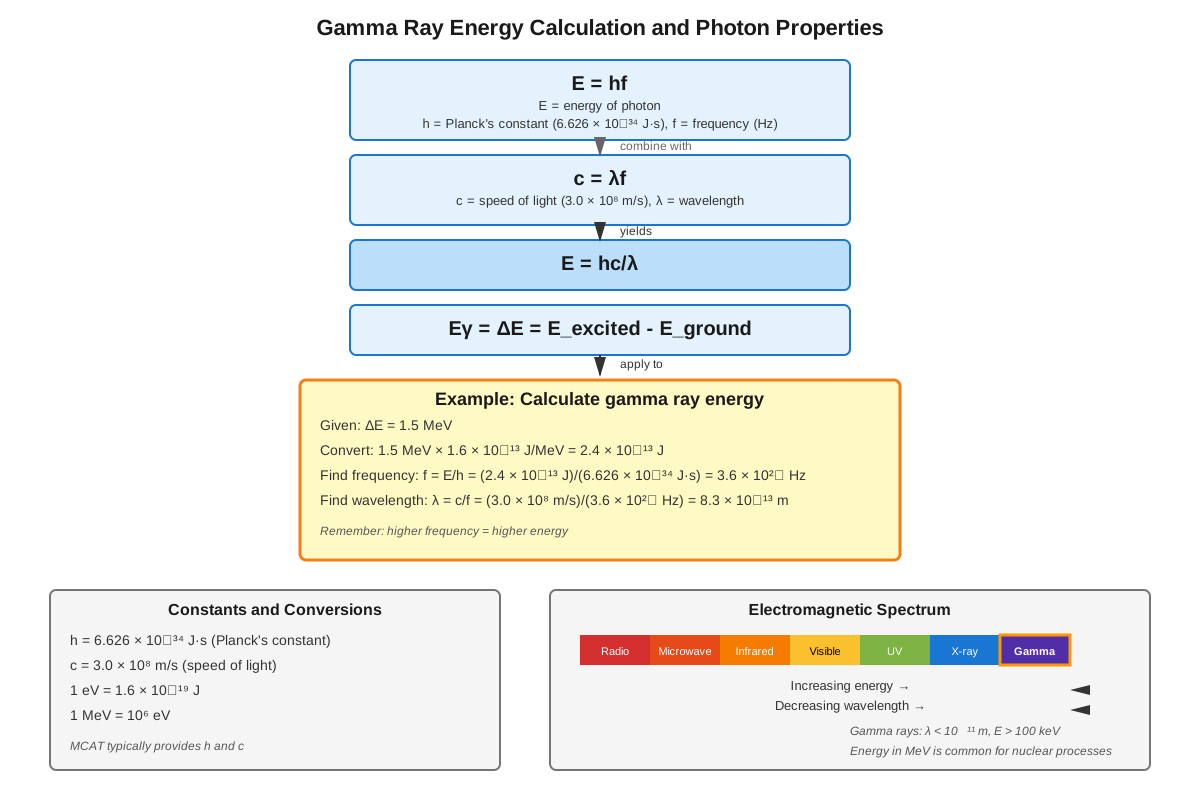
Gamma rays occupy the highest energy region of the electromagnetic spectrum, with photon energies typically ranging from 10 keV to several MeV (kilo-electron volts to mega-electron volts). The energy of the emitted gamma photon corresponds exactly to the energy difference between the excited nuclear state and the lower energy state:
E_γ = E_initial - E_final = hf = hc/λwhere h is Planck's constant (6.626 × 10⁻³⁴ J·s), f is the frequency, c is the speed of light (3.0 × 10⁸ m/s), and λ is the wavelength. Because nuclear energy levels are discrete and specific to each isotope, each radioactive isotope emits gamma rays with characteristic energies that serve as a "fingerprint" for identification.
The extremely high energy of gamma photons results in very short wavelengths (typically less than 10⁻¹¹ m) and high penetrating power. Unlike alpha particles (stopped by paper) or beta particles (stopped by aluminum foil), gamma rays require dense materials like lead or several centimeters of concrete for effective shielding.
Nuclear Excitation and the Origin of Excited States
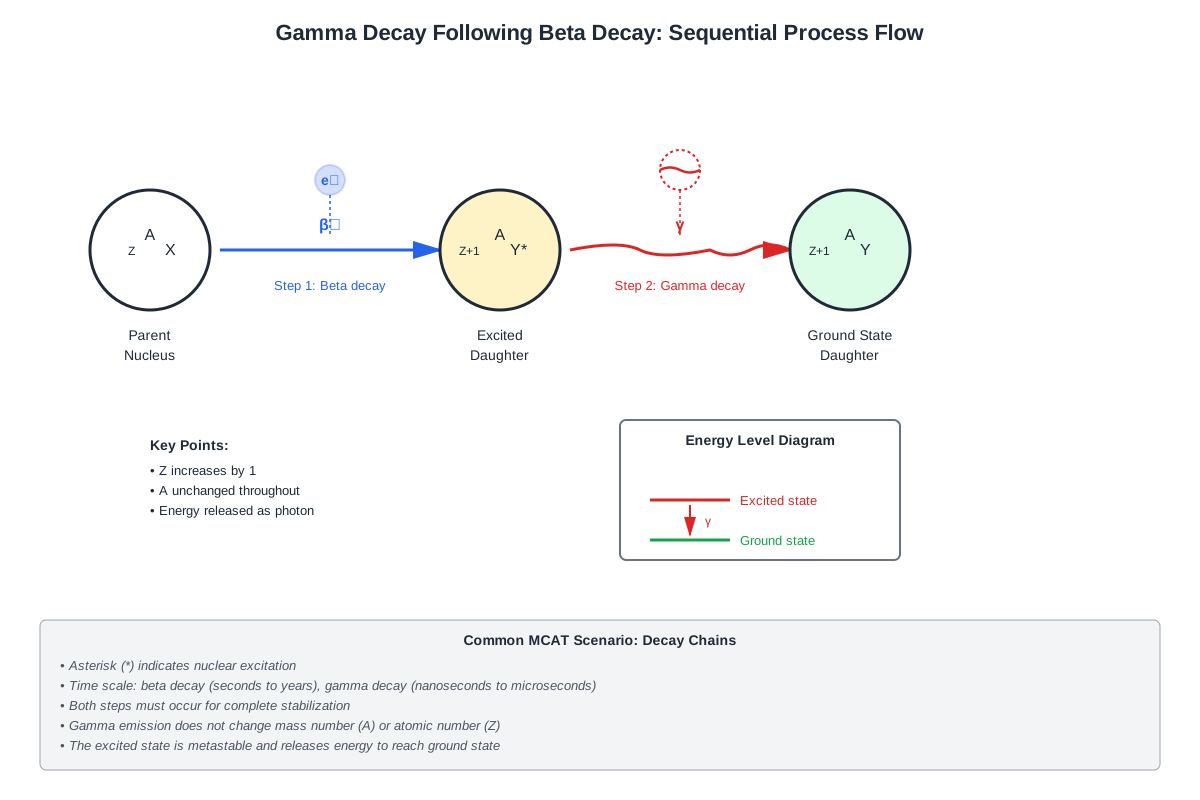
Nuclei typically enter excited states as a consequence of other radioactive decay processes. When a nucleus undergoes alpha decay (emission of a helium nucleus) or beta decay (emission of an electron or positron), the daughter nucleus is frequently left in an excited energy state rather than directly in its ground state. This excited nucleus then rapidly undergoes gamma decay to reach stability.
For example, in the decay of Cobalt-60:
60/27 Co → 60/28 Ni* + β⁻ + ν̄
60/28 Ni* → 60/28 Ni + γ
The beta decay produces an excited nickel-60 nucleus, which immediately emits gamma rays (actually two gamma photons with energies of 1.17 MeV and 1.33 MeV) to reach the ground state. This sequential process is extremely common in radioactive decay series.
Isomeric Transitions and Metastable States
Some excited nuclear states have unusually long lifetimes before undergoing gamma decay, ranging from microseconds to years. These long-lived excited states are called metastable states or nuclear isomers, and the gamma decay from these states is specifically termed an isomeric transition. The most clinically important example is Technetium-99m, where the "m" designation indicates the metastable state.
Technetium-99m has a half-life of 6 hours for its isomeric transition to Technetium-99 (ground state), making it ideal for medical imaging: long enough to perform diagnostic procedures but short enough to minimize patient radiation exposure. The 140 keV gamma ray emitted is also optimal for detection by gamma cameras while having sufficient energy to exit the body.
Conservation Laws in Gamma Decay
Gamma decay obeys all fundamental conservation laws:
- Conservation of mass number (A): The mass number remains unchanged because no nucleons are emitted
- Conservation of atomic number (Z): The atomic number remains unchanged because no protons are gained or lost
- Conservation of energy: The energy lost by the nucleus equals the energy of the emitted gamma photon
- Conservation of momentum: The nucleus recoils slightly to conserve momentum, though the recoil energy is negligible compared to the photon energy
- Conservation of charge: The nuclear charge remains constant
Comparison of Decay Types
| Decay Type | Emission | Change in Z | Change in A | Penetrating Power | Typical Energy |
|---|---|---|---|---|---|
| Alpha | He nucleus (2p, 2n) | -2 | -4 | Low (paper stops) | 4-9 MeV |
| Beta-minus | Electron | +1 | 0 | Medium (Al stops) | 0-3 MeV |
| Beta-plus | Positron | -1 | 0 | Medium (Al stops) | 0-3 MeV |
| Gamma | Photon | 0 | 0 | High (Pb reduces) | 0.01-10 MeV |
This table highlights that gamma decay is unique in producing no change in nuclear composition while having the highest penetrating power.
Internal Conversion: An Alternative to Gamma Emission
In some cases, instead of emitting a gamma ray, an excited nucleus can transfer its excess energy directly to an inner orbital electron, ejecting that electron from the atom. This process, called internal conversion, competes with gamma decay and is more probable when the energy difference between nuclear states is small. The ejected electron (called a conversion electron) carries away the excitation energy minus its binding energy. While internal conversion is not gamma decay per se, it represents an alternative de-excitation pathway that students should recognize on the MCAT.
Concept Relationships
The concepts within gamma decay form a logical progression: nuclear excitation (typically from alpha or beta decay) → metastable or excited nuclear state → energy level transition → gamma photon emission → ground state nucleus. This sequence demonstrates that gamma decay is almost always a secondary process following another nuclear event.
Gamma decay connects intimately to prerequisite topics: it relies on understanding electromagnetic radiation (gamma rays are photons), quantum mechanics (discrete nuclear energy levels), and atomic structure (distinguishing nuclear processes from electronic transitions). The relationship to alpha and beta decay is particularly important—these processes often precede gamma decay and change the nuclear composition, whereas gamma decay only changes the energy state.
Looking forward, mastery of gamma decay enables understanding of radioactive decay series (where multiple decay steps occur sequentially), nuclear medicine applications (PET, SPECT, gamma cameras), and radiation dosimetry (calculating absorbed dose from different radiation types). The concept also connects to electromagnetic spectrum topics in general chemistry and to biological effects of radiation in biochemistry.
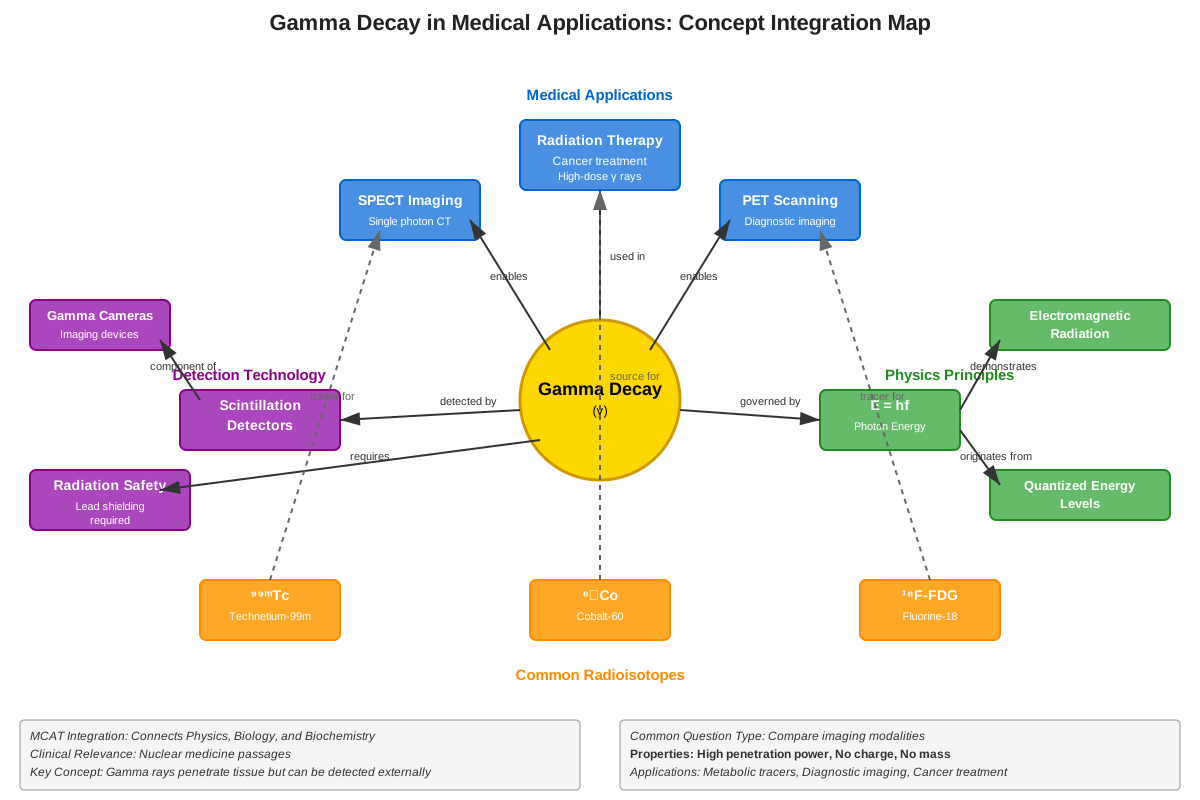
The relationship map: Alpha/Beta Decay → Excited Nucleus → Gamma Decay → Ground State Nucleus + Gamma Photon → Detection (medical imaging) or Interaction with Matter (radiation effects). Additionally: Nuclear Energy Levels → Photon Energy (E = hf) → Wavelength/Frequency → Position in EM Spectrum → Penetrating Power → Shielding Requirements.
High-Yield Facts
⭐ Gamma decay changes neither the atomic number (Z) nor the mass number (A) of the nucleus—it is purely an energy transition
⭐ Gamma rays are high-energy photons with energies typically between 10 keV and 10 MeV, placing them at the highest energy end of the electromagnetic spectrum
⭐ Gamma decay almost always follows alpha or beta decay, occurring when the daughter nucleus is left in an excited state
⭐ Technetium-99m is the most commonly used radioisotope in nuclear medicine, undergoing gamma decay with a 6-hour half-life and emitting 140 keV gamma rays
⭐ Gamma rays have the highest penetrating power of all common radioactive emissions, requiring lead or thick concrete for effective shielding
- The energy of an emitted gamma photon equals the energy difference between nuclear states: E_γ = ΔE_nuclear = hf
- Metastable nuclear states (isomers) can have half-lives ranging from microseconds to years before undergoing gamma decay
- Gamma decay obeys all conservation laws: energy, momentum, charge, mass number, and atomic number
- Internal conversion is a competing process where nuclear excitation energy is transferred to an orbital electron instead of being emitted as a gamma ray
- The notation for an excited nuclear state uses an asterisk () or "m" (for metastable): ⁶⁰Ni or ⁹⁹ᵐTc
- Gamma photon energy can be calculated using E = hc/λ, where h = 6.626 × 10⁻³⁴ J·s and c = 3.0 × 10⁸ m/s
- Positron-electron annihilation produces two 511 keV gamma rays traveling in opposite directions, forming the basis of PET imaging
Quick check — test yourself on Gamma decay so far.
Try Flashcards →Common Misconceptions
Misconception: Gamma decay changes the element because it involves radioactive decay
Correction: Unlike alpha and beta decay, gamma decay involves no change in the number of protons or neutrons. The element remains the same; only the energy state of the nucleus changes. The nucleus transitions from an excited state to a lower energy state.
Misconception: Gamma rays are particles like alpha and beta particles
Correction: Gamma rays are electromagnetic radiation (photons), not particles with mass. They are fundamentally different from alpha particles (helium nuclei) and beta particles (electrons or positrons). Gamma rays travel at the speed of light and have zero rest mass.
Misconception: All radioactive decay processes emit gamma rays
Correction: Gamma decay only occurs when a nucleus is in an excited energy state. Some radioactive decays produce daughter nuclei directly in their ground state, with no subsequent gamma emission. Additionally, some excited nuclei may undergo internal conversion instead of gamma emission.
Misconception: The half-life of a radioactive isotope refers to gamma decay
Correction: The stated half-life of an isotope typically refers to the primary decay mode (alpha or beta decay), not the gamma decay that may follow. Gamma decay from excited states usually occurs within picoseconds to microseconds after the primary decay, except for metastable states. For example, Cobalt-60's 5.27-year half-life refers to its beta decay, while the subsequent gamma emission is essentially instantaneous.
Misconception: Gamma rays and X-rays are completely different types of radiation
Correction: Both gamma rays and X-rays are electromagnetic radiation (photons) and can have overlapping energies. The distinction is based on origin: gamma rays originate from nuclear transitions, while X-rays originate from electronic transitions or bremsstrahlung radiation. A 100 keV photon from a nuclear transition is a gamma ray, while a 100 keV photon from an electronic transition is an X-ray.
Misconception: Gamma decay releases the most energy of all decay types
Correction: While individual gamma photons can be very energetic, the total energy released in gamma decay is typically less than that released in alpha decay. Alpha particles typically carry 4-9 MeV of energy, while gamma photons usually range from 0.01-3 MeV (though some can be higher). The key difference is that gamma rays penetrate much more effectively due to their electromagnetic nature.
Worked Examples
Example 1: Identifying Decay Products and Energy Calculations
Question: Nickel-60 can exist in an excited state (⁶⁰Ni*) that decays to its ground state by emitting a gamma ray with a wavelength of 1.05 × 10⁻¹² m. (a) Write the nuclear equation for this decay. (b) Calculate the energy of the emitted gamma photon in both joules and MeV. (c) Explain why this process does not change the identity of the element.
Solution:
(a) The nuclear equation shows no change in mass number or atomic number:
60/28 Ni* → 60/28 Ni + γ(b) To calculate the photon energy, use E = hc/λ:
E = (6.626 × 10⁻³⁴ J·s)(3.0 × 10⁸ m/s) / (1.05 × 10⁻¹² m)
E = 1.89 × 10⁻¹³ J
To convert to MeV, use the conversion factor 1 eV = 1.6 × 10⁻¹⁹ J:
E = (1.89 × 10⁻¹³ J) / (1.6 × 10⁻¹⁹ J/eV) = 1.18 × 10⁶ eV = 1.18 MeV(c) Gamma decay does not change the element's identity because it involves no change in the number of protons (atomic number Z = 28 remains constant). The nucleus simply transitions from a higher energy configuration to a lower energy configuration, releasing the excess energy as electromagnetic radiation. The nuclear composition—28 protons and 32 neutrons—remains identical before and after the decay.
Connection to Learning Objectives: This example demonstrates the application of gamma decay principles to quantitative problems, reinforces the distinction between gamma decay and other decay types, and shows how to use the photon energy equation—all essential skills for MCAT success.
Example 2: Multi-Step Decay Series Analysis
Question: Cobalt-60 (⁶⁰Co) is used in radiation therapy. It undergoes beta-minus decay to produce Nickel-60, which is formed in an excited state. The excited Nickel-60 then undergoes two successive gamma decays, emitting photons of 1.17 MeV and 1.33 MeV. (a) Write the complete decay scheme showing all three steps. (b) Calculate the total energy released in the process. (c) Explain why gamma emission follows beta decay in this case.
Solution:
(a) The complete decay scheme:
Step 1 (Beta decay):
60/27 Co → 60/28 Ni** + β⁻ + ν̄Step 2 (First gamma decay):
60/28 Ni** → 60/28 Ni* + γ₁ (1.17 MeV)Step 3 (Second gamma decay):
60/28 Ni* → 60/28 Ni + γ₂ (1.33 MeV)where * indicates a highly excited state, indicates an intermediate excited state, and the final product is ground-state Nickel-60.
(b) The total energy released includes the beta particle energy (maximum ~0.32 MeV, though this varies) plus the two gamma photons:
E_total ≈ 0.32 MeV + 1.17 MeV + 1.33 MeV = 2.82 MeVNote: The beta decay energy is distributed between the beta particle and the antineutrino, so the beta particle carries variable energy up to the maximum.
(c) Gamma emission follows beta decay because the beta decay process leaves the daughter nucleus (Nickel-60) in an excited energy state rather than directly in its ground state. When a neutron converts to a proton during beta-minus decay, the nuclear structure reorganizes, and the resulting nucleus often has excess energy. This excess energy is quantized in discrete nuclear energy levels. The nucleus then "cascades" down through these energy levels by emitting gamma photons until it reaches the stable ground state. The two gamma emissions indicate that the Nickel-60 nucleus passes through two intermediate energy levels before reaching its lowest energy configuration.
Connection to Learning Objectives: This example illustrates the typical sequence of radioactive decay processes, demonstrates how gamma decay fits into decay series, applies conservation of energy, and shows why understanding the relationship between different decay types is crucial for interpreting complex MCAT passages about nuclear medicine and radiation physics.
Exam Strategy
When approaching MCAT questions on gamma decay, first identify whether the question is asking about the nuclear changes (none for gamma decay) or the energetic/electromagnetic properties of the emitted radiation. Many students waste time on gamma decay questions by overthinking the nuclear composition changes—remember that Z and A never change in gamma decay.
Trigger words and phrases to watch for include: "excited state," "metastable," "isomeric transition," "nuclear de-excitation," "follows alpha/beta decay," "photon emission," and specific isotopes like "Technetium-99m" or "Cobalt-60." When you see these terms, immediately think about energy transitions rather than nuclear transmutation. Phrases like "penetrating power," "shielding requirements," or "detection in medical imaging" often signal that the question is testing your understanding of gamma rays as high-energy electromagnetic radiation.
For process-of-elimination strategies, remember these key distinctions: If an answer choice shows a change in atomic number or mass number, it cannot be describing pure gamma decay (eliminate it). If an answer choice describes particle emission, it's not gamma decay (eliminate it). If an answer choice suggests that gamma decay occurs independently without prior nuclear excitation, it's likely incorrect (eliminate it unless discussing a metastable isotope). If comparing penetrating power, gamma rays always penetrate more than alpha or beta particles (use this to eliminate incorrect comparisons).
Time allocation: Discrete questions on gamma decay should take 60-90 seconds maximum. These are typically straightforward if you know the core concepts. Passage-based questions may take longer (90-120 seconds) because you need to extract relevant information from the passage, but don't get bogged down in complex calculations—the MCAT rarely requires extensive computation for gamma decay problems. If a calculation is required, it's usually a straightforward application of E = hf or E = hc/λ.
Exam Tip: When a passage discusses medical imaging or radiation therapy, scan for information about which isotopes are used and what type of radiation they emit. Questions often test whether you can identify the decay mode and explain why that particular isotope is suitable for the application (e.g., Tc-99m is ideal because its 6-hour half-life and 140 keV gamma emission balance imaging quality with patient safety).
Memory Techniques
Mnemonic for decay type changes: "GAB" - Gamma changes Absolutely Bupkis (nothing). This reminds you that gamma decay changes neither A nor Z, unlike alpha and beta decay.
Mnemonic for penetration power: "APB-GLaD" - Alpha stopped by Paper, Beta stopped by Glass/Light metal (aluminum), Dense material (lead) needed for gamma. This helps you remember the relative penetrating abilities in increasing order.
Visualization strategy: Picture a nucleus as a building with multiple floors (energy levels). Gamma decay is like turning off lights on upper floors—the building (nucleus) stays the same, but it moves to a lower energy state. Alpha and beta decay, in contrast, are like removing bricks (nucleons) or changing the building's structure.
Acronym for gamma ray properties: "HELP" - High Energy, Low wavelength, Photons. This captures the essential electromagnetic nature of gamma radiation.
Memory aid for Technetium-99m: "Tech-99m Makes Medical imaging" - The "m" stands for metastable, and this isotope is the workhorse of nuclear medicine. Remember "6-140": 6-hour half-life, 140 keV gamma energy.
Conceptual anchor: Always remember that gamma decay is the "cleanup" process after alpha or beta decay. Think of it as the nucleus "settling down" after the disruption of losing a particle. This mental model helps you predict when gamma emission will occur and why it follows other decay modes.
Summary
Gamma decay is a nuclear de-excitation process in which an excited atomic nucleus transitions to a lower energy state by emitting a high-energy photon (gamma ray) without changing its atomic number or mass number. Unlike alpha and beta decay, which involve particle emission and nuclear transmutation, gamma decay is purely an electromagnetic energy release that leaves the nuclear composition unchanged. Gamma rays occupy the highest energy region of the electromagnetic spectrum (typically 10 keV to 10 MeV) and possess the greatest penetrating power of common radioactive emissions, requiring dense shielding materials like lead. Gamma decay almost invariably follows alpha or beta decay, occurring when the daughter nucleus is produced in an excited state. Metastable isotopes like Technetium-99m can have extended half-lives before gamma emission, making them invaluable for medical imaging. Understanding gamma decay requires integrating concepts of nuclear energy levels, photon energy (E = hf), conservation laws, and the electromagnetic spectrum. For the MCAT, students must be able to distinguish gamma decay from other decay types, predict when it occurs, calculate photon energies, and recognize its applications in nuclear medicine and radiation physics.
Key Takeaways
- Gamma decay involves zero change in atomic number (Z) or mass number (A)—only the nuclear energy state changes
- Gamma rays are high-energy photons (electromagnetic radiation), not particles, with energies typically between 10 keV and 10 MeV
- Gamma decay almost always follows alpha or beta decay when the daughter nucleus is left in an excited state
- The energy of the emitted gamma photon equals the energy difference between nuclear states and can be calculated using E = hf = hc/λ
- Gamma rays have the highest penetrating power of common radioactive emissions, requiring lead or thick concrete for shielding
- Technetium-99m (6-hour half-life, 140 keV gamma emission) is the most important medical imaging isotope for the MCAT
- All conservation laws (energy, momentum, charge, mass number, atomic number) are obeyed in gamma decay
Related Topics
Alpha Decay: Understanding alpha decay (emission of helium nuclei) provides essential context for gamma decay, as alpha decay often produces excited daughter nuclei that subsequently undergo gamma emission. Mastering both topics together enables complete analysis of decay series.
Beta Decay: Beta-minus and beta-plus decay frequently precede gamma decay, making this a critical related topic. The interplay between beta and gamma decay is essential for understanding isotopes used in medical imaging (PET scans involve beta-plus decay followed by gamma emission from positron-electron annihilation).
Nuclear Binding Energy: The energy released in gamma decay comes from the nuclear binding energy differences between excited and ground states. Understanding binding energy curves and mass defects deepens comprehension of why certain energy transitions occur.
Electromagnetic Spectrum: Gamma rays represent the highest energy region of the EM spectrum. Connecting gamma decay to the broader spectrum (including X-rays, UV, visible light) reinforces understanding of photon energy, wavelength, and frequency relationships.
Medical Imaging Techniques: PET, SPECT, and gamma camera imaging all rely on detecting gamma rays from radioactive tracers. Mastering gamma decay enables understanding of how these diagnostic tools work and their clinical applications.
Radiation Dosimetry and Safety: The biological effects of gamma radiation, absorbed dose calculations, and shielding requirements build directly on gamma decay fundamentals and are frequently tested in MCAT passages about radiation exposure.
Practice CTA
Now that you've mastered the core concepts of gamma decay, it's time to reinforce your understanding through active practice. Attempt the practice questions and flashcards associated with this topic to test your ability to apply these concepts under exam conditions. Focus particularly on distinguishing gamma decay from other decay types, calculating photon energies, and recognizing gamma decay in the context of medical applications—these are the highest-yield skills for MCAT success. Remember, understanding the theory is just the first step; the ability to quickly and accurately apply these concepts to novel questions is what separates good scores from great scores. You've built a solid foundation—now strengthen it through deliberate practice!
Sign up free to keep reading
Create a free AnvayaPrep account to finish this MCAT guide on Gamma decay — plus flashcards and practice questions.