Overview
Beta decay is a fundamental nuclear process in which an unstable atomic nucleus transforms by emitting a beta particle—either an electron (β⁻) or a positron (β⁺)—along with an antineutrino or neutrino. This radioactive decay mechanism represents one of the three primary types of radioactive decay (alongside alpha and gamma decay) and is essential for understanding nuclear stability, medical imaging techniques, and radioisotope applications in clinical medicine. In Beta decay Physics, the weak nuclear force mediates the transformation of neutrons into protons (or vice versa), fundamentally altering the identity of the element while keeping the mass number constant.
For the MCAT, Beta decay appears regularly in passages involving nuclear medicine, radioactive dating, nuclear reactions, and energy calculations. Understanding this topic requires integrating concepts from Atomic and Nuclear Physics with conservation laws, particle physics, and energy transformations. The MCAT tests not only the mechanics of beta decay but also its practical applications in positron emission tomography (PET) scans, cancer treatment, and diagnostic procedures. Students must be able to write nuclear equations, predict decay products, calculate energy releases, and understand the biological implications of beta radiation exposure.
Beta decay MCAT questions typically assess whether students can distinguish between β⁻ and β⁺ decay, apply conservation of mass number and atomic number, recognize the role of neutrinos in energy and momentum conservation, and connect nuclear transformations to real-world medical applications. This topic bridges pure Physics with biochemistry and biology, making it a high-yield interdisciplinary concept that frequently appears in integrated passages combining multiple science disciplines.
Learning Objectives
- [ ] Define Beta decay using accurate Physics terminology
- [ ] Explain why Beta decay matters for the MCAT
- [ ] Apply Beta decay to exam-style questions
- [ ] Identify common mistakes related to Beta decay
- [ ] Connect Beta decay to related Physics concepts
- [ ] Write balanced nuclear equations for both β⁻ and β⁺ decay processes
- [ ] Calculate the energy released during beta decay using mass-energy equivalence
- [ ] Distinguish between beta decay and electron capture mechanisms
- [ ] Predict which isotopes will undergo β⁻ versus β⁺ decay based on neutron-to-proton ratios
Prerequisites
- Nuclear structure and notation: Understanding atomic number (Z), mass number (A), and isotope notation is essential for writing and interpreting nuclear equations
- Conservation laws: Familiarity with conservation of charge, mass number, and energy is required to balance nuclear reactions and solve decay problems
- Fundamental particles: Knowledge of protons, neutrons, electrons, and their properties enables comprehension of particle transformations during decay
- Radioactive decay basics: General understanding of half-life, decay constants, and exponential decay provides context for beta decay kinetics
- Energy units: Comfort with electron volts (eV), mass-energy equivalence (E=mc²), and energy calculations is necessary for quantitative problems
Why This Topic Matters
Beta decay has profound clinical significance in modern medicine. Positron emission tomography (PET) scans rely on β⁺ decay from radioisotopes like fluorine-18 to create detailed metabolic images of tissues, particularly for cancer detection and neurological assessment. Radioactive iodine-131, which undergoes β⁻ decay, is used therapeutically to treat hyperthyroidism and thyroid cancer. Carbon-14 dating, based on β⁻ decay, has applications in archaeology and forensic science. Understanding beta decay mechanisms is essential for radiation safety protocols, as beta particles have different penetration depths and biological effects compared to alpha or gamma radiation.
On the MCAT, beta decay appears in approximately 2-4 questions per exam, either as standalone discrete questions or embedded within passages about nuclear medicine, radioactive tracers, or energy production. The topic most commonly appears in Chemical and Physical Foundations passages but can also emerge in Biological and Biochemical Foundations sections when discussing radioisotope labeling experiments or medical imaging. Questions typically test nuclear equation balancing (40% of beta decay questions), energy calculations (30%), distinguishing decay types (20%), and clinical applications (10%).
Exam passages frequently present scenarios involving: radiopharmaceutical development, comparing imaging modalities (PET vs. other techniques), radioactive waste management, or experimental designs using radioactive tracers. The MCAT favors questions that integrate beta decay with other concepts like half-life calculations, biological effects of radiation, or the energetics of nuclear transformations. Students who master beta decay gain a significant advantage in passages that combine nuclear physics with biochemistry or medical applications.
Core Concepts
Definition and Mechanism of Beta Decay
Beta decay is a radioactive decay process in which an unstable atomic nucleus emits a beta particle (either an electron or positron) and transforms one type of nucleon into another. This process is mediated by the weak nuclear force, one of the four fundamental forces in nature. Unlike alpha decay, which involves the emission of a helium nucleus, or gamma decay, which involves electromagnetic radiation, beta decay fundamentally changes the identity of the element by altering the atomic number while maintaining the mass number.
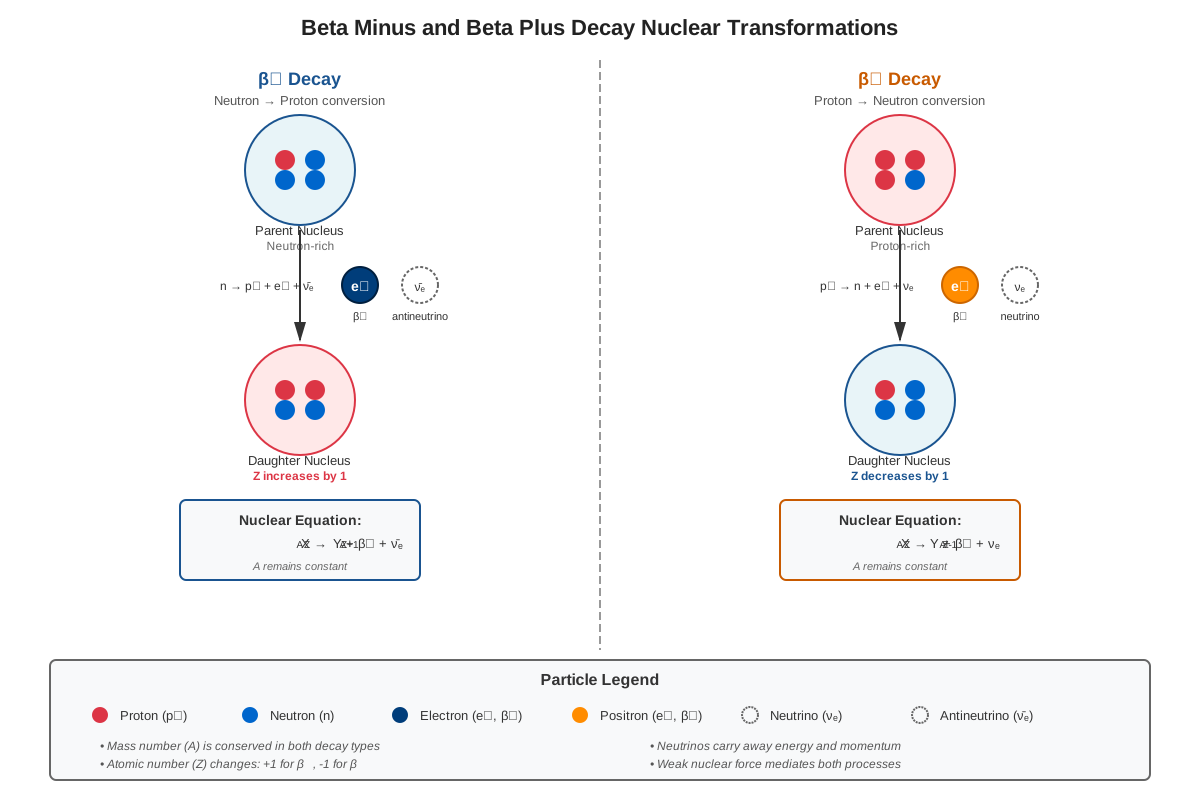
The two primary types of beta decay are β⁻ decay (beta-minus decay) and β⁺ decay (beta-plus decay). In β⁻ decay, a neutron converts into a proton, emitting an electron (the beta particle) and an electron antineutrino. In β⁺ decay, a proton converts into a neutron, emitting a positron and an electron neutrino. Both processes conserve charge, mass number (baryon number), and lepton number, though these conservation laws may not be explicitly tested at the MCAT level beyond charge and mass number.
Beta-Minus (β⁻) Decay
In β⁻ decay, a neutron-rich nucleus becomes more stable by converting a neutron into a proton. The nuclear equation for this process is:
n → p⁺ + e⁻ + ν̄ₑWhere n represents a neutron, p⁺ is a proton, e⁻ is the emitted electron (beta particle), and ν̄ₑ is an electron antineutrino. For a complete nuclear transformation, the equation appears as:
ᴬ_Z X → ᴬ_(Z+1) Y + e⁻ + ν̄ₑThe mass number A remains constant because the total number of nucleons (protons plus neutrons) doesn't change—one neutron simply transforms into one proton. However, the atomic number Z increases by one, creating a new element one position to the right on the periodic table. For example, carbon-14 undergoes β⁻ decay to become nitrogen-14:
¹⁴₆C → ¹⁴₇N + e⁻ + ν̄ₑThe antineutrino is a nearly massless, electrically neutral particle that carries away some of the energy and momentum from the decay. Its inclusion is necessary to satisfy conservation of energy and momentum—early physicists noticed that the emitted electrons had a continuous energy spectrum rather than discrete energies, which would violate energy conservation if only the electron were emitted. Wolfgang Pauli postulated the neutrino's existence in 1930 to resolve this paradox, and it was experimentally confirmed decades later.
Beta-Plus (β⁺) Decay
β⁺ decay occurs in proton-rich nuclei, where a proton converts into a neutron, emitting a positron (the antimatter counterpart of an electron) and an electron neutrino:
p⁺ → n + e⁺ + νₑThe complete nuclear equation is:
ᴬ_Z X → ᴬ_(Z-1) Y + e⁺ + νₑThe mass number remains constant, but the atomic number decreases by one, creating an element one position to the left on the periodic table. For example, fluorine-18 (used in PET scans) undergoes β⁺ decay to become oxygen-18:
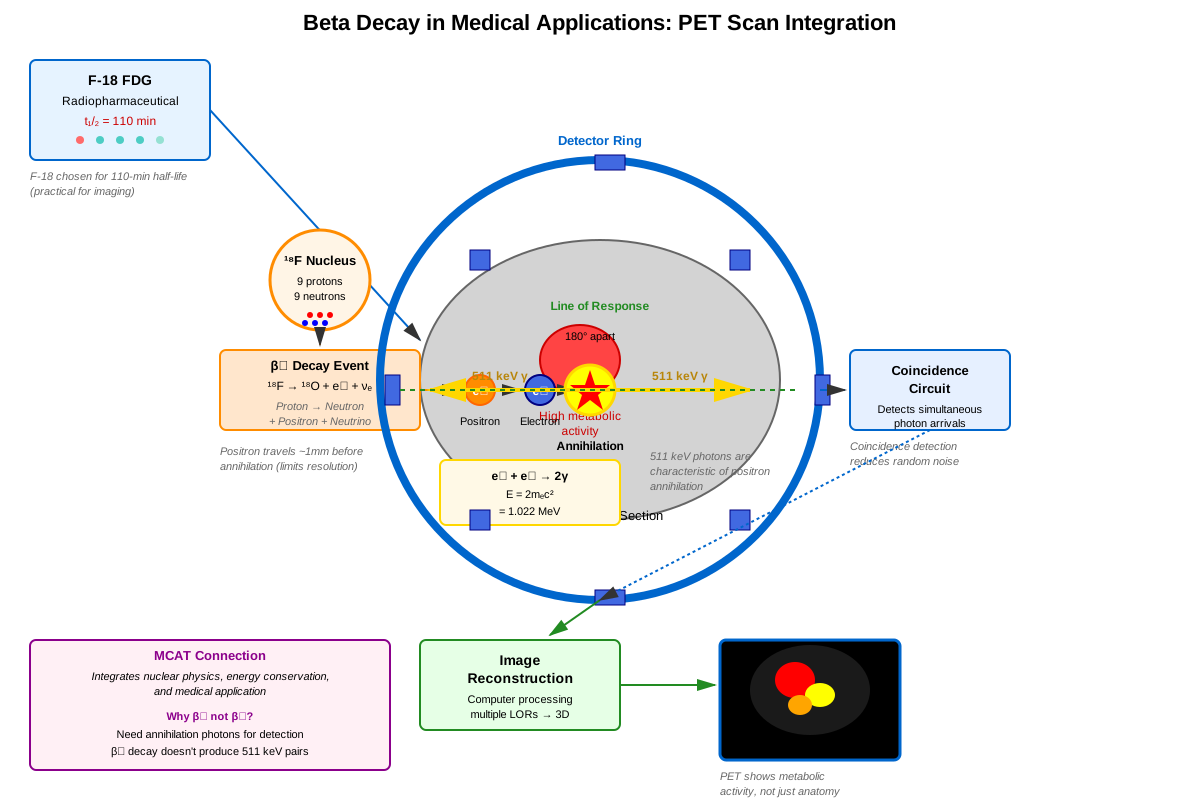
¹⁸₉F → ¹⁸₈O + e⁺ + νₑAn important consideration for β⁺ decay is that it requires more energy than β⁻ decay because the mass of a proton is less than the mass of a neutron, meaning energy must be supplied to create the heavier neutron. Additionally, the emitted positron quickly encounters an electron in surrounding matter, and the two particles annihilate, producing two gamma-ray photons traveling in opposite directions (each with 0.511 MeV energy). This annihilation process is the basis for PET imaging—detectors positioned around the patient detect these coincident gamma rays to localize where the decay occurred.
Electron Capture
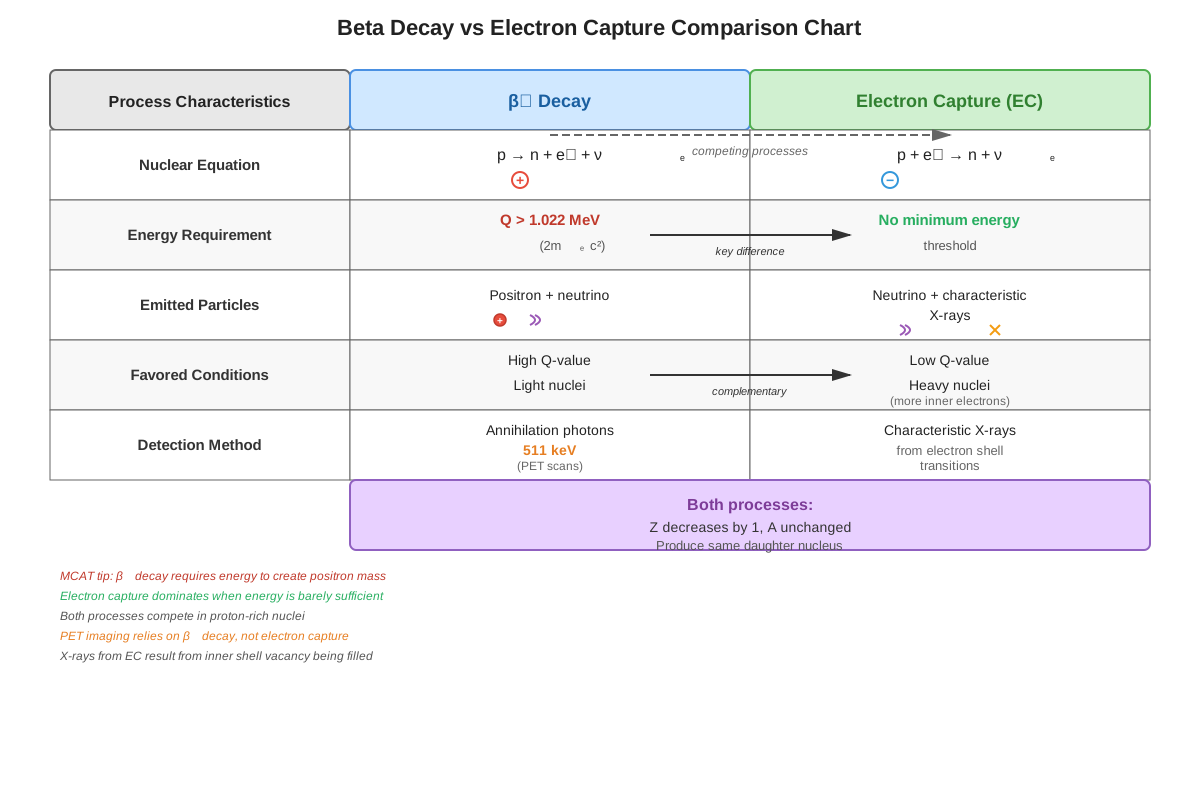
A related process to β⁺ decay is electron capture, where a proton-rich nucleus captures an inner orbital electron (usually from the K-shell), converting a proton into a neutron:
p⁺ + e⁻ → n + νₑThe complete nuclear equation is:
ᴬ_Z X + e⁻ → ᴬ_(Z-1) Y + νₑElectron capture competes with β⁺ decay in proton-rich nuclei. The net result is identical—the atomic number decreases by one while the mass number remains constant—but no positron is emitted. Instead, the atom emits characteristic X-rays as outer electrons fall into the vacancy left by the captured electron. Electron capture is energetically favorable when the mass difference between parent and daughter nuclei is less than twice the electron rest mass (1.022 MeV), making β⁺ decay impossible.
Energy Considerations and Q-Value
The energy released during beta decay, called the Q-value or disintegration energy, can be calculated using Einstein's mass-energy equivalence:
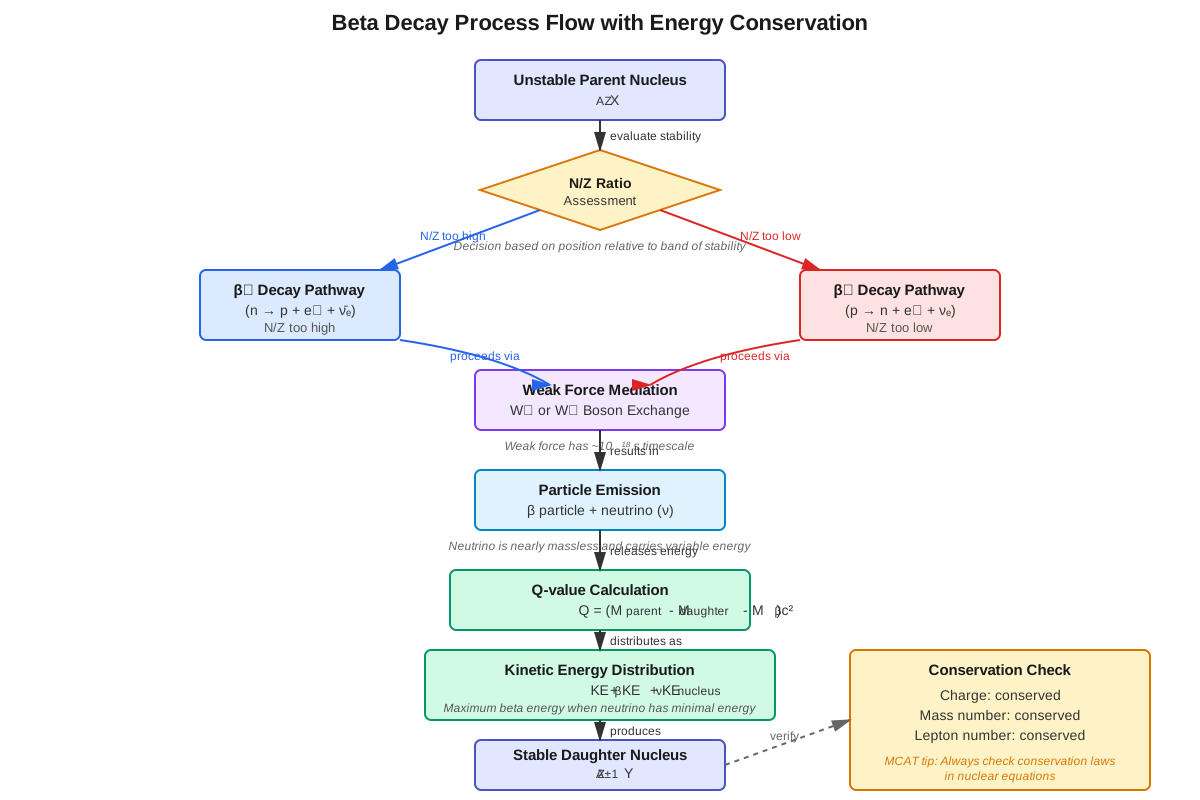
Q = (m_parent - m_daughter - m_particles)c²For β⁻ decay, this energy is shared between the emitted electron, the antineutrino, and the recoiling daughter nucleus. Because the neutrino is nearly massless and travels at nearly the speed of light, it can carry away a significant fraction of the available energy, resulting in a continuous energy spectrum for the emitted electrons rather than a single discrete energy.
For β⁺ decay, the Q-value must account for the creation of the positron and the subsequent annihilation energy. The threshold energy for β⁺ decay is 1.022 MeV (twice the electron rest mass energy of 0.511 MeV) because both a positron and the mass-energy equivalent of converting a lighter proton to a heavier neutron must be supplied.
Neutron-to-Proton Ratio and Nuclear Stability
The type of beta decay an isotope undergoes depends on its neutron-to-proton ratio (N/Z ratio) relative to the band of stability. Stable nuclei follow a predictable pattern: lighter elements (Z < 20) have N/Z ratios close to 1:1, while heavier elements require progressively more neutrons than protons for stability (N/Z ratios up to 1.5:1 for the heaviest stable nuclei).
| Condition | Decay Type | Result |
|---|---|---|
| Too many neutrons (N/Z too high) | β⁻ decay | Converts neutron to proton, decreases N/Z ratio |
| Too many protons (N/Z too low) | β⁺ decay or electron capture | Converts proton to neutron, increases N/Z ratio |
| Within band of stability | Stable (no decay) | No spontaneous transformation |
Nuclei above the band of stability are neutron-rich and undergo β⁻ decay to move toward stability. Nuclei below the band are proton-rich and undergo β⁺ decay or electron capture. This principle allows prediction of decay modes based solely on isotope composition.
Comparison of Beta Decay Types
| Feature | β⁻ Decay | β⁺ Decay | Electron Capture |
|---|---|---|---|
| Particle emitted | Electron (e⁻) | Positron (e⁺) | None (X-rays emitted) |
| Neutrino type | Antineutrino (ν̄ₑ) | Neutrino (νₑ) | Neutrino (νₑ) |
| Change in Z | +1 | -1 | -1 |
| Change in A | 0 | 0 | 0 |
| Occurs in | Neutron-rich nuclei | Proton-rich nuclei | Proton-rich nuclei |
| Energy threshold | None (always possible if energetically favorable) | 1.022 MeV minimum | Lower than β⁺ decay |
| Medical application | Therapeutic (I-131) | Diagnostic imaging (PET) | Less common clinically |
Concept Relationships
Beta decay concepts form an interconnected network centered on nuclear stability. The neutron-to-proton ratio serves as the primary determinant of decay type → which leads to either β⁻ decay (for neutron-rich nuclei) or β⁺ decay/electron capture (for proton-rich nuclei) → both processes conserve mass number while changing atomic number → this transformation releases energy quantified by the Q-value → the energy is distributed among decay products including the often-overlooked neutrino → understanding these relationships enables prediction of decay products and energy spectra.
Beta decay connects to prerequisite knowledge of nuclear structure through isotope notation and nucleon composition. The conservation laws applied in beta decay (charge, mass number, energy) are the same principles used in chemical reactions and other nuclear processes. The concept extends to related topics including half-life calculations (beta decay follows first-order kinetics), radiation safety (beta particles have specific penetration characteristics), and nuclear medicine applications (PET scans, radiotherapy).
The relationship between beta decay and electron capture illustrates how nature selects the most energetically favorable pathway: when insufficient energy exists for positron creation, electron capture becomes the dominant mechanism. Both processes achieve the same nuclear transformation (decreasing Z by one), demonstrating that multiple pathways can lead to the same stability outcome. This parallels chemical kinetics where multiple reaction mechanisms may produce identical products.
Quick check — test yourself on Beta decay so far.
Try Flashcards →High-Yield Facts
⭐ β⁻ decay increases atomic number by 1 while keeping mass number constant; β⁺ decay decreases atomic number by 1 while keeping mass number constant
⭐ Neutrinos (or antineutrinos) are always emitted in beta decay to conserve energy and momentum, explaining the continuous energy spectrum of emitted beta particles
⭐ Positrons from β⁺ decay annihilate with electrons to produce two 0.511 MeV gamma rays traveling in opposite directions—this is the basis for PET imaging
⭐ Neutron-rich isotopes (above the band of stability) undergo β⁻ decay; proton-rich isotopes (below the band) undergo β⁺ decay or electron capture
⭐ β⁺ decay requires a minimum energy of 1.022 MeV (twice the electron rest mass); electron capture has no such threshold and can occur at lower energies
- Beta particles (electrons or positrons) are more penetrating than alpha particles but less penetrating than gamma rays; they can be stopped by a few millimeters of aluminum
- Carbon-14 dating relies on β⁻ decay with a half-life of 5,730 years, converting ¹⁴C to ¹⁴N
- Fluorine-18 (half-life 110 minutes) is the most common PET radioisotope, incorporated into fluorodeoxyglucose (FDG) to image glucose metabolism
- In β⁻ decay, the emitted electron comes from the nucleus (not from electron shells), distinguishing it from orbital electrons
- The weak nuclear force mediates beta decay, making it much slower than electromagnetic processes (typical half-lives range from milliseconds to billions of years)
- Iodine-131 (β⁻ emitter, half-life 8 days) concentrates in the thyroid gland, making it useful for both imaging and destroying thyroid tissue
- Beta decay can be followed by gamma emission if the daughter nucleus is left in an excited state
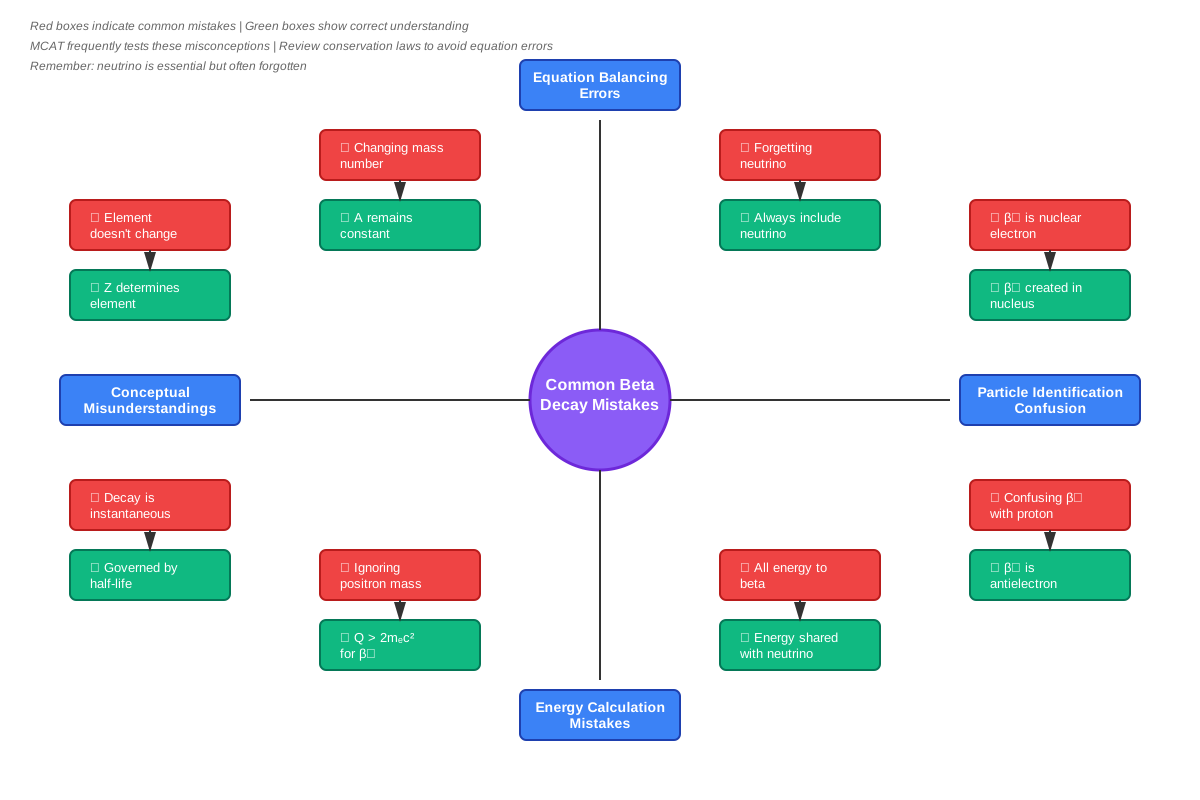
Common Misconceptions
Misconception: Beta particles are orbital electrons ejected from the atom during decay.
Correction: Beta particles (electrons in β⁻ decay) originate from the nucleus when a neutron transforms into a proton. They are not pre-existing orbital electrons but are created during the decay process itself.
Misconception: The mass number changes during beta decay because a particle is emitted.
Correction: The mass number (A) remains constant in all types of beta decay because the total number of nucleons doesn't change—one type of nucleon simply converts into another. Only the atomic number (Z) changes.
Misconception: All the energy released in beta decay goes to the emitted beta particle.
Correction: The decay energy is shared among the beta particle, the neutrino (or antineutrino), and the recoiling daughter nucleus. The neutrino can carry away a variable amount of energy, which is why beta particles show a continuous energy spectrum rather than discrete energies.
Misconception: β⁺ decay and β⁻ decay are equally likely for any unstable nucleus.
Correction: The type of beta decay depends on the neutron-to-proton ratio. Neutron-rich nuclei undergo β⁻ decay, while proton-rich nuclei undergo β⁺ decay or electron capture. A given isotope will undergo only one type based on its position relative to the band of stability.
Misconception: Positrons from β⁺ decay travel long distances through tissue before annihilating.
Correction: Positrons typically travel only 1-2 millimeters in tissue before encountering an electron and annihilating. This short range is actually advantageous for PET imaging because it provides good spatial resolution for localizing the decay event.
Misconception: Electron capture and β⁺ decay are completely different processes with different outcomes.
Correction: Both electron capture and β⁺ decay result in the same nuclear transformation (Z decreases by 1, A stays constant), converting a proton to a neutron. They are competing processes in proton-rich nuclei, with electron capture favored when insufficient energy exists for positron creation.
Misconception: The antineutrino in β⁻ decay is the same as the neutrino in β⁺ decay.
Correction: β⁻ decay produces an electron antineutrino (ν̄ₑ), while β⁺ decay produces an electron neutrino (νₑ). These are antiparticles of each other, though this distinction is rarely tested on the MCAT beyond recognizing that a neutrino-type particle is emitted.
Worked Examples
Example 1: Identifying Decay Type and Writing Nuclear Equations
Question: Phosphorus-32 is a radioisotope used in molecular biology research. It has 15 protons and 17 neutrons. Predict the type of decay it will undergo and write the complete nuclear equation.
Solution:
Step 1: Determine the neutron-to-proton ratio.
- N/Z = 17/15 = 1.13
Step 2: Compare to the band of stability.
- For light elements (Z < 20), the stable N/Z ratio is approximately 1:1
- Phosphorus-32 has excess neutrons (N/Z > 1), placing it above the band of stability
Step 3: Predict decay type.
- Neutron-rich isotopes undergo β⁻ decay to convert a neutron to a proton
Step 4: Write the nuclear equation.
- Parent nucleus: ³²₁₅P (mass number 32, atomic number 15)
- In β⁻ decay: Z increases by 1, A stays constant
- Daughter nucleus: ³²₁₆S (sulfur-32)
- Complete equation: ³²₁₅P → ³²₁₆S + e⁻ + ν̄ₑ
Step 5: Verify conservation laws.
- Mass number: 32 = 32 + 0 + 0 ✓
- Atomic number (charge): 15 = 16 + (-1) + 0 ✓
Answer: Phosphorus-32 undergoes β⁻ decay, producing sulfur-32, an electron, and an electron antineutrino.
Example 2: PET Scan Energy Calculation
Question: In a PET scan, fluorine-18 undergoes β⁺ decay. The emitted positron travels a short distance before annihilating with an electron. Calculate the total energy of the two gamma rays produced during annihilation, and explain why they travel in opposite directions.
Solution:
Step 1: Recall the annihilation process.
- When a positron (e⁺) meets an electron (e⁻), both particles are converted entirely into energy
- The process produces two gamma-ray photons
Step 2: Calculate the rest mass energy of each particle.
- Rest mass energy of electron: E = mc² = 0.511 MeV
- Rest mass energy of positron: E = mc² = 0.511 MeV (same as electron)
Step 3: Calculate total energy available.
- Total energy = 0.511 MeV + 0.511 MeV = 1.022 MeV
Step 4: Determine energy per photon.
- The energy is divided equally between two photons
- Energy per photon = 1.022 MeV ÷ 2 = 0.511 MeV
Step 5: Explain the opposite directions.
- Conservation of momentum requires that the total momentum before and after annihilation be equal
- Before annihilation, the positron and electron have approximately zero net momentum (they're nearly at rest when they meet)
- To conserve momentum, the two photons must travel in opposite directions with equal magnitude momenta
- This 180° separation is what PET scanners detect to localize the decay event
Answer: The two gamma rays have a total energy of 1.022 MeV (0.511 MeV each). They travel in opposite directions to conserve momentum, since the positron-electron pair had negligible net momentum before annihilation. This coincidence detection is the fundamental principle enabling PET imaging.
Exam Strategy
When approaching MCAT questions on beta decay, first identify what type of information is provided: isotope notation, neutron-to-proton ratio, or a description of the decay process. Trigger words include "neutron-rich" (suggests β⁻ decay), "proton-rich" (suggests β⁺ decay or electron capture), "PET scan" (indicates β⁺ decay and positron annihilation), and "continuous energy spectrum" (refers to the role of neutrinos).
For nuclear equation questions, immediately write down the parent nucleus notation and apply the appropriate changes: β⁻ decay increases Z by 1, β⁺ decay decreases Z by 1, and both keep A constant. Always verify that mass number and atomic number are conserved on both sides of the equation. If answer choices include different elements, use the periodic table to confirm that the atomic number matches the element symbol.
When questions involve energy calculations, remember that β⁺ decay has a threshold energy of 1.022 MeV, while β⁻ decay has no such threshold. If a question asks about positron annihilation, recall that two 0.511 MeV photons are produced traveling in opposite directions. For questions comparing decay types, use the neutron-to-proton ratio as your primary decision tool—this single piece of information determines the decay mode.
Process-of-elimination tips: If an answer choice shows the mass number changing during beta decay, eliminate it immediately. If a choice suggests that all decay energy goes to the beta particle (ignoring the neutrino), eliminate it. For questions about PET scans, any answer that doesn't mention positron annihilation or 0.511 MeV gamma rays is likely incorrect. When comparing penetration depths, remember the order: alpha < beta < gamma, so eliminate choices that reverse this order.
Time allocation: Straightforward nuclear equation questions should take 30-45 seconds. Questions requiring energy calculations or multiple steps may need 60-90 seconds. Passage-based questions integrating beta decay with clinical applications typically require 90-120 seconds. Don't spend excessive time trying to recall obscure details about neutrino physics—the MCAT focuses on the practical aspects of beta decay (equation balancing, energy, and applications) rather than particle physics minutiae.
Memory Techniques
Mnemonic for β⁻ decay: "Neutrons Need to Decrease" → β⁻ decay occurs when there are too many Neutrons, and it Decreases the neutron count (converting one to a proton). The atomic number goes UP (like the minus sign's opposite).
Mnemonic for β⁺ decay: "Protons Produce Positrons" → β⁺ decay occurs when there are too many Protons, and it Produces a Positron. The atomic number goes DOWN (like falling from a plus to a minus).
Visualization for positron annihilation: Picture a matter-antimatter collision like two cars crashing head-on—both are destroyed, and the energy radiates outward in opposite directions (the two gamma rays). The "180° rule" for PET imaging becomes intuitive when you visualize this symmetric explosion.
Acronym for conservation in beta decay: MACE - Mass number stays same, Atomic number changes, Charge is conserved, Energy is conserved. Check all four when balancing equations.
Memory aid for energy threshold: β⁺ decay needs "TWO electron masses" (1.022 MeV = TWO × 0.511 MeV) because you're creating a positron AND converting a lighter proton to a heavier neutron. The word "TWO" reminds you of both the threshold value and why it exists.
Visualization for neutrino role: Imagine the decay energy as a pie that must be divided among three "guests": the beta particle, the neutrino, and the recoiling nucleus. The neutrino is a "greedy guest" that can take anywhere from almost nothing to almost everything, which is why the beta particle's energy varies (continuous spectrum).
Summary
Beta decay is a nuclear transformation process mediated by the weak force in which unstable nuclei emit beta particles (electrons or positrons) along with neutrinos to achieve greater stability. The two main types—β⁻ decay and β⁺ decay—are determined by the neutron-to-proton ratio: neutron-rich nuclei undergo β⁻ decay (increasing atomic number by one), while proton-rich nuclei undergo β⁺ decay or electron capture (decreasing atomic number by one). In all cases, the mass number remains constant because the total number of nucleons is unchanged. The energy released during decay is shared among the beta particle, neutrino, and recoiling daughter nucleus, producing a continuous energy spectrum for the emitted beta particles. Positrons from β⁺ decay quickly annihilate with electrons, producing two 0.511 MeV gamma rays traveling in opposite directions—the fundamental principle behind PET imaging. Understanding beta decay requires mastery of nuclear equation balancing, conservation laws, energy calculations, and the relationship between nuclear composition and stability, all of which are regularly tested on the MCAT in both standalone questions and integrated passages involving medical applications.
Key Takeaways
- Beta decay transforms one element into another by changing atomic number (Z) while keeping mass number (A) constant through neutron-proton conversion
- β⁻ decay (neutron → proton + electron + antineutrino) occurs in neutron-rich nuclei and increases Z by 1
- β⁺ decay (proton → neutron + positron + neutrino) occurs in proton-rich nuclei, decreases Z by 1, and requires minimum 1.022 MeV energy
- Neutrinos are essential for energy and momentum conservation, creating the continuous energy spectrum of beta particles
- Positron annihilation produces two 0.511 MeV gamma rays in opposite directions, enabling PET imaging for medical diagnostics
- The neutron-to-proton ratio relative to the band of stability predicts which type of beta decay will occur
- Electron capture competes with β⁺ decay in proton-rich nuclei and becomes dominant when insufficient energy exists for positron creation
Related Topics
Alpha Decay: Understanding alpha decay (emission of helium-4 nuclei) complements beta decay knowledge and completes the picture of radioactive decay modes. Both processes move nuclei toward the band of stability through different mechanisms.
Gamma Decay: Often follows beta decay when daughter nuclei are left in excited states. Mastering gamma emission helps explain why some beta emitters also produce gamma radiation, important for radiation safety and medical imaging.
Half-Life and Decay Kinetics: Beta decay follows first-order kinetics with characteristic half-lives. Understanding exponential decay enables calculation of remaining activity, dating applications, and radiopharmaceutical dosing.
Nuclear Binding Energy: The energy released in beta decay comes from differences in nuclear binding energy between parent and daughter nuclei. This topic provides the thermodynamic foundation for understanding why certain decays are spontaneous.
Medical Imaging Modalities: Beta decay applications in PET scans connect to broader topics of diagnostic imaging, including CT, MRI, and X-ray techniques, allowing comparison of different modalities' strengths and limitations.
Radiation Biology and Safety: Understanding beta particle penetration, ionization potential, and biological effects extends beta decay knowledge into practical radiation protection and therapeutic applications.
Practice CTA
Now that you've mastered the fundamentals of beta decay, it's time to solidify your understanding through active practice. Challenge yourself with MCAT-style questions that test nuclear equation balancing, energy calculations, and clinical applications of beta-emitting radioisotopes. Use flashcards to drill the key differences between β⁻ and β⁺ decay, memorize common medical radioisotopes and their decay modes, and practice predicting decay types from neutron-to-proton ratios. Remember: understanding beta decay isn't just about memorizing equations—it's about developing the intuition to quickly analyze nuclear transformations and connect them to real-world medical applications. Your ability to confidently approach beta decay questions will directly translate to points on test day. Keep practicing, and you'll find that these concepts become second nature!
Sign up free to keep reading
Create a free AnvayaPrep account to finish this MCAT guide on Beta decay — plus flashcards and practice questions.