Overview
Current is one of the foundational concepts in Electricity and Magnetism, representing the flow of electric charge through a conductor over time. Understanding current is essential for the MCAT because it forms the basis for analyzing circuits, understanding physiological processes like nerve conduction and cardiac electrophysiology, and solving quantitative problems involving electrical systems. The concept appears frequently in both passage-based and discrete questions, often integrated with topics such as resistance, voltage, power, and capacitance.
On the MCAT, Current Physics questions test not only computational skills but also conceptual understanding of charge movement, the distinction between conventional and electron flow, and the relationship between microscopic charge carrier behavior and macroscopic circuit properties. Students must be comfortable converting between different units, applying Kirchhoff's laws, and recognizing how current behaves in series versus parallel configurations. The topic bridges fundamental physics principles with practical applications in medical devices, diagnostic equipment, and biological systems.
Mastery of Current MCAT content enables students to tackle more complex topics including magnetic fields generated by moving charges, electromagnetic induction, and the behavior of RC circuits. This topic integrates mathematical problem-solving with conceptual reasoning, making it a medium-difficulty but high-yield area that rewards systematic study and practice.
Learning Objectives
- [ ] Define Current using accurate Physics terminology
- [ ] Explain why Current matters for the MCAT
- [ ] Apply Current to exam-style questions
- [ ] Identify common mistakes related to Current
- [ ] Connect Current to related Physics concepts
- [ ] Calculate current using the fundamental definition and Ohm's law
- [ ] Distinguish between conventional current and electron flow in various contexts
- [ ] Analyze current distribution in series and parallel circuit configurations
- [ ] Relate microscopic charge carrier properties (drift velocity, charge density) to macroscopic current
Prerequisites
- Electric charge and Coulomb's law: Understanding charge as a fundamental property is essential because current represents the movement of these charges
- Basic algebra and unit conversions: Current calculations require manipulating equations and converting between units like amperes, milliamperes, and coulombs per second
- Voltage and electric potential: Current flow is driven by potential differences, making voltage a prerequisite for understanding what causes charge movement
- Basic circuit components: Familiarity with conductors, resistors, and power sources provides context for where and how current flows
Why This Topic Matters
Clinical and Real-World Significance
Current is fundamental to numerous medical applications and physiological processes. Electrocardiography (ECG) measures the electrical currents generated by cardiac muscle depolarization, allowing diagnosis of arrhythmias and myocardial infarctions. Defibrillators deliver controlled electrical currents to restore normal heart rhythm. Nerve conduction studies measure the current flow along neurons to diagnose neuropathies. Understanding current is also essential for medical device safety, as excessive current through the body can cause burns, muscle contractions, or cardiac arrest.
MCAT Exam Statistics
Current appears in approximately 3-5% of Physics questions on the MCAT, with representation in both the Chemical and Physical Foundations of Biological Systems section and occasionally in passage-based questions that integrate physics with biological systems. Questions typically fall into three categories: (1) direct calculation problems requiring application of the current definition or Ohm's law, (2) conceptual questions about current behavior in circuits, and (3) passage-based questions involving experimental setups with electrical measurements.
Common Exam Contexts
The MCAT frequently presents current in the context of circuit analysis where students must determine current through specific components, physiological passages describing action potentials or cardiac conduction, experimental setups involving ammeters and measurement techniques, and power calculations for medical devices. Passages may describe research on ion channels, electrical safety protocols, or the development of biomedical sensors, all requiring solid understanding of current principles.
Core Concepts
Definition of Current
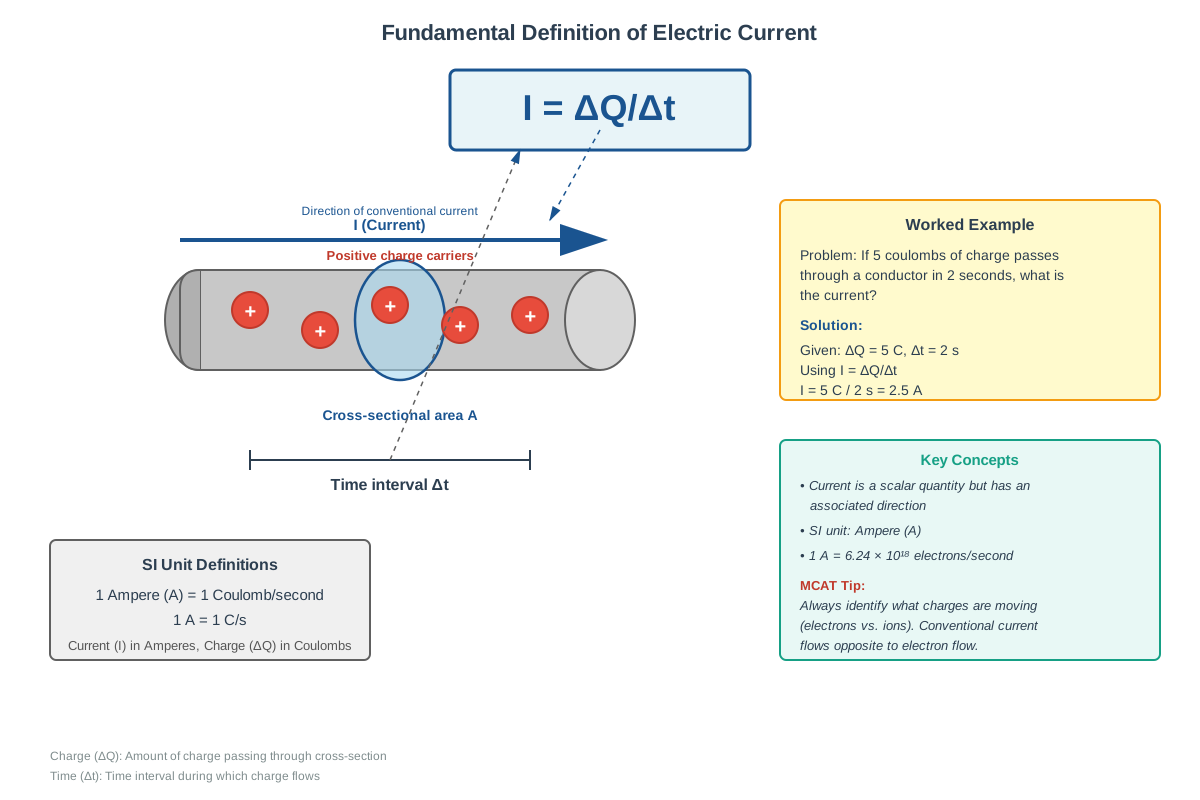
Current (symbol: I) is defined as the rate of flow of electric charge through a cross-sectional area. Mathematically, current is expressed as:
I = ΔQ/Δtwhere ΔQ represents the amount of charge (in coulombs) passing through a point and Δt represents the time interval (in seconds). The SI unit of current is the ampere (A), where 1 ampere equals 1 coulomb per second (1 A = 1 C/s). This fundamental definition applies universally, whether analyzing electron flow in metallic conductors, ion movement in electrolyte solutions, or charge transfer in biological membranes.
For steady-state current (constant flow), the equation simplifies to I = Q/t. However, for time-varying currents, the instantaneous current is defined as the derivative: I = dQ/dt. On the MCAT, most problems involve constant or average current values, making the simpler algebraic form sufficient.
Conventional Current vs. Electron Flow
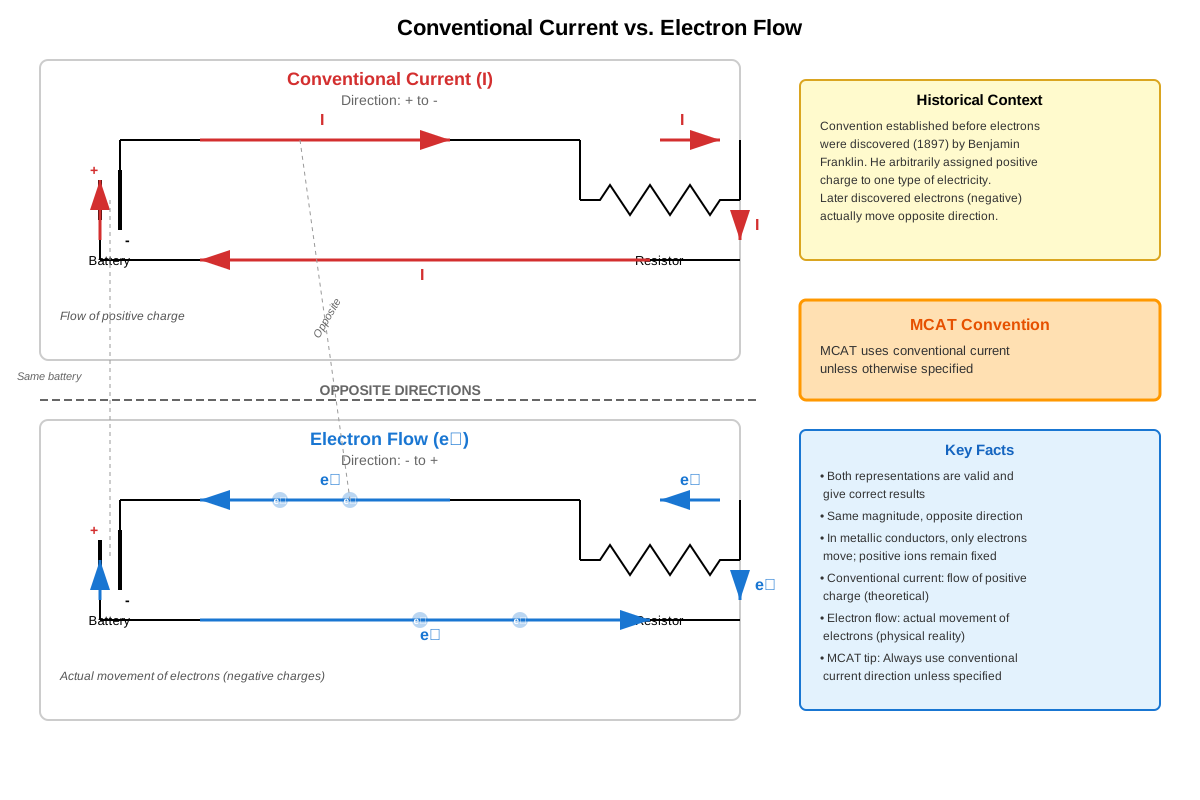
A critical distinction exists between conventional current and actual electron flow. By historical convention established before the discovery of the electron, current is defined as flowing from positive to negative terminals—the direction positive charges would move. However, in metallic conductors, the actual charge carriers are electrons, which move from negative to positive terminals (opposite to conventional current direction).
For MCAT purposes, unless explicitly stated otherwise, always use conventional current direction (positive to negative). This convention is consistent with circuit diagrams, right-hand rules for magnetic fields, and standard physics notation. The distinction matters primarily for understanding the microscopic mechanism but doesn't affect circuit calculations, as the magnitude of current remains the same regardless of which convention is used.
Microscopic Model of Current
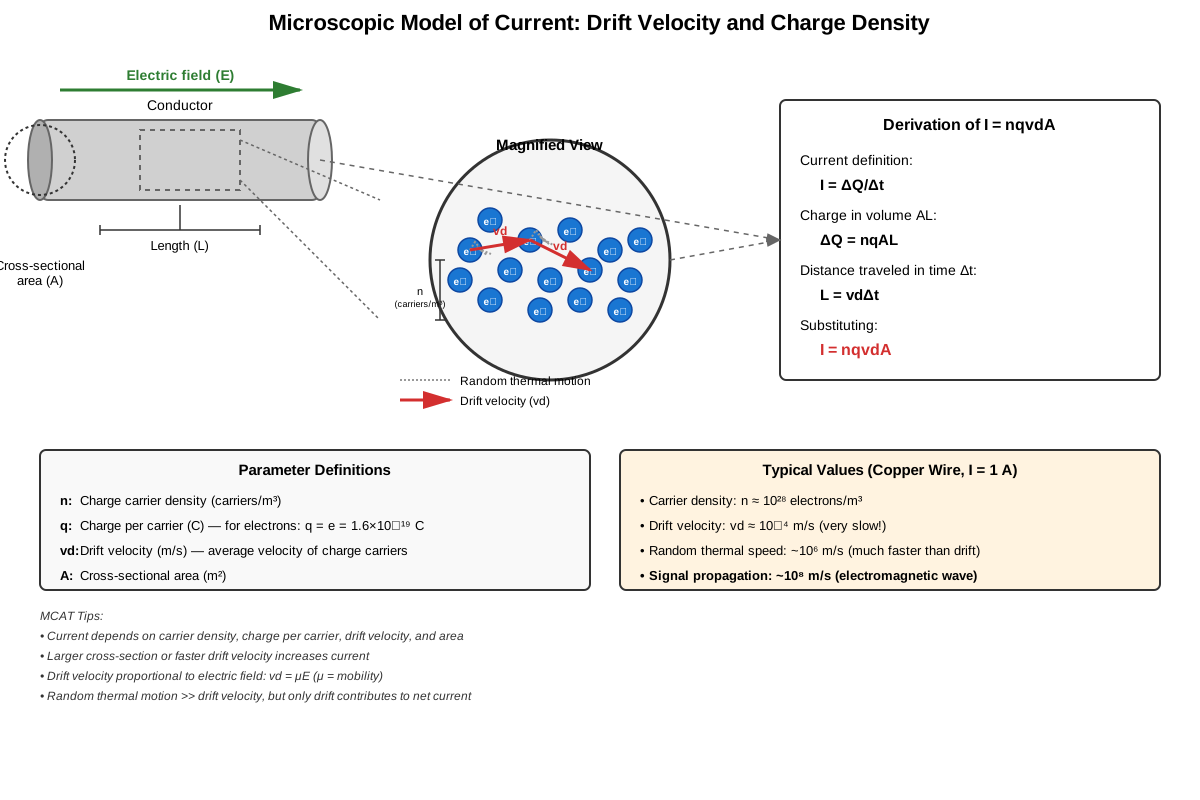
At the microscopic level, current in metallic conductors results from the drift velocity of free electrons. When an electric field is applied across a conductor, electrons experience a force and accelerate, but they constantly collide with atoms in the lattice, resulting in a net average velocity called the drift velocity (v_d). The relationship between microscopic properties and macroscopic current is:
I = nAqv_dwhere:
- n = number density of charge carriers (charges per unit volume)
- A = cross-sectional area of the conductor
- q = charge of each carrier (for electrons, q = 1.6 × 10^-19 C)
- v_d = drift velocity
This equation reveals that current depends on both material properties (n) and geometric factors (A). Surprisingly, drift velocities in typical conductors are quite small (millimeters per second), yet electrical signals propagate at nearly the speed of light because the electric field propagates rapidly, causing all electrons to begin moving almost simultaneously.
Types of Current
Direct current (DC) flows in one constant direction with constant or slowly varying magnitude. Batteries and DC power supplies produce direct current. Alternating current (AC) periodically reverses direction, typically following a sinusoidal pattern. Household electrical outlets provide AC at 60 Hz in North America. While the MCAT focuses primarily on DC circuits, understanding the distinction is important for interpreting experimental passages.
Current in Series and Parallel Circuits
The behavior of current in different circuit configurations is fundamental to circuit analysis:
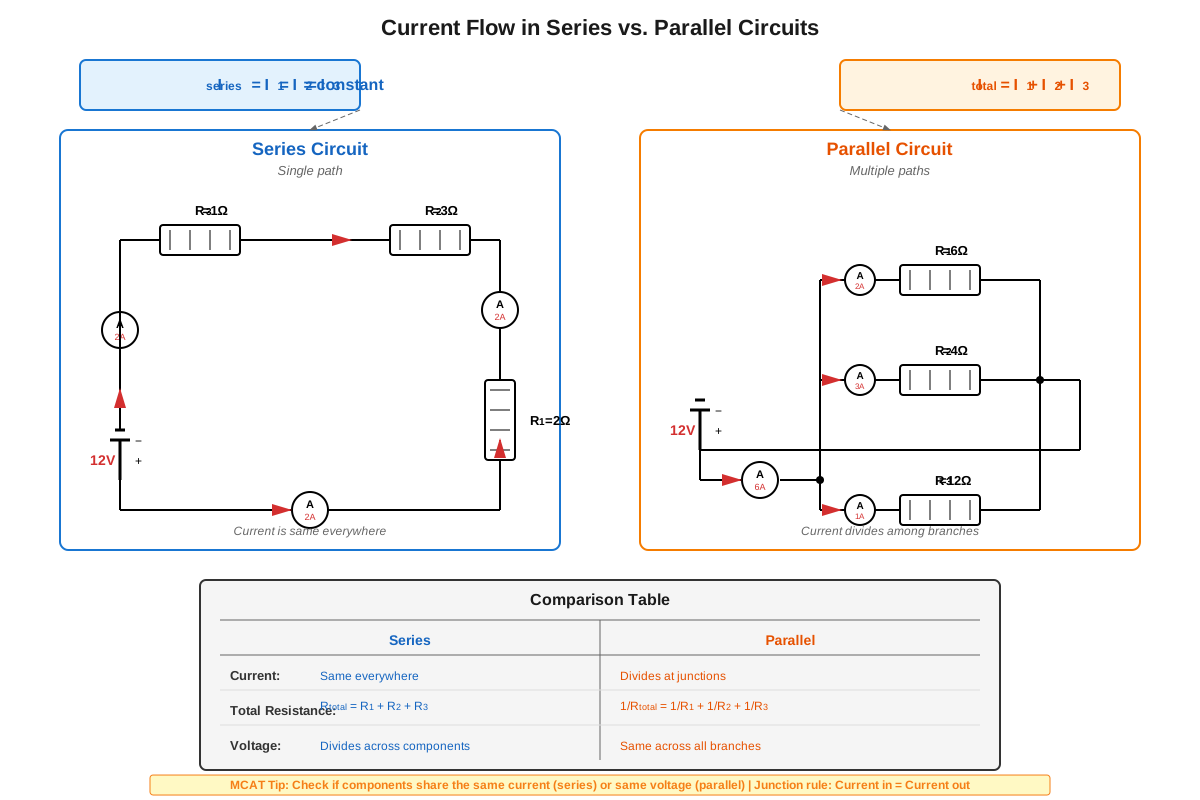
| Circuit Type | Current Behavior | Key Principle | |
|---|---|---|---|
| Series | Same current through all components | I_total = I_1 = I_2 = I_3 | |
| Parallel | Current divides among branches | I_total = I_1 + I_2 + I_3 |
In series circuits, charge has only one path, so the same current must flow through each component (conservation of charge). In parallel circuits, charge can take multiple paths, so the total current entering a junction equals the sum of currents leaving the junction (Kirchhoff's Current Law or KCL).
Relationship to Ohm's Law
While Ohm's law (V = IR) is technically a separate concept, it's intimately connected to current and frequently used to calculate current when voltage and resistance are known:
I = V/RThis relationship indicates that current is directly proportional to voltage (potential difference) and inversely proportional to resistance. Higher voltage drives more current through a given resistance, while higher resistance impedes current flow for a given voltage.
Current Density
Current density (J) represents current per unit area and is particularly useful when analyzing conductors with varying cross-sections:
J = I/ACurrent density is a vector quantity pointing in the direction of current flow. This concept connects to the microscopic model through J = nqv_d and is occasionally tested in more advanced MCAT passages involving material properties or non-uniform conductors.
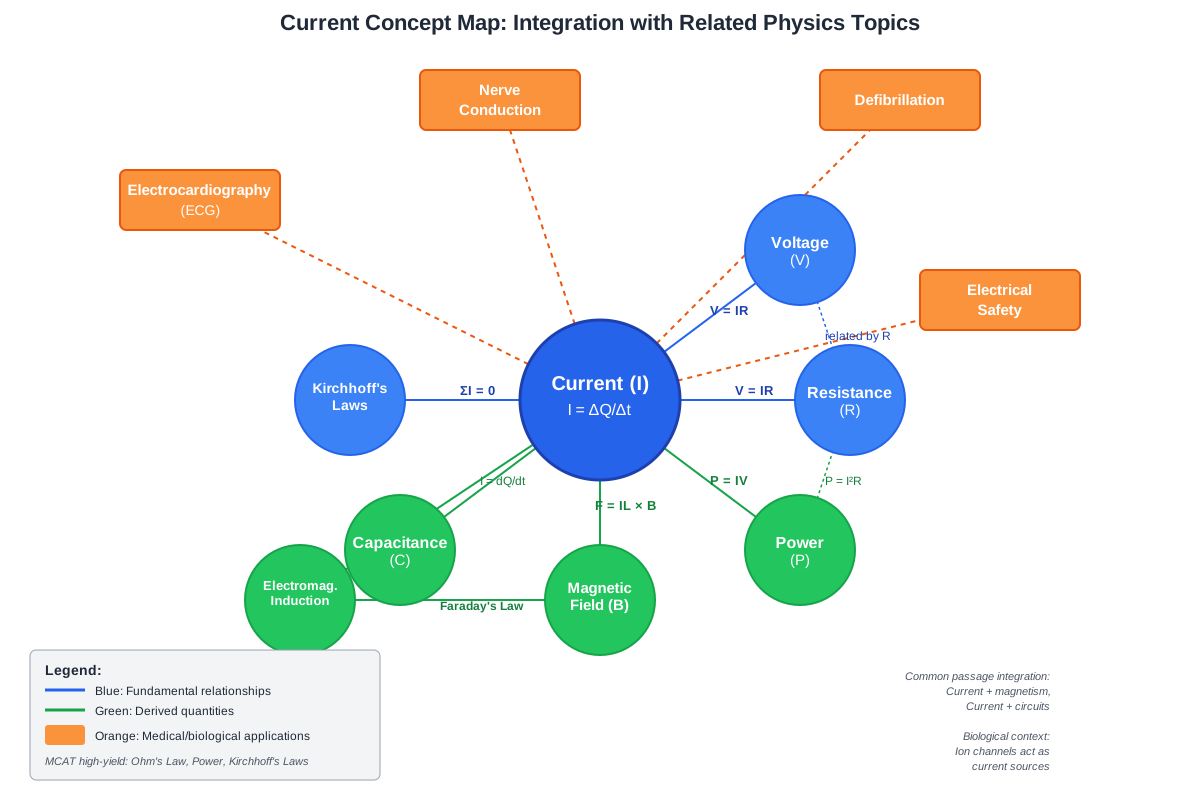
Concept Relationships
The concept of current serves as a central hub connecting multiple electricity and magnetism topics. Current is fundamentally defined by charge (Q) and time (t), making it dependent on understanding electric charge as a conserved quantity. The flow of current is driven by voltage (electric potential difference), establishing the causal relationship: voltage → current flow.
Resistance opposes current flow, creating the inverse relationship expressed in Ohm's law: I = V/R. This triad (voltage, current, resistance) forms the foundation of circuit analysis. Current also determines power dissipation through P = IV = I²R, connecting electrical concepts to energy considerations.
At the microscopic level, current connects to charge carrier properties through the drift velocity equation, linking macroscopic measurements to material science. Moving charges (current) generate magnetic fields (Biot-Savart law, Ampère's law), bridging electricity and magnetism. Time-varying magnetic fields induce currents through electromagnetic induction (Faraday's law), completing the electromagnetic connection.
In circuit analysis, current behavior is governed by Kirchhoff's Current Law (junction rule), which stems from charge conservation. The distribution of current in series versus parallel configurations depends on the circuit topology and resistance values, connecting current to circuit design principles.
Relationship Map:
Electric Charge → Current (charge flow rate) → Magnetic Field Generation
Voltage (potential difference) → Drives Current → Power Dissipation
Resistance → Opposes Current → Heat Generation
Current Distribution → Series/Parallel Topology → Kirchhoff's Laws
Microscopic Drift Velocity → Macroscopic Current → Circuit Measurements
High-Yield Facts
⭐ Current is defined as I = Q/t, measured in amperes (A), where 1 A = 1 C/s
⭐ Conventional current flows from positive to negative terminals, opposite to electron flow in conductors
⭐ In series circuits, current is the same through all components; in parallel circuits, current divides among branches
⭐ Kirchhoff's Current Law states that the sum of currents entering a junction equals the sum leaving (charge conservation)
⭐ Ohm's law relates current to voltage and resistance: I = V/R
- Current density J = I/A represents current per unit cross-sectional area
- The microscopic current equation I = nAqv_d connects drift velocity to macroscopic current
- Direct current (DC) flows in one direction; alternating current (AC) periodically reverses direction
- Power dissipated by current through a resistor is P = I²R
- An ammeter measures current and must be connected in series with the component being measured
- Current through a conductor is directly proportional to the applied voltage (for ohmic materials)
- The drift velocity of electrons in typical conductors is surprisingly slow (mm/s), but signals propagate at nearly the speed of light
- Current can be carried by different charge carriers: electrons in metals, ions in solutions, both electrons and holes in semiconductors
Quick check — test yourself on Current so far.
Try Flashcards →Common Misconceptions
Misconception: Current is "used up" as it flows through a circuit, so less current exits a resistor than enters it.
Correction: Current is conserved in a circuit. The same current that enters a resistor exits it. What decreases across a resistor is voltage (potential energy per charge), not current. This confusion arises from conflating current with energy.
Misconception: Higher resistance means higher current.
Correction: For a given voltage, higher resistance results in lower current (I = V/R). Resistance opposes current flow. Students sometimes confuse the relationship, thinking resistance "creates" current rather than impeding it.
Misconception: Electrons move at the speed of light through conductors.
Correction: Individual electrons drift very slowly (millimeters per second) due to constant collisions. However, the electric field propagates at nearly the speed of light, causing all electrons to begin moving almost simultaneously. This explains why lights turn on instantly despite slow electron drift.
Misconception: Conventional current direction is "wrong" and electron flow direction is "correct."
Correction: Both are valid conventions. Conventional current (positive to negative) is the standard used in circuit analysis, physics equations, and the MCAT. Electron flow (negative to positive) describes the actual particle motion in metals. Neither is wrong; they're different perspectives on the same phenomenon.
Misconception: Current splits equally in parallel branches.
Correction: Current divides inversely proportional to resistance in parallel branches. The branch with lower resistance carries more current. Equal current division only occurs when branch resistances are equal. The relationship is I₁/I₂ = R₂/R₁ for two parallel branches.
Misconception: Amperes measure the "strength" or "force" of electricity.
Correction: Amperes measure the rate of charge flow, not force. Voltage (potential difference) is more analogous to "electrical pressure" or the driving force. Current is the response to that driving force, modulated by resistance.
Misconception: A wire carrying current has a net charge.
Correction: Current-carrying wires are electrically neutral overall. Current represents moving charges, but the wire contains equal amounts of positive (atomic nuclei) and negative (electrons) charges. The electrons move, but the wire remains neutral.
Worked Examples
Example 1: Calculating Current from Charge Flow
Problem: A defibrillator delivers 360 J of energy at 2000 V to a patient's heart. If the discharge lasts 10 ms, what is the average current delivered?
Solution:
Step 1: Identify what we know and what we need to find.
- Energy: E = 360 J
- Voltage: V = 2000 V
- Time: t = 10 ms = 0.010 s
- Find: Current (I)
Step 2: Determine the relevant equations.
We know that power P = E/t and also P = IV. We can combine these to find current.
Step 3: Calculate power.
P = E/t = 360 J / 0.010 s = 36,000 W = 36 kWStep 4: Calculate current using P = IV.
I = P/V = 36,000 W / 2000 V = 18 AAnswer: The average current delivered is 18 amperes.
Key Insights: This problem integrates current with power and energy concepts, typical of MCAT questions. The high current value (18 A) is realistic for defibrillators, which deliver brief, intense electrical pulses. Notice how we converted milliseconds to seconds—unit consistency is crucial.
Example 2: Current Distribution in a Parallel Circuit
Problem: A circuit contains a 12 V battery connected to two parallel resistors: R₁ = 4 Ω and R₂ = 6 Ω. Calculate: (a) the total current from the battery, (b) the current through each resistor, and (c) verify Kirchhoff's Current Law.
Solution:
Step 1: Find the equivalent resistance for parallel resistors.
1/R_eq = 1/R₁ + 1/R₂ = 1/4 + 1/6 = 3/12 + 2/12 = 5/12
R_eq = 12/5 = 2.4 Ω
Step 2: Calculate total current using Ohm's law.
I_total = V/R_eq = 12 V / 2.4 Ω = 5 AStep 3: Calculate current through each resistor.
In parallel, voltage across each branch equals the source voltage (12 V).
I₁ = V/R₁ = 12 V / 4 Ω = 3 A
I₂ = V/R₂ = 12 V / 6 Ω = 2 A
Step 4: Verify Kirchhoff's Current Law.
I_total = I₁ + I₂ = 3 A + 2 A = 5 A ✓Answer: (a) Total current = 5 A, (b) I₁ = 3 A, I₂ = 2 A, (c) KCL verified: 5 A = 3 A + 2 A
Key Insights: Notice that more current flows through the smaller resistor (R₁), demonstrating that current takes the path of least resistance. The verification step using Kirchhoff's Current Law reinforces charge conservation. This type of multi-part problem is common on the MCAT and tests both calculation skills and conceptual understanding.
Example 3: Microscopic Current Analysis
Problem: A copper wire with cross-sectional area 2.0 × 10⁻⁶ m² carries a current of 5.0 A. If copper has a free electron density of 8.5 × 10²⁸ electrons/m³, calculate the drift velocity of electrons.
Solution:
Step 1: Identify the relevant equation.
I = nAqv_dStep 2: Solve for drift velocity.
v_d = I/(nAq)Step 3: Substitute values (q = 1.6 × 10⁻¹⁹ C for electron charge).
v_d = 5.0 A / [(8.5 × 10²⁸ m⁻³)(2.0 × 10⁻⁶ m²)(1.6 × 10⁻¹⁹ C)]
v_d = 5.0 / (2.72 × 10⁴) = 1.84 × 10⁻⁴ m/s = 0.184 mm/sAnswer: The drift velocity is approximately 0.18 mm/s.
Key Insights: This remarkably slow drift velocity surprises many students but is typical for conductors. Despite slow electron movement, the electric field propagates rapidly, enabling near-instantaneous signal transmission. This problem connects microscopic and macroscopic perspectives, a conceptual link the MCAT occasionally tests.
Exam Strategy
Approaching Current Questions
When encountering current problems on the MCAT, first identify whether the question asks for a calculation (requiring equations) or conceptual understanding (requiring qualitative reasoning). For calculations, immediately write down I = Q/t or I = V/R depending on given information. For circuit problems, sketch the circuit if not provided, labeling all known values.
Trigger Words and Phrases
Watch for these key phrases that signal current-related questions:
- "Rate of charge flow" or "charge per unit time" → direct application of I = Q/t
- "Ammeter reading" → current measurement, remember ammeters are in series
- "Current through" or "current in" → may require Ohm's law or circuit analysis
- "Total current" in parallel circuits → sum of branch currents
- "Same current" → indicates series configuration
- "Drift velocity" or "charge carrier density" → microscopic model (I = nAqv_d)
Process of Elimination Tips
For conceptual questions about current:
- Eliminate choices suggesting current is "used up" or decreases through components in series
- Eliminate choices confusing current direction with electron flow (unless specifically asked about electrons)
- Eliminate choices suggesting current splits equally in parallel branches with unequal resistances
- For "which carries more current" questions in parallel circuits, eliminate the branch with higher resistance
Time Allocation
Current calculations are typically straightforward and should take 45-60 seconds for discrete questions. Passage-based questions may require 90-120 seconds if circuit analysis is involved. If a problem requires multiple steps (finding equivalent resistance, then current, then power), budget 2 minutes maximum. Don't get bogged down in complex circuit analysis—the MCAT rarely requires more than two-step calculations.
Exam Tip: If you forget whether current is the same or divides in a particular configuration, think about charge conservation. Charge can't accumulate or disappear, so trace where it must go. This first-principles reasoning can reconstruct series/parallel rules.
Memory Techniques
Mnemonics
"I = Q/t: I Quickly Transfer" - Reminds you that current (I) equals charge (Q) transferred over time (t).
"CIVIL" - While primarily for capacitors and inductors in AC circuits, the "I" reminds you that current (I) is measured in amperes and is central to circuit analysis.
"Series Same, Parallel Parts" - In series circuits, current is the same through all components; in parallel circuits, current parts (divides) among branches.
Visualization Strategies
Water Analogy: Visualize current as water flow rate (gallons per minute), voltage as water pressure, and resistance as pipe narrowness. Just as more pressure drives more flow through a given pipe, more voltage drives more current through a given resistance. This analogy helps remember that current is a rate (flow) rather than a quantity.
Charge Carrier March: Picture electrons as soldiers marching through a wire. In series, they march single-file through each component (same current). In parallel, the group splits at junctions, with more soldiers taking the easier path (lower resistance branch carries more current).
Acronyms
VIPER - Voltage, Current (I), Power, Energy, Resistance - the five key electrical quantities that interrelate. Current is the central "I" connecting the others.
Summary
Current represents the fundamental rate of electric charge flow through a conductor, defined mathematically as I = Q/t and measured in amperes. Understanding current is essential for MCAT success because it connects to virtually every electricity and magnetism topic, appears in circuit analysis problems, and has direct medical applications in cardiac electrophysiology and medical devices. The key conceptual distinctions include recognizing that conventional current flows from positive to negative (opposite to electron flow), current remains constant through series components but divides in parallel branches according to Kirchhoff's Current Law, and current is driven by voltage but opposed by resistance as expressed in Ohm's law (I = V/R). At the microscopic level, current results from charge carrier drift velocity, though this drift is surprisingly slow despite rapid signal propagation. Mastering current requires both computational facility with the defining equations and conceptual understanding of how current behaves in different circuit configurations, making it a medium-difficulty topic that rewards systematic study and practice with worked examples.
Key Takeaways
- Current is the rate of charge flow: I = Q/t, measured in amperes (1 A = 1 C/s), representing how much charge passes a point per unit time
- Conventional current flows positive to negative, opposite to electron flow in metallic conductors, and this convention is used consistently in MCAT problems
- Series circuits maintain constant current through all components, while parallel circuits divide current among branches with more current through lower resistance paths
- Kirchhoff's Current Law (junction rule) states that current entering a junction equals current leaving, reflecting charge conservation
- Ohm's law (I = V/R) is the primary tool for calculating current when voltage and resistance are known
- Current connects to power through P = IV = I²R, making it essential for energy calculations in circuits
- Microscopic understanding (I = nAqv_d) links drift velocity and charge carrier density to macroscopic current measurements
Related Topics
Resistance and Resistivity: Understanding how materials oppose current flow and how resistance depends on geometry and material properties enables deeper circuit analysis and explains why current distributes as it does in parallel branches.
Ohm's Law and Power: The relationships V = IR and P = IV = I²R are inseparable from current and essential for solving most MCAT circuit problems involving energy dissipation.
Kirchhoff's Laws: Both the current law (junction rule) and voltage law (loop rule) build directly on current concepts and are necessary for analyzing complex circuits.
Capacitors and RC Circuits: Time-varying current in charging and discharging capacitors extends current concepts to dynamic situations, occasionally tested in higher-difficulty MCAT questions.
Magnetism and Electromagnetic Induction: Moving charges (current) generate magnetic fields, and changing magnetic fields induce currents, forming the complete electromagnetic picture essential for advanced MCAT physics.
Biological Applications: Action potentials, cardiac conduction, and electrodiagnostic techniques all involve current flow through biological tissues, connecting physics to physiological passages.
Practice CTA
Now that you've mastered the core concepts of current, it's time to solidify your understanding through active practice. Work through the practice questions and flashcards to test your ability to apply these principles under exam conditions. Focus especially on distinguishing series from parallel current behavior and on integrating current with Ohm's law and power calculations. Remember, the MCAT rewards not just knowledge but the ability to apply concepts quickly and accurately under time pressure. Each practice problem you solve builds the pattern recognition and problem-solving speed that will serve you on test day. You've built a strong foundation—now strengthen it through deliberate practice!
Sign up free to keep reading
Create a free AnvayaPrep account to finish this MCAT guide on Current — plus flashcards and practice questions.