Overview
The electric field is one of the most fundamental concepts in Physics, serving as the bridge between electrostatics and the behavior of charged particles in space. An electric field represents the force per unit charge exerted on a test charge at any point in space, providing a powerful framework for understanding how charges interact without direct contact. This concept is essential for Electricity and Magnetism, forming the foundation for understanding capacitors, electric potential, circuits, and electromagnetic phenomena that appear frequently on the MCAT.
For the MCAT, electric field concepts appear in both passage-based and discrete questions within the Chemical and Physical Foundations of Biological Systems section. Students must be comfortable calculating electric field magnitudes and directions, understanding field line representations, and applying superposition principles to multiple charge configurations. The topic bridges pure physics problems with biological applications, such as understanding nerve impulse transmission, electrocardiography, and the behavior of ions in biological membranes.
Mastering electric fields provides the conceptual foundation for understanding electric potential energy, voltage, capacitance, and the behavior of charged particles in uniform and non-uniform fields. This topic connects directly to Coulomb's law, vector addition, and force concepts while serving as a prerequisite for more advanced topics in circuits and electromagnetic induction. The ability to visualize and calculate electric fields is a high-yield skill that appears across multiple question types on the MCAT.
Learning Objectives
- [ ] Define Electric field using accurate Physics terminology
- [ ] Explain why Electric field matters for the MCAT
- [ ] Apply Electric field to exam-style questions
- [ ] Identify common mistakes related to Electric field
- [ ] Connect Electric field to related Physics concepts
- [ ] Calculate the magnitude and direction of electric fields from point charges and charge distributions
- [ ] Apply the principle of superposition to determine net electric fields from multiple sources
- [ ] Interpret electric field line diagrams and relate field line density to field strength
- [ ] Predict the motion of charged particles placed in uniform and non-uniform electric fields
Prerequisites
- Coulomb's Law: Understanding the force between two point charges is essential because the electric field is defined as force per unit charge
- Vector Addition and Components: Electric fields are vector quantities requiring vector addition skills to determine net fields from multiple sources
- Basic Algebra and Trigonometry: Calculating field components and magnitudes requires comfort with algebraic manipulation and trigonometric functions
- Newton's Laws of Motion: Understanding how forces affect particle motion is necessary to predict charged particle behavior in electric fields
- Scientific Notation and Unit Conversions: Electric field problems often involve very large or small numbers requiring proper notation and SI unit manipulation
Why This Topic Matters
Electric fields have profound clinical and biological significance. The human nervous system operates through electric field gradients across cell membranes, with action potentials resulting from rapid changes in local electric fields. Electrocardiograms (ECGs) measure the electric fields generated by cardiac muscle depolarization, while electroencephalograms (EEGs) detect brain electric field patterns. Medical devices like defibrillators apply strong electric fields to reset cardiac rhythms, and electrophoresis techniques separate biomolecules based on their behavior in applied electric fields.
On the MCAT, electric field questions appear in approximately 3-5% of Chemical and Physical Foundations questions, with medium difficulty and high integration with other topics. Questions typically present as calculation-based problems requiring field magnitude determination, conceptual questions about field direction and properties, or passage-based scenarios involving biological applications. The topic frequently appears alongside questions on electric potential, capacitors, and circuits, making it a gateway concept for understanding broader electromagnetism principles.
Common MCAT presentations include: discrete questions asking for field calculations from point charges; passage-based questions describing experimental setups with charged plates or spheres; biological passages discussing ion channels or membrane potentials; and questions requiring interpretation of field line diagrams. The ability to quickly determine field direction using charge sign conventions and to apply superposition principles efficiently separates high-scoring students from those who struggle with time management on test day.
Core Concepts
Definition and Fundamental Properties
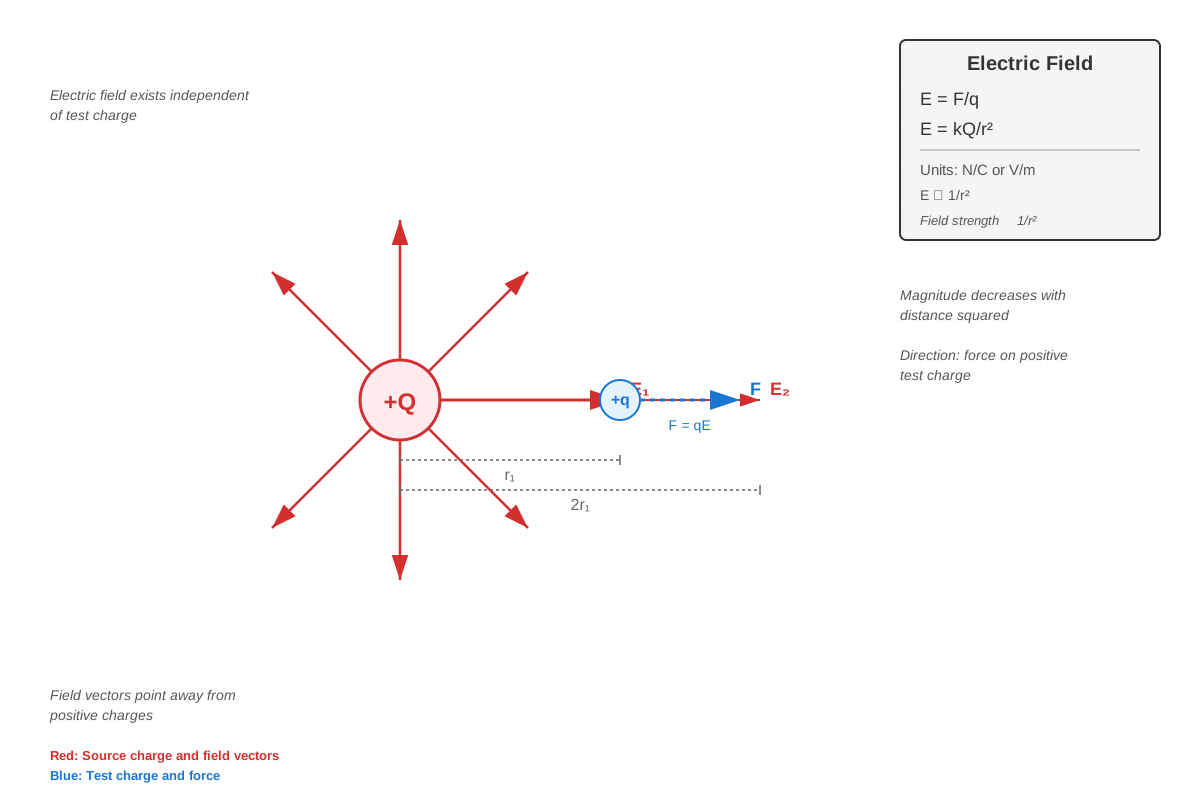
The electric field (symbol: E) is defined as the electric force per unit positive test charge at a point in space. Mathematically, this relationship is expressed as:
E = F/q₀where F is the force experienced by a small positive test charge q₀. The SI unit for electric field is newtons per coulomb (N/C), which is equivalent to volts per meter (V/m). The electric field is a vector quantity, possessing both magnitude and direction. By convention, the electric field direction is defined as the direction a positive test charge would experience force.
The electric field exists independently of whether a test charge is present—it represents the potential to exert force on any charge placed at that location. This concept allows us to separate the source of the field (the charge creating it) from the effect of the field (the force on other charges). The field concept revolutionized physics by eliminating the need for "action at a distance" and instead describing how charges modify the space around them.
Electric Field from a Point Charge
A single point charge q creates an electric field at all points in the surrounding space. The magnitude of this field at distance r from the charge is given by:
E = k|q|/r²where k is Coulomb's constant (k ≈ 9.0 × 10⁹ N·m²/C²). This equation shows that electric field strength follows an inverse square law—doubling the distance reduces the field strength to one-quarter of its original value. The field magnitude depends only on the source charge magnitude and distance, not on any test charge.
The direction of the electric field from a point charge depends on the charge's sign:
- Positive charges create electric fields that point radially outward from the charge
- Negative charges create electric fields that point radially inward toward the charge
This directional convention ensures that positive test charges are repelled by positive source charges and attracted to negative source charges, consistent with Coulomb's law.
Superposition Principle
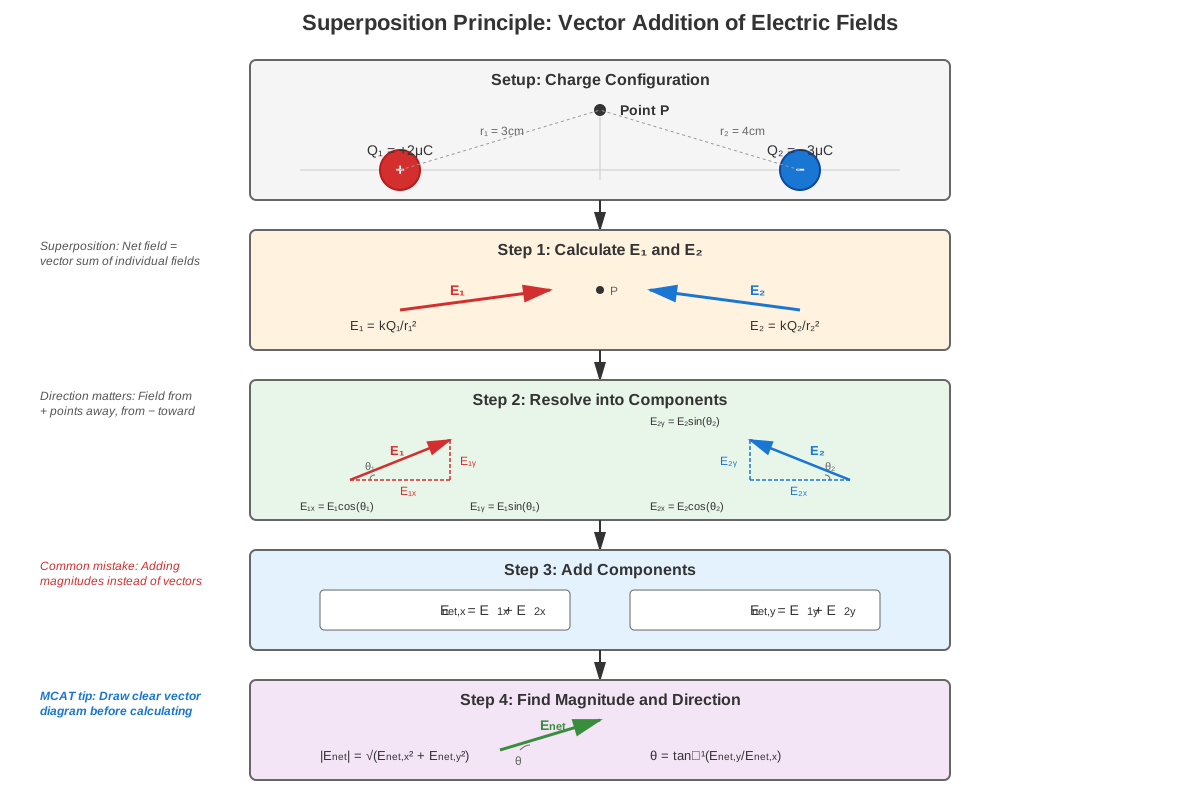
When multiple charges are present, the net electric field at any point is the vector sum of the individual electric fields created by each charge. This is the principle of superposition, which states:
E_net = E₁ + E₂ + E₃ + ... + E_nTo apply superposition:
- Calculate the magnitude of the electric field from each individual charge using E = kq/r²
- Determine the direction of each individual field vector
- Resolve each field vector into x and y components (if working in 2D)
- Sum all x-components to get E_net,x and all y-components to get E_net,y
- Calculate the magnitude using the Pythagorean theorem: E_net = √(E_net,x² + E_net,y²)
- Determine the direction using trigonometry: θ = tan⁻¹(E_net,y/E_net,x)
The superposition principle applies regardless of the number of charges or their configuration, making it a powerful tool for analyzing complex charge distributions.
Electric Field Lines
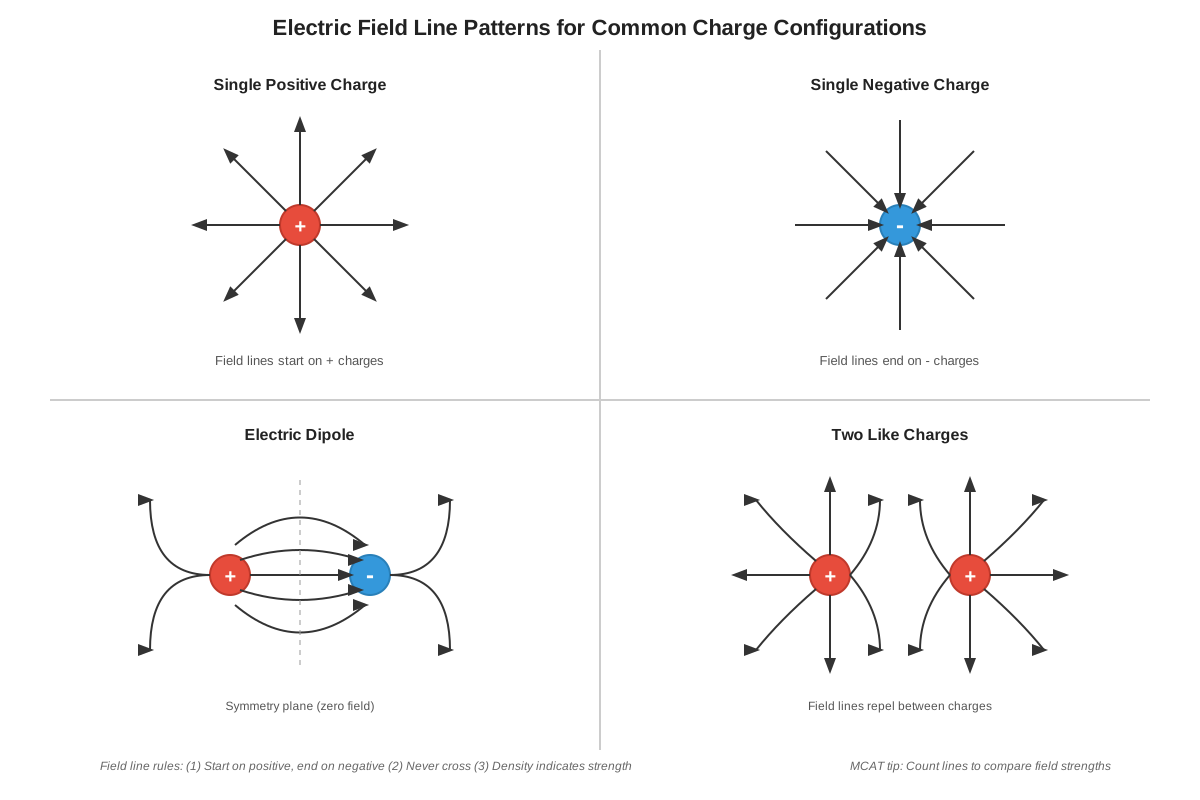
Electric field lines provide a visual representation of electric fields in space. These imaginary lines follow specific rules:
- Field lines originate on positive charges and terminate on negative charges
- The direction of the field line at any point indicates the direction of the electric field at that location
- Field lines never cross each other
- The density of field lines (number per unit area) represents the field strength—closer lines indicate stronger fields
- Field lines are perpendicular to conducting surfaces at equilibrium
| Configuration | Field Line Pattern | Key Characteristics |
|---|---|---|
| Single positive charge | Radial outward | Uniform density at equal distances |
| Single negative charge | Radial inward | Uniform density at equal distances |
| Electric dipole | Curved from + to - | Strongest between charges |
| Parallel plates | Uniform parallel lines | Constant field between plates |
| Two positive charges | Repelling pattern | No lines between charges |
Uniform Electric Fields
A uniform electric field has constant magnitude and direction throughout a region of space. The most common example is the field between two parallel charged plates (a parallel-plate capacitor). For plates separated by distance d with potential difference V:
E = V/dIn a uniform field:
- Field lines are parallel and evenly spaced
- A charged particle experiences constant force: F = qE
- The particle undergoes constant acceleration (if no other forces act)
- Work done moving a charge is path-independent: W = qEd
Uniform fields simplify calculations and frequently appear in MCAT problems involving particle motion, capacitors, and energy considerations.
Motion of Charged Particles in Electric Fields
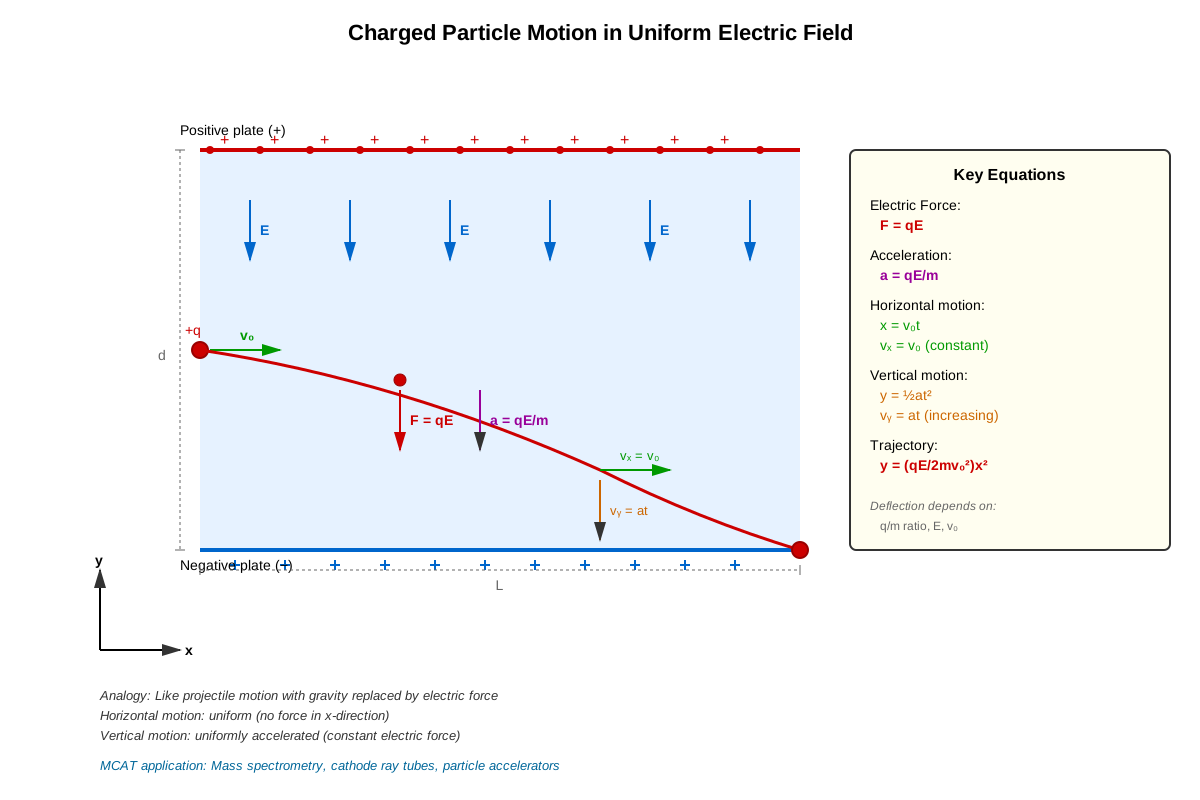
When a charged particle is placed in an electric field, it experiences a force F = qE. The resulting motion depends on the particle's charge, mass, and initial velocity:
For a particle starting from rest in a uniform field:
- Acceleration: a = F/m = qE/m
- The particle accelerates in the field direction (if positive) or opposite the field direction (if negative)
- Kinematic equations apply: v² = v₀² + 2ad, d = v₀t + ½at², etc.
For a particle entering perpendicular to a uniform field:
- Motion resembles projectile motion
- Constant velocity in the direction parallel to initial velocity
- Constant acceleration perpendicular to initial velocity
- Trajectory is parabolic
The ratio of charge to mass (q/m) determines how strongly a particle responds to electric fields—this principle underlies mass spectrometry and particle separation techniques.
Electric Field and Electric Potential Relationship
Electric field and electric potential (voltage) are intimately related. The electric field represents the spatial rate of change of electric potential:
E = -ΔV/ΔdThe negative sign indicates that electric field points from high potential toward low potential (in the direction of decreasing potential). This relationship means:
- Strong electric fields exist where potential changes rapidly over short distances
- Zero electric field exists where potential is constant (equipotential regions)
- Moving a positive charge against the electric field increases its potential energy
This connection allows conversion between field and potential problems, providing multiple solution pathways for MCAT questions.
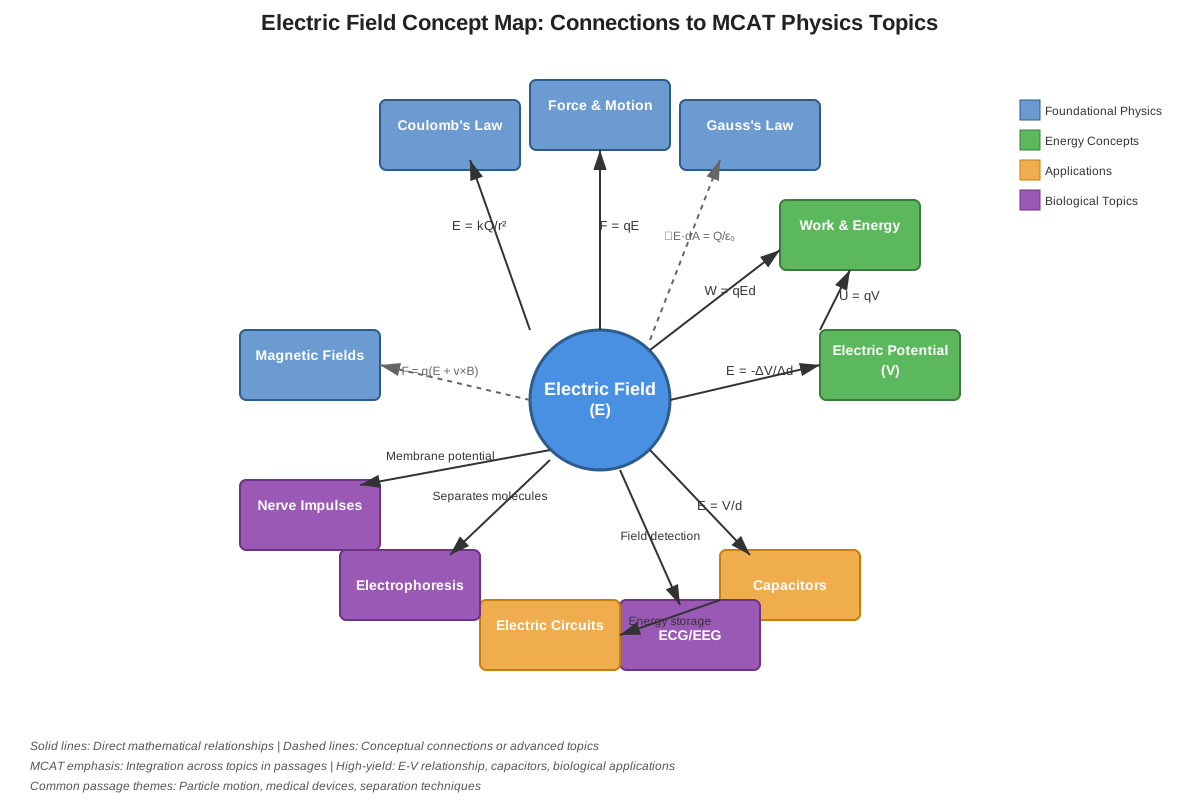
Concept Relationships
The electric field concept builds directly on Coulomb's law, which describes forces between charges. By dividing Coulomb's force by the test charge, we obtain the electric field, transforming a two-charge interaction into a single-charge property of space. This abstraction → Electric field → enables analysis of complex multi-charge systems through superposition.
Electric fields create electric forces on charges (F = qE), which produce acceleration (a = F/m) and subsequent motion according to Newton's laws. This chain connects electrostatics to kinematics: Charge configuration → Electric field → Force → Acceleration → Motion.
The electric field relates to electric potential energy and electric potential through integration and differentiation. Moving charges through electric fields changes their potential energy (ΔPE = qEd for uniform fields), connecting field concepts to energy conservation principles. The relationship E = -ΔV/Δd links field strength to voltage gradients, bridging field and potential topics.
Electric fields between parallel plates create capacitors, devices that store charge and energy. The uniform field in capacitors (E = V/d) determines capacitance (C = ε₀A/d) and stored energy (U = ½CV²), connecting electric fields to circuit analysis and energy storage.
In biological systems, electric fields across membranes create membrane potentials, driving ion flow and enabling nerve impulse transmission. This connects electric field physics to cellular biology, neuroscience, and medical diagnostics like ECG and EEG.
Quick check — test yourself on Electric field so far.
Try Flashcards →High-Yield Facts
⭐ The electric field from a point charge follows an inverse square law: E = kq/r², where doubling distance quarters the field strength
⭐ Electric field direction is defined as the direction a positive test charge would experience force: away from positive charges, toward negative charges
⭐ The net electric field from multiple charges is the vector sum of individual fields (superposition principle)
⭐ In a uniform electric field between parallel plates, E = V/d, where V is potential difference and d is plate separation
⭐ Electric field lines never cross, originate on positive charges, terminate on negative charges, and their density indicates field strength
- The SI unit for electric field is N/C, which equals V/m
- A charged particle in a uniform electric field experiences constant force and constant acceleration
- Electric field is a vector quantity requiring component addition when multiple sources are present
- The force on a charge in an electric field is F = qE, where q can be positive or negative
- Electric field exists independently of test charges—it represents the potential to exert force
- At the midpoint between two equal positive charges, the net electric field is zero due to symmetry
- Electric field strength inside a conductor at electrostatic equilibrium is zero
- The work done moving a charge in an electric field is W = qEd cos(θ), where θ is the angle between field and displacement
Common Misconceptions
Misconception: Electric field requires a test charge to exist → Correction: Electric field is a property of space created by source charges and exists whether or not a test charge is present. The test charge is a conceptual tool for defining and measuring the field, not a requirement for its existence.
Misconception: Electric field points from negative to positive charges → Correction: Electric field direction is defined as the direction a positive test charge would move. Field lines point away from positive charges and toward negative charges. This confusion often arises from conflating field direction with electron motion direction.
Misconception: Larger charges always create stronger electric fields → Correction: Electric field strength depends on both charge magnitude AND distance (E = kq/r²). A small charge very close to a point can create a stronger field than a large charge far away. Distance has a squared effect, making it particularly important.
Misconception: Electric field and electric force are the same thing → Correction: Electric field (E) is force per unit charge and exists at a point in space. Electric force (F = qE) is the actual force experienced by a specific charge in that field. The field is independent of the test charge; the force depends on the test charge magnitude and sign.
Misconception: When adding electric fields from multiple charges, you can simply add magnitudes → Correction: Electric fields are vectors and must be added using vector addition. You must account for direction by using components or geometric methods. Simply adding magnitudes ignores directional information and produces incorrect results.
Misconception: Electric field inside a charged sphere is strongest at the center → Correction: For a uniformly charged spherical shell, the electric field inside is zero everywhere due to symmetry. For a uniformly charged solid sphere, the field increases linearly from zero at the center to maximum at the surface, then decreases as 1/r² outside.
Misconception: Electric field lines represent the path a charged particle would follow → Correction: Field lines show the direction of force at each point, but a moving charged particle has inertia and follows a curved trajectory determined by Newton's laws. Only a particle released from rest in a uniform field would follow a field line.
Worked Examples
Example 1: Electric Field from Multiple Point Charges
Problem: Two charges are positioned on the x-axis: q₁ = +3.0 μC at x = 0 cm and q₂ = -2.0 μC at x = 4.0 cm. Calculate the magnitude and direction of the net electric field at point P located at x = 2.0 cm.
Solution:
Step 1: Identify the distances from each charge to point P
- Distance from q₁ to P: r₁ = 2.0 cm = 0.020 m
- Distance from q₂ to P: r₂ = 4.0 cm - 2.0 cm = 2.0 cm = 0.020 m
Step 2: Calculate the magnitude of electric field from each charge
Using E = kq/r² with k = 9.0 × 10⁹ N·m²/C²:
E₁ = (9.0 × 10⁹)(3.0 × 10⁻⁶)/(0.020)²
E₁ = (9.0 × 10⁹)(3.0 × 10⁻⁶)/(4.0 × 10⁻⁴)
E₁ = 6.75 × 10⁷ N/C
E₂ = (9.0 × 10⁹)(2.0 × 10⁻⁶)/(0.020)²
E₂ = (9.0 × 10⁹)(2.0 × 10⁻⁶)/(4.0 × 10⁻⁴)
E₂ = 4.5 × 10⁷ N/C
Step 3: Determine the direction of each field
- E₁ points to the right (+x direction) because q₁ is positive and P is to the right of q₁
- E₂ points to the left (-x direction) because q₂ is negative and P is to the left of q₂
Step 4: Apply superposition using components
Taking rightward as positive:
- E₁,x = +6.75 × 10⁷ N/C
- E₂,x = -4.5 × 10⁷ N/C
E_net,x = E₁,x + E₂,x = 6.75 × 10⁷ - 4.5 × 10⁷ = 2.25 × 10⁷ N/C
Step 5: State the final answer
The net electric field at point P has magnitude 2.25 × 10⁷ N/C directed to the right (+x direction).
Key Concepts Applied: This problem demonstrates the superposition principle, proper vector addition with attention to direction, and the inverse square relationship. Notice that even though q₁ has larger magnitude, both fields have different magnitudes at P due to identical distances. The positive result indicates the field from the positive charge dominates.
Example 2: Charged Particle Motion in Uniform Electric Field
Problem: An electron (mass = 9.11 × 10⁻³¹ kg, charge = -1.6 × 10⁻¹⁹ C) is released from rest in a uniform electric field of magnitude 500 N/C pointing downward. (a) What is the magnitude and direction of the force on the electron? (b) What is the electron's acceleration? (c) What is the electron's speed after traveling 2.0 cm?
Solution:
(a) Force calculation
Step 1: Apply F = qE
F = |q|E = (1.6 × 10⁻¹⁹ C)(500 N/C)
F = 8.0 × 10⁻¹⁷ N
Step 2: Determine direction
Since the electron is negatively charged and the field points downward, the force points upward (opposite to the field direction).
(b) Acceleration calculation
Step 3: Apply Newton's second law
a = F/m = (8.0 × 10⁻¹⁷ N)/(9.11 × 10⁻³¹ kg)
a = 8.78 × 10¹³ m/s²
The acceleration is directed upward (same direction as the force).
(c) Final speed calculation
Step 4: Use kinematic equation v² = v₀² + 2ad
- Initial velocity: v₀ = 0 (released from rest)
- Distance: d = 2.0 cm = 0.020 m
- Acceleration: a = 8.78 × 10¹³ m/s²
v² = 0 + 2(8.78 × 10¹³)(0.020)
v² = 3.51 × 10¹²
v = 1.87 × 10⁶ m/s
Final Answers:
- (a) Force = 8.0 × 10⁻¹⁷ N upward
- (b) Acceleration = 8.78 × 10¹³ m/s² upward
- (c) Final speed = 1.87 × 10⁶ m/s
Key Concepts Applied: This problem illustrates the relationship between electric field and force (F = qE), the importance of charge sign in determining force direction, application of Newton's second law in electric field contexts, and connection to kinematics. The enormous acceleration demonstrates why electric fields are so effective at manipulating small charged particles like electrons and ions—a principle underlying many biological and technological applications.
Exam Strategy
When approaching MCAT questions on electric fields, begin by identifying whether the question asks for field magnitude, direction, or both. Trigger words include "electric field strength," "field direction," "net field," and "superposition." Questions mentioning "test charge" typically want you to calculate force from field (F = qE), while questions about "source charges" require calculating the field itself (E = kq/r²).
For calculation problems, immediately write down the relevant equation (E = kq/r² for point charges, E = V/d for uniform fields) and identify all given values. Pay careful attention to units—convert all distances to meters, charges to coulombs, and be prepared to work with scientific notation. The MCAT calculator handles scientific notation, but practice entering values efficiently to save time.
Direction determination is often tested conceptually without calculation. Remember: electric field points away from positive charges and toward negative charges. For multiple charges, sketch a quick diagram showing individual field vectors before attempting vector addition. Symmetry arguments can often eliminate wrong answers—if two equal charges are symmetrically placed, the field at the midpoint must lie along the symmetry axis.
For process of elimination, recognize that electric field strength cannot be negative (it's a magnitude), field direction must be consistent with charge signs, and fields from multiple charges must follow superposition. If an answer choice violates these principles, eliminate it immediately. Watch for answer choices that confuse electric field with electric force or potential—these are common distractors.
Time allocation: Discrete questions on electric fields should take 60-90 seconds. If a calculation becomes complex, check whether the question asks for a qualitative answer or whether answer choices differ by orders of magnitude, allowing estimation. For passage-based questions, spend 30-45 seconds per question, using information from the passage to avoid lengthy calculations when possible.
When questions involve charged particle motion, recognize the connection to kinematics and consider whether energy methods (W = qEd, conservation of energy) might be faster than force-acceleration approaches. The MCAT rewards strategic problem-solving, not just computational ability.
Memory Techniques
"PINT" for Electric Field Direction:
- Positive charges: field points In (toward them)? No!
- Positive charges: field points Out (away from them)
- Negative charges: field points IN (toward them)
- Test charge: field shows where positive Test charge would be pushed
"FIELD" for Problem-Solving Steps:
- Find all source charges and distances
- Identify the equation (E = kq/r² or E = V/d)
- Evaluate magnitude for each source
- Locate direction for each field vector
- Determine net field using superposition
Visualization Strategy for Superposition:
Picture electric field vectors as arrows emanating from charges. Positive charges are "field fountains" spraying arrows outward; negative charges are "field drains" sucking arrows inward. At any point, count how many arrows point in each direction—the net field is the difference.
"Square Distance, Quarter Field" for inverse square law:
When distance doubles (×2), field strength quarters (×1/4 = ×2⁻²). When distance triples (×3), field strength becomes one-ninth (×1/9 = ×3⁻²). This mental shortcut helps estimate field changes without full calculation.
Parallel Plate Mnemonic "VoD":
For uniform fields between plates, think "V over D" (E = V/d). Voltage divided by distance gives field strength. Higher voltage or smaller distance means stronger field.
Summary
The electric field is a fundamental concept describing how charges modify the space around them, creating the potential to exert forces on other charges. Defined as force per unit positive test charge (E = F/q₀), electric fields are vector quantities with magnitude and direction. Point charges create fields following the inverse square law (E = kq/r²), with field direction pointing away from positive charges and toward negative charges. Multiple charges create net fields determined by vector superposition, requiring careful attention to both magnitude and direction. Uniform electric fields, such as those between parallel plates (E = V/d), produce constant forces on charged particles, leading to constant acceleration and predictable motion. Electric field lines provide visual representations, with line density indicating field strength and line direction showing field direction. Understanding electric fields is essential for MCAT success, as the concept connects to electric potential, capacitors, circuits, and biological applications including nerve transmission and medical diagnostics. Mastery requires facility with vector addition, inverse square relationships, and the ability to translate between field, force, and motion concepts.
Key Takeaways
- Electric field is defined as force per unit positive test charge (E = F/q₀) and exists independently of test charges
- Point charge fields follow the inverse square law (E = kq/r²), with direction away from positive charges and toward negative charges
- Net electric fields from multiple sources require vector addition using the superposition principle
- Uniform electric fields between parallel plates have constant magnitude (E = V/d) and produce constant acceleration of charged particles
- Electric field lines never cross, originate on positive charges, terminate on negative charges, and have density proportional to field strength
- The relationship F = qE connects electric fields to forces, enabling prediction of charged particle motion
- Electric field direction is defined as the direction a positive test charge would experience force, which is opposite to the direction electrons move
Related Topics
Electric Potential and Voltage: Building on electric field concepts, electric potential describes the potential energy per unit charge at points in space. The relationship E = -ΔV/Δd connects field strength to voltage gradients, enabling energy-based problem solving.
Capacitors and Capacitance: Parallel-plate capacitors create uniform electric fields, storing charge and energy. Understanding electric fields between plates is essential for analyzing capacitor behavior, energy storage, and circuit applications.
Electric Potential Energy: The work done moving charges through electric fields changes their potential energy. This topic extends electric field concepts to energy conservation problems and connects to biological membrane potentials.
Gauss's Law: An advanced approach to calculating electric fields using symmetry and flux concepts. While beyond typical MCAT scope, understanding field line representations prepares students for this more sophisticated treatment.
Magnetic Fields and Electromagnetic Induction: Electric and magnetic fields are intimately related through Maxwell's equations. Mastering electric fields provides the foundation for understanding magnetic field concepts and electromagnetic waves.
Practice CTA
Now that you've mastered the core concepts of electric fields, it's time to solidify your understanding through active practice. Challenge yourself with the practice questions and flashcards designed specifically for this topic. Focus on problems requiring vector addition, direction determination, and connecting fields to particle motion—these are the highest-yield skills for MCAT success. Remember, understanding the concepts is just the first step; applying them under timed conditions is what separates good scores from great scores. You've built a strong foundation—now prove it through practice!
Sign up free to keep reading
Create a free AnvayaPrep account to finish this MCAT guide on Electric field — plus flashcards and practice questions.