Overview
Ohm's law is one of the foundational principles in Electricity and Magnetism and represents a cornerstone concept for understanding electrical circuits on the MCAT. This fundamental relationship describes how voltage, current, and resistance interact in electrical conductors, providing the mathematical framework necessary to analyze everything from simple circuits to complex biological systems. The law states that the voltage across a conductor is directly proportional to the current flowing through it, with resistance serving as the proportionality constant. While seemingly straightforward, Ohm's law serves as the gateway to understanding more complex circuit behaviors, power dissipation, and the electrical properties of biological tissues.
For the MCAT, Ohm's law appears frequently in both discrete questions and passage-based problems within the Physics section. The exam tests not only the ability to manipulate the basic equation but also the capacity to apply it in novel contexts, such as analyzing neuronal membrane potentials, understanding medical devices like electrocardiograms, or solving multi-resistor circuit problems. Questions often integrate Ohm's law with concepts like power, energy, capacitance, and magnetic fields, requiring students to demonstrate conceptual flexibility and problem-solving efficiency under time pressure.
Understanding Ohm's law provides the foundation for analyzing electrical circuits systematically, which connects directly to other high-yield topics including Kirchhoff's laws, series and parallel circuits, capacitors, and electromagnetic induction. The relationship between voltage, current, and resistance also parallels fluid dynamics concepts (pressure, flow rate, and resistance), making it an excellent example of how physical principles manifest across different systems. Mastery of this topic enables students to approach circuit problems with confidence and serves as essential preparation for understanding the electrical properties of biological membranes and nerve conduction.
Learning Objectives
- [ ] Define Ohm's law using accurate Physics terminology
- [ ] Explain why Ohm's law matters for the MCAT
- [ ] Apply Ohm's law to exam-style questions
- [ ] Identify common mistakes related to Ohm's law
- [ ] Connect Ohm's law to related Physics concepts
- [ ] Derive and manipulate the three forms of Ohm's law equation (V = IR, I = V/R, R = V/I)
- [ ] Distinguish between ohmic and non-ohmic materials and predict their behavior
- [ ] Calculate power dissipation in resistive elements using Ohm's law
- [ ] Analyze complex circuits by applying Ohm's law to individual components
Prerequisites
- Basic algebra and equation manipulation: Essential for rearranging Ohm's law to solve for different variables and combining it with other equations
- Understanding of electric charge and current: Current is the flow of charge, which is the fundamental quantity in Ohm's law
- Concept of electric potential and voltage: Voltage represents the potential difference that drives current through a resistor
- Units and dimensional analysis: Critical for ensuring correct calculations and catching errors in problem-solving
- Basic circuit terminology: Familiarity with terms like conductor, resistor, and circuit elements aids in interpreting problems
Why This Topic Matters
Clinical and Real-World Significance
Ohm's law governs the behavior of electrical systems throughout medicine and biology. The human nervous system operates through electrical signals that follow principles derived from Ohm's law—the resistance of cell membranes, the voltage across ion channels, and the current flow of ions all interact according to this fundamental relationship. Medical devices such as defibrillators, pacemakers, and electrocardiogram machines rely on precise control of voltage, current, and resistance to function safely and effectively. Understanding Ohm's law enables clinicians to interpret why certain electrical parameters are chosen for therapeutic interventions and how tissue properties affect electrical signal propagation.
MCAT Exam Statistics
Ohm's law appears in approximately 2-4 questions per MCAT exam, either as discrete items or embedded within passage-based questions. The topic typically appears in the Chemical and Physical Foundations of Biological Systems section, often integrated with questions about circuits, power, or biological applications. Questions range from straightforward calculations requiring direct application of V = IR to complex multi-step problems involving circuit analysis, power dissipation, or conceptual understanding of how changing one variable affects others.
Common Exam Presentations
The MCAT presents Ohm's law in several characteristic formats: (1) circuit diagrams requiring calculation of unknown voltages, currents, or resistances; (2) passages describing experimental setups with electrical measurements where students must analyze data or predict outcomes; (3) biological contexts such as nerve conduction or membrane potentials where electrical principles apply; (4) questions about electrical safety, power consumption, or energy dissipation in medical devices; and (5) conceptual questions testing understanding of proportional relationships without requiring numerical calculation. Recognizing these patterns helps students quickly identify when to apply Ohm's law.
Core Concepts
The Fundamental Statement of Ohm's Law
Ohm's law establishes the linear relationship between voltage (V), current (I), and resistance (R) in an electrical conductor. The law is mathematically expressed as:
V = I × RWhere:
- V represents voltage (potential difference) measured in volts (V)
- I represents current (charge flow rate) measured in amperes or amps (A)
- R represents resistance (opposition to current flow) measured in ohms (Ω)
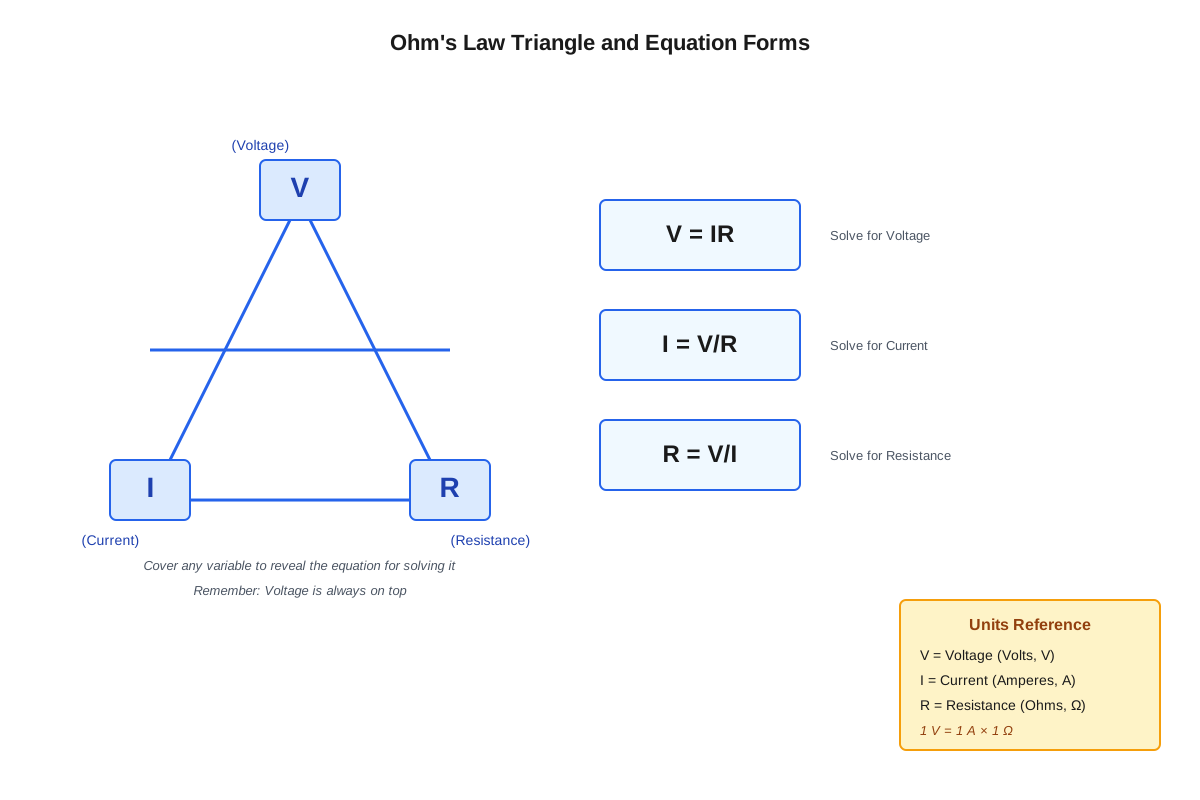
This equation can be algebraically rearranged into three equivalent forms depending on which variable needs to be solved:
V = I × R
I = V / R
R = V / I
The physical interpretation is that voltage is the "driving force" that pushes electric charges through a conductor, current is the resulting flow of charges, and resistance is the property of the material that opposes this flow. The relationship is directly proportional between voltage and current (doubling voltage doubles current if resistance remains constant) and inversely proportional between current and resistance (doubling resistance halves current if voltage remains constant).
Ohmic vs. Non-Ohmic Materials
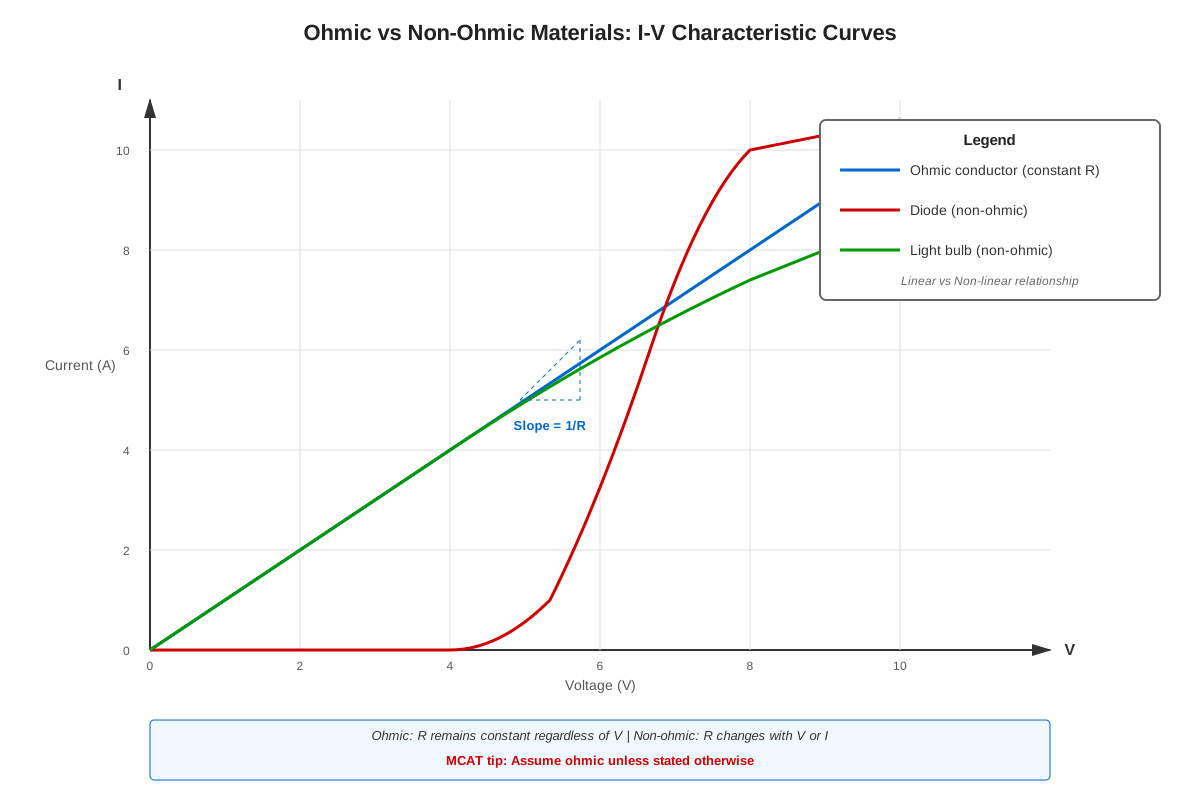
Materials that obey Ohm's law are called ohmic materials or ohmic conductors. These materials maintain a constant resistance regardless of the applied voltage or resulting current, producing a linear I-V (current-voltage) relationship when graphed. Common ohmic materials include most metals at constant temperature, such as copper wires, resistors in circuits, and other conductors under normal operating conditions.
Non-ohmic materials do not maintain constant resistance across different voltages or currents. Their I-V graphs show non-linear relationships. Examples include diodes (which conduct current primarily in one direction), light bulbs (whose resistance increases with temperature as current increases), semiconductors, and biological membranes with voltage-gated ion channels. The MCAT may test the ability to distinguish between these material types by presenting I-V graphs or describing material behaviors.
Resistance and Resistivity
While Ohm's law defines the relationship between V, I, and R, understanding what determines resistance is crucial for deeper applications. The resistance of a conductor depends on its physical properties according to the equation:
R = ρL / AWhere:
- ρ (rho) is the resistivity of the material (measured in Ω·m), an intrinsic property
- L is the length of the conductor
- A is the cross-sectional area
This relationship shows that resistance increases with length (longer wires have more resistance) and decreases with cross-sectional area (thicker wires have less resistance). Resistivity is temperature-dependent for most materials, typically increasing with temperature for metals. This connection explains why electrical wires are made thick (low resistance) and why overheating can affect circuit performance.
Power Dissipation and Ohm's Law
Combining Ohm's law with the power equation yields several useful relationships for calculating energy dissipation in resistive elements. The basic power equation is:
P = I × VBy substituting Ohm's law (V = IR) into this equation, we derive alternative forms:
P = I²R
P = V²/R
These equations are essential for MCAT problems involving energy consumption, heat generation, or electrical safety. The I²R form is particularly useful when current is known, while the V²/R form is convenient when voltage is given. Understanding that power dissipation increases with the square of current explains why high-current situations can rapidly generate dangerous amounts of heat.
Application to Series and Parallel Circuits
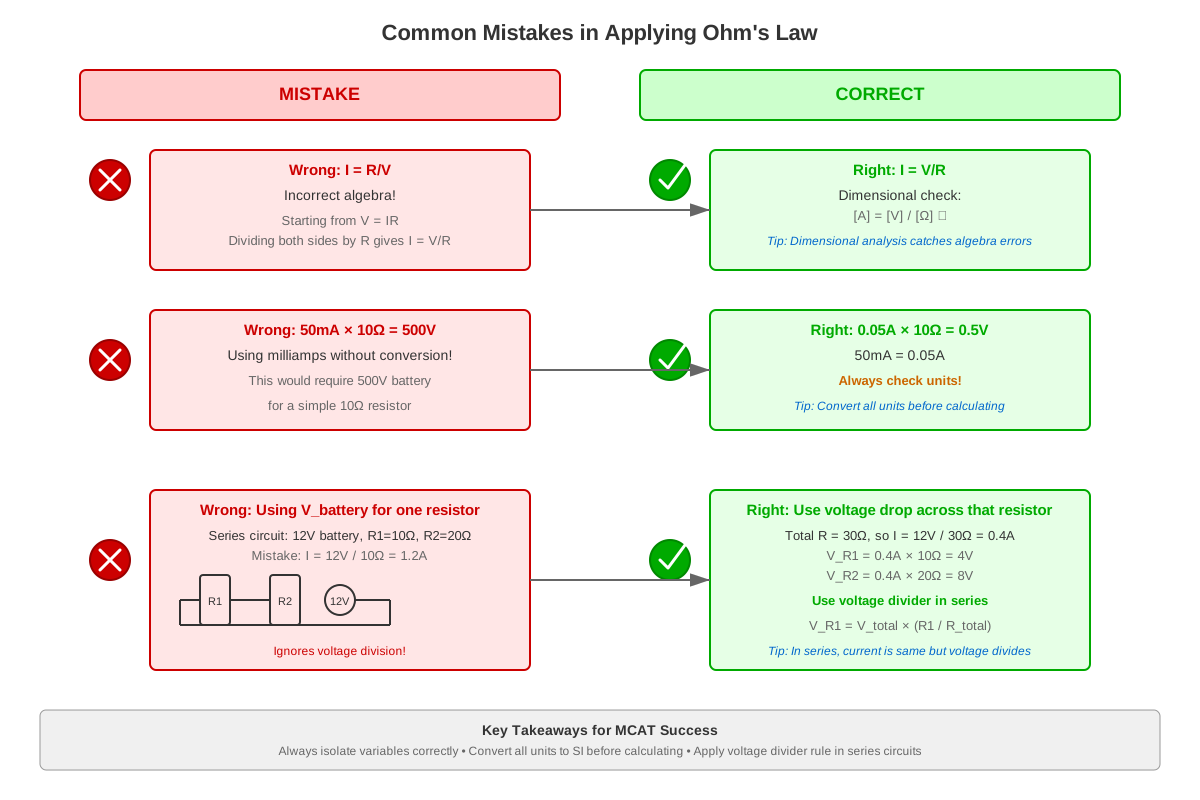
Ohm's law applies to individual components within complex circuits and to entire circuits as wholes. In series circuits, the same current flows through all components, but voltage divides among them according to their resistances. For a resistor in series:
V_resistor = I_total × R_resistorIn parallel circuits, voltage across all branches is identical, but current divides according to the inverse of resistance (more current flows through lower resistance paths). For a resistor in parallel:
I_branch = V_total / R_branchThe MCAT frequently tests the ability to apply Ohm's law selectively to parts of circuits while maintaining awareness of series and parallel rules for combining resistances.
Biological Applications
Biological membranes exhibit electrical properties that follow Ohm's law principles. The membrane potential represents voltage, ion currents through channels represent current, and membrane resistance (determined by the number and state of ion channels) represents resistance. The relationship:
I_ion = V_membrane / R_membranedescribes ion flow across membranes. Voltage-gated channels change membrane resistance in response to voltage changes, creating non-ohmic behavior that enables nerve signal propagation. Understanding this application helps connect physics concepts to biological systems tested on the MCAT.
Concept Relationships
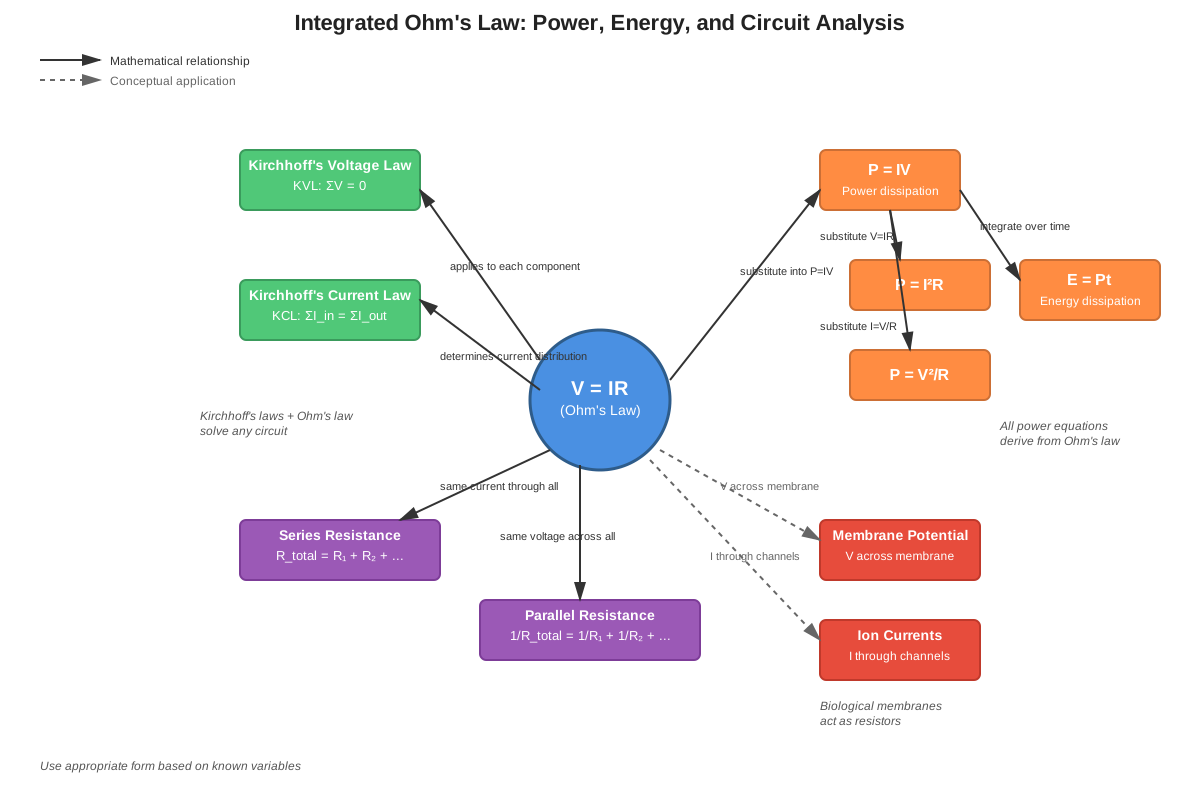
Ohm's law serves as the central hub connecting multiple electrical concepts. The relationship flows as follows:
Electric charge → generates → electric current (I) → experiences opposition from → resistance (R) → requires → voltage (V) to overcome → all related by → Ohm's law (V = IR)
This fundamental relationship then branches into multiple applications:
- Ohm's law + Power equation → Power dissipation formulas (P = I²R, P = V²/R)
- Ohm's law + Circuit topology → Series and parallel circuit analysis
- Ohm's law + Kirchhoff's laws → Complex circuit solving
- Ohm's law + Capacitors → RC circuit behavior and time constants
- Ohm's law + Magnetic fields → Electromagnetic induction and generator principles
The concept also connects to prerequisite knowledge: voltage derives from electric potential energy, current represents charge flow rate (Q/t), and resistance relates to material properties through resistivity. Understanding these connections enables students to see Ohm's law not as an isolated formula but as part of an integrated framework for analyzing electrical phenomena.
Furthermore, Ohm's law parallels fluid dynamics through analogous relationships: voltage corresponds to pressure difference, current corresponds to flow rate, and resistance corresponds to fluid resistance. This analogy helps students transfer understanding between different physical systems and reinforces the universality of proportional relationships in physics.
High-Yield Facts
⭐ Ohm's law states V = IR, where voltage (V) in volts equals current (I) in amperes times resistance (R) in ohms
⭐ The three algebraic forms (V = IR, I = V/R, R = V/I) are all equally valid and should be selected based on which variable is unknown
⭐ Doubling voltage while keeping resistance constant doubles the current (direct proportionality)
⭐ Doubling resistance while keeping voltage constant halves the current (inverse proportionality)
⭐ Power dissipated in a resistor can be calculated using P = I²R or P = V²/R, both derived from combining P = IV with Ohm's law
- Ohmic materials maintain constant resistance regardless of applied voltage, producing linear I-V graphs
- Non-ohmic materials (diodes, light bulbs, biological membranes) have resistance that varies with voltage or current
- Resistance increases with conductor length and decreases with cross-sectional area (R = ρL/A)
- In series circuits, current is constant and voltage divides according to resistance ratios
- In parallel circuits, voltage is constant and current divides inversely with resistance
- Temperature typically increases resistance in metallic conductors, affecting circuit behavior
- The unit ohm (Ω) is equivalent to volts per ampere (V/A)
Quick check — test yourself on Ohm law so far.
Try Flashcards →Common Misconceptions
Misconception: Ohm's law applies universally to all materials and devices under all conditions.
Correction: Ohm's law specifically describes ohmic materials with constant resistance. Many materials (diodes, transistors, light bulbs, voltage-gated ion channels) are non-ohmic and exhibit resistance that changes with voltage or current. Always check whether the material or device is ohmic before applying the linear relationship.
Misconception: Resistance is something that "uses up" current as it flows through a circuit.
Correction: Current is not consumed by resistance; the same current that enters a resistor exits it (charge conservation). Resistance converts electrical energy into heat, reducing the electrical potential energy (voltage) of the charges, but the flow rate (current) remains constant through any series component.
Misconception: Higher resistance always means less power dissipation.
Correction: The relationship between resistance and power depends on whether current or voltage is held constant. Using P = I²R, if current is constant, higher resistance increases power. Using P = V²/R, if voltage is constant, higher resistance decreases power. Always identify which variable is held constant in the specific situation.
Misconception: Voltage and current are the same thing or interchangeable concepts.
Correction: Voltage is the electric potential difference (energy per unit charge) that drives current, while current is the rate of charge flow. Voltage is the cause; current is the effect. They are related through resistance via Ohm's law but represent fundamentally different physical quantities with different units.
Misconception: Ohm's law can be applied to an entire complex circuit by simply using total voltage and total current.
Correction: While Ohm's law can relate total voltage and total current using equivalent resistance, it must be applied carefully. In complex circuits with multiple branches, you often need to apply Ohm's law to individual components or sections, then use Kirchhoff's laws to relate these parts. Blindly applying V = IR to total values without considering circuit topology leads to errors.
Misconception: The resistance value in Ohm's law is always the resistance of a single resistor.
Correction: The R in Ohm's law can represent a single resistor, an equivalent resistance of multiple resistors in series or parallel, or even the total resistance of an entire circuit. The key is ensuring that the voltage and current values correspond to the same portion of the circuit as the resistance value being used.
Worked Examples
Example 1: Basic Circuit Calculation with Power
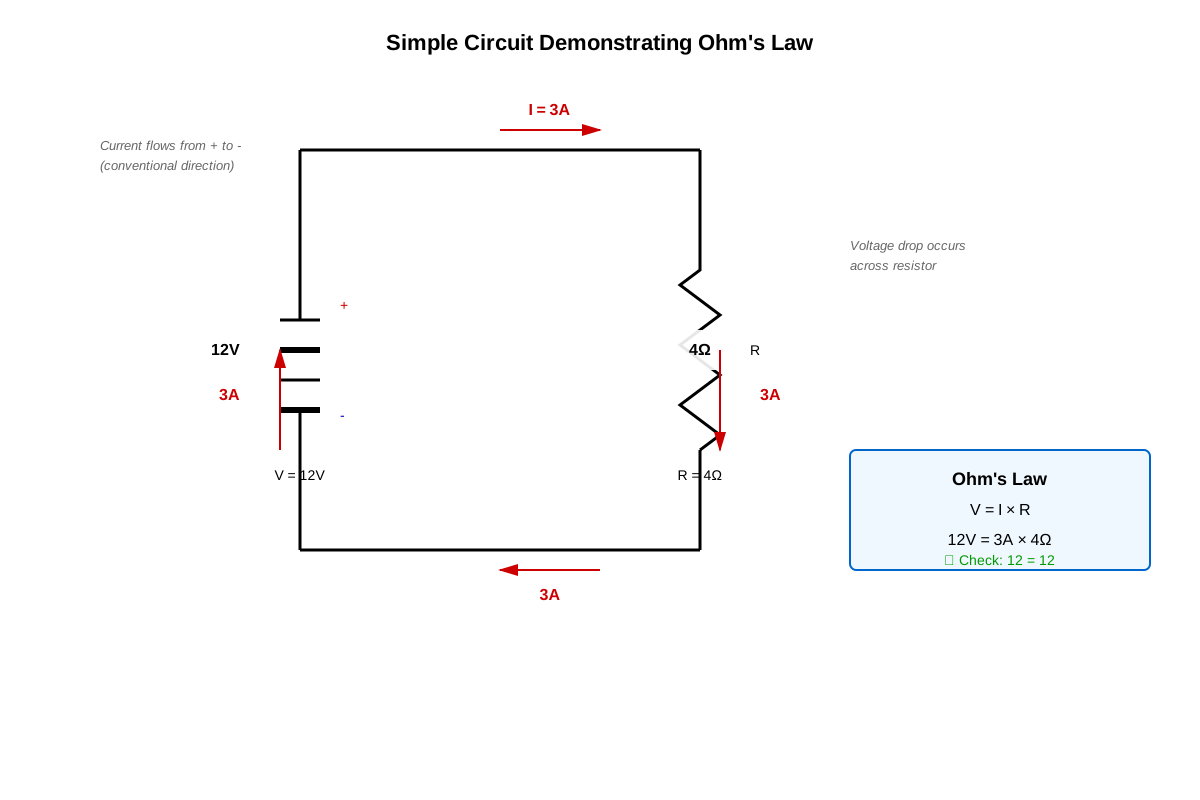
Problem: A 12 V battery is connected to a resistor, and a current of 0.5 A flows through the circuit. (a) What is the resistance of the resistor? (b) How much power is dissipated by the resistor? (c) If the resistance were doubled, what would happen to the power dissipation?
Solution:
Part (a): We need to find resistance given voltage and current. Using Ohm's law:
R = V / I = 12 V / 0.5 A = 24 ΩThe resistance is 24 ohms.
Part (b): Power can be calculated using multiple approaches. Since we know both current and resistance:
P = I²R = (0.5 A)² × 24 Ω = 0.25 × 24 = 6 WAlternatively, using voltage and current directly:
P = IV = 0.5 A × 12 V = 6 WBoth methods yield 6 watts of power dissipation.
Part (c): If resistance doubles to 48 Ω while the battery voltage remains 12 V (voltage sources maintain constant voltage), we need to find the new current first:
I_new = V / R_new = 12 V / 48 Ω = 0.25 AThe current is halved. Now calculate new power:
P_new = V² / R_new = (12 V)² / 48 Ω = 144 / 48 = 3 WThe power dissipation is halved when resistance is doubled (at constant voltage). This demonstrates the inverse relationship between power and resistance when voltage is held constant.
Connection to Learning Objectives: This problem applies Ohm's law to calculate resistance, demonstrates power calculations using multiple derived formulas, and illustrates the conceptual understanding of how changing one variable affects others—all key MCAT skills.
Example 2: Biological Application - Membrane Resistance
Problem: A neuron's membrane has a resting potential of -70 mV. When a particular ion channel opens, it allows a current of 2 pA (picoamperes, 1 pA = 10⁻¹² A) to flow. (a) What is the resistance of this open ion channel? (b) If 100 identical channels open simultaneously, what is the total current, assuming the membrane potential remains constant? (c) What is the effective resistance of the 100 open channels?
Solution:
Part (a): Apply Ohm's law to find the channel resistance. Note that we use the absolute value of voltage for this calculation:
R = V / I = 70 × 10⁻³ V / 2 × 10⁻¹² A = 35 × 10⁹ Ω = 35 GΩA single ion channel has a resistance of 35 gigaohms (GΩ), which is typical for biological ion channels.
Part (b): If 100 identical channels open, they act as 100 resistors in parallel. In parallel, currents add while voltage remains constant:
I_total = 100 × I_single = 100 × 2 pA = 200 pAThe total current is 200 picoamperes.
Part (c): The effective resistance of parallel resistors decreases. Using Ohm's law with total current:
R_effective = V / I_total = 70 × 10⁻³ V / 200 × 10⁻¹² A = 0.35 × 10⁹ Ω = 0.35 GΩAlternatively, for identical resistors in parallel: R_effective = R_single / n = 35 GΩ / 100 = 0.35 GΩ
The effective resistance is 100 times smaller than a single channel, demonstrating that opening more channels decreases membrane resistance and increases current flow.
Connection to Learning Objectives: This example connects Ohm's law to biological systems (neuron membranes), applies the law to realistic physiological values, and integrates understanding of parallel resistance—demonstrating how physics principles underlie biological function, a key MCAT integration skill.
Exam Strategy
Approaching MCAT Questions on Ohm's Law
When encountering Ohm's law questions, follow this systematic approach:
- Identify what's given and what's asked: Circle or note the known values (V, I, or R) and clearly identify the unknown variable
- Determine the appropriate form: Choose V = IR, I = V/R, or R = V/I based on which variable you're solving for
- Check units: Ensure all values are in standard units (volts, amperes, ohms) before calculating; convert mV to V, mA to A, etc.
- Consider circuit context: Determine whether the question involves a single component or requires circuit analysis (series/parallel)
- Verify reasonableness: After calculating, check if the answer makes physical sense (e.g., higher voltage should give higher current at constant resistance)
Trigger Words and Phrases
Watch for these key phrases that signal Ohm's law application:
- "Potential difference across" or "voltage drop" → indicates V in Ohm's law
- "Current through" or "current flowing" → indicates I in Ohm's law
- "Resistance of" or "resistor value" → indicates R in Ohm's law
- "Power dissipated" or "energy consumed" → combine Ohm's law with P = IV
- "Ohmic material" or "linear I-V relationship" → confirms Ohm's law applies
- "Membrane resistance" or "channel conductance" → biological application of Ohm's law
Process of Elimination Tips
When facing multiple-choice questions:
- Eliminate dimensionally incorrect answers: Check units; if the question asks for current (A), eliminate answers in volts or ohms
- Use proportional reasoning: If voltage doubles and resistance is constant, current must double—eliminate answers that don't reflect this
- Test extreme cases: If resistance approaches infinity, current should approach zero; if resistance approaches zero, current should approach infinity
- Check for non-ohmic traps: If the material is described as non-ohmic, eliminate answers that assume constant resistance
- Verify power relationships: Remember P = I²R means power increases with the square of current—linear relationships are wrong
Time Allocation
For straightforward Ohm's law calculations, allocate 30-45 seconds. For problems requiring circuit analysis or multiple steps, allocate 60-90 seconds. If a problem requires more than 2 minutes, consider flagging it and returning later. Practice identifying which form of the equation to use immediately upon reading the question to save time.
Memory Techniques
The Ohm's Law Triangle
Visualize a triangle with V at the top, and I and R at the bottom corners:
    V
   ---
  I | R
To find any variable, cover it with your finger:
- Cover V: you see I × R (V = IR)
- Cover I: you see V over R (I = V/R)
- Cover R: you see V over I (R = V/I)
This visual mnemonic helps quickly recall which form to use without re-deriving.
VIR Mnemonic
Remember "Very Important Relationship" to recall the order V = I × R. The alphabetical order (I before R) reminds you that current is multiplied by resistance to get voltage.
Power Formula Memory
For power formulas, remember "I² Rish" and "V² Reduced":
- I² Rish: P = I²R (when you know current, square it and multiply by R)
- V² Reduced: P = V²/R (when you know voltage, square it and divide by R)
The "reduced" reminds you that R is in the denominator for the voltage form.
Proportionality Relationships
Use "Direct Voltage-Current, Inverse Resistance-Current":
- Direct V-C: Voltage and Current are directly proportional (at constant R)
- Inverse R-C: Resistance and Current are inversely proportional (at constant V)
This helps quickly answer conceptual questions about how changing one variable affects another.
Summary
Ohm's law (V = IR) represents the fundamental relationship between voltage, current, and resistance in electrical conductors, serving as the cornerstone for analyzing circuits on the MCAT. The law states that voltage across a conductor equals the product of current flowing through it and its resistance, with algebraic rearrangements allowing solution for any variable. Ohmic materials maintain constant resistance and exhibit linear I-V relationships, while non-ohmic materials show variable resistance. Combining Ohm's law with the power equation yields essential formulas for calculating energy dissipation (P = I²R and P = V²/R). The law applies to individual circuit components and entire circuits, with careful attention needed for series and parallel configurations. Biological applications include membrane potentials and ion channel currents, connecting physics to physiology. Mastery requires understanding both computational application and conceptual relationships, particularly how changing one variable affects others under different constraints. Success on MCAT questions demands quick identification of which form to use, proper unit conversion, and recognition of when Ohm's law applies versus situations involving non-ohmic behavior.
Key Takeaways
- Ohm's law (V = IR) relates voltage, current, and resistance in a simple linear equation with three interchangeable forms depending on the unknown variable
- Voltage and current are directly proportional at constant resistance; current and resistance are inversely proportional at constant voltage
- Power dissipation formulas P = I²R and P = V²/R derive from combining Ohm's law with P = IV and are essential for energy calculations
- Ohmic materials maintain constant resistance regardless of voltage or current, while non-ohmic materials exhibit variable resistance
- The law applies to individual components, circuit sections, and entire circuits, but requires careful analysis of series and parallel configurations
- Biological membranes and ion channels follow Ohm's law principles, connecting physics to physiological systems tested on the MCAT
- Always verify units, check proportional relationships, and confirm that the material is ohmic before applying the linear relationship
Related Topics
Series and Parallel Circuits: Understanding how resistors combine in different configurations builds directly on Ohm's law, enabling analysis of complex circuits by calculating equivalent resistances and applying V = IR to circuit sections.
Kirchhoff's Laws: These circuit analysis rules (junction rule and loop rule) work in conjunction with Ohm's law to solve multi-loop circuits, representing the next level of circuit problem complexity.
Capacitors and RC Circuits: Capacitors store charge and create time-dependent currents; combining capacitor behavior with Ohm's law describes charging and discharging dynamics essential for understanding biological membranes.
Electric Power and Energy: Deeper exploration of power dissipation, energy consumption, and efficiency builds on the P = I²R and P = V²/R relationships derived from Ohm's law.
Electromagnetism and Induction: Moving charges (currents) create magnetic fields, and changing magnetic fields induce voltages; Ohm's law helps analyze the resulting currents in these electromagnetic systems.
Neurophysiology and Action Potentials: The electrical properties of neurons, including resting potentials, action potentials, and synaptic transmission, all depend on ion currents and membrane resistances governed by Ohm's law principles.
Practice CTA
Now that you've mastered the core concepts of Ohm's law, it's time to solidify your understanding through active practice. Attempt the practice questions and flashcards associated with this topic to test your ability to apply V = IR in various contexts, identify ohmic versus non-ohmic situations, and solve circuit problems efficiently. Remember, the MCAT rewards not just knowledge but the ability to apply concepts quickly and accurately under pressure. Each practice problem you work through builds the pattern recognition and problem-solving speed essential for test day success. You've built a strong foundation—now strengthen it through deliberate practice!
Sign up free to keep reading
Create a free AnvayaPrep account to finish this MCAT guide on Ohm law — plus flashcards and practice questions.