Overview
Series circuits represent one of the fundamental configurations in Electricity and Magnetism, forming the foundation for understanding how electrical components interact when connected end-to-end in a single pathway. In a series circuit, current flows through each component sequentially, creating unique relationships between voltage, current, and resistance that differ markedly from parallel configurations. Mastery of series circuits is essential for MCAT success, as these circuits appear frequently in both discrete questions and passage-based problems, often integrated with topics such as resistivity, power dissipation, and electrochemistry.
Understanding series circuits Physics requires recognizing that all components share the same current, while voltage divides across each element proportionally to its resistance. This principle underlies countless applications in medical instrumentation, from electrocardiogram (ECG) circuits to the design of defibrillators and pacemakers. The MCAT tests not only computational facility with series circuit equations but also conceptual understanding of how changes in one component affect the entire system—a skill that translates directly to clinical reasoning about interconnected physiological systems.
The study of series circuits MCAT content connects intimately with broader Physics principles including Ohm's Law, conservation of energy, Kirchhoff's voltage law, and power relationships. These circuits serve as the simplest model for analyzing more complex electrical networks, making them an indispensable stepping stone toward understanding parallel circuits, combination circuits, and the electrical properties of biological tissues. Students who develop strong intuition about series circuits gain significant advantages in tackling the quantitative reasoning and problem-solving challenges that characterize high-yield MCAT physics questions.
Learning Objectives
- [ ] Define series circuits using accurate Physics terminology
- [ ] Explain why series circuits matters for the MCAT
- [ ] Apply series circuits to exam-style questions
- [ ] Identify common mistakes related to series circuits
- [ ] Connect series circuits to related Physics concepts
- [ ] Calculate equivalent resistance, current, and voltage drops in series configurations
- [ ] Predict qualitative changes in circuit behavior when components are added or removed
- [ ] Analyze power dissipation across multiple resistors in series arrangements
Prerequisites
- Ohm's Law (V = IR): Essential for calculating relationships between voltage, current, and resistance in any circuit configuration
- Basic circuit components (resistors, batteries, capacitors): Understanding individual component behavior is necessary before analyzing their interactions in series
- Electric current and charge flow: Series circuits require comprehension of how charge carriers move through conductors
- Voltage and electric potential difference: Voltage distribution across series components depends on understanding potential energy changes
- Conservation of energy: Kirchhoff's voltage law, fundamental to series circuits, derives from energy conservation principles
- Power relationships (P = IV = I²R = V²/R): Calculating energy dissipation in series circuits requires facility with power equations
Why This Topic Matters
Series circuits appear with remarkable frequency on the MCAT, typically in 2-4 questions per exam either as discrete items or embedded within passages about medical devices, experimental apparatus, or physiological systems. The Chemical and Physical Foundations of Biological Systems section regularly tests series circuit concepts through quantitative problems requiring calculation of equivalent resistance, voltage division, or power dissipation. Understanding series circuits also provides the conceptual foundation for interpreting electrochemical cells, neuronal membrane potentials, and the electrical properties of biological tissues.
Clinically, series circuits model numerous medical technologies. Electrocardiogram leads, pulse oximeters, and certain types of biosensors rely on series configurations to measure physiological signals. Defibrillators and pacemakers incorporate series circuit principles in their design to deliver precise electrical impulses to cardiac tissue. Even the propagation of action potentials along myelinated axons can be conceptualized using series circuit models, where segments of membrane act as resistive and capacitive elements in sequence.
The MCAT frequently presents series circuits within experimental passages describing laboratory setups for measuring resistance, testing battery performance, or calibrating instruments. Questions may ask students to predict how circuit behavior changes when a component fails (opens or shorts), to calculate the fraction of total voltage dropped across a specific resistor, or to determine which resistor dissipates the most power. The ability to rapidly analyze series circuits and apply Kirchhoff's laws distinguishes high-scoring students from those who struggle with the physics section.
Core Concepts
Definition and Fundamental Characteristics
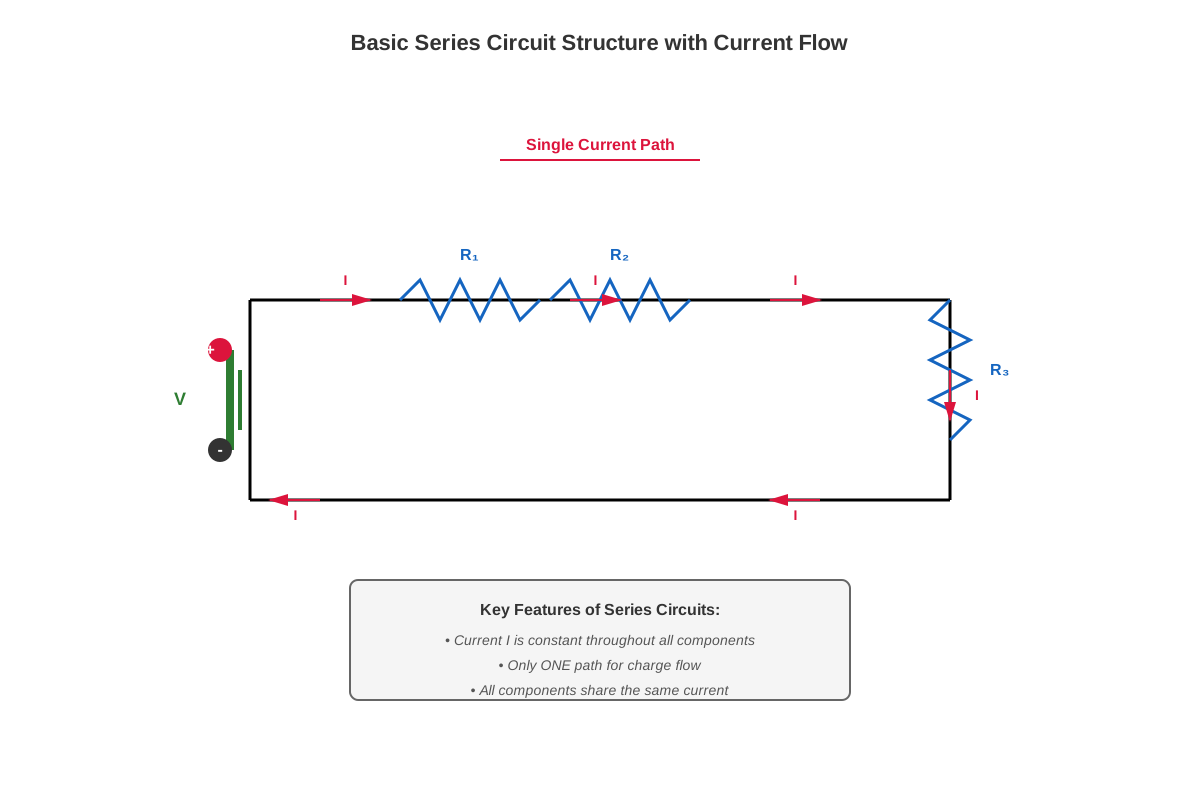
A series circuit is an electrical circuit configuration in which components are connected end-to-end along a single path, such that the same current flows through each component sequentially. The defining characteristic of series circuits is that there is only one pathway for current flow—if any component in the series fails or is removed, the entire circuit becomes open and current ceases to flow. This contrasts sharply with parallel circuits, where multiple pathways exist for current.
In series circuits, three fundamental principles govern behavior:
- Current is constant throughout: The same current (I) flows through every component in the series, regardless of individual resistances
- Voltage divides across components: The total voltage supplied by the source equals the sum of voltage drops across each component
- Resistances add directly: The total or equivalent resistance equals the sum of individual resistances
Current Conservation in Series Circuits
The principle that current remains constant throughout a series circuit derives from charge conservation. Since charge cannot accumulate at any point in a steady-state DC circuit, the rate at which charge enters any component must equal the rate at which it exits. Mathematically:
I_total = I_1 = I_2 = I_3 = ... = I_nThis relationship holds regardless of the resistance values of individual components. A common student error involves assuming that current "gets used up" as it passes through resistors—in reality, while energy is dissipated as heat, the charge flow rate (current) remains unchanged. This principle enables straightforward calculation: once the total current is determined, it applies to every component in the series.
Voltage Division and Kirchhoff's Voltage Law
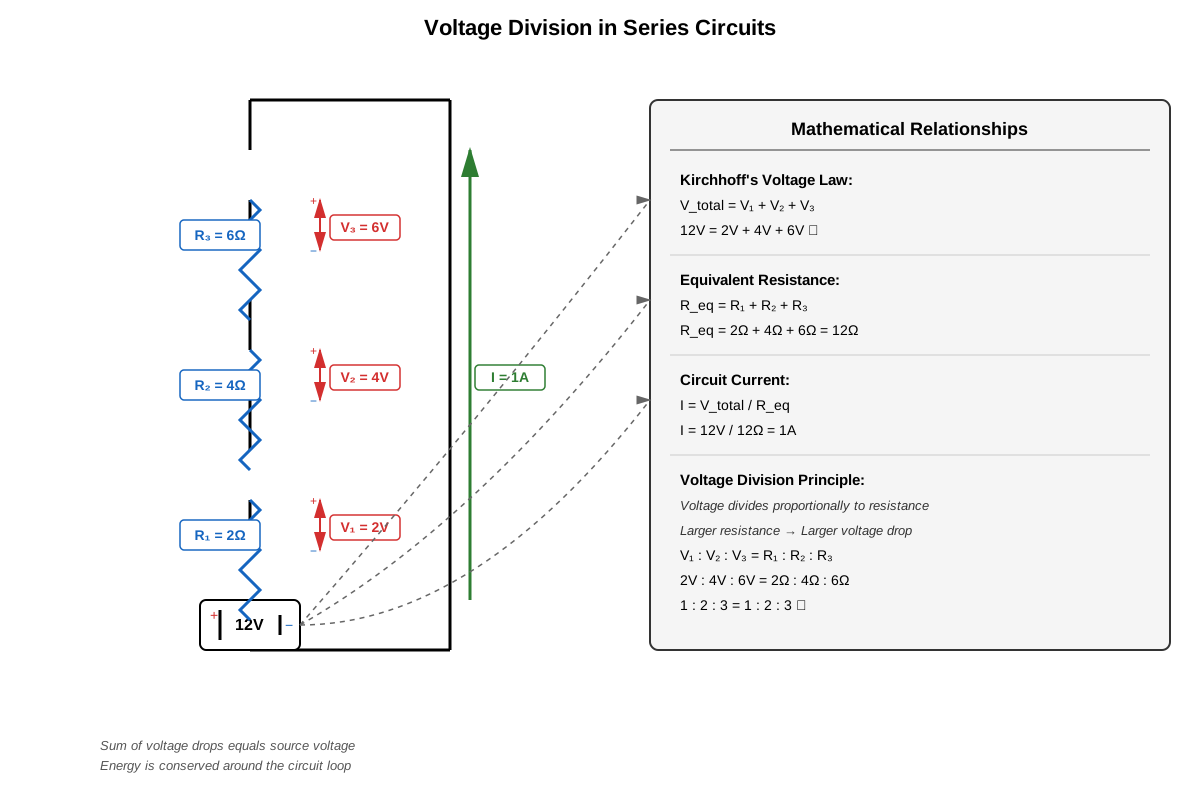
Kirchhoff's Voltage Law (KVL) states that the sum of all voltage changes around any closed loop in a circuit equals zero. For a series circuit with a voltage source and multiple resistors, this means:
V_source = V_1 + V_2 + V_3 + ... + V_nEach resistor experiences a voltage drop proportional to its resistance. Using Ohm's Law (V = IR) and the fact that current is constant:
V_i = I × R_iThe fraction of total voltage dropped across any particular resistor can be expressed as:
V_i = V_source × (R_i / R_total)This voltage divider relationship is extremely high-yield for the MCAT. It allows rapid determination of voltage across any component without calculating current first. For example, in a series circuit with a 12V battery and resistors of 2Ω, 3Ω, and 7Ω, the 3Ω resistor experiences a voltage drop of 12V × (3Ω/12Ω) = 3V.
Equivalent Resistance Calculation
The equivalent resistance (R_eq or R_total) of a series circuit is the single resistance value that could replace all series components while maintaining the same current for a given voltage. For series circuits, equivalent resistance is simply the sum of individual resistances:
R_eq = R_1 + R_2 + R_3 + ... + R_nThis additive relationship makes intuitive sense: each resistor presents an additional obstacle to current flow, and these obstacles accumulate. The equivalent resistance of a series circuit is always greater than any individual resistance in the series. This contrasts with parallel circuits, where equivalent resistance is always less than the smallest individual resistance.
Power Dissipation in Series Circuits
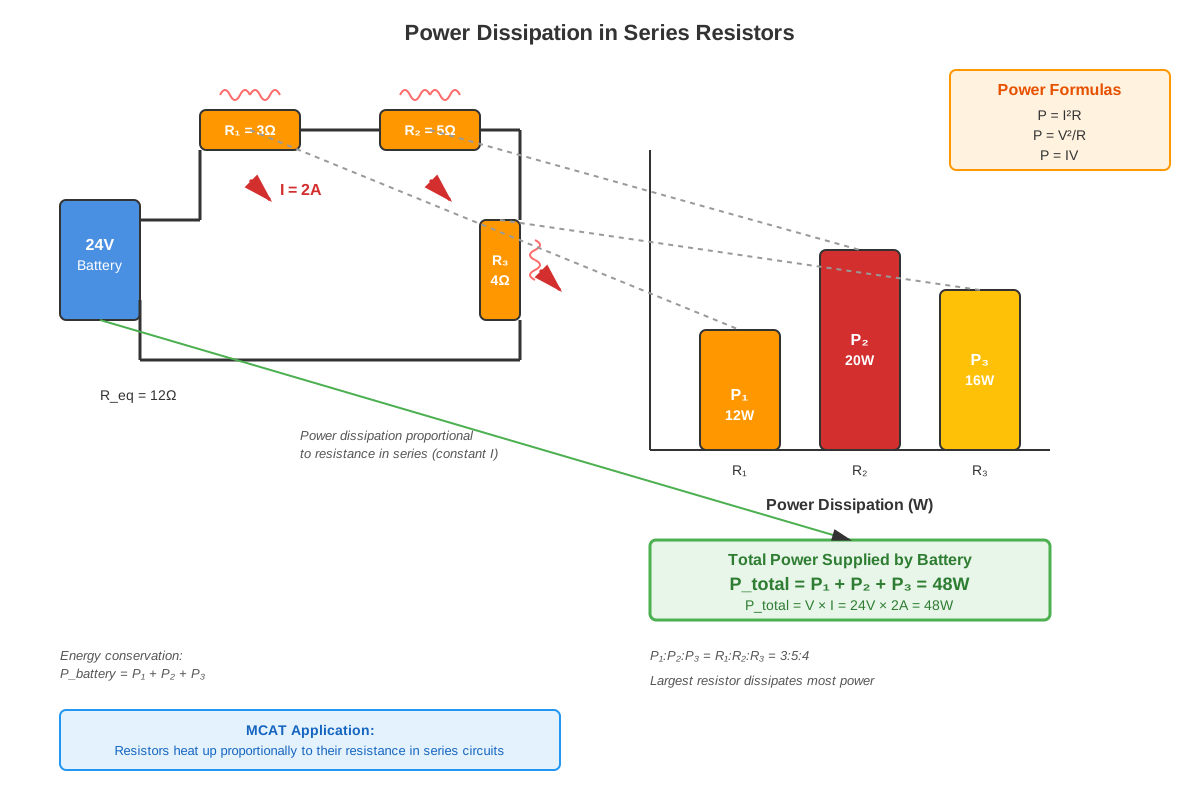
Each resistor in a series circuit dissipates electrical energy as heat according to the power equations:
P = IV = I²R = V²/RSince current is constant throughout a series circuit, the form P = I²R is particularly useful, revealing that power dissipation is directly proportional to resistance. The resistor with the highest resistance dissipates the most power in a series configuration. The total power supplied by the voltage source equals the sum of power dissipated by all components:
P_total = P_1 + P_2 + P_3 + ... + P_nThis relationship reflects energy conservation—all electrical energy supplied by the source is converted to heat (and possibly other forms of energy) in the circuit components.
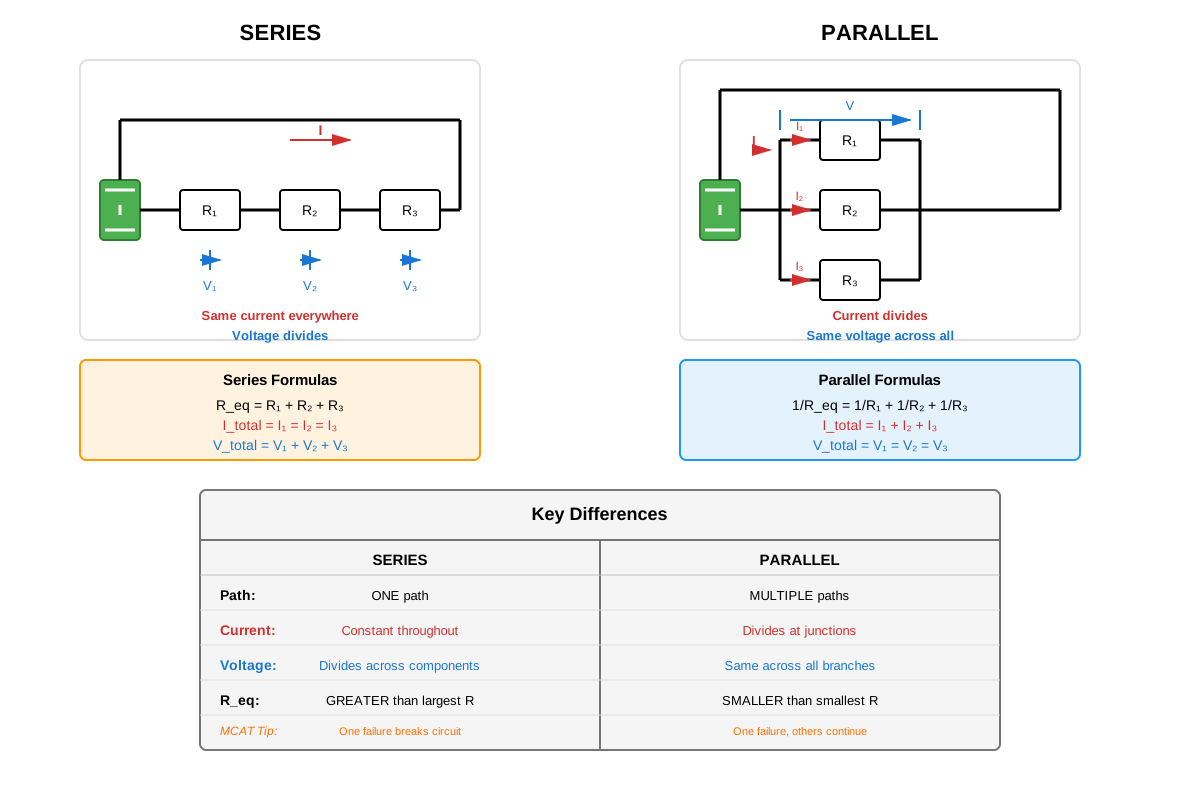
Comparison Table: Series vs. Parallel Circuits
| Property | Series Circuits | Parallel Circuits |
|---|---|---|
| Current | Same through all components | Divides among branches |
| Voltage | Divides across components | Same across all components |
| Equivalent Resistance | R_eq = R_1 + R_2 + R_3 + ... | 1/R_eq = 1/R_1 + 1/R_2 + 1/R_3 + ... |
| Effect of Adding Resistor | Increases total resistance | Decreases total resistance |
| Effect of Component Failure | Entire circuit opens | Other branches continue functioning |
| Power Distribution | Highest R dissipates most power | Lowest R dissipates most power |
Capacitors in Series
While resistors are most commonly discussed in series circuits, capacitors can also be arranged in series. For capacitors in series, the relationship is inverse to that of resistors:
1/C_eq = 1/C_1 + 1/C_2 + 1/C_3 + ... + 1/C_nThe equivalent capacitance of series capacitors is always less than the smallest individual capacitance. This occurs because series capacitors effectively increase the separation distance between the outermost plates, reducing overall capacitance. The charge stored on each capacitor in series is identical, while voltage divides inversely proportional to capacitance.
Circuit Analysis Strategy
Analyzing series circuits systematically involves these steps:
- Identify the series configuration: Verify that components share a single current path
- Calculate equivalent resistance: Sum all resistances in the series
- Determine total current: Apply Ohm's Law using total voltage and equivalent resistance (I = V_total / R_eq)
- Calculate individual voltage drops: Use V = IR for each component with the total current
- Verify using KVL: Confirm that voltage drops sum to the source voltage
- Calculate power if needed: Use P = I²R for each component
Concept Relationships
Series circuits form the foundation of circuit analysis, connecting directly to Ohm's Law as the primary tool for relating voltage, current, and resistance. The constant current principle in series circuits derives from charge conservation, while voltage division reflects energy conservation through Kirchhoff's Voltage Law. Understanding series circuits enables progression to parallel circuits, where the relationships invert (voltage constant, current divides), and to combination circuits that merge both configurations.
The voltage divider principle in series circuits connects to electric potential concepts, as each resistor represents a location where potential energy decreases. Power dissipation relationships link series circuits to thermodynamics, particularly the conversion of electrical energy to thermal energy. The equivalent resistance concept extends to resistivity and the physical properties of conductors, helping students understand how material properties affect circuit behavior.
Series circuits also relate to electrochemistry, where batteries in series add their voltages (analogous to resistors adding resistance), and to capacitance, where series capacitors follow inverse addition rules. The mathematical techniques used in series circuit analysis—particularly systematic application of conservation laws—transfer directly to analyzing magnetic circuits, RC circuits, and AC circuits encountered in advanced physics topics.
Relationship Map:
Ohm's Law → enables calculation of → Voltage drops across series components → which must satisfy → Kirchhoff's Voltage Law → derived from → Conservation of Energy → while → Charge Conservation → requires → Constant current throughout series → which determines → Power dissipation patterns → connecting to → Thermal energy conversion
High-Yield Facts
⭐ In series circuits, current is identical through all components regardless of their individual resistances
⭐ The equivalent resistance of series resistors equals the sum: R_eq = R_1 + R_2 + R_3 + ...
⭐ Voltage divides across series components proportionally to resistance: V_i = V_total × (R_i / R_total)
⭐ The component with the highest resistance in a series circuit dissipates the most power (P = I²R)
⭐ If any component in a series circuit fails open, current ceases throughout the entire circuit
- The sum of voltage drops across series components equals the source voltage (Kirchhoff's Voltage Law)
- Adding a resistor to a series circuit always increases total resistance and decreases total current
- The equivalent resistance of a series circuit is always greater than any individual resistance
- For capacitors in series, the reciprocal relationship applies: 1/C_eq = 1/C_1 + 1/C_2 + ...
- Total power dissipated equals the sum of power dissipated by each component: P_total = ΣP_i
- In a series circuit with identical resistors, voltage divides equally among them
- The voltage drop across a resistor in series can be found without calculating current using the voltage divider formula
- Series circuits model the behavior of batteries connected in series (voltages add)
- The time constant for an RC series circuit is τ = RC, determining charging/discharging rates
Quick check — test yourself on Series circuits so far.
Try Flashcards →Common Misconceptions
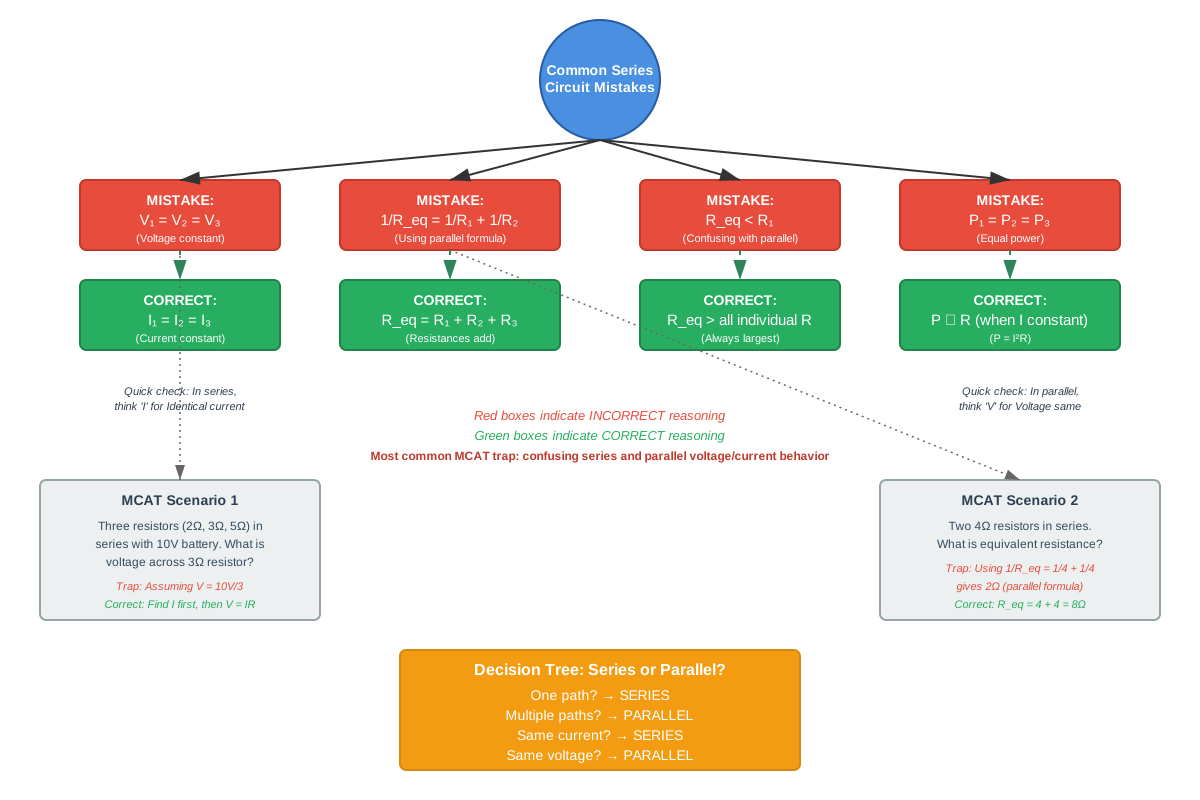
Misconception: Current decreases as it passes through each resistor in a series circuit
Correction: Current remains constant throughout a series circuit due to charge conservation. While energy is dissipated as heat in resistors, the rate of charge flow (current) does not change. Every coulomb that enters a resistor must exit it at the same rate.
Misconception: The resistor closest to the positive terminal of the battery experiences the highest voltage drop
Correction: Voltage drop across a resistor depends only on its resistance value and the current flowing through it (V = IR), not its position in the circuit. A 10Ω resistor experiences the same voltage drop whether it's first or last in the series, as long as the current is the same.
Misconception: Adding a resistor in series increases the current in the circuit
Correction: Adding a resistor in series increases total resistance, which decreases total current according to Ohm's Law (I = V/R). More resistance means less current for a given voltage source.
Misconception: In a series circuit, the battery voltage appears across each resistor
Correction: The battery voltage divides among all resistors in series. Each resistor experiences only a fraction of the total voltage, proportional to its resistance relative to the total resistance. The sum of all voltage drops equals the battery voltage.
Misconception: Power dissipation is the same for all resistors in a series circuit
Correction: Power dissipation varies with resistance in series circuits. Since P = I²R and current is constant, the resistor with the highest resistance dissipates the most power. A 10Ω resistor dissipates twice the power of a 5Ω resistor in the same series circuit.
Misconception: Equivalent resistance of series capacitors is found by adding capacitances
Correction: Series capacitors follow the reciprocal rule: 1/C_eq = 1/C_1 + 1/C_2 + ..., which is opposite to the rule for series resistors. This makes the equivalent capacitance less than the smallest individual capacitance.
Misconception: If one resistor in a series circuit has very high resistance, it blocks all current
Correction: While a very high resistance does significantly reduce current throughout the series circuit, it doesn't completely block current unless the resistance is infinite (open circuit). The current is determined by total resistance: I = V/R_total.
Worked Examples
Example 1: Complete Series Circuit Analysis
Problem: A series circuit contains a 24V battery and three resistors: R₁ = 2Ω, R₂ = 4Ω, and R₃ = 6Ω. Calculate: (a) equivalent resistance, (b) total current, (c) voltage drop across each resistor, (d) power dissipated by R₂, and (e) total power supplied by the battery.
Solution:
(a) Equivalent Resistance
For series resistors, resistances add directly:
R_eq = R_1 + R_2 + R_3 = 2Ω + 4Ω + 6Ω = 12Ω(b) Total Current
Using Ohm's Law with the total voltage and equivalent resistance:
I = V_total / R_eq = 24V / 12Ω = 2AThis 2A current flows through every component in the series.
(c) Voltage Drops
Using V = IR for each resistor with I = 2A:
V_1 = I × R_1 = 2A × 2Ω = 4V
V_2 = I × R_2 = 2A × 4Ω = 8V
V_3 = I × R_3 = 2A × 6Ω = 12V
Verification using KVL: 4V + 8V + 12V = 24V ✓
Alternatively, using the voltage divider formula for R₂:
V_2 = V_total × (R_2 / R_eq) = 24V × (4Ω / 12Ω) = 8V ✓(d) Power Dissipated by R₂
Using P = I²R:
P_2 = I² × R_2 = (2A)² × 4Ω = 4 × 4 = 16WAlternatively, using P = V²/R:
P_2 = V_2² / R_2 = (8V)² / 4Ω = 64 / 4 = 16W ✓(e) Total Power
Method 1 - Sum individual powers:
P_1 = I² × R_1 = 4 × 2 = 8W
P_2 = 16W (calculated above)
P_3 = I² × R_3 = 4 × 6 = 24W
P_total = 8W + 16W + 24W = 48W
Method 2 - Use total voltage and current:
P_total = V_total × I = 24V × 2A = 48W ✓Key Insights: Notice that R₃ (highest resistance) dissipates the most power (24W), while R₁ (lowest resistance) dissipates the least (8W). This demonstrates the P = I²R relationship in series circuits where current is constant.
Example 2: Circuit Modification Analysis
Problem: A series circuit initially contains a 12V battery and two resistors: R₁ = 3Ω and R₂ = 9Ω. A third resistor R₃ = 6Ω is then added in series. Compare the current and voltage drop across R₁ before and after adding R₃.
Solution:
Initial Configuration (before adding R₃)
Equivalent resistance:
R_eq,initial = R_1 + R_2 = 3Ω + 9Ω = 12ΩTotal current:
I_initial = V / R_eq,initial = 12V / 12Ω = 1AVoltage drop across R₁:
V_1,initial = I_initial × R_1 = 1A × 3Ω = 3VFinal Configuration (after adding R₃)
New equivalent resistance:
R_eq,final = R_1 + R_2 + R_3 = 3Ω + 9Ω + 6Ω = 18ΩNew total current:
I_final = V / R_eq,final = 12V / 18Ω = 0.667ANew voltage drop across R₁:
V_1,final = I_final × R_1 = 0.667A × 3Ω = 2VComparison
Current change:
ΔI = I_final - I_initial = 0.667A - 1A = -0.333A (33.3% decrease)Voltage drop change across R₁:
ΔV_1 = V_1,final - V_1,initial = 2V - 3V = -1V (33.3% decrease)Key Insights: Adding a resistor in series increases total resistance, which decreases current throughout the circuit. The voltage drop across R₁ decreases proportionally because V = IR and both I and R₁ change (I decreases while R₁ stays constant). This demonstrates why series circuits are sensitive to component changes—modifying any part affects the entire circuit. This principle is clinically relevant: if one component in a series medical device fails or changes resistance, the entire device performance is compromised.
Exam Strategy
When approaching series circuits MCAT questions, begin by identifying the circuit configuration—look for keywords like "connected end-to-end," "in sequence," or "one after another." The MCAT often tests whether students can distinguish series from parallel configurations, so verify that there's only one current path before applying series circuit rules.
Trigger phrases that indicate series circuit questions include:
- "The same current flows through..."
- "Components connected sequentially..."
- "If one component fails, the entire circuit..."
- "The total resistance is the sum of..."
- "Voltage divides across..."
For calculation problems, use this systematic approach:
- Calculate equivalent resistance first (sum all resistances)
- Find total current using I = V_total / R_eq
- Use this current to find voltage drops (V = IR) or power (P = I²R)
- Verify your answer using Kirchhoff's Voltage Law
Process of elimination tips:
- Eliminate answers suggesting current varies through series components
- Eliminate answers where voltage drops don't sum to source voltage
- For power questions, eliminate answers suggesting the smallest resistor dissipates the most power
- If asked about adding components, eliminate answers suggesting resistance decreases or current increases
Time allocation: Series circuit calculations typically require 60-90 seconds for straightforward problems. If a question requires more than three calculation steps, consider whether there's a conceptual shortcut (like the voltage divider formula) that bypasses intermediate calculations. For qualitative questions about circuit behavior, spend 30-45 seconds analyzing the relationships before selecting an answer.
Exam Tip: When voltage values are given for individual components but not the source, add them to find total voltage. When only the source voltage and resistances are given, calculate current first, then find individual voltages. This decision tree saves valuable time.
Watch for questions that test understanding of circuit failure modes. If a problem states that a component "burns out" or "fails," determine whether it becomes an open circuit (infinite resistance, current stops) or a short circuit (zero resistance, current bypasses). The MCAT favors open circuit scenarios for series configurations.
Memory Techniques
"SCAR" Mnemonic for Series Circuit Properties:
- Same current throughout
- Combine resistances by addition
- All voltage drops sum to source voltage
- Resistor with highest R dissipates most power
Voltage Divider Visualization: Imagine a waterfall with multiple drops. The total height (voltage) divides among the drops (resistors), with taller drops (higher resistance) representing larger voltage changes. The water flow rate (current) remains constant throughout.
"Series = Sum" Memory Aid: In series circuits, resistances sum directly (R_eq = R₁ + R₂ + ...). This contrasts with parallel circuits where conductances sum. Remember: "Series sums simply."
Power Pattern Acronym - "HIP": In series circuits, Highest resistance has Increased Power dissipation (because P = I²R and I is constant).
Capacitor Confusion Buster: For capacitors, remember "Series is Sneaky"—series capacitors use the reciprocal formula (like parallel resistors), which is the opposite of what you'd expect. This "sneaky" behavior helps distinguish it from resistor rules.
KVL Visualization: Picture walking around a circuit loop as hiking around a mountain. You must return to your starting elevation (voltage). Every voltage drop is like descending, and every voltage source is like ascending. The total elevation change must be zero for a complete loop.
Summary
Series circuits represent a fundamental configuration in electricity where components connect end-to-end along a single current path. The defining characteristics—constant current throughout, voltage division across components, and direct addition of resistances—enable systematic analysis of circuit behavior using Ohm's Law and Kirchhoff's Voltage Law. Understanding that current remains identical through all series components while voltage divides proportionally to resistance provides the conceptual foundation for solving quantitative problems and predicting qualitative circuit behavior. The voltage divider relationship (V_i = V_total × R_i/R_total) and the power relationship (P = I²R) are particularly high-yield for MCAT questions. Series circuits contrast with parallel configurations in every major property, making comparative understanding essential. Mastery requires recognizing that adding components increases total resistance and decreases current, that the highest resistance component dissipates the most power, and that component failure opens the entire circuit. These principles apply not only to resistors but also to capacitors (with inverse relationships) and batteries (voltages add), extending series circuit concepts across multiple contexts in physics and medical applications.
Key Takeaways
- Current is constant throughout all components in a series circuit, regardless of individual resistance values—this is the most fundamental property distinguishing series from parallel circuits
- Equivalent resistance equals the sum of individual resistances (R_eq = R₁ + R₂ + R₃ + ...), making total resistance always greater than any single component
- Voltage divides across series components proportionally to their resistance, following the voltage divider formula V_i = V_total × (R_i / R_total)
- The highest resistance component dissipates the most power in a series circuit because P = I²R and current is constant
- Kirchhoff's Voltage Law requires that voltage drops sum to the source voltage, providing a verification method for all series circuit calculations
- Adding any component to a series circuit increases total resistance and decreases total current, affecting every component in the circuit
- Series circuit failure is catastrophic—if any component opens, current ceases throughout the entire circuit, unlike parallel circuits where other branches continue functioning
Related Topics
Parallel Circuits: The complementary configuration where components share common voltage but current divides among branches; understanding series circuits provides the contrast needed to master parallel circuit analysis
Combination Circuits: Complex networks mixing series and parallel configurations; mastery of pure series circuits is prerequisite to analyzing these hybrid systems
Kirchhoff's Laws: Both voltage law (used in series circuits) and current law (used in parallel circuits) form the complete framework for circuit analysis
RC Circuits: Time-dependent circuits combining resistors and capacitors in series, introducing exponential charging and discharging behavior
Internal Resistance: Real batteries have internal resistance in series with their EMF, affecting circuit performance and requiring series circuit analysis
Electrical Power and Energy: Deeper exploration of power dissipation, efficiency, and energy conversion in electrical systems builds on series circuit power relationships
Resistivity and Conductivity: Material properties that determine resistance values, connecting microscopic physics to macroscopic circuit behavior
Practice CTA
Now that you've mastered the core concepts of series circuits, it's time to solidify your understanding through active practice. Challenge yourself with the practice questions and flashcards designed specifically for this topic—they'll help you identify any remaining gaps in your knowledge and build the rapid recall essential for MCAT success. Remember, understanding the theory is just the first step; applying these concepts under timed conditions is what distinguishes top scorers. Each practice problem you solve strengthens the neural pathways that will serve you on test day. You've built a strong foundation—now transform that knowledge into exam-ready skills through deliberate practice!
Sign up free to keep reading
Create a free AnvayaPrep account to finish this MCAT guide on Series circuits — plus flashcards and practice questions.