Overview
Archimedes principle is a cornerstone concept in Fluids and Physics that describes the buoyant force experienced by objects submerged in a fluid. This principle states that any object wholly or partially immersed in a fluid experiences an upward buoyant force equal to the weight of the fluid displaced by the object. Named after the ancient Greek mathematician and physicist Archimedes of Syracuse, this principle explains why ships float, why helium balloons rise, and why objects feel lighter when submerged in water. The mathematical elegance and practical applications of this principle make it an essential topic for understanding fluid mechanics at both macroscopic and microscopic scales.
For the MCAT, Archimedes principle Physics represents a high-yield topic that appears frequently in both passage-based and discrete questions within the Chemical and Physical Foundations of Biological Systems section. The MCAT tests not only the ability to recall the principle but also to apply it in complex scenarios involving density calculations, floating and sinking conditions, and physiological contexts such as blood flow, respiratory mechanics, and medical devices. Understanding this principle enables students to solve problems involving fluid displacement, apparent weight in fluids, and the conditions for equilibrium of floating objects—all common question types on the exam.
Archimedes principle MCAT questions often integrate multiple physics concepts, requiring students to connect buoyancy with density, pressure, gravitational force, and Newton's laws. This topic serves as a bridge between static fluid mechanics (hydrostatics) and dynamic considerations, linking to concepts such as Pascal's principle, fluid pressure at depth, and Bernoulli's equation. Mastery of Archimedes principle provides the foundation for understanding more complex biological systems where fluid mechanics plays a crucial role, including cardiovascular physiology, pulmonary function, and the behavior of cells in suspension.
Learning Objectives
- [ ] Define Archimedes principle using accurate Physics terminology
- [ ] Explain why Archimedes principle matters for the MCAT
- [ ] Apply Archimedes principle to exam-style questions
- [ ] Identify common mistakes related to Archimedes principle
- [ ] Connect Archimedes principle to related Physics concepts
- [ ] Calculate buoyant force for objects of various shapes and densities in different fluids
- [ ] Determine whether an object will float, sink, or remain suspended based on density relationships
- [ ] Analyze apparent weight changes when objects are submerged in fluids
- [ ] Solve multi-step problems involving partial submersion and floating equilibrium
Prerequisites
- Density and specific gravity: Essential for comparing object and fluid properties to determine buoyancy behavior
- Pressure in fluids: Buoyant force arises from pressure differences at different depths in a fluid
- Newton's laws of motion: Required to analyze force equilibrium and acceleration of objects in fluids
- Weight and gravitational force: Buoyant force must be compared to weight to determine net force and motion
- Volume calculations: Displaced fluid volume determines the magnitude of buoyant force
- Unit conversions: Critical for solving problems with mixed units (kg/L, g/cm³, etc.)
Why This Topic Matters
Archimedes principle has profound clinical and real-world significance that extends far beyond theoretical physics. In medicine, understanding buoyancy is essential for comprehending how red blood cells remain suspended in plasma, how lipoproteins of different densities separate during centrifugation, and how body composition analysis using hydrostatic weighing works. Medical devices such as hydrometers measure urine specific gravity to assess hydration status and kidney function, directly applying Archimedes principle. Respiratory physiology involves understanding how surfactant affects the surface tension and effective "buoyancy" of alveoli, preventing collapse.
On the MCAT, Archimedes principle appears in approximately 3-5% of physics questions, making it a high-yield topic with excellent return on study investment. Questions typically appear in three formats: (1) discrete questions testing direct application of the buoyancy formula, (2) passage-based questions involving experimental setups with submerged objects or floating devices, and (3) integrated questions combining buoyancy with other physics concepts like work, energy, or fluid dynamics. The MCAT particularly favors questions that require students to reason through density relationships rather than simply plug numbers into formulas.
Common exam passages involve scenarios such as submarine or hot air balloon operation, hydrometer calibration, density determination experiments, blood cell separation techniques, and aquatic organism adaptations. The MCAT also tests this principle in disguised forms, such as questions about apparent weight loss in water, the fraction of an iceberg above water, or why certain objects float in one fluid but sink in another. Understanding the conceptual basis of Archimedes principle—that buoyant force results from pressure differences between the top and bottom of a submerged object—enables students to tackle novel question formats with confidence.
Core Concepts
The Fundamental Statement of Archimedes Principle
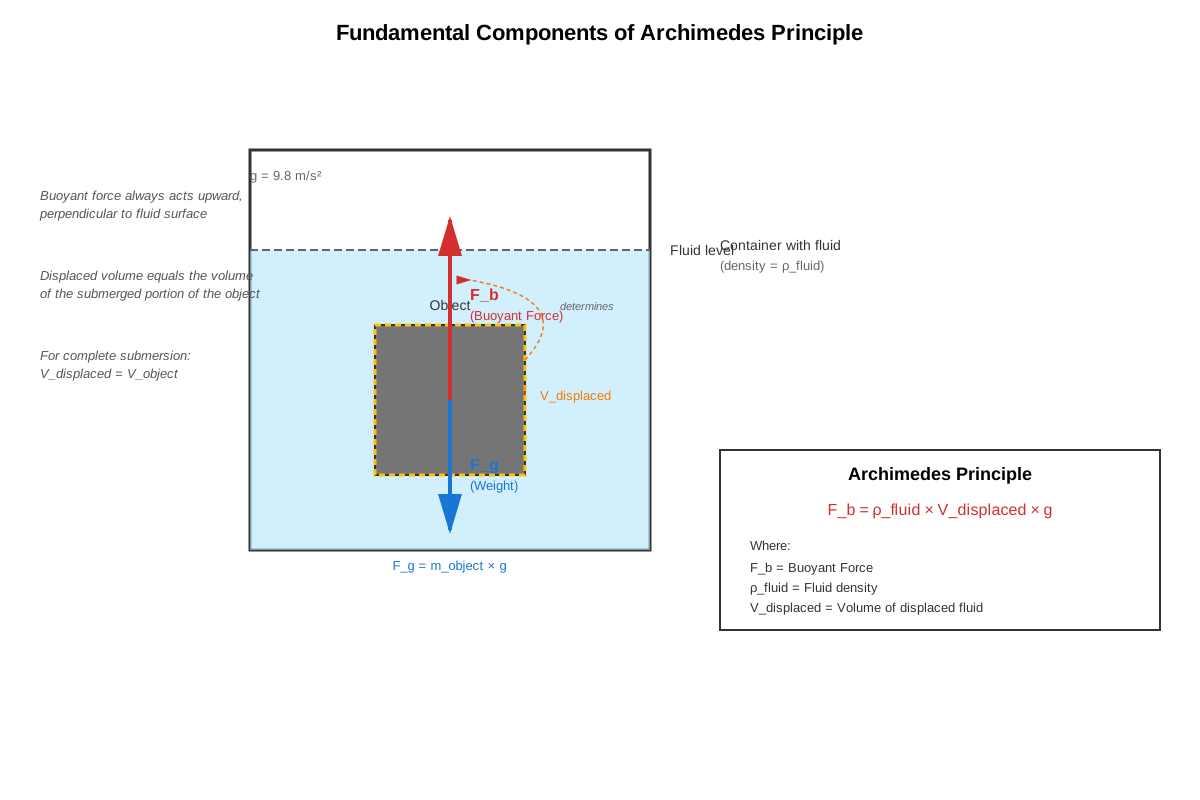
Archimedes principle formally states: Any object completely or partially submerged in a fluid experiences an upward buoyant force equal in magnitude to the weight of the fluid displaced by the object. This principle applies to all fluids, including both liquids and gases, though it is most commonly discussed in the context of liquids due to their higher densities. The buoyant force (F_b) acts vertically upward through the center of buoyancy, which corresponds to the centroid of the displaced fluid volume.
The mathematical expression of Archimedes principle is:
F_b = ρ_fluid × V_displaced × gWhere:
- F_b = buoyant force (N)
- ρ_fluid = density of the fluid (kg/m³)
- V_displaced = volume of fluid displaced by the object (m³)
- g = acceleration due to gravity (9.8 m/s²)
Alternatively, since the weight of the displaced fluid equals its mass times gravity, and mass equals density times volume:
F_b = m_fluid × g = W_fluid displacedThis formulation emphasizes that buoyant force equals the weight of the displaced fluid, not the weight of the object itself—a crucial distinction that prevents many common errors.
Physical Origin of Buoyant Force
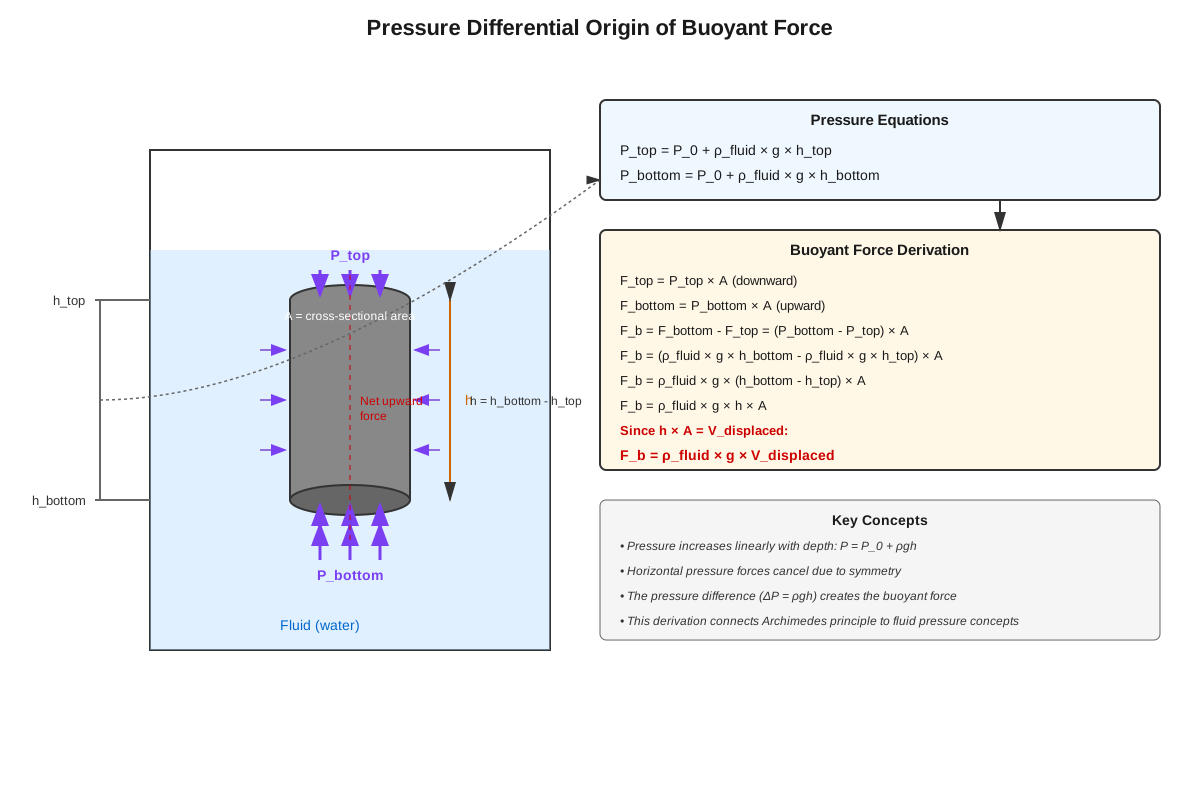
The buoyant force arises from the pressure gradient that exists in any fluid under the influence of gravity. Pressure increases with depth according to the relationship P = P₀ + ρgh, where h is the depth below the surface. When an object is submerged, the bottom surface experiences greater pressure than the top surface because it is at a greater depth. This pressure difference creates a net upward force.
For a simple rectangular object with height h and cross-sectional area A:
- Pressure at top surface: P_top = P₀ + ρg(d)
- Pressure at bottom surface: P_bottom = P₀ + ρg(d + h)
- Force on top (downward): F_top = P_top × A
- Force on bottom (upward): F_bottom = P_bottom × A
- Net upward force: F_b = F_bottom - F_top = ρghA = ρgV
This derivation shows that buoyant force is fundamentally a consequence of fluid pressure variation with depth, connecting Archimedes principle to the broader concept of hydrostatic pressure.
Conditions for Floating, Sinking, and Neutral Buoyancy
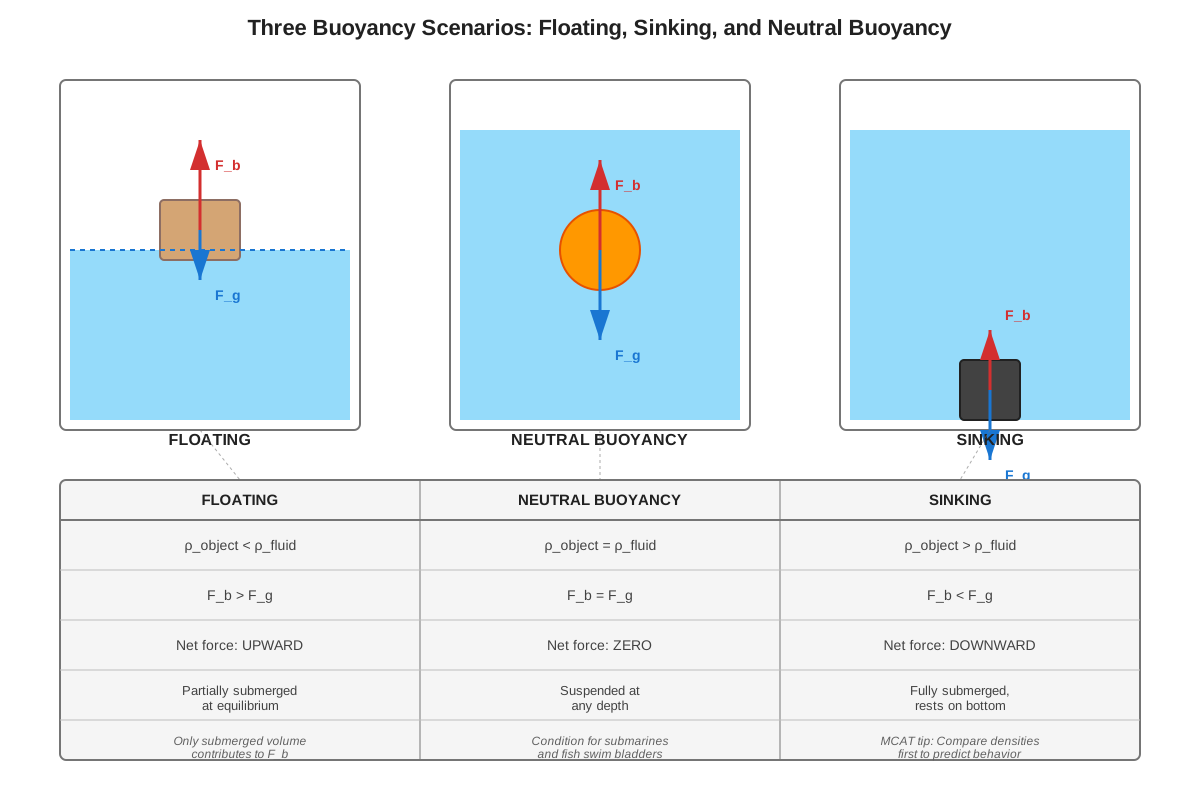
The behavior of an object in a fluid depends on the relationship between the buoyant force and the object's weight. Three distinct scenarios exist:
| Condition | Force Relationship | Density Relationship | Behavior |
|---|---|---|---|
| Sinking | F_b < W_object | ρ_object > ρ_fluid | Net downward force; object accelerates downward |
| Floating | F_b = W_object | ρ_object < ρ_fluid | Zero net force; object partially submerged at equilibrium |
| Neutral Buoyancy | F_b = W_object | ρ_object = ρ_fluid | Zero net force; object fully submerged at any depth |
For a floating object at equilibrium, only a portion of the object is submerged. The fraction submerged can be determined by setting the buoyant force equal to the object's weight:
ρ_fluid × V_submerged × g = ρ_object × V_total × gSimplifying:
V_submerged / V_total = ρ_object / ρ_fluidThis relationship explains why icebergs float with approximately 90% of their volume underwater (since ice has about 90% the density of seawater) and why a person with body fat (lower density) floats more easily than a lean, muscular person (higher density).
Apparent Weight in Fluids
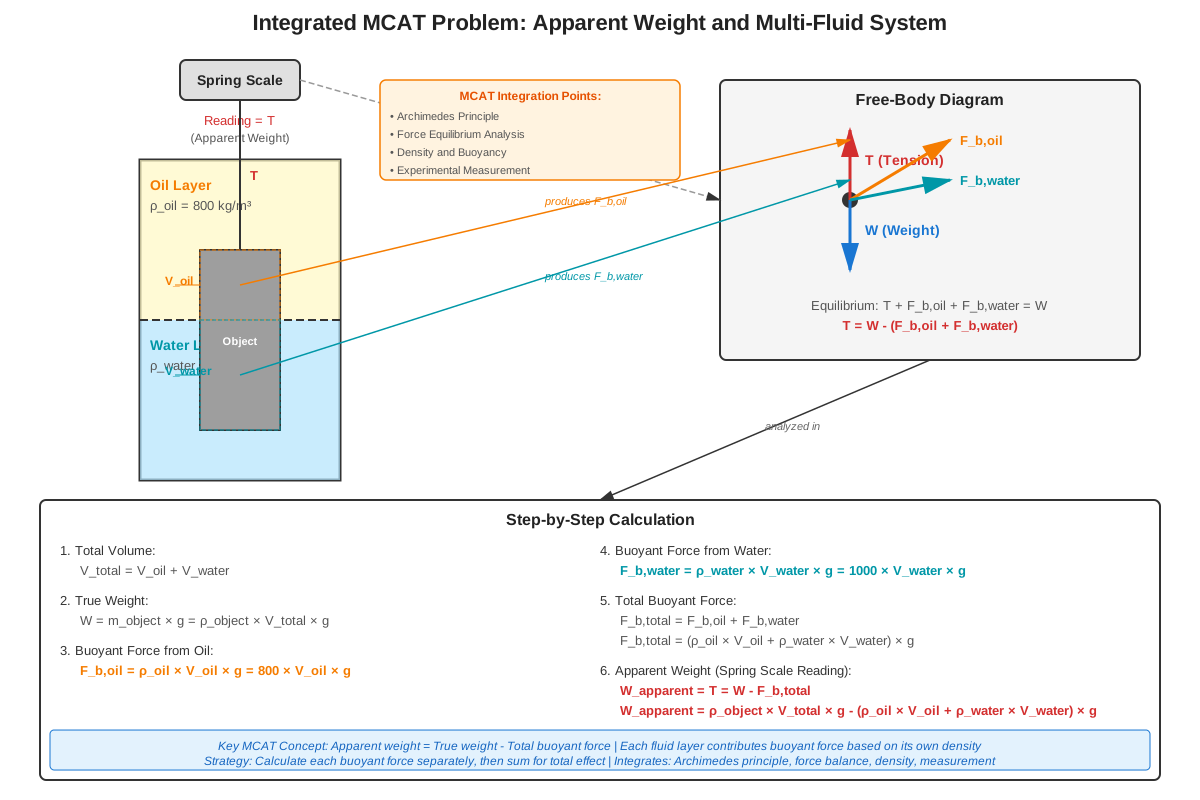
When an object is submerged in a fluid, it experiences an apparent weight that is less than its true weight in air. The apparent weight equals the true weight minus the buoyant force:
W_apparent = W_true - F_b = mg - ρ_fluid × V_object × gThis concept is particularly important for MCAT questions involving scales, tension in strings holding submerged objects, or the force required to hold an object underwater. The apparent weight can even be negative if the buoyant force exceeds the object's weight, meaning an external downward force is required to keep the object submerged.
For objects with density less than the fluid, the apparent weight is negative, indicating that the object naturally accelerates upward. For objects denser than the fluid, the apparent weight is positive but reduced compared to the weight in air. This principle is used in hydrostatic weighing to determine body composition, as the difference between weight in air and weight in water reveals body volume and therefore density.
Archimedes Principle in Gases
While most examples involve liquids, Archimedes principle applies equally to gases. The buoyant force in air is usually negligible for dense objects because air density is approximately 1000 times less than water density. However, for objects with very low density (helium balloons, hot air balloons), the buoyant force in air becomes significant.
A helium balloon rises because:
- The buoyant force (weight of displaced air) exceeds the combined weight of the helium and balloon material
- ρ_air × V_balloon × g > (ρ_helium × V_balloon + m_balloon) × g
Hot air balloons operate on the same principle, but instead of using a less dense gas, they heat air to reduce its density. The buoyant force remains constant (determined by the volume and ambient air density), but the weight decreases as the air inside is heated and expands, with some escaping through the opening at the bottom.
Density Determination Using Archimedes Principle
Archimedes principle provides an elegant method for determining the density of irregularly shaped objects. The procedure involves:
- Weigh the object in air: W_air = m_object × g = ρ_object × V_object × g
- Weigh the object fully submerged in a fluid of known density: W_submerged = W_air - F_b
- Calculate the buoyant force: F_b = W_air - W_submerged = ρ_fluid × V_object × g
- Determine the object's volume: V_object = F_b / (ρ_fluid × g)
- Calculate the object's density: ρ_object = m_object / V_object
This method is particularly useful for objects with complex geometries where direct volume measurement is difficult. The MCAT frequently tests this application in experimental passage contexts.
Concept Relationships
Archimedes principle is intimately connected to multiple foundational physics concepts, forming a web of relationships that the MCAT exploits in integrated questions. The principle fundamentally derives from hydrostatic pressure → which creates pressure differences with depth → leading to net upward forces on submerged objects. This connection means that any factor affecting fluid pressure (such as fluid density or gravitational field strength) directly impacts buoyant force.
The relationship between Archimedes principle and density is bidirectional: density determines buoyancy behavior (floating vs. sinking), while buoyancy measurements can determine unknown densities. This creates a powerful analytical tool: density comparison → determines force balance → predicts motion or equilibrium state. The MCAT frequently requires students to reason through density relationships without explicit calculation.
Newton's second law provides the framework for analyzing object motion in fluids: net force (weight minus buoyant force) → determines acceleration → predicts trajectory. When buoyant force equals weight, acceleration is zero, and the object is in equilibrium (either floating at the surface or neutrally buoyant at depth). This connection to force analysis means that Archimedes principle questions often require free-body diagrams and force summation.
The concept of apparent weight connects Archimedes principle to tension, normal force, and scale readings. When an object is submerged while attached to a string or resting on a submerged scale, the supporting force must only balance the apparent weight, not the true weight. This relationship appears frequently in MCAT questions involving experimental setups.
Archimedes principle also relates to work and energy concepts. Lifting an object through a fluid requires less work than lifting it through a vacuum because the buoyant force assists the lifting process. The work done against the net force (weight minus buoyancy) determines the energy change: reduced net force → less work required → energy conservation with buoyancy assistance.
Finally, Archimedes principle connects to fluid dynamics through the concept of terminal velocity in fluids. When an object sinks or rises through a viscous fluid, it eventually reaches a constant velocity when the net force (weight minus buoyancy minus drag) equals zero. This three-way force balance integrates static buoyancy with dynamic drag forces.
High-Yield Facts
⭐ The buoyant force equals the weight of the displaced fluid, NOT the weight of the object itself
⭐ An object floats when its average density is less than the fluid density (ρ_object < ρ_fluid)
⭐ The fraction of a floating object submerged equals the ratio of object density to fluid density (V_sub/V_total = ρ_obj/ρ_fluid)
⭐ Buoyant force depends only on fluid density, displaced volume, and gravity—NOT on the object's mass, density, or depth of submersion
⭐ Apparent weight in a fluid equals true weight minus buoyant force (W_app = W_true - F_b)
- Archimedes principle applies to both liquids and gases, though buoyancy in air is usually negligible for dense objects
- The buoyant force acts upward through the center of buoyancy (centroid of displaced fluid volume)
- For a completely submerged object, the displaced volume equals the object's volume
- For a floating object at equilibrium, the net force is zero (buoyant force equals weight)
- An object with density equal to the fluid density will remain suspended at any depth (neutral buoyancy)
- Increasing fluid density increases buoyant force for the same displaced volume (easier to float in saltwater than freshwater)
- The buoyant force on a submerged object is the same at all depths (depth affects pressure but not the pressure difference between top and bottom)
- Archimedes principle can be used to determine the density of irregularly shaped objects by comparing weight in air to weight in fluid
- A hollow object can float even if its material is denser than the fluid, because average density (including the hollow space) determines buoyancy
- The buoyant force on an object partially submerged in two immiscible fluids equals the sum of buoyant forces from each fluid layer
Quick check — test yourself on Archimedes principle so far.
Try Flashcards →Common Misconceptions
Misconception: The buoyant force depends on the object's weight or mass.
Correction: Buoyant force depends only on the fluid density, the volume of fluid displaced, and gravity. Two objects of the same volume experience identical buoyant forces in the same fluid, regardless of their masses. The object's weight determines whether it sinks or floats (by comparison with buoyant force), but does not affect the magnitude of the buoyant force itself.
Misconception: Heavier objects always sink and lighter objects always float.
Correction: Buoyancy depends on density (mass per unit volume), not absolute mass or weight. A massive steel ship floats because its average density (including the hollow interior) is less than water density, while a small steel ball bearing sinks because its density exceeds water density. The terms "heavy" and "light" are ambiguous without considering volume.
Misconception: The buoyant force increases as an object sinks deeper into a fluid.
Correction: For a completely submerged object, buoyant force remains constant at all depths. While pressure increases with depth, the pressure difference between the top and bottom of the object (which creates buoyant force) remains constant as long as the object is fully submerged. Buoyant force only changes during the transition from partial to complete submersion.
Misconception: An object floats because water "pushes up" on it more than air does.
Correction: While this statement is directionally correct, it misses the mechanism. The upward force arises from the pressure difference between the bottom and top of the object, not from some special "pushing" property of water. The pressure gradient in the fluid (caused by gravity) creates higher pressure at greater depths, resulting in a net upward force. This same principle applies in air, though the effect is much smaller due to air's low density.
Misconception: The buoyant force on a floating object is less than the buoyant force would be if the object were fully submerged.
Correction: This is actually correct, but students often misunderstand why. For a floating object, only the submerged portion displaces fluid, so the buoyant force equals the weight of the partially displaced fluid. If the same object were forced completely underwater, it would displace more fluid and experience a larger buoyant force. At floating equilibrium, the buoyant force exactly equals the object's weight, which is less than the buoyant force that would act on the fully submerged object.
Misconception: Archimedes principle only applies to objects in water.
Correction: Archimedes principle applies to all fluids, including gases. Helium balloons rise due to buoyancy in air, and even dense objects experience a small (usually negligible) buoyant force in air. The principle is universal for any substance that behaves as a fluid, including liquids, gases, and even plasmas.
Misconception: The shape of an object affects the buoyant force it experiences.
Correction: For a given displaced volume, the buoyant force is identical regardless of object shape. A sphere, cube, and irregular shape that all displace 1 liter of water experience the same 9.8 N buoyant force. Shape affects hydrodynamic drag during motion through a fluid, but not the static buoyant force. However, shape can affect whether an object floats or sinks by determining whether it can trap air or orient itself to displace more or less fluid.
Misconception: An object's density must be calculated to determine if it will float.
Correction: While density comparison is the most direct method, students can also compare the buoyant force (ρ_fluid × V_object × g) to the object's weight (m_object × g). If F_b > W, the object floats; if F_b < W, it sinks. This force-based approach is sometimes more efficient for MCAT questions that provide mass and volume rather than density directly.
Worked Examples
Example 1: Determining the Fraction of a Floating Object Submerged
Problem: A wooden block with density 650 kg/m³ floats in water (density 1000 kg/m³). What fraction of the block's volume is submerged?
Solution:
Step 1: Identify the relevant principle
For a floating object at equilibrium, the buoyant force equals the object's weight. The buoyant force depends on the volume submerged, while the weight depends on the total volume.
Step 2: Set up the force balance equation
At equilibrium: F_b = W_object
ρ_water × V_submerged × g = ρ_wood × V_total × gStep 3: Cancel common terms
The gravitational acceleration g appears on both sides and cancels:
ρ_water × V_submerged = ρ_wood × V_totalStep 4: Solve for the fraction submerged
V_submerged / V_total = ρ_wood / ρ_water
V_submerged / V_total = 650 kg/m³ / 1000 kg/m³ = 0.65
Step 5: Interpret the result
65% of the block's volume is submerged, meaning 35% extends above the water surface.
Key Insight: This problem demonstrates that the fraction submerged depends only on the density ratio, not on the absolute size or mass of the object. This relationship (V_sub/V_total = ρ_obj/ρ_fluid) is one of the highest-yield formulas for MCAT buoyancy questions and should be memorized.
Connection to Learning Objectives: This example directly applies Archimedes principle to determine equilibrium conditions for floating objects, a common MCAT question type. It also illustrates the importance of density relationships in predicting buoyancy behavior.
Example 2: Calculating Apparent Weight and Tension
Problem: A 5.0 kg rock with density 2500 kg/m³ is suspended by a string while completely submerged in water (density 1000 kg/m³). What is the tension in the string?
Solution:
Step 1: Identify all forces acting on the rock
Three forces act on the submerged rock:
- Weight (downward): W = mg
- Buoyant force (upward): F_b
- Tension (upward): T
Step 2: Calculate the weight
W = mg = 5.0 kg × 9.8 m/s² = 49 NStep 3: Calculate the volume of the rock
Using the definition of density:
V = m / ρ_rock = 5.0 kg / 2500 kg/m³ = 0.002 m³ = 2.0 LStep 4: Calculate the buoyant force
The rock is completely submerged, so it displaces a volume of water equal to its own volume:
F_b = ρ_water × V_rock × g
F_b = 1000 kg/m³ × 0.002 m³ × 9.8 m/s²
F_b = 19.6 N
Step 5: Apply Newton's second law
Since the rock is in equilibrium (not accelerating), the net force is zero:
ΣF = T + F_b - W = 0
T = W - F_b = 49 N - 19.6 N = 29.4 N
Step 6: Interpret the result
The tension (29.4 N) is less than the rock's weight in air (49 N) because the buoyant force supports part of the weight. The tension equals the apparent weight of the rock in water.
Alternative Approach: The apparent weight can be calculated directly:
W_apparent = W_true - F_b = mg - ρ_fluid × V_object × g
W_apparent = ρ_object × V × g - ρ_fluid × V × g
W_apparent = (ρ_object - ρ_fluid) × V × g
W_apparent = (2500 - 1000) kg/m³ × 0.002 m³ × 9.8 m/s²
W_apparent = 29.4 N
Key Insight: This problem illustrates that the apparent weight formula W_app = (ρ_obj - ρ_fluid) × V × g provides a shortcut for submerged objects. The tension in a string or the reading on a submerged scale equals the apparent weight, not the true weight.
Connection to Learning Objectives: This example demonstrates how to apply Archimedes principle in force analysis problems, connecting buoyancy to Newton's laws. It also shows how to calculate buoyant force from object properties and how apparent weight differs from true weight—all high-yield MCAT concepts.
Exam Strategy
When approaching MCAT questions on Archimedes principle, begin by identifying whether the object is floating, sinking, or in equilibrium while submerged. This determination guides the entire solution strategy. For floating objects, immediately recognize that buoyant force equals weight, and use the density ratio formula (V_sub/V_total = ρ_obj/ρ_fluid) if asked about the fraction submerged. For submerged objects, draw a free-body diagram showing weight (down), buoyant force (up), and any other forces (tension, normal force, applied force).
Trigger words and phrases that signal Archimedes principle questions include: "buoyant force," "floating," "submerged," "displaced," "apparent weight," "density determination," "hydrometer," "fraction above/below water," "weight in water vs. air," and "neutral buoyancy." Passages describing experimental setups with objects in fluids, density measurements, or flotation devices almost certainly require application of Archimedes principle.
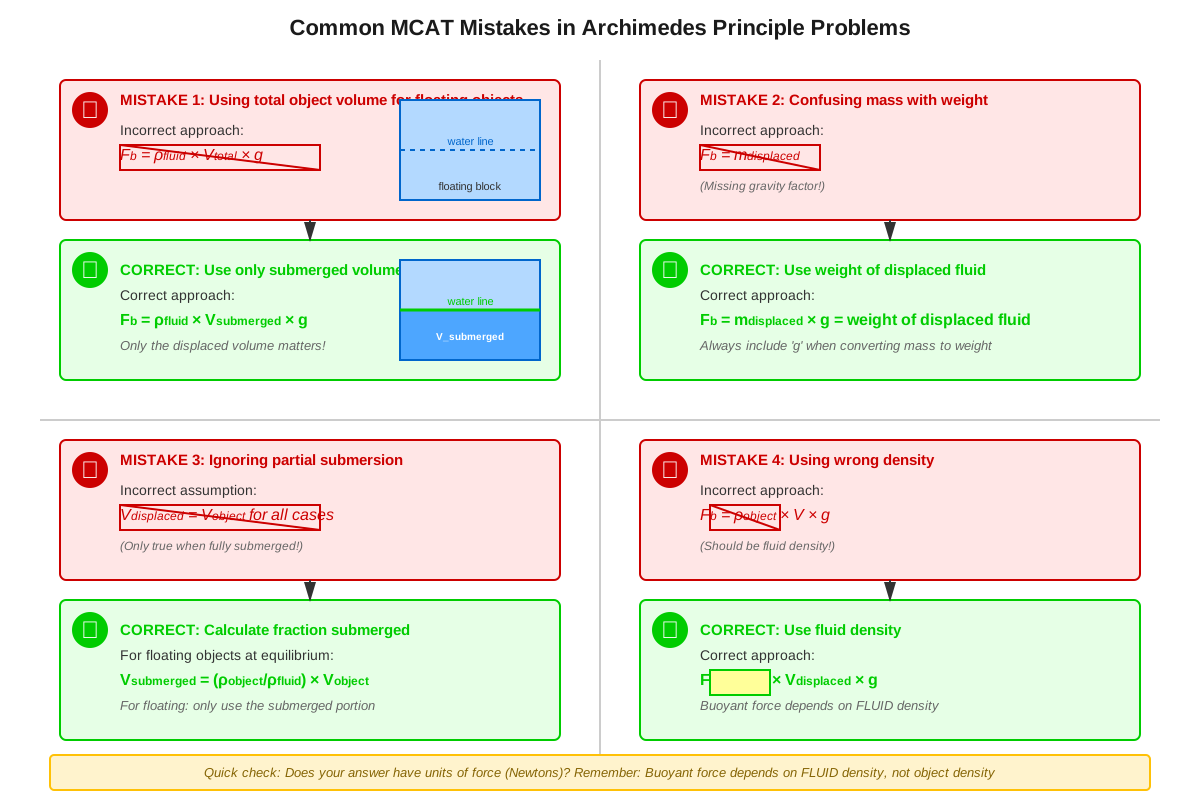
For process of elimination, recognize that incorrect answer choices often:
- Confuse the object's weight with the buoyant force
- State that buoyant force depends on object density (it depends on fluid density)
- Claim that buoyant force increases with depth for fully submerged objects
- Incorrectly apply the buoyancy formula to only part of the object
- Forget to account for buoyant force when calculating apparent weight or tension
Time allocation strategy: Archimedes principle questions are typically medium difficulty and should take 60-90 seconds for discrete questions and 90-120 seconds for passage-based questions. If a question requires multiple steps (calculating volume, then buoyant force, then net force), budget an extra 30 seconds. Avoid getting bogged down in complex calculations—many MCAT questions can be solved through density comparison or conceptual reasoning without numerical computation.
Exam Tip: When a question asks whether an object will float or sink, immediately compare densities rather than calculating forces. If ρ_object < ρ_fluid, it floats; if ρ_object > ρ_fluid, it sinks. This conceptual approach is faster and less error-prone than force calculations.
For questions involving apparent weight, remember that the formula W_app = W_true - F_b applies universally. If the question provides weight in air and weight in water, the difference equals the buoyant force, which can then be used to find the object's volume or the fluid's density. This "weight difference" approach appears frequently in experimental passages.
When passages describe density determination experiments, recognize the standard procedure: weigh in air, weigh in fluid, calculate buoyant force from the difference, determine volume from buoyant force, and calculate density from mass and volume. The MCAT may ask about any step in this sequence or about sources of experimental error.
Memory Techniques
Mnemonic for Archimedes Principle: "Fluids Boost Displaced Volumes Gently" represents F_b = ρ_fluid × V_displaced × g, with each word's first letter corresponding to a variable in the equation.
Density Comparison Rhyme: "Less dense floats, more dense sinks, equal density neither thinks" helps remember the three buoyancy scenarios based on density relationships.
Visualization Strategy: Picture a submerged cube with pressure arrows pointing inward on all faces. The arrows on the bottom are longer (higher pressure) than those on top, creating a net upward force. This mental image reinforces that buoyant force arises from pressure differences and acts upward.
Acronym for Floating Objects: "FRED" = Floating Requires Equal Density comparison (actually, less than, but the acronym helps trigger the density comparison approach). When you see a floating object, think "FRED" and immediately set up the density ratio.
Apparent Weight Memory Aid: "Apparent weight is Actual weight After Accounting for buoyancy" (four A's). This reminds you that apparent weight = actual weight - buoyant force.
Conceptual Anchor: Always remember that buoyant force is the "weight of the water that's not there anymore"—the fluid that would have been in the space now occupied by the object. This conceptual understanding helps prevent confusion about what determines buoyant force magnitude.
Summary
Archimedes principle states that any object submerged in a fluid experiences an upward buoyant force equal to the weight of the displaced fluid, expressed mathematically as F_b = ρ_fluid × V_displaced × g. This fundamental principle explains floating, sinking, and neutral buoyancy through the relationship between buoyant force and object weight. Objects float when their density is less than the fluid density, with the fraction submerged equal to the density ratio (ρ_object/ρ_fluid). Objects sink when denser than the fluid, experiencing a net downward force equal to weight minus buoyant force. The apparent weight of a submerged object (the weight it "seems" to have in the fluid) equals its true weight minus the buoyant force, explaining why objects feel lighter underwater. Buoyant force depends only on fluid density, displaced volume, and gravity—not on object properties, depth, or shape. This principle applies universally to all fluids (liquids and gases) and enables density determination through weight comparison in air versus fluid. For the MCAT, mastering Archimedes principle requires understanding both the mathematical relationships and the conceptual basis (pressure differences with depth), as well as the ability to apply the principle in integrated scenarios involving force analysis, equilibrium conditions, and experimental contexts.
Key Takeaways
- Buoyant force equals the weight of displaced fluid: F_b = ρ_fluid × V_displaced × g, depending only on fluid properties and displaced volume, not object properties
- Floating occurs when ρ_object < ρ_fluid, with the fraction submerged equal to ρ_object/ρ_fluid—a high-yield relationship for MCAT questions
- Apparent weight in a fluid equals true weight minus buoyant force (W_app = W_true - F_b), explaining reduced tension, scale readings, and perceived weight underwater
- Buoyant force remains constant for a fully submerged object at all depths, arising from pressure differences between top and bottom surfaces
- Density comparison provides the fastest approach to determining whether an object will float or sink, avoiding unnecessary force calculations
- Archimedes principle applies to all fluids including gases, though buoyancy in air is usually negligible except for low-density objects like balloons
- The principle enables density determination by comparing weight in air to weight in fluid, a common experimental setup in MCAT passages
Related Topics
Pascal's Principle: Describes how pressure changes in an enclosed fluid are transmitted uniformly throughout the fluid, complementing Archimedes principle in understanding fluid statics and hydraulic systems.
Fluid Pressure and Depth: The relationship P = P₀ + ρgh explains how pressure varies with depth, providing the physical basis for buoyant force through pressure differences.
Bernoulli's Equation: Extends fluid mechanics to moving fluids, connecting pressure, velocity, and height in flowing systems—building on the static fluid concepts underlying Archimedes principle.
Terminal Velocity in Fluids: Combines buoyancy with drag forces to explain the constant velocity reached by objects moving through viscous fluids, integrating Archimedes principle with fluid dynamics.
Specific Gravity and Density: Deepens understanding of density relationships and provides dimensionless comparisons that simplify buoyancy calculations and predictions.
Hydrostatic Weighing and Body Composition: Clinical application of Archimedes principle to determine body density and estimate body fat percentage, connecting physics to physiology.
Practice CTA
Now that you have mastered the core concepts of Archimedes principle, it's time to solidify your understanding through active practice. Attempt the practice questions and work through the flashcards to reinforce the high-yield facts and relationships you've learned. Focus particularly on problems involving density comparisons, apparent weight calculations, and floating equilibrium—these represent the most common MCAT question types. Remember that understanding the conceptual basis of buoyancy (pressure differences creating net upward force) will enable you to tackle novel question formats with confidence. Your investment in mastering this high-yield topic will pay dividends across multiple physics questions on test day. Keep pushing forward—you're building the foundation for MCAT success!
Sign up free to keep reading
Create a free AnvayaPrep account to finish this MCAT guide on Archimedes principle — plus flashcards and practice questions.