Overview
Velocity is a fundamental concept in Mechanics that describes the rate of change of an object's position with respect to time, including both magnitude and direction. Unlike speed, which only tells us how fast something is moving, velocity provides complete information about an object's motion by specifying both how fast and in which direction the object travels. This distinction between scalar and vector quantities forms a cornerstone of Physics understanding and appears repeatedly throughout the MCAT, particularly in passages involving projectile motion, circular motion, fluid dynamics, and even biological systems such as blood flow through vessels.
For the MCAT, mastery of Velocity Physics extends beyond simple calculations. Test-makers frequently embed velocity concepts within complex passages involving multiple moving objects, changing reference frames, or biological applications where understanding the directional component becomes critical for answering questions correctly. The Chemical and Physical Foundations of Biological Systems section regularly features velocity in kinematics problems, while the Biological and Biochemical Foundations of Living Systems section may incorporate velocity when discussing physiological processes like nerve impulse propagation or circulatory dynamics.
Understanding velocity serves as the gateway to more advanced topics in mechanics, including acceleration, momentum, kinetic energy, and Newton's laws of motion. The Velocity MCAT questions test not only computational skills but also conceptual understanding of vector addition, relative motion, and the relationship between position, velocity, and acceleration graphs. Students who develop a robust understanding of velocity position themselves to tackle approximately 15-20% of physics questions on the exam with greater confidence and accuracy.
Learning Objectives
- [ ] Define Velocity using accurate Physics terminology
- [ ] Explain why Velocity matters for the MCAT
- [ ] Apply Velocity to exam-style questions
- [ ] Identify common mistakes related to Velocity
- [ ] Connect Velocity to related Physics concepts
- [ ] Distinguish between average velocity and instantaneous velocity in various contexts
- [ ] Perform vector addition and subtraction operations with velocity vectors
- [ ] Interpret position-time, velocity-time, and acceleration-time graphs to extract velocity information
- [ ] Solve relative velocity problems involving multiple reference frames
Prerequisites
- Scalar vs. Vector quantities: Velocity is a vector, requiring understanding of magnitude and direction components
- Basic algebra and trigonometry: Essential for resolving velocity vectors into components and performing calculations
- Coordinate systems: Necessary for establishing reference frames and defining positive/negative directions
- Units and dimensional analysis: Critical for converting between m/s, km/h, and other velocity units
- Displacement vs. distance: Velocity depends on displacement (vector), not total distance traveled (scalar)
Why This Topic Matters
Clinical and Real-World Significance
Velocity concepts appear throughout medical practice and biological systems. Blood flow velocity through vessels determines oxygen delivery to tissues and helps diagnose cardiovascular conditions through Doppler ultrasound measurements. Nerve impulse velocity (conduction speed) varies with myelination and affects neurological function. Understanding projectile motion velocity helps explain injury mechanisms in trauma cases, while relative velocity concepts apply to drug delivery systems and molecular transport across membranes.
Exam Statistics and Frequency
Velocity appears in approximately 8-12 discrete questions per MCAT administration, either as the primary focus or as a necessary component for solving more complex problems. The topic appears most frequently in:
- Kinematics passages (40% of velocity questions): Multi-part problems involving objects in motion
- Projectile motion scenarios (25%): Two-dimensional motion requiring vector decomposition
- Circular motion contexts (20%): Tangential velocity and angular relationships
- Fluid dynamics passages (15%): Flow rates and continuity equations
Common Exam Presentations
MCAT passages typically embed velocity within experimental scenarios, such as analyzing the motion of a falling object in a physiology experiment, calculating the velocity of blood through narrowed arteries, or determining the relative velocity of molecules in a biochemical assay. Standalone questions often test graph interpretation skills, asking students to extract velocity information from position-time graphs or to identify when velocity is zero, maximum, or changing direction.
Core Concepts
Definition and Mathematical Representation
Velocity is defined as the rate of change of position (displacement) with respect to time. Mathematically, velocity is expressed as a vector quantity:
v⃗ = Δr⃗/Δt = (r⃗_f - r⃗_i)/(t_f - t_i)Where:
- v⃗ represents the velocity vector
- Δr⃗ represents the displacement vector (change in position)
- Δt represents the time interval
- r⃗_f and r⃗_i represent final and initial position vectors
- t_f and t_i represent final and initial times
The SI unit for velocity is meters per second (m/s), though the MCAT may present problems using km/h, cm/s, or other units requiring conversion. The vector nature of velocity means it possesses both magnitude (speed) and direction, distinguishing it fundamentally from the scalar quantity of speed.
Average Velocity vs. Instantaneous Velocity
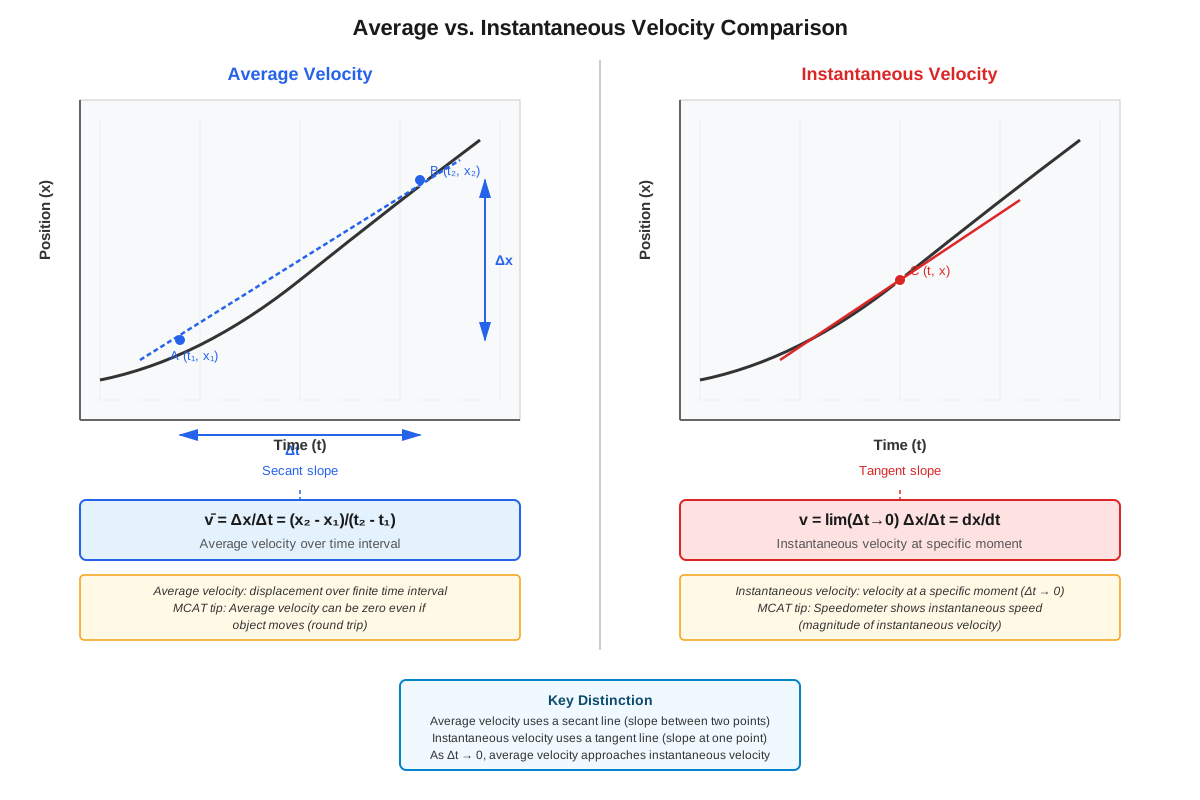
Average velocity describes the overall rate of displacement over a finite time interval. It depends only on the initial and final positions, regardless of the path taken:
v⃗_avg = (r⃗_f - r⃗_i)/(t_f - t_i)Instantaneous velocity represents the velocity at a specific moment in time, calculated as the limit of average velocity as the time interval approaches zero:
v⃗_inst = lim(Δt→0) Δr⃗/Δt = dr⃗/dtOn position-time graphs, instantaneous velocity equals the slope of the tangent line at any point, while average velocity equals the slope of the secant line connecting two points. This graphical interpretation frequently appears in MCAT questions requiring students to identify when an object is speeding up, slowing down, or changing direction.
Velocity Components and Vector Decomposition
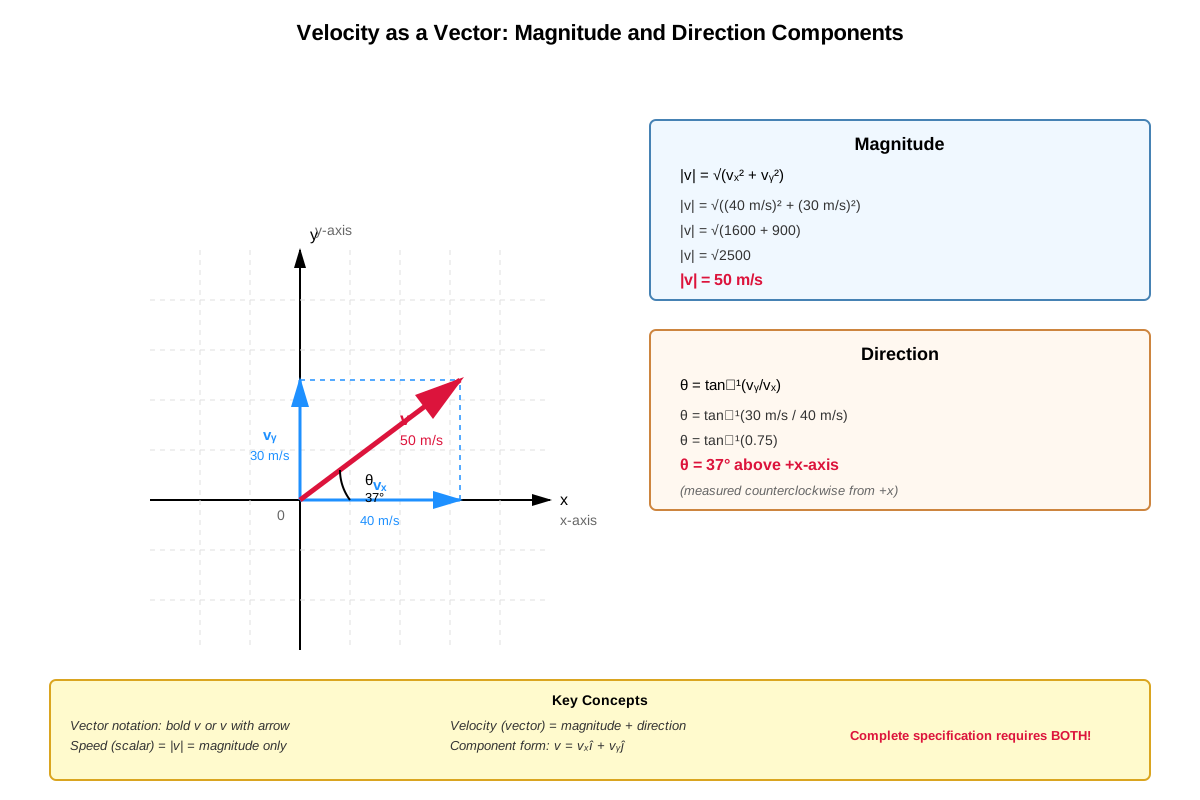
In two or three dimensions, velocity vectors can be decomposed into perpendicular components. For motion in a plane:
v⃗ = v_x î + v_y ĵWhere:
- v_x = v cos(θ) is the horizontal component
- v_y = v sin(θ) is the vertical component
- θ is the angle measured from the positive x-axis
- î and ĵ are unit vectors in the x and y directions
The magnitude of velocity (speed) is calculated using the Pythagorean theorem:
|v⃗| = √(v_x² + v_y²)The direction is found using:
θ = tan⁻¹(v_y/v_x)This decomposition proves essential for projectile motion problems, where horizontal and vertical motions are analyzed independently.
Relative Velocity
Relative velocity describes the velocity of one object as observed from the reference frame of another moving object. The relative velocity of object A with respect to object B is:
v⃗_AB = v⃗_A - v⃗_BThis concept appears in MCAT problems involving:
- Boats crossing rivers with current
- Airplanes flying with or against wind
- Observers on moving platforms
- Molecules moving through flowing fluids
The key principle is that velocities add vectorially when changing reference frames. If object A moves with velocity v⃗_A relative to the ground, and object B moves with velocity v⃗_B relative to the ground, then A's velocity relative to B requires vector subtraction.
Velocity in Different Coordinate Systems
| Coordinate System | Velocity Expression | Common Applications |
|---|---|---|
| Cartesian (x, y, z) | v⃗ = v_x î + v_y ĵ + v_z k̂ | Linear motion, projectiles |
| Polar (r, θ) | v⃗ = v_r r̂ + v_θ θ̂ | Circular motion, orbits |
| Cylindrical (r, θ, z) | v⃗ = v_r r̂ + v_θ θ̂ + v_z k̂ | Helical motion, spirals |
For the MCAT, Cartesian coordinates dominate, though understanding tangential velocity in circular motion (v = rω, where ω is angular velocity) occasionally appears.
Velocity and Calculus Relationships
Velocity represents the first derivative of position with respect to time:
v⃗(t) = dr⃗/dtConversely, position can be found by integrating velocity:
r⃗(t) = r⃗_0 + ∫v⃗(t)dtAcceleration represents the derivative of velocity:
a⃗(t) = dv⃗/dtThese relationships form the foundation of kinematics and appear in questions asking students to move between position, velocity, and acceleration representations.
Sign Conventions and Direction
The sign of velocity indicates direction relative to a chosen coordinate system. Establishing clear sign conventions prevents errors:
- Positive velocity: Motion in the positive direction (typically right, up, or forward)
- Negative velocity: Motion in the negative direction (typically left, down, or backward)
- Zero velocity: Instantaneous rest (though acceleration may be non-zero)
When velocity changes sign, the object changes direction. This occurs at the peak of projectile motion or when an object reverses course.
Concept Relationships
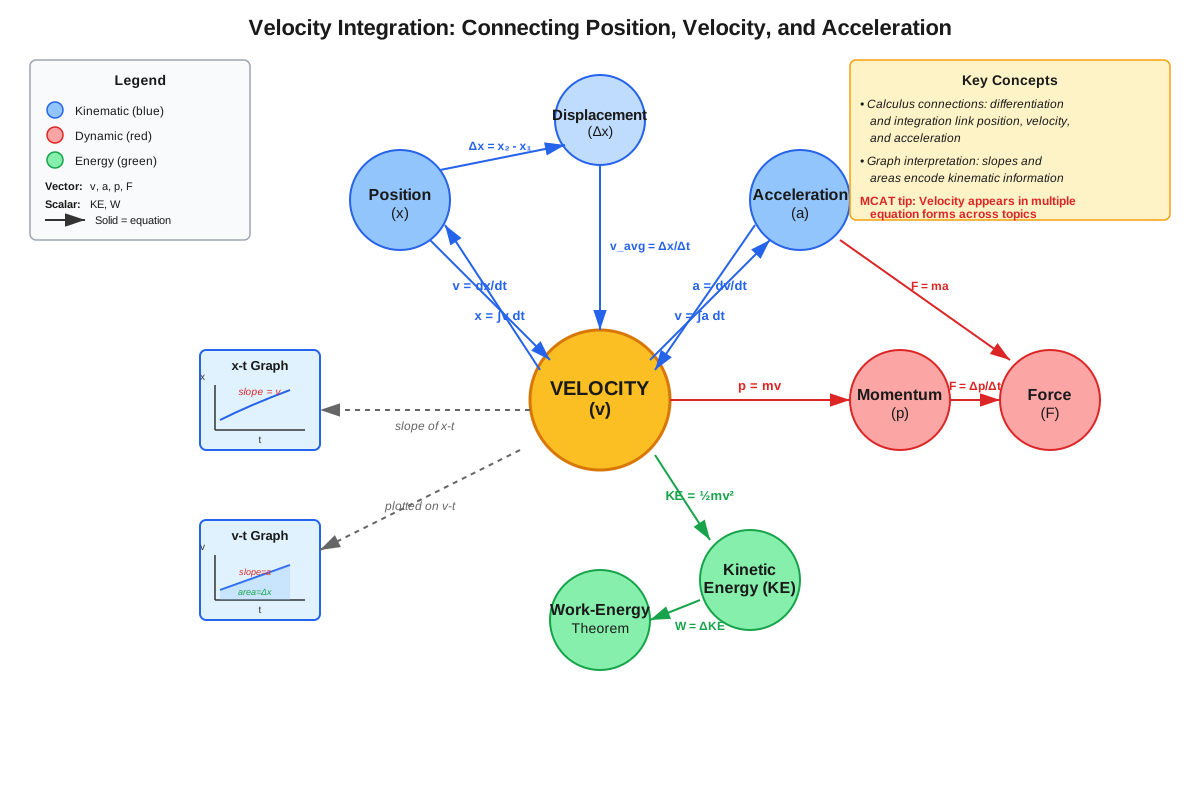
Velocity serves as the central connecting concept in kinematics, linking position to acceleration through calculus relationships. Position (displacement) → differentiation → Velocity → differentiation → Acceleration forms the fundamental chain of kinematic quantities. Conversely, integration moves backward through this chain.
Velocity connects directly to momentum (p⃗ = mv⃗), making it essential for understanding collisions and conservation laws. The kinetic energy relationship (KE = ½mv²) links velocity to energy concepts, where the squared term emphasizes that doubling velocity quadruples kinetic energy—a high-yield MCAT concept.
In circular motion, velocity connects to centripetal acceleration (a_c = v²/r), demonstrating how constant speed can still involve acceleration when direction changes. This relationship bridges linear and rotational mechanics.
For fluids, velocity relates to flow rate (Q = Av, where A is cross-sectional area) through the continuity equation, connecting mechanics to fluid dynamics. Blood flow velocity inversely relates to vessel cross-sectional area, explaining why blood slows in capillaries despite their small individual size.
The work-energy theorem (W = ΔKE) connects force to velocity changes, while impulse-momentum theorem (J = Δp = mΔv) relates force and time to velocity changes. These relationships make velocity the bridge between force concepts and energy concepts.
High-Yield Facts
⭐ Velocity is a vector quantity with both magnitude (speed) and direction; speed is the scalar magnitude of velocity
⭐ Average velocity equals displacement divided by time interval, not total distance divided by time
⭐ On a position-time graph, velocity equals the slope; on a velocity-time graph, acceleration equals the slope
⭐ When velocity is zero, the object is instantaneously at rest, but acceleration may be non-zero (e.g., at the peak of projectile motion)
⭐ Relative velocity requires vector subtraction: v⃗_AB = v⃗_A - v⃗_B
- Instantaneous velocity is the derivative of position: v = dr/dt
- Velocity components in perpendicular directions are independent (crucial for projectile motion)
- The area under a velocity-time graph equals displacement
- Constant velocity means zero acceleration (Newton's First Law)
- In uniform circular motion, speed is constant but velocity continuously changes due to changing direction
- Terminal velocity occurs when drag force equals gravitational force, resulting in zero net acceleration
- The SI unit m/s equals 3.6 km/h (useful conversion for MCAT calculations)
Quick check — test yourself on Velocity so far.
Try Flashcards →Common Misconceptions
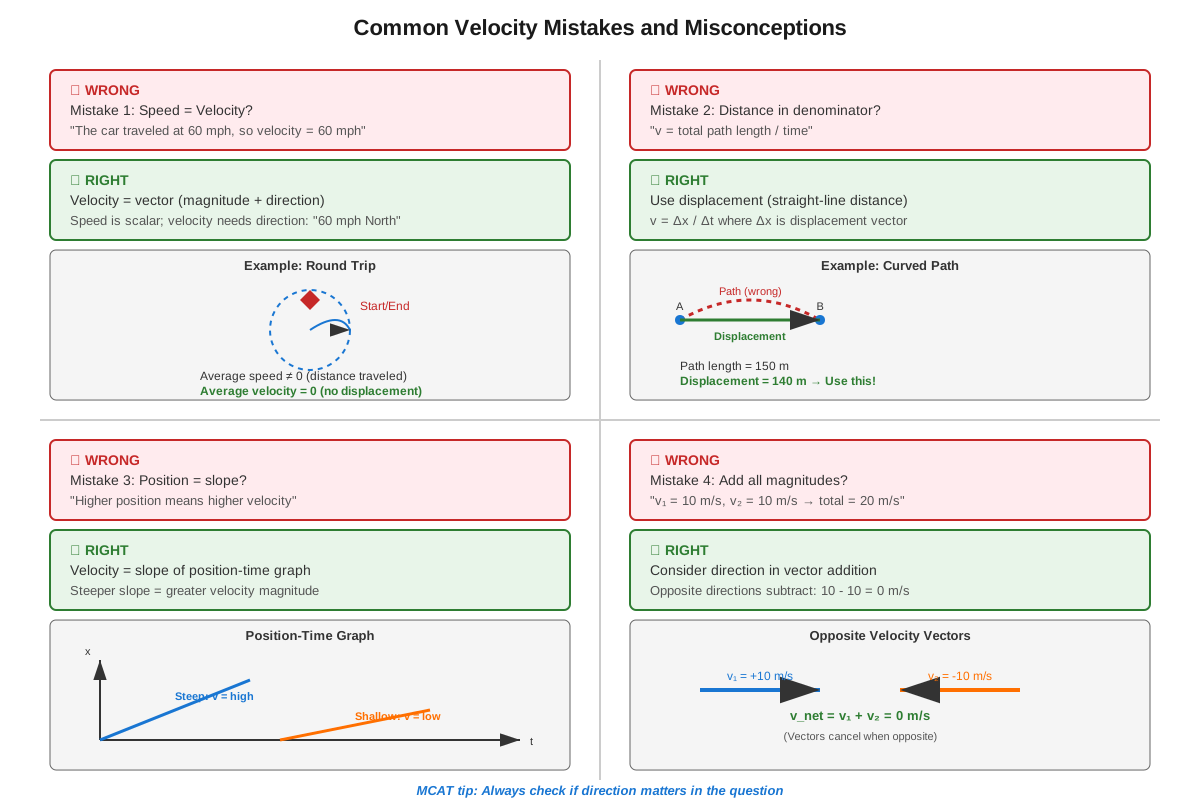
Misconception: Velocity and speed are interchangeable terms.
Correction: Velocity is a vector (includes direction), while speed is a scalar (magnitude only). An object moving in a circle at constant speed has changing velocity because direction changes continuously.
Misconception: Average velocity equals the average of initial and final velocities.
Correction: This is only true for constant acceleration. Average velocity always equals total displacement divided by total time, regardless of acceleration pattern.
Misconception: When velocity is zero, acceleration must also be zero.
Correction: Velocity and acceleration are independent quantities. At the peak of a thrown ball's trajectory, velocity is zero but acceleration equals -9.8 m/s² (gravity) downward.
Misconception: Negative velocity means the object is slowing down.
Correction: Negative velocity simply indicates motion in the negative direction. An object can have negative velocity and be speeding up (becoming more negative) if acceleration is also negative.
Misconception: The velocity of an object relative to another is found by adding their speeds.
Correction: Relative velocity requires vector subtraction, not scalar addition. Direction matters critically. Two cars traveling at 60 mph have relative velocity of 120 mph if moving toward each other, but 0 mph if moving together in the same direction.
Misconception: On a position-time graph, steeper slopes always mean faster speeds.
Correction: Steeper slopes indicate greater velocity magnitude, but negative slopes represent motion in the negative direction. The steepest negative slope represents the fastest motion in the negative direction, not the slowest motion.
Misconception: Velocity must be continuous and cannot change instantaneously.
Correction: While velocity is typically continuous, idealized collisions can involve instantaneous velocity changes. However, this requires infinite acceleration, which doesn't occur in reality but appears in simplified MCAT problems.
Worked Examples
Example 1: Two-Dimensional Velocity and Vector Addition
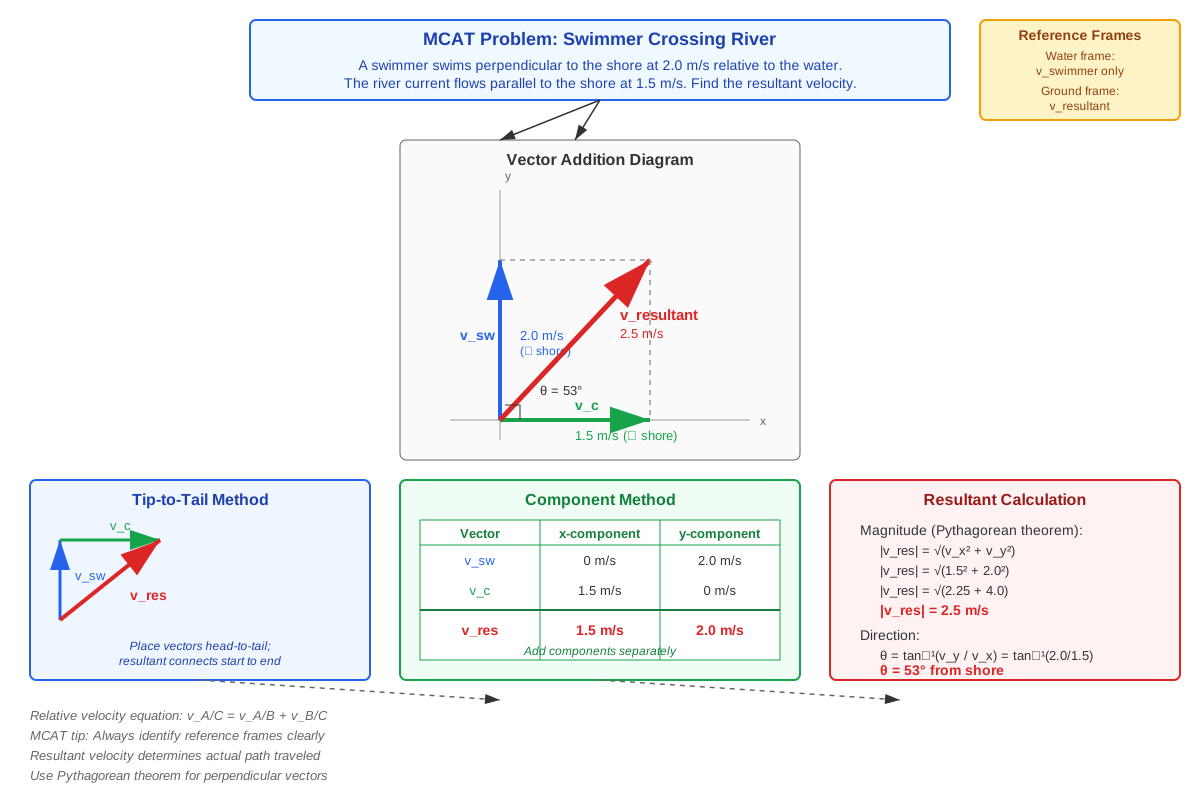
Problem: A swimmer can swim at 2.0 m/s in still water. She attempts to cross a river that flows at 1.5 m/s. If she aims directly perpendicular to the current, what is her resultant velocity relative to the shore, and at what angle does she actually travel?
Solution:
Step 1: Identify the velocity vectors
- Swimmer's velocity relative to water: v⃗_sw = 2.0 m/s perpendicular to shore
- Water's velocity relative to shore: v⃗_ws = 1.5 m/s parallel to shore
Step 2: Apply vector addition
The swimmer's velocity relative to shore is: v⃗_ss = v⃗_sw + v⃗_ws
Since these vectors are perpendicular, we use the Pythagorean theorem:
|v⃗_ss| = √(v_sw² + v_ws²) = √(2.0² + 1.5²) = √(4.0 + 2.25) = √6.25 = 2.5 m/sStep 3: Calculate the angle
θ = tan⁻¹(v_ws/v_sw) = tan⁻¹(1.5/2.0) = tan⁻¹(0.75) = 37° downstream from perpendicularAnswer: The swimmer's resultant velocity is 2.5 m/s at 37° downstream from the perpendicular direction.
Key Concepts Applied: Vector addition, relative velocity, Pythagorean theorem for perpendicular components, trigonometric relationships
Example 2: Velocity from Position-Time Graph
Problem: A particle's position is described by the equation x(t) = 3t² - 12t + 9, where x is in meters and t is in seconds. Find: (a) the velocity at t = 1 s, (b) when the velocity is zero, and (c) the average velocity between t = 0 s and t = 4 s.
Solution:
Part (a): Find instantaneous velocity at t = 1 s
Velocity is the derivative of position:
v(t) = dx/dt = d/dt(3t² - 12t + 9) = 6t - 12At t = 1 s:
v(1) = 6(1) - 12 = -6 m/sThe negative sign indicates motion in the negative x-direction.
Part (b): Find when velocity equals zero
Set v(t) = 0:
6t - 12 = 0
t = 2 s
Part (c): Find average velocity from t = 0 to t = 4 s
Average velocity = (final position - initial position) / time interval
Initial position: x(0) = 3(0)² - 12(0) + 9 = 9 m
Final position: x(4) = 3(4)² - 12(4) + 9 = 48 - 48 + 9 = 9 m
v_avg = (9 - 9)/(4 - 0) = 0 m/sAnswer: (a) -6 m/s, (b) 2 s, (c) 0 m/s
Key Insight: The average velocity is zero because the particle returns to its starting position. This demonstrates that average velocity depends only on displacement, not on the path taken or instantaneous velocities during the journey.
Key Concepts Applied: Differentiation to find velocity from position, solving for specific time values, calculating average velocity from displacement
Exam Strategy
Approaching Velocity Questions
Step 1: Identify whether the question asks for average or instantaneous velocity. Keywords like "at the moment," "at t = 2 s," or "instantaneous" indicate instantaneous velocity, while "over the interval," "during the trip," or "from start to finish" suggest average velocity.
Step 2: Establish a clear coordinate system and sign convention before solving. Draw a diagram if the problem involves two or three dimensions. Label positive directions explicitly.
Step 3: Determine if the problem requires scalar or vector treatment. Single-dimension problems may use signed scalars, but multi-dimensional problems require full vector analysis with components.
Step 4: For graph-based questions, remember:
- Position-time graph slope = velocity
- Velocity-time graph slope = acceleration
- Velocity-time graph area = displacement
Trigger Words and Phrases
- "Rate of change of position" → Definition of velocity
- "Displacement per unit time" → Average velocity calculation
- "At this instant" → Instantaneous velocity, likely requiring derivative
- "Relative to" → Relative velocity problem requiring vector subtraction
- "Resultant velocity" → Vector addition problem
- "Component" → Decompose velocity into perpendicular directions
- "Magnitude of velocity" → Speed (scalar), use Pythagorean theorem if components given
Process of Elimination Tips
When multiple choice answers include velocity values:
- Eliminate answers with incorrect units (watch for m/s vs. km/h)
- Eliminate answers that violate physical constraints (e.g., resultant velocity greater than sum of component magnitudes)
- Check signs carefully—positive and negative versions of the same magnitude often both appear
- For relative velocity, eliminate answers that simply add or subtract speeds without considering direction
Time Allocation
Velocity questions typically require 60-90 seconds for straightforward calculations, but 2-3 minutes for complex multi-step problems involving graphs or multiple reference frames. If a velocity question requires more than 3 minutes, flag it and return later—it may be testing concepts beyond velocity that you haven't yet identified.
Memory Techniques
Mnemonic: "VIP-DA"
Velocity Is Position's Derivative, Acceleration's integral
- Helps remember the calculus relationships: v = dx/dt and v = ∫a dt
Visualization: The Velocity Vector Arrow
Picture velocity as an arrow whose:
- Length represents speed (magnitude)
- Direction represents direction of motion
- Tip points where the object is heading
When velocity changes, visualize either the arrow getting longer/shorter (speed change) or rotating (direction change).
Acronym: "SUVAT" Equations
While not all involve velocity directly, remembering S=displacement, U=initial velocity, V=final velocity, A=acceleration, T=time helps organize kinematic problem-solving.
The "Slope-Area" Rule for Graphs
- Slope of position-time = velocity
- Slope of velocity-time = acceleration
- Area under velocity-time = displacement
- Area under acceleration-time = velocity change
Relative Velocity Subscript Trick
For v_AB (velocity of A relative to B), read the subscripts left-to-right: "A relative to B" = v_A - v_B. The first subscript is what you want, the second is what you subtract.
Summary
Velocity represents the fundamental rate of change of position with respect to time, distinguished from speed by its vector nature that includes both magnitude and direction. Mastery of velocity requires understanding the distinction between average velocity (displacement over time interval) and instantaneous velocity (derivative of position), the ability to decompose velocity vectors into components for multi-dimensional problems, and facility with relative velocity calculations involving multiple reference frames. The MCAT tests velocity through direct calculation problems, graph interpretation questions requiring students to extract velocity from position-time or acceleration-time graphs, and complex passages embedding velocity within projectile motion, circular motion, or fluid dynamics contexts. Success requires recognizing that velocity connects position to acceleration through calculus relationships, serves as the foundation for momentum and kinetic energy concepts, and appears throughout biological applications from blood flow to nerve conduction. Students must avoid common pitfalls such as confusing velocity with speed, incorrectly calculating average velocity, or misapplying relative velocity principles.
Key Takeaways
- Velocity is a vector quantity defined as displacement per unit time, fundamentally different from the scalar quantity speed
- Average velocity depends only on initial and final positions, while instantaneous velocity represents the rate of change at a specific moment
- On position-time graphs, velocity equals the slope; zero slope indicates zero velocity, not necessarily zero acceleration
- Relative velocity requires vector subtraction (v⃗_AB = v⃗_A - v⃗_B), with direction being critical for correct answers
- Velocity components in perpendicular directions are independent, enabling separate analysis of horizontal and vertical motion in projectile problems
- Velocity serves as the bridge between position and acceleration, connecting to momentum (p = mv) and kinetic energy (KE = ½mv²)
- MCAT questions frequently test velocity through graph interpretation, multi-dimensional vector problems, and biological applications like blood flow
Related Topics
Acceleration: The rate of change of velocity with respect to time; mastering velocity enables understanding how motion changes and prepares students for dynamics problems involving forces.
Projectile Motion: Two-dimensional motion under constant gravitational acceleration; requires decomposing velocity into horizontal and vertical components and analyzing each independently.
Circular Motion: Motion along a curved path where velocity direction continuously changes; introduces tangential velocity, angular velocity, and centripetal acceleration concepts.
Momentum and Collisions: The product of mass and velocity; understanding velocity is essential for conservation of momentum problems and analyzing elastic and inelastic collisions.
Fluid Dynamics: The study of fluids in motion; velocity appears in the continuity equation (A₁v₁ = A₂v₂) and Bernoulli's equation, with applications to blood flow and respiratory physiology.
Work and Energy: Kinetic energy depends on velocity squared (KE = ½mv²); understanding how forces change velocity connects mechanics to energy concepts.
Practice CTA
Now that you've mastered the core concepts of velocity, it's time to solidify your understanding through active practice. Attempt the practice questions and flashcards associated with this topic to test your ability to apply velocity concepts under exam conditions. Focus particularly on graph interpretation problems and multi-dimensional vector questions, as these represent the highest-yield question types on the MCAT. Remember that understanding velocity isn't just about memorizing formulas—it's about developing the physical intuition to visualize motion and the mathematical facility to translate that intuition into correct answers. Each practice problem you complete strengthens the neural pathways that will serve you on test day. You've got this!
Sign up free to keep reading
Create a free AnvayaPrep account to finish this MCAT guide on Velocity — plus flashcards and practice questions.