Overview
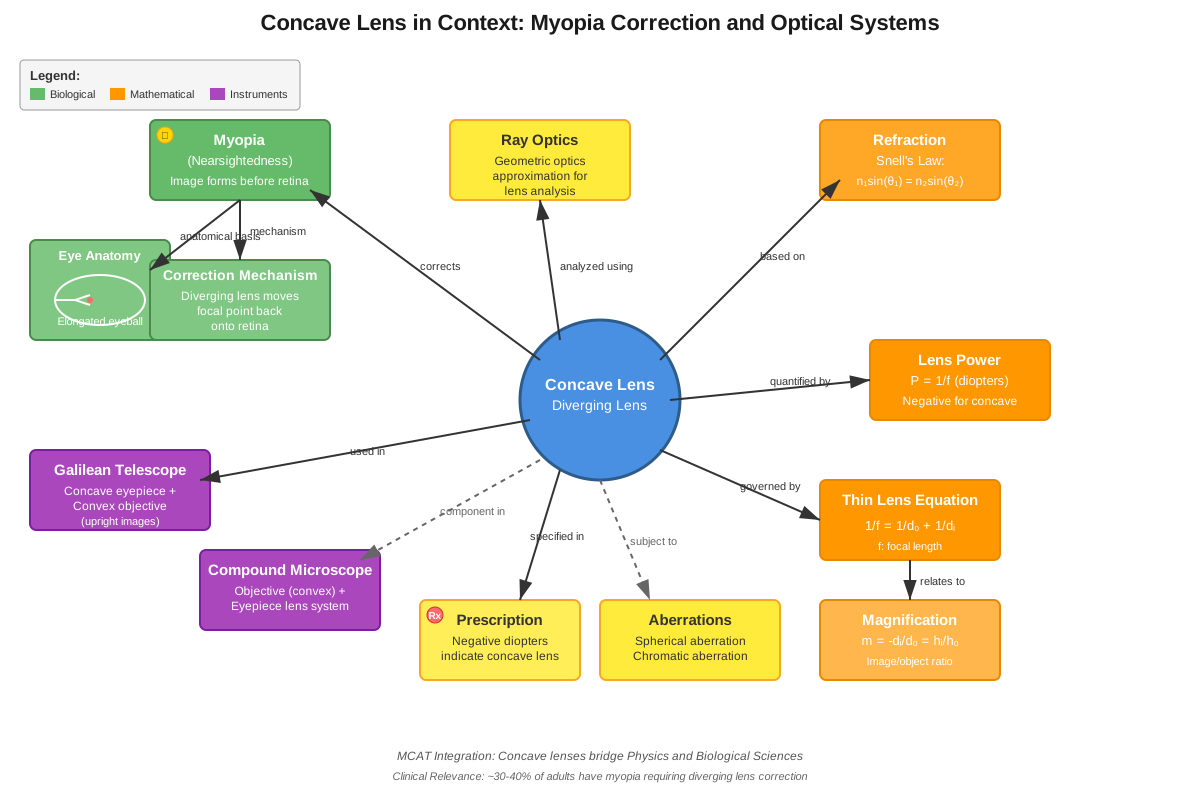
Concave lenses are diverging optical elements that play a crucial role in understanding light behavior and image formation in Physics. These lenses, thinner at the center than at the edges, cause parallel light rays to spread apart as if emanating from a single focal point. On the MCAT, concave lenses represent a fundamental component of Light and Optics, appearing frequently in both standalone questions and passage-based scenarios involving vision correction, optical instruments, and ray diagrams. Mastery of concave lens behavior is essential for success on test day, as questions often require rapid identification of image characteristics, application of the thin lens equation, and understanding of sign conventions.
The study of concave lenses bridges multiple physics domains tested on the MCAT. Understanding how these lenses manipulate light requires knowledge of refraction, Snell's law, and the relationship between focal length and lens curvature. Additionally, concave lenses connect directly to biological applications, particularly myopia (nearsightedness) correction, making them relevant for both the Chemical and Physical Foundations of Biological Systems section and potentially the Biological and Biochemical Foundations of Living Systems section when integrated with anatomical or physiological contexts.
Concave lenses MCAT questions typically test the ability to predict image characteristics (virtual, upright, reduced), apply mathematical relationships between object distance, image distance, and focal length, and interpret ray diagrams. The topic's medium difficulty stems from the need to integrate conceptual understanding with quantitative problem-solving while maintaining accuracy with sign conventions—a common source of errors even among well-prepared students. Dedicating focused study time to this topic yields high returns, as the principles learned apply broadly across optics questions and demonstrate the analytical reasoning skills the MCAT values.
Learning Objectives
- [ ] Define concave lenses using accurate Physics terminology
- [ ] Explain why concave lenses matters for the MCAT
- [ ] Apply concave lenses to exam-style questions
- [ ] Identify common mistakes related to concave lenses
- [ ] Connect concave lenses to related Physics concepts
- [ ] Calculate image distance, magnification, and focal length using the thin lens equation with proper sign conventions
- [ ] Construct and interpret accurate ray diagrams for concave lenses with objects at various positions
- [ ] Distinguish between concave and convex lens behavior in compound optical systems
Prerequisites
- Refraction and Snell's Law: Understanding how light bends when transitioning between media of different refractive indices is essential for comprehending how lens surfaces redirect light rays
- Basic geometric optics principles: Familiarity with ray tracing, focal points, and optical axes provides the foundation for analyzing lens behavior
- Sign conventions in optics: Knowledge of positive and negative values for distances and focal lengths prevents calculation errors
- Linear magnification concepts: Understanding the relationship between object and image sizes enables interpretation of lens effects
- Basic algebra and equation manipulation: Solving the thin lens equation requires comfort with reciprocals and algebraic rearrangement
Why This Topic Matters
Clinical and Real-World Significance: Concave lenses are ubiquitous in medical and everyday applications. Optometrists prescribe diverging lenses to correct myopia, one of the most common refractive errors affecting approximately 30-40% of adults in Western populations. Understanding concave lens function is essential for comprehending how corrective eyewear works, how microscopes and telescopes achieve magnification, and how camera systems control depth of field. In medical imaging, diverging lenses play roles in endoscopic equipment and diagnostic instruments.
Exam Statistics and Frequency: Analysis of released MCAT materials and student reports indicates that optics questions appear in approximately 10-15% of physics passages and discrete questions. Within optics, lenses (both concave and convex) represent roughly 40-50% of these questions, making them high-yield content. The MCAT frequently tests concave lenses through:
- Calculation-based questions requiring the thin lens equation
- Conceptual questions about image characteristics (real vs. virtual, upright vs. inverted)
- Ray diagram interpretation and construction
- Comparison questions contrasting concave and convex lens behavior
- Application questions involving vision correction or optical instruments
Common Exam Presentations: Concave lenses typically appear in MCAT passages describing optical systems, vision correction scenarios, or experimental setups involving light manipulation. Questions may present a patient with myopia requiring lens prescription calculations, describe a compound microscope requiring analysis of multiple lens interactions, or provide experimental data about image formation requiring interpretation through lens equations. Discrete questions often test fundamental concepts like identifying image characteristics or applying sign conventions correctly.
Core Concepts
Definition and Physical Structure
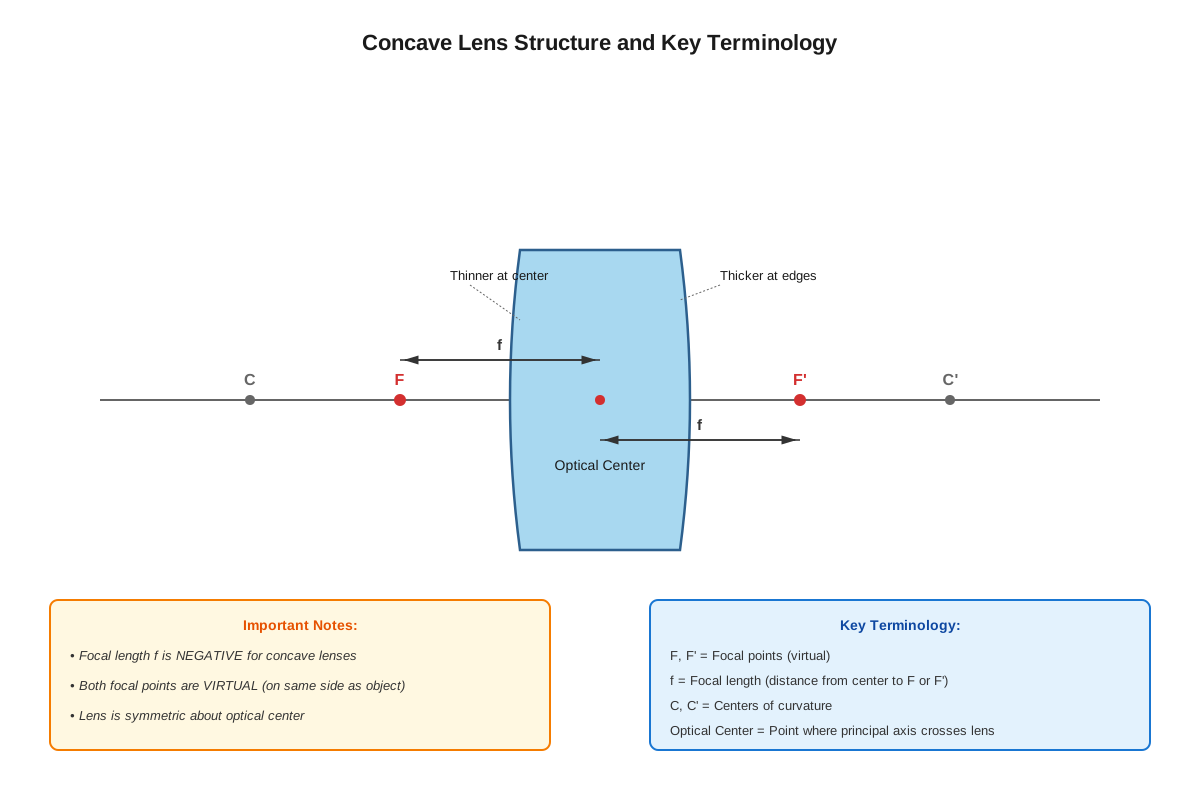
A concave lens (also called a diverging lens) is an optical element that is thinner at its center than at its edges, causing parallel incident light rays to spread apart (diverge) after passing through. The lens surfaces curve inward, creating a biconcave (both surfaces concave), plano-concave (one flat, one concave), or convex-concave (one convex, one more strongly concave) configuration. The key defining characteristic is that the lens has a negative focal length, meaning it cannot form real images of real objects—only virtual images.
When parallel light rays strike a concave lens, they refract at both the front and back surfaces according to Snell's law. The geometry of the curved surfaces causes rays to bend away from the optical axis. If these diverging rays are traced backward (opposite to their actual direction of travel), they appear to originate from a single point on the same side of the lens as the incoming light. This point is the virtual focal point of the concave lens.
Focal Length and Power
The focal length (f) of a concave lens is the distance from the lens center to the virtual focal point. By convention, concave lenses have negative focal lengths (f < 0). A concave lens with a focal length of -20 cm has its virtual focal point 20 cm from the lens center on the same side as incoming parallel light.
The power (P) of a lens, measured in diopters (D), is the reciprocal of the focal length in meters:
P = 1/f (where f is in meters)For concave lenses, power is negative. A lens with f = -0.50 m has P = -2.0 D. Higher magnitude power (more negative) indicates stronger diverging ability and shorter focal length. Optometrists prescribe lens power rather than focal length; a prescription of -3.0 D indicates a concave lens with f = -0.33 m.
The Thin Lens Equation
The relationship between object distance (d₀ or s₀), image distance (dᵢ or sᵢ), and focal length (f) is given by the thin lens equation:
1/f = 1/d₀ + 1/dᵢOr equivalently:
1/d₀ + 1/dᵢ = 1/fSign conventions are critical for correct application:
- Object distance (d₀): positive when the object is on the incoming light side (real object)
- Image distance (dᵢ): positive for real images (opposite side from object), negative for virtual images (same side as object)
- Focal length (f): negative for concave lenses, positive for convex lenses
For concave lenses with real objects (d₀ > 0), the thin lens equation always yields negative image distances (dᵢ < 0), confirming that concave lenses produce virtual images of real objects.
Magnification
Linear magnification (m) describes the ratio of image height (hᵢ) to object height (h₀):
m = hᵢ/h₀ = -dᵢ/d₀For concave lenses:
- Magnification is always positive (since dᵢ is negative and the negative sign in the equation makes the overall result positive)
- Positive magnification indicates an upright image (same orientation as object)
- The magnitude of magnification is always less than 1 (|m| < 1), indicating a reduced image (smaller than the object)
Ray Diagrams for Concave Lenses
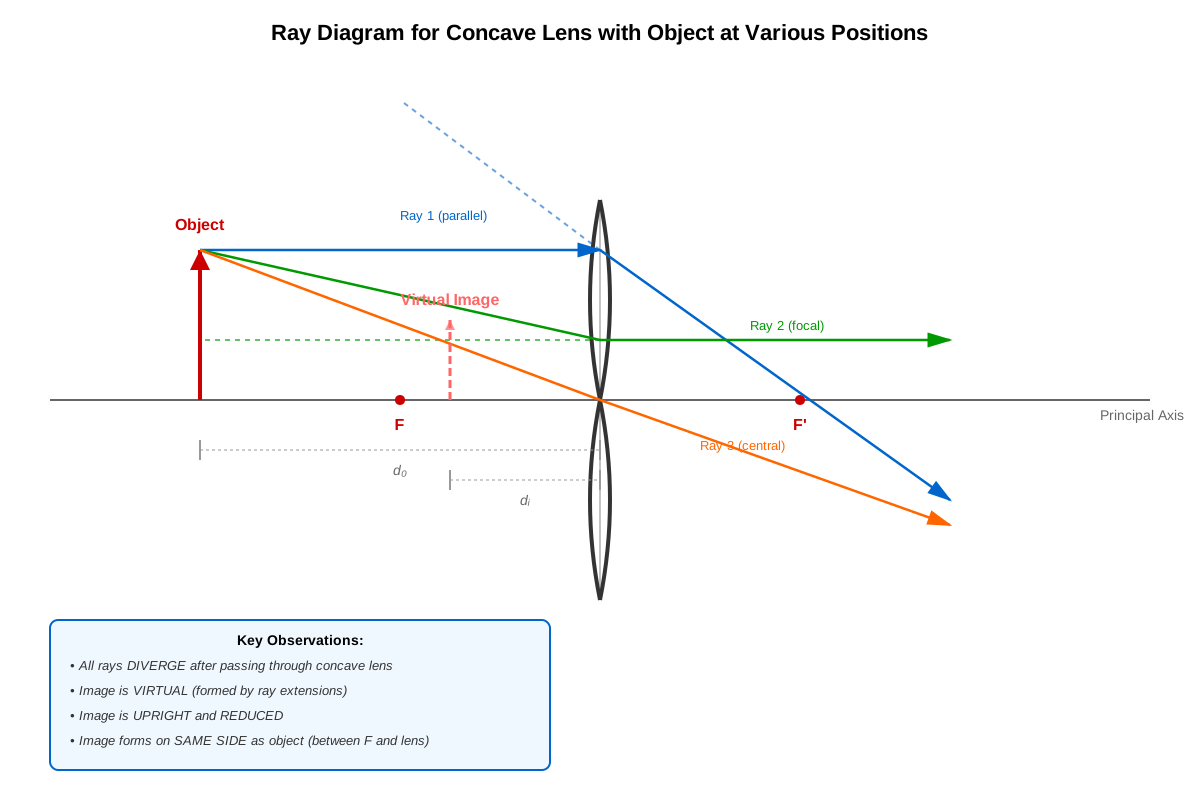
Three principal rays enable construction of accurate ray diagrams:
- Parallel ray: A ray traveling parallel to the optical axis refracts through the lens and diverges as if coming from the focal point on the same side as the object
- Central ray: A ray passing through the lens center continues straight without bending (for thin lenses)
- Focal ray: A ray directed toward the focal point on the opposite side of the lens emerges parallel to the optical axis after refraction
For concave lenses with real objects at any distance, these rays diverge after passing through the lens. Tracing the diverging rays backward (using dashed lines) reveals their apparent point of origin—the location of the virtual image. The virtual image is always:
- Located on the same side of the lens as the object
- Upright (same orientation as object)
- Reduced (smaller than the object)
- Between the lens and the focal point
Image Characteristics Summary
| Object Position | Image Location | Image Type | Image Orientation | Image Size |
|---|---|---|---|---|
| Any distance from concave lens | Between lens and focal point (same side as object) | Virtual | Upright | Reduced (smaller) |
This consistency makes concave lens behavior more predictable than convex lenses, which produce different image characteristics depending on object position.
Lens Maker's Equation
The lens maker's equation relates focal length to the lens material's refractive index (n) and the radii of curvature of the two surfaces (R₁ and R₂):
1/f = (n - 1)(1/R₁ - 1/R₂)For concave lenses, the radii of curvature are negative (by convention, R is negative when the center of curvature is on the incoming light side). This equation explains why:
- Higher refractive index materials create stronger lenses (shorter focal length magnitude)
- More sharply curved surfaces produce stronger divergence
- The same glass can form either converging or diverging lenses depending on surface curvature
While the lens maker's equation appears less frequently on the MCAT than the thin lens equation, understanding it provides insight into how lens properties arise from physical structure.
Concept Relationships
The study of concave lenses integrates multiple optical principles into a coherent framework. Refraction at curved surfaces → causes light ray divergence → which creates virtual focal points → leading to virtual image formation. The mathematical description through the thin lens equation connects object distance, image distance, and focal length in a single relationship, while magnification links these distances to image size and orientation.
Concave lenses connect to prerequisite knowledge of Snell's law and refraction: each lens surface acts as a refracting interface where light bends according to the change in refractive index and angle of incidence. The cumulative effect of refraction at both surfaces produces the overall diverging behavior. Understanding sign conventions from general optics is essential—the negative focal length of concave lenses directly determines that image distances will be negative (virtual images).
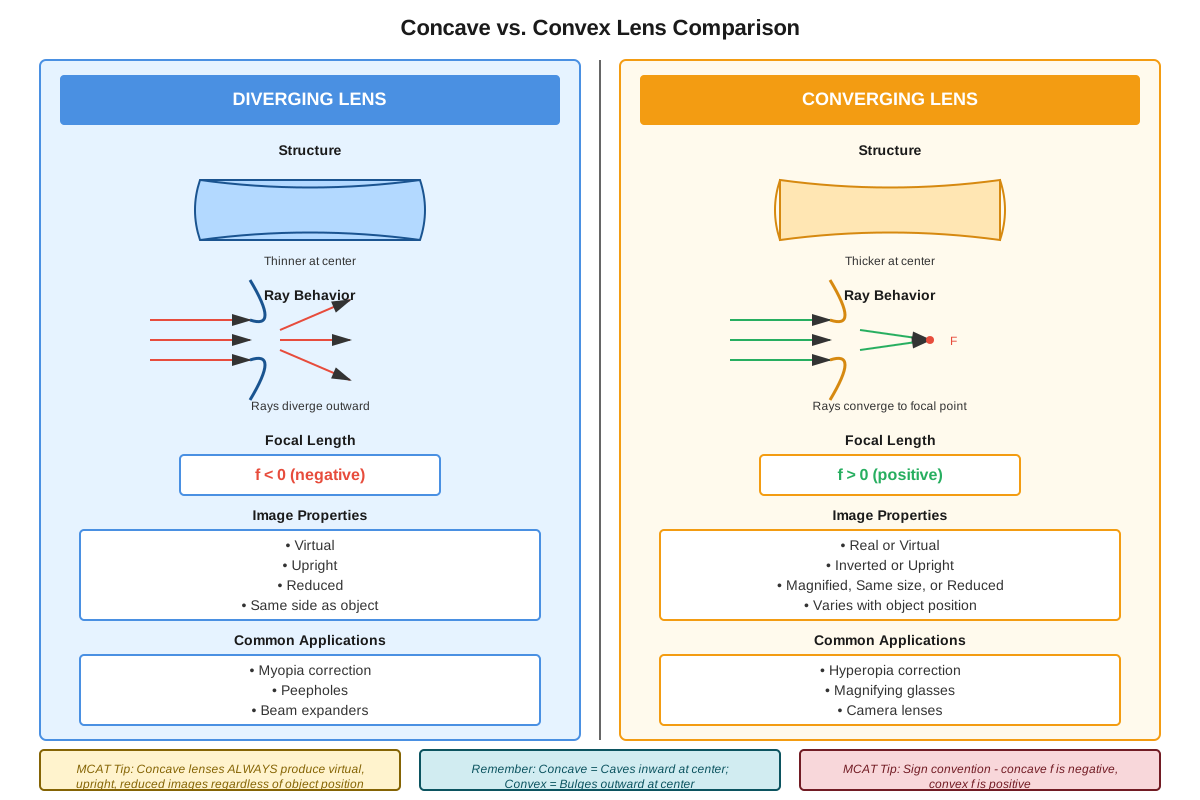
Within the broader context of Light and Optics, concave lenses contrast with convex (converging) lenses, which have positive focal lengths and can form real images. Many optical instruments use compound lens systems combining both types, requiring understanding of how diverging and converging elements interact. The principles learned for single concave lenses extend to multiple lens systems where the image from one lens becomes the object for the next.
Concave lens concepts also connect to biological applications: the eye's lens-cornea system acts as a converging lens, and when this system is too powerful (myopia), a concave corrective lens placed in front of the eye diverges light before it enters, effectively reducing the overall converging power to focus images properly on the retina. This clinical application frequently appears in MCAT passages integrating physics with biological systems.
High-Yield Facts
⭐ Concave lenses always have negative focal lengths and negative power (measured in diopters)
⭐ Concave lenses produce only virtual, upright, and reduced images when the object is real (positive object distance)
⭐ The thin lens equation (1/f = 1/d₀ + 1/dᵢ) applies to all thin lenses with proper sign conventions: f < 0 for concave, dᵢ < 0 for virtual images
⭐ Magnification for concave lenses is always positive and less than 1 (0 < m < 1), indicating upright and reduced images
⭐ Concave lenses correct myopia (nearsightedness) by diverging light before it enters the eye, reducing the effective converging power of the eye's optical system
- Virtual images cannot be projected onto a screen because light rays don't actually converge at the image location
- The virtual focal point of a concave lens is on the same side as incoming parallel light (the object side)
- As object distance increases, the virtual image formed by a concave lens moves closer to the focal point and becomes smaller
- Lens power in diopters equals 1/f where f is in meters; a -2.0 D lens has f = -0.50 m
- In ray diagrams, virtual images are located where diverging rays appear to originate when traced backward
- The central ray through a thin lens center passes straight through without bending, regardless of lens type
- Concave lenses are thinner at the center than at the edges, while convex lenses are thicker at the center
Quick check — test yourself on Concave lenses so far.
Try Flashcards →Common Misconceptions
Misconception: Concave lenses can form real images under certain conditions.
Correction: Concave lenses with real objects (positive object distance) always form virtual images. Real images require light rays to actually converge, which diverging lenses cannot accomplish with real objects. Only when a concave lens is used in combination with other optical elements that pre-converge light can the system potentially form real images.
Misconception: The focal length of a concave lens is positive but measured on the opposite side of the lens.
Correction: The focal length of concave lenses is negative by convention. While the virtual focal point is located on the same side as the object (the "opposite" side from where real focal points appear for convex lenses), the sign convention assigns negative values to concave lens focal lengths. This negative sign is essential for correct application of the thin lens equation.
Misconception: Magnification less than 1 means the image is inverted.
Correction: Magnification magnitude indicates size (|m| < 1 means reduced, |m| > 1 means enlarged), while the sign indicates orientation (positive = upright, negative = inverted). Concave lenses produce m values between 0 and 1 (positive and less than 1), meaning upright and reduced images.
Misconception: Virtual images are somehow "not real" or cannot be observed.
Correction: Virtual images are observable and appear exactly where ray tracing predicts. The term "virtual" means light rays don't actually converge at the image location—they only appear to diverge from that point. Your eye or a camera can observe virtual images because these devices collect the diverging rays and form real images on the retina or sensor. You see virtual images every time you look in a flat mirror.
Misconception: The thin lens equation only works for convex lenses or requires different forms for different lens types.
Correction: The thin lens equation (1/f = 1/d₀ + 1/dᵢ) is universal for all thin lenses. The lens type is encoded in the sign of f (negative for concave, positive for convex). Using consistent sign conventions allows the same equation to correctly predict image formation for any thin lens configuration.
Misconception: Stronger concave lenses have larger (less negative) focal lengths.
Correction: Stronger diverging lenses have shorter focal lengths with larger magnitudes (more negative values). A -10 cm focal length represents a stronger concave lens than -50 cm. In terms of power, stronger lenses have larger magnitude negative powers (e.g., -5.0 D is stronger than -2.0 D).
Misconception: Ray diagrams for concave lenses show rays converging at the focal point.
Correction: For concave lenses, rays diverge after passing through the lens. The focal point is virtual—rays appear to originate from this point when traced backward, but they never actually pass through it. Ray diagrams should show solid lines for actual ray paths (diverging) and dashed lines for virtual extensions (converging backward to the virtual focal point).
Worked Examples
Example 1: Calculating Image Position and Characteristics
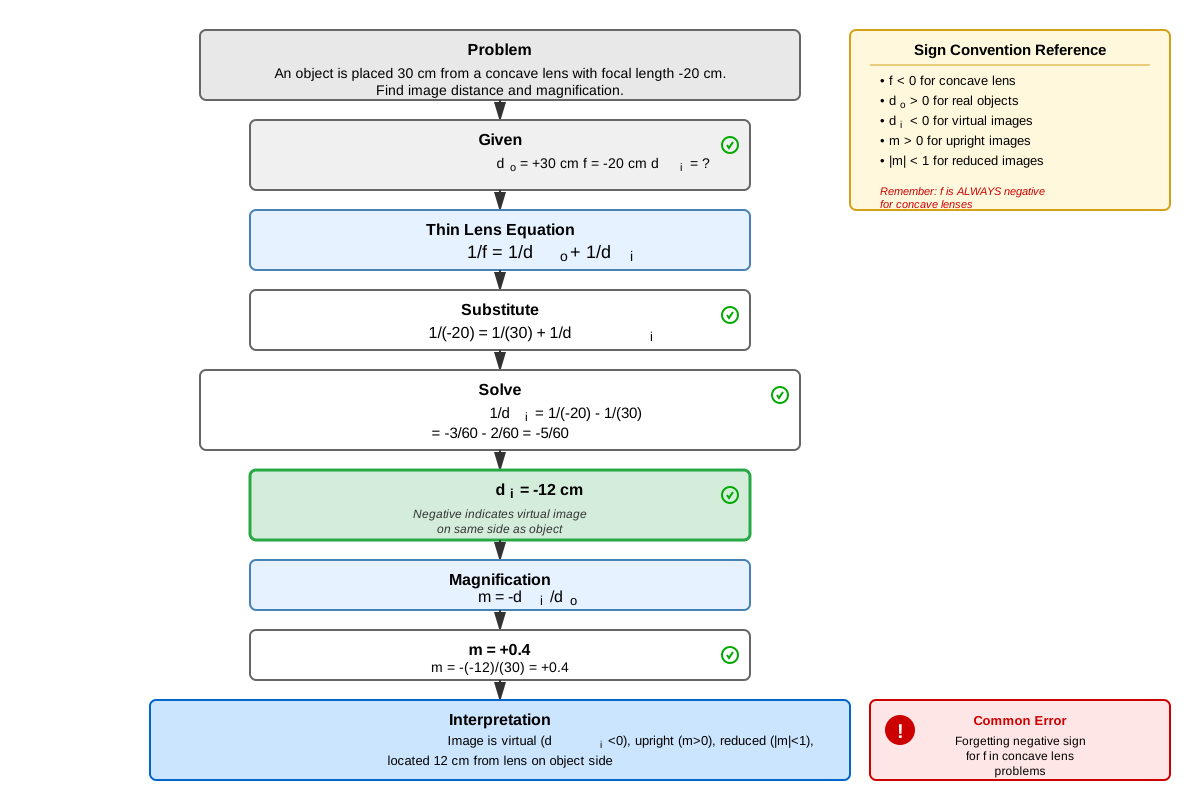
Problem: A concave lens has a focal length of -15 cm. An object 4.0 cm tall is placed 30 cm in front of the lens. Determine: (a) the image distance, (b) the magnification, (c) the image height, and (d) describe the image characteristics.
Solution:
(a) Finding image distance using the thin lens equation:
Given:
- f = -15 cm (negative for concave lens)
- d₀ = +30 cm (positive for real object)
- dᵢ = ? (to be determined)
Apply the thin lens equation:
1/f = 1/d₀ + 1/dᵢRearranging to solve for dᵢ:
1/dᵢ = 1/f - 1/d₀
1/dᵢ = 1/(-15) - 1/(30)
1/dᵢ = -1/15 - 1/30
1/dᵢ = -2/30 - 1/30
1/dᵢ = -3/30 = -1/10
dᵢ = -10 cm
The negative image distance confirms a virtual image located 10 cm on the same side of the lens as the object.
(b) Calculating magnification:
m = -dᵢ/d₀ = -(-10)/30 = 10/30 = 0.33The positive magnification indicates an upright image, and the magnitude less than 1 indicates a reduced image.
(c) Finding image height:
m = hᵢ/h₀
hᵢ = m × h₀ = 0.33 × 4.0 cm = 1.3 cm
(d) Image characteristics:
- Type: Virtual (dᵢ < 0)
- Location: 10 cm from lens on the same side as the object
- Orientation: Upright (m > 0)
- Size: Reduced to 1.3 cm, approximately one-third the object height (m = 0.33)
Connection to Learning Objectives: This problem demonstrates application of the thin lens equation with proper sign conventions, calculation of magnification, and identification of image characteristics—all essential skills for MCAT questions on concave lenses.
Example 2: Myopia Correction Application
Problem: A patient with myopia has a far point of 50 cm (can see clearly only up to 50 cm away, rather than infinity for normal vision). What power lens is needed to correct this condition, allowing the patient to see distant objects clearly? Assume the corrective lens is placed very close to the eye.
Solution:
Conceptual approach: For the patient to see distant objects clearly, the corrective lens must take light from infinity (distant objects) and create a virtual image at the patient's far point (50 cm). The eye can then focus on this virtual image comfortably.
Setting up the problem:
- Object distance: d₀ = ∞ (distant objects)
- Desired image distance: dᵢ = -50 cm (virtual image at far point; negative because virtual)
- Focal length: f = ? (to be determined)
Applying the thin lens equation:
1/f = 1/d₀ + 1/dᵢWhen d₀ = ∞, the term 1/d₀ = 0:
1/f = 0 + 1/(-50)
1/f = -1/50
f = -50 cm = -0.50 m
Calculating lens power:
P = 1/f = 1/(-0.50 m) = -2.0 DAnswer: The patient requires a concave lens with power -2.0 diopters (or focal length -50 cm).
Verification: A concave lens with f = -50 cm will take parallel rays (from distant objects) and diverge them so they appear to come from 50 cm away—exactly where the patient's eye can focus clearly.
Connection to Learning Objectives: This problem integrates concave lens physics with a clinical application, demonstrating why understanding diverging lenses matters for the MCAT. It requires recognizing that myopia correction needs diverging (concave) lenses, applying the thin lens equation with an object at infinity, and converting between focal length and lens power—all high-yield skills for test day.
Exam Strategy
Approaching MCAT Questions on Concave Lenses:
- Immediately identify lens type: Look for keywords like "diverging," "concave," "negative focal length," or "myopia correction" to confirm you're dealing with a concave lens. This determines the sign of f in all calculations.
- Establish sign conventions before calculating: Write down what you know with proper signs (f < 0 for concave, d₀ > 0 for real objects, dᵢ < 0 for virtual images). This prevents the most common calculation errors.
- Predict qualitatively before calculating: For concave lenses with real objects, you know the image will be virtual, upright, and reduced. Use this to check if your calculated answer makes sense.
- Watch for compound lens systems: Passages may describe multiple lenses. Remember that the image from the first lens becomes the object for the second lens. Track signs carefully through each step.
Trigger Words and Phrases:
- "Diverging lens" → concave lens, f < 0
- "Myopia" or "nearsightedness" → requires concave corrective lens
- "Virtual image" → dᵢ < 0, cannot be projected on screen
- "Upright image" → m > 0
- "Reduced image" → |m| < 1
- "Negative power" or "negative diopters" → concave lens
- "Thinner at the center" → concave lens structure
Process-of-Elimination Tips:
- Eliminate any answer choice suggesting a concave lens forms a real image of a real object (impossible without additional optical elements)
- Eliminate choices showing inverted images from concave lenses with real objects (concave lenses always produce upright images in this scenario)
- For calculation questions, eliminate answers with wrong signs (e.g., positive image distance for a simple concave lens setup)
- If a question asks about correcting myopia, eliminate convex lens options immediately
Time Allocation:
- Conceptual questions (image characteristics): 30-45 seconds—these should be rapid recognition
- Single calculation questions (thin lens equation): 60-90 seconds—set up, solve, verify
- Multi-step problems (compound systems or with additional calculations): 2-3 minutes—work systematically, check signs at each step
- Passage-based questions: Allocate time proportionally, but use passage information to set up equations rather than memorizing every detail
Exam Tip: If you're unsure about sign conventions during the test, quickly sketch a ray diagram. Even a rough sketch showing diverging rays helps confirm whether the image distance should be positive or negative.
Memory Techniques
Mnemonic for Concave Lens Image Characteristics - "VUR":
- Virtual
- Upright
- Reduced
All three characteristics apply to images formed by concave lenses with real objects. Remember: concave lenses are "VUR-y predictable."
Focal Length Sign Memory - "Concave = Negative Cave":
Picture a concave lens as a "negative cave" (depression or hollow). The negative association helps remember f < 0 for concave lenses, while convex lenses are "positive peaks" with f > 0.
Myopia Correction - "Near-sighted needs Negative":
Both "nearsighted" and "negative lens" start with 'N'. Myopia (nearsightedness) requires negative (concave) lenses for correction.
Thin Lens Equation Setup - "FOD":
Remember the equation structure as Focal, Object, Distance (image):
1/F = 1/O + 1/DThis helps recall that focal length equals the sum of reciprocals of object and image distances.
Ray Diagram Rules - "PFC":
The three principal rays are:
- Parallel ray (goes parallel, refracts through/from focal point)
- Focal ray (aims at focal point, emerges parallel)
- Central ray (through center, continues straight)
Visualization Strategy:
When studying, always visualize concave lenses as thinner in the middle, causing light to "spread out" or "escape" from the center. This physical spreading creates the diverging behavior. Contrast this mental image with convex lenses that are "fat in the middle" and "squeeze" light together.
Summary
Concave lenses are diverging optical elements with negative focal lengths that produce virtual, upright, and reduced images of real objects. Understanding concave lens behavior requires mastery of the thin lens equation (1/f = 1/d₀ + 1/dᵢ) with proper sign conventions: f < 0 for concave lenses, d₀ > 0 for real objects, and dᵢ < 0 for virtual images. Magnification is always positive and less than one (0 < m < 1), confirming upright and reduced images. Ray diagrams show three principal rays diverging after passing through the lens, with backward extensions revealing the virtual image location between the lens and focal point. Clinically, concave lenses correct myopia by diverging light before it enters the eye, effectively reducing the eye's excessive converging power. MCAT questions test these concepts through calculations, ray diagram interpretation, and clinical applications, making concave lenses high-yield content requiring both conceptual understanding and quantitative problem-solving skills.
Key Takeaways
- Concave lenses always have negative focal lengths and produce only virtual, upright, and reduced images when objects are real
- The thin lens equation (1/f = 1/d₀ + 1/dᵢ) applies universally to all thin lenses when proper sign conventions are used
- Sign conventions are critical: f < 0 for concave, d₀ > 0 for real objects, dᵢ < 0 for virtual images, m > 0 for upright images
- Concave lenses correct myopia by diverging light to compensate for excessive eye converging power
- Ray diagrams use three principal rays: parallel (refracts from focal point), focal (emerges parallel), and central (straight through)
- Lens power in diopters equals 1/f (in meters), with negative power indicating diverging lenses
- Virtual images are observable but cannot be projected on screens because light rays don't actually converge at the image location
Related Topics
Convex (Converging) Lenses: Understanding concave lenses provides the foundation for contrasting with convex lenses, which have positive focal lengths and can form real images. Mastering both lens types enables analysis of compound optical systems.
Mirrors (Concave and Convex): The mathematical framework for lenses (thin lens equation, magnification) applies similarly to mirrors with modified sign conventions. Concave lens mastery facilitates learning mirror optics.
The Human Eye and Vision Correction: Building on concave lens principles, study of the eye's optical system explains emmetropia (normal vision), myopia, hyperopia, and presbyopia, integrating physics with biological systems.
Optical Instruments: Microscopes, telescopes, and cameras use combinations of lenses. Understanding individual concave lens behavior is essential for analyzing these compound systems.
Refraction and Snell's Law (Advanced): Deeper exploration of how lens surfaces refract light connects concave lens behavior to fundamental wave optics and the lens maker's equation.
Practice CTA
Now that you've mastered the core concepts of concave lenses, it's time to solidify your understanding through active practice. Work through the practice questions to test your ability to apply the thin lens equation, interpret ray diagrams, and solve clinical scenarios involving vision correction. Use the flashcards to reinforce high-yield facts and sign conventions until they become automatic. Remember: MCAT success in physics comes not just from understanding concepts but from rapid, accurate application under time pressure. Each practice problem you solve builds the pattern recognition and problem-solving speed that will serve you on test day. You've got this—now prove it through practice!
Sign up free to keep reading
Create a free AnvayaPrep account to finish this MCAT guide on Concave lenses — plus flashcards and practice questions.