Overview
Real images are a fundamental concept in Light and Optics that appear consistently on the MCAT, particularly in passages involving optical instruments, vision correction, and experimental setups. A real image forms when light rays physically converge at a point in space after interacting with mirrors or lenses. Unlike virtual images, which cannot be projected onto a screen, real images can be captured on photographic film, digital sensors, or any surface placed at the convergence point. Understanding the formation, characteristics, and mathematical description of real images is essential for success on Physics questions involving ray diagrams, lens equations, and optical systems.
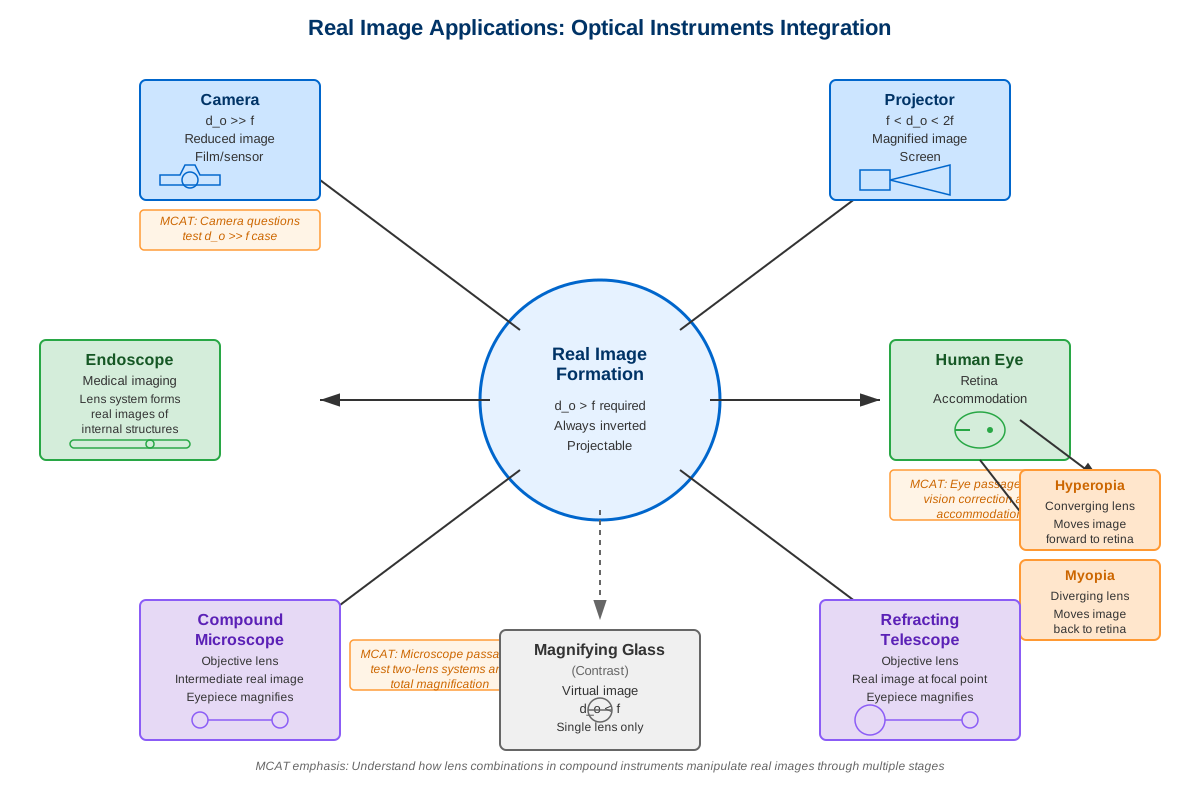
The distinction between real and virtual images represents one of the most testable concepts in MCAT Physics, appearing in both discrete questions and passage-based items. Students must not only recognize when an image is real but also predict its orientation, size, and location using mathematical relationships. Real images connect directly to practical applications including cameras, projectors, the human eye, microscopes, and telescopes—all of which have appeared in MCAT passages. The ability to quickly determine image characteristics from given optical parameters separates high-scoring students from those who struggle with this material.
Mastery of real images requires integration of geometric optics principles, sign conventions, and algebraic problem-solving skills. This topic bridges foundational ray optics with more complex multi-lens systems and serves as prerequisite knowledge for understanding how optical instruments manipulate light to serve specific functions. The MCAT frequently tests whether students can apply the thin lens equation, interpret ray diagrams, and predict how changes in object position or optical element properties affect image formation—making this a high-yield topic worthy of focused study.
Learning Objectives
- [ ] Define Real images using accurate Physics terminology
- [ ] Explain why Real images matters for the MCAT
- [ ] Apply Real images to exam-style questions
- [ ] Identify common mistakes related to Real images
- [ ] Connect Real images to related Physics concepts
- [ ] Distinguish between real and virtual images based on ray convergence and projection capability
- [ ] Calculate image distance, magnification, and height using the thin lens equation and mirror equation
- [ ] Predict image characteristics (real vs. virtual, upright vs. inverted, magnified vs. reduced) from object position relative to focal length
- [ ] Interpret ray diagrams to determine image type and location for converging and diverging optical elements
Prerequisites
- Reflection and refraction of light: Understanding how light changes direction at interfaces is essential for tracing rays through optical systems
- Focal length and focal points: The focal length determines where parallel rays converge and is the key parameter in all image formation equations
- Sign conventions in optics: Consistent application of positive and negative values for distances and heights is critical for correct calculations
- Basic geometry and similar triangles: Ray diagrams rely on geometric relationships to determine image properties
- Wave properties of light: While geometric optics dominates this topic, understanding light as electromagnetic radiation provides context for optical phenomena
Why This Topic Matters
Real images have direct clinical and technological relevance that makes them attractive for MCAT test writers. The human eye forms real images on the retina, and vision correction devices (glasses, contact lenses) manipulate where real images form to compensate for refractive errors. Medical imaging devices including endoscopes, ophthalmoscopes, and surgical microscopes all rely on precise control of real image formation. Cameras used in medical photography and documentation operate on identical principles. Understanding real images enables students to analyze how optical instruments function and troubleshoot when they malfunction.
On the MCAT, real images appear in approximately 2-4 questions per exam, either as discrete items or embedded within passages about experimental apparatus, vision, or optical instruments. Questions typically test whether students can: (1) identify if an image is real or virtual from given parameters, (2) calculate image position using the thin lens or mirror equation, (3) determine magnification and orientation, or (4) predict how changing object distance affects image characteristics. The Chemical and Physical Foundations of Biological Systems section frequently includes passages describing experimental setups where understanding image formation is necessary to interpret results or identify equipment modifications.
Common passage contexts include: descriptions of microscope or telescope configurations requiring students to trace light through multiple optical elements; vision correction scenarios where students must determine appropriate lens types and powers; experimental apparatus passages where image formation affects measurement accuracy; and comparative passages contrasting different optical instruments. The ability to quickly sketch ray diagrams and apply the thin lens equation under time pressure is a skill that directly translates to MCAT points.
Core Concepts
Definition and Formation of Real Images
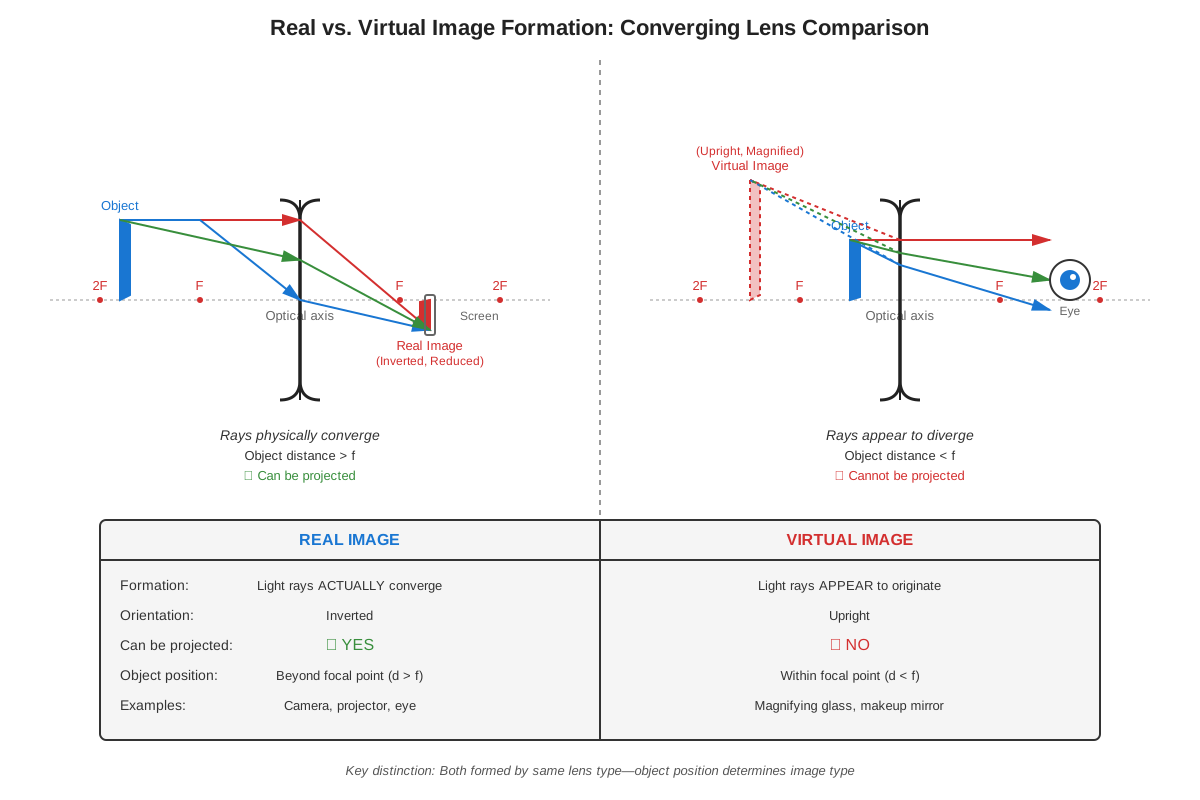
A real image forms when light rays actually converge at a point in space after reflection from a mirror or refraction through a lens. The defining characteristic of real images is that light physically passes through the image location, allowing the image to be projected onto a screen, captured by a camera sensor, or focused onto the retina. This contrasts fundamentally with virtual images, where light rays only appear to diverge from a point but never actually converge there.
Real images form through two primary mechanisms: (1) converging lenses (convex lenses with positive focal lengths) when the object is placed beyond the focal point, and (2) converging mirrors (concave mirrors with positive focal lengths) when the object is similarly positioned beyond the focal point. The key requirement is that the optical element must bend light rays toward the optical axis strongly enough that they intersect on the opposite side of the element from where they originated.
Mathematical Description: The Thin Lens Equation
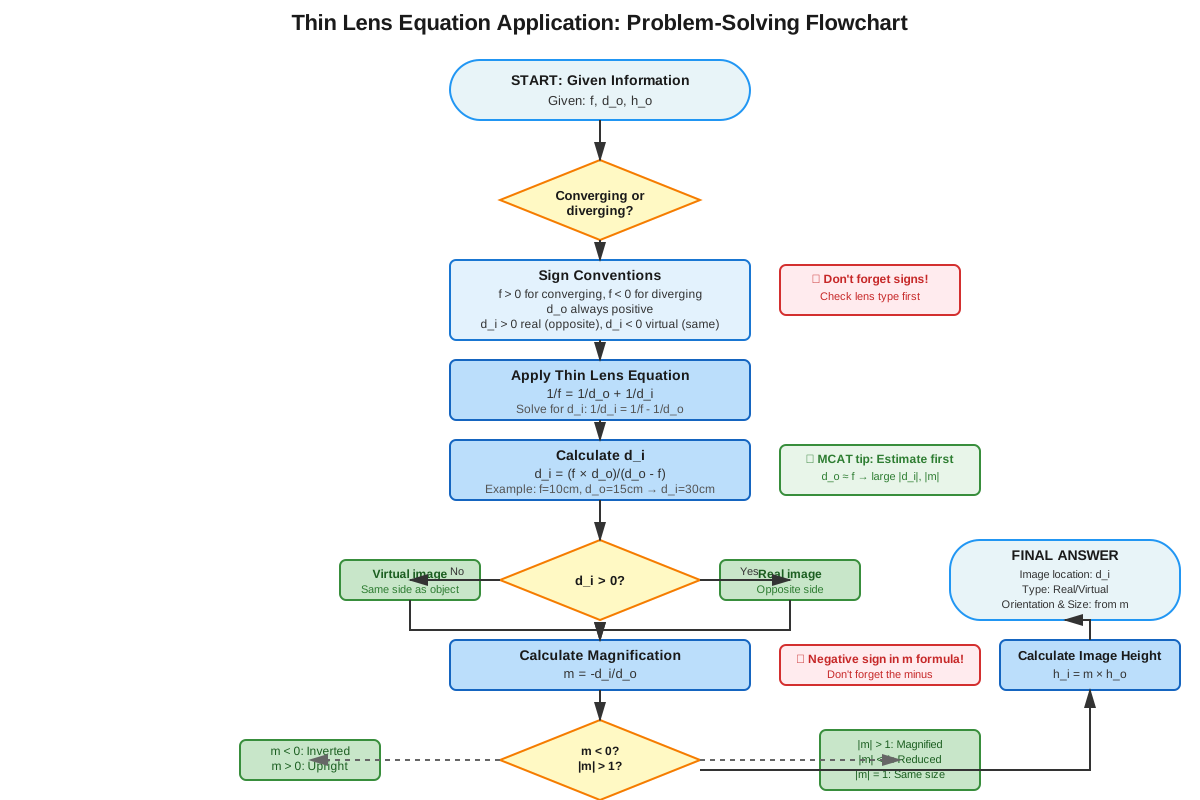
The thin lens equation governs real image formation and is one of the most important formulas in MCAT optics:
1/f = 1/do + 1/diWhere:
- f = focal length of the lens or mirror
- do = object distance (distance from object to optical element)
- di = image distance (distance from optical element to image)
For real images formed by converging lenses, the image distance (di) is positive, indicating the image forms on the opposite side of the lens from the object. The sign convention is critical: distances measured on the same side as the object are positive for object distance, while image distances are positive when measured on the opposite side from the object (where light actually travels after passing through the lens).
Magnification and Image Characteristics
The magnification equation relates image size to object size:
m = -di/do = hi/hoWhere:
- m = magnification (dimensionless)
- hi = image height
- ho = object height
For real images, the magnification is negative, indicating the image is inverted (upside down) relative to the object. This inversion is a universal characteristic of real images formed by single converging lenses or mirrors. The absolute value of magnification indicates size change: |m| > 1 means the image is magnified (larger than the object), |m| = 1 means the image is the same size, and |m| < 1 means the image is reduced (smaller than the object).
Ray Diagrams for Real Image Formation
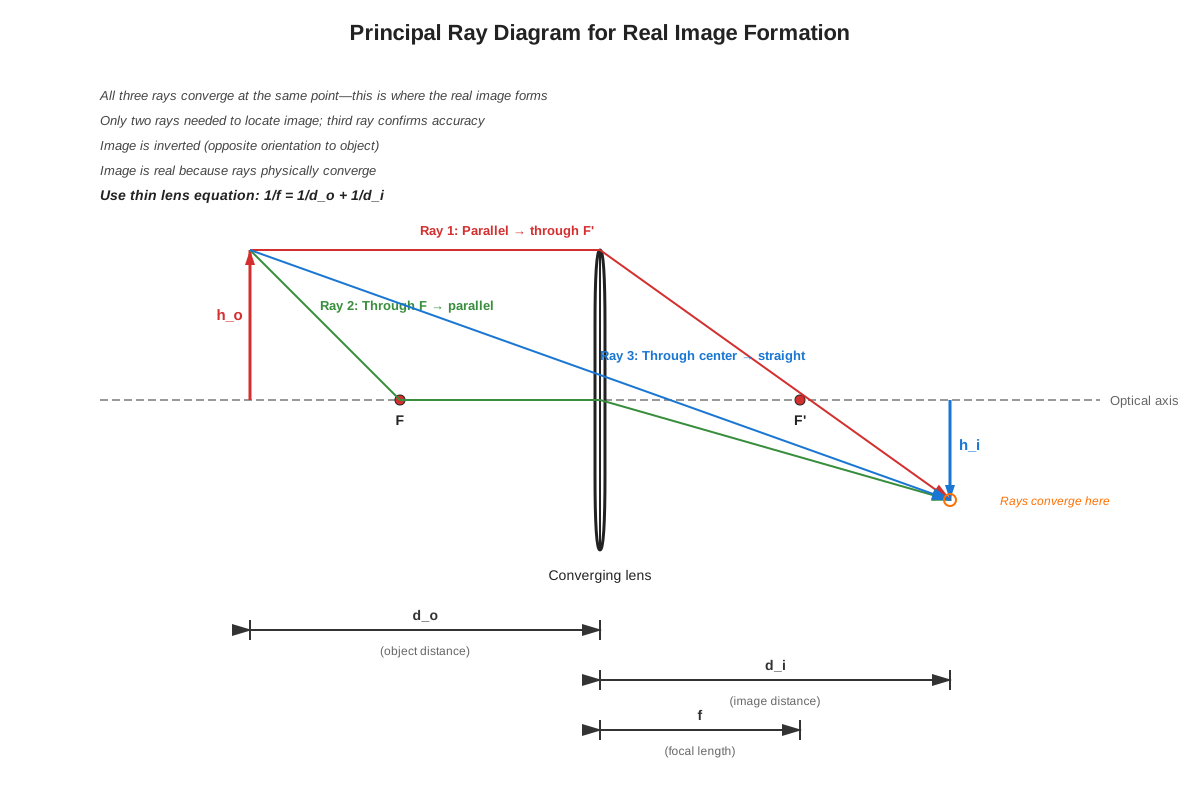
Three principal rays are used to locate real images graphically:
- Parallel ray: A ray traveling parallel to the optical axis refracts through (or reflects toward) the focal point on the opposite side
- Focal ray: A ray passing through the focal point on the object side emerges parallel to the optical axis
- Central ray: A ray passing through the center of a thin lens continues undeviated; for mirrors, a ray striking the vertex reflects symmetrically
Where these three rays converge determines the real image location. If the rays actually intersect (rather than their backward extensions intersecting), the image is real. The intersection point can be located on a screen placed at that position.
Conditions for Real Image Formation
Real images form under specific geometric conditions:
| Optical Element | Condition for Real Image | Image Location |
|---|---|---|
| Converging lens (f > 0) | Object distance do > f | Opposite side from object, di > 0 |
| Converging mirror (f > 0) | Object distance do > f | Same side as object, di > 0 |
| Diverging lens (f < 0) | Never | N/A - always forms virtual images |
| Diverging mirror (f < 0) | Never | N/A - always forms virtual images |
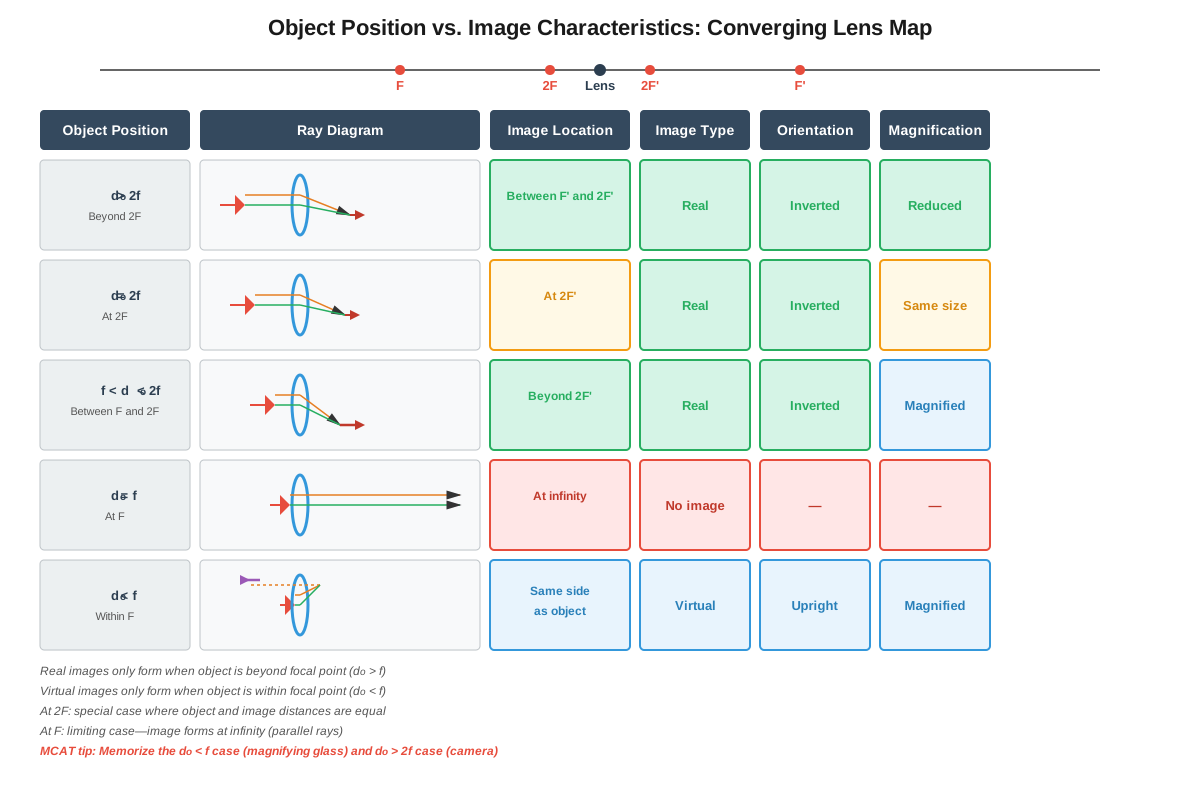
The critical boundary is the focal point. When an object is placed exactly at the focal point (do = f), the thin lens equation predicts di = ∞, meaning rays emerge parallel and never converge to form an image. When the object is inside the focal length (do < f), converging elements produce virtual images instead of real images.
Real Images in Converging Mirrors
Concave mirrors (converging mirrors) follow the same mathematical relationships as converging lenses but with an important geometric difference: the real image forms on the same side of the mirror as the object. The mirror equation is identical to the thin lens equation:
1/f = 1/do + 1/diHowever, the sign convention differs slightly. For mirrors, both object and image distances are measured from the mirror surface, with distances in front of the mirror (where light approaches from) considered positive. Real images in concave mirrors are inverted and form when do > f, just as with lenses.
Power and Focal Length Relationship
Optical power (P), measured in diopters (D), relates inversely to focal length:
P = 1/fWhere f is measured in meters. Converging lenses and mirrors have positive power, while diverging elements have negative power. Since only converging elements can form real images, real image formation requires positive optical power. This relationship is particularly important for MCAT questions involving vision correction, where lens prescriptions are given in diopters.
Concept Relationships
Real image formation connects hierarchically to broader optics principles. The fundamental behavior of light (traveling in straight lines in uniform media, reflecting and refracting at interfaces) → enables the construction of ray diagrams → which predict where light converges → determining whether images are real or virtual. The thin lens equation mathematically encodes the geometric relationships visible in ray diagrams, providing an algebraic alternative to graphical analysis.
Within the topic of real images, several internal connections exist: the sign of image distance (di) determines whether an image is real (di > 0 for lenses) or virtual (di < 0), while the sign of magnification (m) determines orientation (negative m means inverted, characteristic of real images). The relationship between object distance and focal length (do compared to f) determines not only whether the image is real but also its magnification: as do decreases from infinity toward f, real images move farther from the lens and become increasingly magnified.
Real images connect forward to more complex topics including multi-lens systems (where the real image from one lens becomes the object for the next), optical instruments (microscopes use real intermediate images), and the human eye (which forms real images on the retina). Understanding real images is prerequisite for analyzing aberrations, resolution limits, and advanced optical phenomena. The concept also bridges to wave optics, where diffraction and interference can be observed at real image locations but not at virtual image positions.
Quick check — test yourself on Real images so far.
Try Flashcards →High-Yield Facts
⭐ Real images form when light rays physically converge at a point and can be projected onto a screen
⭐ Real images are always inverted (upside down) when formed by a single lens or mirror
⭐ For converging lenses, real images form when object distance exceeds focal length (do > f)
⭐ The thin lens equation (1/f = 1/do + 1/di) applies to both lenses and mirrors with appropriate sign conventions
⭐ Magnification m = -di/do; negative magnification indicates an inverted real image
- Diverging lenses (f < 0) and diverging mirrors never produce real images under any circumstances
- Real images have positive image distance (di > 0) for lenses when using standard sign conventions
- As an object approaches the focal point from beyond it, the real image moves farther away and becomes larger
- At exactly do = f, no image forms (rays emerge parallel); this is the boundary between real and virtual image formation
- The human eye, cameras, and projectors all rely on real image formation for their function
- Concave mirrors produce real images on the same side as the object when do > f
- Real images can be magnified (|m| > 1), same size (|m| = 1), or reduced (|m| < 1) depending on object position
Common Misconceptions
Misconception: Real images are always larger than the object → Correction: Real images can be magnified, reduced, or the same size as the object depending on the ratio of image distance to object distance. When do is only slightly greater than f, the real image is magnified; when do >> f, the real image is reduced.
Misconception: All lenses can produce real images if positioned correctly → Correction: Only converging lenses (convex, positive focal length) can produce real images. Diverging lenses (concave, negative focal length) produce exclusively virtual images regardless of object position because they spread light rays apart rather than converging them.
Misconception: Real images are always upright because they can be seen on a screen → Correction: Real images formed by single lenses or mirrors are always inverted. The negative sign in the magnification equation (m = -di/do) reflects this inversion. When viewing a real image on a screen, it appears upside down relative to the object.
Misconception: Virtual images and real images can both be projected onto screens → Correction: Only real images can be projected onto screens because only real images involve actual light convergence at the image location. Virtual images exist only as apparent positions from which light seems to originate; no light actually passes through virtual image locations.
Misconception: The focal length changes depending on object distance → Correction: Focal length is an intrinsic property of the optical element determined by its curvature and refractive index (for lenses). Object distance affects where the image forms and its characteristics, but focal length remains constant for a given lens or mirror.
Misconception: Real images always form on the opposite side of a lens from the object → Correction: While this is true for lenses, real images formed by concave mirrors appear on the same side as the object. The sign conventions differ between lenses and mirrors, but in both cases, real images have positive image distance values.
Worked Examples
Example 1: Calculating Real Image Position and Magnification
Problem: A converging lens with focal length f = 20 cm is used to project an image of an object onto a screen. The object is placed 30 cm from the lens. (a) Where does the real image form? (b) What is the magnification? (c) Is the image upright or inverted?
Solution:
(a) Finding image distance:
Given: f = 20 cm, do = 30 cm
Using the thin lens equation:
1/f = 1/do + 1/di
1/20 = 1/30 + 1/di
Solving for di:
1/di = 1/20 - 1/30
1/di = (3 - 2)/60 = 1/60
di = 60 cm
The real image forms 60 cm from the lens on the opposite side from the object. Since di is positive, this confirms the image is real.
(b) Finding magnification:
Using the magnification equation:
m = -di/do = -60/30 = -2The magnification is -2, meaning the image is twice as large as the object.
(c) Determining orientation:
Since m = -2 is negative, the image is inverted (upside down). The negative sign always indicates inversion for single-lens systems.
Key takeaway: When do > f for a converging lens, a real, inverted image forms on the opposite side. The specific position and size depend on the exact ratio of do to f.
Example 2: Determining Image Type from Object Position
Problem: A concave mirror has a focal length of 15 cm. An object is placed at the following distances: (a) 40 cm, (b) 15 cm, (c) 10 cm. For each position, determine whether a real or virtual image forms and calculate the image distance.
Solution:
(a) Object at do = 40 cm (beyond focal point):
1/f = 1/do + 1/di
1/15 = 1/40 + 1/di
1/di = 1/15 - 1/40 = (8 - 3)/120 = 5/120 = 1/24
di = 24 cm
Since di is positive, a real image forms 24 cm in front of the mirror. The image is inverted with magnification m = -24/40 = -0.6 (reduced size).
(b) Object at do = 15 cm (at focal point):
1/15 = 1/15 + 1/di
1/di = 0
di = ∞
No image forms. Light rays emerge parallel and never converge. This is the boundary condition between real and virtual image formation.
(c) Object at do = 10 cm (inside focal point):
1/15 = 1/10 + 1/di
1/di = 1/15 - 1/10 = (2 - 3)/30 = -1/30
di = -30 cm
Since di is negative, a virtual image forms 30 cm behind the mirror. Virtual images form when objects are placed inside the focal length of converging mirrors.
Key takeaway: The relationship between object distance and focal length determines image type. For converging mirrors: do > f yields real images, do = f yields no image, and do < f yields virtual images.
Exam Strategy
When approaching MCAT questions on real images, first identify the type of optical element (converging vs. diverging lens or mirror) and immediately recall that only converging elements can produce real images. Look for trigger phrases like "projected onto a screen," "captured by a camera," or "focused on the retina"—these always indicate real images since virtual images cannot be projected.
Quickly assess the relationship between object distance and focal length. If do > f for a converging element, expect a real image; if do < f, expect virtual. This single comparison allows elimination of answer choices before performing calculations. When numerical answers are required, write out the thin lens equation and carefully apply sign conventions—this is where most errors occur under time pressure.
For questions involving ray diagrams, sketch quickly but accurately. Draw the optical axis, mark the focal points, and trace at least two principal rays. Where they physically intersect (not where their extensions intersect) is the real image location. If the question asks about image characteristics without requiring calculations, the ray diagram alone may provide the answer faster than algebra.
Watch for questions that change a single parameter (moving the object, changing focal length, or switching lens type) and ask how image characteristics change. These test conceptual understanding rather than calculation ability. Remember the key relationships: moving an object closer to a converging lens (while staying beyond f) moves the real image farther away and increases magnification; increasing focal length decreases optical power and moves the image closer to the lens.
Time management is critical. If a question requires multiple steps (finding di, then calculating m, then determining hi), ensure each step is correct before proceeding. A sign error in di will propagate through all subsequent calculations. For passage-based questions, identify which optical elements in the described apparatus produce real images—this often reveals the function of the instrument and helps answer multiple questions efficiently.
Memory Techniques
"REAL = Rays Eventually Actually Land": Real images form where light rays actually converge and land, unlike virtual images where rays only appear to originate from a point.
"Positive di, Positive reality": For lenses, positive image distance means a real image (using standard sign conventions where the opposite side from the object is positive).
"Converging Can Create Concrete images": Only converging (convex) lenses and concave mirrors can create real images that exist concretely in space.
"Inverted Is Real": Single-lens real images are always inverted; if an image is upright, it's virtual (for single optical elements).
Focal Point Boundary Visualization: Picture the focal point as a "gate"—objects beyond the gate (do > f) produce real images that can pass through to the other side; objects inside the gate (do < f) produce virtual images trapped on the same side.
The "2f Rule": When an object is at exactly 2f (twice the focal length), the real image also forms at 2f on the opposite side with magnification m = -1 (same size, inverted). This symmetric case is frequently tested and serves as a reference point for predicting magnification.
Sign Convention Finger Method: Point your left index finger toward the object (left side) and right index finger toward where light travels after the lens (right side). For lenses, distances measured in the direction of your right finger are positive for images—this helps maintain consistent sign conventions under pressure.
Summary
Real images represent a cornerstone concept in MCAT optics, defined by the physical convergence of light rays at a point in space where the image can be projected onto a screen or captured by a detector. These images form exclusively with converging optical elements (convex lenses or concave mirrors) when objects are positioned beyond the focal point, and they are universally inverted when produced by single lenses or mirrors. The thin lens equation (1/f = 1/do + 1/di) and magnification equation (m = -di/do) provide the mathematical framework for predicting image location, size, and orientation. Understanding the distinction between real and virtual images, recognizing the conditions under which each forms, and rapidly applying sign conventions are essential skills for MCAT success. Real images connect directly to practical applications including cameras, projectors, microscopes, and the human eye, making them frequent subjects of passage-based questions. Mastery requires both conceptual understanding of ray convergence and computational facility with optical equations.
Key Takeaways
- Real images form where light rays physically converge and can be projected onto screens, unlike virtual images which cannot
- Only converging lenses (f > 0) and concave mirrors produce real images, and only when object distance exceeds focal length (do > f)
- Real images are always inverted (m < 0) when formed by single optical elements, with magnification determined by m = -di/do
- The thin lens equation 1/f = 1/do + 1/di applies universally to both lenses and mirrors with appropriate sign conventions
- Positive image distance (di > 0) indicates a real image for lenses; the focal point at do = f represents the boundary between real and virtual image formation
- Real image applications include cameras, projectors, the human eye, and optical instruments—all high-yield MCAT topics
- Quick assessment of do relative to f allows immediate prediction of image type before performing calculations
Related Topics
Virtual Images: Understanding virtual images (formed by diverging elements or when objects are inside the focal point of converging elements) provides essential contrast to real images and completes the picture of image formation in geometric optics.
Multi-Lens Systems: Real images from one lens can serve as objects for subsequent lenses, enabling complex optical instruments like microscopes and telescopes—mastery of single-lens real images is prerequisite for analyzing these systems.
Spherical Mirrors and Aberrations: While ideal mirrors follow the equations presented here, real mirrors exhibit aberrations that affect image quality, particularly relevant for understanding optical instrument limitations.
The Human Eye and Vision Correction: The eye forms real images on the retina; understanding this process and how corrective lenses modify image formation is essential for MCAT passages on vision and ophthalmology.
Optical Instruments: Cameras, projectors, microscopes, and telescopes all manipulate real image formation through specific lens arrangements—this topic builds directly on real image fundamentals.
Practice CTA
Now that you've mastered the core concepts of real images, it's time to solidify your understanding through active practice. Work through the practice questions to test your ability to apply the thin lens equation, interpret ray diagrams, and distinguish between real and virtual images under exam conditions. Use the flashcards to reinforce high-yield facts and ensure rapid recall of key relationships. Remember: understanding real images opens the door to analyzing complex optical systems and answering high-value MCAT questions with confidence. Your investment in mastering this topic will pay dividends across multiple passages and discrete questions on test day!
Sign up free to keep reading
Create a free AnvayaPrep account to finish this MCAT guide on Real images — plus flashcards and practice questions.