Overview
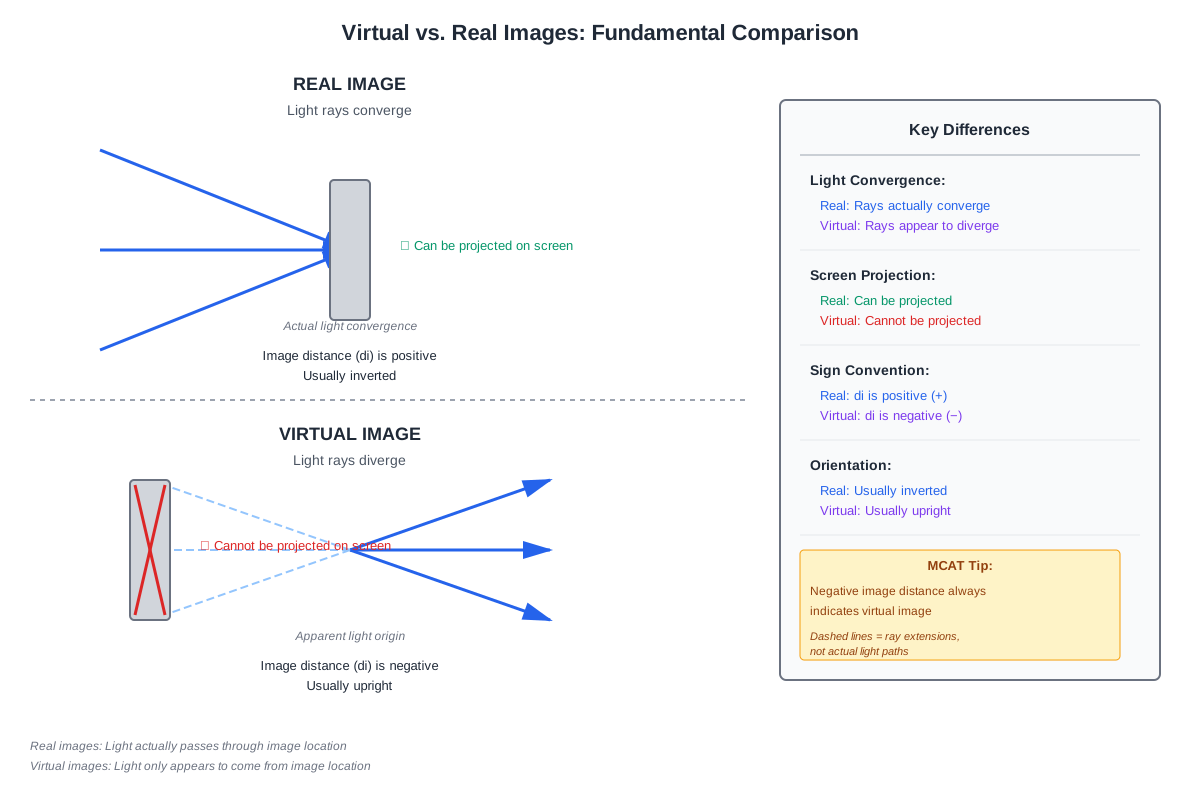
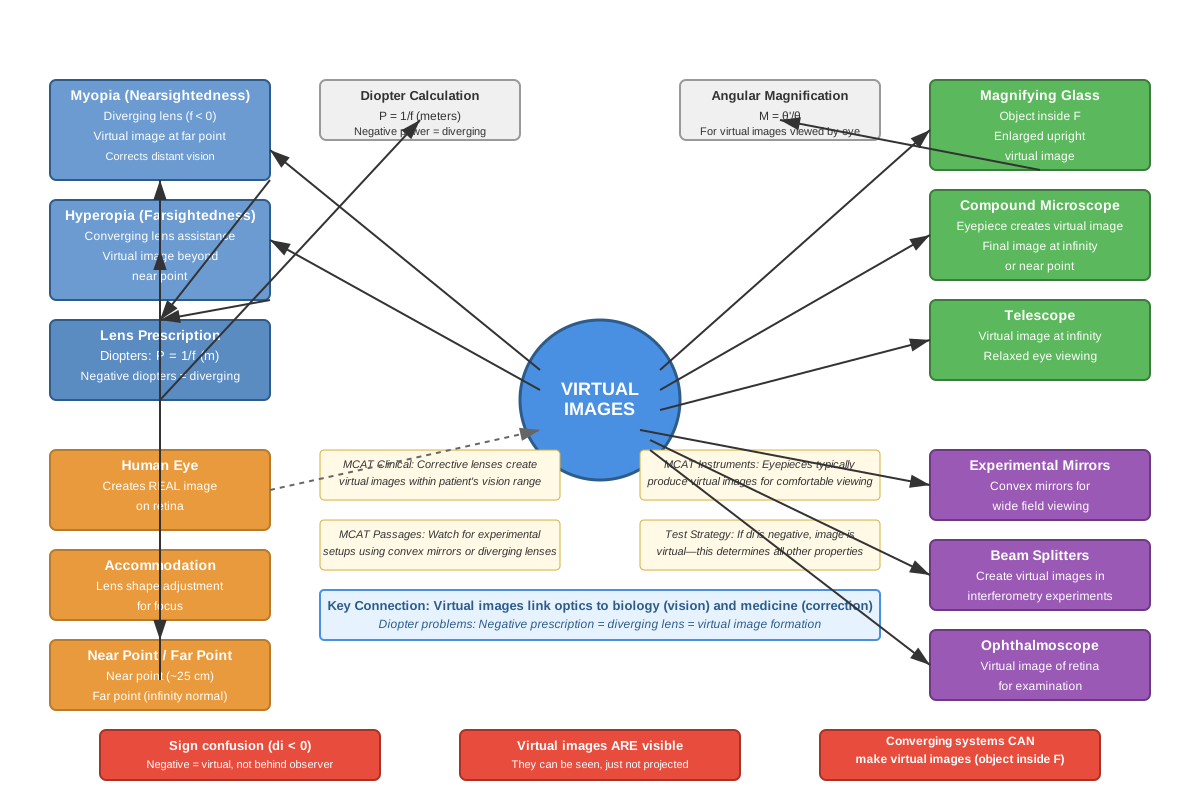
Virtual images represent one of the most fundamental yet frequently misunderstood concepts in Light and Optics, a critical component of Physics tested on the MCAT. Unlike real images that can be projected onto a screen, virtual images appear to be located at positions where light rays do not actually converge. Instead, these images form where light rays appear to originate when traced backward. Understanding virtual images is essential for mastering mirror and lens systems, which appear regularly in MCAT passages involving optical instruments, vision correction, and experimental apparatus.
The concept of virtual images bridges multiple areas of physics tested on the MCAT, including geometric optics, ray tracing, and the behavior of electromagnetic radiation. Virtual images are produced by plane mirrors, convex mirrors, and diverging lenses under all circumstances, and by concave mirrors and converging lenses under specific geometric conditions. The MCAT frequently tests students' ability to distinguish between real and virtual images, predict image characteristics using ray diagrams and equations, and apply these principles to biological systems such as the human eye or microscopy setups in experimental passages.
Mastery of virtual images provides the foundation for understanding more complex optical systems, including compound microscopes, telescopes, and corrective lenses for vision disorders. This topic connects directly to wave properties of light, reflection and refraction principles, and quantitative problem-solving using the mirror and lens equations. Students who thoroughly understand virtual images gain a significant advantage in tackling both discrete questions and passage-based problems in the Chemical and Physical Foundations of Biological Systems section of the MCAT.
Learning Objectives
- [ ] Define virtual images using accurate Physics terminology
- [ ] Explain why virtual images matter for the MCAT
- [ ] Apply virtual images concepts to exam-style questions
- [ ] Identify common mistakes related to virtual images
- [ ] Connect virtual images to related Physics concepts
- [ ] Distinguish between real and virtual images using ray diagrams and mathematical criteria
- [ ] Predict image characteristics (orientation, magnification, location) for various optical systems
- [ ] Solve quantitative problems using sign conventions for virtual images in mirror and lens equations
Prerequisites
- Reflection and refraction: Understanding how light behaves at interfaces is essential for tracing rays through optical systems
- Basic geometry and trigonometry: Ray diagrams require understanding angles of incidence, reflection, and similar triangles
- Sign conventions: Familiarity with positive and negative values in equations is necessary for solving lens and mirror problems
- Properties of light: Knowledge that light travels in straight lines and can be modeled using rays enables geometric optics analysis
- Focal length and focal points: Understanding these fundamental optical parameters is required before analyzing image formation
Why This Topic Matters
Virtual images appear in multiple contexts on the MCAT, making this a high-yield topic for test preparation. Clinically, virtual images are relevant to understanding how corrective lenses work for myopia (nearsightedness), how magnifying glasses assist vision, and how ophthalmoscopes allow physicians to examine the retina. The human eye itself creates real images on the retina, but understanding the contrast with virtual images helps explain various vision correction strategies.
On the MCAT, virtual images appear in approximately 2-4 questions per exam, either as discrete questions or embedded within passages about experimental setups, optical instruments, or biological vision systems. Questions typically test whether students can: (1) identify when a virtual image forms versus a real image, (2) use the mirror/lens equation with proper sign conventions, (3) interpret ray diagrams, and (4) predict image characteristics without calculation.
Common passage contexts include descriptions of microscope components, laser experimental setups, fiber optic systems in medical imaging, vision correction scenarios, and astronomical telescope configurations. The MCAT particularly favors questions that require students to integrate conceptual understanding with quantitative problem-solving, such as determining whether an image can be projected onto a screen (real) or only viewed by looking into the optical system (virtual). Understanding virtual images also appears in passages discussing the physics of photography, endoscopy, and other medical imaging technologies.
Core Concepts
Definition and Fundamental Properties
A virtual image is an optical image formed at a location where light rays appear to diverge from, but do not actually pass through. When an observer looks at a virtual image, their eye traces diverging light rays backward, and the brain interprets these rays as originating from a point behind the optical element. This contrasts with real images, where light rays physically converge at the image location.
Virtual images possess several defining characteristics:
- They cannot be projected onto a screen because light does not actually arrive at the image location
- They are always upright (erect) relative to the object when formed by single mirrors or lenses
- They appear on the same side of the optical element as the object for mirrors, and on the opposite side for lenses
- They have negative image distances (di < 0) according to standard sign conventions
Ray Tracing for Virtual Images
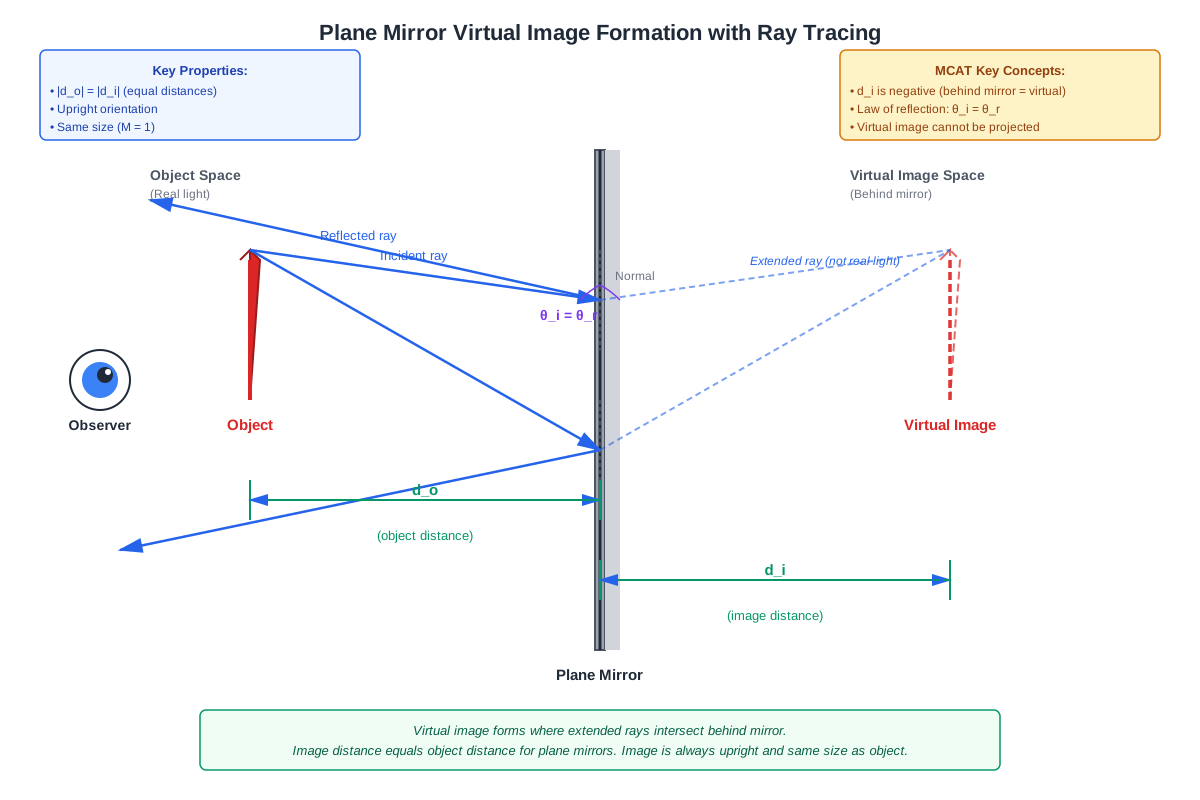
Ray diagrams provide the most intuitive method for understanding virtual image formation. For plane mirrors, all images are virtual. The ray tracing process involves:
- Drawing a ray from the object perpendicular to the mirror surface, which reflects straight back
- Drawing a ray at an angle to the mirror, which reflects at an equal angle on the opposite side of the normal
- Extending the reflected rays backward (shown as dashed lines) until they intersect
- The intersection point represents the virtual image location
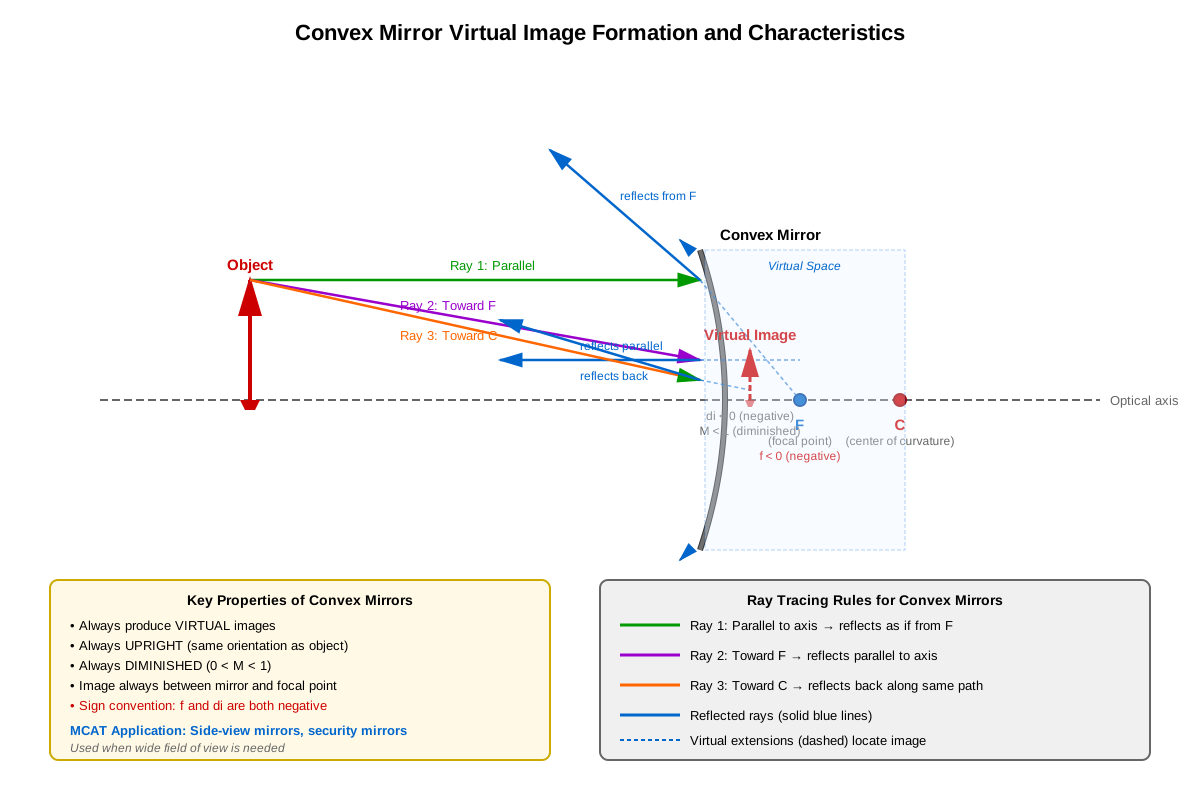
For convex (diverging) mirrors, which curve outward, all images are virtual regardless of object position. The ray tracing follows these rules:
- A ray parallel to the principal axis reflects as if coming from the focal point behind the mirror
- A ray directed toward the focal point reflects parallel to the principal axis
- A ray toward the center of curvature reflects back along the same path
- The backward extensions of reflected rays intersect at the virtual image location
For diverging lenses, the process is similar but involves refraction rather than reflection. All images formed by diverging lenses are virtual, upright, and reduced in size.
Mathematical Treatment and Sign Conventions
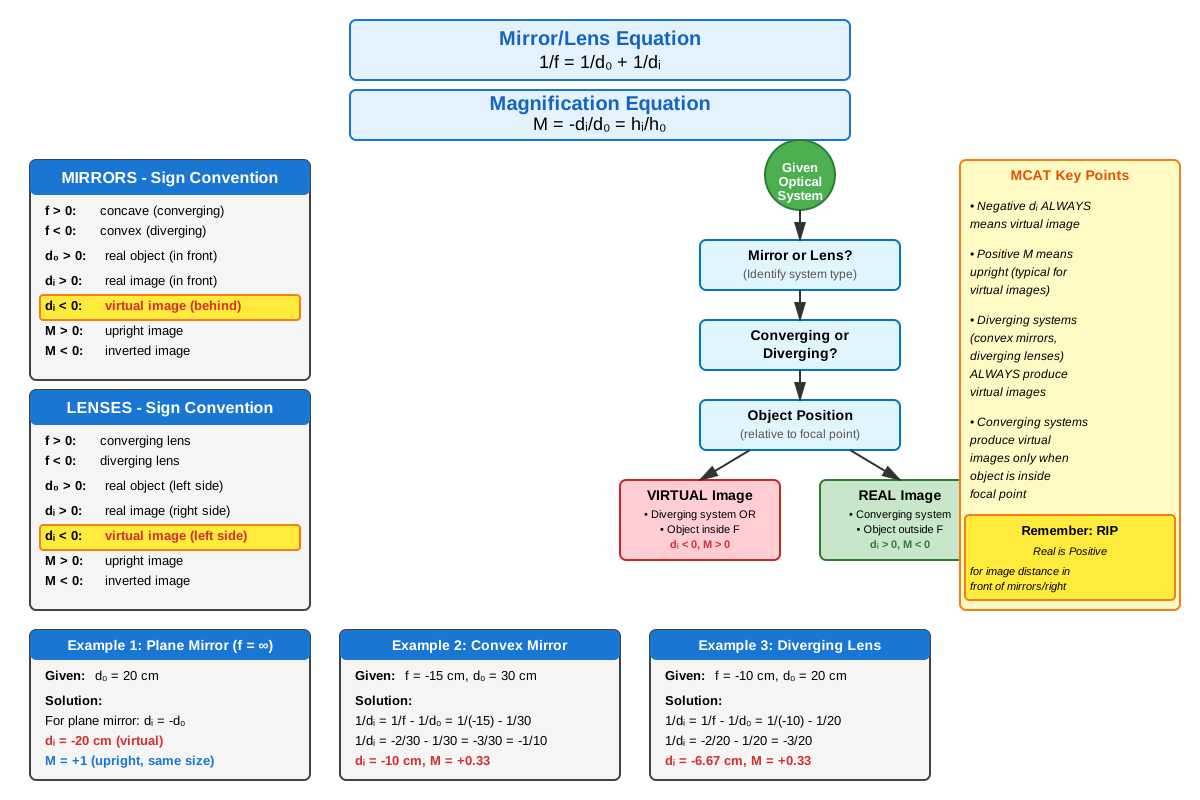
The mirror equation and thin lens equation both take the form:
1/f = 1/do + 1/diWhere:
- f = focal length
- do = object distance (always positive for real objects)
- di = image distance
For virtual images, the critical sign convention rules are:
| Parameter | Real Image | Virtual Image |
|---|---|---|
| Image distance (di) | Positive (+) | Negative (−) |
| Image orientation | Inverted | Upright |
| Focal length (converging) | Positive (+) | N/A |
| Focal length (diverging) | Negative (−) | Negative (−) |
The magnification equation relates image and object characteristics:
M = -di/do = hi/hoWhere:
- M = magnification
- hi = image height
- ho = object height
For virtual images, since di is negative, the magnification M is positive, confirming the image is upright. When |M| < 1, the image is reduced; when |M| > 1, the image is enlarged.
Optical Systems That Produce Virtual Images
Plane mirrors always produce virtual images with specific properties:
- Image distance equals object distance (|di| = do)
- Magnification equals +1 (same size, upright)
- Image appears as far behind the mirror as the object is in front
- Left-right reversal occurs (lateral inversion)
Convex mirrors (diverging mirrors) always produce virtual images that are:
- Upright and reduced in size (0 < M < 1)
- Located between the mirror surface and the focal point
- Useful for wide-angle viewing (security mirrors, vehicle side mirrors)
Concave mirrors (converging mirrors) produce virtual images only when the object is placed between the focal point and the mirror surface (do < f). These virtual images are:
- Upright and magnified (M > 1)
- Located behind the mirror
- The principle behind magnifying makeup mirrors and shaving mirrors
Diverging lenses (concave lenses) always produce virtual images that are:
- Upright and reduced
- Located on the same side as the object (opposite side of lens from where light emerges)
- Used to correct myopia by diverging light before it enters the eye
Converging lenses (convex lenses) produce virtual images when the object is placed closer than the focal length (do < f), creating:
- Upright and magnified images
- The magnifying glass effect
- Images on the same side of the lens as the object
Virtual Images in Biological Systems
The human eye normally forms real, inverted images on the retina. However, understanding virtual images is crucial for vision correction:
- Myopia correction: Diverging lenses create virtual images of distant objects at the eye's far point, where the eye can focus them properly
- Magnifying glasses: When an object is placed within the focal length of a converging lens, a virtual, magnified image forms that the eye can view comfortably
- Compound microscopes: The eyepiece views the real image from the objective as an object, creating a final virtual image for comfortable viewing
Concept Relationships
Virtual images connect to numerous concepts within Light and Optics and broader Physics principles. The fundamental relationship begins with light propagation → which enables geometric optics → leading to reflection and refraction → producing either real or virtual images depending on ray convergence or divergence.
Within the topic itself, the relationships flow as follows:
Ray behavior (reflection/refraction) → optical element type (mirror/lens, converging/diverging) → object position relative to focal point → image characteristics (real/virtual, upright/inverted, magnified/reduced)
Virtual images connect backward to prerequisite concepts:
- Wave nature of light explains why light travels in straight lines that can be traced as rays
- Reflection laws (angle of incidence = angle of reflection) enable ray tracing for mirrors
- Refraction and Snell's Law govern ray bending in lenses
Virtual images connect forward to advanced topics:
- Compound optical systems use combinations of real and virtual images
- Optical instruments (microscopes, telescopes) rely on understanding both image types
- Vision correction applies virtual image principles to biological systems
- Aberrations affect both real and virtual image quality
The mathematical framework connects through: Sign conventions → mirror/lens equations → magnification calculations → quantitative predictions of image properties.
High-Yield Facts
⭐ Virtual images cannot be projected onto a screen because light rays do not actually converge at the image location
⭐ Virtual images always have negative image distances (di < 0) in standard sign conventions
⭐ Plane mirrors, convex mirrors, and diverging lenses always produce virtual images regardless of object position
⭐ Virtual images formed by single optical elements are always upright (erect) relative to the object
⭐ Concave mirrors produce virtual images only when the object is placed between the focal point and the mirror (do < f)
- Converging lenses produce virtual images only when the object is within the focal length (do < f), creating the magnifying glass effect
- The magnification of virtual images is positive (M > 0), confirming upright orientation
- Virtual images appear on the same side of a mirror as the object, but on the opposite side of a lens from where light emerges
- Convex mirrors always produce reduced virtual images (0 < M < 1) useful for wide-angle viewing
- Virtual images from concave mirrors used as magnifying mirrors have magnification greater than 1 (M > 1)
- In the mirror/lens equation, diverging optical elements have negative focal lengths (f < 0)
- Virtual images in plane mirrors appear at the same distance behind the mirror as the object is in front (|di| = do)
Quick check — test yourself on Virtual images so far.
Try Flashcards →Common Misconceptions
Misconception: Virtual images are not "real" and therefore cannot be seen by the human eye.
Correction: Virtual images are absolutely visible and observable. The term "virtual" refers only to the fact that light rays do not physically converge at the image location. Your eye can see virtual images by tracing diverging rays backward—this is exactly what happens when you look in any mirror.
Misconception: Virtual images always appear smaller than the object.
Correction: Virtual image size depends on the optical system. Plane mirrors produce same-size virtual images (M = 1), convex mirrors produce reduced images (M < 1), but concave mirrors used as magnifying mirrors produce enlarged virtual images (M > 1) when the object is within the focal length.
Misconception: A negative image distance means the image is inverted.
Correction: Negative image distance indicates a virtual image, which is actually upright. The orientation is determined by the sign of magnification: positive M means upright, negative M means inverted. Virtual images have negative di but positive M, making them upright.
Misconception: Converging optical elements (concave mirrors and convex lenses) always produce real images.
Correction: Converging elements produce virtual images when the object is placed closer than the focal length. This is the principle behind magnifying glasses (convex lens with object at do < f) and magnifying makeup mirrors (concave mirror with object at do < f).
Misconception: Virtual images are located on the opposite side of the optical element from the object.
Correction: This is only true for lenses. For mirrors, virtual images appear on the same side as the object (behind the mirror surface). This distinction is crucial for correctly applying sign conventions and interpreting ray diagrams.
Misconception: The mirror/lens equation cannot be used for virtual images.
Correction: The mirror and lens equations work perfectly for virtual images when proper sign conventions are applied. Virtual images yield negative values for di, which when substituted correctly into the equations, produce accurate predictions of image location and magnification.
Worked Examples
Example 1: Convex Mirror in a Store
Problem: A security mirror in a store is a convex mirror with a focal length of −20 cm. A customer stands 150 cm in front of the mirror. Determine: (a) the image distance, (b) the magnification, (c) whether the image is real or virtual, and (d) the image characteristics.
Solution:
Given information:
- f = −20 cm (negative because convex mirrors are diverging)
- do = 150 cm (positive, object in front of mirror)
- di = ? (to be determined)
(a) Using the mirror equation:
1/f = 1/do + 1/di
1/(−20) = 1/150 + 1/di
−0.050 = 0.00667 + 1/di
1/di = −0.050 − 0.00667 = −0.05667
di = −17.6 cm
(b) Calculate magnification:
M = −di/do = −(−17.6)/150 = +0.117(c) Since di is negative, this is a virtual image.
(d) Image characteristics:
- Virtual (di < 0)
- Upright (M > 0)
- Reduced in size (|M| < 1, specifically about 11.7% of object size)
- Located 17.6 cm behind the mirror surface
- Cannot be projected on a screen
Connection to learning objectives: This problem demonstrates applying virtual image concepts to exam-style questions, using proper sign conventions, and predicting all image characteristics from mathematical analysis.
Example 2: Magnifying Glass Analysis
Problem: A student uses a converging lens with focal length +8.0 cm as a magnifying glass to examine a small insect. The insect is placed 5.0 cm from the lens. (a) Where is the image located? (b) What is the magnification? (c) Describe the image characteristics and explain why this setup works as a magnifying glass.
Solution:
Given information:
- f = +8.0 cm (positive for converging lens)
- do = 5.0 cm (object distance)
- Note: do < f, which is the condition for virtual image formation with converging lenses
(a) Using the thin lens equation:
1/f = 1/do + 1/di
1/8.0 = 1/5.0 + 1/di
0.125 = 0.200 + 1/di
1/di = 0.125 − 0.200 = −0.075
di = −13.3 cm
The image is located 13.3 cm on the same side of the lens as the object (the side where the insect is).
(b) Calculate magnification:
M = −di/do = −(−13.3)/5.0 = +2.67(c) Image characteristics:
- Virtual (di < 0, cannot be projected)
- Upright (M > 0)
- Magnified (M = 2.67, meaning 2.67 times larger than the object)
- Located on the same side as the object, 13.3 cm from the lens
Why this works as a magnifying glass: The virtual, upright, magnified image appears farther from the eye than the actual object, allowing the eye to view it comfortably without straining to focus on a very close object. The eye sees diverging rays from the lens and traces them back to form the perception of a larger image. This is the fundamental principle of all simple magnifying glasses.
Connection to learning objectives: This example illustrates the specific condition for virtual image formation with converging lenses (do < f), demonstrates proper application of sign conventions, and connects the physics concept to a practical application students can visualize.
Exam Strategy
Key Strategy: When approaching MCAT questions on virtual images, first identify the optical element type (plane mirror, curved mirror, or lens) and immediately recall which configurations always produce virtual images versus which depend on object position.
Trigger words and phrases to recognize:
- "Cannot be projected onto a screen" → virtual image
- "Appears behind the mirror" → virtual image from mirror
- "Upright image" → likely virtual (for single optical elements)
- "Magnifying glass" → virtual image from converging lens with do < f
- "Security mirror" or "wide-angle mirror" → convex mirror, always virtual
- "Makeup mirror" or "shaving mirror" → concave mirror producing virtual image when face is close
Systematic approach for image problems:
- Identify the optical element: Determine if it's a mirror or lens, converging or diverging
- Recall the "always rules": Plane mirrors, convex mirrors, and diverging lenses always produce virtual images
- Check object position: For converging elements, compare do to f to determine image type
- Apply sign conventions carefully: Write down what's positive and negative before calculating
- Verify answer consistency: Check that di sign matches image type (negative for virtual) and M sign matches orientation (positive for upright)
Process of elimination tips:
- Eliminate any answer choice claiming a virtual image can be projected onto a screen
- Eliminate choices showing inverted images from single diverging elements
- If the problem states the image is magnified and upright, eliminate real image options
- For convex mirrors or diverging lenses, immediately eliminate real image choices
- If do < f for a converging element, eliminate real image options
Time allocation:
- Spend 15-20 seconds identifying the optical system and recalling which image type it produces
- Allocate 45-60 seconds for calculations using mirror/lens equations
- Reserve 15-20 seconds to verify your answer makes physical sense (sign consistency, can't project virtual images, etc.)
- For purely conceptual questions without calculations, use 30-40 seconds total
Common question formats:
- Calculation-based: Given optical element and object position, find image characteristics
- Conceptual: Identify which setup produces a virtual image
- Ray diagram interpretation: Determine image type from a provided diagram
- Application-based: Explain how an optical instrument uses virtual images
Memory Techniques
Mnemonic for virtual image properties - "VNUS":
- Virtual images have
- Negative image distances
- Upright orientation
- Same side as object (for mirrors)
Mnemonic for optical elements that always produce virtual images - "PCD":
- Plane mirrors
- Convex mirrors (diverging)
- Diverging lenses
Visualization strategy for sign conventions:
Picture a number line with the optical element at zero. For mirrors, negative (virtual) images are behind the mirror where light doesn't actually go. For lenses, think of light traveling left-to-right: real images form where light actually arrives (right side, positive), virtual images appear where light seems to come from but doesn't actually reach (left side, negative).
Acronym for magnification interpretation - "PUN":
- Positive M → Upright
- Negative M → Inverted
Memory aid for converging element virtual images:
"Closer than Focal makes it Virtual" (CF-V)
When object distance is closer than focal length for converging elements, the image is virtual.
Rhyme for convex mirrors:
"Convex mirrors curve away, virtual images every day"
Summary
Virtual images represent a fundamental concept in Light and Optics that appears regularly on the MCAT in both discrete questions and passage-based contexts. These images form where light rays appear to originate when traced backward, but where light does not actually converge. Virtual images cannot be projected onto screens, always appear upright when formed by single optical elements, and have negative image distances according to standard sign conventions. Plane mirrors, convex mirrors, and diverging lenses invariably produce virtual images, while concave mirrors and converging lenses create virtual images only when objects are positioned closer than the focal length. Mastery requires understanding both conceptual principles—such as ray tracing and the physical meaning of virtual image formation—and quantitative skills using the mirror and lens equations with proper sign conventions. The magnification equation confirms that virtual images have positive magnification values, indicating upright orientation. MCAT success on this topic demands the ability to quickly identify optical system types, predict image characteristics, apply mathematical relationships correctly, and connect these physics principles to biological applications like vision correction and optical instruments used in medical and research settings.
Key Takeaways
- Virtual images form where light rays appear to diverge from but do not actually pass through, making them impossible to project onto screens
- Plane mirrors, convex mirrors, and diverging lenses always produce virtual images; converging elements produce virtual images only when do < f
- Virtual images have negative image distances (di < 0) and positive magnification (M > 0), confirming upright orientation
- The mirror equation (1/f = 1/do + 1/di) and magnification equation (M = −di/do) apply to virtual images when proper sign conventions are used
- Virtual images are essential for understanding magnifying glasses, vision correction for myopia, security mirrors, and various optical instruments tested on the MCAT
- Ray tracing provides intuitive understanding: virtual images appear where backward extensions of reflected or refracted rays intersect
- Distinguishing between real and virtual images based on optical element type and object position is a high-yield skill for MCAT success
Related Topics
Real Images: Understanding the complementary concept of real images, where light actually converges, enables complete mastery of image formation and helps distinguish between the two types in exam questions.
Lens Systems and Compound Microscopes: Building on virtual image knowledge, compound optical systems use combinations of real and virtual images to achieve high magnification, a common MCAT passage topic.
Vision Correction and the Human Eye: Virtual images from diverging lenses correct myopia, while understanding how the eye forms real images on the retina connects physics to biological systems.
Spherical Mirrors and Aberrations: Advanced treatment of curved mirrors includes understanding how aberrations affect both real and virtual image quality in practical optical systems.
Wave Optics and Interference: Moving beyond geometric optics, wave properties of light explain phenomena that ray tracing cannot, including diffraction and interference patterns in optical instruments.
Practice CTA
Now that you've mastered the core concepts of virtual images, it's time to solidify your understanding through active practice. Work through the practice questions to test your ability to identify virtual images, apply sign conventions correctly, and solve quantitative problems efficiently. Use the flashcards to reinforce high-yield facts and ensure rapid recall of key principles during timed exam conditions. Remember: understanding virtual images gives you a significant advantage on Light and Optics questions, which consistently appear on every MCAT. Your investment in mastering this topic will pay dividends on test day—keep pushing forward!
Sign up free to keep reading
Create a free AnvayaPrep account to finish this MCAT guide on Virtual images — plus flashcards and practice questions.