Overview
Snell's law (also known as the law of refraction) is a fundamental principle in Light and Optics that describes how light bends when it passes from one transparent medium to another. This mathematical relationship connects the angles of incidence and refraction to the refractive indices of the two media, providing a quantitative framework for understanding optical phenomena. For the MCAT, Snell's law represents a critical bridge between conceptual understanding of light behavior and quantitative problem-solving skills that appear regularly in the Physics section.
Understanding Snell's law is essential for MCAT success because it forms the foundation for analyzing numerous optical systems tested on the exam, including lenses, prisms, fiber optics, and biological structures like the human eye. The MCAT frequently presents passages involving light transmission through different media—from air to water, glass to tissue, or across the cornea—requiring students to apply Snell's law both qualitatively and quantitatively. Beyond isolated calculations, test-makers often embed Snell's law within complex scenarios involving total internal reflection, critical angles, and optical instrument design.
The broader significance of Snell's law Physics extends throughout the Light and Optics unit, connecting directly to concepts such as refraction, dispersion, total internal reflection, and lens behavior. Mastery of this topic enables students to tackle interdisciplinary MCAT questions that integrate physics principles with biological applications, such as understanding how the eye focuses light or how microscopes magnify specimens. The mathematical simplicity of Snell's law belies its profound importance—it is one of the most frequently tested quantitative relationships in MCAT optics.
Learning Objectives
- [ ] Define Snell's law using accurate Physics terminology
- [ ] Explain why Snell's law matters for the MCAT
- [ ] Apply Snell's law to exam-style questions
- [ ] Identify common mistakes related to Snell's law
- [ ] Connect Snell's law to related Physics concepts
- [ ] Calculate critical angles for total internal reflection using Snell's law
- [ ] Predict qualitatively whether light will bend toward or away from the normal when crossing media boundaries
- [ ] Analyze complex multi-interface refraction problems involving sequential media transitions
Prerequisites
- Basic trigonometry (sine, cosine, tangent functions): Essential for manipulating Snell's law equation and solving for unknown angles
- Understanding of light as electromagnetic radiation: Provides context for why light changes speed in different media
- Concept of wave speed and frequency: Explains the physical mechanism underlying refraction
- Vector representation of light rays: Necessary for properly identifying angles of incidence and refraction relative to the normal
- Index of refraction definition: The fundamental property that quantifies how light propagates through different materials
Why This Topic Matters
Snell's law appears with remarkable consistency on the MCAT, typically showing up in 1-3 questions per exam either as standalone problems or embedded within passage-based questions. The AAMC frequently tests this concept through biological contexts—particularly vision and optical instruments used in medical diagnostics. Understanding how light refracts at the air-cornea interface, how corrective lenses work, or how endoscopes transmit images all require facility with Snell's law.
Clinically, refraction principles underlie numerous medical applications. Ophthalmology relies entirely on understanding how light bends through the eye's optical components (cornea, aqueous humor, lens, vitreous humor). Refractive errors like myopia and hyperopia result from improper light bending, and their correction requires precise application of optical principles rooted in Snell's law. Fiber optic technology, which enables minimally invasive endoscopic procedures, depends on total internal reflection—a direct consequence of Snell's law at critical angles.
On the MCAT, Snell's law MCAT questions typically appear in three formats: (1) direct calculation problems requiring numerical application of the equation, (2) qualitative reasoning questions asking students to predict light behavior without calculation, and (3) passage-based questions integrating refraction with biological systems or optical instruments. The exam particularly favors questions that test conceptual understanding—such as predicting whether light bends toward or away from the normal—rather than pure mathematical manipulation. Students who can rapidly identify the relationship between refractive indices and bending direction gain significant time advantages.
Core Concepts
The Mathematical Statement of Snell's Law
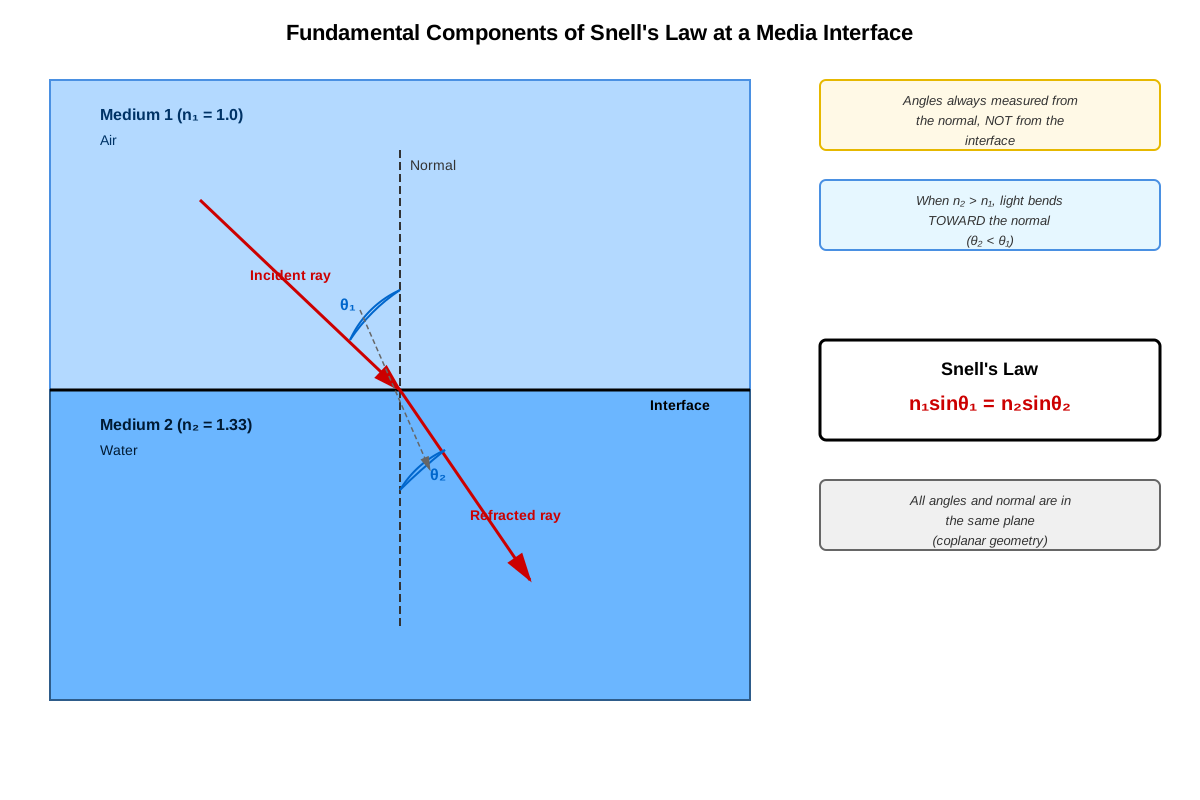
Snell's law mathematically relates the angles and refractive indices when light crosses a boundary between two transparent media. The equation is expressed as:
n₁ sin(θ₁) = n₂ sin(θ₂)Where:
- n₁ = index of refraction of the first medium (incident medium)
- θ₁ = angle of incidence (measured from the normal to the interface)
- n₂ = index of refraction of the second medium (refractive medium)
- θ₂ = angle of refraction (measured from the normal to the interface)
The normal is an imaginary line perpendicular to the interface between the two media. All angles in Snell's law must be measured from this normal line, not from the surface itself—this is a critical detail that students frequently overlook. The index of refraction (n) is a dimensionless quantity that describes how much light slows down in a medium compared to its speed in vacuum, defined as n = c/v, where c is the speed of light in vacuum and v is the speed of light in the medium.
Physical Mechanism of Refraction
Refraction occurs because light travels at different speeds in different media. When a light wave enters a new medium at an angle, one part of the wavefront enters the new medium before the rest, causing that portion to speed up or slow down first. This differential speed change causes the entire wavefront to pivot, changing the direction of propagation—this is the essence of refraction.
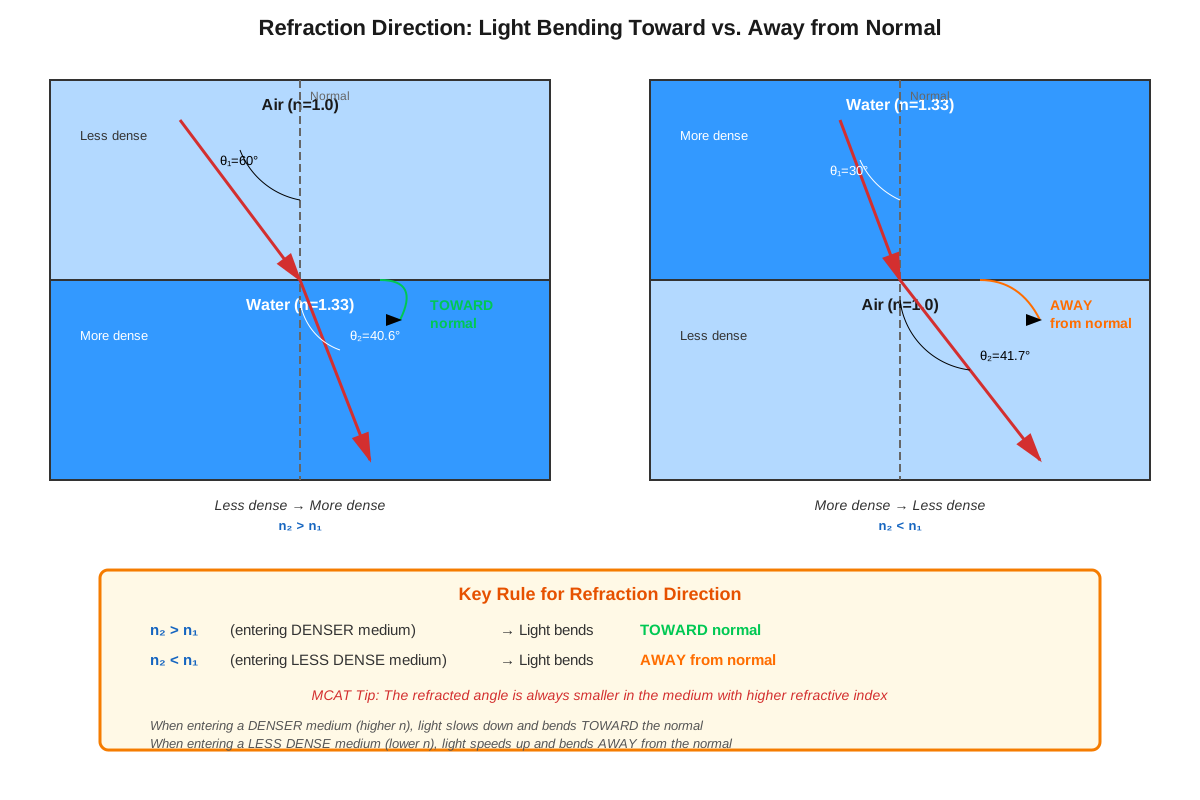
When light enters a medium with a higher index of refraction (optically denser medium), it slows down and bends toward the normal. Conversely, when light enters a medium with a lower index of refraction (optically less dense medium), it speeds up and bends away from the normal. This relationship is fundamental: higher n means slower light speed and bending toward the normal; lower n means faster light speed and bending away from the normal.
Qualitative Predictions Using Snell's Law
For MCAT success, students must rapidly predict light behavior without always calculating exact angles. The key insight: compare the refractive indices of the two media.
| Transition | Relative Indices | Light Behavior | Angle Relationship |
|---|---|---|---|
| Less dense → More dense | n₁ < n₂ | Bends toward normal | θ₂ < θ₁ |
| More dense → Less dense | n₁ > n₂ | Bends away from normal | θ₂ > θ₁ |
| Same density | n₁ = n₂ | No bending | θ₂ = θ₁ |
This qualitative understanding allows rapid elimination of incorrect answer choices on multiple-choice questions without performing calculations.
Total Internal Reflection and Critical Angle
When light travels from a more optically dense medium to a less dense medium (n₁ > n₂), there exists a special angle of incidence called the critical angle (θc) beyond which no refraction occurs—instead, all light reflects back into the original medium. This phenomenon is called total internal reflection.
The critical angle is found by setting θ₂ = 90° in Snell's law:
n₁ sin(θc) = n₂ sin(90°)
n₁ sin(θc) = n₂
sin(θc) = n₂/n₁
θc = arcsin(n₂/n₁)
Total internal reflection only occurs when:
- Light travels from higher to lower refractive index (n₁ > n₂)
- The angle of incidence exceeds the critical angle (θ₁ > θc)
This principle enables fiber optic cables, which trap light through repeated total internal reflections, and explains the sparkle of diamonds, which have a very small critical angle due to their high refractive index.
Common Refractive Indices
For MCAT problem-solving, memorizing common refractive indices accelerates calculations:
| Medium | Index of Refraction (n) |
|---|---|
| Vacuum | 1.00 (exactly) |
| Air | 1.00 (≈1.0003, treated as 1.00) |
| Water | 1.33 |
| Glass (typical) | 1.5 |
| Diamond | 2.42 |
| Cornea | 1.38 |
| Aqueous/Vitreous humor | 1.33 |
| Lens (eye) | 1.41 |
The MCAT typically provides refractive indices when needed, but recognizing that water and biological fluids cluster around 1.33 helps with estimation and error-checking.
Application to Biological Systems
The human eye provides the most clinically relevant application of Snell's law for the MCAT. Light undergoes refraction at multiple interfaces:
- Air-cornea interface (n = 1.00 → 1.38): Provides approximately 2/3 of the eye's total refractive power
- Cornea-aqueous humor (n = 1.38 → 1.33): Minor refraction
- Aqueous humor-lens (n = 1.33 → 1.41): Adjustable refraction for accommodation
- Lens-vitreous humor (n = 1.41 → 1.33): Final refraction before retina
The large refractive index change at the air-cornea interface explains why the cornea contributes most to focusing power and why corneal shape abnormalities (astigmatism) significantly affect vision.
Concept Relationships
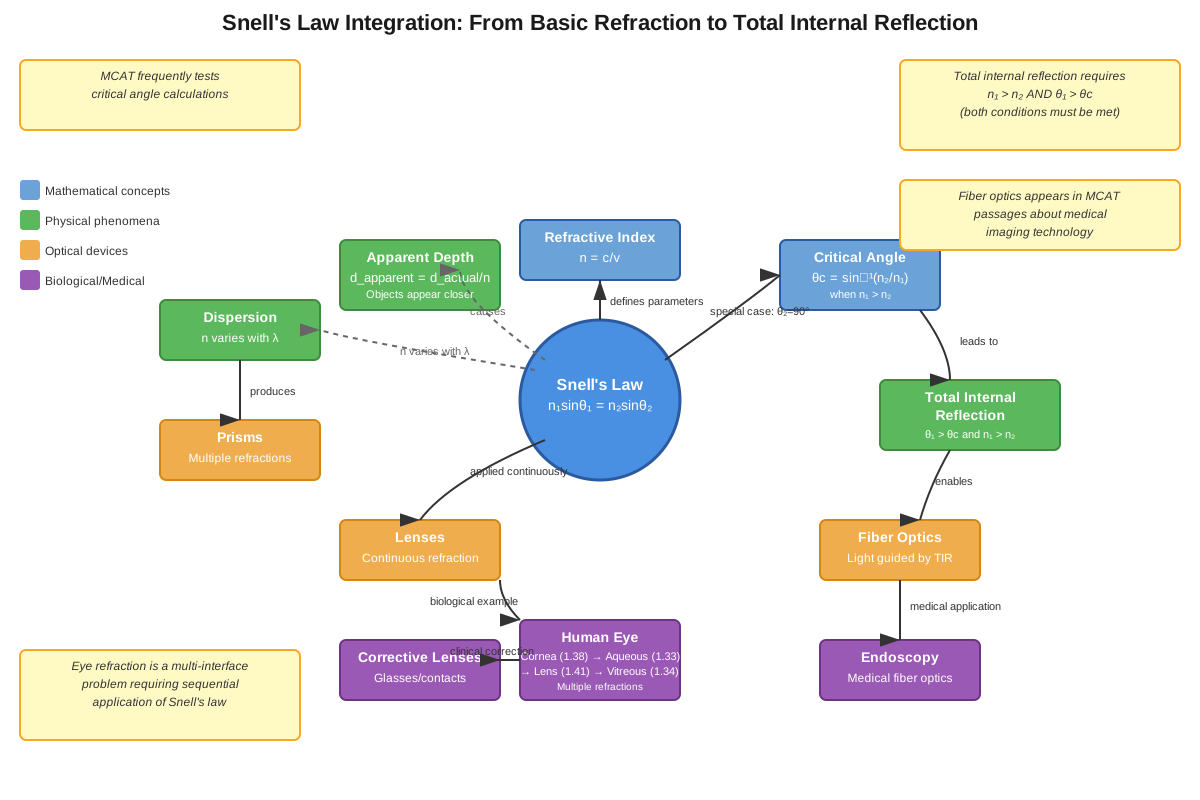
Snell's law serves as the central quantitative tool connecting multiple optical phenomena. The relationship map flows as follows:
Index of refraction (material property) → determines light speed in medium → Snell's law (mathematical relationship) → predicts refraction (light bending) → enables analysis of lenses (curved refracting surfaces) → explains optical instruments (microscopes, telescopes)
When the conditions n₁ > n₂ and θ₁ > θc are met, Snell's law → predicts total internal reflection → enables fiber optics and explains prisms and diamond brilliance.
The connection to dispersion arises because refractive index varies with wavelength (n is wavelength-dependent), causing different colors to refract by different amounts—this is why prisms separate white light into spectra and why chromatic aberration occurs in simple lenses.
Snell's law also connects to wave physics more broadly: refraction represents a special case of wave behavior at boundaries, related to concepts like impedance matching in other wave systems. The principle that waves change direction when their speed changes applies equally to sound waves, water waves, and electromagnetic radiation.
Quick check — test yourself on Snell law so far.
Try Flashcards →High-Yield Facts
⭐ Snell's law equation: n₁ sin(θ₁) = n₂ sin(θ₂), where all angles are measured from the normal to the interface
⭐ Light bends toward the normal when entering a medium with higher refractive index (n₁ < n₂)
⭐ Light bends away from the normal when entering a medium with lower refractive index (n₁ > n₂)
⭐ Critical angle formula: sin(θc) = n₂/n₁, applicable only when n₁ > n₂
⭐ Total internal reflection occurs only when light travels from higher to lower refractive index AND the incident angle exceeds the critical angle
- The refractive index of water and most biological fluids is approximately 1.33
- The refractive index of typical glass is approximately 1.5
- At normal incidence (θ₁ = 0°), light passes straight through without bending regardless of refractive indices
- The cornea provides approximately 2/3 of the eye's total refractive power due to the large index change at the air-cornea interface
- When n₁ = n₂, no refraction occurs (θ₁ = θ₂) regardless of incident angle
- Refractive index is always ≥ 1.00 for physical materials (vacuum has n = 1.00 exactly)
- The frequency of light remains constant during refraction; only wavelength and speed change
Common Misconceptions
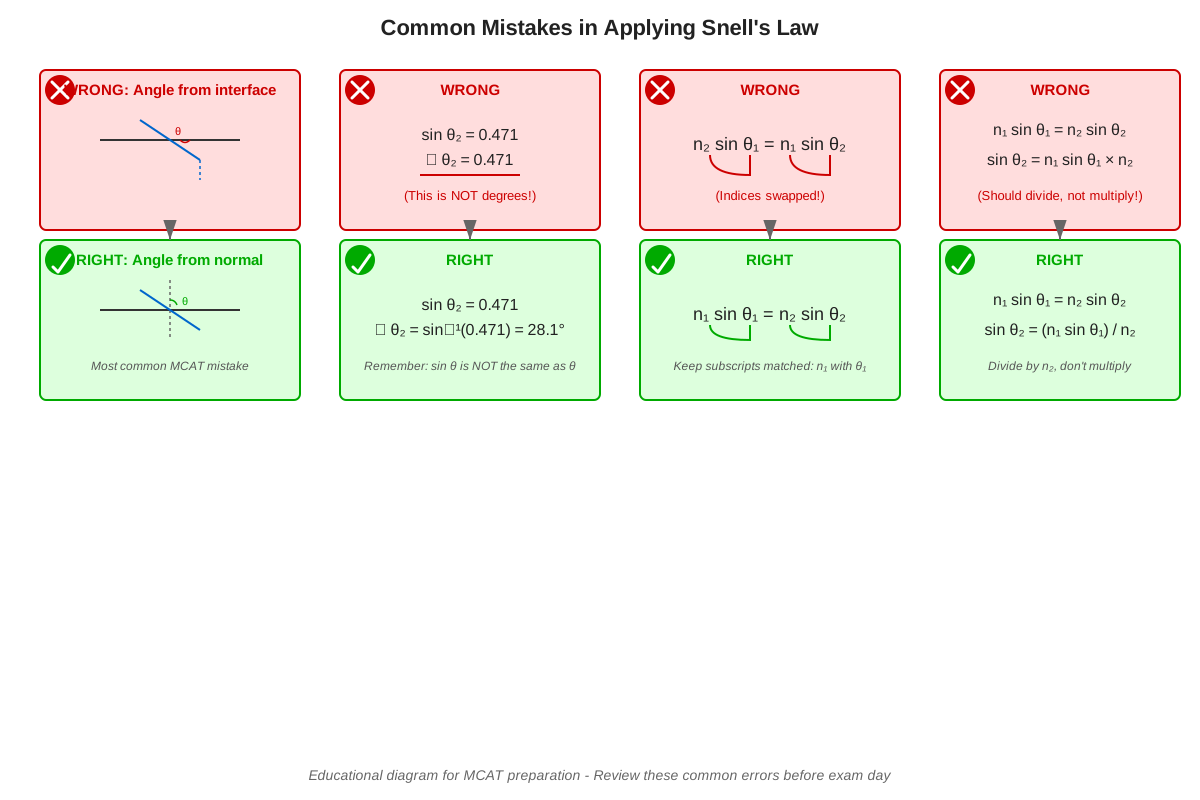
Misconception: Angles in Snell's law are measured from the surface of the interface.
Correction: All angles must be measured from the normal (perpendicular) to the interface. An angle of 30° from the surface corresponds to 60° from the normal.
Misconception: Light always bends when crossing between media.
Correction: Light only bends when it enters at an angle (θ₁ ≠ 0°) AND the refractive indices differ (n₁ ≠ n₂). At normal incidence (perpendicular entry), light continues straight regardless of refractive index change.
Misconception: Total internal reflection can occur when light travels from a less dense to a more dense medium.
Correction: Total internal reflection only occurs when light travels from higher to lower refractive index (n₁ > n₂). When going from lower to higher index, refraction always occurs—the refracted angle simply becomes smaller than the incident angle.
Misconception: A higher refractive index means light travels faster in that medium.
Correction: Higher refractive index means light travels slower. The relationship is n = c/v, so as n increases, v (speed in the medium) decreases. This is why light slows down in glass (n = 1.5) compared to air (n = 1.0).
Misconception: The critical angle increases as the refractive index difference between media increases.
Correction: The critical angle decreases as the refractive index of the first medium increases relative to the second. A larger n₁/n₂ ratio produces a smaller critical angle, making total internal reflection easier to achieve (this is why diamonds sparkle—their high refractive index creates a very small critical angle).
Misconception: Snell's law applies to all types of waves equally without modification.
Correction: While the general principle of refraction applies to all waves, the specific refractive indices used in Snell's law are defined for electromagnetic waves. Other wave types (sound, water waves) follow similar mathematical relationships but require different material properties (acoustic impedance, wave speed ratios).
Worked Examples
Example 1: Calculating Refraction Angle
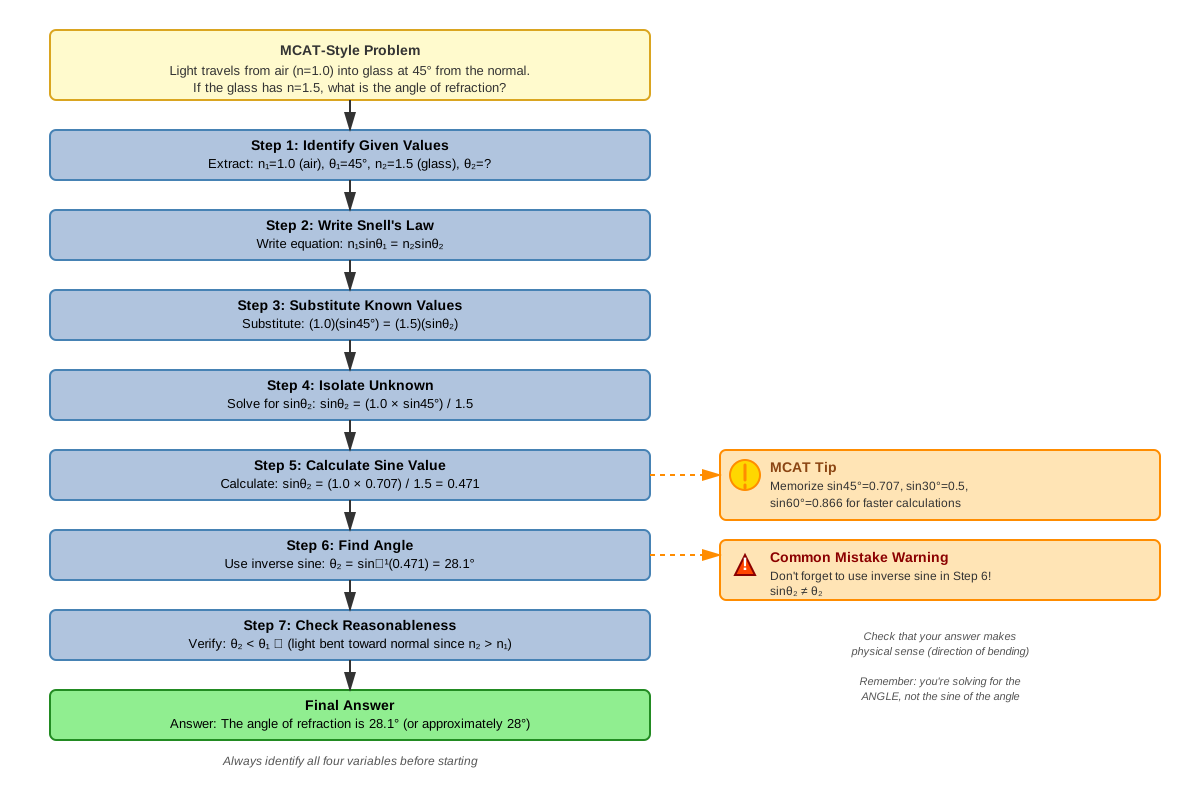
Problem: A light ray traveling through air (n = 1.00) strikes the surface of water (n = 1.33) at an angle of 45° from the normal. What is the angle of refraction in the water?
Solution:
Step 1: Identify the known values
- n₁ = 1.00 (air)
- θ₁ = 45°
- n₂ = 1.33 (water)
- θ₂ = ? (what we're solving for)
Step 2: Apply Snell's law
n₁ sin(θ₁) = n₂ sin(θ₂)Step 3: Substitute known values
(1.00) sin(45°) = (1.33) sin(θ₂)Step 4: Calculate sin(45°)
(1.00)(0.707) = (1.33) sin(θ₂)
0.707 = 1.33 sin(θ₂)
Step 5: Solve for sin(θ₂)
sin(θ₂) = 0.707/1.33 = 0.532Step 6: Find θ₂ using inverse sine
θ₂ = arcsin(0.532) = 32.1°Answer: The angle of refraction is approximately 32°.
Conceptual check: Since light is entering a more optically dense medium (n₁ < n₂), we expect the light to bend toward the normal, meaning θ₂ should be less than θ₁. Indeed, 32° < 45°, confirming our answer makes physical sense.
Example 2: Critical Angle and Total Internal Reflection
Problem: An optical fiber has a glass core (n = 1.50) surrounded by a cladding material (n = 1.38). (a) Calculate the critical angle for total internal reflection at the core-cladding interface. (b) If light in the core strikes the interface at 65° from the normal, will total internal reflection occur?
Solution:
Part (a): Finding the critical angle
Step 1: Identify the condition for total internal reflection
- Light must travel from higher to lower index: n₁ = 1.50 > n₂ = 1.38 ✓
- Total internal reflection is possible
Step 2: Apply the critical angle formula
sin(θc) = n₂/n₁Step 3: Substitute values
sin(θc) = 1.38/1.50 = 0.920Step 4: Calculate critical angle
θc = arcsin(0.920) = 67.0°Answer (a): The critical angle is 67°.
Part (b): Determining if total internal reflection occurs
Step 1: Compare incident angle to critical angle
- Incident angle: θ₁ = 65°
- Critical angle: θc = 67°
- Since θ₁ < θc, the incident angle is below the critical angle
Step 2: Determine the outcome
When the incident angle is less than the critical angle, refraction occurs (not total internal reflection).
Answer (b): No, total internal reflection will not occur. The light will refract into the cladding material because 65° < 67°.
Practical significance: This explains why optical fibers must maintain light rays at sufficiently steep angles (relative to the fiber axis) to ensure total internal reflection. Light entering at too shallow an angle relative to the fiber wall will leak out through the cladding, causing signal loss.
Exam Strategy
When approaching Snell's law MCAT questions, employ this systematic strategy:
Step 1: Identify the interface and media
Immediately determine what two materials are involved and locate their refractive indices. If not provided, use standard values (air = 1.0, water = 1.33, glass ≈ 1.5).
Step 2: Determine if calculation is necessary
Many MCAT questions test qualitative understanding rather than numerical calculation. If the question asks "which direction" or "compared to," use the qualitative rule: higher n means bending toward normal, lower n means bending away.
Step 3: Check for total internal reflection conditions
Before applying Snell's law, verify whether total internal reflection might occur. This requires n₁ > n₂ and θ₁ > θc. If both conditions are met, no refracted ray exists.
Step 4: Draw a diagram
Even a quick sketch showing the normal, incident ray, and interface helps prevent angle measurement errors. Mark which side has higher refractive index.
Trigger words to watch for:
- "Angle from the surface" → convert to angle from normal (subtract from 90°)
- "Optically dense" → higher refractive index
- "Faster/slower" → relates inversely to refractive index
- "Critical angle" → signals potential total internal reflection question
- "Fiber optic" → almost certainly involves total internal reflection
Process of elimination tips:
- Eliminate any answer showing light bending away from normal when entering higher-index medium
- Eliminate answers with refraction angles greater than 90° (physically impossible)
- Eliminate answers showing total internal reflection when n₁ < n₂
- If incident angle is small (< 30°), refracted angle will also be relatively small
Time allocation:
Straightforward Snell's law calculations should take 30-45 seconds. If a problem requires more than 90 seconds, consider whether you're missing a qualitative shortcut or whether strategic guessing might be more efficient.
Memory Techniques
Mnemonic for bending direction: "HIND"
- Higher Index → Normal Direction
- When entering a higher index medium, light bends toward the normal
Mnemonic for critical angle conditions: "HALO"
- High to Low
- Angle Over critical
- Total internal reflection requires going from high to low index with angle over the critical angle
Visualization strategy:
Imagine light as a car driving from pavement onto mud at an angle. The wheel that enters the mud first slows down while the other wheel continues at normal speed, causing the car to turn toward the perpendicular. This models light entering a higher-index (slower) medium bending toward the normal.
Acronym for Snell's law setup: "NANA"
- N₁ Angle₁ = N₂ Angle₂ (with sine of angles)
- Helps remember the equation structure: n₁ sin(θ₁) = n₂ sin(θ₂)
Memory aid for common indices:
- Air = 1 (one letter, one value)
- Water = 1.33 (W has 3 points at bottom, think 1.3-3)
- Glass = 1.5 (G is halfway through alphabet, 1.5 is halfway between 1 and 2)
Summary
Snell's law provides the fundamental quantitative relationship governing light refraction at interfaces between transparent media, expressed as n₁ sin(θ₁) = n₂ sin(θ₂). This principle enables prediction of light bending direction and magnitude based on refractive indices: light bends toward the normal when entering optically denser media (higher n) and away from the normal when entering less dense media (lower n). The critical angle, derived from Snell's law by setting the refracted angle to 90°, determines the threshold for total internal reflection, which occurs only when light travels from higher to lower refractive index at incident angles exceeding this critical value. For MCAT success, students must master both quantitative calculations using the equation and qualitative predictions based on refractive index comparisons. The biological relevance centers on vision—particularly refraction at the cornea—and medical optical instruments. Understanding that angles must be measured from the normal, recognizing when total internal reflection conditions are met, and rapidly predicting bending direction without calculation are essential skills for efficient MCAT performance on Light and Optics questions.
Key Takeaways
- Snell's law (n₁ sin θ₁ = n₂ sin θ₂) quantitatively relates incident and refracted angles to refractive indices at media interfaces
- Light bends toward the normal when entering higher-index media and away from the normal when entering lower-index media
- All angles in Snell's law must be measured from the normal (perpendicular to the interface), not from the surface
- Total internal reflection occurs only when light travels from higher to lower refractive index (n₁ > n₂) at angles exceeding the critical angle (θc = arcsin[n₂/n₁])
- The cornea provides most of the eye's refractive power due to the large refractive index change at the air-cornea interface (1.0 → 1.38)
- Qualitative prediction of light behavior (bending direction) is often more valuable on the MCAT than precise numerical calculation
- Common refractive indices to remember: air = 1.0, water/biological fluids = 1.33, glass = 1.5
Related Topics
Total Internal Reflection and Fiber Optics: Building directly on Snell's law, this topic explores the conditions and applications of complete light reflection at interfaces, including medical endoscopy and telecommunications.
Lenses and Lens Equations: Snell's law applied to curved surfaces explains how converging and diverging lenses focus light, essential for understanding corrective eyewear and optical instruments.
Dispersion and Chromatic Aberration: The wavelength-dependence of refractive index causes different colors to refract by different amounts, explaining prisms and optical system limitations.
The Human Eye and Vision Correction: Integration of multiple refractive interfaces (cornea, lens) and how refractive errors (myopia, hyperopia, astigmatism) arise from improper light bending.
Optical Instruments: Microscopes, telescopes, and other devices rely on controlled refraction through multiple elements, requiring systematic application of Snell's law.
Practice CTA
Now that you've mastered the core concepts of Snell's law, it's time to solidify your understanding through active practice. Work through the practice questions to test your ability to apply Snell's law in various contexts, from straightforward calculations to complex biological scenarios. Use the flashcards to reinforce high-yield facts and ensure rapid recall during timed exam conditions. Remember: understanding the concept is the first step, but MCAT success requires the ability to apply that knowledge quickly and accurately under pressure. Your investment in deliberate practice now will pay dividends on test day—every problem you solve strengthens the neural pathways that enable automatic, confident performance when it matters most.
Sign up free to keep reading
Create a free AnvayaPrep account to finish this MCAT guide on Snell law — plus flashcards and practice questions.