Overview
Thin lenses represent one of the most clinically relevant and frequently tested topics within Light and Optics on the MCAT. These optical devices refract light to form images and are fundamental to understanding how the human eye functions, how corrective lenses work, and how medical instruments like microscopes and endoscopes operate. A thin lens is defined as an optical element whose thickness is negligible compared to its focal length and the distances of objects and images from it. This simplification allows the use of elegant mathematical relationships that predict image formation with remarkable accuracy.
Understanding thin lenses Physics requires mastery of ray diagrams, sign conventions, and the thin lens equation—tools that appear repeatedly in MCAT passages involving vision correction, optical instruments, and experimental setups. The MCAT tests not only computational facility with lens equations but also conceptual understanding of how changing lens properties affects image characteristics. Students must be able to predict whether images will be real or virtual, upright or inverted, magnified or diminished, based solely on object position and lens type.
This topic connects intimately with geometric optics, refraction at interfaces, and the wave nature of light. Mastery of thin lenses provides the foundation for understanding compound optical systems, aberrations, and the physics underlying common medical diagnostic tools. The thin lenses MCAT questions often integrate biological concepts—particularly the anatomy and physiology of the eye—making this a high-yield interdisciplinary topic that bridges Physics with the biological sciences.
Learning Objectives
- [ ] Define thin lenses using accurate Physics terminology
- [ ] Explain why thin lenses matters for the MCAT
- [ ] Apply thin lenses to exam-style questions
- [ ] Identify common mistakes related to thin lenses
- [ ] Connect thin lenses to related Physics concepts
- [ ] Derive and apply the thin lens equation to calculate image position, object position, or focal length
- [ ] Construct accurate ray diagrams for both converging and diverging lenses
- [ ] Calculate magnification and determine image characteristics (real/virtual, upright/inverted, size)
- [ ] Analyze compound lens systems and determine overall magnification
- [ ] Apply lens concepts to biological systems, particularly the human eye and vision correction
Prerequisites
- Refraction and Snell's Law: Understanding how light bends at interfaces between media with different refractive indices is essential because lenses function by refracting light at curved surfaces
- Basic geometry and trigonometry: Ray diagrams and lens equations rely on geometric relationships and similar triangles
- Sign conventions in physics: Consistent application of positive and negative values for distances and heights is critical for correct calculations
- Wave properties of light: Understanding wavelength, frequency, and the electromagnetic spectrum provides context for optical phenomena
- Basic algebra: Solving equations with multiple variables and manipulating fractions is necessary for lens calculations
Why This Topic Matters
Clinical and Real-World Significance
Thin lenses are ubiquitous in medicine and daily life. The human eye itself functions as a compound lens system, with the cornea and crystalline lens working together to focus light on the retina. Vision disorders—myopia (nearsightedness), hyperopia (farsightedness), presbyopia, and astigmatism—all involve failures of proper image formation that are corrected using thin lenses. Understanding lens physics enables comprehension of how corrective eyeglasses, contact lenses, and refractive surgery (like LASIK) restore normal vision.
Medical instruments depend critically on lens systems. Microscopes use compound lens arrangements to magnify small specimens for pathological examination. Endoscopes employ lens systems to visualize internal organs. Ophthalmoscopes allow examination of the retina. Each of these applications requires precise control of image formation through careful lens selection and positioning.
MCAT Exam Relevance
Thin lenses appear in approximately 2-4 questions per MCAT exam, making them high-yield for the time invested in mastering them. Questions typically fall into three categories:
- Computational problems: Direct application of the thin lens equation and magnification formula, often embedded in experimental passages
- Conceptual questions: Predicting image characteristics without calculation, testing understanding of ray diagrams and lens behavior
- Biological integration: Questions about the eye, vision correction, or optical instruments that require applying lens physics to physiological contexts
Passages frequently present experimental setups involving lenses, requiring students to analyze how changing variables (object distance, lens type, focal length) affects outcomes. The MCAT also tests the ability to interpret ray diagrams and recognize when approximations (like the thin lens approximation) are valid.
Core Concepts
Types of Thin Lenses
Thin lenses are categorized into two fundamental types based on their shape and optical behavior:
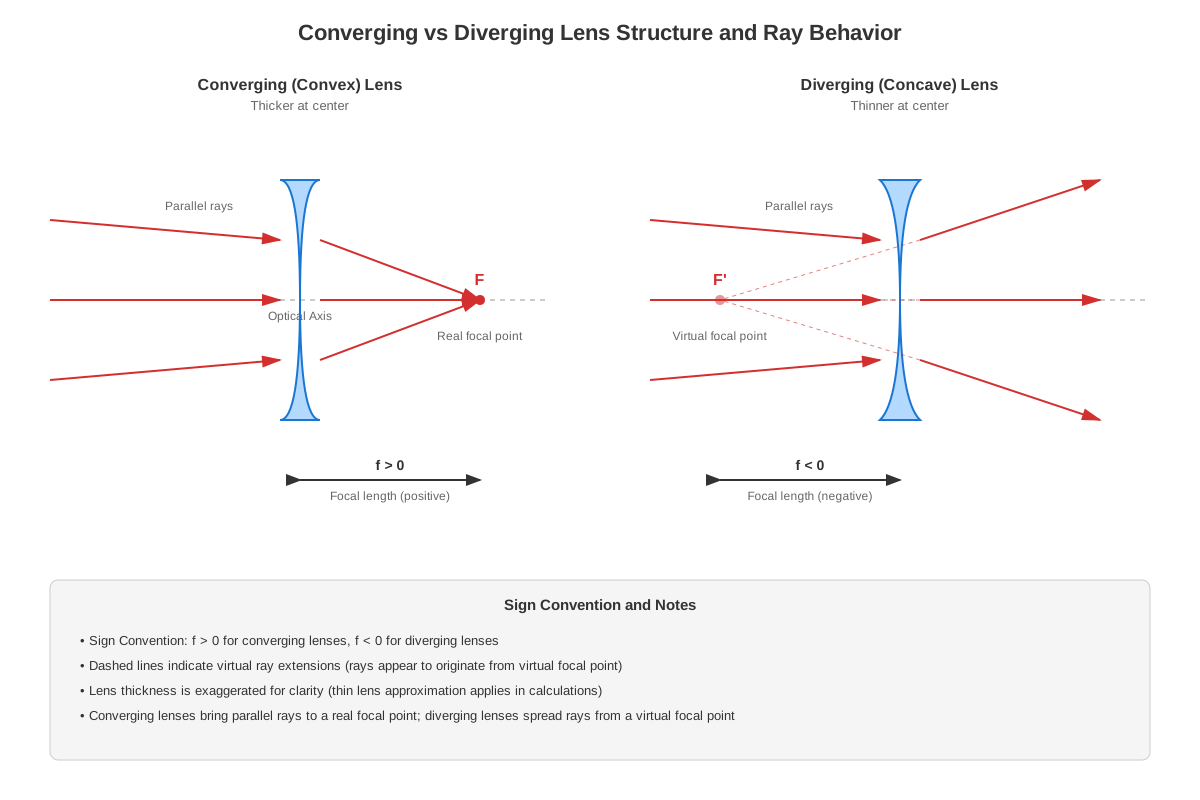
Converging lenses (also called convex lenses or positive lenses) are thicker at the center than at the edges. They refract parallel light rays so that they converge to a point called the focal point. The most common shapes are biconvex (curved outward on both sides), plano-convex (flat on one side, curved outward on the other), and convex meniscus. Converging lenses have positive focal lengths and can form both real and virtual images depending on object position.
Diverging lenses (also called concave lenses or negative lenses) are thinner at the center than at the edges. They refract parallel light rays so that they appear to diverge from a focal point on the same side as the incoming light. Common shapes include biconcave, plano-concave, and concave meniscus. Diverging lenses have negative focal lengths and always form virtual, upright, diminished images regardless of object position.
The Thin Lens Equation
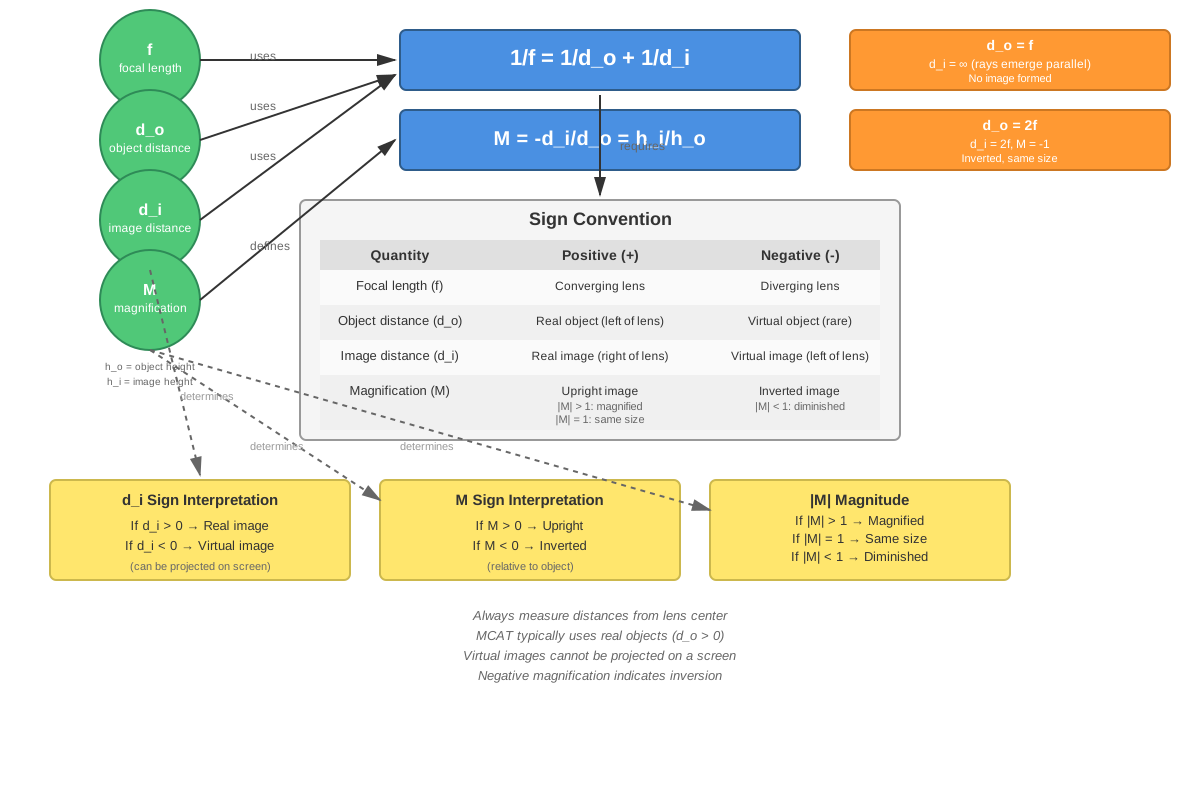
The fundamental relationship governing image formation by thin lenses is the thin lens equation:
1/f = 1/d_o + 1/d_iWhere:
- f = focal length of the lens
- d_o = object distance (distance from object to lens)
- d_i = image distance (distance from image to lens)
This equation applies to both converging and diverging lenses when proper sign conventions are followed. The focal length represents the distance from the lens center to the focal point where parallel rays converge (or appear to diverge from).
Sign Conventions
Consistent application of sign conventions is absolutely critical for correct calculations:
| Quantity | Positive | Negative |
|---|---|---|
| Focal length (f) | Converging lens | Diverging lens |
| Object distance (d_o) | Real object (light comes from it) | Virtual object (rare) |
| Image distance (d_i) | Real image (same side as light exits) | Virtual image (same side as object) |
| Object height (h_o) | Upright object | Inverted object |
| Image height (h_i) | Upright image | Inverted image |
Exam Tip: The MCAT consistently uses the convention that real images have positive image distances and virtual images have negative image distances. Real images form where light actually converges and can be projected on a screen; virtual images form where light appears to come from but doesn't actually converge.
Magnification
The magnification (m) describes how much larger or smaller the image is compared to the object:
m = h_i/h_o = -d_i/d_oWhere:
- h_i = image height
- h_o = object height
Key magnification principles:
- |m| > 1: Image is magnified (larger than object)
- |m| < 1: Image is diminished (smaller than object)
- |m| = 1: Image is same size as object
- m > 0: Image is upright relative to object
- m < 0: Image is inverted relative to object
Ray Diagrams for Converging Lenses
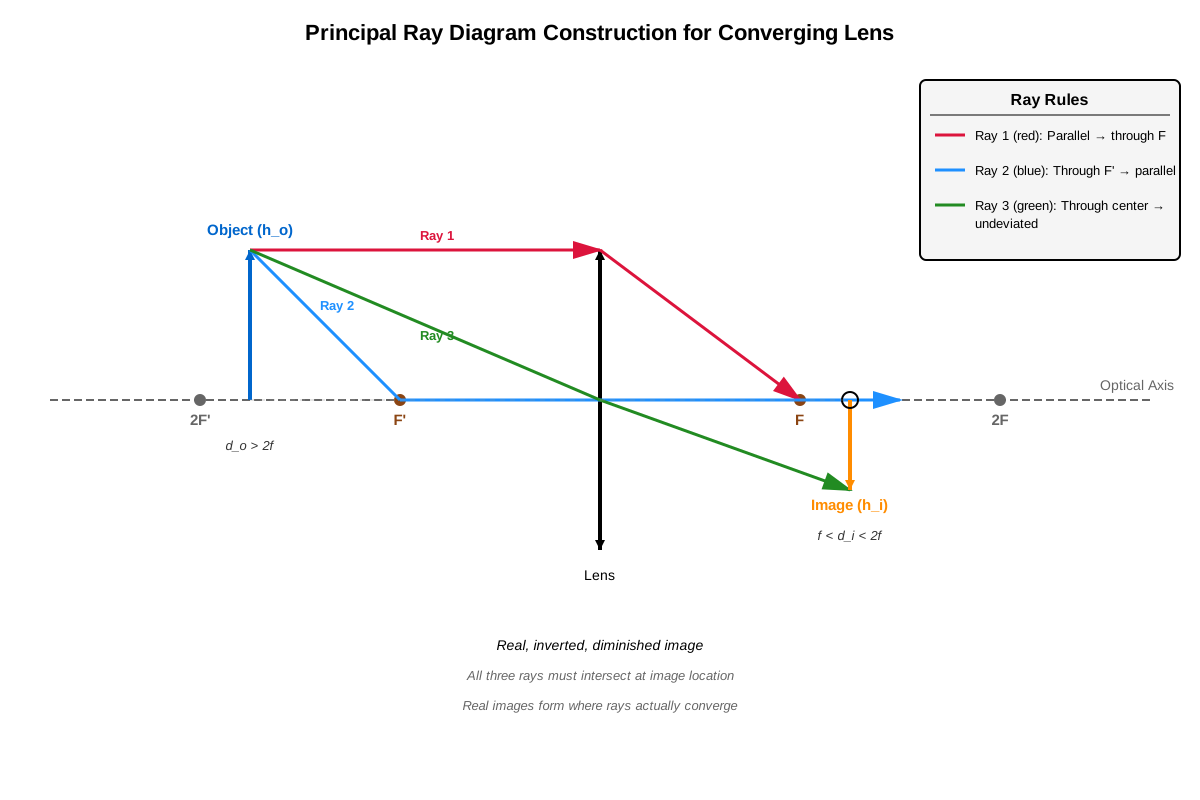
Ray diagrams provide a graphical method to determine image location and characteristics. For converging lenses, three principal rays are drawn from the top of the object:
- Parallel ray: Travels parallel to the principal axis, then refracts through the far focal point
- Focal ray: Passes through the near focal point, then refracts parallel to the principal axis
- Central ray: Passes through the lens center without bending (valid for thin lenses)
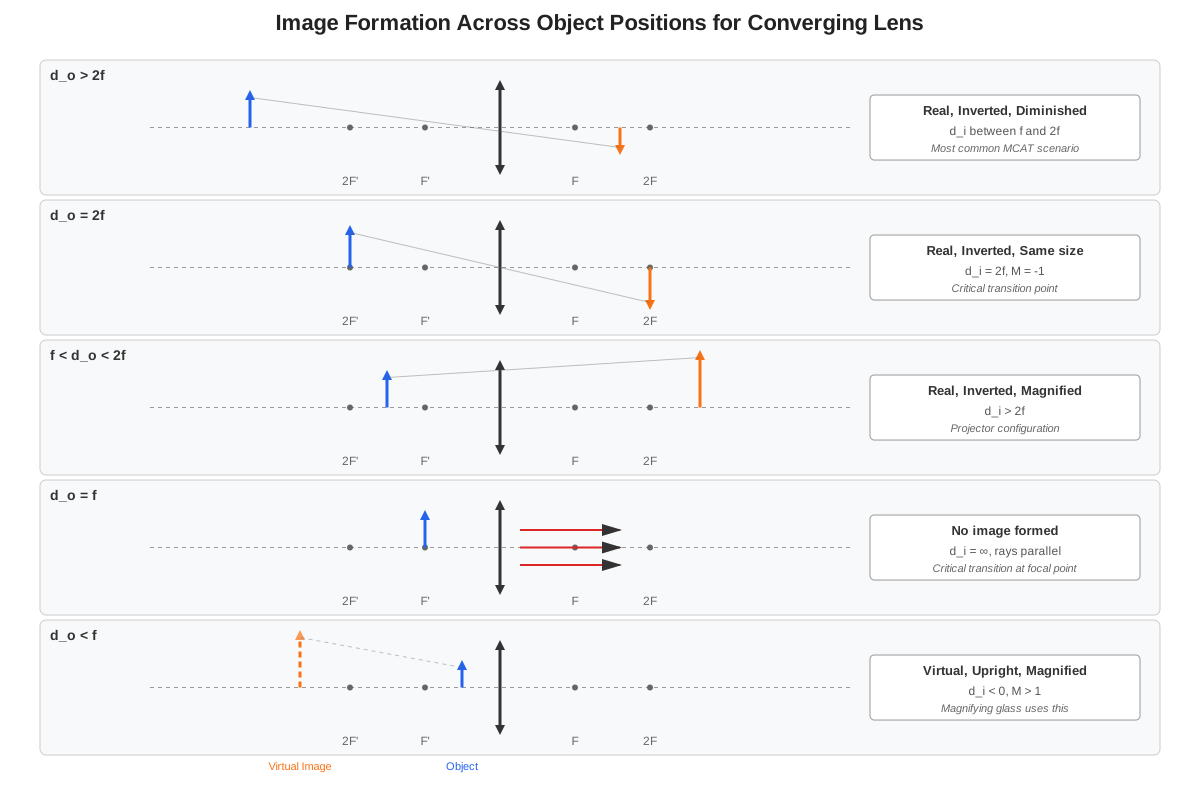
The intersection of these rays locates the image position. The image characteristics depend on object position:
Object beyond 2f (d_o > 2f):
- Image is real, inverted, diminished
- Image forms between f and 2f on opposite side
- Example: Camera, human eye viewing distant objects
Object at 2f (d_o = 2f):
- Image is real, inverted, same size
- Image forms at 2f on opposite side
- Magnification = -1
Object between f and 2f (f < d_o < 2f):
- Image is real, inverted, magnified
- Image forms beyond 2f on opposite side
- Example: Projector, slide projector
Object at f (d_o = f):
- No image forms (rays emerge parallel)
- Image distance approaches infinity
Object inside f (d_o < f):
- Image is virtual, upright, magnified
- Image forms on same side as object
- Example: Magnifying glass, simple microscope
Ray Diagrams for Diverging Lenses
For diverging lenses, the three principal rays are:
- Parallel ray: Travels parallel to principal axis, then refracts as if coming from the near focal point
- Focal ray: Travels toward the far focal point, then refracts parallel to principal axis
- Central ray: Passes through lens center without bending
Diverging lenses always produce the same type of image regardless of object position:
- Image is always virtual (d_i is negative)
- Image is always upright (m is positive)
- Image is always diminished (|m| < 1)
- Image forms between lens and focal point on same side as object
Power of a Lens
The power (P) of a lens quantifies its ability to refract light:
P = 1/fWhere:
- P is measured in diopters (D), where 1 D = 1 m⁻¹
- f must be in meters
Converging lenses have positive power; diverging lenses have negative power. When multiple thin lenses are placed in contact, their powers add:
P_total = P_1 + P_2 + P_3 + ...This additive property makes power particularly useful for analyzing compound lens systems and for prescribing corrective lenses.
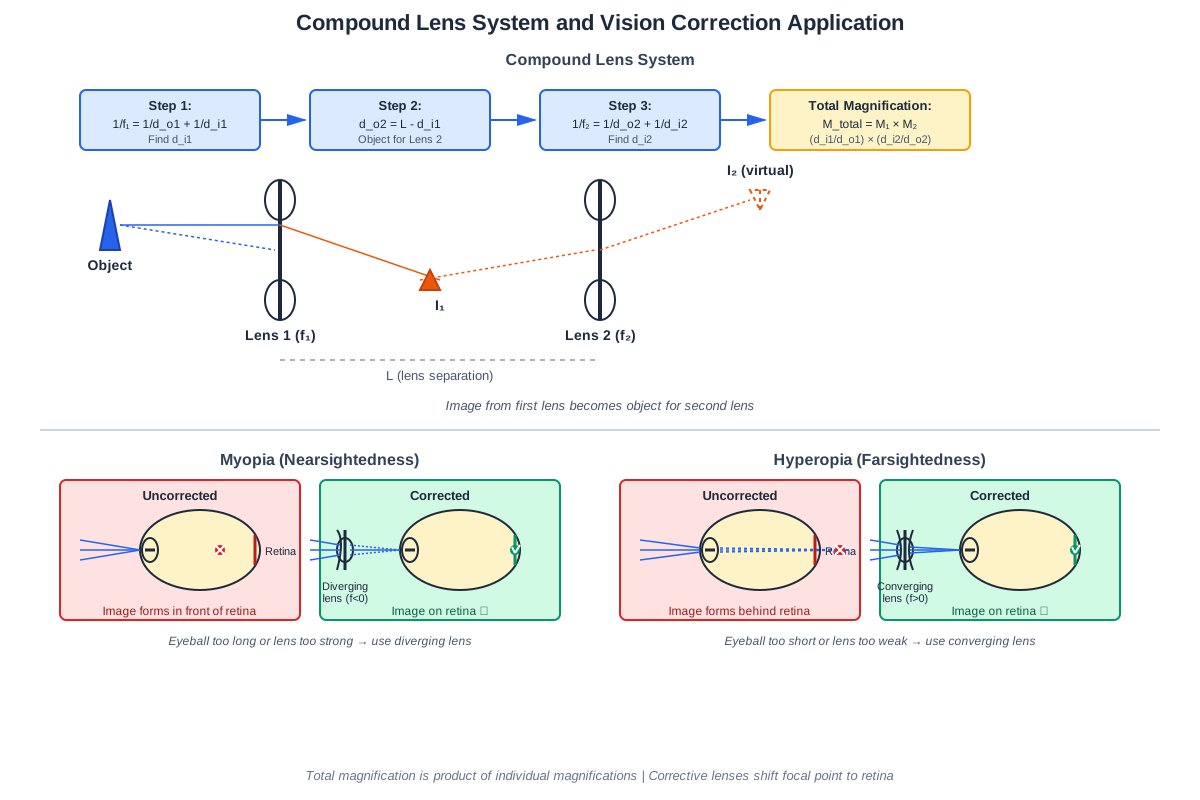
Compound Lens Systems
When multiple lenses are separated by distance, the image formed by the first lens becomes the object for the second lens. The process is sequential:
- Use the thin lens equation for the first lens to find its image position
- Calculate the object distance for the second lens (accounting for the separation)
- Use the thin lens equation for the second lens
- Total magnification is the product of individual magnifications: m_total = m_1 × m_2
This principle underlies microscopes (objective lens + eyepiece) and telescopes.
Concept Relationships
The physics of thin lenses emerges from more fundamental principles of light behavior. Refraction at curved surfaces → causes light rays to bend according to Snell's Law → which in thin lenses produces convergence or divergence → leading to image formation at predictable locations.
Within thin lens physics, several interconnected concepts form a coherent framework:
Focal length ↔ determines → lens power ↔ affects → degree of convergence/divergence → which controls → image position → combined with object position → determines → magnification and image characteristics
The thin lens equation mathematically encodes the relationship between focal length, object distance, and image distance. Magnification connects these distances to the physical sizes of object and image. Ray diagrams provide geometric visualization of these algebraic relationships.
Thin lenses connect to broader physics concepts:
- Geometric optics: Thin lenses exemplify ray-based analysis of light
- Wave optics: Lens aberrations and resolution limits require wave treatment
- Energy conservation: Light intensity changes with magnification follow energy principles
- Biological systems: The eye is a variable-power lens system with accommodation
Understanding thin lenses enables progression to:
- Optical instruments: Microscopes, telescopes, cameras
- Vision correction: Prescribing corrective lenses for refractive errors
- Advanced optics: Aberrations, diffraction limits, fiber optics
Quick check — test yourself on Thin lenses so far.
Try Flashcards →High-Yield Facts
⭐ The thin lens equation (1/f = 1/d_o + 1/d_i) applies to both converging and diverging lenses with proper sign conventions
⭐ Converging lenses have positive focal lengths; diverging lenses have negative focal lengths
⭐ Real images have positive image distances and can be projected on a screen; virtual images have negative image distances and cannot be projected
⭐ Magnification m = -d_i/d_o; negative magnification indicates an inverted image
⭐ Diverging lenses always produce virtual, upright, diminished images regardless of object position
- When an object is placed at the focal point of a converging lens, no image forms (rays emerge parallel)
- Lens power in diopters equals the reciprocal of focal length in meters (P = 1/f)
- For lenses in contact, total power equals the sum of individual powers
- A converging lens produces a virtual image only when the object is inside the focal length
- The magnification of a compound lens system equals the product of individual magnifications
- An object at twice the focal length (2f) of a converging lens produces an inverted, real image of equal size at 2f on the opposite side
- The human eye uses a converging lens system with variable focal length (accommodation)
- Myopia (nearsightedness) is corrected with diverging lenses; hyperopia (farsightedness) is corrected with converging lenses
- For a magnifying glass to work, the object must be placed inside the focal length of a converging lens
- The central ray through a thin lens passes undeviated through the lens center
Common Misconceptions
Misconception: Diverging lenses can produce real images if the object is positioned correctly.
Correction: Diverging lenses always produce virtual images when used alone with real objects. Only converging lenses can produce real images. Diverging lenses can only produce real images in compound systems where they receive converging light from another lens.
Misconception: A negative magnification means the image is smaller than the object.
Correction: Negative magnification indicates the image is inverted relative to the object. The magnitude of magnification determines size: |m| > 1 means magnified, |m| < 1 means diminished, regardless of sign. An image with m = -3 is inverted and three times larger than the object.
Misconception: Virtual images are not "real" and cannot be seen.
Correction: Virtual images are absolutely visible—you see them every time you look in a mirror or use a magnifying glass. "Virtual" means light doesn't actually converge at the image location; instead, light appears to diverge from that point. Virtual images cannot be projected onto a screen, but they can be seen by an eye or camera positioned to receive the diverging rays.
Misconception: The thin lens equation only works for converging lenses.
Correction: The thin lens equation applies to both converging and diverging lenses. The key is using correct sign conventions: diverging lenses have negative focal lengths, and virtual images have negative image distances. When these signs are properly applied, the equation works universally.
Misconception: Placing an object at the focal point of a lens produces a highly magnified image.
Correction: When an object is exactly at the focal point of a converging lens, no image forms at any finite distance. The refracted rays emerge parallel and never converge. As the object approaches the focal point from outside, the image distance approaches infinity and magnification increases without bound, but exactly at f, no image exists.
Misconception: Lens power and focal length are directly proportional.
Correction: Lens power and focal length are inversely related: P = 1/f. A stronger lens (higher power) has a shorter focal length and bends light more sharply. A lens with power +4 D has a focal length of 0.25 m (25 cm), while a lens with power +2 D has a focal length of 0.5 m (50 cm).
Misconception: All rays passing through a lens must pass through the focal point.
Correction: Only rays initially parallel to the principal axis pass through (or appear to come from) the focal point after refraction. Rays at other angles follow different paths determined by Snell's Law at each lens surface. The focal point is a special location, not a universal convergence point for all rays.
Worked Examples
Example 1: Image Formation by a Converging Lens
Problem: A converging lens has a focal length of 15 cm. An object 4 cm tall is placed 30 cm from the lens. Determine: (a) the image distance, (b) the magnification, (c) the image height, and (d) the characteristics of the image (real/virtual, upright/inverted, magnified/diminished).
Solution:
(a) Finding image distance:
Given:
- f = +15 cm (positive for converging lens)
- d_o = +30 cm (positive for real object)
- d_i = ?
Using the thin lens equation:
1/f = 1/d_o + 1/d_i
1/15 = 1/30 + 1/d_i
1/d_i = 1/15 - 1/30
1/d_i = 2/30 - 1/30 = 1/30
d_i = +30 cm
(b) Finding magnification:
m = -d_i/d_o = -30/30 = -1(c) Finding image height:
m = h_i/h_o
-1 = h_i/4
h_i = -4 cm
(d) Image characteristics:
- Real: d_i is positive (+30 cm)
- Inverted: m is negative (-1) and h_i is negative (-4 cm)
- Same size: |m| = 1
- The image forms 30 cm on the opposite side of the lens from the object
Conceptual insight: This problem demonstrates the special case where the object is placed at 2f (twice the focal length). At this position, the image forms at 2f on the opposite side with magnification of exactly -1. This configuration is used in some optical systems requiring 1:1 imaging.
Example 2: Correcting Myopia
Problem: A myopic (nearsighted) patient can see objects clearly only when they are 50 cm or closer. To correct this condition so the patient can see distant objects clearly, what power lens is required?
Solution:
Understanding the problem: Myopia occurs when the eye's lens system is too powerful, causing distant objects to focus in front of the retina. For distant objects (d_o = ∞), the uncorrected eye forms an image at 50 cm (the far point). We need a corrective lens that takes light from infinity and creates a virtual image at 50 cm, which the myopic eye can then focus properly on the retina.
Setting up the lens equation:
- Object distance: d_o = ∞ (distant objects)
- Image distance: d_i = -50 cm (virtual image at the far point; negative because virtual)
- Focal length: f = ?
Using the thin lens equation:
1/f = 1/d_o + 1/d_i
1/f = 1/∞ + 1/(-50)
1/f = 0 - 1/50
1/f = -1/50
f = -50 cm = -0.50 m
Finding the power:
P = 1/f = 1/(-0.50) = -2.0 DAnswer: A diverging lens with power -2.0 diopters is required.
Conceptual insight: Myopia is corrected with diverging (negative) lenses that slightly diverge incoming parallel rays, effectively moving the focal point backward onto the retina. The prescription would be written as -2.00 D. This example demonstrates the clinical application of thin lens physics and connects to the biological sciences portion of the MCAT.
Exam Strategy
Approaching MCAT Lens Questions
Step 1: Identify the lens type
- Look for keywords: "converging," "convex," "positive," "diverging," "concave," "negative"
- Check if focal length or power is given with a sign
- Converging → positive f, diverging → negative f
Step 2: Determine what's being asked
- Image location (d_i)?
- Image characteristics (real/virtual, upright/inverted, size)?
- Magnification?
- Focal length or power?
- Compound system analysis?
Step 3: Set up with correct signs
- Real objects: d_o positive
- Converging lenses: f positive
- Diverging lenses: f negative
- Real images: d_i positive
- Virtual images: d_i negative
Step 4: Choose your approach
- For quantitative questions: Use thin lens equation and magnification formula
- For qualitative questions: Use ray diagram logic or memorized image characteristics
- For compound systems: Work through lenses sequentially
Trigger Words and Phrases
Watch for these exam triggers:
- "Corrective lens," "eyeglasses," "contact lens": Think about vision defects and lens power
- "Magnifying glass": Object inside focal length of converging lens, virtual upright magnified image
- "Projected on a screen": Must be a real image (positive d_i)
- "Appears to come from": Virtual image (negative d_i)
- "Parallel rays": Object at infinity or image at infinity (object at focal point)
- "Diopters": Power of lens; remember P = 1/f with f in meters
- "Compound microscope," "telescope": Multiple lens system; multiply magnifications
Process of Elimination Tips
When faced with answer choices:
- Eliminate based on image type: If the question describes a real image, eliminate any answer with negative d_i
- Eliminate based on magnification sign: Inverted images have negative m; upright images have positive m
- Check reasonableness: Image distance should be on the same order of magnitude as object distance and focal length
- Use limiting cases: If d_o >> f, then d_i ≈ f for converging lenses
- Remember diverging lens behavior: Always virtual, upright, diminished—eliminate any other characteristics
Time Allocation
- Simple calculation (one lens, one unknown): 60-90 seconds
- Complex calculation (compound system or multiple steps): 2-3 minutes
- Conceptual question (no calculation): 30-45 seconds
- Passage-based question: 60-90 seconds after passage analysis
Exam Tip: If a calculation becomes algebraically messy, check whether the question can be answered conceptually. Many MCAT lens questions test understanding rather than computational skill. Knowing that a diverging lens always produces a virtual, upright, diminished image can answer a question in 10 seconds that might take 2 minutes to calculate.
Memory Techniques
Mnemonic for Converging Lens Image Characteristics
"Beyond 2F: Really Inverted, Diminished" (object beyond 2f → real, inverted, diminished)
"Between F and 2F: Really Inverted, Magnified" (object between f and 2f → real, inverted, magnified)
"Inside F: Virtual, Upright, Magnified" (object inside f → virtual, upright, magnified)
Acronym for Sign Conventions: PRIN
Positive for converging (Positive focal length)
Real images are positive (positive d_i)
Inverted images are negative (negative m)
Negative for diverging (Negative focal length)
Visualization Strategy for Ray Diagrams
Remember the "Three Magic Rays":
- Parallel → Focal: Starts parallel, goes through focal point
- Focal → Parallel: Starts through focal point, exits parallel
- Center → Straight: Goes through center, continues straight
For diverging lenses, remember rays appear to come from the focal point on the same side as the object (use dashed lines to trace back).
Power and Focal Length Relationship
"Short and Strong, Long and Weak"
- Short focal length → Strong lens → High power
- Long focal length → Weak lens → Low power
Vision Correction Memory Aid
"MYDE" (My Diverging Eye)
- MYopia needs Diverging lenses
- Hyperopia needs converging lenses (not in acronym, so it's the opposite)
Summary
Thin lenses are optical devices that refract light to form images, governed by the thin lens equation (1/f = 1/d_o + 1/d_i) and characterized by magnification (m = -d_i/d_o). Converging lenses have positive focal lengths and can produce both real and virtual images depending on object position, while diverging lenses have negative focal lengths and always produce virtual, upright, diminished images. Proper application of sign conventions is essential: real images have positive image distances and can be projected, while virtual images have negative image distances and cannot be projected but are still visible. Ray diagrams provide geometric insight into image formation using three principal rays. Lens power, measured in diopters, equals the reciprocal of focal length in meters and is additive for lenses in contact. Understanding thin lenses is crucial for analyzing vision correction, optical instruments, and experimental setups on the MCAT, where questions test both computational facility and conceptual understanding of image characteristics.
Key Takeaways
- The thin lens equation (1/f = 1/d_o + 1/d_i) universally describes image formation for both converging and diverging lenses when proper sign conventions are applied
- Converging lenses (positive f) can form real or virtual images; diverging lenses (negative f) always form virtual, upright, diminished images
- Real images (positive d_i) form where light actually converges and can be projected; virtual images (negative d_i) form where light appears to originate
- Magnification m = -d_i/d_o determines image size and orientation; negative m indicates inversion, |m| > 1 indicates magnification
- Lens power in diopters equals 1/f (with f in meters); powers add for lenses in contact
- Ray diagrams use three principal rays to graphically determine image location and characteristics
- Clinical applications include vision correction (myopia with diverging lenses, hyperopia with converging lenses) and optical instruments (microscopes, telescopes)
Related Topics
Mirrors and Curved Reflective Surfaces: Similar mathematical treatment to lenses but involving reflection rather than refraction; understanding lenses facilitates learning mirror equations and ray diagrams.
The Human Eye and Vision: The eye functions as a variable-power lens system; mastering thin lenses enables understanding of accommodation, common vision defects, and their corrections.
Optical Instruments: Microscopes, telescopes, and cameras are compound lens systems; thin lens principles extend directly to analyzing these multi-element systems.
Wave Optics and Diffraction: While thin lenses are treated with ray optics, understanding their limitations (aberrations, resolution limits) requires wave analysis.
Refraction and Snell's Law: The underlying physics of how lenses work; deeper understanding of refraction at curved interfaces explains why the thin lens equations work.
Practice CTA
Now that you've mastered the core concepts of thin lenses, it's time to solidify your understanding through active practice. Work through the practice questions to test your ability to apply the thin lens equation, construct ray diagrams, and analyze image characteristics under exam conditions. Use the flashcards to reinforce high-yield facts and ensure rapid recall of key relationships. Remember: understanding the concepts is the first step, but MCAT success requires the ability to apply that knowledge quickly and accurately under pressure. Each practice problem you solve strengthens your neural pathways and builds the confidence you need to excel on test day. You've got this!
Sign up free to keep reading
Create a free AnvayaPrep account to finish this MCAT guide on Thin lenses — plus flashcards and practice questions.