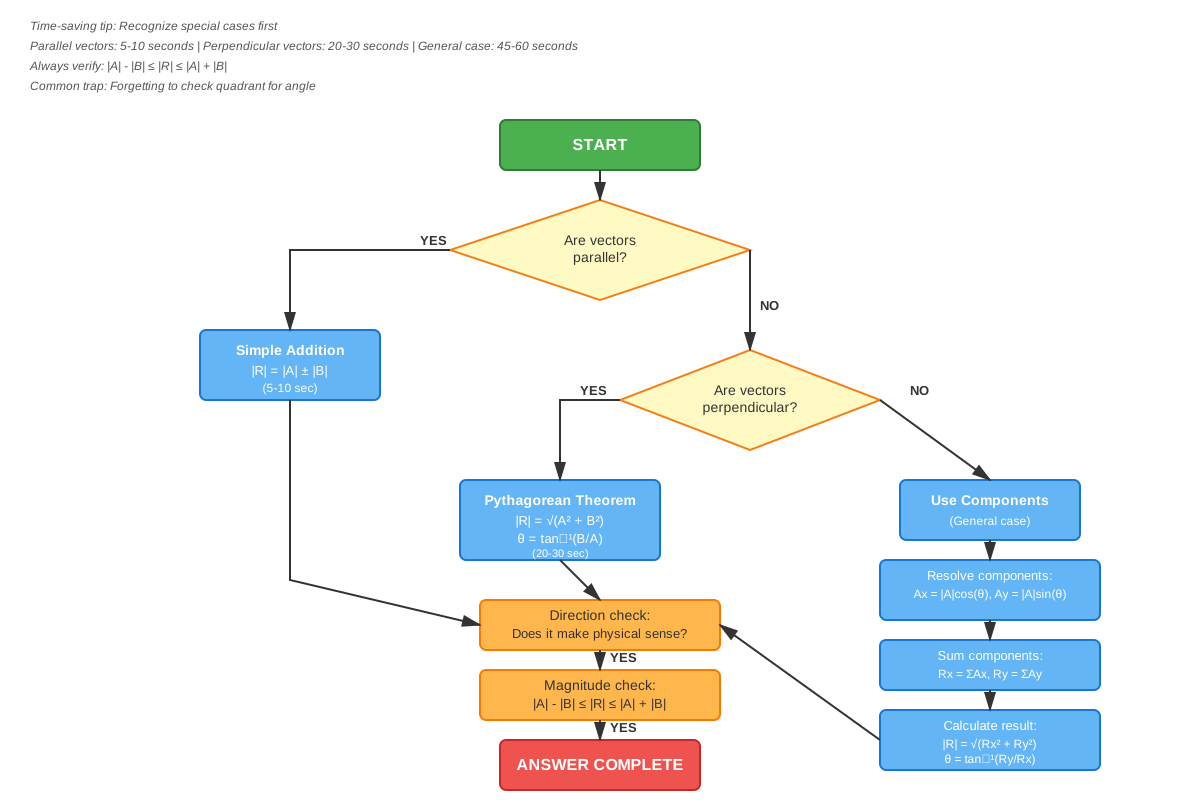
Overview
Vectors are fundamental mathematical tools in Physics that describe quantities possessing both magnitude and direction. Unlike scalar quantities (such as temperature or mass) that are fully described by a single number, vectors require specification of both how much and which way. On the MCAT, vector concepts appear across multiple physics domains including kinematics, forces, momentum, and electric fields. Understanding vectors is not merely an abstract mathematical exercise—it forms the foundation for analyzing motion in two and three dimensions, resolving forces acting at angles, and predicting the behavior of physical systems under complex conditions.
The MCAT tests vector knowledge both explicitly through direct calculation problems and implicitly through passage-based questions where vector reasoning enables efficient problem-solving. Students must be comfortable with vector addition, subtraction, component resolution, and the geometric interpretation of vector operations. These skills directly support higher-level physics concepts tested on the exam, including projectile motion, inclined plane problems, circular motion, and electromagnetic field interactions. Mastery of Vectors Physics concepts allows test-takers to approach multidimensional problems systematically rather than relying on intuition alone.
Within the broader Math and Units framework of MCAT physics preparation, vectors serve as the bridge between basic algebra and the spatial reasoning required for real-world physics applications. This topic connects directly to trigonometry, coordinate systems, and graphical analysis—all essential tools for the Chemical and Physical Foundations of Biological Systems section. Strong vector skills enable students to tackle the most challenging physics passages efficiently, often revealing shortcuts that save precious exam time.
Learning Objectives
- [ ] Define Vectors using accurate Physics terminology
- [ ] Explain why Vectors matters for the MCAT
- [ ] Apply Vectors to exam-style questions
- [ ] Identify common mistakes related to Vectors
- [ ] Connect Vectors to related Physics concepts
- [ ] Resolve vectors into perpendicular components using trigonometric functions
- [ ] Perform vector addition and subtraction using both graphical and component methods
- [ ] Calculate the magnitude and direction of resultant vectors from components
Prerequisites
- Basic trigonometry: Understanding sine, cosine, and tangent functions is essential for resolving vectors into components and finding angles
- Pythagorean theorem: Required for calculating vector magnitudes from perpendicular components
- Coordinate systems: Familiarity with Cartesian (x-y) coordinate planes enables proper vector representation
- Basic algebra: Necessary for manipulating vector component equations and solving for unknowns
- Unit analysis: Ensures dimensional consistency when working with physical vector quantities
Why This Topic Matters
Vectors MCAT questions appear with moderate frequency across the Chemical and Physical Foundations section, typically in 3-5 discrete questions per exam and within 1-2 physics passages. The topic's importance extends beyond direct vector calculation problems—vector reasoning underlies approximately 30-40% of all mechanics questions, making it a high-yield investment of study time. Questions may ask students to resolve forces on an inclined plane, analyze projectile trajectories, determine net electric or magnetic fields, or calculate momentum changes in collisions.
Clinically, vector concepts apply to biomechanics problems such as analyzing forces on joints during movement, understanding blood flow velocity in branching vessels, or calculating the resultant force on a bone from multiple muscle attachments. Medical imaging techniques like ultrasound Doppler measurements rely on vector decomposition of velocity components. While the MCAT rarely presents explicitly clinical vector problems, the spatial reasoning developed through vector practice directly transfers to interpreting anatomical relationships and physiological processes.
Common exam presentations include force diagrams requiring vector addition, velocity problems in two dimensions, and field superposition questions in electricity and magnetism. Passages may describe experimental setups where multiple forces or fields act simultaneously, requiring students to find net effects through vector summation. Discrete questions often test component resolution or the relationship between vector magnitude and direction, frequently incorporating answer choices designed to catch students who confuse scalar and vector operations.
Core Concepts
Definition and Characteristics of Vectors
A vector is a mathematical quantity characterized by both magnitude (size) and direction. This dual nature distinguishes vectors from scalar quantities, which possess only magnitude. Common vector quantities in physics include displacement, velocity, acceleration, force, momentum, and electric field. Each vector can be represented graphically as an arrow, where the arrow's length corresponds to magnitude and the arrow points in the vector's direction.
Vectors are typically denoted with boldface letters (e.g., F) or with arrows above the symbol (F⃗). The magnitude of a vector is represented by the same letter without boldface or by absolute value notation: |F| or F. Two vectors are equal if and only if they have identical magnitude and direction, regardless of their position in space—this property is called the free vector principle, meaning vectors can be translated parallel to themselves without changing their identity.
Vector Components and Resolution
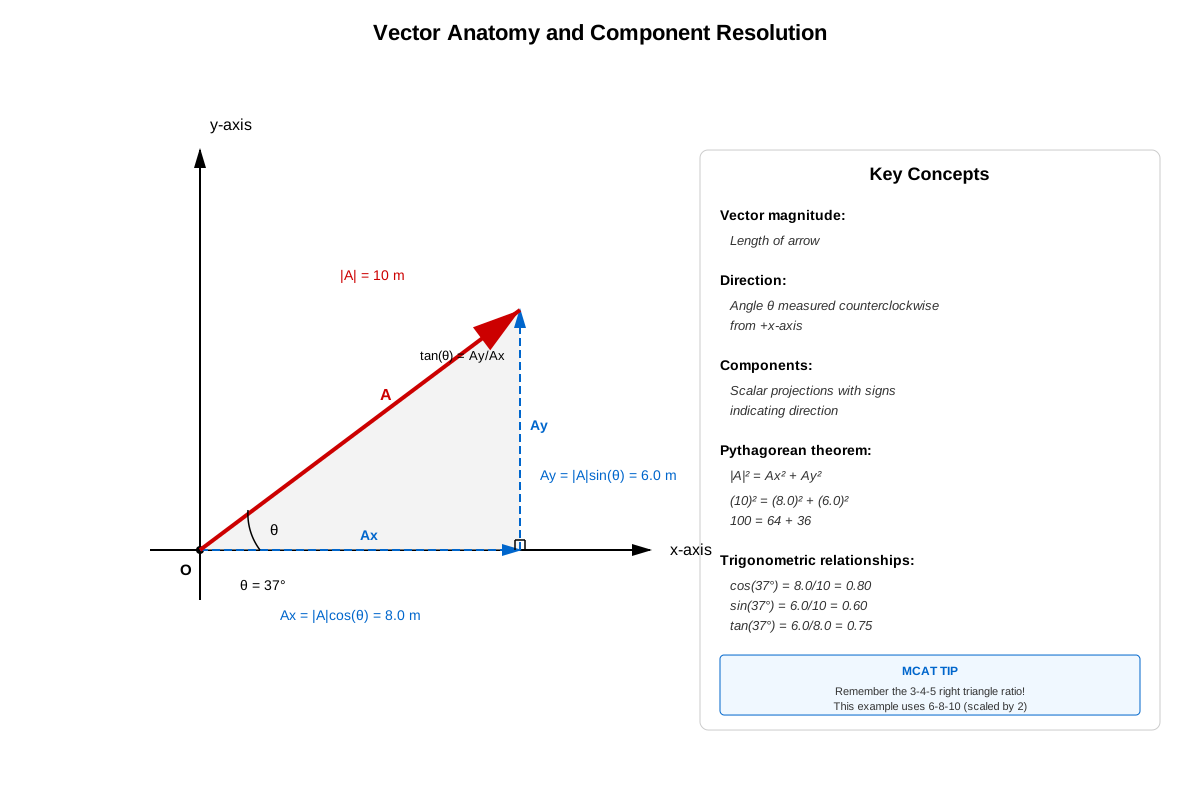
Any vector in two dimensions can be decomposed into perpendicular components, typically along the x-axis (horizontal) and y-axis (vertical). This process, called vector resolution, transforms a single vector into two scalar quantities that, when combined, reproduce the original vector. For a vector A making an angle θ with the positive x-axis:
A_x = A cos(θ)
A_y = A sin(θ)
Where A_x is the x-component, A_y is the y-component, and A is the magnitude. The angle θ is measured counterclockwise from the positive x-axis by convention. These component equations derive directly from the definitions of cosine (adjacent/hypotenuse) and sine (opposite/hypotenuse) in right triangle trigonometry.
Given components, the magnitude and direction of the original vector can be reconstructed using:
A = √(A_x² + A_y²)
θ = tan⁻¹(A_y/A_x)
The first equation applies the Pythagorean theorem, while the second uses the inverse tangent function. Care must be taken with the arctangent calculation, as calculators typically return values between -90° and +90°, requiring adjustment based on which quadrant the vector occupies.
Vector Addition: Graphical Methods
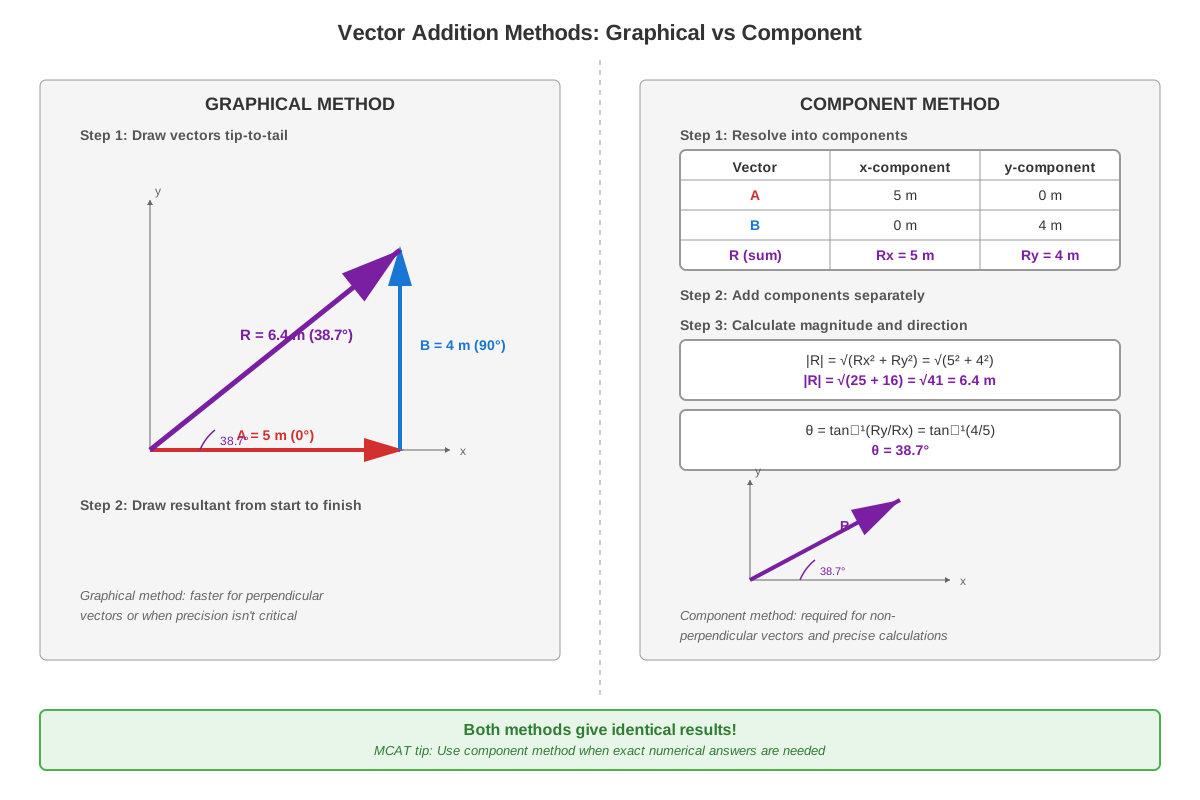
Vectors can be added graphically using two equivalent methods: the tip-to-tail method (also called the triangle method) and the parallelogram method. In the tip-to-tail approach, the second vector's tail is placed at the first vector's tip, and the resultant vector extends from the first vector's tail to the second vector's tip. This method extends naturally to adding multiple vectors by chaining them sequentially.
The parallelogram method places both vectors' tails at a common origin, then constructs a parallelogram using the vectors as adjacent sides. The diagonal from the origin represents the resultant vector. Both methods yield identical results and are particularly useful for visualizing vector addition when precise numerical answers aren't required.
The resultant vector (or sum vector) represents the combined effect of the original vectors. Vector addition is commutative (A + B = B + A) and associative ((A + B) + C = A + (B + C)), properties that simplify complex multi-vector problems.
Vector Addition: Component Method
The component method provides the most accurate and systematic approach for vector addition, especially when dealing with more than two vectors or when precise numerical results are required. The procedure follows these steps:
- Resolve each vector into x and y components
- Sum all x-components to find the resultant's x-component: R_x = A_x + B_x + C_x + ...
- Sum all y-components to find the resultant's y-component: R_y = A_y + B_y + C_y + ...
- Calculate the resultant's magnitude: R = √(R_x² + R_y²)
- Calculate the resultant's direction: θ = tan⁻¹(R_y/R_x)
This method's power lies in its ability to reduce vector problems to simple arithmetic. Each component direction is treated independently, converting a two-dimensional problem into two one-dimensional problems. The MCAT frequently tests this systematic approach, as it's less prone to error than purely graphical methods.
Vector Subtraction
Vector subtraction (A - B) is equivalent to adding the negative of the second vector (A + (-B)). The negative of a vector has the same magnitude but opposite direction—graphically, the arrow points the opposite way. Using the component method, subtraction becomes:
R_x = A_x - B_x
R_y = A_y - B_y
Vector subtraction commonly appears in MCAT problems involving displacement changes, velocity changes (acceleration), or force imbalances. For example, finding the change in velocity (Δv = v_final - v_initial) requires vector subtraction, not simple scalar subtraction of speeds.
Unit Vectors and Vector Notation
Unit vectors are vectors with magnitude equal to one, used to indicate direction. The standard unit vectors in Cartesian coordinates are:
- î (or e_x): points in the positive x-direction
- ĵ (or e_y): points in the positive y-direction
- k̂ (or e_z): points in the positive z-direction (for three-dimensional problems)
Any vector can be expressed in unit vector notation:
A = A_x î + A_y ĵ + A_z k̂This notation makes vector operations explicit and algebraically clear. Addition becomes straightforward: simply add the coefficients of like unit vectors. While the MCAT rarely requires formal unit vector notation, understanding this representation clarifies the independence of perpendicular components.
Scalar Multiplication
Multiplying a vector by a scalar (ordinary number) changes the vector's magnitude but not its direction (unless the scalar is negative, which reverses direction). If A is multiplied by scalar c:
cA = (cA_x)î + (cA_y)ĵEach component is multiplied by the scalar. This operation appears in physics equations like F = ma (force equals mass times acceleration vector) or p = mv (momentum equals mass times velocity vector), where scalar quantities multiply vector quantities.
Special Vector Operations
The dot product (scalar product) of two vectors yields a scalar:
A · B = |A||B|cos(θ) = A_x B_x + A_y B_yWhere θ is the angle between the vectors. The dot product measures how much one vector extends in the direction of another. When vectors are perpendicular, their dot product equals zero. While less commonly tested than basic vector addition, dot products appear in work calculations (W = F · d) and power calculations.
The cross product (vector product) yields a vector perpendicular to both original vectors, with magnitude:
|A × B| = |A||B|sin(θ)Cross products appear in torque calculations (τ = r × F) and magnetic force problems (F = qv × B). The MCAT typically tests conceptual understanding of cross products rather than detailed calculations.
Concept Relationships
Vector resolution forms the foundation for all other vector operations—without the ability to decompose vectors into components, systematic addition and subtraction become impossible. This foundational skill connects directly to trigonometry prerequisites, as sine and cosine functions provide the mathematical bridge between angular representation and component representation.
Component addition builds upon resolution, enabling the systematic combination of multiple vectors regardless of their orientations. This process connects to algebraic prerequisites, as component addition reduces to simple arithmetic once vectors are resolved. The resultant vector calculation then applies the Pythagorean theorem, connecting back to geometric prerequisites.
The relationship flow can be mapped as:
Trigonometry & Coordinate Systems → Vector Resolution → Component Addition/Subtraction → Resultant Calculation → Application to Physics Problems
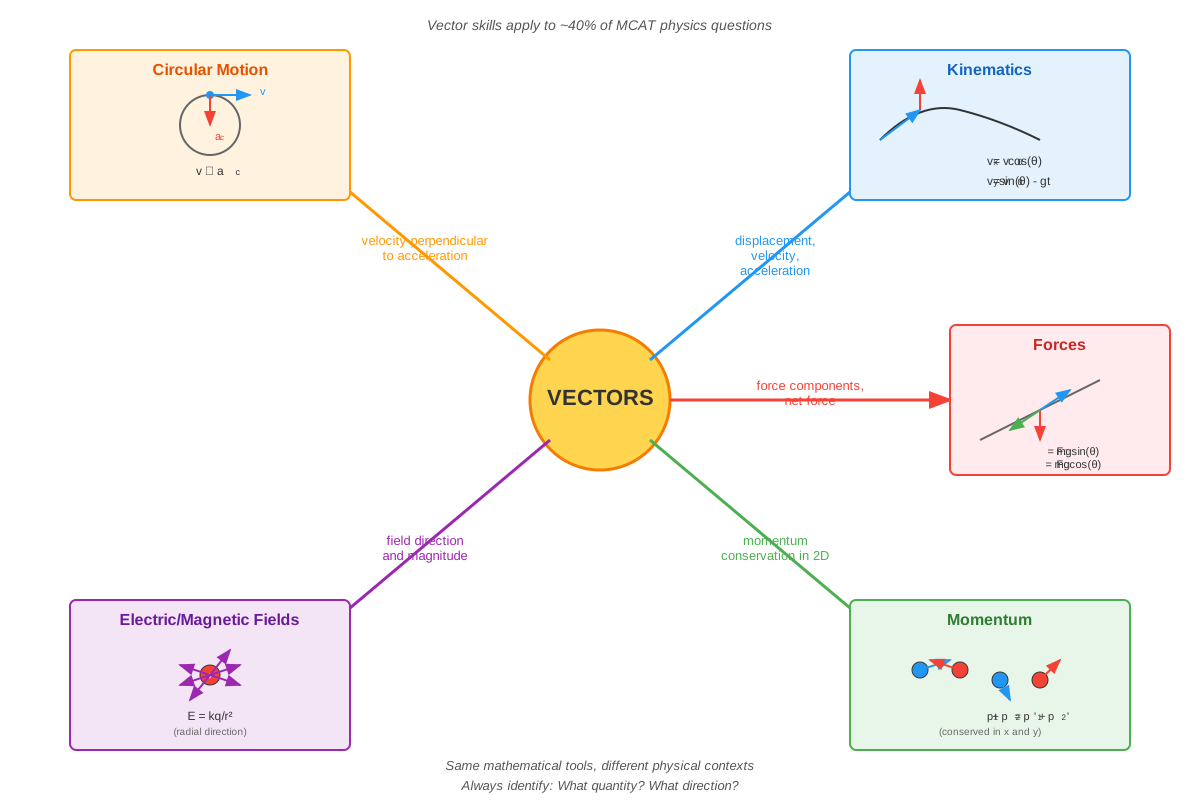
Within physics applications, vectors connect to virtually every mechanics topic: kinematics uses displacement, velocity, and acceleration vectors; dynamics uses force vectors; momentum and impulse are vector quantities; and fields (gravitational, electric, magnetic) are vector fields. Each application domain uses identical vector mathematics, making vector mastery a force multiplier for MCAT preparation efficiency.
Vector concepts also connect forward to calculus-based physics (though calculus itself isn't tested on the MCAT). Derivatives and integrals of vector quantities follow component-wise rules, meaning strong component method skills provide intuition even for conceptual calculus questions that occasionally appear.
Quick check — test yourself on Vectors so far.
Try Flashcards →High-Yield Facts
⭐ Vectors require both magnitude and direction; scalars require only magnitude
⭐ Vector components are calculated using A_x = A cos(θ) and A_y = A sin(θ), where θ is measured from the positive x-axis
⭐ The magnitude of a resultant vector is found using the Pythagorean theorem: R = √(R_x² + R_y²)
⭐ Vector addition is commutative and associative; the order of addition doesn't affect the resultant
⭐ To subtract vectors, add the negative: A - B = A + (-B)
- The component method is more accurate than graphical methods for numerical problems
- Perpendicular vector components are independent—motion in one direction doesn't affect motion in a perpendicular direction
- When two vectors are perpendicular, their dot product equals zero
- The angle for arctangent calculations must be adjusted based on the quadrant where the vector lies
- Unit vectors (î, ĵ, k̂) have magnitude one and indicate direction only
- Multiplying a vector by a negative scalar reverses its direction
- The resultant of two equal-magnitude perpendicular vectors has magnitude √2 times either original magnitude and points at 45°
Common Misconceptions
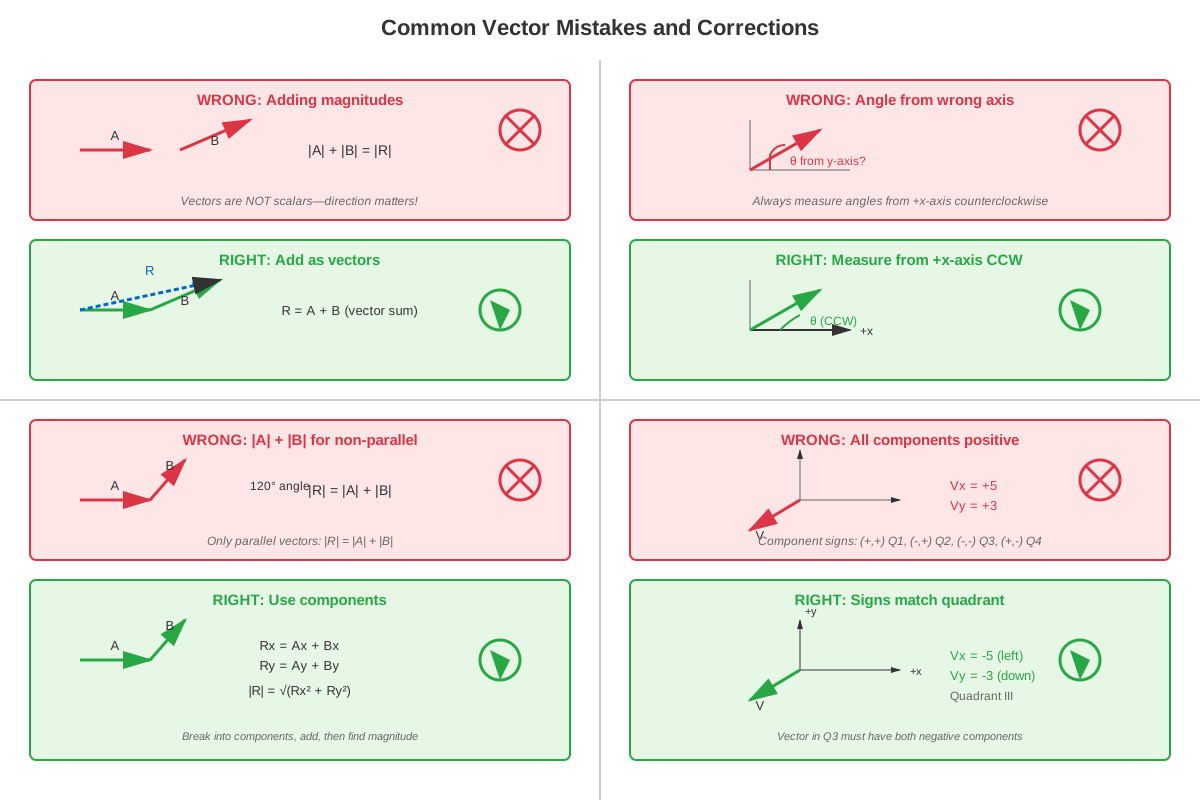
Misconception: Vector magnitude can be found by simply adding component magnitudes (A = A_x + A_y)
Correction: Vector magnitude requires the Pythagorean theorem: A = √(A_x² + A_y²). Components must be squared, summed, then square-rooted. Simply adding components ignores the perpendicular relationship between them.
Misconception: The angle returned by tan⁻¹(A_y/A_x) is always correct without adjustment
Correction: Calculators return arctangent values between -90° and +90°, but vectors can point in any direction (0° to 360°). When A_x is negative, add 180° to the calculator result. Always check that the angle places the vector in the correct quadrant based on the signs of A_x and A_y.
Misconception: Vector subtraction means subtracting magnitudes (|A - B| = |A| - |B|)
Correction: Vector subtraction requires component-wise subtraction or adding the negative vector. The magnitude of A - B generally does NOT equal |A| - |B|. For example, if two equal-magnitude vectors point in opposite directions, their difference has magnitude 2|A|, not zero.
Misconception: Velocity and speed are the same thing
Correction: Velocity is a vector (includes direction), while speed is a scalar (magnitude only). An object moving in a circle at constant speed has changing velocity because direction changes continuously. The MCAT frequently tests this distinction.
Misconception: When resolving a vector, the component can be larger than the original vector magnitude
Correction: Each component must be less than or equal to the vector's magnitude (since cos(θ) and sin(θ) are always ≤ 1). If a calculated component exceeds the magnitude, an error has occurred—likely using the wrong trigonometric function or angle.
Misconception: Vectors at different positions in space cannot be added
Correction: Vectors are free vectors—they can be translated parallel to themselves without changing their properties. Position doesn't matter for vector addition; only magnitude and direction matter. This principle allows the tip-to-tail method to work.
Misconception: The resultant of two vectors always lies between them in direction
Correction: The resultant's direction depends on the relative magnitudes and directions of the component vectors. If one vector is much larger than the other, the resultant points nearly in the larger vector's direction, not between them.
Worked Examples
Example 1: Force Resolution on an Inclined Plane
Problem: A 10 kg block rests on a frictionless incline angled at 30° above the horizontal. Calculate the components of the gravitational force parallel and perpendicular to the incline surface.
Solution:
Step 1: Identify the vector and coordinate system. The gravitational force vector points straight down with magnitude F_g = mg = (10 kg)(10 m/s²) = 100 N. We need components parallel and perpendicular to the incline, so we'll use a tilted coordinate system where x is parallel to the incline (positive down the slope) and y is perpendicular to the incline (positive away from surface).
Step 2: Determine the angle. The gravitational force makes an angle with the perpendicular-to-incline direction equal to the incline angle: 30°. This is a key geometric insight—the angle between the force and the perpendicular direction equals the incline angle.
Step 3: Resolve components. The component perpendicular to the incline is:
F_perp = F_g cos(30°) = 100 N × 0.866 = 86.6 NThe component parallel to the incline is:
F_parallel = F_g sin(30°) = 100 N × 0.5 = 50 NStep 4: Interpret. The perpendicular component (86.6 N) is balanced by the normal force from the incline. The parallel component (50 N) would cause the block to accelerate down the incline if not restrained. This problem demonstrates how vector resolution transforms a single force into components that reveal the physics of the situation.
Connection to learning objectives: This example applies vector resolution to a classic MCAT physics scenario, demonstrating why understanding component calculation matters for mechanics problems.
Example 2: Resultant Velocity in River Crossing
Problem: A swimmer can swim at 2.0 m/s in still water. She swims perpendicular to the bank of a river flowing at 1.5 m/s. What is her resultant velocity relative to the ground (magnitude and direction)?
Solution:
Step 1: Set up the coordinate system. Let x be the direction of river flow (parallel to banks) and y be perpendicular to banks (the direction the swimmer aims).
Step 2: Identify vector components. The swimmer's velocity relative to water has components:
- v_swimmer,x = 0 m/s (she aims perpendicular to flow)
- v_swimmer,y = 2.0 m/s
The river's velocity has components:
- v_river,x = 1.5 m/s
- v_river,y = 0 m/s
Step 3: Add components to find resultant. The resultant velocity relative to ground:
v_x = 0 + 1.5 = 1.5 m/s
v_y = 2.0 + 0 = 2.0 m/s
Step 4: Calculate magnitude:
v = √(v_x² + v_y²) = √(1.5² + 2.0²) = √(2.25 + 4.0) = √6.25 = 2.5 m/sStep 5: Calculate direction:
θ = tan⁻¹(v_y/v_x) = tan⁻¹(2.0/1.5) = tan⁻¹(1.33) = 53.1°This angle is measured from the river flow direction (x-axis) toward the perpendicular direction (y-axis).
Interpretation: Although the swimmer aims straight across, the river current carries her downstream, resulting in a diagonal path. Her actual speed relative to ground (2.5 m/s) exceeds her swimming speed (2.0 m/s) because the velocities add as vectors, not scalars.
Connection to learning objectives: This problem demonstrates vector addition using the component method and shows how vector concepts apply to relative motion problems common on the MCAT.
Exam Strategy
When approaching Vectors MCAT questions, first identify whether the problem requires qualitative reasoning (direction only) or quantitative calculation (specific numbers). Many passage-based questions can be answered by understanding vector direction relationships without detailed calculations, saving valuable time. Look for phrases like "net force," "resultant velocity," or "total displacement"—these signal vector addition problems.
Trigger words and phrases to watch for:
- "Magnitude and direction" → vector quantity
- "Resultant" or "net" → vector addition required
- "Component" → resolution needed
- "Perpendicular" or "parallel" → coordinate system choice matters
- "Relative to" → may involve vector subtraction
For calculation problems, immediately draw a diagram showing all vectors with their angles clearly marked. Label your coordinate system explicitly—many errors arise from inconsistent angle measurements. When resolving components, write out the sine and cosine expressions before substituting numbers; this prevents sign errors and wrong-function mistakes.
Process of elimination tips:
- Eliminate any answer choice where a component magnitude exceeds the original vector magnitude
- If two vectors are perpendicular and equal in magnitude, the resultant magnitude must be √2 times either magnitude (approximately 1.4×)
- Check units—vector magnitudes must have the same units as the original quantities
- For direction answers, eliminate choices that place the resultant in the wrong quadrant based on component signs
Time allocation: Simple component resolution should take 30-45 seconds. Full vector addition problems with magnitude and direction calculation should take 60-90 seconds. If a problem is taking longer, consider whether a qualitative approach or estimation might suffice. Remember that the MCAT rewards efficient problem-solving—sometimes recognizing that two forces are perpendicular and equal is enough without calculating exact values.
For passage-based questions, scan for vector diagrams or descriptions of multi-directional motion. These passages often yield multiple questions, making it worthwhile to invest time understanding the vector setup thoroughly before attempting questions. Annotate diagrams directly on your scratch paper, adding component labels and resultant vectors as you work through the passage.
Memory Techniques
SOH-CAH-TOA remains the classic mnemonic for trigonometric functions:
- Sine = Opposite / Hypotenuse
- Cosine = Adjacent / Hypotenuse
- Tangent = Opposite / Adjacent
For vector components, remember "Cosine is Close"—the cosine function gives the component close to (along) the reference axis, while sine gives the component perpendicular to it.
Visualization strategy: Picture vectors as arrows you can slide around (but not rotate) on a frictionless table. This mental model reinforces the free vector principle and makes tip-to-tail addition intuitive. When adding vectors, imagine physically sliding the second arrow to touch the first arrow's tip.
Component method acronym - RSCR:
- Resolve all vectors into components
- Sum components in each direction
- Calculate magnitude using Pythagorean theorem
- Recover direction using arctangent
For remembering which trigonometric function to use: "X-axis uses Cosine, Y-axis uses Sine" (alphabetically, C comes before S, and X comes before Y).
Quadrant check mnemonic - "All Students Take Calculus":
- Quadrant I (0° to 90°): All functions positive
- Quadrant II (90° to 180°): Sine positive only
- Quadrant III (180° to 270°): Tangent positive only
- Quadrant IV (270° to 360°): Cosine positive only
This helps verify that component signs match the expected quadrant.
Summary
Vectors are mathematical quantities possessing both magnitude and direction, distinguishing them from scalar quantities that have magnitude alone. Mastery of vector concepts is essential for MCAT physics success, as vectors underlie mechanics, kinematics, and field problems throughout the exam. The component method provides the most systematic approach: resolve each vector into perpendicular components using trigonometric functions (A_x = A cos θ, A_y = A sin θ), sum components independently, then reconstruct the resultant using the Pythagorean theorem for magnitude and arctangent for direction. Vector addition follows commutative and associative rules, while subtraction is accomplished by adding the negative vector. Common applications include force resolution on inclined planes, projectile motion analysis, and relative velocity problems. Success requires careful attention to coordinate system choice, angle measurement conventions, and quadrant verification for calculated directions. The ability to translate between graphical representations and component calculations enables efficient problem-solving across diverse physics contexts.
Key Takeaways
- Vectors require both magnitude and direction; always specify both when describing vector quantities
- The component method (resolve → sum → reconstruct) provides the most reliable approach for vector addition and subtraction
- Use A_x = A cos(θ) and A_y = A sin(θ) for component resolution, with θ measured from the positive x-axis
- Calculate resultant magnitude with R = √(R_x² + R_y²) and direction with θ = tan⁻¹(R_y/R_x), adjusting for quadrant
- Perpendicular vector components are independent—analyze each direction separately
- Vector subtraction means adding the negative: A - B = A + (-B)
- Draw clear diagrams with labeled coordinate systems to prevent sign errors and angle mistakes
Related Topics
Projectile Motion: Applies vector concepts to two-dimensional kinematics, decomposing initial velocity into horizontal and vertical components that evolve independently under gravity. Mastering vectors makes projectile problems straightforward.
Forces and Newton's Laws: Force is a vector quantity, and net force calculations require vector addition. Inclined plane problems, tension problems, and equilibrium situations all depend on vector resolution skills.
Momentum and Impulse: Both momentum and impulse are vector quantities. Collision problems in two dimensions require vector addition to find final velocities or momentum changes.
Electric and Magnetic Fields: Field vectors from multiple sources superpose (add) according to vector addition rules. Understanding vector addition enables calculation of net fields at any point in space.
Circular Motion: Velocity, acceleration, and force vectors in circular motion constantly change direction. Vector concepts clarify why centripetal acceleration points toward the center despite constant speed.
Practice CTA
Now that you've mastered the core concepts of vectors, it's time to solidify your understanding through active practice. Attempt the practice questions associated with this topic, focusing on applying the component method systematically and checking your angle calculations carefully. Work through the flashcards to reinforce high-yield facts and common formulas. Remember that vector skills improve dramatically with practice—each problem you solve strengthens your spatial reasoning and calculation speed. These foundational skills will serve you across dozens of MCAT physics questions, making your investment in vector mastery one of the highest-yield uses of your study time. You've got this!
Sign up free to keep reading
Create a free AnvayaPrep account to finish this MCAT guide on Vectors — plus flashcards and practice questions.