Overview
Centripetal force represents one of the most frequently tested concepts in MCAT Physics, appearing in both discrete questions and passage-based scenarios across the Chemical and Physical Foundations of Biological Systems section. This force is not a new type of force but rather describes any force—or combination of forces—that causes an object to follow a curved path. Understanding centripetal force requires synthesizing knowledge of Newton's laws, circular motion kinematics, and force analysis, making it a cornerstone concept in Mechanics. The MCAT regularly tests this concept through problems involving satellites orbiting planets, cars navigating curves, objects swinging on strings, and even biological applications such as centrifuges separating blood components.
The significance of centripetal force Physics extends beyond pure mechanics problems. On the MCAT, this topic frequently appears integrated with energy conservation, gravitational force, friction, tension, and normal forces. Test-makers favor scenarios where students must identify which force or forces provide the centripetal acceleration, calculate the minimum speed for maintaining circular motion, or analyze what happens when centripetal force requirements are not met. Mastery of this concept enables students to tackle complex multi-step problems that combine circular motion with other physics principles.
For centripetal force MCAT preparation, students must develop both conceptual understanding and quantitative problem-solving skills. The topic connects directly to uniform circular motion, Newton's second law, and force diagrams—all high-yield areas. Additionally, centripetal force concepts appear in biological contexts such as ultracentrifugation for molecular separation, blood flow through curved vessels, and the biomechanics of joint motion. This integration of physics principles with biological applications exemplifies the interdisciplinary nature of MCAT content and underscores why thorough mastery of centripetal force is essential for exam success.
Learning Objectives
- [ ] Define centripetal force using accurate Physics terminology
- [ ] Explain why centripetal force matters for the MCAT
- [ ] Apply centripetal force to exam-style questions
- [ ] Identify common mistakes related to centripetal force
- [ ] Connect centripetal force to related Physics concepts
- [ ] Calculate centripetal force magnitude using multiple force scenarios (tension, gravity, friction, normal force)
- [ ] Analyze free-body diagrams to identify which forces contribute to centripetal acceleration
- [ ] Predict the motion of objects when centripetal force requirements are not satisfied
- [ ] Distinguish between centripetal and centrifugal force conceptually and mathematically
Prerequisites
- Newton's Laws of Motion: Essential for understanding that centripetal force is simply the net force causing centripetal acceleration, not a separate force type
- Kinematics of Uniform Circular Motion: Required to understand the relationship between velocity, radius, and centripetal acceleration (a = v²/r)
- Vector Addition and Components: Necessary for resolving forces in radial and tangential directions when analyzing circular motion
- Free-Body Diagrams: Critical skill for identifying all forces acting on an object and determining which provide centripetal acceleration
- Work and Energy Principles: Useful for solving problems involving circular motion with changing speeds or heights
- Gravitational Force: Frequently appears as the centripetal force in orbital motion problems
Why This Topic Matters
Centripetal force appears in approximately 3-5% of MCAT physics questions, making it a high-yield topic that warrants dedicated study time. The concept appears across multiple question formats: discrete questions testing fundamental understanding, passage-based questions requiring application to novel scenarios, and integrated problems combining circular motion with energy, momentum, or other mechanics principles. The MCAT particularly favors questions that require students to identify which real force (or forces) provides the centripetal force in a given situation—a conceptual distinction that separates high-scoring students from those with superficial understanding.
Clinically and scientifically, centripetal force principles underlie numerous medical technologies and biological phenomena. Centrifuges, which separate blood components, cellular organelles, or DNA fragments based on density, operate entirely on centripetal force principles. The MCAT has featured passages about ultracentrifugation techniques used in molecular biology research. Additionally, cardiovascular physiology involves circular motion concepts when analyzing blood flow through curved vessels, where pressure differences must provide the necessary centripetal force to change flow direction. Understanding these applications helps students recognize centripetal force in passage contexts that might initially appear purely biological.
Common MCAT scenarios include: a car navigating a banked or unbanked curve (testing friction and normal force as centripetal force sources), a mass on a string in vertical or horizontal circular motion (testing tension and gravity), satellite or planetary orbital motion (testing gravitational force), and laboratory centrifuge applications (testing the relationship between rotation rate, radius, and centripetal acceleration). Recognizing these standard setups allows students to quickly identify the relevant physics principles and apply systematic problem-solving approaches.
Core Concepts
Definition and Fundamental Nature of Centripetal Force
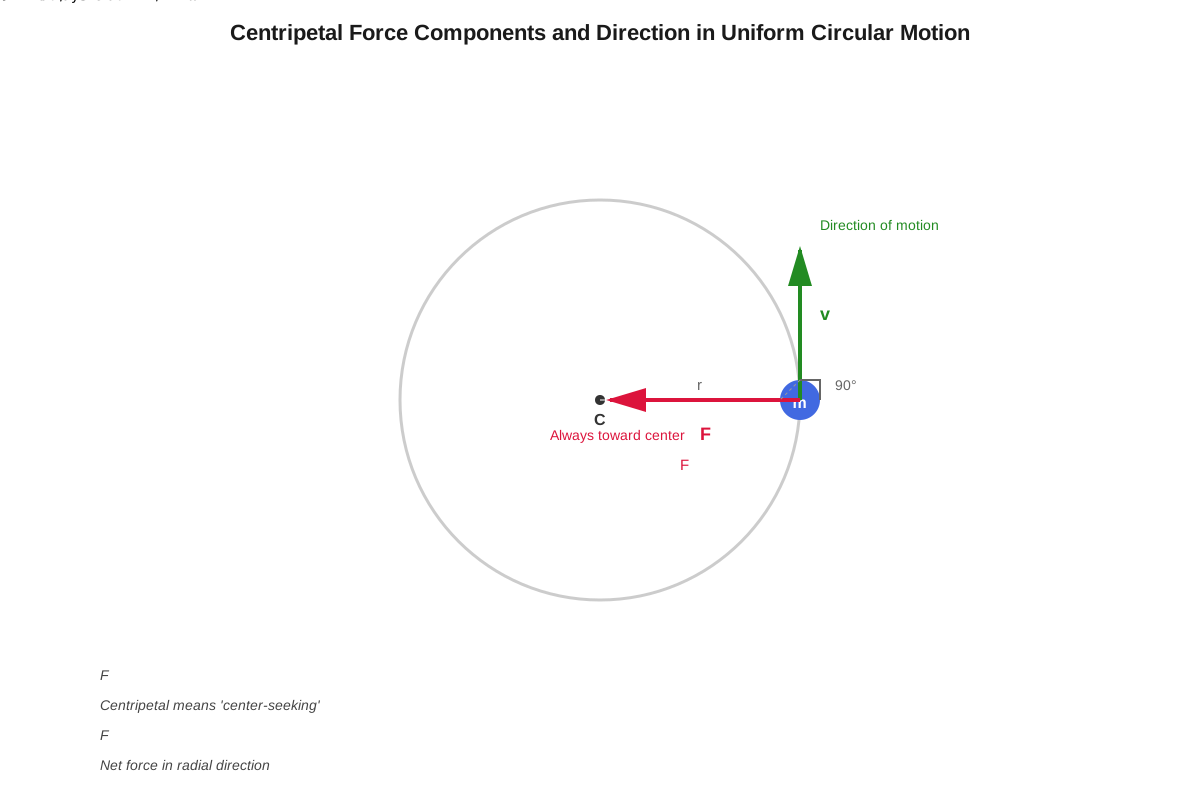
Centripetal force is defined as the net force directed toward the center of curvature that causes an object to follow a circular path. The term "centripetal" derives from Latin words meaning "center-seeking." This force is not a new or separate type of force; rather, it describes the role that one or more real forces play in producing circular motion. Any force—tension, gravity, friction, normal force, or electromagnetic force—can serve as a centripetal force if it acts toward the center of the circular path.
The magnitude of centripetal force required for circular motion is given by:
F_c = ma_c = m(v²/r) = mω²rWhere:
- F_c = centripetal force (N)
- m = mass of the object (kg)
- v = tangential (linear) speed (m/s)
- r = radius of the circular path (m)
- ω = angular velocity (rad/s)
- a_c = centripetal acceleration (m/s²)
This equation represents a requirement, not a separate force. The actual forces present in the situation must sum vectorially to provide this required centripetal force. If the available forces cannot provide sufficient centripetal force, the object will not maintain circular motion and will instead move in a path with a larger radius or depart from the circular path entirely.
Direction and Acceleration in Circular Motion
Centripetal acceleration always points toward the center of the circular path, perpendicular to the instantaneous velocity vector. Even when an object moves at constant speed in a circle (uniform circular motion), it experiences acceleration because velocity is a vector quantity—the direction continuously changes even if the magnitude remains constant. This acceleration does not change the speed of the object; it only changes the direction of motion.
The distinction between tangential and radial components is crucial for MCAT problems:
- Radial (centripetal) component: Points toward the center; changes direction of velocity
- Tangential component: Points along the velocity direction; changes speed magnitude
In uniform circular motion, only centripetal acceleration exists (tangential acceleration equals zero). In non-uniform circular motion, both components exist simultaneously, and the net acceleration is the vector sum of these components.
Sources of Centripetal Force in Common MCAT Scenarios
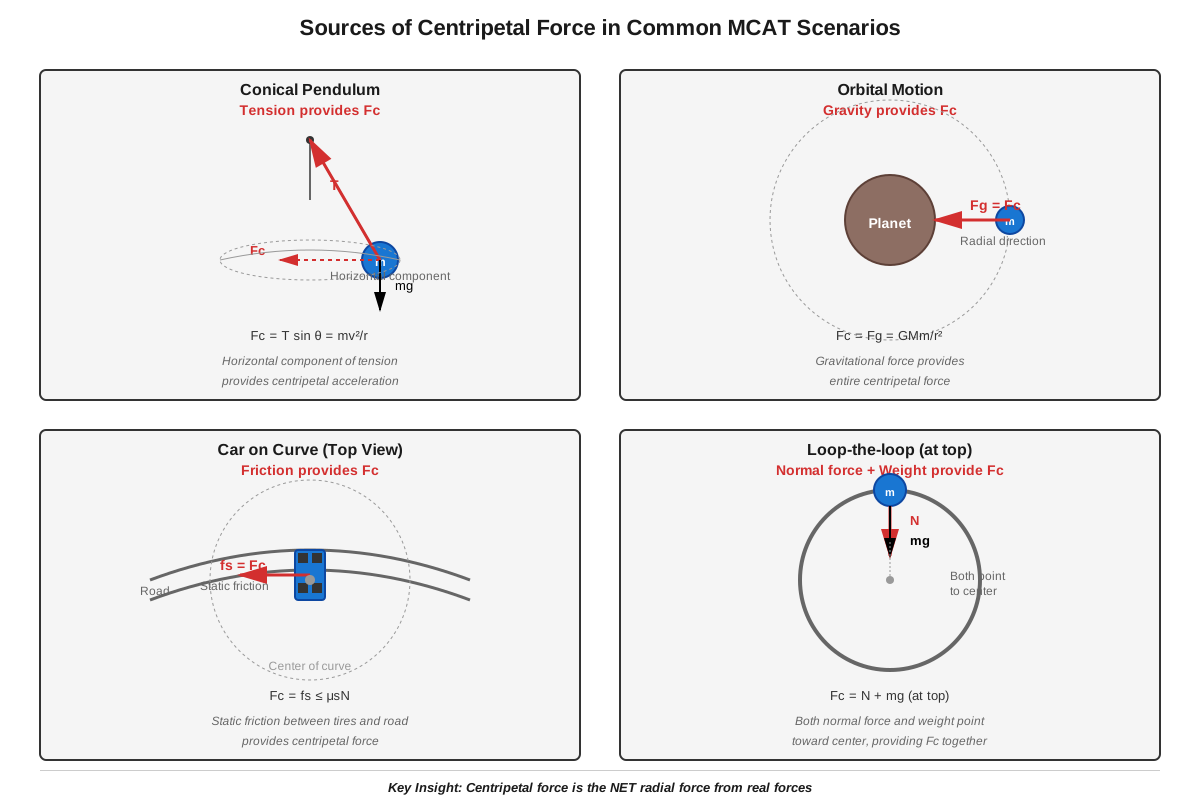
Understanding which forces provide centripetal force in different situations is essential for MCAT success:
| Scenario | Centripetal Force Source | Key Considerations |
|---|---|---|
| Mass on horizontal string | Tension in string | Tension provides entire centripetal force |
| Mass on vertical string (top of circle) | Tension + Weight (both toward center) | Minimum speed needed to maintain tension |
| Mass on vertical string (bottom of circle) | Tension - Weight (net toward center) | Maximum tension occurs here |
| Car on flat curve | Static friction | Maximum speed limited by coefficient of friction |
| Car on banked curve | Horizontal component of normal force (+ friction if needed) | Banking allows higher speeds |
| Satellite in orbit | Gravitational force | Orbital speed determined by radius and gravitational constant |
| Object on rotating platform | Static friction | Object slides off when required F_c exceeds maximum static friction |
Vertical Circular Motion Analysis
Vertical circular motion presents unique challenges because gravitational force affects the centripetal force requirement differently at various points in the circle. Consider a mass on a string moving in a vertical circle:
At the bottom of the circle:
T_bottom - mg = mv²/r
T_bottom = mg + mv²/r
The tension must support the weight AND provide centripetal force, making this the point of maximum tension.
At the top of the circle:
T_top + mg = mv²/r
T_top = mv²/r - mg
Both tension and weight point toward the center (downward). The minimum speed for maintaining circular motion occurs when tension approaches zero:
v_min = √(gr)If the speed falls below this minimum, the string goes slack and the object follows a parabolic projectile path rather than completing the circle.
At the side (horizontal position):
T_side = mv²/rTension provides the entire centripetal force; weight acts tangentially at this point.
Banked Curves and Friction
Banked curves demonstrate how normal force components can provide centripetal force. When a curve is banked at angle θ, the horizontal component of the normal force points toward the center of the curve:
N sin(θ) = mv²/r (horizontal direction)
N cos(θ) = mg (vertical direction)
Dividing these equations yields the ideal banking angle for a given speed:
tan(θ) = v²/(rg)At this ideal speed, no friction is required for circular motion. For speeds above or below this ideal, friction must supplement or oppose the normal force component. The maximum speed on a banked curve with friction involves both the normal force component and maximum static friction:
v_max = √[rg(sin(θ) + μ_s cos(θ))/(cos(θ) - μ_s sin(θ))]Centripetal Force in Orbital Motion
Gravitational force provides the centripetal force for orbital motion. For a satellite of mass m orbiting a planet of mass M at radius r:
F_gravity = F_centripetal
GMm/r² = mv²/r
Simplifying yields the orbital speed:
v = √(GM/r)This relationship shows that orbital speed decreases as orbital radius increases—a counterintuitive result that frequently appears on the MCAT. The period of orbit can be derived from this relationship:
T = 2πr/v = 2π√(r³/GM)This is Kepler's third law, showing that orbital period increases with the 3/2 power of orbital radius.
Centrifugal Force: A Fictitious Force
Centrifugal force is not a real force but rather a fictitious (or pseudo) force that appears to act on objects in a rotating reference frame. From an inertial (non-accelerating) reference frame, an object in circular motion experiences only centripetal force toward the center. However, from the perspective of someone rotating with the object (a non-inertial reference frame), the object appears stationary, and an outward "centrifugal force" seems to balance the inward centripetal force.
The MCAT may test whether students recognize that centrifugal force is not a real force and should not appear in free-body diagrams drawn from an inertial reference frame. In an inertial frame, the object accelerates toward the center due to centripetal force; there is no outward force. The sensation of being "thrown outward" in a turning car results from inertia—the tendency to continue in a straight line—not from an actual outward force.
Concept Relationships
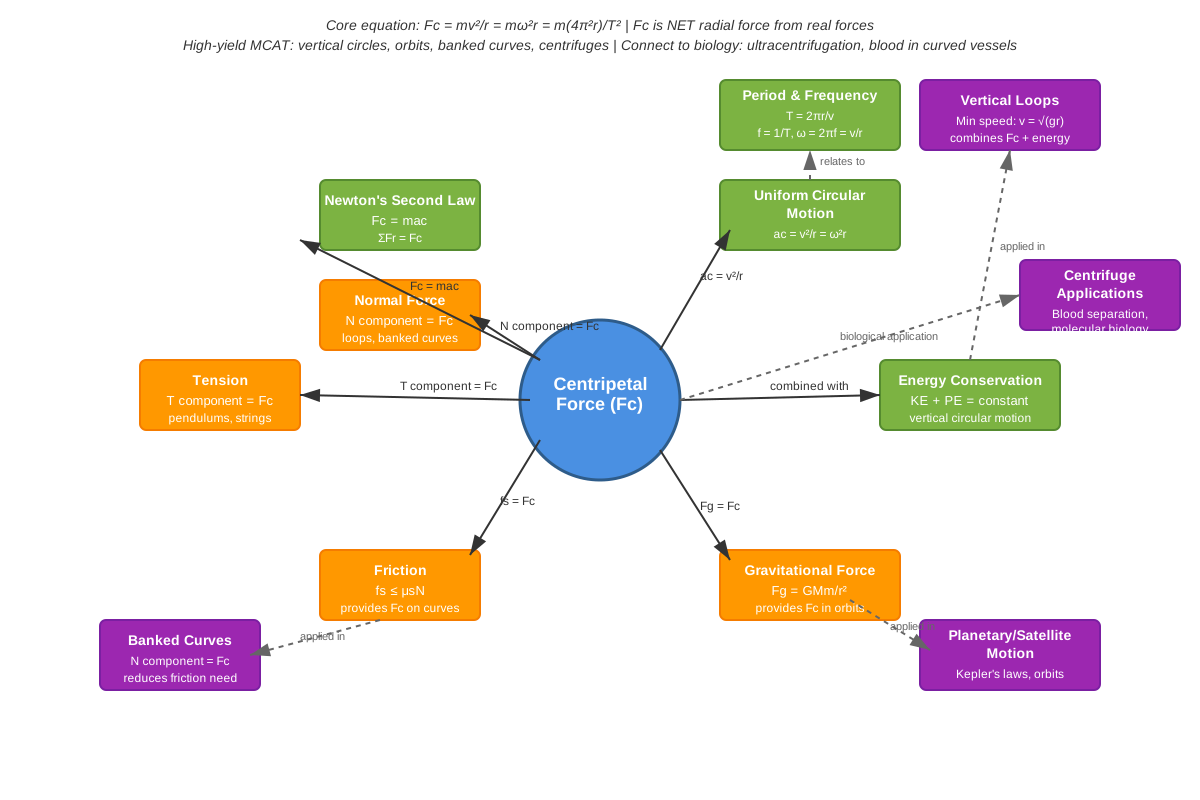
Centripetal force serves as a unifying concept that connects multiple areas of mechanics. The relationship begins with Newton's Second Law (F = ma), which provides the foundation: centripetal force is simply the net force causing centripetal acceleration. This acceleration, in turn, derives from the kinematics of circular motion, specifically the relationship a_c = v²/r, which describes how velocity and radius determine the required acceleration.
The concept map flows as follows:
Circular Motion Kinematics (v, r, ω, a_c) → Newton's Second Law (F_net = ma_c) → Centripetal Force (identification of which real forces provide F_c) → Specific Force Analysis (tension, gravity, friction, normal force) → Application Scenarios (vertical circles, banked curves, orbits)
Centripetal force connects backward to prerequisite topics through free-body diagrams, which are essential for identifying all forces and determining their components in radial and tangential directions. The concept connects forward to energy conservation in problems involving changing speeds in circular paths, to angular momentum in rotational dynamics, and to gravitation in orbital mechanics.
Within the topic itself, the concepts interconnect hierarchically: understanding the fundamental definition and direction of centripetal force enables analysis of specific scenarios (vertical circles, banked curves), which in turn allows application to complex integrated problems. The distinction between centripetal and centrifugal force clarifies reference frame considerations, while the various source forces (tension, friction, gravity, normal force) demonstrate how the same principle applies across diverse physical situations.
High-Yield Facts
⭐ Centripetal force always points toward the center of the circular path and is perpendicular to the instantaneous velocity vector.
⭐ Centripetal force is not a new type of force; it is the net force from real forces (tension, gravity, friction, normal force) that causes circular motion.
⭐ The magnitude of required centripetal force is F_c = mv²/r = mω²r; if available forces cannot provide this, circular motion cannot be maintained.
⭐ At the top of a vertical circle, the minimum speed for maintaining circular motion is v_min = √(gr), which occurs when tension (or normal force) approaches zero.
⭐ For a satellite in circular orbit, gravitational force provides centripetal force: GMm/r² = mv²/r, yielding orbital speed v = √(GM/r).
- In uniform circular motion, speed is constant but velocity continuously changes direction, requiring centripetal acceleration even with zero tangential acceleration.
- Maximum tension in vertical circular motion occurs at the bottom of the circle: T_bottom = mg + mv²/r.
- On a flat curve, maximum speed is limited by static friction: v_max = √(μ_s gr).
- The ideal banking angle for a curve at speed v is given by tan(θ) = v²/(rg), requiring no friction at this specific speed.
- Centrifugal force is a fictitious force appearing only in rotating (non-inertial) reference frames and should not appear in free-body diagrams drawn from inertial frames.
- Orbital speed decreases as orbital radius increases: v ∝ 1/√r.
- The period of circular motion is T = 2πr/v = 2π√(r/a_c).
- When an object moves faster than the speed required for circular motion at a given radius, it will move outward to a larger radius; when moving slower, it will move inward.
Quick check — test yourself on Centripetal force so far.
Try Flashcards →Common Misconceptions
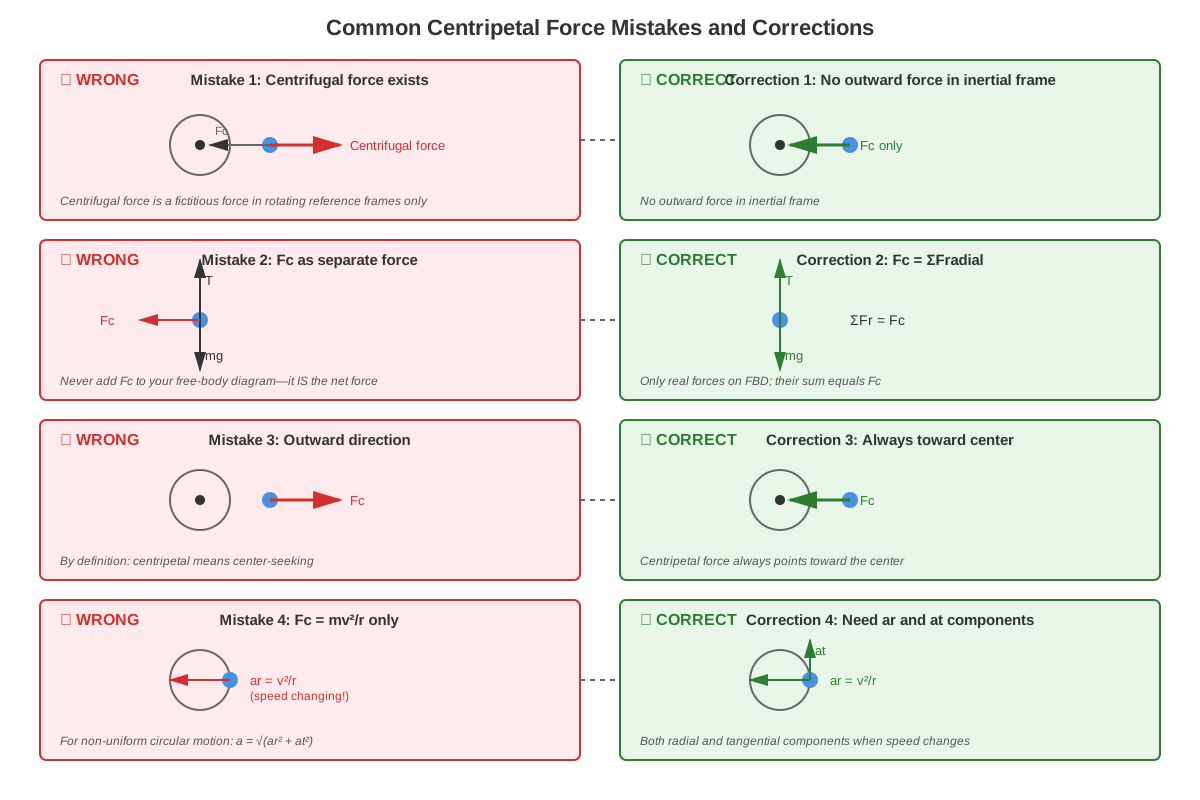
Misconception: Centripetal force is a specific type of force like gravity or friction.
Correction: Centripetal force is not a separate force type but rather describes the role that real forces play. Any force or combination of forces directed toward the center of curvature serves as the centripetal force. On free-body diagrams, label the actual forces (tension, friction, etc.), not "centripetal force."
Misconception: Objects in circular motion experience an outward centrifugal force that balances the inward centripetal force.
Correction: From an inertial reference frame, no outward force acts on the object. The object accelerates toward the center due to centripetal force. Centrifugal force is a fictitious force that appears only in rotating reference frames and represents the inertia of the object resisting the change in direction.
Misconception: Centripetal acceleration only occurs when an object is speeding up or slowing down.
Correction: Centripetal acceleration occurs whenever an object follows a curved path, even at constant speed. This acceleration changes the direction of velocity, not its magnitude. Tangential acceleration (which changes speed) is a separate component that may or may not be present.
Misconception: At the top of a vertical circle, tension and weight oppose each other.
Correction: At the top of a vertical circle, both tension and weight point downward (toward the center), so they add together to provide the required centripetal force: T + mg = mv²/r. This is why minimum speed occurs at the top—tension can reduce to zero while gravity still contributes to centripetal force.
Misconception: Faster satellites orbit at larger radii than slower satellites.
Correction: The opposite is true. Orbital speed v = √(GM/r) shows that speed decreases as radius increases. Satellites in low Earth orbit move faster than those in higher orbits. This counterintuitive relationship results from the balance between gravitational force and centripetal force requirements.
Misconception: Banking a curve eliminates the need for any force to provide centripetal acceleration.
Correction: Banking a curve changes which force provides centripetal acceleration (from friction to the horizontal component of normal force) but does not eliminate the need for centripetal force. The horizontal component of the normal force on a banked curve provides the centripetal force at the ideal speed.
Misconception: The formula F_c = mv²/r can be used to calculate a force to add to free-body diagrams.
Correction: The formula F_c = mv²/r represents the required net force toward the center, not an additional force. First, identify all real forces on the object, then set their net radial component equal to mv²/r to solve for unknowns.
Worked Examples
Example 1: Vertical Circular Motion with Minimum Speed
Problem: A 0.50 kg ball is attached to a 1.2 m string and swung in a vertical circle. (a) What is the minimum speed the ball can have at the top of the circle while maintaining circular motion? (b) What is the tension in the string at the bottom of the circle if the ball moves at twice the minimum speed throughout its path?
Solution:
Part (a): Minimum speed at the top
At the top of the circle, both tension and weight point downward (toward the center). The minimum speed occurs when tension approaches zero, leaving only gravity to provide centripetal force:
T + mg = mv²/rAt minimum speed, T = 0:
mg = mv²_min/r
v²_min = gr
v_min = √(gr) = √(9.8 m/s² × 1.2 m) = √11.76 = 3.43 m/sAnswer: The minimum speed at the top is 3.43 m/s.
Part (b): Tension at the bottom
If the ball moves at twice the minimum speed: v = 2 × 3.43 m/s = 6.86 m/s
At the bottom of the circle, tension points upward (toward center) and weight points downward (away from center):
T_bottom - mg = mv²/r
T_bottom = mg + mv²/r
T_bottom = (0.50 kg)(9.8 m/s²) + (0.50 kg)(6.86 m/s)²/(1.2 m)
T_bottom = 4.9 N + (0.50)(47.06)/(1.2)
T_bottom = 4.9 N + 19.6 N = 24.5 NAnswer: The tension at the bottom is 24.5 N.
Key Concepts Applied: This problem demonstrates the critical distinction between forces at different points in vertical circular motion. At the top, tension and gravity both contribute to centripetal force (they add), while at the bottom, they oppose each other (tension must overcome gravity and provide centripetal force). The minimum speed concept appears frequently on the MCAT and requires understanding that tension cannot be negative—when it would become negative, the string goes slack.
Example 2: Banked Curve with Friction
Problem: A highway curve with radius 80 m is banked at an angle of 15° to allow cars to navigate the curve safely. (a) What is the ideal speed for this banked curve (the speed at which no friction is required)? (b) If the coefficient of static friction between tires and road is 0.60, what is the maximum speed a car can travel around this curve without sliding?
Solution:
Part (a): Ideal speed without friction
At the ideal speed, the horizontal component of the normal force provides exactly the required centripetal force:
N sin(θ) = mv²/r (horizontal)
N cos(θ) = mg (vertical)
Dividing these equations:
tan(θ) = v²/(rg)
v = √(rg tan(θ))
v = √(80 m × 9.8 m/s² × tan(15°))
v = √(784 × 0.268) = √210 = 14.5 m/sAnswer: The ideal speed is 14.5 m/s (about 32 mph).
Part (b): Maximum speed with friction
At maximum speed, static friction acts down the incline (toward the center) to supplement the normal force component:
In the radial direction (toward center):
N sin(θ) + f cos(θ) = mv²_max/rIn the vertical direction:
N cos(θ) - f sin(θ) = mgWith f = μ_s N:
N sin(θ) + μ_s N cos(θ) = mv²_max/r
N cos(θ) - μ_s N sin(θ) = mg
Dividing these equations:
[sin(θ) + μ_s cos(θ)]/[cos(θ) - μ_s sin(θ)] = v²_max/(rg)
v_max = √{rg[sin(θ) + μ_s cos(θ)]/[cos(θ) - μ_s sin(θ)]}
v_max = √{(80)(9.8)[sin(15°) + 0.60 cos(15°)]/[cos(15°) - 0.60 sin(15°)]}
v_max = √{784[0.259 + 0.579]/[0.966 - 0.155]}
v_max = √{784 × 0.838/0.811} = √{811} = 28.5 m/sAnswer: The maximum speed is 28.5 m/s (about 64 mph).
Key Concepts Applied: This problem illustrates how banking converts normal force into a source of centripetal force, reducing dependence on friction. The ideal banking angle depends on the design speed of the curve. At speeds above the ideal, friction must act down the slope (toward the center) to prevent sliding outward; at speeds below ideal, friction would act up the slope to prevent sliding inward. The MCAT frequently tests whether students can identify the direction friction acts in various scenarios.
Exam Strategy
When approaching MCAT questions on centripetal force, begin by identifying the geometry of the circular motion: Is it horizontal or vertical? Is the object at a specific point in the circle (top, bottom, side) or is the question asking about the entire path? This initial assessment determines which forces contribute to centripetal force and how they combine.
Trigger words and phrases that signal centripetal force problems include:
- "Circular path," "circular motion," "moves in a circle"
- "Banked curve," "rounding a curve"
- "Vertical loop," "loop-the-loop"
- "Satellite orbit," "planetary motion"
- "Centrifuge," "rotating platform"
- "Minimum speed," "maximum speed"
- "String goes slack," "loses contact"
Systematic approach for problem-solving:
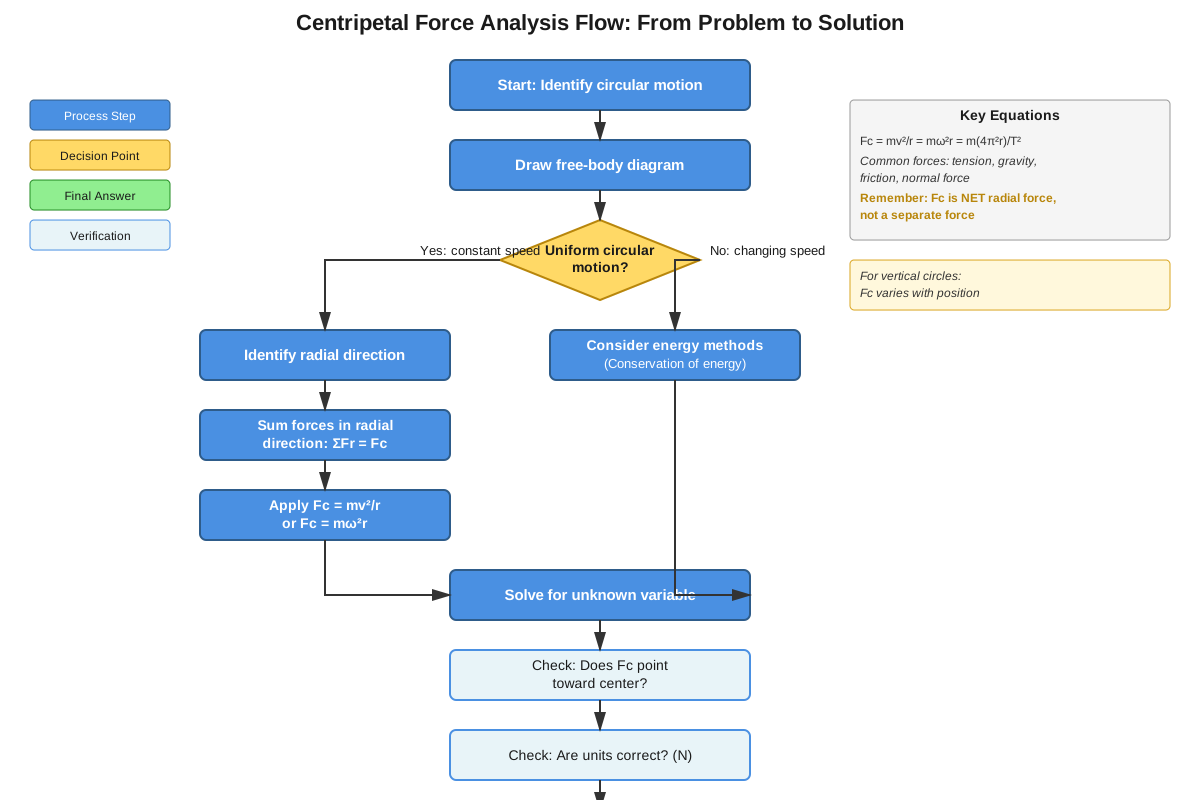
- Draw a clear diagram showing the circular path, the object's position, and the center of the circle
- Identify all real forces acting on the object (never include "centripetal force" as a separate force)
- Draw a free-body diagram with forces in their actual directions
- Choose a coordinate system with one axis pointing toward the center (radial direction)
- Resolve forces into radial (centripetal) and tangential components
- Apply Newton's Second Law in the radial direction: ΣF_radial = mv²/r
- Apply Newton's Second Law in the tangential direction if needed: ΣF_tangential = ma_tangential
- Solve for the unknown using algebra and given values
Process-of-elimination strategies:
- Eliminate answer choices that include "centrifugal force" as a real force acting on the object (unless the question specifically asks about non-inertial reference frames)
- For minimum speed questions in vertical circles, eliminate answers that don't involve √(gr) or similar square root relationships
- For orbital motion, eliminate answers showing speed increasing with radius (the opposite is true)
- For banked curve problems, eliminate answers that don't involve the banking angle when asking for ideal speed
- Check units: centripetal force should have units of Newtons (kg⋅m/s²), and speed should have units of m/s
Time allocation: Discrete centripetal force questions typically require 60-90 seconds. Passage-based questions may require 90-120 seconds, especially if they involve multiple steps or integration with other concepts. If a problem requires extensive calculation, consider whether estimation or conceptual reasoning can eliminate wrong answers more quickly. The MCAT rewards efficient problem-solving, so practice identifying when full calculation is necessary versus when conceptual understanding suffices.
Memory Techniques
Mnemonic for forces at the top of a vertical circle: "Top Together" — At the Top of a vertical circle, Tension and weight point Together (both toward center, both downward), so they add: T + mg = mv²/r.
Mnemonic for forces at the bottom of a vertical circle: "Bottom Battle" — At the Bottom, tension and weight Battle (oppose each other), so tension must overcome weight: T - mg = mv²/r.
Visualization for centripetal vs. centrifugal: Imagine sitting in a car turning left. From outside the car (inertial frame), you see the car door pushing you leftward (toward the center)—this is the real centripetal force. From inside the car (rotating frame), you feel pushed rightward against the door—this is the fictitious centrifugal "force," which is actually your inertia resisting the change in direction. Remember: Centripetal is Center-seeking and Correct; Centrifugal is Fictitious.
Acronym for orbital motion relationships: "RSVP" — Radius increases, Speed decreases, Velocity formula is v = √(GM/r), Period increases with r^(3/2). This reminds you that larger orbits mean slower speeds and longer periods.
Memory aid for banking angle formula: "TANgent of angle equals Velocity squared over RG" — tan(θ) = v²/(rg). The word "tangent" contains "tan," and "RG" sounds like "are-gee" (rg).
Visualization for minimum speed: Picture a ball on a string at the top of a vertical circle. As speed decreases, tension decreases. At minimum speed, the string barely remains taut (T ≈ 0), and only gravity provides centripetal force. Below this speed, the string goes slack and the ball falls. This mental image helps remember that v_min = √(gr) at the top of a vertical circle.
Summary
Centripetal force represents the net force directed toward the center of curvature that causes an object to follow a circular path. This force is not a new type of force but rather describes the role that real forces—tension, gravity, friction, normal force, or combinations thereof—play in producing circular motion. The magnitude of required centripetal force is F_c = mv²/r = mω²r, and if the available forces cannot provide this net force, the object cannot maintain circular motion. In vertical circular motion, the minimum speed at the top occurs when tension approaches zero, yielding v_min = √(gr), while maximum tension occurs at the bottom where tension must overcome gravity and provide centripetal force. Banked curves utilize the horizontal component of normal force to provide centripetal force, with the ideal banking angle given by tan(θ) = v²/(rg). In orbital motion, gravitational force provides the centripetal force, resulting in orbital speed v = √(GM/r), which decreases as orbital radius increases. Centrifugal force is a fictitious force appearing only in rotating reference frames and should not be included in free-body diagrams drawn from inertial frames. Mastery of centripetal force requires both conceptual understanding of which forces provide the center-seeking acceleration and quantitative problem-solving skills to calculate speeds, forces, and angles in various scenarios.
Key Takeaways
- Centripetal force is the net force toward the center of a circular path, provided by real forces (tension, gravity, friction, normal force), not a separate force type
- The required centripetal force magnitude is F_c = mv²/r; if available forces cannot provide this, circular motion cannot be maintained
- At the top of a vertical circle, tension and weight both point toward the center (add together), and minimum speed is v_min = √(gr)
- At the bottom of a vertical circle, tension points toward the center while weight points away (they oppose), creating maximum tension: T = mg + mv²/r
- For orbital motion, gravitational force provides centripetal force, yielding v = √(GM/r), meaning orbital speed decreases as radius increases
- Banked curves use the horizontal component of normal force for centripetal force, with ideal angle tan(θ) = v²/(rg)
- Centrifugal force is fictitious, appearing only in rotating reference frames; from inertial frames, only centripetal force acts on objects in circular motion
Related Topics
Uniform Circular Motion Kinematics: Explores the relationships between angular velocity (ω), tangential velocity (v), period (T), frequency (f), and centripetal acceleration (a_c = v²/r = ω²r). Mastering centripetal force enables deeper understanding of how these kinematic quantities relate to the forces causing circular motion.
Rotational Dynamics and Torque: Extends circular motion concepts to rotating rigid bodies, introducing moment of inertia, angular momentum, and rotational kinetic energy. Understanding centripetal force provides the foundation for analyzing forces in rotating systems.
Gravitation and Kepler's Laws: Applies centripetal force principles to planetary and satellite motion, deriving orbital speeds, periods, and energies. The gravitational force as centripetal force connection is essential for understanding celestial mechanics.
Energy Conservation in Circular Motion: Combines centripetal force with work-energy principles to solve problems involving changing speeds in circular paths, such as roller coasters or pendulums. Understanding when and how to apply energy methods versus force methods is crucial for efficient problem-solving.
Friction and Normal Forces: Deepens understanding of how these forces provide centripetal force in scenarios like cars on curves or objects on rotating platforms. Mastery of centripetal force clarifies when static versus kinetic friction applies and how normal force varies in different orientations.
Practice CTA
Now that you've mastered the core concepts of centripetal force, it's time to solidify your understanding through active practice. Attempt the practice questions and flashcards associated with this topic to test your ability to identify centripetal force sources, calculate required forces and speeds, and analyze complex scenarios involving vertical circles, banked curves, and orbital motion. Remember that MCAT success comes not just from understanding concepts but from applying them efficiently under timed conditions. Each practice problem you work through builds the pattern recognition and problem-solving speed essential for test day. You've built a strong foundation—now strengthen it through deliberate practice. Your future high score depends on the work you put in today!
Sign up free to keep reading
Create a free AnvayaPrep account to finish this MCAT guide on Centripetal force — plus flashcards and practice questions.