Overview
Impulse is a fundamental concept in mechanics that bridges the gap between force, time, and momentum. In Physics, impulse represents the change in momentum of an object when a force acts upon it over a specific time interval. This concept is essential for understanding collisions, safety mechanisms, and any scenario where forces act over time to change an object's motion. The mathematical relationship between impulse and momentum provides one of the most powerful problem-solving tools in mechanics, allowing students to analyze complex interactions without needing to know every detail of the forces involved.
For the MCAT, impulse appears regularly in both passage-based and discrete questions within the Chemical and Physical Foundations of Biological Systems section. Understanding impulse is crucial because it connects multiple high-yield topics including Newton's laws, conservation of momentum, work-energy relationships, and force analysis. The MCAT frequently tests impulse in contexts such as biomechanical scenarios (joint impacts, muscle forces), collision problems, and safety device analysis (airbags, helmets, padding). Questions often require students to recognize when impulse provides a more efficient solution path than force analysis alone.
The beauty of impulse lies in its practical applications and its role as a conceptual bridge. While force tells us about instantaneous interactions, impulse captures the cumulative effect of forces over time. This makes it particularly valuable for analyzing real-world scenarios where forces vary or where we care more about the overall change in motion than the instantaneous details. Mastering impulse enables students to tackle momentum problems more efficiently and provides essential preparation for understanding more advanced topics in dynamics and energy transfer.
Learning Objectives
- [ ] Define Impulse using accurate Physics terminology
- [ ] Explain why Impulse matters for the MCAT
- [ ] Apply Impulse to exam-style questions
- [ ] Identify common mistakes related to Impulse
- [ ] Connect Impulse to related Physics concepts
- [ ] Calculate impulse from force-time graphs using area analysis
- [ ] Distinguish between average force and instantaneous force in impulse scenarios
- [ ] Predict the effects of changing collision time on force magnitude in real-world applications
Prerequisites
- Newton's Laws of Motion: Essential for understanding how forces create changes in motion and why impulse relates to momentum changes
- Vectors and Vector Addition: Required because impulse and momentum are vector quantities with both magnitude and direction
- Kinematics: Necessary for understanding velocity changes and relating them to momentum
- Basic Calculus Concepts: Helpful for understanding impulse as the integral of force over time, though not required for MCAT-level problems
- Units and Dimensional Analysis: Critical for working with impulse units (N·s or kg·m/s) and checking answer reasonableness
Why This Topic Matters
Clinical and Real-World Significance
Impulse principles underlie numerous medical and safety applications that appear in MCAT passages. Orthopedic medicine relies on impulse concepts when analyzing joint impacts and designing protective equipment. When a person lands from a jump, bending the knees increases the collision time, reducing the peak force on joints—a direct application of impulse-momentum relationships. Similarly, car safety features like airbags, crumple zones, and seatbelts all function by extending collision time to reduce peak forces on the human body. Understanding impulse helps explain why a boxer rolls with a punch, why padding protects athletes, and how falling technique can prevent injuries.
MCAT Exam Statistics
Impulse appears in approximately 2-4 questions per MCAT exam, either as the primary concept or integrated with momentum conservation problems. Questions typically fall into three categories: quantitative calculations requiring the impulse-momentum theorem (40%), conceptual questions about force-time relationships (35%), and passage-based applications in biological or safety contexts (25%). The MCAT particularly favors questions that combine impulse with graphical analysis, asking students to interpret force-time graphs or compare scenarios with different collision times.
Common Exam Contexts
MCAT passages frequently present impulse in biomechanical scenarios such as analyzing forces during gait, impact forces in sports injuries, or the effectiveness of protective equipment. Discrete questions often involve collision problems, projectile impacts, or comparing different methods of stopping moving objects. The exam may present force-time graphs and ask students to calculate impulse from the area under the curve, or provide scenarios where students must determine how changing collision time affects peak forces. Questions commonly require students to recognize that the same momentum change can result from different force-time combinations.
Core Concepts
Definition and Mathematical Formulation
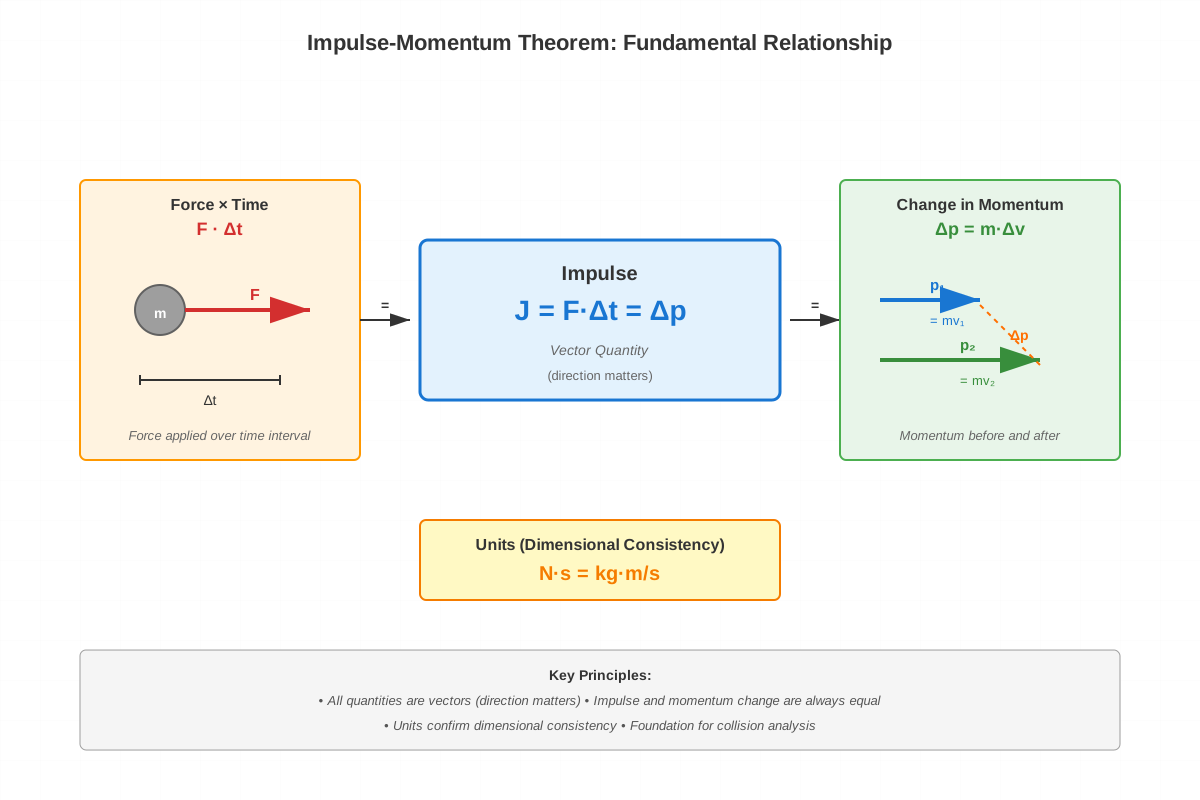
Impulse (represented by the symbol J) is defined as the product of force and the time interval over which that force acts. Mathematically, for a constant force:
J = F·ΔtWhere:
- J = impulse (units: N·s or kg·m/s)
- F = force (units: N)
- Δt = time interval (units: s)
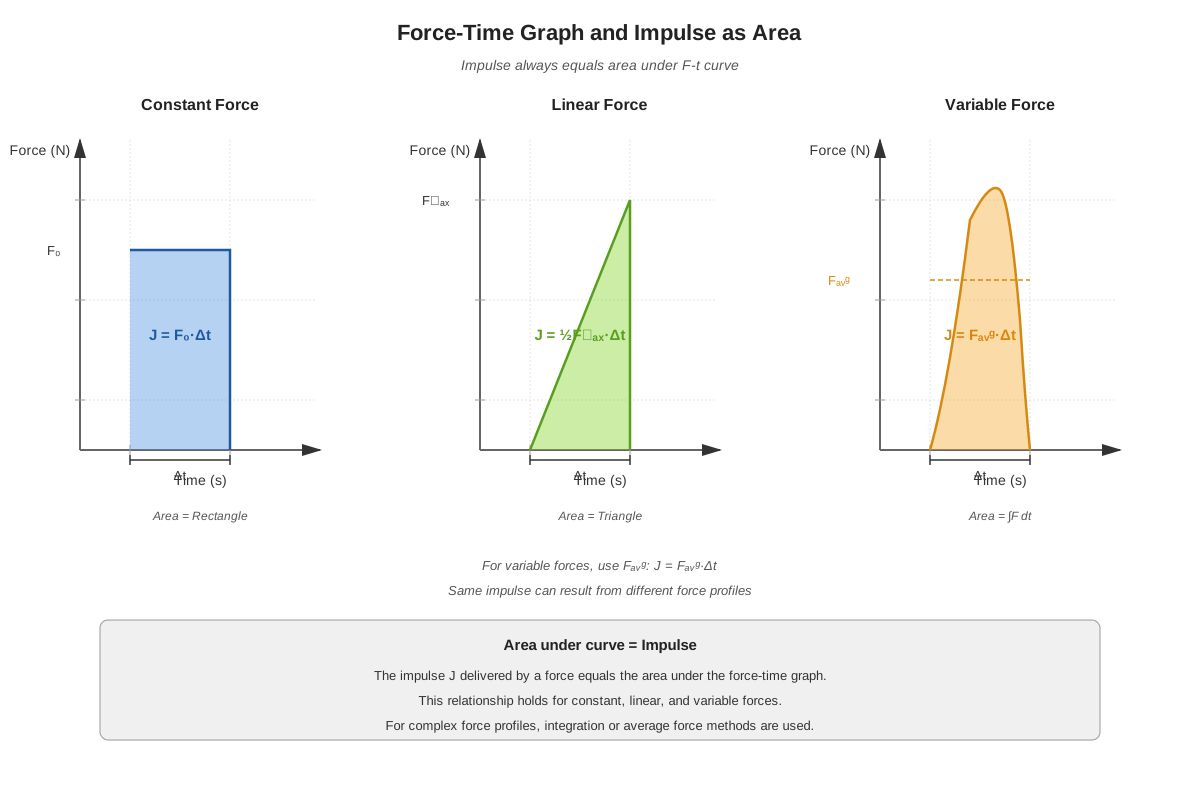
For variable forces, impulse is the integral of force with respect to time:
J = ∫F dtThis integral represents the area under a force-time graph, making graphical analysis a powerful tool for impulse problems. The vector nature of impulse means it has both magnitude and direction, determined by the direction of the net force.
The Impulse-Momentum Theorem
The impulse-momentum theorem establishes the fundamental relationship between impulse and momentum change. This theorem states that the impulse applied to an object equals the change in that object's momentum:
J = Δp = m·Δv = m(v_f - v_i)Where:
- Δp = change in momentum
- m = mass
- v_f = final velocity
- v_i = initial velocity
This relationship derives directly from Newton's second law. Since F = ma and a = Δv/Δt, we can write:
F = m(Δv/Δt)
F·Δt = m·Δv
J = Δp
This theorem is extraordinarily powerful because it allows us to solve problems involving forces and motion without knowing the detailed time-variation of forces. We only need to know the overall change in momentum.
Average Force vs. Instantaneous Force
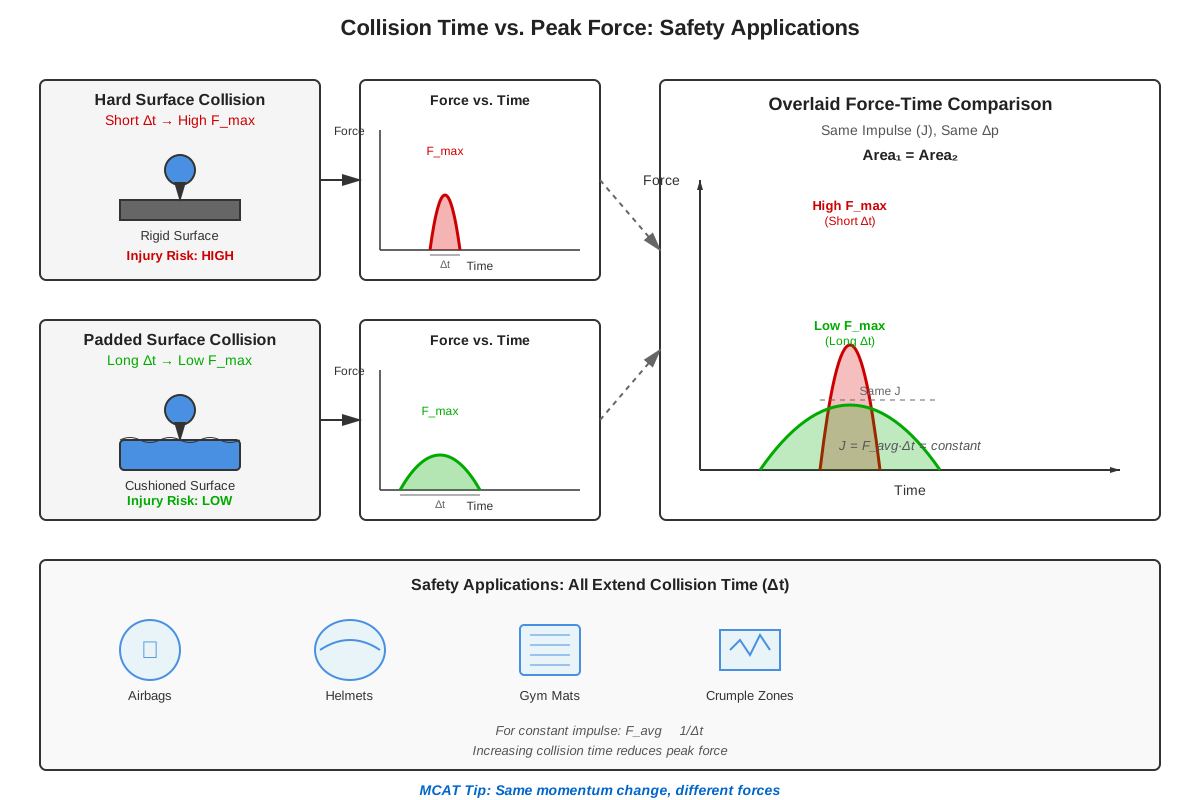
In most real-world collisions, forces vary throughout the interaction. A collision typically involves forces that start at zero, rise to a maximum, then return to zero. The impulse-momentum theorem allows us to work with an average force (F_avg) that would produce the same impulse:
J = F_avg·Δt = ΔpTherefore:
F_avg = Δp/ΔtThis relationship reveals a crucial insight: for a given momentum change, the average force is inversely proportional to the collision time. Doubling the collision time halves the average force. This principle explains why safety devices work—they extend collision time to reduce forces.
Force-Time Graphs and Impulse
When force varies with time, graphical analysis becomes essential. On a force-time graph:
- The area under the curve equals the impulse
- The height represents force magnitude
- The width represents time duration
- Rectangular areas (constant force) are calculated as F·Δt
- Triangular areas (linearly varying force) are calculated as (1/2)·F_max·Δt
- Complex shapes may require integration or geometric decomposition
Exam Tip: MCAT questions frequently present force-time graphs. Always remember that impulse equals area, regardless of the shape of the curve.
Direction and Vector Nature
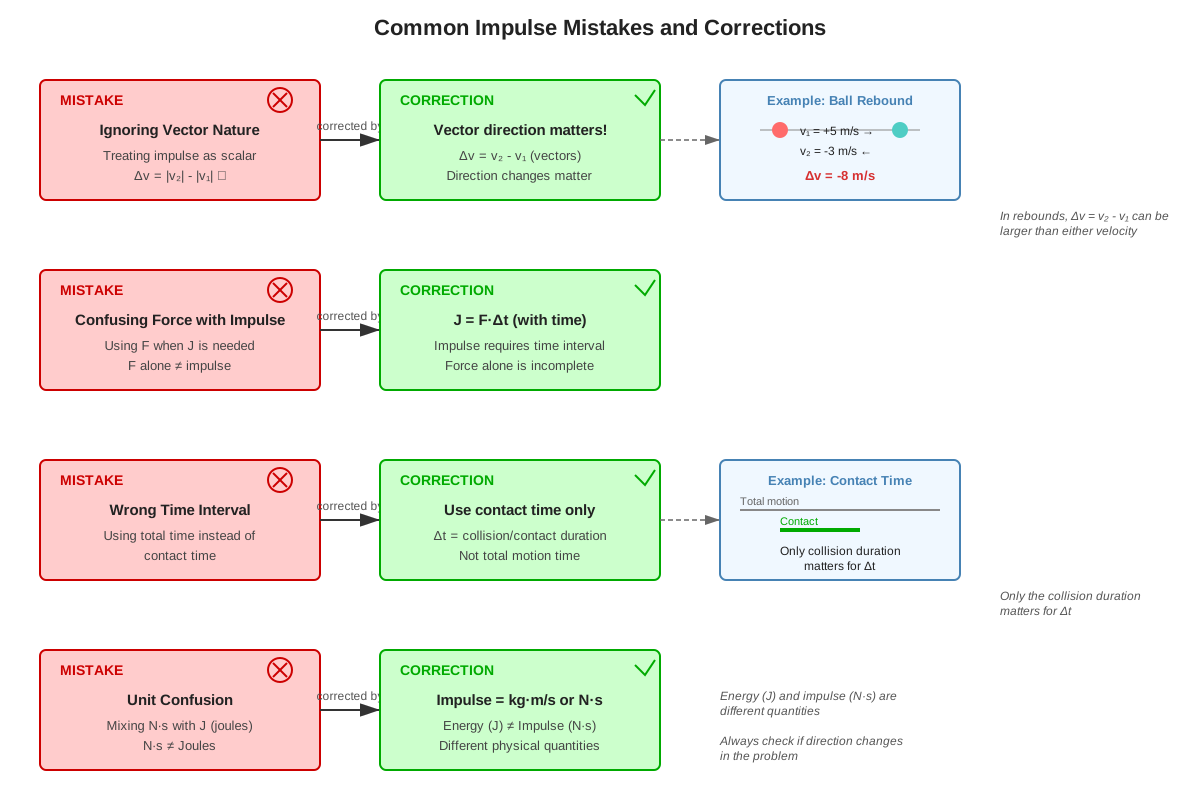
Impulse is a vector quantity, meaning direction matters. When solving impulse problems:
- Establish a coordinate system (typically positive direction is the initial direction of motion)
- Assign positive or negative signs to forces and velocities based on direction
- Calculate impulse components separately for multi-dimensional problems
- Remember that opposite forces produce opposite impulses
For example, if a ball moving at +5 m/s bounces back at -3 m/s, the velocity change is Δv = (-3) - (+5) = -8 m/s, indicating the impulse was in the negative direction.
Impulse in Collisions
Collisions provide the most common application of impulse concepts. During any collision:
- Both objects experience equal and opposite impulses (Newton's third law)
- The total momentum of the system is conserved (if no external forces)
- Individual object momentum changes equal the impulse each receives
- Collision time is the same for both objects
| Collision Type | Characteristics | Impulse Considerations |
|---|---|---|
| Elastic | Kinetic energy conserved | Maximum velocity change, maximum impulse magnitude |
| Inelastic | Kinetic energy lost | Reduced velocity change compared to elastic |
| Perfectly Inelastic | Objects stick together | Minimum velocity change for given masses |
Time Extension and Force Reduction
The inverse relationship between collision time and average force has profound practical implications:
Scenario 1: Catching a ball with stiff arms
- Short collision time (Δt small)
- Large average force (F_avg large)
- Painful, potential for injury
Scenario 2: Catching a ball while pulling hands back
- Extended collision time (Δt large)
- Reduced average force (F_avg small)
- Comfortable, safe
The momentum change (impulse) is identical in both cases—only the force-time distribution differs. This principle applies to:
- Airbags extending collision time in car crashes
- Gymnastic mats increasing landing time
- Bending knees when landing from heights
- Padding in helmets and protective gear
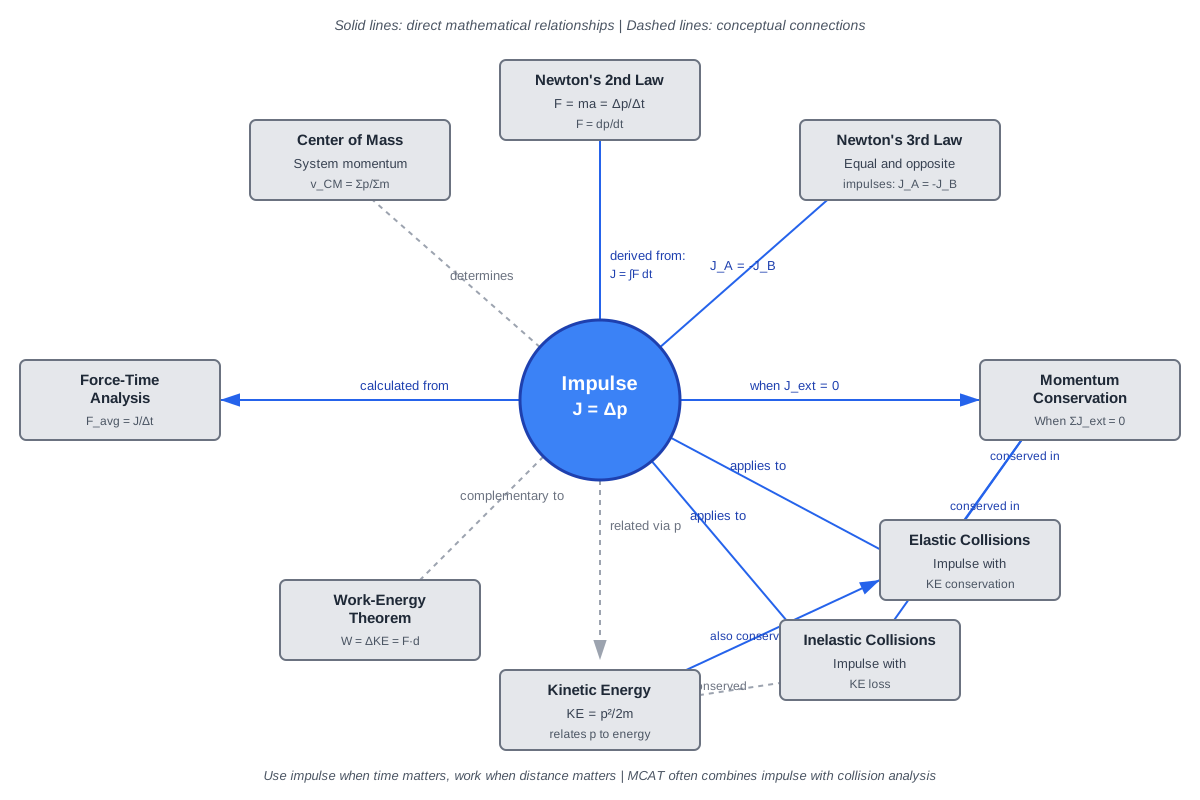
Concept Relationships
The concept of impulse sits at the intersection of several fundamental physics principles, serving as a bridge between force analysis and momentum considerations. Newton's Second Law (F = ma) provides the foundation from which impulse derives, as impulse represents the time-integrated effect of force. This leads directly to the impulse-momentum theorem, which connects impulse to momentum change.
The relationship flows as follows:
Newton's Second Law → Force over time → Impulse → Momentum Change → Conservation of Momentum
Impulse also connects to work and energy concepts, though the relationship is more subtle. While work involves force acting over a distance (W = F·d), impulse involves force acting over time (J = F·Δt). Both describe the effect of forces, but from different perspectives—spatial vs. temporal.
In collision problems, impulse analysis often provides a more efficient solution path than force analysis because:
- We can calculate momentum changes from velocities alone
- We don't need to know how forces vary during collision
- The impulse-momentum theorem gives us the average force directly
The connection to kinematics appears through velocity changes: Δp = m·Δv. This links impulse problems to motion analysis, allowing students to work backward from velocity changes to determine forces or forward from forces to predict motion changes.
For systems of multiple objects, impulse on individual objects relates to conservation of momentum for the system. Internal forces between objects create equal and opposite impulses (Newton's third law), which cancel when considering total system momentum. External impulses, however, change the total system momentum.
Quick check — test yourself on Impulse so far.
Try Flashcards →High-Yield Facts
⭐ Impulse equals the change in momentum: J = Δp = m(v_f - v_i), making it possible to solve collision problems without detailed force information
⭐ Impulse is the area under a force-time graph: This graphical interpretation appears frequently on the MCAT and provides a quick calculation method
⭐ Average force is inversely proportional to collision time: F_avg = Δp/Δt, explaining why extending collision time reduces forces in safety applications
⭐ Impulse is a vector quantity: Direction matters, and sign conventions must be carefully maintained throughout calculations
⭐ Equal and opposite impulses act on colliding objects: Newton's third law ensures that action-reaction pairs create equal magnitude, opposite direction impulses
- Impulse has units of N·s or kg·m/s, which are dimensionally equivalent
- For the same momentum change, a longer collision time always results in a smaller average force
- In elastic collisions, the impulse magnitude is greater than in inelastic collisions between the same objects at the same initial velocities
- The impulse delivered by gravity on a projectile during its flight equals m·g·Δt, pointing downward
- When an object bounces back, the impulse magnitude is greater than when it sticks because the velocity change is larger
- Impulse can be calculated even when force varies in complex ways, as long as the momentum change is known
- The center of mass of a system moves according to the net external impulse divided by total mass
Common Misconceptions
Misconception: Impulse and momentum are the same thing.
Correction: Impulse is the change in momentum, not momentum itself. Impulse (J = F·Δt) is what causes momentum to change. An object can have momentum while experiencing zero impulse if no net force acts on it.
Misconception: A larger force always produces a larger impulse.
Correction: Impulse depends on both force and time (J = F·Δt). A small force acting over a long time can produce the same impulse as a large force acting briefly. This is why a gentle push over several seconds can change an object's momentum as much as a sharp hit.
Misconception: Impulse only applies to collisions.
Correction: While collisions are common applications, impulse applies whenever a force acts over time. Rocket thrust, gravitational effects during projectile motion, and sustained pushes all involve impulse. Any force-time interaction can be analyzed using impulse concepts.
Misconception: In a collision, the heavier object experiences less impulse.
Correction: Both objects in a collision experience equal magnitude impulses (Newton's third law), regardless of their masses. The lighter object experiences a greater velocity change because Δv = J/m, but the impulse magnitude is identical for both objects.
Misconception: Extending collision time increases the impulse.
Correction: For a given momentum change, the impulse magnitude remains constant regardless of collision time (J = Δp). Extending collision time reduces the average force (F_avg = J/Δt), not the impulse. The same impulse is delivered more gently over a longer time.
Misconception: Impulse is always positive.
Correction: As a vector quantity, impulse can be positive or negative depending on the chosen coordinate system and force direction. A force opposing motion produces negative impulse (in the chosen positive direction), while a force in the direction of motion produces positive impulse.
Misconception: The area under a velocity-time graph gives impulse.
Correction: The area under a velocity-time graph gives displacement, not impulse. Impulse is the area under a force-time graph. Students often confuse these graphical relationships, but remembering that impulse involves force (not velocity) helps avoid this error.
Worked Examples
Example 1: Airbag Safety Analysis
Problem: A 70 kg driver traveling at 25 m/s is brought to rest by an airbag. If the airbag extends the collision time to 0.15 s, what average force does the driver experience? Compare this to a collision without an airbag where the collision time is only 0.01 s.
Solution:
Step 1: Identify the momentum change
- Initial velocity: v_i = 25 m/s
- Final velocity: v_f = 0 m/s
- Mass: m = 70 kg
- Δp = m(v_f - v_i) = 70(0 - 25) = -1,750 kg·m/s
The negative sign indicates the impulse opposes the initial motion direction.
Step 2: Calculate impulse magnitude
- |J| = |Δp| = 1,750 N·s
Step 3: Calculate average force with airbag
- Δt = 0.15 s
- F_avg = J/Δt = 1,750/0.15 = 11,667 N ≈ 11,700 N
Step 4: Calculate average force without airbag
- Δt = 0.01 s
- F_avg = J/Δt = 1,750/0.01 = 175,000 N
Step 5: Compare the forces
- Force ratio = 175,000/11,667 = 15
- The airbag reduces the average force by a factor of 15
Key Insights: This problem demonstrates the core principle behind safety devices. The momentum change (impulse) is identical in both scenarios—the driver must lose the same amount of momentum to stop. However, by extending the collision time by a factor of 15, the airbag reduces the average force by the same factor. This dramatic force reduction is the difference between survivable and fatal injuries. This type of analysis appears frequently on the MCAT in passages about safety equipment, biomechanics, or collision scenarios.
Example 2: Force-Time Graph Analysis
Problem: A 2.0 kg object initially at rest experiences a force that varies with time as shown in a triangular force-time graph. The force increases linearly from 0 N to 60 N over 0.4 s, then decreases linearly back to 0 N over the next 0.4 s. Calculate: (a) the impulse delivered, (b) the final velocity of the object, and (c) the average force during the interaction.
Solution:
Step 1: Calculate impulse from graph area
- The graph forms a triangle with base = 0.8 s and height = 60 N
- Area = (1/2) × base × height
- J = (1/2) × 0.8 × 60 = 24 N·s
Step 2: Apply impulse-momentum theorem to find final velocity
- J = Δp = m(v_f - v_i)
- 24 = 2.0(v_f - 0)
- v_f = 24/2.0 = 12 m/s
Step 3: Calculate average force
- F_avg = J/Δt = 24/0.8 = 30 N
Note: The average force (30 N) is exactly half the maximum force (60 N), which makes sense for a symmetric triangular distribution.
Key Insights: This problem illustrates the graphical approach to impulse, which is highly testable on the MCAT. The area under any force-time curve gives impulse, regardless of the curve's shape. For triangular distributions, the average force equals half the maximum force. Students should recognize that complex force patterns can be analyzed without knowing the mathematical function—geometric area calculation suffices. The MCAT often presents force-time graphs and asks students to determine velocity changes or compare different scenarios, making this skill essential.
Exam Strategy
Approaching MCAT Impulse Questions
When encountering impulse questions on the MCAT, follow this systematic approach:
- Identify whether impulse or momentum is given/requested: Questions may provide force and time (use J = F·Δt) or velocity changes (use J = Δp = m·Δv)
- Establish a clear coordinate system: Choose positive direction explicitly and maintain consistency throughout the problem
- Look for graphical information: If a force-time graph appears, immediately recognize that area equals impulse
- Consider whether average force or instantaneous force is relevant: Most MCAT problems involve average force calculations
- Check for comparison questions: Many MCAT questions ask you to compare scenarios (with/without safety device, different masses, different collision times)
Trigger Words and Phrases
Watch for these key phrases that signal impulse concepts:
- "Average force during collision"
- "Time of contact"
- "Force-time graph"
- "Change in momentum"
- "Brought to rest over time"
- "Impact duration"
- "Safety device" or "protective equipment"
- "Extends the collision time"
- "Cushioning effect"
Exam Tip: When a question mentions both force and time, or asks about force when velocities are given, impulse-momentum theorem is likely the most efficient solution path.
Process of Elimination Tips
For conceptual impulse questions:
- Eliminate answers that violate Newton's third law: In collisions, both objects must experience equal magnitude impulses
- Eliminate answers suggesting impulse changes with collision time: For a given momentum change, impulse magnitude is constant
- Eliminate answers that confuse force and impulse: Longer collision time reduces force, not impulse
- Check dimensional consistency: Impulse must have units of N·s or kg·m/s
Time Allocation Advice
Impulse problems typically require 60-90 seconds:
- 15-20 seconds: Read and identify the problem type
- 20-30 seconds: Set up the equation (J = F·Δt or J = Δp)
- 20-30 seconds: Calculate and check units
- 10-15 seconds: Verify answer reasonableness
For passage-based questions, budget an additional 30-45 seconds to extract relevant information from the passage. Force-time graph problems may require slightly more time for area calculations, but should still be completable within 90 seconds.
Memory Techniques
Impulse Equation Mnemonic
"Just Force Time" → J = F·t
Remember that impulse (J) is Just the product of Force and Time.
Impulse-Momentum Connection
"Jump Produces Momentum" → J = Δp
The impulse (J) you get from Jumping Produces a change in Momentum.
Safety Device Principle
"Time Takes Force Away" → F_avg = J/Δt
Increasing Time Takes the Force Away (reduces it). This helps remember that extending collision time reduces force.
Vector Direction Memory Aid
"Force Direction = Impulse Direction"
The impulse vector always points in the same direction as the net force vector. If force opposes motion, impulse is negative (in the chosen positive direction).
Collision Impulse Pairs
"Action-Reaction = Equal Impulse"
In any collision, think of Newton's third law: action-reaction force pairs create equal and opposite impulses. The impulses are equal in magnitude, opposite in direction.
Graph Area Visualization
"Area Under Force = Impulse Treasure"
When you see a force-time graph, the "treasure" (impulse) is hidden in the area under the curve. This rhyme helps students remember to calculate area rather than slope or other graph features.
Summary
Impulse represents the cumulative effect of force acting over time and equals the change in momentum of an object. Defined mathematically as J = F·Δt for constant forces or as the area under a force-time graph for variable forces, impulse provides a powerful tool for analyzing collisions and force interactions without requiring detailed knowledge of how forces vary. The impulse-momentum theorem (J = Δp) connects force-time interactions to velocity changes, enabling efficient problem-solving in mechanics. The inverse relationship between collision time and average force (F_avg = Δp/Δt) explains the function of safety devices and protective equipment, which extend collision time to reduce peak forces. As a vector quantity, impulse requires careful attention to direction and sign conventions. For the MCAT, students must master impulse calculations from both equations and graphs, understand the conceptual basis for safety applications, and recognize when impulse provides the most efficient solution path. The equal and opposite impulses experienced by colliding objects (Newton's third law) and the conservation of momentum in isolated systems provide additional problem-solving tools that frequently appear in exam questions.
Key Takeaways
- Impulse equals both F·Δt and Δp, providing two equivalent calculation methods depending on what information is given
- The area under a force-time graph always equals impulse, making graphical analysis a high-yield skill for the MCAT
- Average force is inversely proportional to collision time for a given momentum change, explaining why safety devices extend collision time
- Impulse is a vector quantity requiring consistent sign conventions and directional awareness throughout calculations
- Both objects in a collision experience equal magnitude, opposite direction impulses regardless of their masses
- Extending collision time reduces force but does not change impulse magnitude—the same momentum change occurs more gently
- Impulse problems often provide the most efficient solution path when forces and times are known or when velocity changes need to be determined
Related Topics
Conservation of Momentum: Building directly on impulse concepts, momentum conservation applies when net external impulse is zero, enabling analysis of complex collision and explosion problems without knowing internal forces.
Work and Energy: While impulse involves force over time, work involves force over distance, providing complementary approaches to analyzing motion changes and connecting kinetic energy changes to force interactions.
Newton's Laws of Motion: Impulse derives from Newton's second law and relies on the third law for understanding collision pairs, making deeper study of these laws essential for advanced mechanics problems.
Rotational Dynamics: Angular impulse (τ·Δt = ΔL) extends impulse concepts to rotational motion, where torque and angular momentum replace force and linear momentum.
Center of Mass Motion: The motion of a system's center of mass depends on net external impulse, connecting impulse to system-level analysis and multi-object problems.
Practice CTA
Now that you've mastered the core concepts of impulse, it's time to solidify your understanding through active practice. Work through the practice questions to test your ability to apply impulse-momentum theorem in various contexts, from collision problems to safety device analysis. Use the flashcards to reinforce key equations, relationships, and conceptual understanding. Remember that impulse problems reward systematic approaches—establish your coordinate system, identify what's given and what's requested, and choose the most efficient equation. The more you practice recognizing impulse scenarios and applying the appropriate problem-solving strategies, the more confident and efficient you'll become on test day. You've got this!
Sign up free to keep reading
Create a free AnvayaPrep account to finish this MCAT guide on Impulse — plus flashcards and practice questions.