Overview
Conservation of momentum is one of the most fundamental principles in Physics and a cornerstone concept within Mechanics that appears consistently on the MCAT. This principle states that in a closed system with no external forces, the total momentum before an interaction equals the total momentum after the interaction. Unlike energy, which can transform between different forms and may be "lost" to heat or sound, momentum in an isolated system remains constant—making it an exceptionally powerful tool for solving collision problems, explosion scenarios, and complex multi-body interactions.
For MCAT test-takers, mastering conservation of momentum is essential because it bridges multiple physics concepts and frequently appears in both discrete questions and passage-based problems. The MCAT tests this concept in various contexts: collisions between objects, recoil phenomena, rocket propulsion, and even biological systems like blood flow dynamics. Understanding momentum conservation allows students to solve problems that would be extraordinarily difficult using force analysis alone, particularly when dealing with brief interactions where forces change rapidly or are difficult to measure.
The principle connects intimately with Newton's laws of motion, energy conservation, impulse, and center of mass dynamics. While energy conservation helps determine whether kinetic energy is preserved in a collision, momentum conservation applies universally to all collisions regardless of whether they are elastic or inelastic. This universality makes momentum conservation an indispensable problem-solving tool that complements other mechanical principles, and the MCAT frequently tests students' ability to recognize when and how to apply this concept alongside related physics principles.
Learning Objectives
- [ ] Define Conservation of momentum using accurate Physics terminology
- [ ] Explain why Conservation of momentum matters for the MCAT
- [ ] Apply Conservation of momentum to exam-style questions
- [ ] Identify common mistakes related to Conservation of momentum
- [ ] Connect Conservation of momentum to related Physics concepts
- [ ] Distinguish between elastic and inelastic collisions using momentum and energy conservation principles
- [ ] Calculate final velocities in one-dimensional and two-dimensional collision problems
- [ ] Analyze systems involving variable mass, such as rocket propulsion or fluid dynamics
Prerequisites
- Newton's Laws of Motion: Understanding force, mass, and acceleration relationships is essential because momentum conservation derives from Newton's third law and the absence of external forces
- Vector Addition and Subtraction: Momentum is a vector quantity, requiring competency in vector operations for two-dimensional collision problems
- Kinetic Energy: Distinguishing between momentum and energy conservation requires understanding kinetic energy calculations and transformations
- Basic Algebra and Equation Manipulation: Solving momentum conservation problems involves setting up and solving systems of equations with multiple unknowns
Why This Topic Matters
Clinical and Real-World Significance
Conservation of momentum governs countless phenomena in medicine and daily life. In cardiovascular physiology, blood flow through vessels and the heart involves momentum transfer. When the heart ejects blood during systole, the recoil effect on the heart itself demonstrates momentum conservation. In trauma medicine, understanding collision dynamics helps physicians predict injury patterns—the momentum transfer during vehicular accidents determines the severity and location of injuries. Ballistic trauma analysis relies heavily on momentum principles to understand projectile behavior in tissue.
MCAT Exam Statistics
Momentum conservation appears in approximately 3-5% of MCAT Physics questions, making it a medium-yield topic that students cannot afford to ignore. Questions typically appear as:
- Discrete questions testing direct application of conservation principles (40% of momentum questions)
- Passage-based questions embedding momentum within experimental scenarios or physiological contexts (50%)
- Multi-concept questions requiring integration with energy conservation, forces, or circular motion (10%)
The AAMC particularly favors questions that test conceptual understanding over pure calculation, asking students to predict outcomes, compare scenarios, or identify when momentum is or isn't conserved.
Common Exam Contexts
The MCAT presents momentum conservation in several recurring contexts:
- Collision problems involving carts, balls, or vehicles
- Explosion or separation scenarios (objects initially at rest breaking apart)
- Recoil situations (firearms, rocket propulsion)
- Biological systems (blood flow, molecular collisions)
- Two-dimensional collisions requiring vector decomposition
- Center of mass motion in multi-body systems
Core Concepts
Definition and Mathematical Formulation
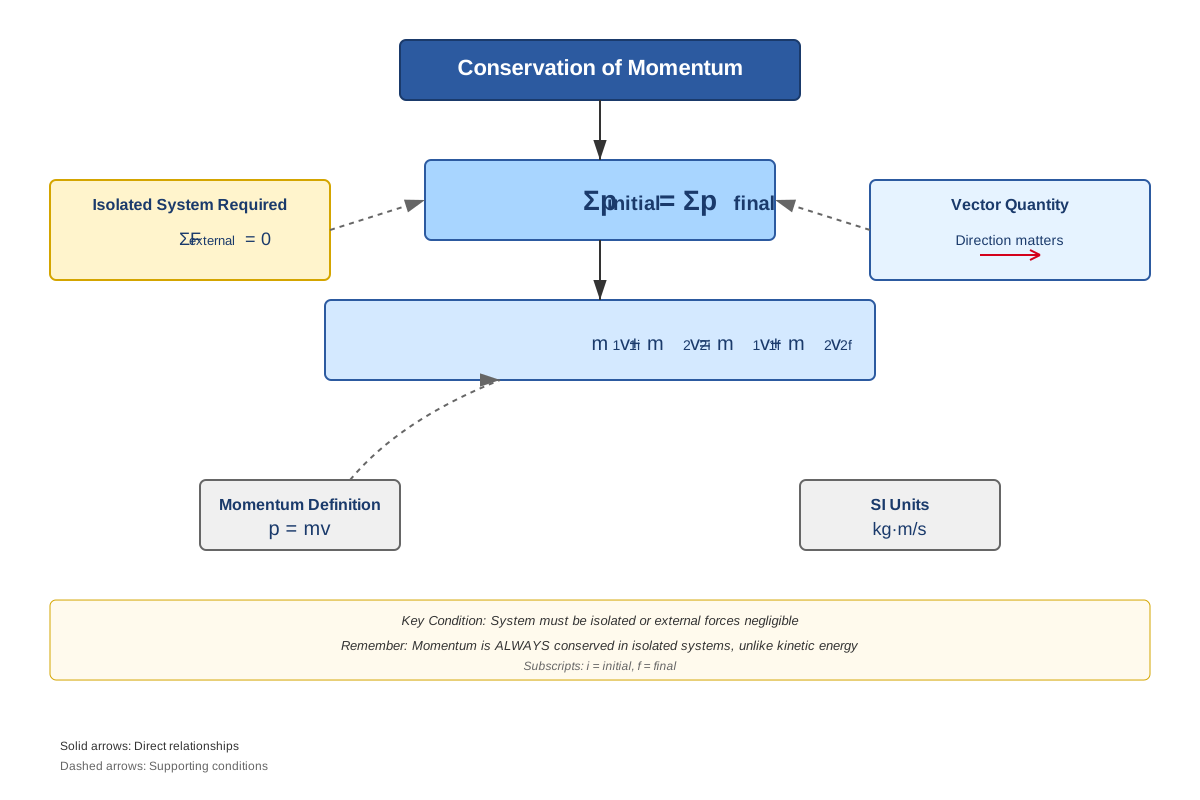
Conservation of momentum states that the total momentum of a closed system remains constant when no external forces act upon it. Momentum (symbol p) is defined as the product of an object's mass and velocity:
p = mvFor a system of multiple objects, the total momentum is the vector sum of individual momenta:
p_total = p₁ + p₂ + p₃ + ... = m₁v₁ + m₂v₂ + m₃v₃ + ...The conservation principle mathematically states:
p_initial = p_finalOr more explicitly for a two-object system:
m₁v₁ᵢ + m₂v₂ᵢ = m₁v₁f + m₂v₂fWhere subscript i denotes initial values and f denotes final values.
Conditions for Momentum Conservation
Momentum conservation applies when the net external force on a system equals zero. This is a critical distinction: internal forces between objects within the system do not affect total momentum conservation. During a collision, objects exert enormous forces on each other (internal forces), but these forces are equal and opposite by Newton's third law, causing no net change in system momentum.
Key conditions:
- The system must be isolated or closed (no mass enters or leaves)
- External forces must be negligible or sum to zero
- The time frame considered must be appropriate (momentum is conserved at every instant)
Even when external forces exist, if they're much smaller than internal collision forces or act perpendicular to motion, momentum may be conserved in specific directions. For example, in a collision on a horizontal surface, vertical momentum isn't conserved (gravity and normal force), but horizontal momentum is conserved if friction is negligible.
Types of Collisions
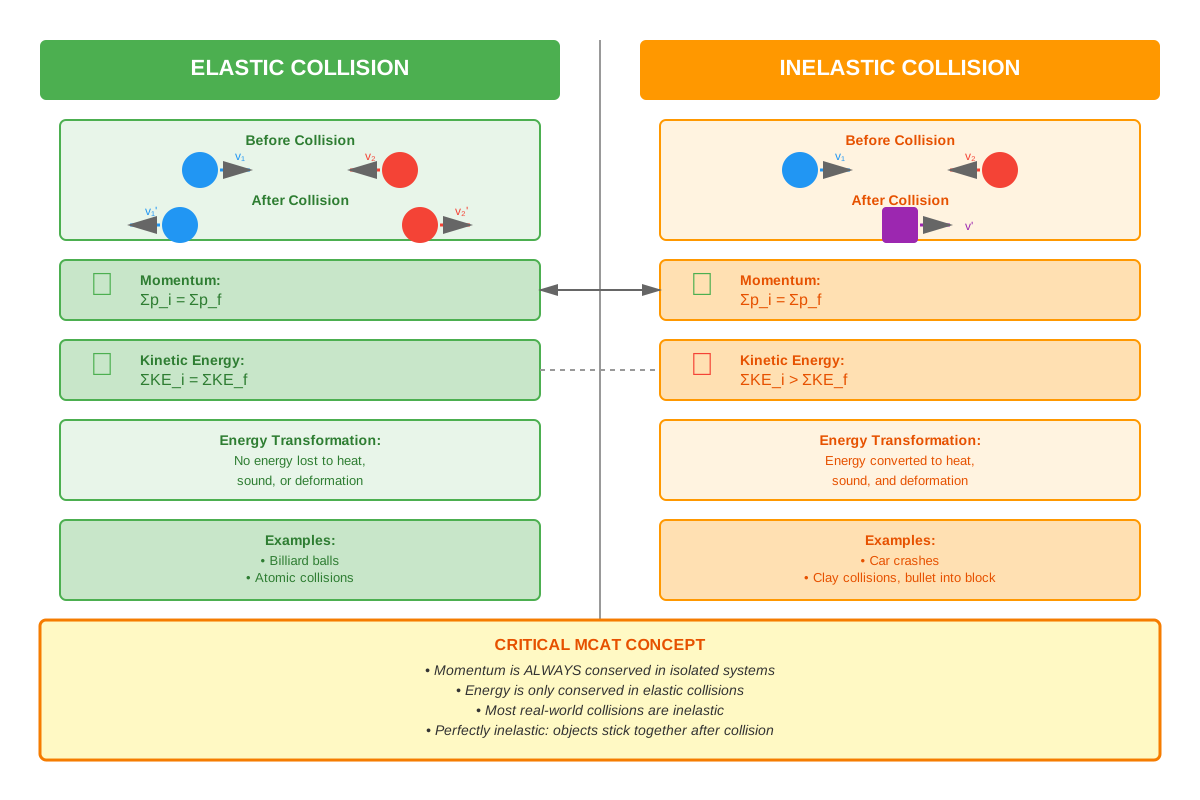
Collisions are categorized based on whether kinetic energy is conserved:
| Collision Type | Momentum Conserved? | Kinetic Energy Conserved? | Characteristics |
|---|---|---|---|
| Elastic | Yes | Yes | Objects bounce apart; no deformation or heat generation; ideal scenario |
| Inelastic | Yes | No | Objects may deform; energy converts to heat, sound, or deformation |
| Perfectly Inelastic | Yes | No (maximum loss) | Objects stick together after collision; move with common final velocity |
The distinction is crucial for MCAT problem-solving. Elastic collisions require two equations (momentum and energy conservation) to solve for two unknowns. Perfectly inelastic collisions simplify because both objects share the same final velocity, requiring only momentum conservation.
One-Dimensional Collision Analysis
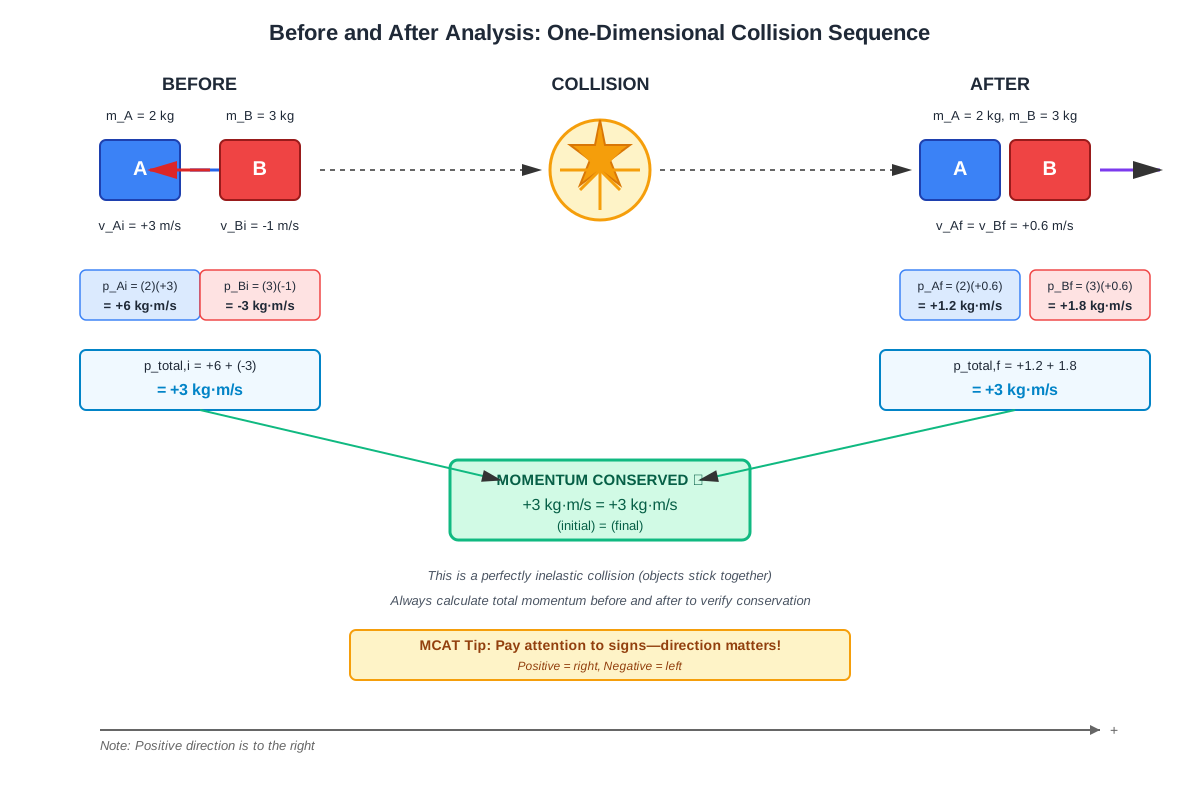
In one-dimensional collisions, all motion occurs along a single line. The vector nature of momentum simplifies to positive and negative directions.
For perfectly inelastic collisions:
m₁v₁ᵢ + m₂v₂ᵢ = (m₁ + m₂)vfThe final velocity can be solved directly:
vf = (m₁v₁ᵢ + m₂v₂ᵢ)/(m₁ + m₂)For elastic collisions, combining momentum and energy conservation yields:
v₁f = ((m₁ - m₂)/(m₁ + m₂))v₁ᵢ + ((2m₂)/(m₁ + m₂))v₂ᵢv₂f = ((2m₁)/(m₁ + m₂))v₁ᵢ + ((m₂ - m₁)/(m₁ + m₂))v₂ᵢThese formulas reveal important special cases:
- Equal masses (m₁ = m₂): objects exchange velocities in elastic collisions
- Massive target (m₂ >> m₁): projectile bounces back with reversed velocity
- Massive projectile (m₁ >> m₂): projectile continues nearly unchanged; target acquires twice projectile's velocity
Two-Dimensional Collisions
When collisions occur in two dimensions, momentum conservation applies independently to each direction. This principle of component-wise conservation is essential for MCAT problem-solving:
x-direction: m₁v₁ₓᵢ + m₂v₂ₓᵢ = m₁v₁ₓf + m₂v₂ₓfy-direction: m₁v₁yᵢ + m₂v₂yᵢ = m₁v₁yf + m₂v₂yfThis creates two independent equations. Combined with energy conservation (for elastic collisions) or the perfectly inelastic condition, these equations can solve for final velocities and angles.
Explosions and Recoil
Explosions represent the inverse of perfectly inelastic collisions—objects initially at rest or moving together separate due to internal forces. Momentum conservation still applies:
p_initial = 0 = p₁_final + p₂_finalThis means the momentum vectors of separating fragments must be equal in magnitude and opposite in direction:
m₁v₁ = -m₂v₂Recoil phenomena, such as a rifle firing a bullet, follow the same principle. The rifle and bullet initially share zero momentum. After firing, the bullet's forward momentum equals the rifle's backward momentum in magnitude.
Center of Mass and Momentum
The center of mass of a system moves according to the total momentum:
v_cm = p_total/M_totalWhen momentum is conserved, the center of mass velocity remains constant. This provides an elegant way to analyze complex systems: regardless of internal interactions, the center of mass continues moving uniformly if no external forces act.
Impulse-Momentum Theorem Connection
While impulse (J = FΔt) and momentum change (Δp) are related concepts, understanding their connection clarifies when momentum is conserved. The impulse-momentum theorem states:
J = Δp = FΔtWhen net external force is zero, impulse is zero, and momentum doesn't change—this is conservation of momentum from another perspective. During collisions, internal forces create impulses on individual objects, changing their individual momenta, but the system's total momentum remains constant because internal impulses cancel.
Concept Relationships
Conservation of momentum sits at the nexus of multiple mechanics concepts, forming a conceptual web essential for MCAT mastery.
Internal Concept Relationships:
- Collision type → determines whether → energy conservation applies alongside momentum conservation
- Vector nature of momentum → requires → component-wise analysis in two-dimensional problems
- Center of mass motion → is governed by → total system momentum
- Explosion scenarios → are inverse applications of → perfectly inelastic collision principles
Connections to Prerequisites:
- Newton's Third Law → provides theoretical foundation for → conservation of momentum (action-reaction pairs ensure internal forces cancel)
- Vector addition → enables calculation of → total momentum in multi-dimensional systems
- Kinetic energy concepts → distinguish → elastic from inelastic collisions
Connections to Related Topics:
- Conservation of momentum + Conservation of energy → together solve → elastic collision problems completely
- Impulse → represents → change in momentum → connects to → force-time relationships
- Rotational motion → has analogous principle → conservation of angular momentum
- Fluid dynamics → applies momentum conservation to → continuous mass flow in cardiovascular systems
Conceptual Flow:
Newton's Laws → Momentum Definition → Impulse-Momentum Theorem → Conservation Principle → Collision Analysis → Center of Mass Dynamics → Applications in Complex Systems
High-Yield Facts
⭐ Momentum is ALWAYS conserved in an isolated system, regardless of collision type (elastic or inelastic)
⭐ In perfectly inelastic collisions, objects stick together and move with a common final velocity
⭐ Momentum is a vector quantity; conservation applies independently to each direction (x, y, z components)
⭐ Kinetic energy is conserved only in elastic collisions; momentum is conserved in all collisions
⭐ When two objects of equal mass collide elastically with one initially at rest, they exchange velocities
- The center of mass velocity of an isolated system remains constant when momentum is conserved
- In explosions, the total momentum before and after separation equals zero if the system starts at rest
- Recoil velocity is inversely proportional to mass: lighter objects recoil faster than heavier objects
- External forces perpendicular to motion don't affect momentum conservation in the direction of motion
- The impulse delivered to an object equals its change in momentum (J = Δp = mΔv)
- In two-dimensional collisions, you need at least two equations (x and y momentum conservation) to solve for unknowns
- Momentum has SI units of kg⋅m/s, equivalent to N⋅s (newton-seconds)
- A system's momentum can be zero even when individual objects are moving (equal and opposite momenta)
- Friction and air resistance are external forces that violate momentum conservation unless explicitly negligible
- The relative velocity of approach equals the relative velocity of separation in elastic collisions (coefficient of restitution = 1)
Quick check — test yourself on Conservation of momentum so far.
Try Flashcards →Common Misconceptions
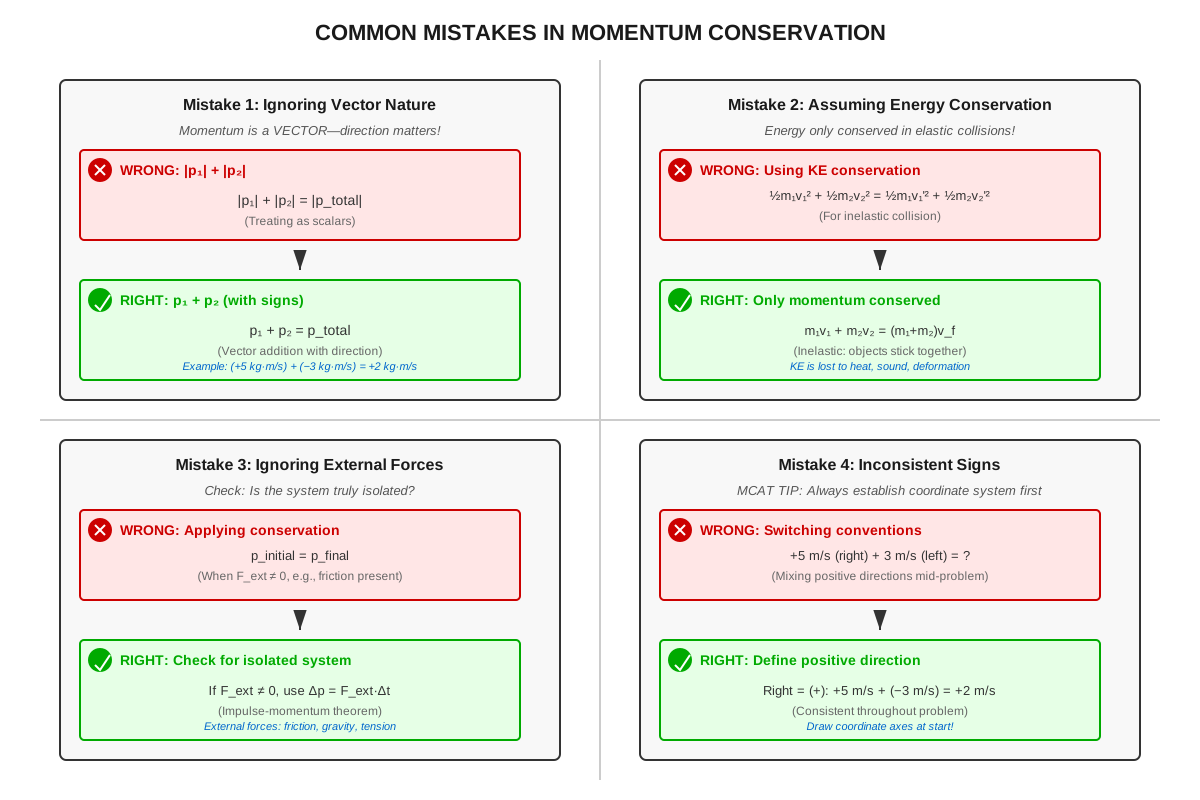
Misconception: Momentum and kinetic energy are the same thing and both are always conserved.
Correction: Momentum (p = mv) and kinetic energy (KE = ½mv²) are distinct quantities. Momentum is always conserved in isolated systems, but kinetic energy is conserved only in elastic collisions. In inelastic collisions, kinetic energy converts to other forms (heat, sound, deformation) while momentum remains constant.
Misconception: Heavier objects always have more momentum than lighter objects.
Correction: Momentum depends on both mass and velocity (p = mv). A light object moving very fast can have more momentum than a heavy object moving slowly. For example, a bullet has less mass than a baseball, but its much higher velocity gives it greater momentum.
Misconception: When two objects collide and stick together, all kinetic energy is lost.
Correction: In perfectly inelastic collisions, maximum kinetic energy is lost compared to other collision types, but not all kinetic energy disappears. The combined object continues moving with kinetic energy equal to ½(m₁ + m₂)v²f. Only the kinetic energy associated with relative motion is lost.
Misconception: Momentum conservation only applies during the brief moment of collision.
Correction: Momentum is conserved at every instant for an isolated system, not just during collisions. The collision is simply when momentum transfer between objects occurs. Before, during, and after the collision, total system momentum remains constant if no external forces act.
Misconception: In a collision between a moving object and a stationary object, the stationary object gains all the momentum.
Correction: The total momentum is distributed between both objects according to their masses and the collision type. In elastic collisions between equal masses, the moving object stops and the stationary object acquires all the velocity. In other scenarios, both objects typically move after collision, sharing the initial momentum.
Misconception: If momentum is conserved, the objects must be moving in the same direction after collision.
Correction: Momentum conservation only requires that the vector sum of momenta remains constant. Objects can move in any direction after collision, including opposite directions, as long as the total momentum vector equals the initial momentum vector. This is especially important in two-dimensional collisions.
Misconception: Momentum conservation doesn't apply when external forces like gravity are present.
Correction: Momentum conservation can still apply in specific directions even when external forces exist. For horizontal collisions, if the time is brief and friction is negligible, horizontal momentum is conserved even though gravity acts vertically. The key is whether external forces have components in the direction being analyzed.
Worked Examples
Example 1: Perfectly Inelastic Collision (One-Dimensional)
Problem: A 1200 kg car traveling east at 15 m/s collides with a 1800 kg truck traveling west at 10 m/s. The vehicles lock together after collision. What is their final velocity?
Solution:
Step 1: Identify the collision type and applicable principles.
This is a perfectly inelastic collision (vehicles lock together), so momentum is conserved but kinetic energy is not. We need only momentum conservation.
Step 2: Define a coordinate system.
Let east be positive, west be negative.
- Car: m₁ = 1200 kg, v₁ᵢ = +15 m/s
- Truck: m₂ = 1800 kg, v₂ᵢ = -10 m/s (negative because westward)
Step 3: Apply conservation of momentum.
m₁v₁ᵢ + m₂v₂ᵢ = (m₁ + m₂)vf(1200 kg)(15 m/s) + (1800 kg)(-10 m/s) = (1200 kg + 1800 kg)vf18,000 kg⋅m/s - 18,000 kg⋅m/s = 3000 kg × vf0 = 3000 kg × vfvf = 0 m/sStep 4: Interpret the result.
The combined wreckage is stationary after collision. This makes physical sense: the eastward momentum of the car exactly canceled the westward momentum of the truck because (1200 kg)(15 m/s) = (1800 kg)(10 m/s) = 18,000 kg⋅m/s.
Connection to Learning Objectives: This example demonstrates applying conservation of momentum to exam-style questions and shows how to handle vector directions in one-dimensional problems.
Example 2: Two-Dimensional Elastic Collision
Problem: A 2 kg ball moving at 4 m/s in the +x direction strikes a 3 kg ball at rest. After the elastic collision, the 2 kg ball moves at 30° above the +x axis. Find the velocity components of both balls after collision.
Solution:
Step 1: Identify given information and unknowns.
- m₁ = 2 kg, v₁ᵢ = 4 m/s (x-direction only)
- m₂ = 3 kg, v₂ᵢ = 0 m/s
- After collision: ball 1 moves at angle θ₁ = 30°
- Unknowns: v₁f, v₂f, θ₂ (angle of ball 2)
Step 2: Apply x-component momentum conservation.
m₁v₁ᵢ = m₁v₁f cos(30°) + m₂v₂f cos(θ₂)(2 kg)(4 m/s) = (2 kg)v₁f(0.866) + (3 kg)v₂f cos(θ₂)8 kg⋅m/s = 1.732v₁f + 3v₂f cos(θ₂) ... (Equation 1)Step 3: Apply y-component momentum conservation.
0 = m₁v₁f sin(30°) + m₂v₂f sin(θ₂)0 = (2 kg)v₁f(0.5) + (3 kg)v₂f sin(θ₂)0 = v₁f + 3v₂f sin(θ₂) ... (Equation 2)Step 4: Apply energy conservation (elastic collision).
½m₁v₁ᵢ² = ½m₁v₁f² + ½m₂v₂f²(2 kg)(4 m/s)² = (2 kg)v₁f² + (3 kg)v₂f²32 J = 2v₁f² + 3v₂f² ... (Equation 3)Step 5: Solve the system of equations.
From Equation 2: v₁f = -3v₂f sin(θ₂)
This problem requires three equations with three unknowns (v₁f, v₂f, θ₂). For MCAT purposes, recognize that:
- The problem is solvable using momentum conservation in both directions plus energy conservation
- The negative sign in Equation 2 indicates ball 2 moves below the x-axis (opposite y-component to ball 1)
- Actual numerical solution would require substitution and algebraic manipulation beyond typical MCAT scope
Connection to Learning Objectives: This example illustrates two-dimensional collision analysis, demonstrates component-wise momentum conservation, and shows how elastic collisions require both momentum and energy conservation for complete solution.
Exam Strategy
Question Recognition
MCAT momentum questions typically include trigger phrases:
- "Collide," "impact," "strike," "crash"
- "Stick together," "lock together," "couple" (perfectly inelastic)
- "Bounce," "rebound," "elastic collision"
- "Explode," "separate," "fragment," "recoil"
- "Isolated system," "no external forces," "frictionless"
When you see these phrases, immediately consider whether momentum conservation applies.
Systematic Approach
- Identify the system: Draw boundaries around all interacting objects
- Check for isolation: Are external forces negligible or zero?
- Determine collision type: Elastic, inelastic, or perfectly inelastic?
- Choose coordinate system: Make one direction positive; be consistent
- Write conservation equation(s): Use component form for 2D problems
- Add energy conservation if needed: Only for elastic collisions
- Solve algebraically before plugging numbers: Reduces calculation errors
Process of Elimination Tips
- Eliminate answers where momentum direction is wrong: If initial momentum is eastward, final momentum cannot be purely westward
- Check units: Momentum must have units of kg⋅m/s or equivalent
- Use limiting cases: If one mass is much larger, the lighter object should change velocity more dramatically
- Energy constraints: In inelastic collisions, final kinetic energy must be less than initial
- Magnitude checks: Final velocities should be reasonable given initial conditions
Time Management
Momentum problems typically require 60-90 seconds:
- 15 seconds: Read and identify collision type
- 30 seconds: Set up conservation equation(s)
- 30 seconds: Solve and check answer
- 15 seconds: Verify reasonableness
For complex two-dimensional problems, allocate up to 2 minutes. If a problem requires extensive calculation beyond basic algebra, consider flagging and returning if time permits—MCAT momentum questions usually test concepts more than calculation endurance.
Common Question Formats
- Conceptual questions: "Which quantity is conserved?" or "What happens to the center of mass?"
- Calculation questions: "Find the final velocity" or "Calculate the momentum change"
- Comparison questions: "Which collision transfers more energy?" or "In which scenario is momentum conserved?"
- Passage-based applications: Experimental setups, physiological scenarios, or real-world contexts requiring momentum analysis
Memory Techniques
Momentum Conservation Mnemonic: "MICE"
Momentum is conserved
In
Closed systems with
External forces = 0
Collision Type Memory Aid: "SKIP"
Stick together = perfectly inelastic
Kinetic energy conserved = elastic
Inelastic = energy lost but momentum conserved
Perfectly inelastic loses maximum energy
Vector Component Visualization
Picture momentum as arrows: the total arrow length and direction before collision must equal the total after collision. In 2D, imagine completing a triangle—the momentum vectors must form a closed shape when arranged head-to-tail.
Equal Mass Elastic Collision Rule
"Equal masses exchange places"—when two objects of equal mass collide elastically with one at rest, they swap velocities. The moving one stops; the stationary one moves with the original velocity.
Recoil Relationship
"Light flies, heavy stays"—in recoil or explosion, the lighter object moves faster. Mathematically: m₁v₁ = m₂v₂, so v₁/v₂ = m₂/m₁ (inverse relationship).
Acronym for Problem-Solving: "DICE"
Draw the system and define positive direction
Identify collision type and conservation laws
Calculate using conservation equations
Evaluate answer for reasonableness
Summary
Conservation of momentum is a fundamental principle stating that the total momentum of an isolated system remains constant when no net external forces act upon it. This principle applies universally to all collision types—elastic, inelastic, and perfectly inelastic—making it more broadly applicable than energy conservation. Momentum, defined as the product of mass and velocity (p = mv), is a vector quantity requiring component-wise analysis in multi-dimensional problems. The MCAT tests momentum conservation through collision problems, explosion scenarios, recoil situations, and biological applications, often requiring students to distinguish between momentum conservation (always applies in isolated systems) and energy conservation (applies only in elastic collisions). Successful problem-solving requires identifying the system, verifying isolation from external forces, choosing an appropriate coordinate system, and applying conservation equations systematically. Understanding the relationship between collision type and energy loss, recognizing when to apply component-wise conservation in two dimensions, and connecting momentum principles to center of mass motion are essential for MCAT success.
Key Takeaways
- Momentum is always conserved in isolated systems regardless of collision type; kinetic energy is conserved only in elastic collisions
- Momentum is a vector quantity (p = mv) requiring component-wise conservation in multi-dimensional problems
- Perfectly inelastic collisions result in objects sticking together with a common final velocity, simplifying calculations
- The center of mass of an isolated system moves with constant velocity when momentum is conserved
- In explosions and recoil, momentum conservation requires that separating objects have equal and opposite momenta
- MCAT momentum questions test conceptual understanding of when and how conservation applies, not just calculation ability
- Combining momentum conservation with energy conservation enables complete solution of elastic collision problems
Related Topics
Impulse and Momentum Change: The impulse-momentum theorem (J = Δp) connects force, time, and momentum change, providing an alternative approach to collision analysis and explaining how forces during brief interactions produce momentum changes.
Center of Mass Dynamics: Understanding how the center of mass moves according to total system momentum enables analysis of complex multi-body systems and connects to momentum conservation principles.
Conservation of Energy: Energy conservation complements momentum conservation, particularly in elastic collisions where both principles apply simultaneously, and helps distinguish collision types.
Rotational Momentum (Angular Momentum): The rotational analog of linear momentum, angular momentum conservation governs rotating systems and follows similar principles, extending momentum concepts to rotational motion.
Fluid Dynamics and Continuity: Momentum conservation applies to fluid flow, connecting to cardiovascular physiology and explaining phenomena like blood pressure and flow rates in vessels.
Newton's Laws of Motion: The theoretical foundation for momentum conservation, particularly Newton's third law, which ensures internal forces cancel and momentum is conserved in isolated systems.
Practice CTA
Now that you've mastered the core concepts of conservation of momentum, it's time to solidify your understanding through active practice. Attempt the practice questions and work through the flashcards to reinforce these high-yield concepts. Remember, momentum conservation is one of the most powerful problem-solving tools in physics—mastering it will not only help you tackle momentum questions directly but also provide insights into complex multi-concept problems. The more you practice identifying when momentum is conserved and systematically applying conservation principles, the more confident and efficient you'll become on test day. Your investment in understanding this fundamental principle will pay dividends across multiple physics topics on the MCAT!
Sign up free to keep reading
Create a free AnvayaPrep account to finish this MCAT guide on Conservation of momentum — plus flashcards and practice questions.