Overview
Kinetic energy is one of the most fundamental concepts in Physics and a cornerstone of Mechanics tested extensively on the MCAT. It represents the energy an object possesses due to its motion, quantified by the equation KE = ½mv², where m is mass and v is velocity. This deceptively simple formula underlies countless biological and physical phenomena, from the molecular motion that drives diffusion across cell membranes to the biomechanics of human movement. Understanding kinetic energy is essential not only for solving direct calculation problems but also for analyzing energy transformations, collisions, and the work-energy theorem—all high-yield topics that appear regularly in MCAT passages.
The importance of kinetic energy for the MCAT extends beyond isolated physics problems. Test-makers frequently embed kinetic energy concepts within interdisciplinary passages that combine physics with biology, chemistry, or physiology. For example, a passage might describe the motion of blood through vessels (requiring understanding of fluid kinetics), the energy requirements of muscle contraction, or the behavior of gas molecules in the lungs. The ability to recognize when kinetic energy principles apply, set up the appropriate equations, and reason through energy conservation scenarios distinguishes high-scoring students from those who struggle with the physical sciences.
Within the broader framework of Physics, kinetic energy serves as a bridge between kinematics (the description of motion) and dynamics (the causes of motion). It connects directly to Newton's laws, work, power, momentum, and conservation principles. Mastering kinetic energy provides the foundation for understanding more complex topics like rotational motion, oscillations, and thermodynamics. The concept also appears in chemical kinetics (molecular collision theory) and biochemistry (enzyme-substrate interactions), making it truly interdisciplinary in its MCAT applications.
Learning Objectives
- [ ] Define kinetic energy using accurate Physics terminology
- [ ] Explain why kinetic energy matters for the MCAT
- [ ] Apply kinetic energy to exam-style questions
- [ ] Identify common mistakes related to kinetic energy
- [ ] Connect kinetic energy to related Physics concepts
- [ ] Derive and manipulate the kinetic energy equation in various problem contexts
- [ ] Distinguish between translational and rotational kinetic energy
- [ ] Apply the work-energy theorem to solve multi-step problems involving kinetic energy changes
Prerequisites
- Basic algebra and equation manipulation: Essential for rearranging the kinetic energy formula and solving for unknown variables in multi-step problems
- Understanding of velocity and speed: Kinetic energy depends on the square of velocity, requiring clear distinction between these quantities and their vector/scalar nature
- Concept of mass: Mass appears as a linear factor in kinetic energy calculations and affects how objects respond to forces
- Units and dimensional analysis: Critical for ensuring calculations yield energy units (Joules) and for catching algebraic errors
- Vector basics: While kinetic energy itself is scalar, understanding velocity as a vector helps explain why direction changes affect kinetic energy
Why This Topic Matters
Kinetic energy appears in approximately 15-20% of MCAT physics passages, making it one of the highest-yield topics in the physical sciences section. The concept serves as a foundation for understanding energy conservation, one of the most powerful problem-solving tools in physics. In clinical contexts, kinetic energy principles explain phenomena ranging from the impact forces in traumatic injuries to the energy expenditure during exercise. Radiologists use kinetic energy concepts when analyzing projectile motion of contrast agents, and cardiologists apply these principles when studying blood flow dynamics and the work performed by the heart.
On the MCAT, kinetic energy MCAT questions typically appear in three formats: direct calculation problems requiring application of KE = ½mv², conceptual questions testing understanding of how changes in mass or velocity affect kinetic energy, and complex passages requiring integration with work, potential energy, or momentum concepts. Passages frequently present scenarios involving collisions (elastic and inelastic), objects moving through gravitational or electric fields, or biological systems performing mechanical work. The test-makers favor questions that require students to recognize when kinetic energy is conserved versus when it's converted to other forms.
Understanding kinetic energy also provides insight into everyday physiological processes. The kinetic theory of gases explains respiratory gas exchange, diffusion rates depend on molecular kinetic energy, and muscle physiology involves converting chemical potential energy into the kinetic energy of muscle contraction. These connections make kinetic energy questions particularly suitable for interdisciplinary passages that test both physics reasoning and biological knowledge—exactly the type of integration the MCAT emphasizes.
Core Concepts
Definition and Mathematical Expression
Kinetic energy is defined as the energy possessed by an object due to its motion. For an object undergoing translational motion (movement from one location to another), the kinetic energy is given by:
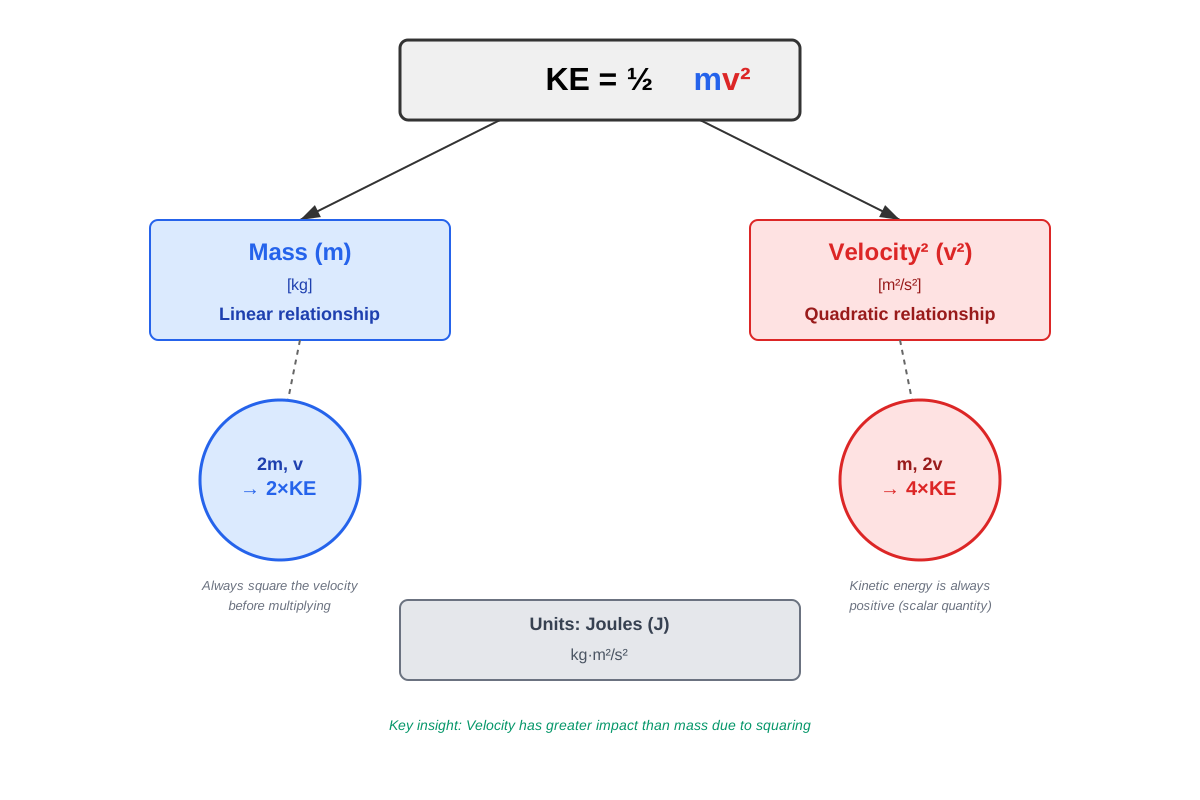
KE = ½mv²where m represents the mass of the object (in kilograms) and v represents the speed or magnitude of velocity (in meters per second). The resulting kinetic energy is expressed in Joules (J), where 1 J = 1 kg⋅m²/s². This equation reveals two critical relationships: kinetic energy is directly proportional to mass but proportional to the square of velocity. This quadratic relationship with velocity means that doubling an object's speed quadruples its kinetic energy—a fact with profound implications for everything from car crash physics to molecular collision rates.
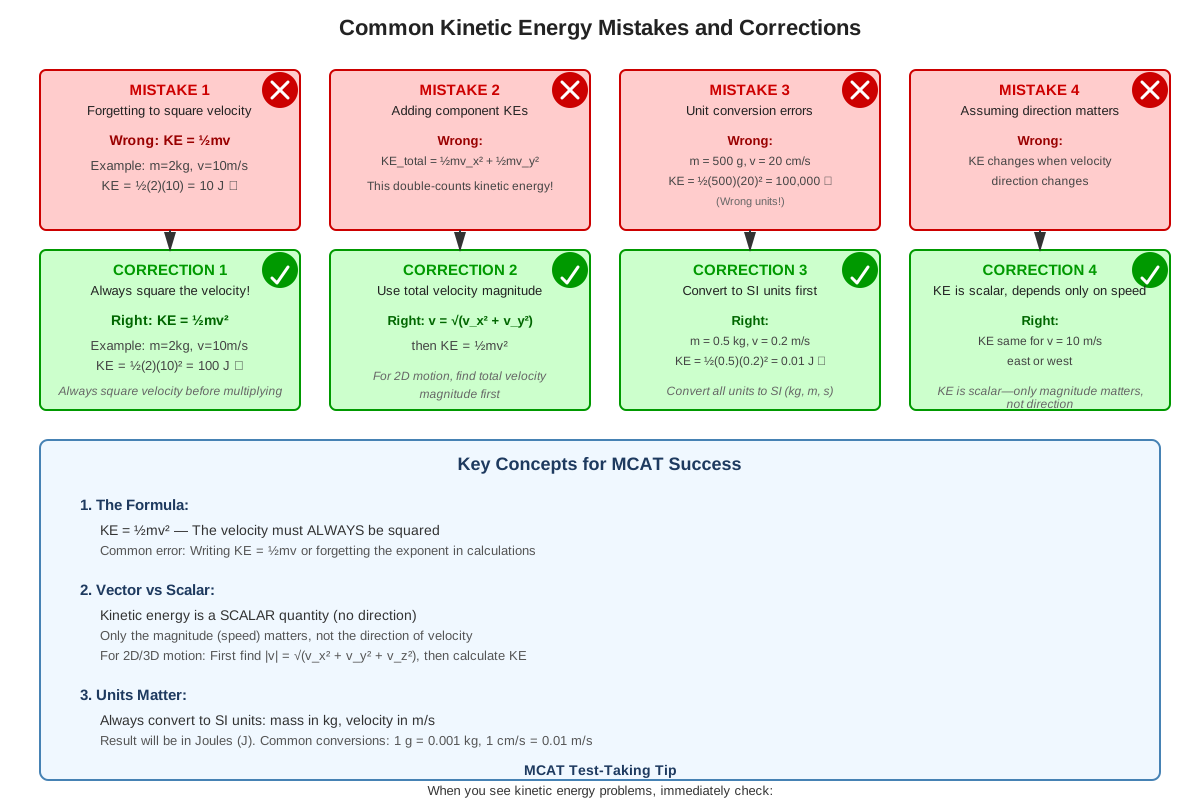
The scalar nature of kinetic energy deserves emphasis. Unlike velocity or momentum, kinetic energy has no direction; it's always positive (or zero) regardless of which direction an object moves. An object moving north at 10 m/s has the same kinetic energy as an identical object moving south at 10 m/s. This property makes kinetic energy particularly useful in conservation problems where directional information might complicate momentum-based approaches.
Derivation from Work
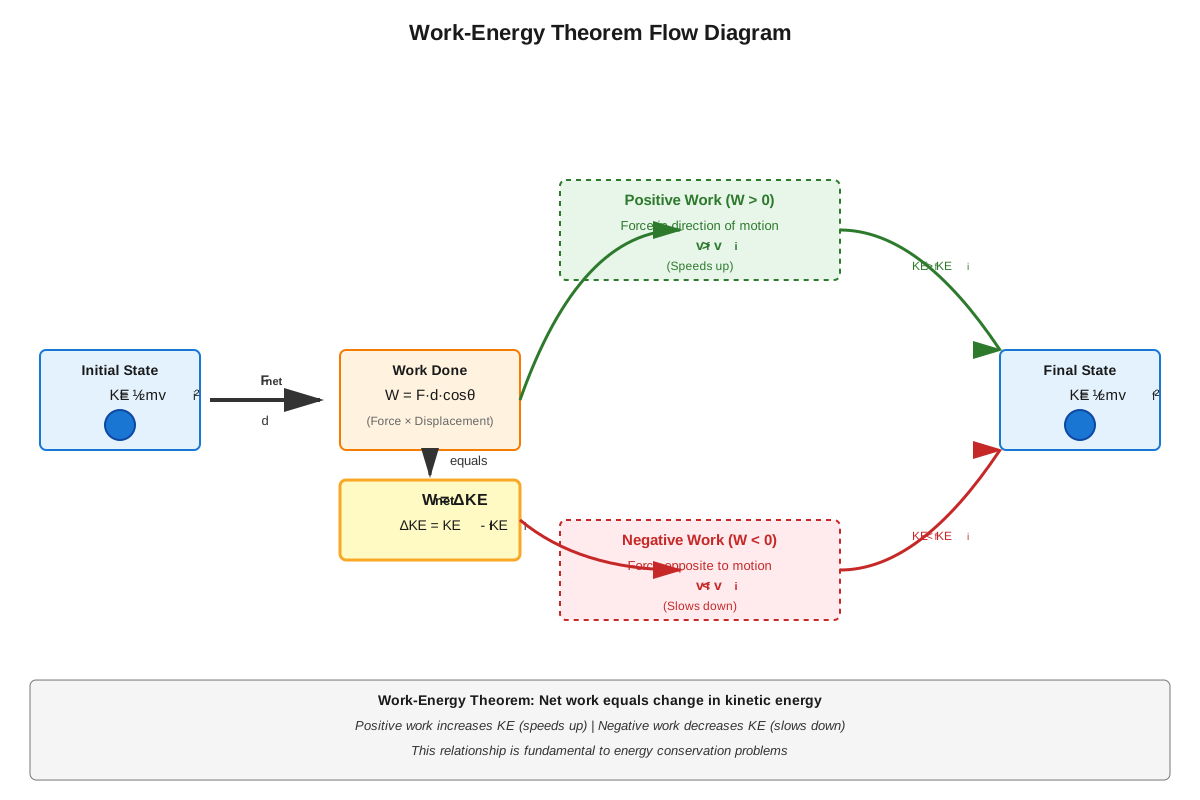
The kinetic energy equation emerges naturally from the definition of work. When a net force F acts on an object of mass m over a displacement d, causing it to accelerate from initial velocity v₀ to final velocity v, the work done equals:
W = Fd = (ma)dUsing the kinematic equation v² = v₀² + 2ad, we can solve for acceleration: a = (v² - v₀²)/(2d). Substituting this into the work equation:
W = m[(v² - v₀²)/(2d)]d = ½mv² - ½mv₀²This derivation establishes the work-energy theorem: the net work done on an object equals its change in kinetic energy (W = ΔKE). This theorem is extraordinarily powerful for MCAT problem-solving because it allows energy-based solutions that bypass the need for detailed force and acceleration analysis.
Factors Affecting Kinetic Energy
The kinetic energy formula reveals how different variables influence an object's energy of motion:
| Variable | Relationship | Effect of Doubling | Example |
|---|---|---|---|
| Mass (m) | Linear | KE doubles | A 2 kg object has twice the KE of a 1 kg object at the same speed |
| Velocity (v) | Quadratic | KE quadruples | Increasing speed from 10 m/s to 20 m/s increases KE by factor of 4 |
| Momentum (p = mv) | Quadratic | KE quadruples | Since KE = p²/(2m), doubling momentum quadruples KE |
The quadratic dependence on velocity has critical implications. In automotive safety, this explains why high-speed collisions are disproportionately more dangerous than low-speed ones—the kinetic energy that must be dissipated (often through deformation of the vehicle and injury to occupants) increases with the square of speed. In physiology, this relationship affects the energy cost of running: doubling running speed requires more than double the energy expenditure because air resistance forces increase with velocity squared.
Kinetic Energy in Different Reference Frames
An often-overlooked aspect of kinetic energy is its reference frame dependence. The kinetic energy of an object depends on the observer's frame of reference. A passenger sitting in a moving train has zero kinetic energy relative to the train but substantial kinetic energy relative to the ground. This concept becomes important in collision problems and when analyzing systems from different perspectives.
For MCAT purposes, problems typically specify or imply the reference frame (usually Earth's surface or the lab frame). However, recognizing that kinetic energy is frame-dependent helps explain why different observers might calculate different energy values for the same object—all correct within their respective frames.
Translational vs. Rotational Kinetic Energy
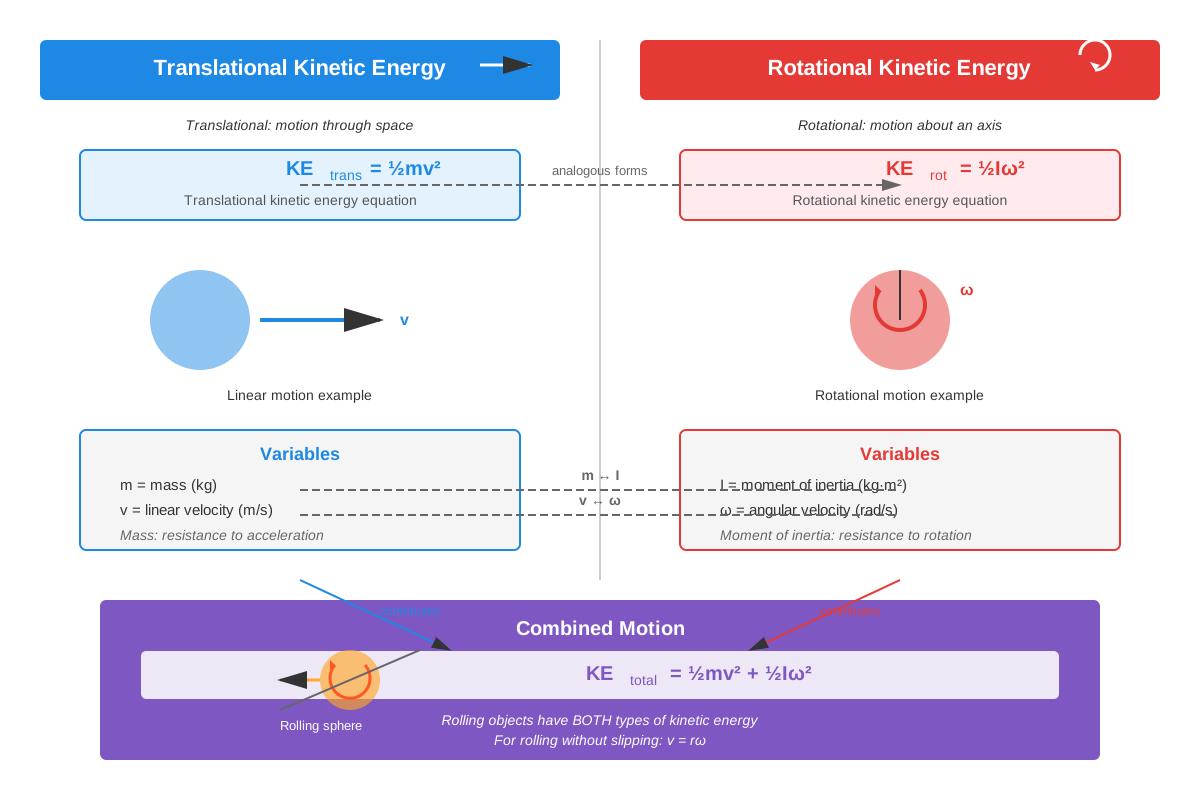
While the standard formula KE = ½mv² applies to translational kinetic energy (linear motion), objects that rotate possess rotational kinetic energy given by:
KE_rot = ½Iω²where I is the moment of inertia and ω is angular velocity. Many real-world objects exhibit both forms simultaneously. A rolling wheel, for instance, has translational kinetic energy from its center-of-mass motion and rotational kinetic energy from its spinning. The total kinetic energy is the sum of both components. While detailed rotational mechanics appears less frequently on the MCAT, recognizing that rolling objects have "extra" kinetic energy compared to sliding objects at the same linear speed can be important for energy conservation problems.
Energy Conservation and Transformations
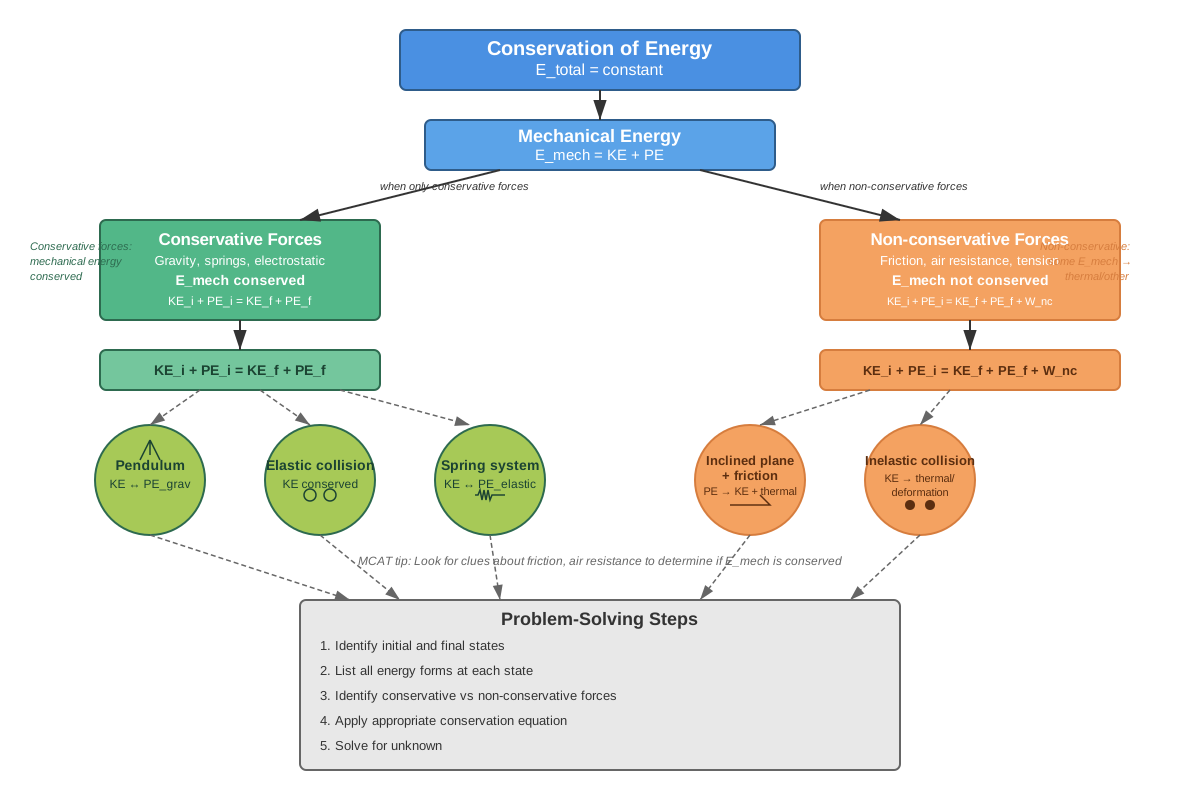
Kinetic energy rarely exists in isolation; it constantly transforms into and from other energy forms. The principle of conservation of energy states that in a closed system, total energy remains constant, though it may change forms. Common transformations include:
- Kinetic ↔ Gravitational Potential: A ball thrown upward converts kinetic energy to potential energy as it rises, then back to kinetic as it falls
- Kinetic ↔ Elastic Potential: A compressed spring stores elastic potential energy that converts to kinetic energy when released
- Kinetic → Thermal: Friction converts kinetic energy to heat (non-conservative process)
- Chemical Potential → Kinetic: Muscle contraction converts ATP chemical energy to kinetic energy of movement
In conservative systems (no friction or other dissipative forces), mechanical energy (KE + PE) remains constant. In non-conservative systems, some mechanical energy converts to thermal energy or other non-recoverable forms. The MCAT frequently tests the ability to identify which type of system a problem describes and apply the appropriate conservation principles.
Concept Relationships
The concept of kinetic energy sits at the nexus of multiple physics principles, forming a web of interconnected ideas essential for MCAT success. Kinetic energy directly derives from the concepts of mass and velocity, both fundamental kinematic quantities. The quadratic relationship with velocity means that kinetic energy connects intimately with acceleration—any process that changes velocity necessarily changes kinetic energy.
The work-energy theorem (W = ΔKE) creates a bidirectional relationship between work and kinetic energy changes. This connection allows two approaches to many problems: force-based analysis using Newton's laws or energy-based analysis using work and energy conservation. The energy approach often proves simpler, especially for complex paths or when only initial and final states matter.
Momentum (p = mv) and kinetic energy are related but distinct concepts. Both depend on mass and velocity, but their mathematical relationships differ: KE = p²/(2m). This connection becomes crucial in collision problems, where momentum is always conserved but kinetic energy is conserved only in elastic collisions. Understanding when to apply momentum conservation versus energy conservation distinguishes sophisticated problem-solvers from those who struggle with mechanics.
The relationship map flows as follows: Force → Work → Change in Kinetic Energy → Change in Velocity → Change in Momentum. Alternatively, Potential Energy → Kinetic Energy (in conservative systems) or Kinetic Energy → Thermal Energy (through friction). These pathways represent the fundamental energy transformations that govern mechanical systems.
Power represents the rate of kinetic energy change: P = dKE/dt. This connects kinetic energy to time-dependent processes, important for understanding physiological work rates like cardiac output or metabolic energy expenditure during exercise. The relationship between kinetic energy and temperature in gases (average KE per molecule = 3/2 kT) bridges mechanics and thermodynamics, explaining phenomena like diffusion rates and gas pressure.
Quick check — test yourself on Kinetic energy so far.
Try Flashcards →High-Yield Facts
⭐ Kinetic energy is proportional to the square of velocity: Doubling speed quadruples kinetic energy; this explains why high-speed impacts are disproportionately more destructive.
⭐ The work-energy theorem states W_net = ΔKE: The net work done on an object equals its change in kinetic energy, providing a powerful alternative to force-based analysis.
⭐ Kinetic energy is always positive or zero: Unlike velocity or momentum, KE has no direction and cannot be negative; a stationary object has zero kinetic energy.
⭐ In elastic collisions, kinetic energy is conserved: Both momentum and kinetic energy remain constant in perfectly elastic collisions (rare in real systems but common in MCAT problems).
⭐ In inelastic collisions, kinetic energy is not conserved: Some kinetic energy converts to thermal energy, sound, or deformation; momentum is still conserved.
- Kinetic energy has SI units of Joules (J), equivalent to kg⋅m²/s² or N⋅m
- The kinetic energy of an object can be expressed as KE = p²/(2m), useful when momentum is known
- For a system of particles, total kinetic energy equals the sum of individual kinetic energies (scalar addition)
- Rotational kinetic energy (½Iω²) adds to translational kinetic energy for rolling objects
- Average molecular kinetic energy in a gas is directly proportional to absolute temperature: KE_avg = 3/2 kT
- Work done by conservative forces (gravity, springs) can be recovered as kinetic energy; work done by non-conservative forces (friction) cannot
- The kinetic energy of the center of mass represents the minimum kinetic energy of a system in any reference frame
Common Misconceptions
Misconception: Kinetic energy and momentum are the same thing because both depend on mass and velocity.
Correction: While both depend on mass and velocity, they have different mathematical relationships (KE ∝ v², p ∝ v) and different properties. Momentum is a vector with direction; kinetic energy is a scalar. Momentum is always conserved in collisions; kinetic energy is conserved only in elastic collisions.
Misconception: If an object's velocity doubles, its kinetic energy also doubles.
Correction: Because kinetic energy depends on velocity squared (KE = ½mv²), doubling velocity quadruples kinetic energy. This quadratic relationship is one of the most commonly tested concepts and a frequent source of calculation errors.
Misconception: Heavier objects always have more kinetic energy than lighter objects.
Correction: Kinetic energy depends on both mass and velocity. A light object moving very fast can have more kinetic energy than a heavy object moving slowly. For example, a 0.1 kg bullet at 500 m/s has KE = 12,500 J, while a 10 kg object at 10 m/s has KE = 500 J.
Misconception: Kinetic energy is conserved in all collisions.
Correction: Kinetic energy is conserved only in perfectly elastic collisions. In inelastic collisions (the vast majority of real-world collisions), some kinetic energy converts to thermal energy, sound, or permanent deformation. However, momentum is always conserved in all collisions when no external forces act.
Misconception: An object at rest has negative kinetic energy.
Correction: Kinetic energy is always zero or positive, never negative. An object at rest has zero kinetic energy. The squared velocity term in KE = ½mv² ensures that kinetic energy is always non-negative regardless of direction of motion.
Misconception: Work and kinetic energy are the same thing.
Correction: Work is energy transfer that can change kinetic energy, but they're not identical. Work is the process; kinetic energy change is the result. The work-energy theorem (W_net = ΔKE) relates them, but work can also change potential energy or be done by systems with constant kinetic energy.
Worked Examples
Example 1: Multi-Step Energy Transformation
Problem: A 2.0 kg ball is dropped from rest at a height of 5.0 m above the ground. Assuming no air resistance, what is the ball's kinetic energy just before it hits the ground? What is its speed at that moment?
Solution:
Step 1: Identify the approach
This is an energy conservation problem. Initially, the ball has gravitational potential energy and zero kinetic energy. Just before impact, all potential energy has converted to kinetic energy.
Step 2: Set up the energy conservation equation
Initial energy = Final energy
PE_initial + KE_initial = PE_final + KE_final
Step 3: Define the reference point and substitute values
Taking ground level as the reference point (PE = 0 there):
- PE_initial = mgh = (2.0 kg)(10 m/s²)(5.0 m) = 100 J
- KE_initial = 0 (dropped from rest)
- PE_final = 0 (at ground level)
- KE_final = ?
Therefore: 100 J + 0 = 0 + KE_final
KE_final = 100 J
Step 4: Find the speed using the kinetic energy
KE = ½mv²
100 J = ½(2.0 kg)v²
100 = 1.0v²
v² = 100
v = 10 m/s
Step 5: Verify using kinematics (optional check)
Using v² = v₀² + 2ad: v² = 0 + 2(10)(5) = 100, so v = 10 m/s ✓
Key Insight: This problem demonstrates the power of energy methods. We found the final speed without needing to track the ball's position or acceleration at intermediate points—only initial and final states matter for energy conservation.
Example 2: Collision Analysis
Problem: A 1500 kg car traveling at 20 m/s collides head-on with a 1000 kg car traveling in the opposite direction at 15 m/s. After the collision, the cars stick together. (a) What is the total kinetic energy before the collision? (b) What is the velocity of the combined wreckage after the collision? (c) What is the kinetic energy after the collision? (d) How much kinetic energy was lost?
Solution:
Step 1: Calculate initial kinetic energies
Define positive direction as the direction of the 1500 kg car.
KE₁ = ½m₁v₁² = ½(1500 kg)(20 m/s)² = ½(1500)(400) = 300,000 J
KE₂ = ½m₂v₂² = ½(1000 kg)(15 m/s)² = ½(1000)(225) = 112,500 J
Total initial KE = 300,000 + 112,500 = 412,500 J
Note: Both kinetic energies are positive even though the cars move in opposite directions—kinetic energy is scalar.
Step 2: Find final velocity using momentum conservation
This is an inelastic collision (cars stick together), so momentum is conserved but kinetic energy is not.
p_initial = p_final
m₁v₁ + m₂v₂ = (m₁ + m₂)v_f
Taking the 1500 kg car's direction as positive and the 1000 kg car's as negative:
(1500)(20) + (1000)(-15) = (1500 + 1000)v_f
30,000 - 15,000 = 2500v_f
15,000 = 2500v_f
v_f = 6.0 m/s (in the direction of the initially faster car)
Step 3: Calculate final kinetic energy
KE_final = ½(m₁ + m₂)v_f² = ½(2500 kg)(6.0 m/s)²
KE_final = ½(2500)(36) = 45,000 J
Step 4: Calculate energy lost
ΔKE = KE_final - KE_initial = 45,000 - 412,500 = -367,500 J
The negative sign indicates energy was lost from the kinetic energy "account." This energy converted to thermal energy (heat), sound, and permanent deformation of the vehicles.
Key Insights:
- Momentum conservation applies to all collisions; kinetic energy conservation applies only to elastic collisions
- In this inelastic collision, approximately 89% of the kinetic energy was lost (367,500/412,500 ≈ 0.89)
- The lost kinetic energy doesn't disappear—it transforms into other forms, consistent with total energy conservation
Exam Strategy
When approaching kinetic energy MCAT questions, begin by identifying whether the problem requires direct calculation (using KE = ½mv²) or application of conservation principles. Questions asking "what is the kinetic energy" or "what is the speed" typically require direct calculation, while questions about "before and after" scenarios or "how much energy is transferred" suggest conservation approaches.
Trigger words and phrases to watch for include:
- "Initially at rest" → v₀ = 0, so KE₀ = 0
- "Comes to a stop" → v_f = 0, so KE_f = 0
- "Elastic collision" → both momentum and KE conserved
- "Stick together" or "inelastic collision" → momentum conserved, KE not conserved
- "Frictionless" or "no air resistance" → mechanical energy conserved
- "Work done by" → use work-energy theorem
For process-of-elimination strategies, remember these principles:
- Kinetic energy can never be negative—eliminate any answer choice with negative KE
- If velocity doubles, KE must quadruple (not double)—use this to eliminate incorrect proportional relationships
- In any collision without external forces, momentum must be conserved—eliminate scenarios violating this
- Kinetic energy is scalar—if a problem asks about "direction of kinetic energy," it's likely a distractor
Time allocation: Simple kinetic energy calculations should take 30-45 seconds. Multi-step problems involving energy conservation might require 90-120 seconds. If a problem seems to require extensive calculation, look for a conceptual shortcut—MCAT physics rewards understanding over computation. For passage-based questions, identify which information is relevant to kinetic energy (mass, velocity, height for potential energy conversion) and which is extraneous.
When stuck, try working backwards from answer choices. If asked for final velocity, plug each answer into KE = ½mv² and see which gives a kinetic energy consistent with energy conservation. This reverse-engineering approach can save time and reduce algebraic errors.
Memory Techniques
KE = ½mv² Mnemonic: "Keep Everyone Moving Very Very fast" emphasizes that kinetic energy (KE) depends on mass (M) and velocity twice (V, V for v²).
Quadratic Relationship Visualization: Picture a graph where the x-axis is velocity and y-axis is kinetic energy. The curve is a parabola opening upward, getting steeper as velocity increases. This visual reinforces that small increases in velocity at high speeds produce large increases in kinetic energy—crucial for understanding why high-speed collisions are so dangerous.
Elastic vs. Inelastic Collision Memory Aid: "Elastic = Everything conserved (both momentum and KE); Inelastic = Incomplete conservation (only momentum conserved, KE lost)."
Work-Energy Theorem Acronym: Work Equals Delta KE → "WEDding KE" (imagine work and kinetic energy getting married—they're intimately connected).
Units Check Mnemonic: Remember that Joules = kg⋅m²/s². When you see these units in your calculation, you know you're on track for energy. If you get kg⋅m/s, that's momentum (wrong units for energy).
Conservation Decision Tree: Create a mental flowchart:
- Is the system isolated (no external forces)? → Momentum conserved
- Are all forces conservative (no friction)? → Mechanical energy (KE + PE) conserved
- Is the collision elastic? → Kinetic energy specifically conserved
This systematic approach prevents confusion about which conservation laws apply in different scenarios.
Summary
Kinetic energy represents the energy of motion, quantified by KE = ½mv², where the quadratic dependence on velocity creates profound implications for everything from collision physics to molecular behavior. The work-energy theorem (W_net = ΔKE) establishes kinetic energy as the result of net work, providing a powerful problem-solving framework that often simplifies complex mechanics problems. Understanding the distinction between situations where kinetic energy is conserved (elastic collisions, conservative forces) versus transformed (inelastic collisions, friction) is essential for MCAT success. Kinetic energy connects intimately with momentum, potential energy, work, and power, forming a conceptual network that underlies much of mechanics and extends into thermodynamics and molecular physics. Mastery requires not just memorizing the formula but understanding when and how to apply energy conservation principles, recognizing the scalar nature of kinetic energy, and appreciating the quadratic velocity relationship that makes high-speed phenomena qualitatively different from low-speed ones.
Key Takeaways
- Kinetic energy (KE = ½mv²) is always positive or zero, depends linearly on mass but quadratically on velocity, and has SI units of Joules
- The work-energy theorem (W_net = ΔKE) provides a powerful alternative to force-based analysis, especially useful when only initial and final states matter
- Doubling velocity quadruples kinetic energy—this quadratic relationship is among the most frequently tested concepts in MCAT physics
- Momentum is conserved in all collisions; kinetic energy is conserved only in elastic collisions, making it crucial to identify collision type
- Energy conservation (KE + PE = constant in conservative systems) allows solving complex problems without tracking intermediate steps
- Kinetic energy is scalar (no direction) but reference-frame dependent, distinguishing it from momentum (vector) and making it useful for certain problem types
- Recognizing trigger words like "elastic," "frictionless," "comes to rest," and "initially at rest" guides selection of appropriate conservation principles
Related Topics
Work and Power: Understanding how forces transfer energy and the rate of energy transfer deepens comprehension of kinetic energy changes and connects to physiological concepts like metabolic rate and cardiac work.
Potential Energy: Gravitational and elastic potential energy frequently convert to and from kinetic energy; mastering these transformations is essential for energy conservation problems.
Momentum and Collisions: While related to kinetic energy through shared dependence on mass and velocity, momentum conservation applies more broadly and requires different problem-solving approaches.
Rotational Motion: Extends kinetic energy concepts to spinning objects through rotational kinetic energy (½Iω²), important for understanding rolling motion and angular dynamics.
Thermodynamics and Kinetic Theory: The connection between molecular kinetic energy and temperature bridges mechanics and thermal physics, explaining gas behavior and diffusion rates.
Practice CTA
Now that you've mastered the core concepts of kinetic energy, it's time to solidify your understanding through active practice. Work through the practice questions to test your ability to apply these principles under exam-like conditions, and use the flashcards to reinforce high-yield facts and formulas. Remember, the MCAT rewards not just knowledge but the ability to apply concepts quickly and accurately—skills that develop only through deliberate practice. Each problem you solve strengthens your conceptual framework and builds the pattern recognition that distinguishes top scorers. You've built the foundation; now construct mastery through application!
Sign up free to keep reading
Create a free AnvayaPrep account to finish this MCAT guide on Kinetic energy — plus flashcards and practice questions.