Overview
Potential energy is one of the foundational pillars of mechanics and a cornerstone concept in Physics that appears frequently on the MCAT. At its core, potential energy represents stored energy that an object possesses by virtue of its position, configuration, or state within a force field. Unlike kinetic energy, which describes energy of motion, potential energy captures the capacity to do work that exists before motion occurs. This concept bridges multiple domains of physics—from gravitational interactions to elastic deformations to electrical forces—making it an integrative topic that connects mechanical systems, energy conservation principles, and real-world biological applications.
Understanding potential energy Physics is essential for MCAT success because it forms the basis for analyzing energy transformations in biological systems, mechanical devices, and physiological processes. The exam frequently tests potential energy through passage-based questions involving biomechanics (muscle contraction, bone stress), cardiovascular dynamics (blood pressure and gravitational effects), and molecular interactions (protein folding, membrane potentials). Questions may require calculating gravitational potential energy changes during human movement, analyzing elastic potential energy in tendons and ligaments, or applying conservation of energy principles to complex systems where potential and kinetic energy interconvert.
The potential energy MCAT content integrates seamlessly with other physics concepts including work, kinetic energy, conservation of energy, forces, and fields. Mastering potential energy enables students to solve problems involving energy conservation (where total mechanical energy remains constant in the absence of non-conservative forces), understand the work-energy theorem, and analyze force-displacement relationships. This topic serves as a gateway to understanding more advanced concepts in thermodynamics, electrostatics, and fluid dynamics that appear throughout the MCAT physical sciences sections.
Learning Objectives
- [ ] Define potential energy using accurate Physics terminology
- [ ] Explain why potential energy matters for the MCAT
- [ ] Apply potential energy to exam-style questions
- [ ] Identify common mistakes related to potential energy
- [ ] Connect potential energy to related Physics concepts
- [ ] Calculate gravitational potential energy for objects at various heights and in different gravitational fields
- [ ] Determine elastic potential energy stored in springs and deformable materials
- [ ] Apply conservation of mechanical energy to solve multi-step problems involving potential and kinetic energy transformations
- [ ] Analyze force-potential energy relationships using graphical representations and derivatives
Prerequisites
- Work and energy fundamentals: Understanding that work represents energy transfer and that energy is the capacity to do work provides the foundation for comprehending stored energy concepts
- Force and Newton's Laws: Potential energy arises from conservative forces, requiring familiarity with force vectors, force fields, and how forces cause acceleration
- Kinematics and motion: Analyzing energy transformations requires understanding position, displacement, velocity, and acceleration relationships
- Basic calculus concepts: Recognizing that force is the negative derivative of potential energy and that work involves integration of force over distance
- Vector mathematics: Potential energy calculations often involve vector quantities like displacement and force, requiring component analysis
Why This Topic Matters
Clinical and Real-World Significance
Potential energy concepts directly apply to numerous physiological and clinical scenarios that appear in MCAT passages. The cardiovascular system relies on gravitational potential energy differences—blood pressure measurements vary with height, and orthostatic hypotension occurs when gravitational potential energy changes affect cerebral perfusion. Musculoskeletal biomechanics involves elastic potential energy storage in tendons (particularly the Achilles tendon during running), ligaments, and cartilage, enabling efficient movement and shock absorption. Molecular biology depends on potential energy stored in chemical bonds, concentration gradients across membranes, and conformational states of proteins. Understanding potential energy helps explain why ATP hydrolysis releases energy, how ion channels create electrical potentials, and why molecules diffuse down concentration gradients.
Exam Statistics and Question Types
Potential energy appears in approximately 15-20% of MCAT physics questions, either as the primary focus or as part of multi-concept problems. The exam most commonly tests this topic through:
- Quantitative calculations: Direct computation of gravitational or elastic potential energy using standard formulas
- Energy conservation problems: Multi-step scenarios requiring tracking energy transformations between potential and kinetic forms
- Graphical analysis: Interpreting potential energy curves, identifying equilibrium positions, and relating force to potential energy slopes
- Passage-based applications: Biomechanics passages involving human movement, cardiovascular physiology passages addressing hydrostatic pressure, or molecular biology passages discussing conformational energy
Common Exam Contexts
MCAT passages frequently embed potential energy within scenarios involving: athletes performing vertical jumps (gravitational PE to KE conversion), blood flow through vessels at different body heights (gravitational PE affecting pressure), spring-based medical devices or prosthetics (elastic PE), molecular motors and protein conformational changes (chemical PE), and pendulum or oscillatory motion in physiological systems (PE-KE interchange). Recognizing these contexts allows rapid identification of relevant principles and solution strategies.
Core Concepts
Definition and Fundamental Nature
Potential energy (PE or U) represents the energy stored in a system due to the position or configuration of objects within a conservative force field. A conservative force is one for which the work done depends only on initial and final positions, not on the path taken—gravity, elastic spring forces, and electrostatic forces are conservative, while friction and air resistance are non-conservative. The potential energy of a system increases when work is done against a conservative force and decreases when the force does positive work on the system.
Mathematically, the change in potential energy equals the negative of the work done by the conservative force:
ΔPE = -W_conservative = -∫F⃗·dr⃗The negative sign reflects that when a conservative force does positive work (force and displacement in same direction), potential energy decreases, converting to other energy forms like kinetic energy. Conversely, when work is done against a conservative force, potential energy increases, storing energy for future release.
Gravitational Potential Energy
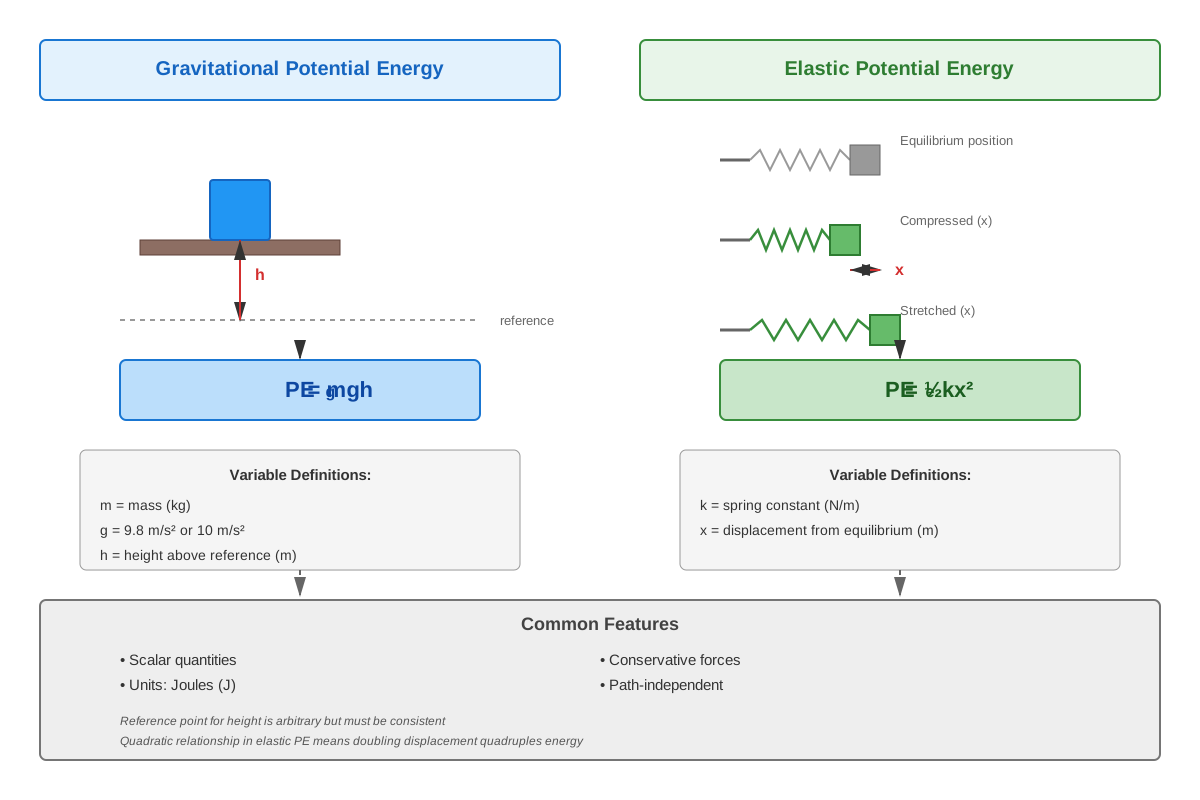
Gravitational potential energy represents the energy stored in an object-Earth system (or any two-mass system) due to their separation in a gravitational field. Near Earth's surface, where gravitational acceleration g remains approximately constant (9.8 m/s²), gravitational potential energy is:
PE_gravity = mghwhere:
- m = mass (kg)
- g = gravitational acceleration (9.8 m/s² on Earth)
- h = height above reference point (m)
The reference point (h = 0) can be chosen arbitrarily since only changes in potential energy have physical significance. Common reference choices include ground level, the lowest point in a system's motion, or the initial position of an object.
Key properties of gravitational potential energy:
- Directly proportional to mass—doubling mass doubles potential energy
- Directly proportional to height—linear relationship
- Depends on choice of reference level, but ΔPE is reference-independent
- Always involves at least two objects (typically object and Earth)
- Scalar quantity (has magnitude but no direction)
For situations involving large height changes or astronomical distances where g varies significantly, the more general form applies:
PE_gravity = -GMm/rwhere G is the gravitational constant, M and m are the two masses, and r is the separation distance between their centers. This form shows that gravitational PE is actually negative (with zero at infinite separation) and becomes less negative (increases) as objects separate.
Elastic Potential Energy
Elastic potential energy represents energy stored in deformable objects when they are compressed, stretched, or otherwise deformed from their equilibrium configuration. The most common example involves ideal springs obeying Hooke's Law, where the restoring force is proportional to displacement:
F_spring = -kxwhere k is the spring constant (N/m) measuring stiffness, and x is displacement from equilibrium. The negative sign indicates the force opposes displacement (restoring force).
The elastic potential energy stored in a spring is:
PE_elastic = (1/2)kx²This quadratic relationship means that doubling the compression or extension quadruples the stored energy. The energy comes from work done to deform the spring and can be completely recovered when the spring returns to equilibrium (in ideal, frictionless conditions).
Applications of elastic potential energy:
- Tendons and ligaments storing energy during movement
- Arterial walls stretching during systole, releasing energy during diastole
- Molecular bonds behaving as springs in vibration modes
- Diving boards, trampolines, and other elastic devices
- Cartilage compression in joints during weight-bearing
Energy Conservation and Transformations
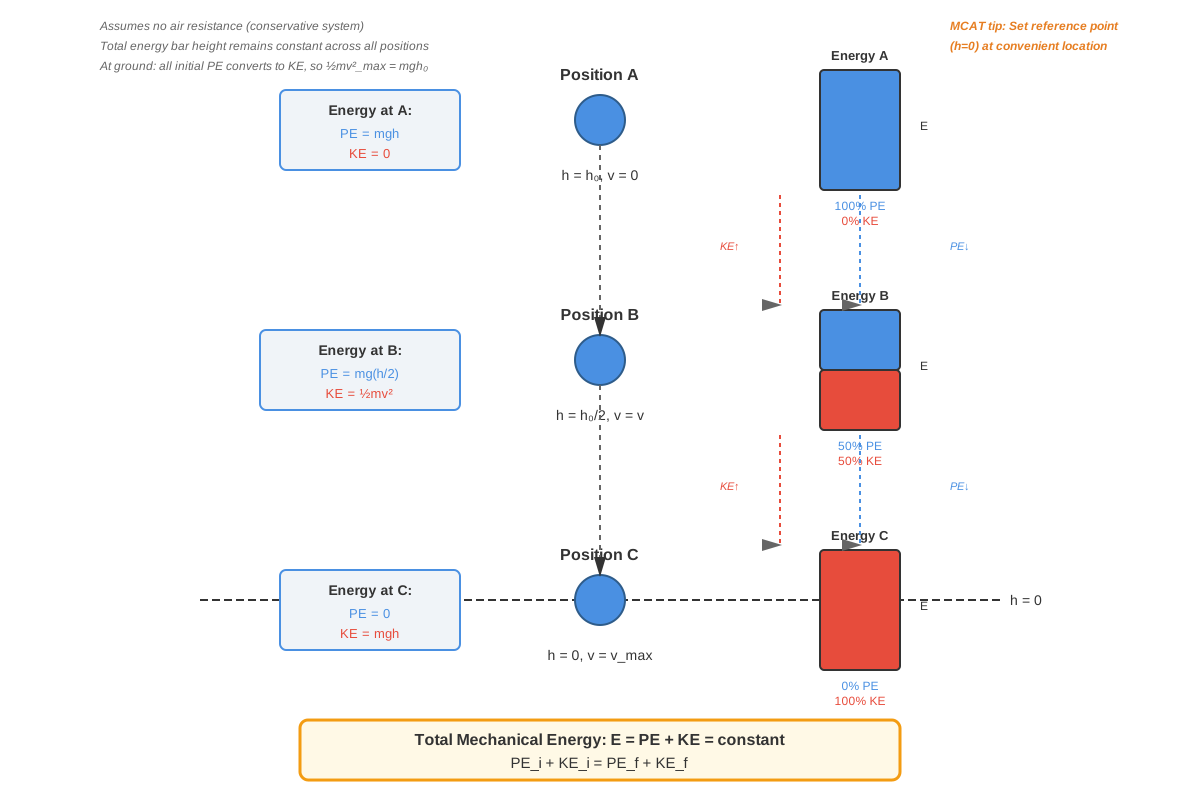
The principle of conservation of mechanical energy states that in the absence of non-conservative forces (friction, air resistance, internal energy dissipation), the total mechanical energy (sum of kinetic and potential energies) remains constant:
E_total = KE + PE = constant
ΔKE + ΔPE = 0
This principle enables solving complex motion problems by tracking energy transformations rather than analyzing forces and accelerations at each instant. When an object falls, gravitational PE converts to KE; when a spring releases, elastic PE converts to KE; when an object rises, KE converts to gravitational PE.
When non-conservative forces act, mechanical energy is not conserved, but total energy (including thermal, sound, and other forms) remains conserved:
ΔKE + ΔPE = W_non-conservativeThe work done by non-conservative forces equals the change in mechanical energy, typically representing energy dissipation to heat.
Force-Potential Energy Relationships
The relationship between conservative force and potential energy is fundamental:
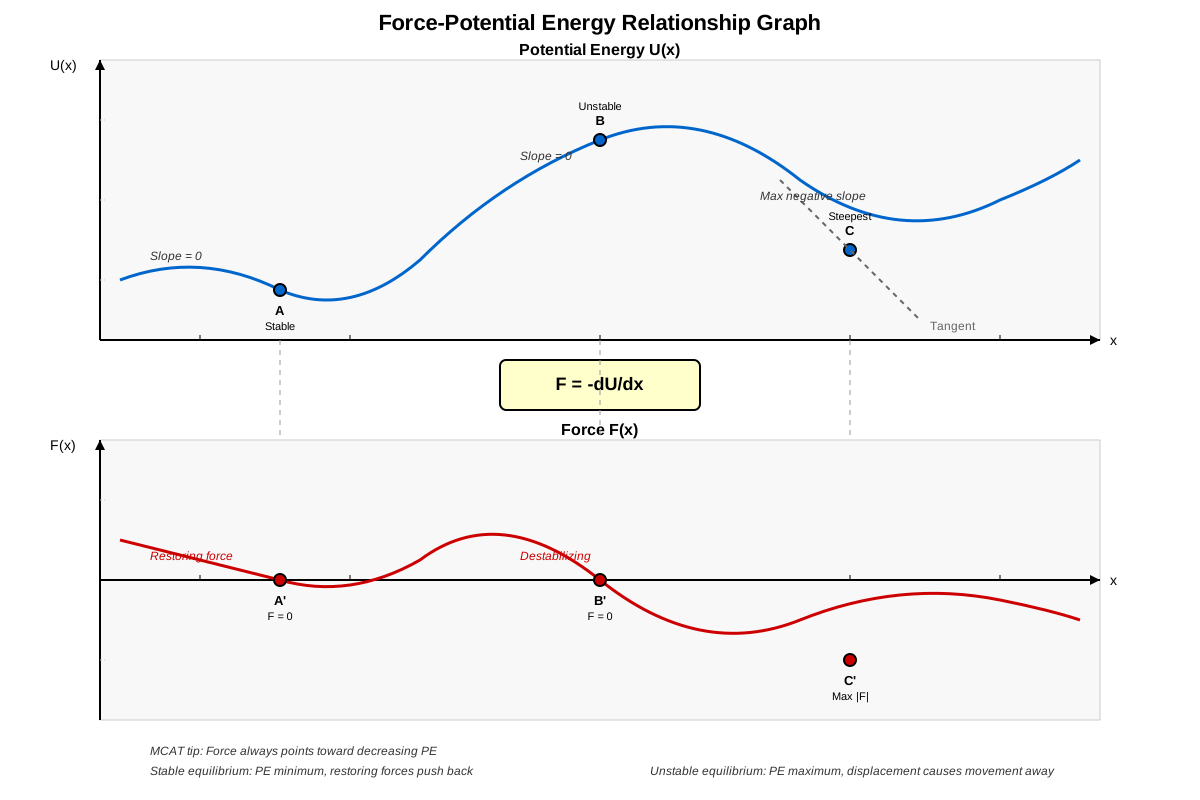
F = -dU/dxThe force equals the negative derivative (negative slope) of the potential energy function. This relationship means:
- Where PE increases with position, force points in the negative direction (opposes motion)
- Where PE decreases with position, force points in the positive direction (favors motion)
- At PE minima (stable equilibrium), force equals zero and small displacements produce restoring forces
- At PE maxima (unstable equilibrium), force equals zero but small displacements produce forces that increase displacement
Graphical interpretation:
- Steep PE slopes indicate large forces
- Flat PE regions indicate zero force (equilibrium)
- PE valleys represent stable equilibrium positions
- PE peaks represent unstable equilibrium positions
Potential Energy in Multiple Dimensions
While MCAT problems typically involve one-dimensional scenarios, understanding that potential energy exists in three-dimensional space is important for passage comprehension. In multiple dimensions:
F⃗ = -∇U = -(∂U/∂x)î - (∂U/∂y)ĵ - (∂U/∂z)k̂The force vector points in the direction of steepest PE decrease (down the PE gradient). This concept applies to:
- Molecular potential energy surfaces in protein folding
- Gravitational PE in three-dimensional space
- Electrostatic PE around charged molecules
Comparison of Potential Energy Types
| Property | Gravitational PE | Elastic PE | Electrostatic PE |
|---|---|---|---|
| Formula (simple) | mgh | (1/2)kx² | kq₁q₂/r |
| Force relationship | F = mg (constant) | F = -kx (linear) | F = kq₁q₂/r² (inverse square) |
| Dependence | Linear with height | Quadratic with displacement | Inverse with distance |
| Reference point | Arbitrary height | Equilibrium position | Infinite separation |
| Sign convention | Positive above reference | Always positive (squared term) | Positive (like charges) or negative (opposite charges) |
| MCAT frequency | Very high | High | Moderate |
Concept Relationships
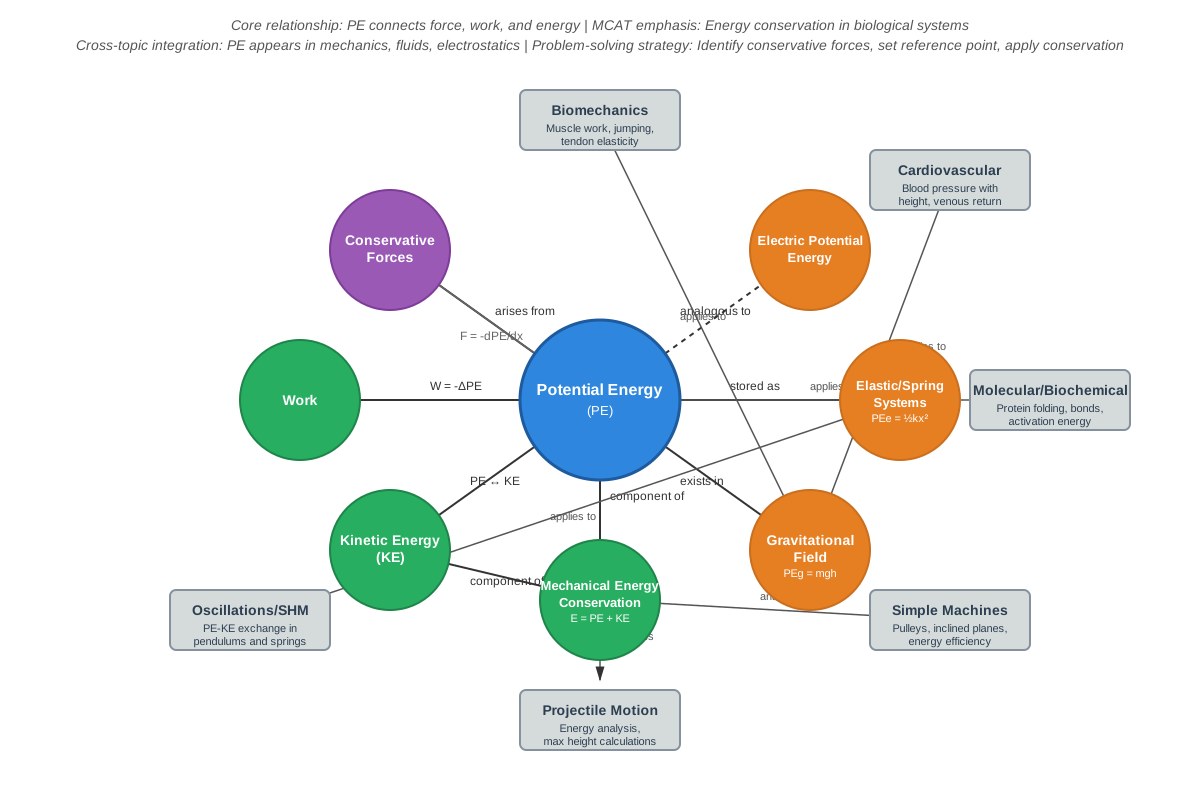
Potential energy serves as a central hub connecting multiple physics concepts. Work represents the mechanism by which potential energy changes—doing work against a conservative force increases PE, while conservative forces doing work decrease PE. This relationship flows directly into the work-energy theorem, which states that net work equals change in kinetic energy, and when combined with PE changes, yields the conservation of energy principle.
Force and potential energy maintain an inverse relationship through differentiation: force equals the negative gradient of PE. This means that analyzing PE functions provides information about forces without directly measuring them, particularly useful in molecular and atomic systems where direct force measurement is impractical. Conversely, integrating force over distance yields PE changes, connecting force analysis to energy analysis.
Kinetic energy and potential energy continuously interchange in oscillatory and periodic motion. In a simple pendulum, gravitational PE is maximum at the highest points (where KE = 0) and minimum at the lowest point (where KE is maximum). In simple harmonic motion of a spring-mass system, elastic PE and KE oscillate with a phase difference, but their sum remains constant in ideal conditions.
The concept extends to power, which represents the rate of energy transfer. When potential energy changes over time, power equals dPE/dt, connecting energy concepts to time-dependent processes. In physiological systems, metabolic power must supply the rate of PE increase when climbing stairs or lifting objects.
Conservation laws unify potential energy with broader physics principles. Conservation of mechanical energy (KE + PE = constant) applies when only conservative forces act. When non-conservative forces are present, the broader conservation of total energy applies, with mechanical energy converting to thermal energy, sound, or other forms.
Relationship map:
Conservative Forces → define → Potential Energy → changes via → Work → relates to → Kinetic Energy → together form → Mechanical Energy → governed by → Conservation of Energy → applies to → Real Systems (with non-conservative forces) → connects to → Thermodynamics
High-Yield Facts
⭐ Gravitational potential energy near Earth's surface: PE = mgh, where g = 9.8 m/s² (often approximated as 10 m/s² for quick calculations)
⭐ Elastic potential energy in springs: PE = (1/2)kx², where x is displacement from equilibrium (not total length)
⭐ Conservation of mechanical energy: KE₁ + PE₁ = KE₂ + PE₂ when only conservative forces act (no friction or air resistance)
⭐ Force-PE relationship: F = -dU/dx; force points in the direction of decreasing potential energy (down the PE slope)
⭐ Reference point independence: Only changes in PE (ΔPE) have physical meaning; absolute PE depends on arbitrary reference choice
- Potential energy is a scalar quantity (no direction), though it may depend on vector quantities like position
- At stable equilibrium, PE is at a local minimum; at unstable equilibrium, PE is at a local maximum
- Work done by conservative forces is path-independent and equals the negative change in potential energy: W = -ΔPE
- Gravitational PE increases linearly with height in uniform fields but varies as -1/r in general gravitational fields
- Elastic PE is always positive (due to x² term) regardless of compression or extension direction
- In energy conservation problems, choosing the reference level at the lowest point in motion often simplifies calculations
- The spring constant k has units of N/m and represents stiffness—larger k means stiffer spring and more energy storage per unit displacement
- Potential energy can be negative (gravitational PE with certain reference choices, electrostatic PE for opposite charges) but kinetic energy is always non-negative
- When multiple types of PE exist simultaneously (gravitational + elastic), total PE equals their sum
- Energy dissipation by friction converts mechanical energy to thermal energy: ΔKE + ΔPE = -W_friction (negative because friction opposes motion)
Quick check — test yourself on Potential energy so far.
Try Flashcards →Common Misconceptions
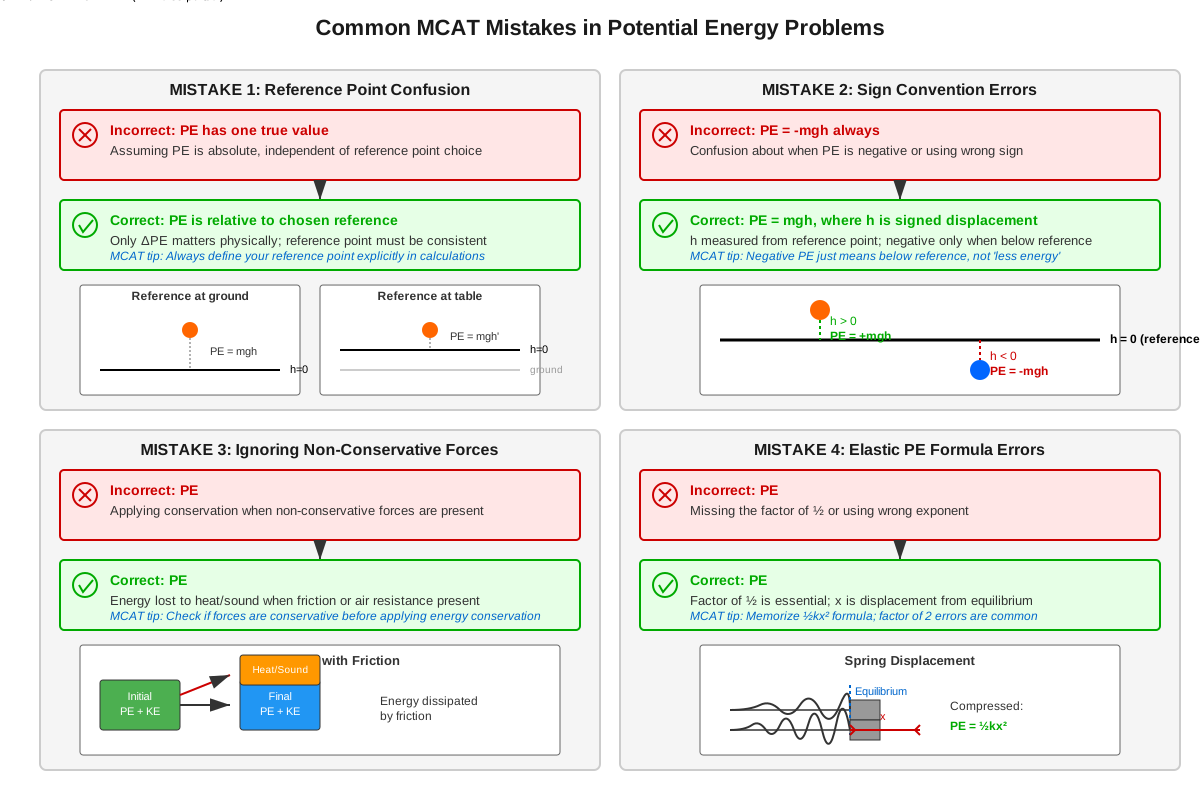
Misconception: Potential energy is a property of a single object.
Correction: Potential energy is a property of a system of interacting objects. Gravitational PE belongs to the object-Earth system, elastic PE to the spring-mass system. While we often say "the ball has PE," this is shorthand for "the ball-Earth system has PE."
Misconception: The reference point for PE must be at ground level or the Earth's surface.
Correction: The reference point (where PE = 0) can be chosen anywhere for convenience. Common choices include the lowest point in the motion, the initial position, or ground level. Only changes in PE have physical significance, so the reference choice doesn't affect answers to physical questions. Choose the reference that simplifies calculations.
Misconception: Elastic PE = (1/2)kx² where x is the total length of the spring.
Correction: The variable x represents displacement from the equilibrium (natural, unstretched) length, not the total length. If a spring's natural length is 10 cm and it's stretched to 15 cm, then x = 5 cm = 0.05 m. Using total length would give incorrect results.
Misconception: Potential energy is always positive.
Correction: Gravitational PE can be negative depending on reference point choice. The general gravitational PE formula (PE = -GMm/r) is negative with the standard reference at infinity. Electrostatic PE is negative for opposite charges. Only elastic PE (due to the x² term) is always positive. The sign of PE depends on the reference point and the nature of the force.
Misconception: Conservation of energy means KE and PE individually remain constant.
Correction: Conservation of mechanical energy means the sum (KE + PE) remains constant, not the individual terms. KE and PE continuously interchange—as an object falls, PE decreases while KE increases by an equal amount. Only their total stays constant (when no non-conservative forces act).
Misconception: If an object returns to its starting height, no net work was done.
Correction: While the change in gravitational PE is zero when returning to the starting height, net work may still have been done if non-conservative forces (friction, air resistance) acted. These forces dissipate mechanical energy to heat. The work-energy theorem states W_net = ΔKE, and if the object returns with the same speed, then W_net = 0, but this doesn't mean no work occurred—positive and negative work contributions canceled.
Misconception: Heavier objects have more potential energy at the same height, so they fall faster.
Correction: While heavier objects do have more gravitational PE at the same height (PE = mgh), they also have proportionally more inertia (mass). The acceleration due to gravity (g) is independent of mass, so all objects fall at the same rate in the absence of air resistance. The greater PE converts to proportionally greater KE, but the velocity at any height is the same regardless of mass.
Misconception: The spring constant k depends on how much the spring is compressed or stretched.
Correction: The spring constant k is an intrinsic property of the spring (determined by material, wire thickness, coil diameter, number of coils) and remains constant regardless of compression or extension, as long as the elastic limit isn't exceeded. The force and PE change with displacement, but k itself doesn't change.
Worked Examples
Example 1: Gravitational Potential Energy and Energy Conservation
Problem: A 60-kg medical student stands on a platform 2.0 m above a pool. She steps off and falls freely into the water. (a) What is her gravitational potential energy relative to the water surface before stepping off? (b) What is her speed just before entering the water? (c) If she instead jumps upward with an initial speed of 3.0 m/s, what maximum height above the platform does she reach?
Solution:
(a) Calculate initial gravitational PE:
- Given: m = 60 kg, h = 2.0 m, g = 9.8 m/s² (use 10 m/s² for estimation)
- Choose reference: water surface (h = 0, PE = 0)
- PE_initial = mgh = (60 kg)(10 m/s²)(2.0 m) = 1,200 J
Using precise g = 9.8 m/s²: PE = (60)(9.8)(2.0) = 1,176 J ≈ 1,200 J
(b) Find speed just before water entry using energy conservation:
- Initial state: height h, velocity = 0, so KE₁ = 0, PE₁ = mgh
- Final state: height = 0, velocity = v, so KE₂ = (1/2)mv², PE₂ = 0
- Conservation: KE₁ + PE₁ = KE₂ + PE₂
- 0 + mgh = (1/2)mv² + 0
- mgh = (1/2)mv²
- gh = (1/2)v² (mass cancels—velocity independent of mass!)
- v² = 2gh = 2(10)(2.0) = 40 m²/s²
- v = √40 = 6.3 m/s
(c) Maximum height above platform with initial upward velocity:
- Initial state (at platform): h = 0 (new reference), v₀ = 3.0 m/s
- KE₁ = (1/2)mv₀² = (1/2)(60)(3.0)² = 270 J
- PE₁ = 0 (platform is reference)
- Final state (maximum height): v = 0 (instantaneously at rest), h = h_max
- KE₂ = 0
- PE₂ = mgh_max
- Conservation: 270 + 0 = 0 + (60)(10)h_max
- h_max = 270/600 = 0.45 m above platform
- Total height above water = 2.0 + 0.45 = 2.45 m
Key concepts demonstrated: Reference point choice, energy conservation, mass cancellation in free fall, conversion between KE and PE.
Example 2: Elastic Potential Energy in Biomechanics
Problem: During running, the Achilles tendon acts like a spring, storing and releasing energy. Suppose a runner's Achilles tendon has an effective spring constant of 2,500 N/m and stretches by 8.0 mm during each foot strike. (a) How much elastic potential energy is stored in the tendon? (b) If 90% of this energy is returned to help propel the runner forward, how much energy is returned per stride? (c) If the runner has a mass of 70 kg and this returned energy converts entirely to kinetic energy, what speed increase does it provide?
Solution:
(a) Calculate elastic PE stored:
- Given: k = 2,500 N/m, x = 8.0 mm = 0.008 m
- PE_elastic = (1/2)kx² = (1/2)(2,500)(0.008)²
- PE_elastic = (1/2)(2,500)(0.000064) = 0.08 J
(b) Energy returned per stride:
- Efficiency = 90% = 0.90
- Energy returned = 0.90 × 0.08 J = 0.072 J ≈ 0.07 J
(c) Speed increase from returned energy:
- Energy returned converts to KE: ΔKE = 0.072 J
- ΔKE = (1/2)m(v_f² - v_i²) = (1/2)mΔ(v²)
- For small speed changes: ΔKE ≈ mv_avg Δv
- However, without knowing initial velocity, we can find the speed if starting from rest:
- (1/2)mv² = 0.072
- v² = 2(0.072)/70 = 0.00206
- v = 0.045 m/s = 4.5 cm/s
This small value indicates that tendon energy return provides a modest contribution to each stride, but over thousands of strides in a long run, the cumulative energy savings is substantial, improving running efficiency.
Key concepts demonstrated: Elastic PE calculation with unit conversion, energy efficiency, practical biomechanical application, interpretation of results in physiological context.
Exam Strategy
Question Recognition and Approach
When encountering MCAT questions involving potential energy, first identify which type(s) of PE are relevant:
- Vertical motion, height changes, falling objects → gravitational PE
- Springs, elastic materials, compression/extension → elastic PE
- Charged particles, ions, electrical interactions → electrostatic PE (less common on MCAT)
Trigger words and phrases to watch for:
- "Height," "falls from," "rises to," "above ground" → gravitational PE
- "Spring," "compressed," "stretched," "elastic" → elastic PE
- "Stored energy," "energy available" → potential energy
- "Frictionless," "no air resistance," "ideal conditions" → energy conservation applies
- "Rough surface," "friction," "air resistance" → mechanical energy not conserved
Systematic Problem-Solving Process
- Identify the system and energy types: What objects are involved? What types of energy (KE, gravitational PE, elastic PE) are present?
- Choose reference points strategically: For gravitational PE, set h = 0 at the lowest point in the motion or where the object ends. This often makes PE₂ = 0, simplifying calculations.
- Define initial and final states clearly: Write out what you know about position, velocity, and energy at each state.
- Determine if energy is conserved: Are only conservative forces acting? If yes, use KE₁ + PE₁ = KE₂ + PE₂. If non-conservative forces act, account for work done: ΔKE + ΔPE = W_non-conservative.
- Set up the equation before plugging in numbers: This helps catch errors and makes the physics clear.
- Check units and reasonableness: PE should have units of Joules (kg⋅m²/s²). Does the answer make physical sense?
Process of Elimination Tips
- Eliminate answers with wrong units: PE must have energy units (J, kJ, etc.), not force (N) or power (W) units
- Check proportionality: If height doubles, gravitational PE doubles (linear); if spring compression doubles, elastic PE quadruples (quadratic)
- Verify energy conservation: If the problem states "frictionless" or "ideal," total mechanical energy must be the same at all points—eliminate answers that violate this
- Consider limiting cases: If height = 0, gravitational PE = 0; if displacement = 0, elastic PE = 0; use these to eliminate impossible answers
- Watch for mass cancellation: In free fall problems, final velocity is independent of mass—eliminate answers that include mass in the final velocity expression
Time Allocation
For straightforward PE calculation questions (10-15% of physics questions), allocate 60-90 seconds. For multi-step energy conservation problems (more common, 20-25% of physics questions), allocate 90-120 seconds. If a problem requires more than 2 minutes, flag it and return later—you may be overcomplicating or missing a key insight. Practice recognizing when to use energy methods versus force/kinematics methods; energy approaches are often faster for problems involving initial and final states without requiring detailed motion analysis.
Memory Techniques
Mnemonics and Acronyms
"PEEKS" for potential energy problem-solving:
- Position: Identify positions and heights
- Energy types: Determine which PE types are present
- Equilibrium: Choose reference points
- Kinetic: Account for KE at each state
- Solve: Apply conservation or work-energy theorem
"GRACE" for gravitational PE:
- Gravitational PE = mgh
- Reference point is arbitrary
- Always proportional to height
- Conservative force involved
- Energy stored in position
"SHED" for elastic PE:
- Spring constant k measures stiffness
- Half k x-squared: (1/2)kx²
- Equilibrium position is reference (x = 0)
- Displacement squared means quadratic relationship
Visualization Strategies
Energy bar charts: Draw vertical bars representing KE and PE at different states. As an object falls, the PE bar shrinks while the KE bar grows, but their total height remains constant (if energy is conserved). This visual immediately shows energy transformation.
Potential energy curves: Visualize PE as a function of position. Imagine a ball rolling on a track shaped like the PE curve—it speeds up going downhill (decreasing PE, increasing KE) and slows going uphill (increasing PE, decreasing KE). Valleys represent stable equilibrium (ball settles there), peaks represent unstable equilibrium (ball rolls away).
Spring compression mental image: Picture compressing a spring between your hands—you feel increasing resistance (force) as compression increases, and you sense energy being stored. When released, this stored energy converts to kinetic energy of the spring or attached mass.
Conceptual Anchors
"Height = Stored Energy": Whenever you see vertical position changes, think stored gravitational energy. Lifting an object stores energy that can be recovered when it falls.
"Deformation = Stored Energy": Whenever materials compress, stretch, or deform elastically, energy is stored and can be recovered when they return to equilibrium.
"Energy Transforms but Doesn't Disappear": In ideal systems, PE ↔ KE continuously interchange. In real systems, mechanical energy → thermal energy, but total energy is always conserved.
Summary
Potential energy represents stored energy arising from an object's position or configuration within a conservative force field, forming a cornerstone concept in MCAT physics. The two primary types tested are gravitational potential energy (PE = mgh near Earth's surface) and elastic potential energy (PE = (1/2)kx² for springs), both of which continuously interchange with kinetic energy in mechanical systems. The principle of conservation of mechanical energy—that KE + PE remains constant when only conservative forces act—enables efficient problem-solving by tracking energy transformations rather than analyzing forces at each instant. The relationship between force and potential energy (F = -dU/dx) connects these concepts, with forces pointing toward decreasing PE. MCAT questions frequently test PE through biomechanics scenarios (tendons, jumping, falling), cardiovascular applications (blood pressure and height), and energy conservation problems requiring multi-step analysis. Success requires recognizing which PE types are relevant, choosing reference points strategically, applying conservation principles correctly, and avoiding common misconceptions about reference point dependence, the system nature of PE, and the distinction between individual energy components and total energy. Mastering potential energy provides the foundation for understanding work, power, oscillations, and thermodynamics throughout the MCAT physical sciences.
Key Takeaways
- Potential energy is stored energy due to position in a conservative force field; only changes in PE have physical meaning, making reference point choice arbitrary but strategically important
- Gravitational PE = mgh (near Earth's surface) increases linearly with height; elastic PE = (1/2)kx² increases quadratically with displacement from equilibrium
- Conservation of mechanical energy (KE + PE = constant) applies when only conservative forces act; when friction or other non-conservative forces are present, mechanical energy converts to other forms but total energy is conserved
- Force equals negative PE gradient (F = -dU/dx); forces point toward decreasing PE, with stable equilibrium at PE minima and unstable equilibrium at PE maxima
- PE belongs to systems, not individual objects; gravitational PE is a property of the object-Earth system, elastic PE of the spring-mass system
- Energy methods often provide faster solutions than force-based approaches for problems involving initial and final states, particularly when intermediate motion details are unnecessary
- Common MCAT contexts include biomechanics (tendon elasticity, jumping, falling), cardiovascular physiology (blood pressure variations with height), and molecular interactions (conformational energy, binding)
Related Topics
Work and the Work-Energy Theorem: Understanding how work transfers energy and changes both kinetic and potential energy forms the foundation for energy analysis in all mechanical systems.
Conservation of Energy and Thermodynamics: Extending mechanical energy conservation to include thermal, chemical, and other energy forms provides a complete picture of energy transformations in biological systems.
Simple Harmonic Motion: Oscillating systems like pendulums and spring-mass systems continuously interchange kinetic and potential energy, with PE-KE relationships determining motion characteristics.
Circular Motion and Gravitation: Gravitational potential energy in non-uniform fields (PE = -GMm/r) applies to orbital mechanics and understanding satellite motion, occasionally appearing in MCAT passages.
Fluid Dynamics and Bernoulli's Equation: Bernoulli's principle represents energy conservation for flowing fluids, incorporating gravitational PE, pressure energy, and kinetic energy—essential for cardiovascular physiology.
Electrostatics and Electric Potential: Electrostatic potential energy (PE = kq₁q₂/r) parallels gravitational PE and applies to ion interactions, membrane potentials, and molecular binding—important for biochemistry passages.
Mastering potential energy enables progression to these advanced topics by providing the energy framework that unifies diverse physical phenomena across the MCAT curriculum.
Practice CTA
Now that you've thoroughly reviewed potential energy concepts, it's time to solidify your understanding through active practice. Attempt the practice questions and work through the flashcards to reinforce key formulas, relationships, and problem-solving strategies. Focus particularly on energy conservation problems and identifying which type of potential energy applies in different scenarios—these skills will serve you across multiple MCAT physics topics. Remember that mastery comes through repeated application, so challenge yourself with progressively difficult problems and review any mistakes carefully to understand the underlying conceptual gaps. You've built a strong foundation—now strengthen it through deliberate practice!
Sign up free to keep reading
Create a free AnvayaPrep account to finish this MCAT guide on Potential energy — plus flashcards and practice questions.