Overview
Newton's first law, also known as the law of inertia, stands as one of the foundational principles in classical mechanics and represents a cornerstone concept tested on the MCAT. This law states that an object at rest stays at rest, and an object in motion continues in motion with constant velocity, unless acted upon by a net external force. While this principle may seem intuitive at first glance, its implications run deep throughout Physics and form the conceptual basis for understanding force, motion, and equilibrium—topics that appear frequently across multiple MCAT passages and discrete questions.
Understanding Newton first law is essential for MCAT success because it provides the framework for analyzing mechanical systems, interpreting free-body diagrams, and solving problems involving forces and motion. The MCAT regularly tests this concept both directly through conceptual questions and indirectly through complex scenarios involving multiple forces, friction, tension, and circular motion. Students who master this law develop the ability to identify when systems are in equilibrium, recognize the presence (or absence) of net forces, and predict the motion of objects—skills that translate directly to higher scores on test day.
Beyond its immediate application to mechanics problems, Newton's first law connects to broader Physics concepts including Newton's second and third laws, conservation of momentum, energy considerations, and even fluid dynamics. The principle of inertia underlies our understanding of reference frames, apparent forces in accelerating systems, and the behavior of objects in both terrestrial and celestial mechanics. For the MCAT, this topic bridges fundamental Physics knowledge with practical problem-solving skills, making it an indispensable component of comprehensive exam preparation.
Learning Objectives
- [ ] Define Newton first law using accurate Physics terminology
- [ ] Explain why Newton first law matters for the MCAT
- [ ] Apply Newton first law to exam-style questions
- [ ] Identify common mistakes related to Newton first law
- [ ] Connect Newton first law to related Physics concepts
- [ ] Distinguish between situations where net force is zero versus non-zero based on motion descriptions
- [ ] Analyze free-body diagrams to determine whether Newton's first law applies to a given system
- [ ] Predict the motion of objects in various reference frames using the principle of inertia
Prerequisites
- Vector addition and subtraction: Essential for determining net force by combining multiple force vectors acting on an object
- Basic kinematics: Understanding velocity, acceleration, and displacement provides the foundation for recognizing when Newton's first law applies
- Coordinate systems: Necessary for decomposing forces into components and analyzing motion in multiple dimensions
- Force concept: Familiarity with force as a vector quantity that causes changes in motion enables proper application of Newton's first law
Why This Topic Matters
Newton's first law appears with remarkable frequency on the MCAT, both as a standalone concept and as the foundation for more complex mechanics problems. Clinical applications abound: understanding equilibrium forces helps explain how muscles maintain posture, how blood pressure relates to vessel wall forces, and how surgical instruments must balance forces during delicate procedures. In biomechanics, the principle of inertia explains why sudden stops can cause injury (whiplash), why seat belts are necessary, and how the body maintains balance during movement.
From an exam statistics perspective, Newton's first law appears in approximately 15-20% of Physics passages on the MCAT, either directly or as a prerequisite for solving more complex problems. Questions typically present in three formats: conceptual questions asking students to identify when the law applies, calculation problems requiring force analysis to determine equilibrium conditions, and passage-based questions embedding the principle within experimental scenarios or physiological contexts. The AAMC consistently tests whether students can distinguish between zero net force (constant velocity or rest) and non-zero net force (acceleration).
Common MCAT passage contexts include: objects on inclined planes, tension in cables or tendons, friction scenarios, circular motion at constant speed, and systems in static or dynamic equilibrium. The exam frequently presents situations where multiple forces act on an object, requiring students to determine whether these forces balance (Newton's first law applies) or produce net force (Newton's second law applies). Understanding this distinction is crucial for success on test day.
Core Concepts
The Fundamental Statement of Newton First Law
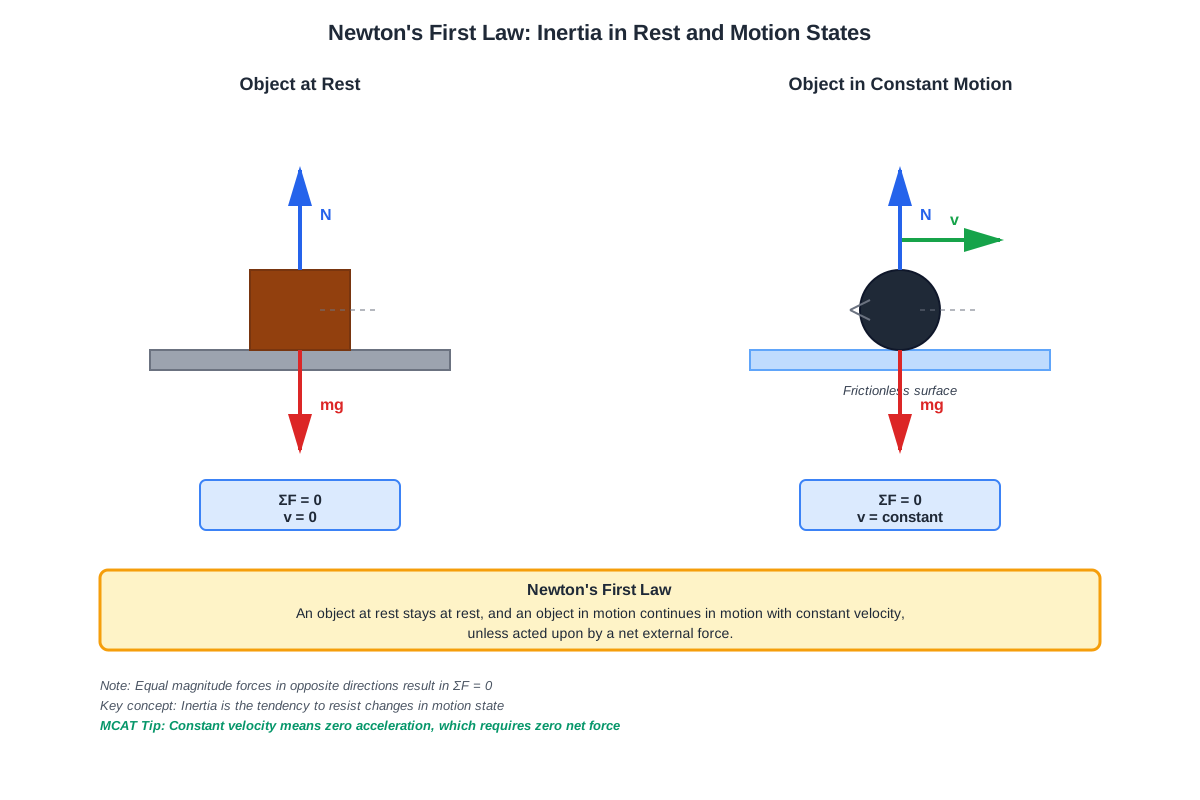
Newton first law formally states: "An object at rest remains at rest, and an object in motion continues to move with constant velocity (constant speed in a straight line), unless acted upon by a net external force." This principle, also called the law of inertia, establishes that objects naturally resist changes to their state of motion. The term inertia refers to this inherent property of matter to maintain its current motion state—whether stationary or moving.
The law contains two distinct but related components. First, objects at rest (velocity = 0) remain at rest when the net force equals zero. Second, objects in motion maintain constant velocity (both magnitude and direction unchanged) when the net force equals zero. Both scenarios share the critical condition: net force = 0. This means that while multiple forces may act on an object, if they sum vectorially to zero, Newton's first law governs the object's behavior.
Net Force and Equilibrium
The concept of net force (also called resultant force) represents the vector sum of all forces acting on an object. Mathematically, this is expressed as:
F_net = ΣF = F₁ + F₂ + F₃ + ... + FₙWhen F_net = 0, the object is in equilibrium. Two types of equilibrium exist: static equilibrium (object at rest) and dynamic equilibrium (object moving with constant velocity). Both satisfy Newton's first law because both involve zero net force. The MCAT frequently tests the distinction between these equilibrium types and situations involving net force.
Consider a book resting on a table. The gravitational force pulls downward (F_gravity = mg), while the normal force from the table pushes upward (F_normal). These forces are equal in magnitude and opposite in direction, producing F_net = 0. The book remains at rest, demonstrating static equilibrium. Now consider a car traveling at constant 60 mph on a straight highway. The engine's forward force exactly balances air resistance and friction, again producing F_net = 0. The car maintains constant velocity, demonstrating dynamic equilibrium.
Inertia and Mass
Inertia quantifies an object's resistance to changes in motion. The measure of inertia is mass—objects with greater mass possess greater inertia and resist motion changes more strongly. A bowling ball requires more force to accelerate than a tennis ball precisely because the bowling ball has greater inertia (greater mass). This relationship becomes explicit in Newton's second law (F = ma), but the concept originates from the first law.
The MCAT may present scenarios comparing objects of different masses under identical force conditions. Understanding that mass determines inertia helps predict which object will experience greater motion changes. For example, when equal forces act on a 1 kg object and a 10 kg object, the lighter object undergoes greater acceleration because it has less inertia resisting the motion change.
Reference Frames and Inertial Frames
Newton's first law holds true only in inertial reference frames—coordinate systems that are not accelerating. An inertial frame is one where an object with no net force acting on it either remains at rest or moves with constant velocity. Earth's surface approximates an inertial frame for most MCAT purposes, though technically Earth rotates and orbits the sun.
In non-inertial reference frames (accelerating frames), objects appear to experience forces that don't arise from physical interactions. These pseudo-forces or fictitious forces emerge because the reference frame itself accelerates. For example, when a car accelerates forward, passengers feel pushed backward into their seats. No actual backward force acts on the passengers; rather, their inertia resists the forward acceleration, and from the car's (non-inertial) reference frame, this appears as a backward force.
The MCAT may test this concept by presenting scenarios in elevators, rotating platforms, or accelerating vehicles. Recognizing whether a reference frame is inertial helps determine whether Newton's first law applies directly or requires modification.
Application to Free-Body Diagrams
Free-body diagrams (FBDs) serve as essential tools for applying Newton's first law. These diagrams represent an object as a point and show all forces acting on it as vectors. To determine whether Newton's first law applies, analyze the FBD to see if forces balance in all directions.
For equilibrium in two dimensions, forces must balance both horizontally and vertically:
ΣF_x = 0 (horizontal equilibrium)
ΣF_y = 0 (vertical equilibrium)
When both conditions are satisfied, the object either remains at rest or moves with constant velocity. MCAT questions frequently provide scenarios requiring FBD construction and force analysis to determine motion states.
Common Force Scenarios
Several force configurations appear repeatedly on the MCAT:
| Scenario | Forces Present | Equilibrium Condition |
|---|---|---|
| Object on horizontal surface | Weight (down), Normal force (up), Applied force (horizontal), Friction (horizontal) | Normal = Weight; Applied = Friction |
| Hanging object | Weight (down), Tension (up) | Tension = Weight |
| Object on incline | Weight components, Normal force, Friction | Forces parallel and perpendicular to incline both balance |
| Object in fluid | Weight (down), Buoyant force (up), Drag (opposes motion) | All forces sum to zero |
Understanding these standard configurations accelerates problem-solving on exam day.
Concept Relationships
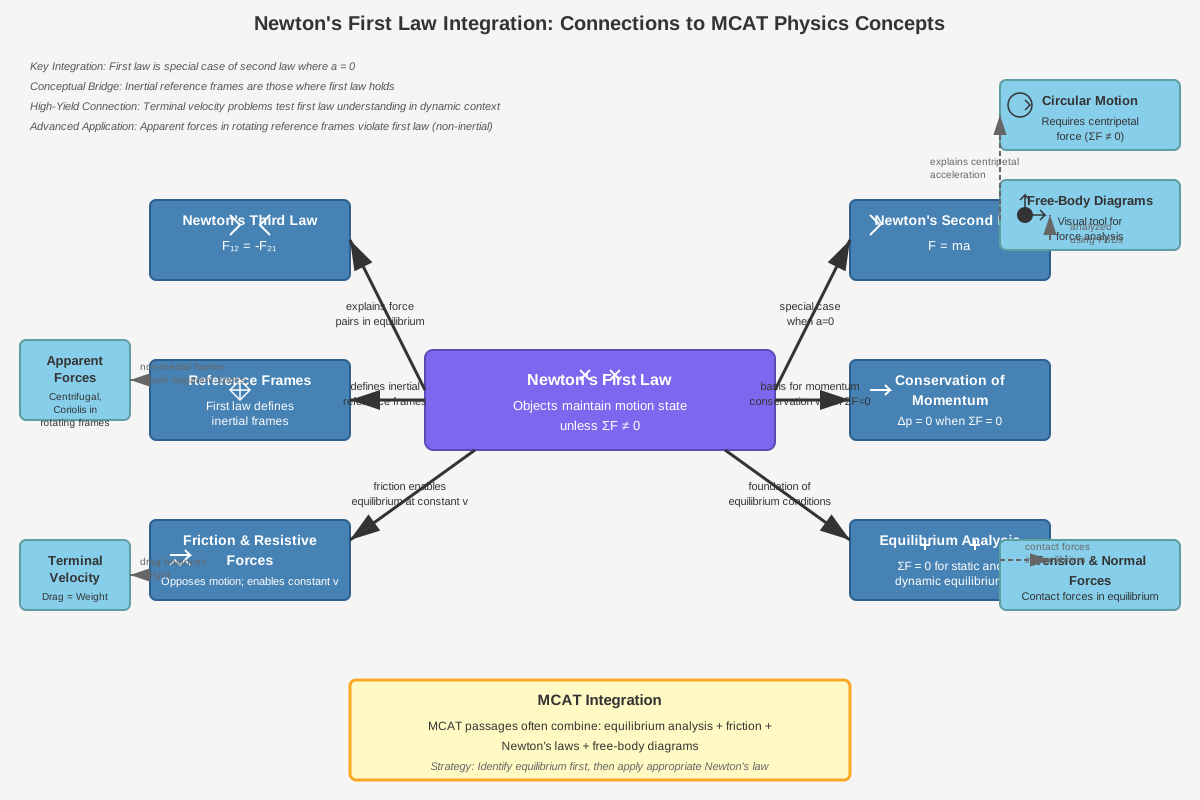
Newton's first law serves as the conceptual foundation for Newton's second law (F = ma). When net force equals zero, acceleration equals zero, representing the special case where Newton's first law applies. Conversely, when net force is non-zero, acceleration occurs, and Newton's second law governs the motion. This relationship can be visualized as: Newton's First Law (F_net = 0, a = 0) ↔ Newton's Second Law (F_net ≠ 0, a ≠ 0).
The first law connects intimately with kinematics. Constant velocity motion (described by x = x₀ + vt) occurs precisely when Newton's first law conditions are met. When net force becomes non-zero, motion transitions to constant acceleration kinematics (x = x₀ + v₀t + ½at²), governed by Newton's second law.
Newton's third law (action-reaction pairs) often appears alongside the first law in MCAT problems. While the third law describes force pairs between interacting objects, the first law describes the motion of individual objects based on net force. For example, a book on a table experiences downward gravitational force and upward normal force (first law analysis). The book also exerts downward force on the table, which exerts upward force on the book (third law pairs). These concepts are distinct but complementary.
The principle of inertia connects to momentum (p = mv). Objects in motion possess momentum, and Newton's first law implies that momentum remains constant when net force equals zero. This leads directly to the conservation of momentum principle for isolated systems. The relationship flows: Inertia → Constant Velocity (First Law) → Constant Momentum → Conservation of Momentum.
Friction and tension problems frequently invoke Newton's first law. When an object moves at constant velocity despite friction, the applied force exactly balances frictional force, satisfying F_net = 0. Similarly, objects suspended by cables at rest demonstrate tension forces balancing gravitational forces.
Quick check — test yourself on Newton first law so far.
Try Flashcards →High-Yield Facts
⭐ Newton's first law applies when net force equals zero, resulting in either rest or constant velocity motion
⭐ Constant velocity means both constant speed AND constant direction—circular motion at constant speed does NOT satisfy Newton's first law
⭐ Equilibrium (static or dynamic) always indicates that Newton's first law governs the system
⭐ Mass measures inertia—greater mass means greater resistance to motion changes
⭐ In inertial reference frames, objects with no net force maintain their velocity; in non-inertial frames, pseudo-forces appear
- An object can have multiple forces acting on it and still satisfy Newton's first law if those forces sum vectorially to zero
- Newton's first law is a special case of Newton's second law where acceleration equals zero
- The law applies independently in each dimension—an object can be in equilibrium vertically while accelerating horizontally
- Terminal velocity represents dynamic equilibrium where drag force balances gravitational force
- Objects in orbit experience gravitational force but are not in equilibrium because they continuously accelerate toward the central body
- The first law implies that force causes acceleration, not velocity—a common source of MCAT questions
- Inertial mass (resistance to acceleration) and gravitational mass (response to gravity) are equivalent, though conceptually distinct
Common Misconceptions
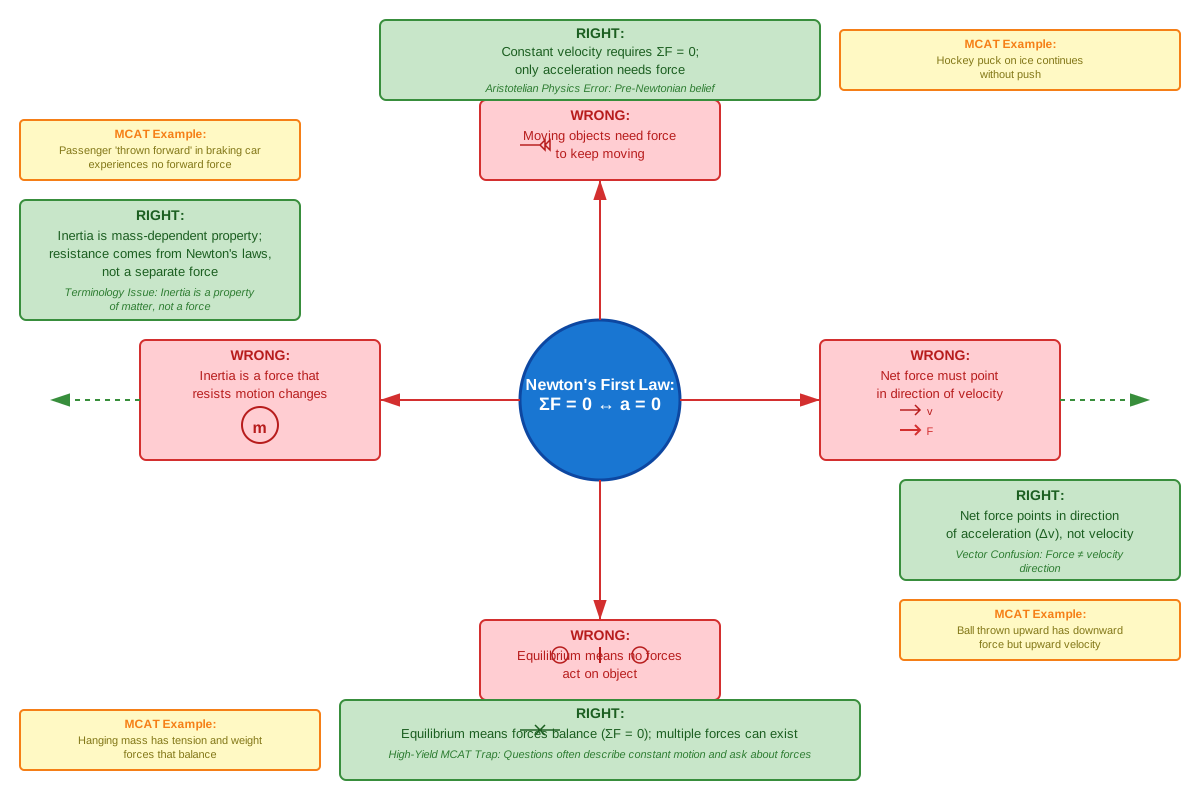
Misconception: Objects in motion naturally slow down and stop, so force is needed to maintain motion.
Correction: Objects in motion maintain constant velocity unless acted upon by net force. In everyday experience, friction and air resistance provide forces that slow objects, creating the illusion that motion naturally ceases. In frictionless environments (like space), objects continue moving indefinitely without applied force.
Misconception: If an object is moving, there must be a net force acting on it in the direction of motion.
Correction: Motion does not require net force; only changes in motion (acceleration) require net force. An object moving at constant velocity has zero net force acting on it, even though it's moving. Force causes acceleration, not velocity.
Misconception: Newton's first law only applies to objects at rest.
Correction: The law applies equally to objects at rest (static equilibrium) and objects moving with constant velocity (dynamic equilibrium). Both scenarios involve zero net force and satisfy the first law.
Misconception: Circular motion at constant speed satisfies Newton's first law because speed is constant.
Correction: Constant velocity requires both constant speed and constant direction. Circular motion involves continuously changing direction, meaning velocity changes even if speed remains constant. This requires centripetal acceleration and net force, so Newton's second law (not first law) applies.
Misconception: Heavier objects have more force acting on them, so they fall faster.
Correction: While heavier objects experience greater gravitational force (F = mg), they also have proportionally greater inertia (mass). These effects exactly cancel, producing identical acceleration for all objects in free fall (neglecting air resistance). This demonstrates the equivalence of inertial and gravitational mass.
Misconception: When you push on a wall and it doesn't move, no forces are acting.
Correction: Multiple forces act in this scenario. You exert force on the wall, the wall exerts equal and opposite force on you (Newton's third law), and the wall experiences your force balanced by forces from its foundation and structure. The wall remains at rest because net force equals zero (Newton's first law), not because forces are absent.
Misconception: In an accelerating elevator, objects inside experience additional gravitational force.
Correction: Gravitational force (weight) remains constant regardless of elevator motion. However, the elevator represents a non-inertial reference frame, creating pseudo-forces that make objects appear heavier or lighter. The actual gravitational force doesn't change; the apparent weight changes due to the non-inertial frame.
Worked Examples
Example 1: Block on Inclined Plane
Problem: A 5 kg block rests motionless on a 30° inclined plane. The coefficient of static friction between the block and plane is μ_s = 0.6. Determine whether Newton's first law applies and calculate the magnitude of the friction force.
Solution:
Step 1: Identify the motion state. The block is at rest, suggesting static equilibrium and Newton's first law application.
Step 2: Draw a free-body diagram. Forces acting on the block include:
- Weight (W = mg = 5 kg × 10 m/s² = 50 N, directed vertically downward)
- Normal force (N, perpendicular to incline surface)
- Static friction force (f_s, parallel to incline surface, opposing potential motion)
Step 3: Establish coordinate system. Use axes parallel and perpendicular to the incline surface.
Step 4: Decompose weight into components:
- Parallel to incline: W_parallel = mg sin(30°) = 50 N × 0.5 = 25 N (down the incline)
- Perpendicular to incline: W_perpendicular = mg cos(30°) = 50 N × 0.866 = 43.3 N (into the incline)
Step 5: Apply Newton's first law (equilibrium conditions):
Perpendicular to incline: ΣF_perp = 0
N - W_perpendicular = 0
N = 43.3 N
Parallel to incline: ΣF_parallel = 0
f_s - W_parallel = 0
f_s = 25 N (up the incline)
Step 6: Verify that static friction can provide this force:
Maximum static friction: f_s,max = μ_s × N = 0.6 × 43.3 N = 26 N
Since f_s (25 N) < f_s,max (26 N), static friction can maintain equilibrium.
Conclusion: Newton's first law applies because the block is in static equilibrium (at rest with F_net = 0). The friction force magnitude is 25 N, directed up the incline. This example demonstrates how Newton's first law requires force balance in all directions and how static friction adjusts to maintain equilibrium up to its maximum value.
Example 2: Skydiver at Terminal Velocity
Problem: A 70 kg skydiver falls through the atmosphere and reaches terminal velocity of 50 m/s. At this point, does Newton's first law or second law govern the motion? Calculate the magnitude of air resistance at terminal velocity.
Solution:
Step 1: Analyze the motion state. Terminal velocity means constant velocity (constant speed in straight downward direction). This indicates dynamic equilibrium.
Step 2: Identify which law applies. Constant velocity implies zero acceleration, which means zero net force. Therefore, Newton's first law governs the motion at terminal velocity.
Step 3: Draw a free-body diagram. Two forces act on the skydiver:
- Weight (W = mg, directed downward)
- Air resistance/drag (F_drag, directed upward, opposing motion)
Step 4: Apply Newton's first law (equilibrium condition):
ΣF = 0
F_drag - W = 0
F_drag = W
Step 5: Calculate weight:
W = mg = 70 kg × 10 m/s² = 700 N
Step 6: Determine air resistance:
F_drag = 700 N (upward)
Conclusion: Newton's first law applies at terminal velocity because the skydiver moves with constant velocity (dynamic equilibrium). The air resistance exactly balances the gravitational force at 700 N. This example illustrates that motion does not require net force—only changes in motion require net force. Before reaching terminal velocity, the skydiver accelerated downward (Newton's second law applied), but once drag increased to equal weight, acceleration ceased and Newton's first law took over.
MCAT Connection: Terminal velocity problems frequently appear in MCAT passages about fluid dynamics, drag forces, or physiological scenarios (blood cells settling in centrifuges, particles in solution). Recognizing that terminal velocity represents equilibrium helps quickly identify that forces balance and Newton's first law applies.
Exam Strategy
When approaching MCAT questions involving Newton's first law, begin by identifying the motion state described in the question stem or passage. Key trigger phrases include: "at rest," "constant velocity," "constant speed in a straight line," "equilibrium," "terminal velocity," and "uniform motion." These phrases signal that Newton's first law likely applies and net force equals zero.
Conversely, watch for phrases indicating Newton's first law does NOT apply: "accelerating," "speeding up," "slowing down," "changing direction," "circular motion," and "starting from rest." These scenarios involve non-zero net force and require Newton's second law instead.
Exam Tip: If a question asks whether an object is in equilibrium, immediately check if velocity is constant (magnitude and direction). Many students incorrectly assume constant speed alone indicates equilibrium, missing that changing direction means changing velocity and therefore non-zero net force.
For calculation problems, systematically apply this approach:
- Draw a free-body diagram showing all forces
- Choose an appropriate coordinate system (often aligned with motion or surface)
- Decompose forces into components along chosen axes
- Write equilibrium equations (ΣF_x = 0, ΣF_y = 0) for each direction
- Solve algebraically for unknown quantities
Process-of-elimination strategies work well for Newton's first law questions. If answer choices include scenarios with acceleration, immediately eliminate them if the question describes equilibrium. If choices suggest net force exists when the problem describes constant velocity, eliminate those options.
Time allocation: Most Newton's first law questions should take 60-90 seconds. If you find yourself spending more than 2 minutes, you may be overcomplicating the problem. Remember that the first law is conceptually simpler than the second law—if your solution involves complex calculations, reconsider whether you've correctly identified which law applies.
For passage-based questions, scan for experimental setups involving force measurements, equilibrium conditions, or objects at rest. These passages often test whether students can identify when systems are in equilibrium versus when they experience net force. Pay attention to control conditions where forces balance, as these frequently serve as comparison points for experimental conditions.
Memory Techniques
Mnemonic for Newton's First Law: "Inertia Resists Changes" (IRC)
- Inertia: Objects resist changes to motion
- Rest or constant velocity: The two states satisfying the law
- Changes require force: Only net force changes motion state
Visualization Strategy: Picture a hockey puck sliding on frictionless ice. Once set in motion, it continues indefinitely at constant velocity without additional force. This mental image captures the essence of inertia and helps remember that motion doesn't require force—only changes in motion require force.
Equilibrium Acronym: "ZERO Net Force"
- Zero acceleration
- Equilibrium (static or dynamic)
- Rest or constant velocity
- Opposite forces balance
Force Balance Mnemonic: "SAND" for analyzing equilibrium
- Sum all forces
- Analyze each direction separately
- Net force must equal zero
- Determine unknown forces from balance
Reference Frame Reminder: "Inertial frames are Not Accelerating" (INA)
This helps remember that Newton's first law applies directly only in inertial (non-accelerating) reference frames.
Summary
Newton's first law establishes that objects maintain their state of motion—either at rest or moving with constant velocity—unless acted upon by a net external force. This principle, also called the law of inertia, forms the foundation of classical mechanics and appears frequently on the MCAT in various contexts. The law applies when net force equals zero, creating either static equilibrium (rest) or dynamic equilibrium (constant velocity). Mass quantifies inertia, representing an object's resistance to motion changes. Understanding that force causes acceleration rather than velocity itself is crucial for MCAT success. The law holds true in inertial reference frames but requires modification in accelerating (non-inertial) frames where pseudo-forces appear. Common MCAT applications include objects on inclines, hanging masses, friction scenarios, and terminal velocity problems. Mastering Newton's first law requires recognizing equilibrium conditions, constructing accurate free-body diagrams, and distinguishing between scenarios where the first law applies (zero net force) versus where the second law applies (non-zero net force).
Key Takeaways
- Newton's first law states that objects at rest remain at rest and objects in motion maintain constant velocity unless acted upon by net external force
- The law applies when net force equals zero, creating equilibrium (static or dynamic)
- Constant velocity requires both constant speed AND constant direction—circular motion does not satisfy the first law
- Mass measures inertia, quantifying an object's resistance to changes in motion
- Force causes acceleration, not velocity—motion at constant velocity requires zero net force
- Free-body diagrams and force balance equations (ΣF = 0) are essential tools for applying the first law
- The first law is a special case of the second law where acceleration equals zero
Related Topics
Newton's Second Law (F = ma): Extends the first law to situations with non-zero net force, quantifying the relationship between force, mass, and acceleration. Mastering the first law provides the conceptual foundation for understanding when and how to apply the second law.
Newton's Third Law (Action-Reaction Pairs): Describes force pairs between interacting objects, complementing the first law's focus on individual object motion. Together, these laws enable comprehensive analysis of multi-body systems.
Friction and Drag Forces: These resistive forces frequently appear in first law problems, particularly in equilibrium scenarios where applied forces balance friction or drag. Understanding how friction maintains or prevents equilibrium is essential for MCAT success.
Circular Motion and Centripetal Force: Provides contrast to the first law by demonstrating that constant speed with changing direction requires net force. This topic clarifies the distinction between speed and velocity.
Conservation of Momentum: Emerges from Newton's first law for isolated systems where net external force equals zero. The first law's principle that momentum remains constant without net force leads directly to momentum conservation.
Practice CTA
Now that you've mastered the conceptual foundation of Newton's first law, it's time to solidify your understanding through active practice. Work through the practice questions and flashcards to test your ability to identify equilibrium conditions, analyze force scenarios, and distinguish between first and second law applications. Remember that MCAT success comes not just from understanding concepts but from applying them rapidly and accurately under test conditions. Each practice problem you solve strengthens your pattern recognition and builds the confidence you need to excel on exam day. You've built a strong foundation—now put it to work!
Sign up free to keep reading
Create a free AnvayaPrep account to finish this MCAT guide on Newton first law — plus flashcards and practice questions.