Overview
Newton's second law stands as one of the most fundamental principles in Physics and forms the cornerstone of classical Mechanics. This law establishes the quantitative relationship between force, mass, and acceleration, providing the mathematical framework needed to predict and analyze motion in virtually every physical system. For the MCAT, Newton's second law serves as an essential tool that appears across multiple contexts—from analyzing forces on the human body during movement to understanding cardiovascular dynamics and the behavior of objects in experimental passages.
The Newton second law is elegantly expressed as F = ma, where the net force acting on an object equals the product of its mass and acceleration. This deceptively simple equation underlies countless MCAT questions in the Chemical and Physical Foundations of Biological Systems section. Understanding this law enables students to solve problems involving inclined planes, pulley systems, circular motion, projectile motion, and even fluid dynamics. The Newton second law MCAT applications extend beyond pure physics problems into biological contexts, such as calculating forces during muscle contraction, analyzing centrifugation in laboratory settings, and understanding the mechanics of blood flow.
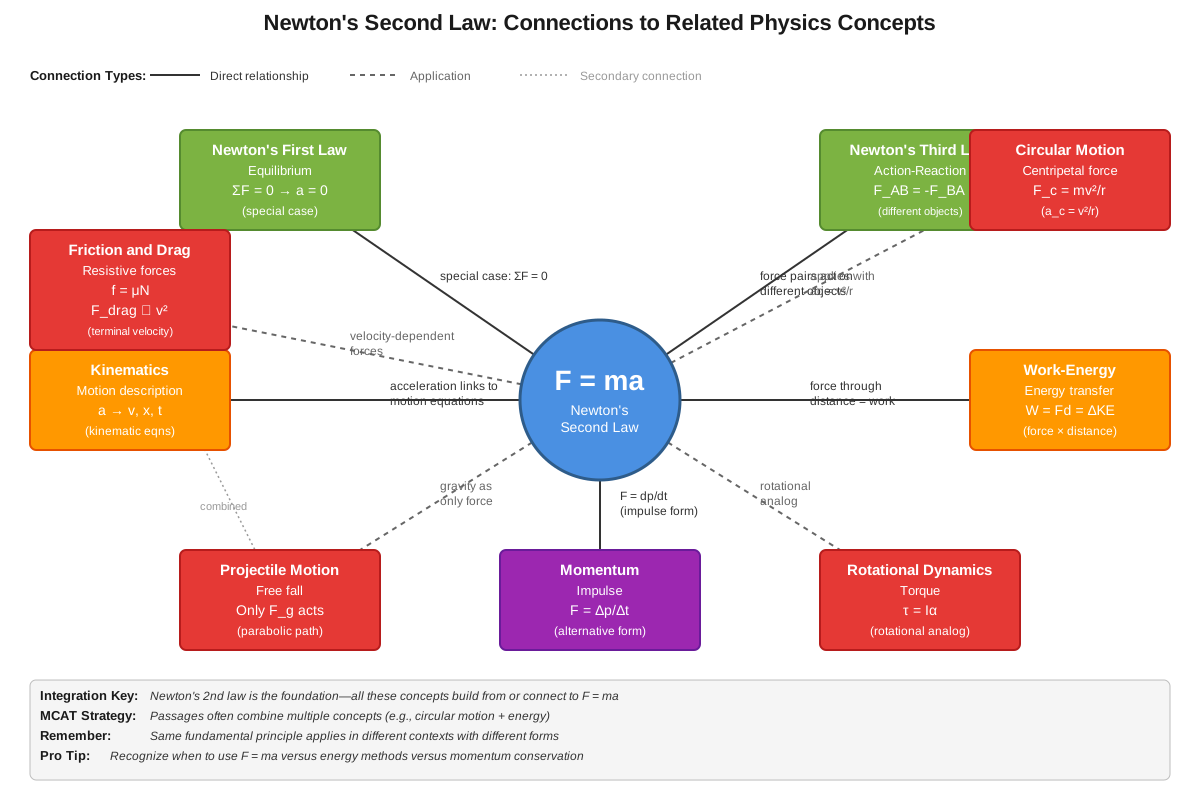
Within the broader landscape of Physics concepts tested on the MCAT, Newton's second law bridges kinematics (the description of motion) with dynamics (the causes of motion). It connects directly to Newton's first and third laws, work-energy relationships, momentum conservation, and rotational dynamics. Mastery of this topic provides the foundation for understanding how forces create changes in motion, which is essential for tackling approximately 15-20% of physics questions on the exam. The ability to quickly identify forces, draw free-body diagrams, and apply F = ma systematically separates high-scoring students from those who struggle with mechanics problems.
Learning Objectives
- [ ] Define Newton second law using accurate Physics terminology
- [ ] Explain why Newton second law matters for the MCAT
- [ ] Apply Newton second law to exam-style questions
- [ ] Identify common mistakes related to Newton second law
- [ ] Connect Newton second law to related Physics concepts
- [ ] Construct accurate free-body diagrams for multi-force systems
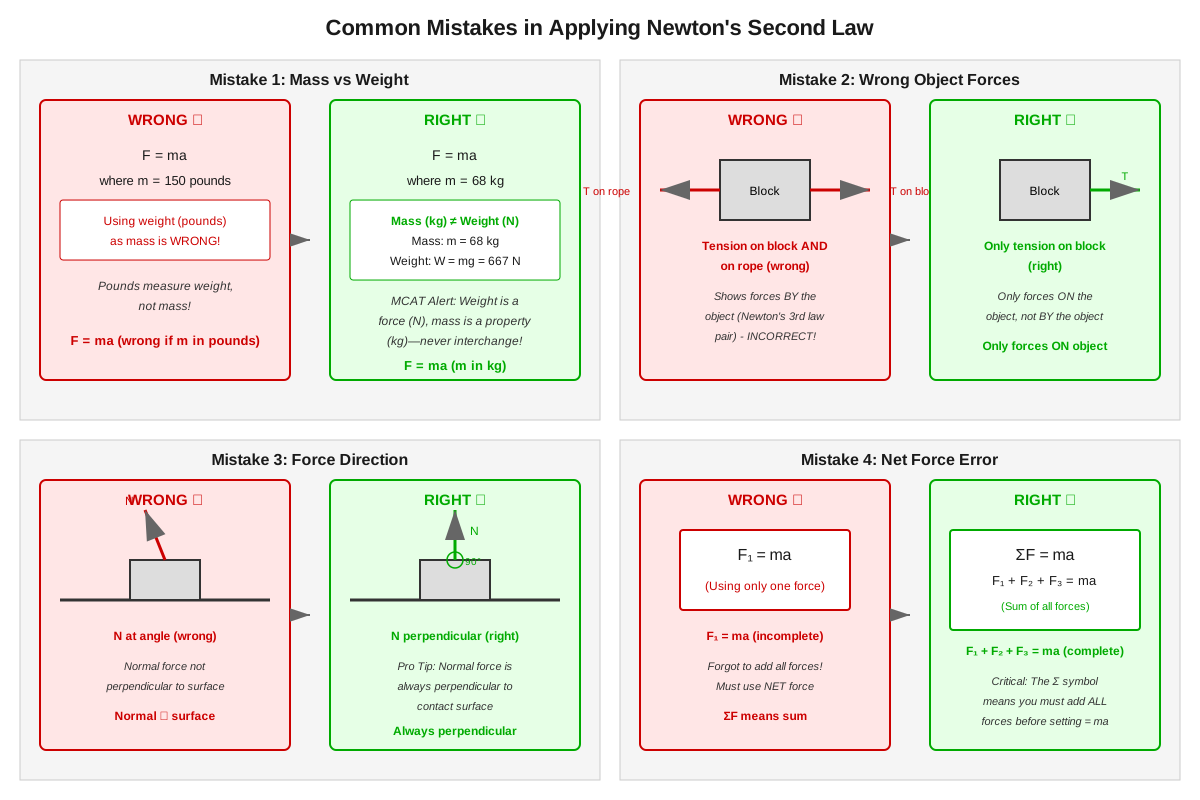
- [ ] Distinguish between mass and weight in force calculations
- [ ] Solve problems involving multiple objects connected by strings or in contact
- [ ] Apply Newton's second law in two dimensions simultaneously
Prerequisites
- Vector addition and decomposition: Newton's second law requires adding forces vectorially and resolving forces into components, particularly on inclined planes
- Kinematics equations: Understanding acceleration, velocity, and displacement relationships helps interpret the acceleration term in F = ma
- Basic trigonometry: Sine, cosine, and tangent functions are essential for decomposing forces into perpendicular components
- Units and dimensional analysis: Recognizing that force is measured in Newtons (kg⋅m/s²) prevents calculation errors
- Newton's first law: Understanding inertia and equilibrium (ΣF = 0) provides context for when acceleration occurs versus when it doesn't
Why This Topic Matters
Clinical and Real-World Significance
Newton's second law governs every aspect of human movement and medical intervention. When a physical therapist designs rehabilitation exercises, they apply this law to calculate the forces muscles must generate to move limbs against resistance. Orthopedic surgeons use these principles to understand fracture mechanics and the forces that bones must withstand. In cardiology, the acceleration of blood through vessels relates directly to pressure gradients (forces) and fluid mass. Even the simple act of standing requires muscles to generate forces that counteract gravitational acceleration, a direct application of F = ma.
Exam Statistics and Question Types
Newton's second law appears in approximately 8-12 questions per MCAT exam, either directly or as a necessary step in solving more complex problems. The MCAT tests this concept through:
- Discrete questions asking for direct calculation of force, mass, or acceleration
- Passage-based questions embedded in experimental contexts (centrifuges, inclined surfaces, pulley systems)
- Pseudo-discrete questions requiring force analysis as an intermediate step to answer questions about energy, momentum, or work
- Two-dimensional problems involving projectile motion or forces on inclined planes
Common Exam Contexts
MCAT passages frequently present Newton's second law within:
- Laboratory centrifugation scenarios (circular motion applications)
- Biomechanics passages analyzing joint forces, muscle tension, or gait analysis
- Experimental apparatus descriptions involving masses, pulleys, and strings
- Cardiovascular physiology passages where pressure differences create fluid acceleration
- Sports medicine contexts examining impact forces, jumping mechanics, or collision dynamics
Core Concepts
The Fundamental Statement of Newton's Second Law
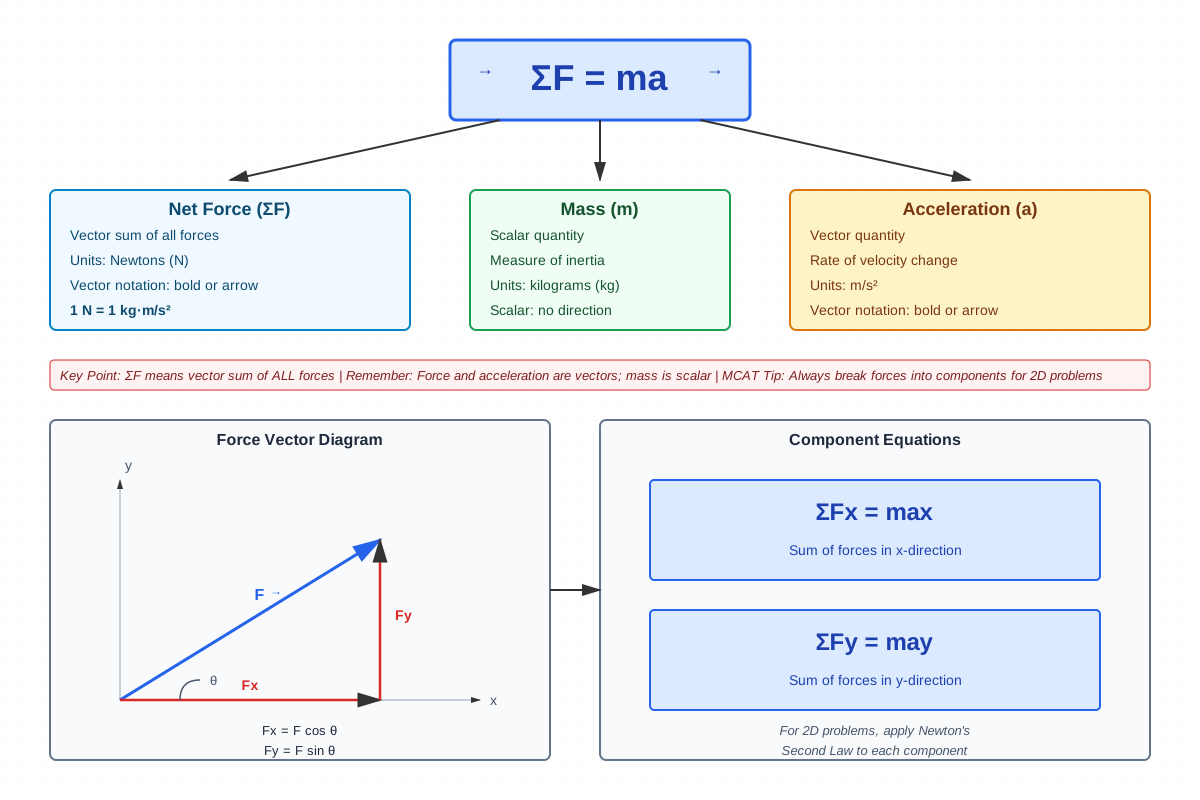
Newton's second law states that the acceleration of an object is directly proportional to the net force acting upon it and inversely proportional to its mass. Mathematically:
ΣF = maWhere:
- ΣF (sigma F) represents the vector sum of all forces acting on the object (net force)
- m is the object's mass (a scalar quantity measured in kilograms)
- a is the resulting acceleration (a vector quantity measured in m/s²)
The vector nature of this equation is crucial: both force and acceleration have magnitude and direction. The acceleration vector always points in the same direction as the net force vector. This means Newton's second law actually represents three equations when working in three-dimensional space (one for each coordinate axis):
ΣFₓ = maₓ
ΣFᵧ = maᵧ
ΣFᵤ = maᵤ
For MCAT purposes, most problems involve one or two dimensions, but understanding the component-wise application is essential for inclined plane problems and projectile motion.
Mass vs. Weight: A Critical Distinction
Mass is an intrinsic property of matter representing the quantity of material in an object and its resistance to acceleration (inertia). Mass remains constant regardless of location. Weight, however, is the gravitational force acting on a mass:
W = mgWhere g is the acceleration due to gravity (approximately 9.8 m/s² or 10 m/s² for MCAT calculations). Weight is a force measured in Newtons, while mass is measured in kilograms. This distinction is frequently tested: when an object is on a scale, the scale reads the normal force, which equals weight only when the object is at rest or moving at constant velocity. During acceleration (like in an elevator), the scale reading differs from the object's weight.
Net Force and Force Summation
The net force (ΣF) is the vector sum of all individual forces acting on an object. To find net force:
- Identify all forces acting on the object
- Choose a coordinate system (typically with one axis along the direction of motion)
- Resolve all forces into components along chosen axes
- Sum all x-components to get ΣFₓ
- Sum all y-components to get ΣFᵧ
- Apply Newton's second law to each direction independently
Common forces to consider include:
- Gravitational force (weight): always acts downward with magnitude mg
- Normal force: perpendicular to contact surfaces
- Tension: along strings, ropes, or cables (always pulls)
- Friction: opposes motion or potential motion along surfaces
- Applied forces: pushes or pulls from external agents
- Air resistance: opposes motion through fluids
Free-Body Diagrams: The Essential Tool
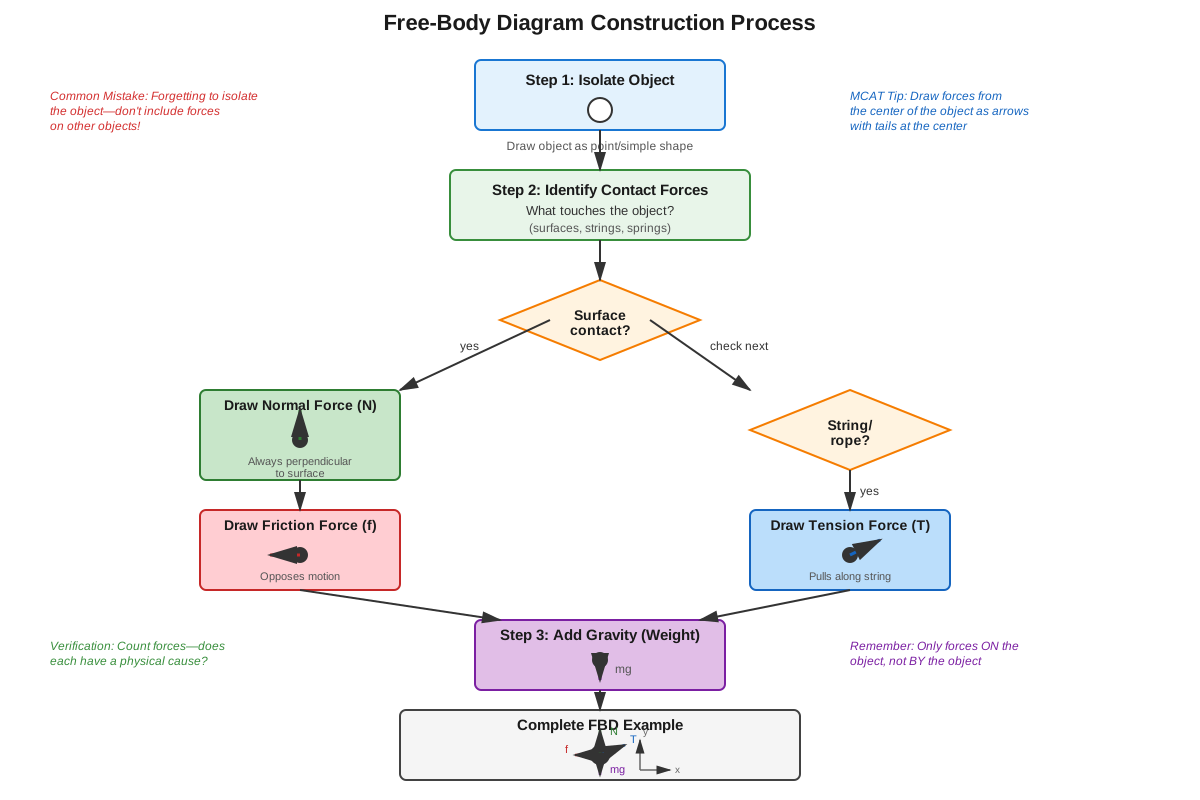
A free-body diagram (FBD) is a simplified representation showing only the object of interest and all forces acting on it. Creating accurate FBDs is the most important skill for applying Newton's second law:
Steps to construct a free-body diagram:
- Isolate the object of interest (draw it as a dot or simple shape)
- Identify every force acting ON the object (not forces the object exerts on other things)
- Draw each force as an arrow starting from the object's center
- Label each force with its type and magnitude (if known)
- Make arrow lengths roughly proportional to force magnitudes
- Indicate your chosen coordinate system with labeled axes
MCAT Tip: Even if not explicitly asked, quickly sketching a free-body diagram on your scratch paper prevents missing forces and helps organize your solution approach.
Applications to Connected Systems
When multiple objects are connected (by strings, in contact, or on surfaces), Newton's second law must be applied strategically:
For objects connected by massless, inextensible strings:
- All connected objects have the same magnitude of acceleration
- Tension is uniform throughout a massless string
- Draw separate free-body diagrams for each object
- Write Newton's second law for each object
- Solve the system of equations simultaneously
For objects in contact:
- Objects in contact share a normal force pair (Newton's third law)
- If moving together, they share the same acceleration
- Can sometimes treat the system as a single object with combined mass
Newton's Second Law on Inclined Planes
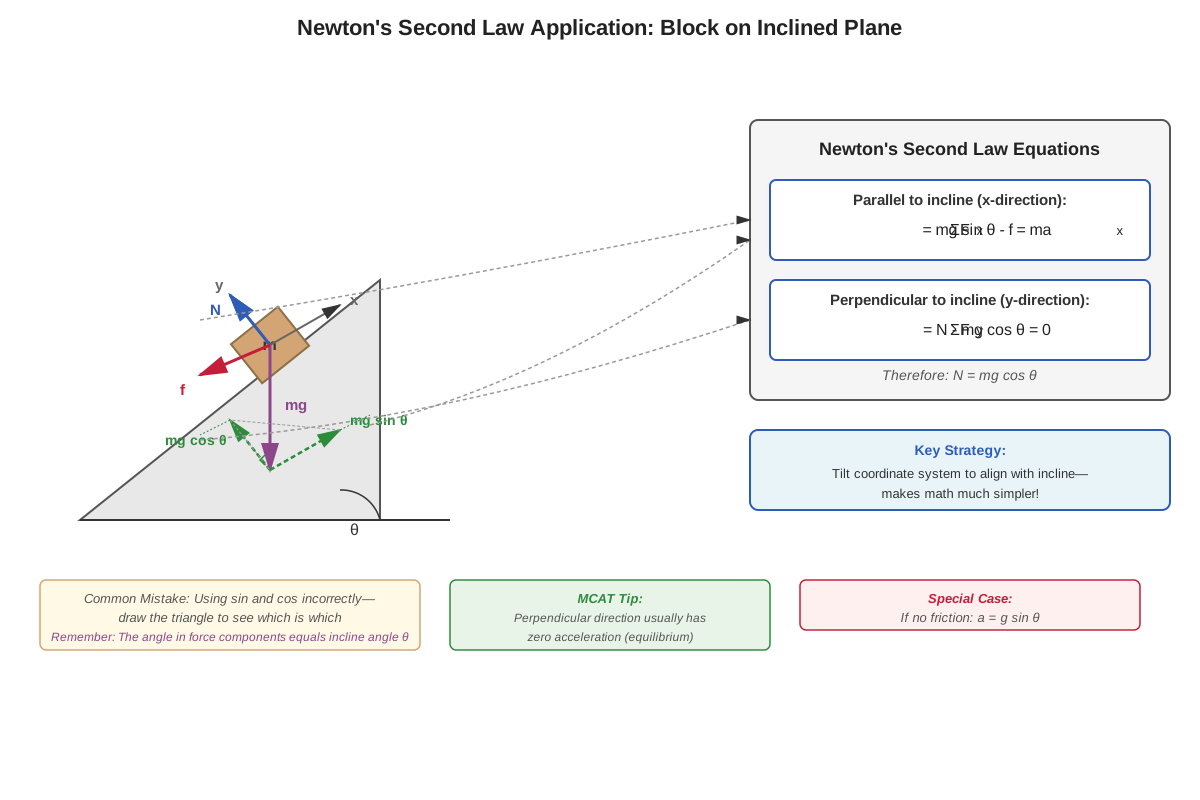
Inclined plane problems are high-yield for the MCAT. The key is choosing an appropriate coordinate system:
Standard approach:
- Rotate the coordinate system so the x-axis is parallel to the incline
- The y-axis is perpendicular to the incline
- Decompose the gravitational force:
- Component parallel to incline: mg sin(θ)
- Component perpendicular to incline: mg cos(θ)
- Normal force equals mg cos(θ) when no other perpendicular forces exist
- Apply ΣF = ma along the incline direction
| Force Component | Direction | Magnitude |
|---|---|---|
| Weight parallel to incline | Down the slope | mg sin(θ) |
| Weight perpendicular to incline | Into the surface | mg cos(θ) |
| Normal force | Away from surface | N = mg cos(θ) (if no acceleration perpendicular to surface) |
| Friction (if present) | Opposing motion | f = μN |
Circular Motion and Centripetal Force
When Newton's second law is applied to circular motion, the acceleration is centripetal (directed toward the center):
ΣF_radial = ma_c = m(v²/r)The net force toward the center provides the centripetal acceleration. This "centripetal force" is not a new type of force but rather the net effect of real forces (tension, gravity, normal force, friction) that happen to point toward the center. MCAT questions often involve:
- Objects on strings moving in horizontal or vertical circles
- Cars rounding curves (friction provides centripetal force)
- Centrifuges in laboratory settings
- Planetary or satellite motion
Problem-Solving Framework
Systematic approach for Newton's second law problems:
- Read carefully and identify what is being asked
- Draw a diagram showing the physical situation
- Identify the object(s) whose motion you need to analyze
- Create free-body diagram(s) for each object
- Choose coordinate system(s) aligned with motion when possible
- Write Newton's second law for each direction: ΣF = ma
- Substitute known values and force expressions
- Solve algebraically before plugging in numbers
- Check units and reasonableness of answer
Concept Relationships
Newton's second law serves as the central hub connecting multiple mechanics concepts. Newton's first law (inertia) is actually a special case of the second law: when ΣF = 0, then a = 0, meaning objects maintain constant velocity. Newton's third law (action-reaction pairs) identifies the forces that appear in the ΣF term—every force in a free-body diagram has an equal and opposite partner acting on a different object.
The relationship flows as follows: Forces (from various sources) → Net force calculation (vector sum) → Newton's second law application (ΣF = ma) → Acceleration determination → Kinematics equations (to find velocity, position, time) → Work-energy theorem (integrating force over distance) → Momentum changes (integrating force over time).
Friction and normal forces are forces that appear in the ΣF summation. Gravitational force (weight) is always present near Earth's surface. These forces, when summed and applied through F = ma, determine acceleration. That acceleration then connects to kinematics (describing the resulting motion) and to energy concepts (since work equals force times displacement, and kinetic energy relates to velocity squared).
For circular motion, Newton's second law takes the specific form ΣF_radial = mv²/r, connecting linear concepts to rotational dynamics. For systems of particles, the second law can be applied to the center of mass: ΣF_external = M_total × a_cm, bridging individual particle dynamics to system behavior.
High-Yield Facts
⭐ Newton's second law states ΣF = ma, where net force equals mass times acceleration; both force and acceleration are vectors pointing in the same direction
⭐ Weight (W = mg) is a force measured in Newtons; mass is measured in kilograms and represents inertia
⭐ On an incline of angle θ, the component of weight parallel to the surface is mg sin(θ), and perpendicular is mg cos(θ)
⭐ For objects connected by massless strings, all objects have the same magnitude of acceleration, and tension is uniform throughout each string
⭐ In circular motion, the net force toward the center equals mv²/r, where v is tangential speed and r is radius
- The normal force equals weight (mg) only when an object is on a horizontal surface with no vertical acceleration
- When an elevator accelerates upward, apparent weight (normal force) exceeds actual weight; when accelerating downward, apparent weight is less than actual weight
- For two objects in contact on a frictionless surface with applied force F, the contact force between them is F × (m₂/(m₁ + m₂))
- The acceleration of a system can be found by treating all connected objects as a single system with combined mass and considering only external forces
- In two-dimensional problems, apply Newton's second law independently to x and y directions: ΣFₓ = maₓ and ΣFᵧ = maᵧ
- The net force is zero when an object moves at constant velocity (including zero velocity), not just when stationary
- Tension in a rope pulling an object up an incline must overcome both the parallel component of weight and friction
Quick check — test yourself on Newton second law so far.
Try Flashcards →Common Misconceptions
Misconception: Force is required to maintain constant velocity motion.
Correction: Newton's second law shows that when ΣF = 0, acceleration is zero, meaning velocity remains constant (which could be zero or any constant value). Force is only required to change velocity (accelerate), not to maintain it. This confusion stems from everyday experience with friction, which requires continuous applied force to counteract.
Misconception: Heavier objects always accelerate faster than lighter objects when dropped.
Correction: In the absence of air resistance, all objects experience the same gravitational acceleration (g ≈ 9.8 m/s²) regardless of mass. While weight (force) is greater for heavier objects (W = mg), mass is proportionally greater, so a = F/m = mg/m = g. Air resistance does affect objects differently based on their mass-to-surface-area ratio, but this is a secondary effect.
Misconception: The normal force always equals the weight of an object.
Correction: The normal force equals weight only for objects on horizontal surfaces with no vertical acceleration. On inclines, N = mg cos(θ). In accelerating systems (like elevators), N = m(g ± a), where the sign depends on acceleration direction. The normal force is whatever value is required to prevent the object from penetrating the surface.
Misconception: Tension in a rope is always equal to the weight of the hanging object.
Correction: Tension equals weight only when the object is at rest or moving at constant velocity (a = 0). When accelerating upward, T > mg; when accelerating downward, T < mg. Apply Newton's second law: T - mg = ma, so T = m(g + a), where a is positive upward.
Misconception: In connected systems, all forces are equal.
Correction: While connected objects share the same acceleration magnitude, the forces on each object differ. For example, in an Atwood machine (two masses over a pulley), the heavier mass experiences greater weight, but both experience the same tension. The net force on each differs, but their accelerations have equal magnitude because their masses differ proportionally.
Misconception: Centrifugal force is a real force that should appear in free-body diagrams.
Correction: Centrifugal force is a fictitious force that appears only in rotating reference frames. In an inertial reference frame (which should always be used for MCAT problems), only real forces (tension, gravity, normal force, friction) appear. The net inward force provides centripetal acceleration; there is no outward centrifugal force in the correct analysis.
Misconception: Newton's second law only applies to objects that are moving.
Correction: Newton's second law applies to all objects at all times. When an object is stationary, a = 0, which means ΣF = 0 (equilibrium). The law doesn't require motion; it relates net force to acceleration, which can be zero.
Worked Examples
Example 1: Elevator Acceleration Problem
Problem: A 70 kg person stands on a scale in an elevator. The scale reads 840 N. Determine the acceleration of the elevator and its direction. (Use g = 10 m/s²)
Solution:
Step 1: Identify the situation
The scale reading represents the normal force (N) exerted by the scale on the person. The person experiences two forces: weight (downward) and normal force (upward).
Step 2: Draw a free-body diagram
- Weight: W = mg = (70 kg)(10 m/s²) = 700 N (downward)
- Normal force: N = 840 N (upward, given by scale reading)
Step 3: Choose coordinate system
Let upward be positive (+y direction).
Step 4: Apply Newton's second law
ΣF = ma
N - W = ma
840 N - 700 N = (70 kg)a
140 N = (70 kg)a
a = 2 m/s²
Step 5: Interpret the result
The acceleration is +2 m/s² (positive indicates upward direction). The elevator is either:
- Accelerating upward at 2 m/s², or
- Decelerating while moving downward at 2 m/s²
Both scenarios produce upward acceleration.
Key insight: The scale reads more than the person's weight (700 N) because the elevator accelerates upward. This is why you feel heavier when an elevator starts moving upward. The apparent weight (normal force) differs from actual weight during acceleration.
Example 2: Two-Block System with Pulley
Problem: Two blocks are connected by a massless string over a frictionless pulley. Block A (mass = 4 kg) rests on a frictionless horizontal table, while Block B (mass = 6 kg) hangs vertically. When released, find: (a) the acceleration of the system, and (b) the tension in the string. (Use g = 10 m/s²)
Solution:
Step 1: Visualize and identify
Block A will accelerate horizontally to the right; Block B will accelerate downward. Both have the same magnitude of acceleration because they're connected by an inextensible string.
Step 2: Free-body diagrams
For Block A (horizontal motion):
- Tension T (to the right)
- Normal force N (upward)
- Weight 4g (downward)
Note: N and weight cancel in the vertical direction (no vertical acceleration)
For Block B (vertical motion):
- Tension T (upward)
- Weight 6g (downward)
Step 3: Choose coordinate systems
For A: positive direction is to the right
For B: positive direction is downward (to match the direction of motion)
Step 4: Apply Newton's second law to each block
For Block A (horizontal):
ΣF = ma
T = (4 kg)a
For Block B (vertical, taking downward as positive):
ΣF = ma
6g - T = (6 kg)a
60 N - T = (6 kg)a
Step 5: Solve the system of equations
From Block A: T = 4a
Substitute into Block B equation:
60 - 4a = 6a
60 = 10a
a = 6 m/s²
Step 6: Find tension
T = 4a = 4(6) = 24 NAnswers:
(a) The system accelerates at 6 m/s²
(b) The tension in the string is 24 N
Key insights:
- The acceleration (6 m/s²) is less than free fall (10 m/s²) because Block A's inertia resists the motion
- Tension (24 N) is less than Block B's weight (60 N) because Block B accelerates downward
- If Block A were much more massive, acceleration would approach zero; if Block A were negligible, acceleration would approach g
Exam Strategy
Question Recognition and Approach
When you encounter an MCAT question involving forces and motion, immediately ask: "What is accelerating?" If anything is changing velocity (speeding up, slowing down, or changing direction), Newton's second law applies. Look for these trigger phrases:
- "What force is required to..."
- "Calculate the acceleration..."
- "The tension in the rope..."
- "An object on an incline..."
- "A mass hanging from..."
- "In a centrifuge rotating at..."
Systematic Problem-Solving Sequence
- Invest 10-15 seconds in a free-body diagram even if the question seems simple—this prevents careless errors
- Identify whether the problem involves one or two dimensions—inclines and projectiles require component analysis
- Look for equilibrium conditions first—if velocity is constant, ΣF = 0, which often simplifies the problem
- For connected systems, decide whether to analyze individually or as a combined system—use combined mass when finding system acceleration, individual analysis when finding internal forces like tension
Process of Elimination Tips
- Eliminate answers with wrong units: Force must be in Newtons (kg⋅m/s²), acceleration in m/s², mass in kg
- Check limiting cases: If mass approaches zero, acceleration should approach infinity (for fixed force); if force approaches zero, acceleration should approach zero
- Verify direction: Acceleration must be in the same direction as net force—eliminate answers suggesting otherwise
- Compare magnitudes: In elevator problems, if accelerating upward, normal force > weight; eliminate answers showing N < mg
- For incline problems: The parallel component mg sin(θ) must be less than mg (since sin(θ) < 1 for θ < 90°)
Time Management
- Discrete questions: Allocate 60-90 seconds; if you can't identify the forces within 30 seconds, flag and move on
- Passage-based questions: Use passage information to identify the physical setup, then apply standard Newton's second law approach (90-120 seconds)
- Multi-step problems: If asked for final velocity or displacement after finding acceleration, remember you'll need kinematics equations—budget extra time
High-Yield Strategy: On test day, if you see a pulley system or inclined plane, immediately draw the free-body diagram on your scratch paper before even reading the question stem completely. This primes your brain for the force analysis and saves time.
Memory Techniques
The "FIND" Mnemonic for Problem-Solving
Free-body diagram first
Identify all forces
Net force calculation (vector sum)
Determine acceleration using ΣF = ma
Incline Force Components: "Sine Slides, Cosine Crushes"
- Sine slides: The component parallel to the incline (causing sliding) is mg sin(θ)
- Cosine crushes: The component perpendicular to the incline (crushing into surface) is mg cos(θ)
Visualization: As the angle increases toward 90°, sine increases (more sliding tendency) and cosine decreases (less crushing into surface), which matches physical intuition.
Elevator Acceleration: "Up-Up, Down-Down"
- Accelerating up → apparent weight goes up (N > mg)
- Accelerating down → apparent weight goes down (N < mg)
Remember: The direction of acceleration determines whether you add or subtract from g in the equation N = m(g ± a).
Force Type Checklist: "GNT-FAR"
When drawing free-body diagrams, check for:
- Gravity (weight, always present near Earth)
- Normal (perpendicular to surfaces in contact)
- Tension (along strings, ropes, cables)
- Friction (parallel to surfaces, opposes motion)
- Applied forces (pushes, pulls from external agents)
- Resistance (air or fluid resistance)
Vector Direction Rule
"Force and acceleration are friends—they always point the same way"
The net force vector and acceleration vector are always parallel. If you calculate an acceleration pointing left but your net force points right, you've made an error.
Summary
Newton's second law, expressed as ΣF = ma, establishes the fundamental relationship between forces and motion that underlies virtually all mechanics problems on the MCAT. This law states that the vector sum of all forces acting on an object equals the product of the object's mass and its acceleration, with force and acceleration always pointing in the same direction. Successful application requires constructing accurate free-body diagrams, identifying all forces acting on the object of interest, resolving forces into components when necessary, and applying the law independently to each dimension. Critical distinctions include recognizing that mass and weight are different (weight is the gravitational force W = mg), understanding that normal force equals weight only in specific circumstances, and knowing that connected objects share acceleration magnitude but experience different individual forces. For MCAT success, students must master systematic problem-solving approaches, recognize common setups like inclined planes (where weight components are mg sin θ parallel and mg cos θ perpendicular to the surface) and connected systems (where tension and acceleration relate through simultaneous equations), and apply the law to circular motion contexts where net inward force provides centripetal acceleration.
Key Takeaways
- Newton's second law (ΣF = ma) relates net force to acceleration; both are vectors pointing in the same direction, and the law applies independently to each coordinate direction
- Free-body diagrams are essential—they prevent missing forces and organize the solution by showing only forces acting ON the object of interest
- Weight (W = mg) is a force in Newtons; mass is in kilograms—normal force equals weight only on horizontal surfaces with no vertical acceleration
- On inclines, decompose weight into mg sin(θ) parallel to the surface and mg cos(θ) perpendicular to it—this is the highest-yield geometry relationship for MCAT mechanics
- Connected systems require separate free-body diagrams for each object—all connected objects share acceleration magnitude, but individual forces differ
- Apparent weight changes during acceleration—in elevators accelerating upward, N = m(g + a); accelerating downward, N = m(g - a)
- Centripetal acceleration in circular motion requires net inward force—apply ΣF_radial = mv²/r, where the net force comes from real forces like tension, gravity, or friction
Related Topics
Newton's First Law (Inertia): Understanding equilibrium conditions (ΣF = 0) provides the foundation for recognizing when Newton's second law predicts zero acceleration versus non-zero acceleration. Mastering the second law makes first law applications trivial.
Newton's Third Law (Action-Reaction): Every force in a free-body diagram has an equal and opposite partner acting on a different object. Understanding force pairs helps identify all forces correctly when applying the second law.
Friction and Drag Forces: These resistive forces appear in the ΣF summation and often oppose motion. Combining friction (f = μN) with Newton's second law enables solving problems involving surfaces with resistance.
Work-Energy Theorem: Force applied over a distance does work (W = Fd cos θ), changing kinetic energy. Newton's second law provides the force needed to calculate work, bridging dynamics and energy concepts.
Impulse and Momentum: Force applied over time changes momentum (FΔt = Δp). Newton's second law can be rewritten as F = Δp/Δt, connecting force to momentum changes and preparing for collision problems.
Circular Motion and Centripetal Force: Applying Newton's second law to circular paths requires understanding that acceleration points toward the center with magnitude v²/r, leading to advanced applications in laboratory centrifuges and planetary motion.
Rotational Dynamics: The rotational analog of F = ma is τ = Iα (torque equals moment of inertia times angular acceleration), extending Newton's second law principles to rotating systems.
Practice CTA
Now that you've mastered the core concepts of Newton's second law, it's time to solidify your understanding through active practice. Work through the practice questions to test your ability to construct free-body diagrams, apply the law to multi-dimensional problems, and analyze connected systems. Use the flashcards to reinforce high-yield facts and common problem setups. Remember: understanding the theory is only half the battle—MCAT success comes from repeatedly applying these principles under timed conditions until the problem-solving approach becomes automatic. Every practice problem you solve builds the pattern recognition and confidence you'll need on test day. You've got this!
Sign up free to keep reading
Create a free AnvayaPrep account to finish this MCAT guide on Newton second law — plus flashcards and practice questions.