Overview
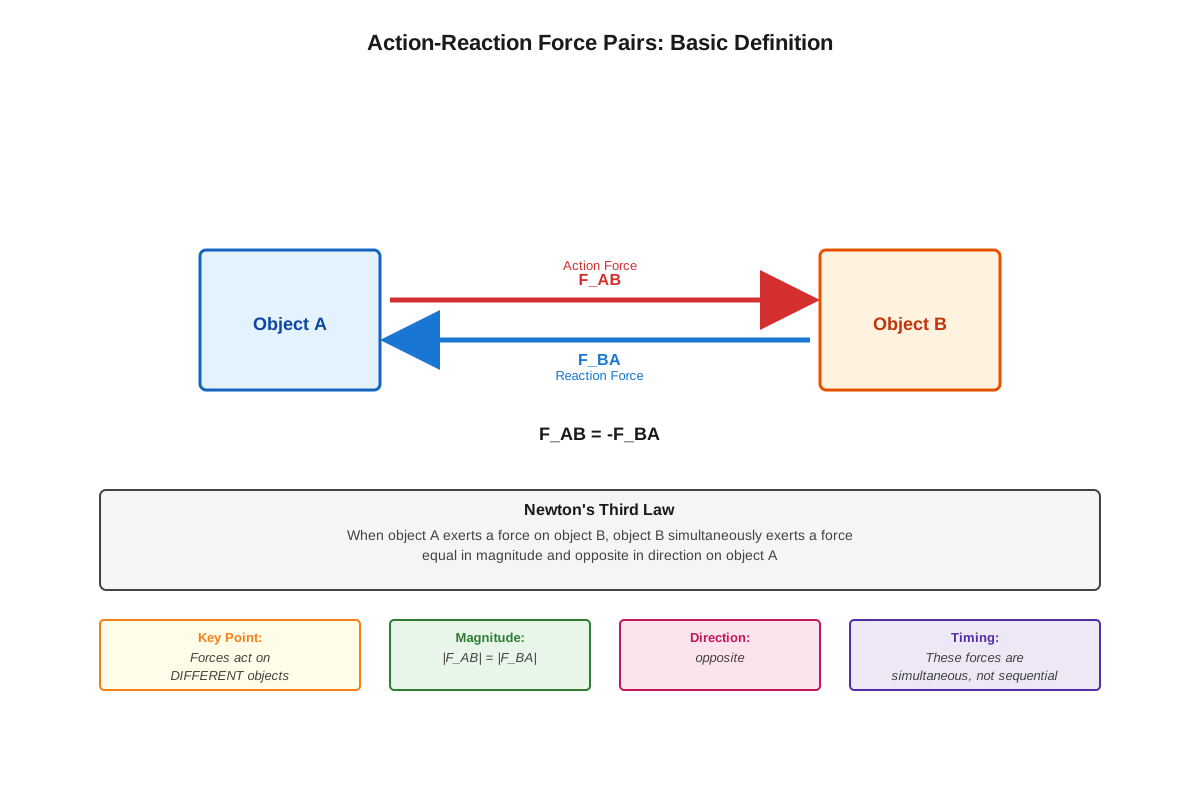
Newton's third law is one of the three foundational principles of classical mechanics that governs how objects interact through forces. Often stated as "for every action, there is an equal and opposite reaction," this law describes the mutual nature of forces between two interacting bodies. When object A exerts a force on object B, object B simultaneously exerts a force of equal magnitude but opposite direction on object A. These paired forces, called action-reaction pairs, are fundamental to understanding everything from rocket propulsion to the biomechanics of human movement. Unlike Newton's first and second laws, which focus on individual objects, the third law emphasizes the reciprocal nature of all force interactions in the universe.
For the MCAT, Newton's third law appears frequently in both standalone questions and passage-based problems across multiple contexts. Test-makers favor this topic because it requires conceptual understanding rather than mere memorization, and it connects seamlessly to biological systems such as muscle contraction, cardiovascular dynamics, and locomotion. Students must recognize action-reaction pairs in complex scenarios, distinguish them from balanced forces on a single object, and apply the law to solve quantitative problems involving multiple interacting bodies. The Physics section of the MCAT regularly tests whether students can identify which forces form true action-reaction pairs versus forces that merely balance each other on one object.
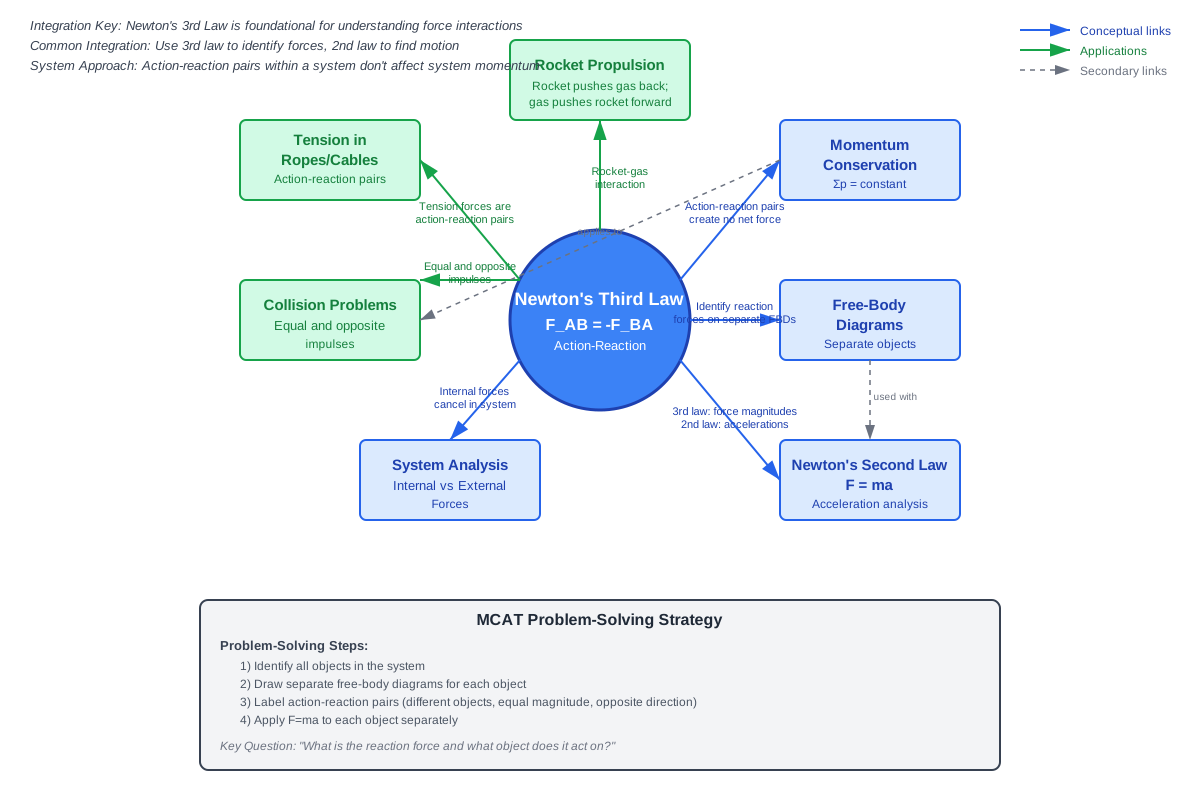
This topic integrates deeply with other Physics concepts in the Mechanics unit. Newton's third law works in concert with the first and second laws to provide a complete framework for analyzing motion and forces. It connects to momentum conservation (since action-reaction pairs create no net external force on a system), free-body diagrams (where identifying all forces requires recognizing reaction forces), and energy transfer between objects. Understanding this law is essential for analyzing collisions, tension in ropes, normal forces, and any scenario involving contact or gravitational interactions between bodies.
Learning Objectives
- [ ] Define Newton's third law using accurate Physics terminology
- [ ] Explain why Newton's third law matters for the MCAT
- [ ] Apply Newton's third law to exam-style questions
- [ ] Identify common mistakes related to Newton's third law
- [ ] Connect Newton's third law to related Physics concepts
- [ ] Distinguish between action-reaction pairs and balanced forces on a single object
- [ ] Calculate the magnitude and direction of reaction forces in multi-body systems
- [ ] Analyze biological systems using Newton's third law principles
Prerequisites
- Newton's First Law (Law of Inertia): Understanding that objects maintain constant velocity unless acted upon by a net force provides context for why forces must come in pairs and how systems reach equilibrium
- Newton's Second Law (F = ma): Familiarity with the relationship between force, mass, and acceleration is essential because the third law describes the forces themselves, while the second law describes their effects on motion
- Vector Addition and Subtraction: Since forces are vectors with magnitude and direction, students must be able to add, subtract, and resolve forces into components to properly analyze action-reaction pairs
- Free-Body Diagrams: The ability to draw and interpret free-body diagrams is crucial for identifying which forces act on which objects and recognizing action-reaction pairs across different bodies
- Basic Force Types: Knowledge of gravitational, normal, tension, and friction forces helps identify the specific nature of action-reaction pairs in various scenarios
Why This Topic Matters
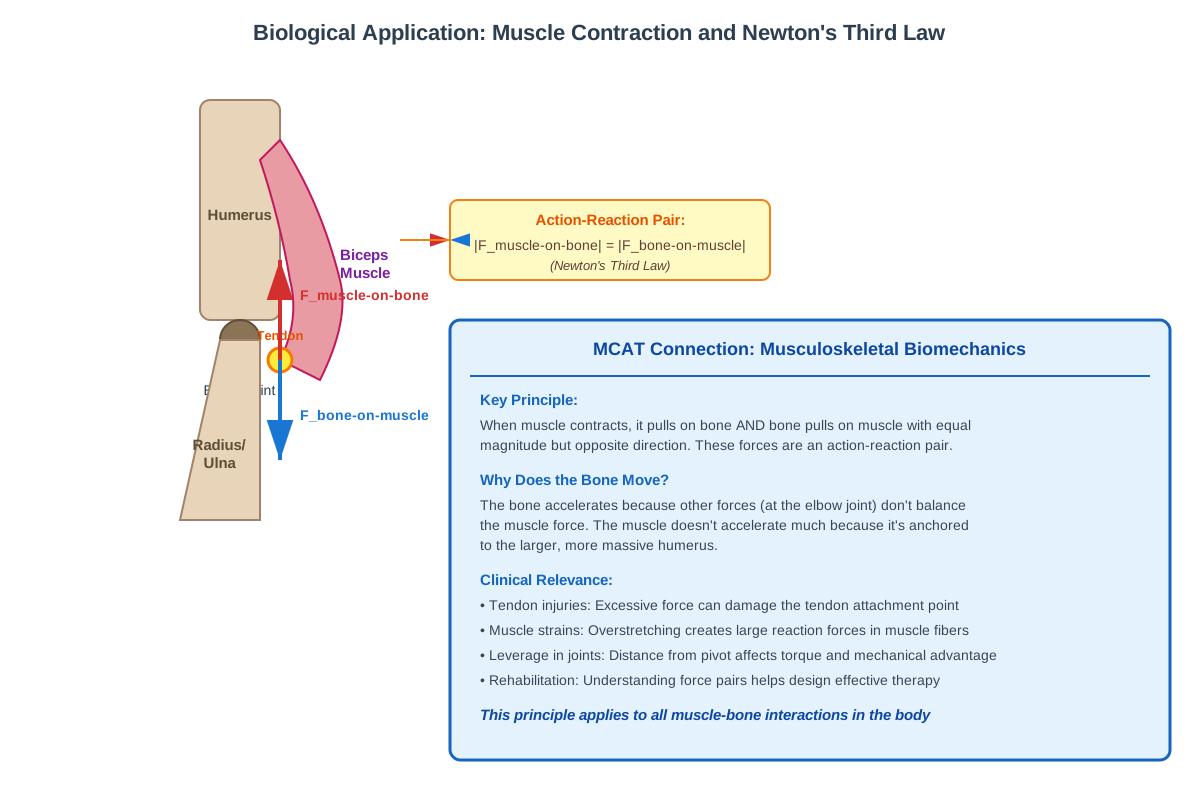
Newton's third law has profound clinical and real-world significance that extends far beyond theoretical physics. In human biomechanics, every muscle contraction involves action-reaction pairs: when the quadriceps muscle pulls on the tibia to extend the knee, the tibia simultaneously pulls back on the muscle with equal force. Walking and running depend entirely on the third law—the foot pushes backward on the ground, and the ground pushes forward on the foot, propelling the body forward. Cardiovascular dynamics also demonstrate this principle: when the heart ejects blood forward into the aorta, the blood exerts an equal and opposite force on the heart wall. Understanding these interactions is essential for analyzing gait abnormalities, joint mechanics, and the physics of medical devices like prosthetics and orthotic supports.
On the MCAT, Newton's third law appears in approximately 3-5% of Physics questions, making it a medium-yield topic that nonetheless appears consistently across test administrations. Questions typically fall into three categories: conceptual identification of action-reaction pairs (40% of third law questions), quantitative problems involving multiple connected objects (35%), and passage-based applications to biological or medical scenarios (25%). The AAMC particularly favors questions that require students to distinguish between action-reaction pairs and forces that balance on a single object, as this distinction reveals deep conceptual understanding versus superficial memorization.
Common MCAT passages involving this topic include: biomechanics passages analyzing human movement or athletic performance, collision scenarios in the context of injury mechanics, rocket or jet propulsion systems (relevant to medical imaging devices), and cardiovascular passages examining blood flow dynamics. The law frequently appears in questions about tension in tendons, normal forces on joints, and the mechanics of medical equipment. Test-makers often embed third law concepts within more complex scenarios requiring integration with momentum conservation, energy transfer, or Newton's second law applications.
Core Concepts
The Fundamental Statement of Newton's Third Law
Newton's third law states that when object A exerts a force on object B (the action force), object B simultaneously exerts a force on object A (the reaction force) that is equal in magnitude, opposite in direction, and of the same type. Mathematically, this is expressed as:
F_AB = -F_BAWhere F_AB represents the force that object A exerts on object B, and F_BA represents the force that object B exerts on object A. The negative sign indicates opposite directions. These paired forces are called action-reaction pairs, and they always act on different objects—this is the most critical feature distinguishing them from balanced forces.
The law applies universally to all force interactions without exception. Whether the forces involve contact (normal forces, tension, friction) or act at a distance (gravitational, electromagnetic), action-reaction pairs always exist. The forces in an action-reaction pair are always the same type: if the action is a gravitational force, the reaction is also gravitational; if the action is a normal force, the reaction is also a normal force.
Characteristics of Action-Reaction Pairs
Action-reaction pairs possess several defining characteristics that students must recognize for the MCAT:
- Equal Magnitude: The forces have exactly the same magnitude, regardless of the masses of the objects involved
- Opposite Direction: The forces point in exactly opposite directions along the same line of action
- Same Type: Both forces are the same fundamental type (both gravitational, both normal, both tension, etc.)
- Simultaneous: The forces exist at exactly the same time; one does not cause the other
- Different Objects: The forces act on different objects; this is the key distinguishing feature
- Cannot Cancel: Since they act on different objects, action-reaction pairs never cancel each other out
Distinguishing Action-Reaction Pairs from Balanced Forces
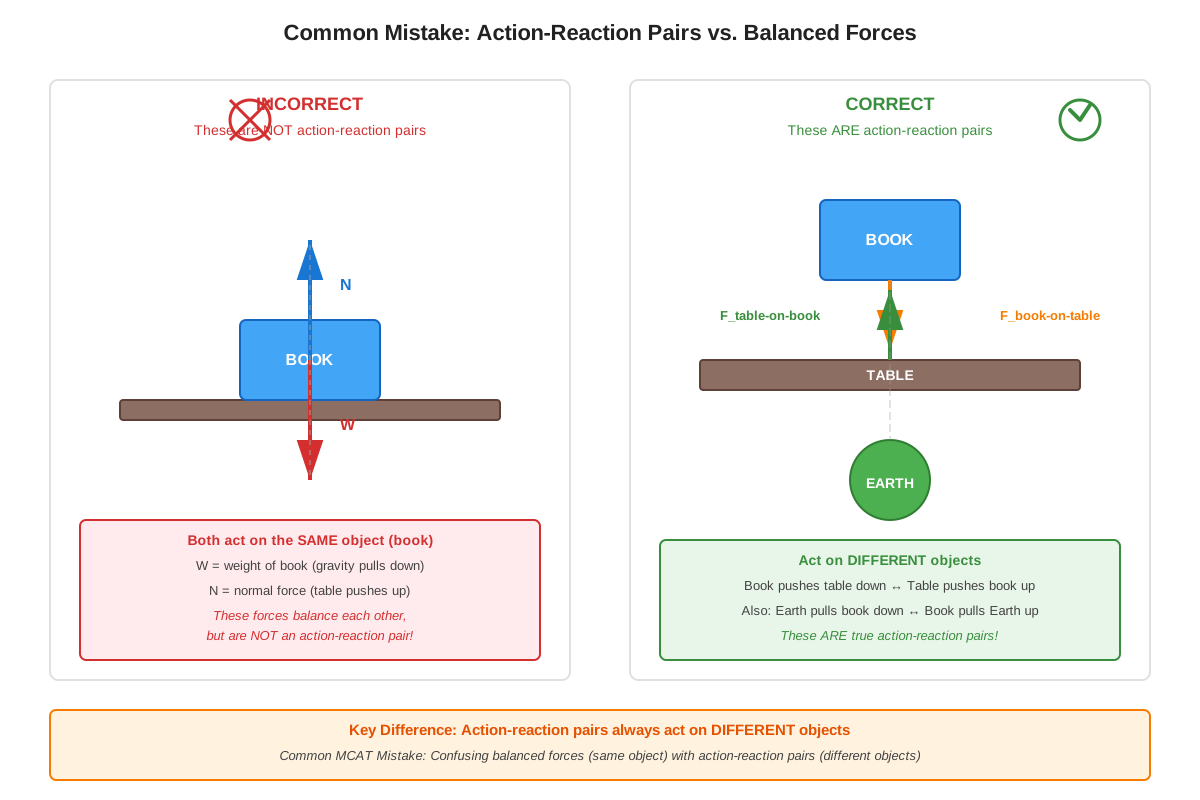
A critical MCAT skill involves distinguishing true action-reaction pairs from forces that merely balance on a single object. Consider a book resting on a table:
| Feature | Action-Reaction Pair | Balanced Forces |
|---|---|---|
| Objects involved | Two different objects | One object |
| Force directions | Opposite | Opposite |
| Force magnitudes | Always equal | Equal only in equilibrium |
| Can cancel? | No (different objects) | Yes (same object) |
| Example | Earth pulls book down; book pulls Earth up | Earth pulls book down; table pushes book up |
The weight of the book (Earth pulling book downward) and the normal force (table pushing book upward) are NOT action-reaction pairs—they are balanced forces on the same object (the book). The actual action-reaction pair for the weight is: Earth pulls book downward, and book pulls Earth upward with equal force. The action-reaction pair for the normal force is: table pushes book upward, and book pushes table downward.
Applications to Connected Objects
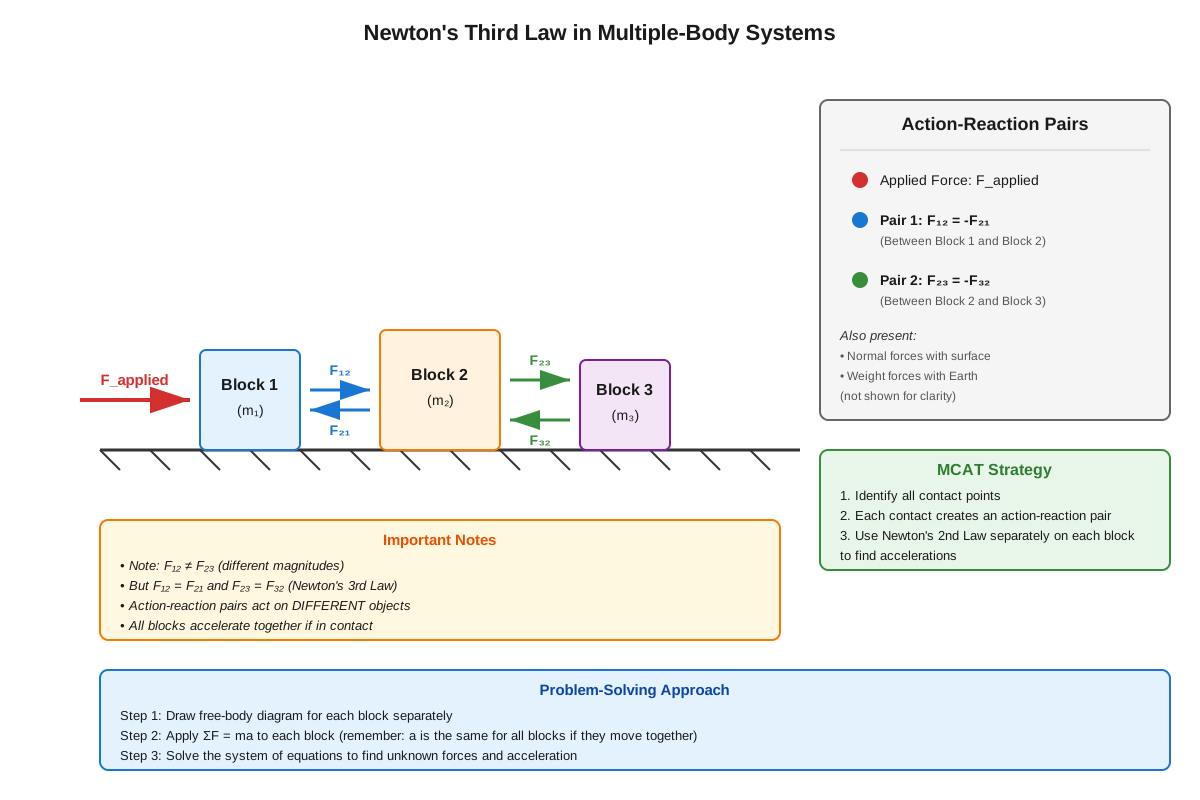
When multiple objects are connected by ropes, strings, or in contact, Newton's third law becomes essential for analyzing the system. Consider two blocks (mass m₁ and m₂) connected by a rope on a frictionless surface, with a force F pulling m₁:
The rope exerts a tension force T on m₁ (pulling backward) and m₁ exerts a tension force T on the rope (pulling forward)—these form an action-reaction pair. Similarly, the rope exerts tension T on m₂ (pulling forward) and m₂ exerts tension T on the rope (pulling backward). By the third law, these tensions have equal magnitude. This principle allows us to analyze complex systems by breaking them into individual objects and applying Newton's second law to each while recognizing the constraint forces between them.
Newton's Third Law and Momentum Conservation
Newton's third law provides the fundamental basis for momentum conservation. When two objects interact through action-reaction forces, the forces are equal and opposite. Using Newton's second law (F = ma = Δp/Δt), we can write:
F_AB = -F_BA
Δp_A/Δt = -Δp_B/Δt
Δp_A = -Δp_B
This shows that the momentum change of object A is equal and opposite to the momentum change of object B, meaning the total momentum of the system remains constant. This connection is frequently tested on the MCAT in collision problems and explosion scenarios.
Biological Applications
In biological systems, Newton's third law governs numerous physiological processes. During muscle contraction, when the muscle exerts a force on the bone through the tendon, the bone exerts an equal and opposite force on the muscle. In the cardiovascular system, when blood flows through vessels, the blood exerts pressure forces on the vessel walls, and the walls exert equal and opposite forces on the blood, affecting flow dynamics. During respiration, when the diaphragm contracts and moves downward, it exerts forces on the abdominal contents, which push back with equal force, creating the pressure changes necessary for breathing.
The mechanics of human locomotion provides a particularly rich application. When walking, the foot pushes backward and downward on the ground (action), and the ground pushes forward and upward on the foot (reaction). The forward component of this reaction force propels the body forward, while the upward component supports body weight. Without the third law, walking would be impossible—there would be no reaction force to propel us forward.
Concept Relationships
Newton's third law forms the central pillar connecting force interactions to system behavior in mechanics. The law directly builds upon Newton's first and second laws: while the first law describes motion in the absence of net force and the second law quantifies how net force affects motion, the third law reveals that forces always come in pairs, fundamentally constraining how objects can interact.
The relationship flows as follows: Newton's third law → establishes that all forces exist in pairs → these paired forces act on different objects → when analyzing a single object (Newton's second law), only forces acting ON that object matter → the reaction forces act on other objects → to analyze multi-body systems, apply Newton's second law to each object separately → the action-reaction pairs provide constraints linking the objects' motions.
This topic connects intimately with momentum conservation. The third law guarantees that internal forces (action-reaction pairs within a system) cannot change the system's total momentum because they sum to zero. This connection enables: Newton's third law → action-reaction pairs sum to zero → no net internal force on system → total momentum conserved (when no external forces) → collision analysis and explosion problems become solvable.
The concept also links to free-body diagrams through a critical relationship: when drawing a free-body diagram for object A, students must identify all forces acting ON object A, including reaction forces from objects that A pushes or pulls on. The systematic approach is: identify all objects → for each object, draw separate free-body diagram → for each force on object A from object B, recognize there exists an equal and opposite force on object B from object A → apply Newton's second law to each object → solve the coupled equations.
Newton's third law enables understanding of constraint forces like tension and normal forces. When a rope connects two objects, the tension throughout an ideal rope is uniform because of the third law—the rope pulls on each object with equal force, and each object pulls back on the rope with equal force. This relationship extends to: tension in ropes → normal forces at contact surfaces → friction forces between surfaces → all constraint forces that keep objects connected or in contact.
High-Yield Facts
⭐ Action-reaction pairs always act on different objects—this is the single most important distinguishing feature and the most commonly tested concept on the MCAT
⭐ Action-reaction pairs have equal magnitude regardless of the masses involved—a small object exerts the same magnitude force on a large object as the large object exerts on the small one
⭐ Action-reaction pairs are always the same type of force—gravitational pairs with gravitational, normal with normal, tension with tension, friction with friction
⭐ The forces in an action-reaction pair cannot cancel each other because they act on different objects—only forces acting on the same object can sum to produce net force
⭐ Newton's third law is the foundation for momentum conservation—internal forces (action-reaction pairs) sum to zero, so total system momentum remains constant without external forces
- Action-reaction pairs exist simultaneously; neither force causes the other—they are mutual and instantaneous
- When object A pushes object B, object B pushes back on A with equal force even if B is stationary or accelerating
- The normal force between two surfaces forms an action-reaction pair: surface A pushes on surface B, and surface B pushes on surface A
- In walking or running, the ground pushes forward on the foot (reaction) because the foot pushes backward on the ground (action)
- Rocket propulsion demonstrates the third law: expelled gases push backward on the rocket, and the rocket pushes forward on the gases with equal force
- When analyzing tension in a rope connecting two objects, the tension forces on each object form action-reaction pairs with the rope
- The Earth pulls on an object with gravitational force (weight), and the object pulls on Earth with equal force—this is why Earth doesn't noticeably accelerate (F = ma, but Earth's mass is enormous)
Quick check — test yourself on Newton third law so far.
Try Flashcards →Common Misconceptions
Misconception: Action-reaction pairs cancel each other out, so objects never accelerate.
Correction: Action-reaction pairs act on different objects, so they cannot cancel. Only forces acting on the same object can sum to produce net force. An object accelerates based on the net force acting ON it, not on the forces it exerts on other objects.
Misconception: The heavier object in an interaction exerts a larger force than the lighter object.
Correction: Action-reaction pairs always have equal magnitude regardless of mass. When a small car collides with a large truck, each vehicle exerts the same magnitude force on the other. The different accelerations result from F = ma with different masses, not different forces.
Misconception: The normal force and weight of an object resting on a surface form an action-reaction pair.
Correction: These are balanced forces on the same object (the resting object), not an action-reaction pair. The action-reaction pair for weight is: Earth pulls object down, object pulls Earth up. The action-reaction pair for the normal force is: surface pushes object up, object pushes surface down.
Misconception: The reaction force occurs after the action force, with some time delay.
Correction: Action and reaction forces are simultaneous and mutual. Neither causes the other; they exist together as long as the interaction exists. The terms "action" and "reaction" are arbitrary labels, not a temporal sequence.
Misconception: If two objects aren't moving, there are no action-reaction forces between them.
Correction: Action-reaction pairs exist whenever objects interact, regardless of motion. A book resting on a table involves multiple action-reaction pairs (gravitational forces between book and Earth, normal forces between book and table) even though nothing moves.
Misconception: Friction forces don't follow Newton's third law because they oppose motion.
Correction: Friction forces absolutely follow the third law. When object A slides on object B, surface A exerts friction on surface B in one direction, and surface B exerts friction on surface A in the opposite direction with equal magnitude. These form a proper action-reaction pair.
Misconception: In a rope under tension, the tension at one end differs from the tension at the other end.
Correction: In an ideal (massless, unstretchable) rope, tension is uniform throughout because of Newton's third law. Each segment of rope pulls on adjacent segments with equal force. Real ropes with mass may have varying tension, but this is a secondary effect.
Worked Examples
Example 1: Identifying Action-Reaction Pairs in a Biological System
Problem: A person with mass 70 kg stands on a scale in an elevator. The scale reads 770 N. Identify all action-reaction pairs involving the person, and explain why the scale reading differs from the person's weight.
Solution:
First, calculate the person's weight:
W = mg = (70 kg)(10 m/s²) = 700 NThe scale reads 770 N, which is greater than the weight, indicating the elevator is accelerating upward.
Action-Reaction Pairs:
- Gravitational interaction between person and Earth:
- Action: Earth pulls person downward with force 700 N
- Reaction: Person pulls Earth upward with force 700 N
- These forces act on different objects (person and Earth)
- Normal force interaction between person and scale:
- Action: Scale pushes person upward with force 770 N
- Reaction: Person pushes scale downward with force 770 N
- These forces act on different objects (person and scale)
- Normal force interaction between scale and elevator floor:
- Action: Elevator floor pushes scale upward with force 770 N
- Reaction: Scale pushes elevator floor downward with force 770 N
Why the scale reading differs from weight:
The scale reading (770 N) is NOT an action-reaction pair with the person's weight (700 N). These are two different forces acting on the person:
- Weight (700 N downward): gravitational force from Earth
- Normal force (770 N upward): contact force from scale
The net force on the person is:
F_net = 770 N - 700 N = 70 N upwardUsing Newton's second law:
a = F_net/m = 70 N / 70 kg = 1 m/s² upwardThe elevator accelerates upward at 1 m/s². The scale must push harder than the person's weight to provide this upward acceleration.
Key MCAT Insight: The scale reading equals the normal force (the reaction to the person pushing on the scale), not the person's weight. These are separate forces that happen to be equal only when acceleration is zero.
Example 2: Newton's Third Law in a Multi-Body System
Problem: Two blocks are connected by a light string on a frictionless horizontal surface. Block A has mass 2 kg, and block B has mass 3 kg. A horizontal force of 10 N pulls block A to the right. Find: (a) the acceleration of the system, (b) the tension in the string, and (c) identify the action-reaction pair involving the tension.
Solution:
(a) Finding the acceleration:
Treat the two-block system as a single object:
Total mass = m_A + m_B = 2 kg + 3 kg = 5 kg
F_net = 10 N (applied force)
a = F_net / m_total = 10 N / 5 kg = 2 m/s²
Both blocks accelerate together at 2 m/s² to the right.
(b) Finding the tension:
Analyze block B separately (the block being pulled by the string):
F_net on B = T (tension is the only horizontal force on B)
m_B × a = T
T = (3 kg)(2 m/s²) = 6 N
We can verify this by analyzing block A:
F_net on A = F_applied - T = m_A × a
10 N - T = (2 kg)(2 m/s²)
10 N - T = 4 N
T = 6 N ✓
(c) Action-reaction pairs involving tension:
There are two action-reaction pairs:
Pair 1 (String and Block A):
- Action: String pulls block A to the left with force 6 N
- Reaction: Block A pulls string to the right with force 6 N
Pair 2 (String and Block B):
- Action: String pulls block B to the right with force 6 N
- Reaction: Block B pulls string to the left with force 6 N
Critical MCAT Point: The tension forces on blocks A and B (both 6 N) are NOT action-reaction pairs with each other—they act on different blocks but are both forces exerted BY the string. The actual action-reaction pairs involve the string and each block separately. The tension is uniform throughout the string because the string is ideal (massless), so it doesn't accelerate relative to the blocks.
Conceptual Check: Why doesn't the string break if block A pulls it right with 6 N and block B pulls it left with 6 N? Because these forces act on opposite ends of the string. The string experiences tension (internal stress) but no net force because the forces are balanced. This is analogous to pulling on both ends of a rope—the rope experiences tension but doesn't accelerate.
Exam Strategy
When approaching MCAT questions on Newton's third law, follow this systematic strategy:
Step 1: Identify all objects in the system. Draw a simple sketch and label each distinct object. Remember that the ground, Earth, ropes, and surfaces are all separate objects that can exert and experience forces.
Step 2: For each force mentioned, immediately ask: "What object exerts this force, and what object experiences this force?" Write this explicitly as "Force on [object A] by [object B]." This notation prevents confusion about which forces form action-reaction pairs.
Step 3: Apply the action-reaction test. For any force on object A by object B, there must exist an equal and opposite force on object B by object A. These forces must be the same type (both gravitational, both normal, etc.).
Step 4: Watch for trigger words and phrases:
- "Action-reaction pair" → forces must act on different objects
- "Balanced forces" or "equilibrium" → forces act on the same object
- "The force that [object A] exerts on [object B]" → immediately identify the reaction force
- "Why doesn't [object] accelerate?" → look for balanced forces on that object, not action-reaction pairs
- "Connected by a rope/string" → tension forces form action-reaction pairs with each object
- "Collision between" → action-reaction pairs are equal even if masses differ
Step 5: Eliminate wrong answers using these principles:
- Eliminate any choice claiming action-reaction pairs can cancel (they act on different objects)
- Eliminate choices suggesting heavier objects exert larger forces in interactions (magnitudes are always equal)
- Eliminate choices confusing balanced forces with action-reaction pairs
- Eliminate choices suggesting reaction forces are delayed or secondary
Time allocation advice: Newton's third law questions typically require 60-90 seconds. Spend 20-30 seconds carefully identifying objects and forces, 30-40 seconds applying the law and doing calculations if needed, and 10-20 seconds checking your answer against common misconceptions. Don't rush the identification phase—most errors occur from misidentifying which forces form action-reaction pairs.
Exam Tip: If a question asks about forces during a collision or interaction, immediately recognize that the forces on each object are equal in magnitude. The different accelerations or velocity changes result from different masses (F = ma), not different forces. This insight eliminates wrong answers quickly.
Passage Strategy: In passages involving biomechanics or multi-body systems, create a quick reference table listing each action-reaction pair. This prevents confusion when questions ask about specific forces later in the passage.
Memory Techniques
Mnemonic for Action-Reaction Pair Characteristics - "MOST DENSE":
- Magnitude equal
- Opposite directions
- Same type of force
- Together simultaneously
- Different objects
- Equal even if masses differ
- Never cancel
- Simultaneous existence
- Exist as long as interaction exists
Visualization Strategy: Picture action-reaction pairs as a "force handshake." When two people shake hands, each person pushes on the other's hand with equal force. The forces are opposite in direction, act on different people (different objects), and exist simultaneously. Neither person's push causes the other's—they're mutual. This mental image helps remember that forces always come in pairs acting on different objects.
The "Different Objects" Mantra: Before identifying any action-reaction pair on the MCAT, repeat: "Different objects, different objects, different objects." This prevents the most common error of confusing balanced forces (same object) with action-reaction pairs (different objects).
Acronym for Common Action-Reaction Pairs - "GNTF":
- Gravitational: Earth pulls object down ↔ object pulls Earth up
- Normal: Surface pushes object up ↔ object pushes surface down
- Tension: Rope pulls object ↔ object pulls rope
- Friction: Surface A pushes surface B ↔ surface B pushes surface A
The Rocket Reminder: When confused about Newton's third law, think of a rocket. The rocket pushes gas backward (action), and the gas pushes the rocket forward (reaction). The forces are equal, act on different objects (rocket and gas), and exist simultaneously. This concrete example clarifies abstract concepts.
Summary
Newton's third law establishes that forces always exist in pairs: when object A exerts a force on object B, object B simultaneously exerts an equal magnitude, opposite direction force on object A. These action-reaction pairs are fundamental to all force interactions in mechanics and form the basis for momentum conservation. The critical distinguishing feature of action-reaction pairs is that they act on different objects, meaning they cannot cancel each other. This contrasts with balanced forces, which act on the same object and can sum to zero net force. For the MCAT, students must recognize action-reaction pairs in diverse contexts including biological systems (muscle-bone interactions, cardiovascular dynamics, locomotion), multi-body problems (connected objects, collisions), and everyday scenarios (normal forces, tension, friction). The law applies universally regardless of object masses, motion states, or force types. Mastery requires distinguishing action-reaction pairs from balanced forces, identifying the objects involved in each force, and applying the law systematically to analyze complex systems. Success on MCAT questions demands recognizing that equal magnitude forces in interactions produce different accelerations due to different masses (Newton's second law), not different force magnitudes. The third law connects intimately with momentum conservation, free-body diagram analysis, and constraint forces, making it essential for comprehensive understanding of Physics on the MCAT.
Key Takeaways
- Action-reaction pairs always act on different objects with equal magnitude and opposite direction—this is the defining characteristic that distinguishes them from balanced forces on a single object
- The forces in an action-reaction pair are always the same type (both gravitational, both normal, both tension, etc.) and exist simultaneously without time delay
- Newton's third law applies universally regardless of object masses—a small object exerts the same magnitude force on a large object as the large object exerts on it
- Action-reaction pairs provide the foundation for momentum conservation because internal forces sum to zero, leaving total system momentum unchanged without external forces
- Common MCAT applications include biomechanics (muscle-bone forces, locomotion), multi-body systems (tension in connecting ropes), and collision analysis where equal forces produce different accelerations due to different masses
- The systematic approach for MCAT questions involves identifying all objects, labeling forces as "force on [object A] by [object B]," recognizing the corresponding reaction force, and applying Newton's second law to each object separately
- Biological systems demonstrate the third law continuously: walking depends on the ground pushing forward on the foot, muscle contraction involves equal forces between muscle and bone, and cardiovascular flow involves reciprocal forces between blood and vessel walls
Related Topics
Newton's First Law (Law of Inertia): Understanding how objects maintain constant velocity without net force provides context for analyzing when action-reaction pairs result in equilibrium versus acceleration. Mastering the third law enables deeper analysis of why objects remain at rest or in uniform motion.
Newton's Second Law (F = ma): The quantitative relationship between force, mass, and acceleration works in concert with the third law. While the third law tells us forces come in equal pairs, the second law explains why equal forces produce different accelerations on objects with different masses.
Momentum and Impulse: Newton's third law provides the theoretical foundation for momentum conservation. Understanding action-reaction pairs is essential before studying collisions, explosions, and impulse-momentum applications.
Free-Body Diagrams: Systematic force analysis requires identifying all forces on an object, including reaction forces from objects the original object pushes or pulls. Mastering the third law improves free-body diagram accuracy.
Friction and Inclined Planes: Friction forces between surfaces form action-reaction pairs. Understanding the third law clarifies why friction on object A from surface B equals friction on surface B from object A, essential for analyzing motion on inclined planes.
Circular Motion and Centripetal Force: When objects move in circles, the forces providing centripetal acceleration (tension, normal force, friction) all have reaction forces acting on other objects. The third law helps analyze these complex scenarios.
Practice CTA
Now that you've mastered the conceptual foundation of Newton's third law, it's time to solidify your understanding through active practice. Attempt the practice questions to test your ability to identify action-reaction pairs, distinguish them from balanced forces, and apply the law to MCAT-style scenarios. Use the flashcards to reinforce high-yield facts and common misconceptions. Remember, the MCAT rewards deep conceptual understanding over memorization—focus on why action-reaction pairs must act on different objects and how this principle connects to momentum conservation and multi-body analysis. Your ability to systematically identify forces and apply Newton's laws will serve you throughout the Physics section and in biological applications. You've got this!
Sign up free to keep reading
Create a free AnvayaPrep account to finish this MCAT guide on Newton third law — plus flashcards and practice questions.