Overview
Heat is a fundamental concept in General Chemistry and Thermodynamics that describes the transfer of thermal energy between systems or objects at different temperatures. Unlike temperature, which measures the average kinetic energy of particles in a substance, heat represents energy in transit—it only exists during the process of transfer and ceases to be "heat" once it has been absorbed by a system. Understanding heat is essential for mastering energy transformations, chemical reactions, and physical processes that appear throughout the MCAT.
For the MCAT, heat serves as a cornerstone concept that bridges multiple disciplines. In the Chemical and Physical Foundations of Biological Systems section, heat appears in questions about calorimetry, phase transitions, enthalpy changes, and metabolic processes. The MCAT frequently tests students' ability to distinguish between heat and temperature, calculate heat transfer using specific heat capacity equations, and apply the first law of thermodynamics to biological and chemical systems. Questions may present experimental scenarios involving calorimeters, ask students to interpret heating curves, or require calculations of energy changes during reactions.
Heat connects intimately with other General Chemistry concepts including internal energy, work, enthalpy, entropy, and Gibbs free energy. It forms the foundation for understanding why reactions occur spontaneously, how living organisms maintain homeostasis, and how energy flows through biological systems. Mastery of heat is prerequisite knowledge for advanced topics in biochemistry, including enzyme kinetics, metabolic pathways, and the thermodynamics of protein folding. The MCAT expects students to apply heat concepts not just in isolated calculations but within complex passages describing physiological processes, experimental designs, and real-world applications.
Learning Objectives
- [ ] Define Heat using accurate General Chemistry terminology
- [ ] Explain why Heat matters for the MCAT
- [ ] Apply Heat to exam-style questions
- [ ] Identify common mistakes related to Heat
- [ ] Connect Heat to related General Chemistry concepts
- [ ] Calculate heat transfer using the equation q = mcΔT for various substances
- [ ] Distinguish between heat, temperature, and internal energy in thermodynamic systems
- [ ] Analyze heating curves and identify phase transitions with their associated enthalpy changes
- [ ] Apply calorimetry principles to determine specific heat capacities and enthalpy changes of reactions
Prerequisites
- Temperature and Kinetic Molecular Theory: Understanding that temperature measures average kinetic energy of particles is essential for distinguishing it from heat, which is energy transfer.
- Energy and Energy Conservation: The law of conservation of energy underpins all heat transfer calculations and thermodynamic processes.
- States of Matter: Knowledge of solid, liquid, and gas phases is necessary to understand phase transitions and associated heat changes.
- Basic Algebra and Unit Conversions: Heat calculations require manipulating equations and converting between units (Joules, calories, kilojoules).
- Chemical Reactions and Stoichiometry: Heat is often released or absorbed during reactions, requiring stoichiometric calculations to determine energy changes per mole.
Why This Topic Matters
Heat is clinically and biologically significant because all living organisms are thermodynamic systems that constantly exchange heat with their surroundings. Humans maintain a core body temperature of approximately 37°C through metabolic heat production and dissipation mechanisms. Fever, hypothermia, heat stroke, and metabolic disorders all involve disruptions in heat balance. Medical interventions like therapeutic hypothermia after cardiac arrest or warming protocols during surgery directly apply heat transfer principles.
On the MCAT, heat appears in approximately 3-5% of Chemical and Physical Foundations questions, making it a medium-yield topic that nonetheless appears consistently across test administrations. Questions typically fall into three categories: (1) quantitative calculations involving specific heat capacity or calorimetry, (2) conceptual questions about heat flow direction and thermodynamic principles, and (3) passage-based questions integrating heat with experimental design or biological processes. The MCAT particularly favors questions that require students to interpret graphs (heating curves, calorimetry data) or apply heat concepts to novel scenarios like enzyme activity at different temperatures or the energetics of phase transitions in biological membranes.
Common passage contexts include: calorimetry experiments measuring enthalpy of combustion or neutralization, physiological thermoregulation mechanisms, phase diagrams and transitions, metabolic heat production during exercise, and the thermodynamics of protein denaturation. The exam tests whether students can move beyond memorized formulas to apply heat concepts in integrated, multistep problems that mirror real scientific reasoning.
Core Concepts
Definition and Nature of Heat
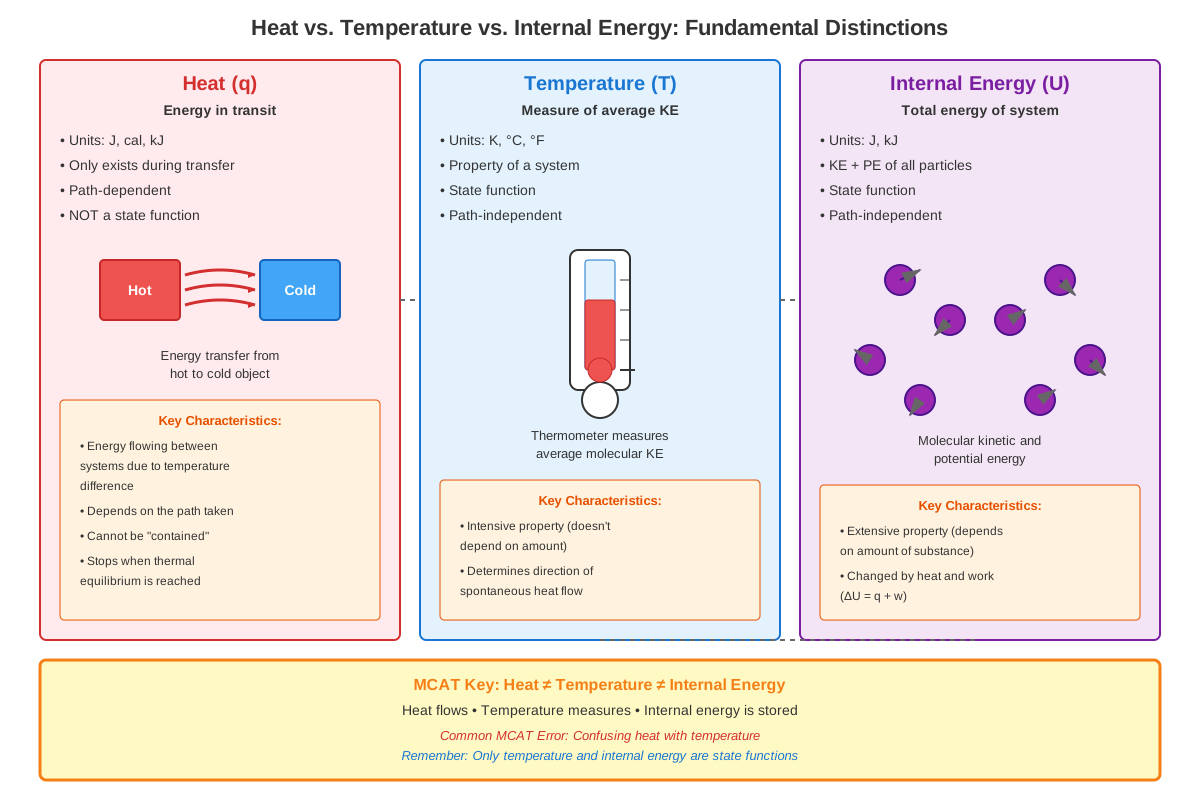
Heat (symbol: q or Q) is the transfer of thermal energy between two objects or systems due to a temperature difference. Heat always flows spontaneously from higher temperature to lower temperature until thermal equilibrium is reached. This directional flow is a consequence of the second law of thermodynamics and the tendency toward maximum entropy. Heat is measured in joules (J) in the SI system, though calories (cal) are also used, where 1 cal = 4.184 J.
Critically, heat is not a property of a system—it is a process. A system does not "contain" heat; rather, heat describes energy in transit. Once energy has been transferred, it becomes part of the system's internal energy. This distinction separates heat from temperature, which is a state function measuring the average kinetic energy of particles within a system.
Heat vs. Temperature vs. Internal Energy
These three concepts are frequently confused but represent distinct thermodynamic quantities:
| Property | Definition | Units | Nature |
|---|---|---|---|
| Temperature | Average kinetic energy of particles | Kelvin (K), Celsius (°C) | Intensive property; state function |
| Heat | Energy transfer due to temperature difference | Joules (J), calories (cal) | Extensive property; path function |
| Internal Energy | Total energy contained within a system | Joules (J) | Extensive property; state function |
Temperature is intensive (independent of amount), while heat and internal energy are extensive (depend on amount of substance). Two objects at the same temperature have no net heat flow between them, even if they have vastly different internal energies due to different masses or compositions.
The Heat Transfer Equation
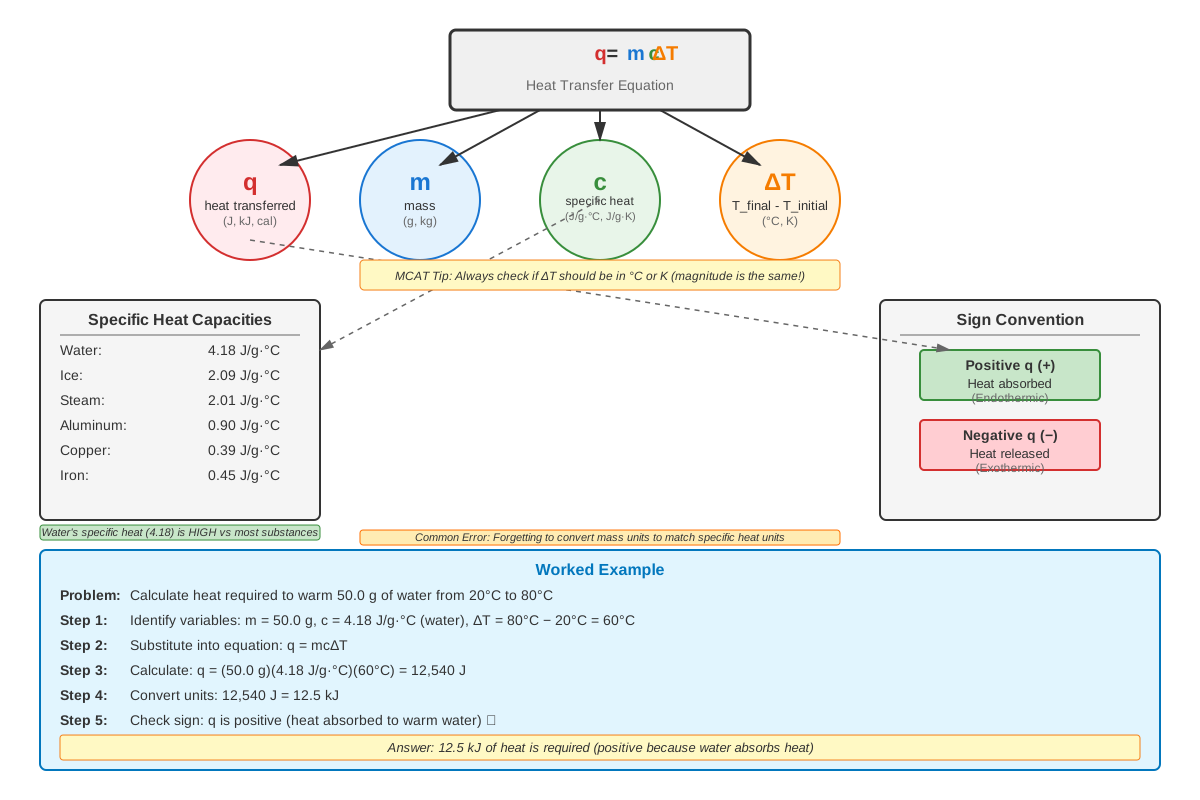
The fundamental equation for calculating heat transfer during temperature change (without phase change) is:
q = mcΔTWhere:
- q = heat transferred (J)
- m = mass of substance (g or kg)
- c = specific heat capacity (J/g·°C or J/kg·K)
- ΔT = change in temperature (T_final - T_initial)
Specific heat capacity is the amount of heat required to raise the temperature of one gram of a substance by one degree Celsius. It is an intensive property characteristic of each substance. Water has an exceptionally high specific heat capacity (4.184 J/g·°C), which explains its role in temperature regulation in biological systems and climate moderation.
The sign of q indicates direction: positive q means heat is absorbed by the system (endothermic), while negative q means heat is released (exothermic). When solving problems, always define your system clearly and maintain consistent sign conventions.
Calorimetry
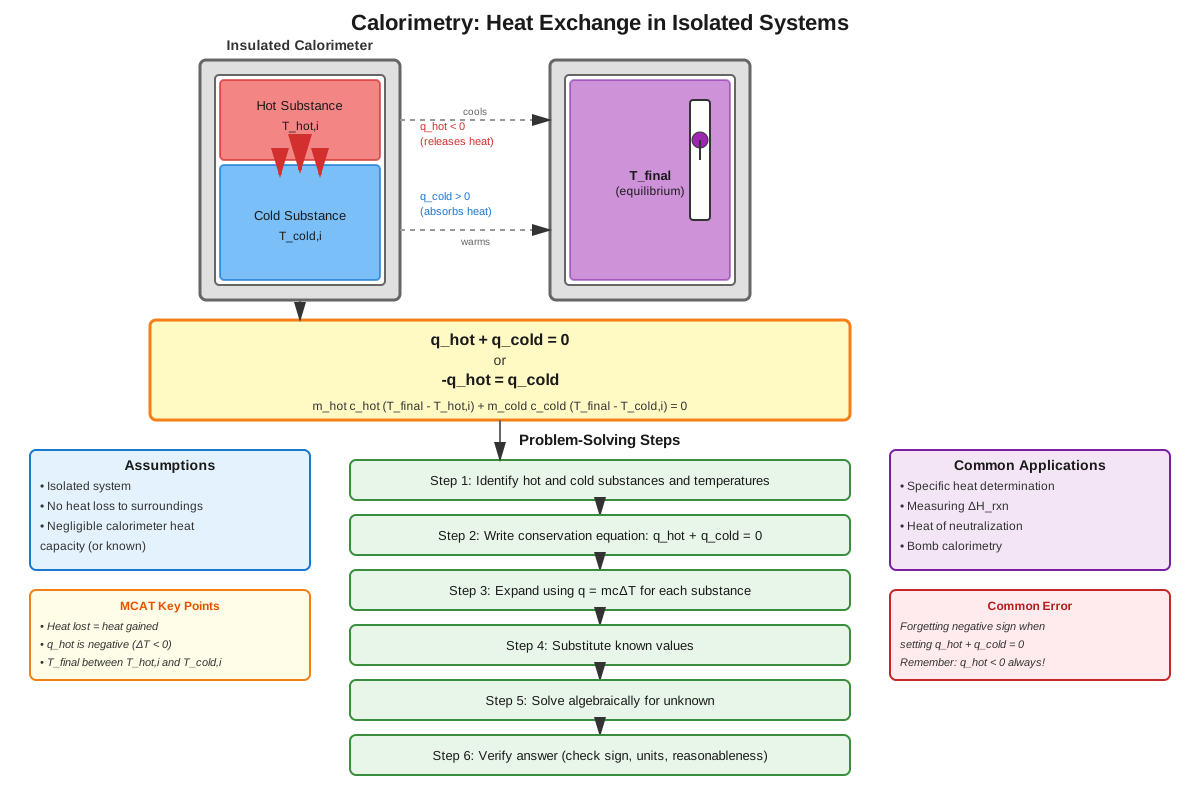
Calorimetry is the experimental technique for measuring heat changes during chemical reactions or physical processes. A calorimeter is an insulated device that prevents heat exchange with the surroundings, allowing all heat released or absorbed by a reaction to be transferred to or from a known quantity of water or other substance.
The principle of calorimetry relies on conservation of energy:
q_reaction + q_surroundings = 0Or equivalently:
q_reaction = -q_surroundingsIn a simple coffee-cup calorimeter (constant pressure), the heat released by an exothermic reaction is absorbed by the water:
q_reaction = -m_water × c_water × ΔT_waterBomb calorimeters operate at constant volume and measure heat changes for combustion reactions. The heat capacity of the entire calorimeter (bomb + water) must be determined through calibration.
Phase Transitions and Latent Heat
During phase transitions (melting, freezing, vaporization, condensation), heat is absorbed or released without a temperature change. This energy breaks or forms intermolecular forces rather than increasing kinetic energy.
Heat of fusion (ΔH_fus) is the energy required to convert one gram (or mole) of solid to liquid at the melting point:
q = m × ΔH_fusHeat of vaporization (ΔH_vap) is the energy required to convert one gram (or mole) of liquid to gas at the boiling point:
q = m × ΔH_vapFor water: ΔH_fus = 334 J/g and ΔH_vap = 2260 J/g. The heat of vaporization is much larger because vaporization requires completely overcoming all intermolecular forces, while melting only partially disrupts them.
Heating Curves
A heating curve graphs temperature versus heat added for a substance undergoing heating from solid through liquid to gas. The curve has five distinct regions:
- Solid heating: Temperature increases linearly (q = mcΔT with c_solid)
- Melting plateau: Temperature constant at melting point while solid → liquid (q = mΔH_fus)
- Liquid heating: Temperature increases linearly (q = mcΔT with c_liquid)
- Boiling plateau: Temperature constant at boiling point while liquid → gas (q = mΔH_vap)
- Gas heating: Temperature increases linearly (q = mcΔT with c_gas)
The horizontal plateaus represent phase transitions where all added heat breaks intermolecular forces rather than increasing temperature. The length of each plateau is proportional to the heat of transition.
Heat and the First Law of Thermodynamics
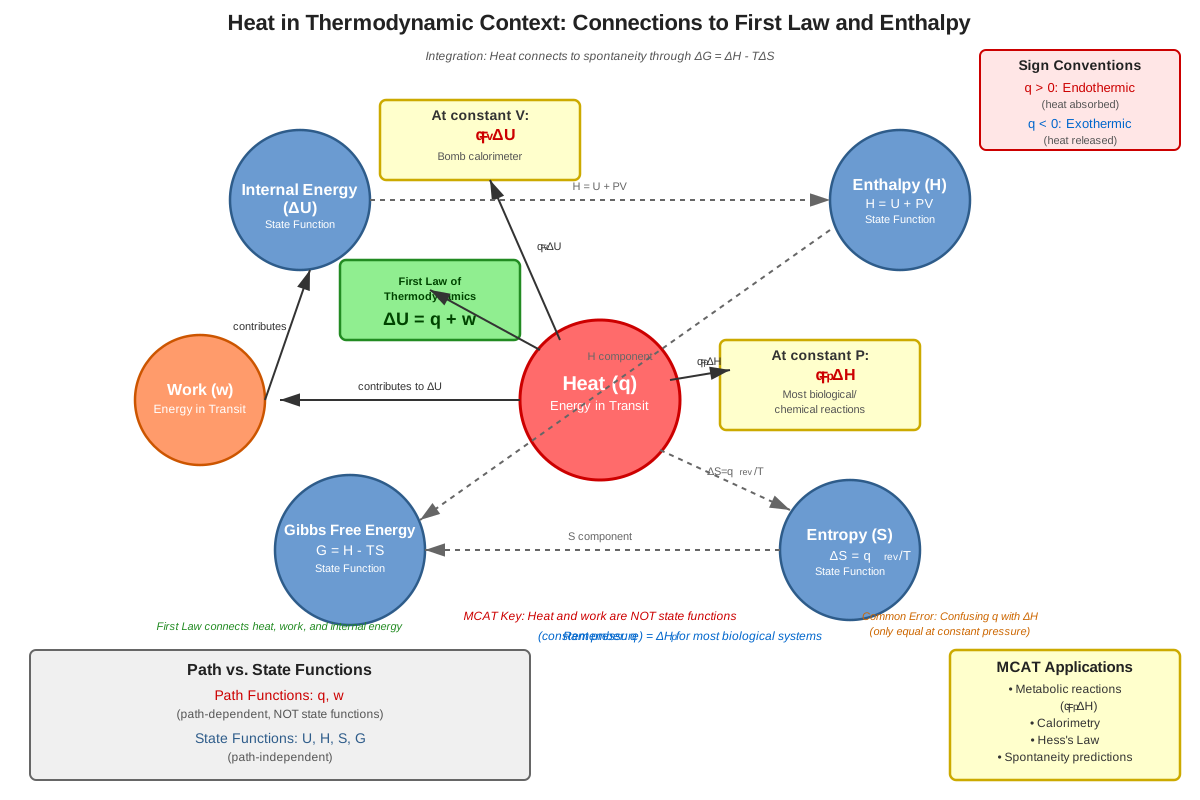
The first law of thermodynamics states that energy is conserved:
ΔU = q + wWhere:
- ΔU = change in internal energy
- q = heat transferred to the system
- w = work done on the system
This equation connects heat to the broader framework of thermodynamics. For processes at constant pressure (most biological and chemical processes), the heat transferred equals the enthalpy change:
q_p = ΔHUnderstanding this relationship allows students to connect calorimetry measurements to thermochemical equations and Hess's law calculations.
Sign Conventions in Thermodynamics
Consistent sign conventions are critical for avoiding errors:
- Endothermic processes: q > 0 (heat absorbed by system, ΔH > 0)
- Exothermic processes: q < 0 (heat released by system, ΔH < 0)
- Work done on system: w > 0
- Work done by system: w < 0
The MCAT uses the perspective of the system (not surroundings). When a reaction releases heat, the system loses energy, so q is negative from the system's perspective.
Concept Relationships
Heat serves as the central connecting concept between microscopic particle behavior and macroscopic thermodynamic properties. At the molecular level, temperature reflects average kinetic energy, which determines the direction and magnitude of heat flow. When heat is transferred to a substance, it increases internal energy, which manifests as either increased temperature (higher kinetic energy) or phase transitions (changes in potential energy due to intermolecular forces).
The relationship flows: Temperature difference → Heat transfer → Change in internal energy → Observable effects (temperature change or phase transition)
Heat connects to enthalpy through the relationship q_p = ΔH, making calorimetry the experimental method for determining enthalpy changes of reactions. These enthalpy values feed into Hess's law calculations and thermochemical equations, which predict whether reactions are energetically favorable.
Heat also connects to entropy because spontaneous heat flow from hot to cold increases the entropy of the universe. This relationship underpins the second law of thermodynamics and ultimately determines reaction spontaneity through Gibbs free energy: ΔG = ΔH - TΔS.
In biological contexts, heat connects to metabolism (cellular respiration releases heat), enzyme kinetics (temperature affects reaction rates), and homeostasis (thermoregulation maintains constant body temperature despite heat production and loss).
The prerequisite concept of energy conservation enables all heat calculations, while understanding states of matter and intermolecular forces explains why phase transitions require heat input or release. Stoichiometry connects heat to chemical reactions through molar heat capacities and enthalpies of reaction.
Quick check — test yourself on Heat so far.
Try Flashcards →High-Yield Facts
⭐ Heat is energy in transit due to temperature difference; it is not a property contained within a system
⭐ The equation q = mcΔT applies only when temperature changes without phase transitions
⭐ Water has a specific heat capacity of 4.184 J/g·°C, the highest of common substances, which is critical for biological temperature regulation
⭐ During phase transitions, temperature remains constant while heat is absorbed or released (q = mΔH_transition)
⭐ In calorimetry, q_reaction = -q_surroundings due to conservation of energy in an isolated system
- Heat of vaporization is always greater than heat of fusion for the same substance because vaporization requires complete separation of molecules
- Specific heat capacity is an intensive property that varies by substance and phase (c_solid ≠ c_liquid ≠ c_gas)
- Positive q indicates endothermic (heat absorbed); negative q indicates exothermic (heat released)
- At constant pressure, heat transferred equals enthalpy change (q_p = ΔH)
- The sign of ΔT determines the sign of q: if T_final > T_initial, then ΔT > 0 and q > 0 (heat absorbed)
- Heat capacity (C) differs from specific heat capacity (c): C = mc, measured in J/°C rather than J/g·°C
- The calorie (cal) is defined as the heat required to raise 1 g of water by 1°C; 1 cal = 4.184 J
Common Misconceptions
Misconception: Heat and temperature are the same thing.
Correction: Temperature measures the average kinetic energy of particles (intensive property), while heat is the transfer of thermal energy between systems (extensive property). Two objects at the same temperature have no heat flow between them, even if they have different amounts of internal energy.
Misconception: Objects contain heat that can be measured.
Correction: Objects contain internal energy, not heat. Heat only exists during the process of energy transfer. Once energy has been transferred, it becomes part of the system's internal energy. Saying "the water contains heat" is incorrect; "the water has high internal energy" or "the water is at high temperature" is correct.
Misconception: During phase transitions, adding heat increases temperature.
Correction: During phase transitions (melting, boiling), temperature remains constant while heat is absorbed. The energy breaks intermolecular forces rather than increasing kinetic energy. Only after the phase transition is complete does added heat increase temperature again.
Misconception: Specific heat capacity is the same for all substances.
Correction: Specific heat capacity is a characteristic property that varies widely among substances. Water (4.184 J/g·°C) has a much higher specific heat than metals like copper (0.385 J/g·°C), meaning water requires much more heat to change temperature.
Misconception: In calorimetry, q_reaction and q_water have the same sign.
Correction: In calorimetry, q_reaction and q_water have opposite signs because energy is conserved: q_reaction = -q_water. If the reaction is exothermic (q_reaction < 0), the water absorbs that heat (q_water > 0), causing its temperature to increase.
Misconception: The heat of fusion and heat of vaporization are the same for a substance.
Correction: The heat of vaporization is always significantly larger than the heat of fusion because vaporization requires completely overcoming all intermolecular forces, while fusion only partially disrupts the ordered structure. For water, ΔH_vap (2260 J/g) is about 6.8 times larger than ΔH_fus (334 J/g).
Misconception: A larger mass always means more heat is required.
Correction: While q = mcΔT shows heat is proportional to mass, the specific heat capacity (c) also matters greatly. A small mass of water may require more heat to change temperature than a large mass of metal due to water's much higher specific heat capacity.
Worked Examples
Example 1: Calorimetry Calculation
Problem: A 50.0 g sample of metal at 95.0°C is placed in 100.0 g of water at 22.0°C in an insulated calorimeter. The final temperature of both the metal and water is 25.5°C. Calculate the specific heat capacity of the metal. (c_water = 4.184 J/g·°C)
Solution:
Step 1: Define the system and identify what we know.
- System 1 (metal): m = 50.0 g, T_initial = 95.0°C, T_final = 25.5°C, c = ?
- System 2 (water): m = 100.0 g, T_initial = 22.0°C, T_final = 25.5°C, c = 4.184 J/g·°C
Step 2: Apply conservation of energy in the isolated calorimeter.
q_metal + q_water = 0
q_metal = -q_water
Step 3: Calculate q_water using q = mcΔT.
q_water = (100.0 g)(4.184 J/g·°C)(25.5°C - 22.0°C)
q_water = (100.0 g)(4.184 J/g·°C)(3.5°C)
q_water = 1464.4 J
Step 4: Determine q_metal.
q_metal = -q_water = -1464.4 JThe negative sign makes sense because the metal cooled down (lost heat).
Step 5: Calculate the specific heat capacity of the metal.
q_metal = m_metal × c_metal × ΔT_metal
-1464.4 J = (50.0 g) × c_metal × (25.5°C - 95.0°C)
-1464.4 J = (50.0 g) × c_metal × (-69.5°C)
c_metal = -1464.4 J / [(50.0 g)(-69.5°C)]
c_metal = -1464.4 J / (-3475 g·°C)
c_metal = 0.421 J/g·°CAnswer: The specific heat capacity of the metal is 0.421 J/g·°C, which is consistent with iron or steel.
Key Concepts Applied: This problem demonstrates calorimetry principles, conservation of energy, proper sign conventions, and the relationship between heat transfer and temperature change. The MCAT expects students to set up these problems systematically and track signs carefully.
Example 2: Heating Curve with Phase Transitions
Problem: Calculate the total heat required to convert 25.0 g of ice at -10.0°C to steam at 120.0°C. Use the following data:
- c_ice = 2.09 J/g·°C
- c_water = 4.184 J/g·°C
- c_steam = 2.01 J/g·°C
- ΔH_fus = 334 J/g
- ΔH_vap = 2260 J/g
Solution:
This problem requires calculating heat for five separate steps along the heating curve.
Step 1: Heat ice from -10.0°C to 0°C (solid heating)
q_1 = m × c_ice × ΔT
q_1 = (25.0 g)(2.09 J/g·°C)(0°C - (-10.0°C))
q_1 = (25.0 g)(2.09 J/g·°C)(10.0°C)
q_1 = 522.5 J
Step 2: Melt ice at 0°C (phase transition: solid → liquid)
q_2 = m × ΔH_fus
q_2 = (25.0 g)(334 J/g)
q_2 = 8350 J
Step 3: Heat water from 0°C to 100°C (liquid heating)
q_3 = m × c_water × ΔT
q_3 = (25.0 g)(4.184 J/g·°C)(100°C - 0°C)
q_3 = (25.0 g)(4.184 J/g·°C)(100°C)
q_3 = 10,460 J
Step 4: Vaporize water at 100°C (phase transition: liquid → gas)
q_4 = m × ΔH_vap
q_4 = (25.0 g)(2260 J/g)
q_4 = 56,500 J
Step 5: Heat steam from 100°C to 120°C (gas heating)
q_5 = m × c_steam × ΔT
q_5 = (25.0 g)(2.01 J/g·°C)(120°C - 100°C)
q_5 = (25.0 g)(2.01 J/g·°C)(20°C)
q_5 = 1005 J
Step 6: Sum all heat contributions
q_total = q_1 + q_2 + q_3 + q_4 + q_5
q_total = 522.5 + 8350 + 10,460 + 56,500 + 1005
q_total = 76,837.5 J ≈ 76.8 kJAnswer: The total heat required is approximately 76.8 kJ.
Analysis: Notice that the vaporization step (q_4 = 56,500 J) accounts for about 74% of the total heat, demonstrating that phase transitions—especially vaporization—require far more energy than temperature changes. This explains why sweating is such an effective cooling mechanism: evaporating water removes large amounts of heat from the body.
Key Concepts Applied: This problem integrates multiple heat equations, phase transitions, heating curves, and unit conversions. The MCAT may present similar multi-step problems in passage-based questions about experimental procedures or physiological processes.
Exam Strategy
When approaching MCAT questions about heat, first identify whether the problem involves:
- Temperature change only (use q = mcΔT)
- Phase transition only (use q = mΔH_transition)
- Both temperature change and phase transition (break into multiple steps)
- Calorimetry (apply conservation of energy: q_reaction = -q_surroundings)
Trigger words and phrases to watch for:
- "Heat absorbed" or "endothermic" → q > 0, ΔH > 0
- "Heat released" or "exothermic" → q < 0, ΔH < 0
- "Melting," "freezing," "boiling," "condensing" → phase transition, use ΔH_fus or ΔH_vap
- "Specific heat capacity" → use q = mcΔT
- "Calorimeter" → apply q_reaction = -q_surroundings
- "Final temperature" → set up energy balance equation
- "Heating curve" → identify regions of temperature change vs. phase transition
Process-of-elimination strategies:
- Eliminate answers with incorrect signs (endothermic processes must have positive q)
- Check units: heat should be in joules or calories, not degrees
- Verify that answers make physical sense (water should not heat faster than metals given its high specific heat)
- For calorimetry, the substance that changes temperature more has the lower heat capacity
- During phase transitions, any answer showing temperature change is incorrect
Time allocation: Straightforward q = mcΔT calculations should take 30-45 seconds. Multi-step heating curve problems may require 90-120 seconds. Passage-based questions integrating heat with experimental design may take 2-3 minutes. If a calculation becomes complex, check whether you've correctly identified the type of problem and applied the appropriate equation.
Common traps: The MCAT may present distractors that use the wrong equation (using q = mcΔT during a phase transition), incorrect signs (treating exothermic as positive), or confusion between heat and temperature. Always define your system clearly and maintain consistent sign conventions throughout the problem.
Memory Techniques
Mnemonic for heat equation components: "Queen Mary Can Dance Tango"
- Q = heat
- M = mass
- C = specific heat capacity
- D = delta (Δ)
- T = temperature
Visualization for heat flow: Picture heat as water flowing downhill—it always flows from high temperature (high elevation) to low temperature (low elevation) spontaneously. Just as water doesn't flow uphill without a pump, heat doesn't flow from cold to hot without external work (like a refrigerator).
Acronym for heating curve phases: "Solid Melts, Liquid Boils, Gas"
- S = Solid heating (temperature increases)
- M = Melting (temperature constant)
- L = Liquid heating (temperature increases)
- B = Boiling (temperature constant)
- G = Gas heating (temperature increases)
Memory aid for sign conventions: "ENDO = IN" (endothermic means heat goes IN to the system, so q is positive). "EXO = EXIT" (exothermic means heat EXITs the system, so q is negative).
Specific heat of water: Remember "4-1-84" as the year 1984, which equals 4.184 J/g·°C. Water's high specific heat is why coastal climates are moderate and why your body is mostly water for temperature regulation.
Phase transition comparison: "Vaporization is Very large" compared to fusion. ΔH_vap >> ΔH_fus because vaporization requires complete molecular separation.
Summary
Heat is the transfer of thermal energy between systems due to temperature differences, always flowing spontaneously from higher to lower temperature until equilibrium is reached. Unlike temperature (which measures average kinetic energy) or internal energy (total energy within a system), heat is energy in transit and only exists during transfer. The fundamental equation q = mcΔT calculates heat transfer during temperature changes, where specific heat capacity (c) is a characteristic property of each substance. Water's exceptionally high specific heat (4.184 J/g·°C) makes it crucial for biological temperature regulation. During phase transitions, temperature remains constant while heat is absorbed or released according to q = mΔH_transition, with heats of vaporization being much larger than heats of fusion. Calorimetry applies conservation of energy (q_reaction = -q_surroundings) to experimentally determine heat changes. Heat connects to broader thermodynamics through the first law (ΔU = q + w) and the relationship q_p = ΔH at constant pressure. For the MCAT, students must distinguish heat from related concepts, perform multi-step calculations involving heating curves, apply calorimetry principles, and integrate heat with biological processes like metabolism and thermoregulation.
Key Takeaways
- Heat is energy transfer due to temperature difference, not a property contained within objects; it only exists during the transfer process
- The equation q = mcΔT applies to temperature changes without phase transitions; specific heat capacity (c) is substance-specific and intensive
- During phase transitions, temperature remains constant while heat is absorbed (melting, vaporization) or released (freezing, condensation) according to q = mΔH_transition
- Calorimetry relies on conservation of energy: q_reaction = -q_surroundings in an isolated system
- Water's high specific heat capacity (4.184 J/g·°C) and large heat of vaporization (2260 J/g) are critical for biological temperature regulation
- Sign conventions: positive q means endothermic (heat absorbed), negative q means exothermic (heat released)
- Heating curves have five regions: solid heating, melting plateau, liquid heating, boiling plateau, and gas heating
Related Topics
Enthalpy and Thermochemical Equations: Mastering heat provides the foundation for understanding enthalpy changes (ΔH) in chemical reactions, Hess's law calculations, and bond energy analysis. The relationship q_p = ΔH connects calorimetry measurements to thermochemical predictions.
Entropy and the Second Law of Thermodynamics: Heat flow from hot to cold increases universal entropy, explaining why this process is spontaneous. Understanding heat is prerequisite to grasping entropy's role in determining reaction spontaneity.
Gibbs Free Energy: The equation ΔG = ΔH - TΔS integrates heat-related enthalpy with entropy to predict spontaneity. Heat concepts enable interpretation of how temperature affects reaction favorability.
Kinetics and Activation Energy: Temperature affects reaction rates through the Arrhenius equation. Understanding heat transfer helps explain how temperature changes molecular kinetic energy and collision frequency.
Phase Diagrams: Heat and phase transitions connect to phase diagrams showing how pressure and temperature determine physical states. Mastery of heating curves enables interpretation of phase boundaries.
Metabolic Biochemistry: Cellular respiration, ATP synthesis, and metabolic pathways all involve heat production and transfer. Understanding thermodynamics of heat prepares students for analyzing energy efficiency in biological systems.
Practice CTA
Now that you've mastered the core concepts of heat, it's time to solidify your understanding through active practice. Work through the practice questions to test your ability to apply heat equations, analyze calorimetry scenarios, and interpret heating curves under timed conditions. Use the flashcards to reinforce high-yield facts and ensure rapid recall of key equations and concepts. Remember: understanding heat is not just about memorizing formulas—it's about developing the thermodynamic reasoning that will serve you throughout the MCAT and in medical school. The more problems you solve, the more confident and efficient you'll become at recognizing question types and selecting the right approach. You've got this!
Sign up free to keep reading
Create a free AnvayaPrep account to finish this MCAT guide on Heat — plus flashcards and practice questions.