Overview
Amplitude is a fundamental property of waves that describes the maximum displacement of a wave from its equilibrium position. In the context of Physics and specifically Waves and Sound, amplitude represents the "height" or intensity of oscillation, whether dealing with mechanical waves like sound or electromagnetic waves like light. Understanding amplitude is crucial because it directly relates to the energy carried by a wave and manifests in observable phenomena such as loudness in sound waves and brightness in light waves.
For the MCAT, amplitude serves as a bridge concept connecting multiple physics domains. It appears in questions about wave behavior, energy transfer, sound intensity, and even in biological contexts such as hearing physiology and medical imaging technologies. The Amplitude MCAT content typically tests students' ability to distinguish amplitude from other wave properties like frequency and wavelength, understand its relationship to energy and intensity, and apply these concepts to interpret experimental data or clinical scenarios.
Amplitude Physics extends beyond simple wave descriptions to encompass energy considerations, interference patterns, and resonance phenomena. Mastery of amplitude enables students to tackle complex MCAT passages involving ultrasound imaging, musical instruments, electromagnetic radiation, and oscillatory motion. This topic integrates mathematical relationships, conceptual understanding, and practical applications—making it a medium-difficulty but high-yield area for exam preparation.
Learning Objectives
- [ ] Define Amplitude using accurate Physics terminology
- [ ] Explain why Amplitude matters for the MCAT
- [ ] Apply Amplitude to exam-style questions
- [ ] Identify common mistakes related to Amplitude
- [ ] Connect Amplitude to related Physics concepts
- [ ] Calculate the relationship between amplitude and wave energy/intensity
- [ ] Distinguish amplitude from other wave parameters in experimental contexts
- [ ] Predict the effects of amplitude changes on observable wave phenomena
Prerequisites
- Wave motion fundamentals: Understanding that waves transfer energy without net displacement of matter is essential for grasping why amplitude matters
- Equilibrium position concept: Recognizing the reference point from which displacement is measured provides the foundation for amplitude definition
- Energy basics: Familiarity with kinetic and potential energy helps connect amplitude to the energy content of waves
- Trigonometric functions: Basic sine and cosine functions describe wave displacement mathematically, with amplitude as the coefficient
- Units and dimensional analysis: Ability to work with meters, decibels, and intensity units ensures proper quantitative reasoning
Why This Topic Matters
Clinical and Real-World Significance
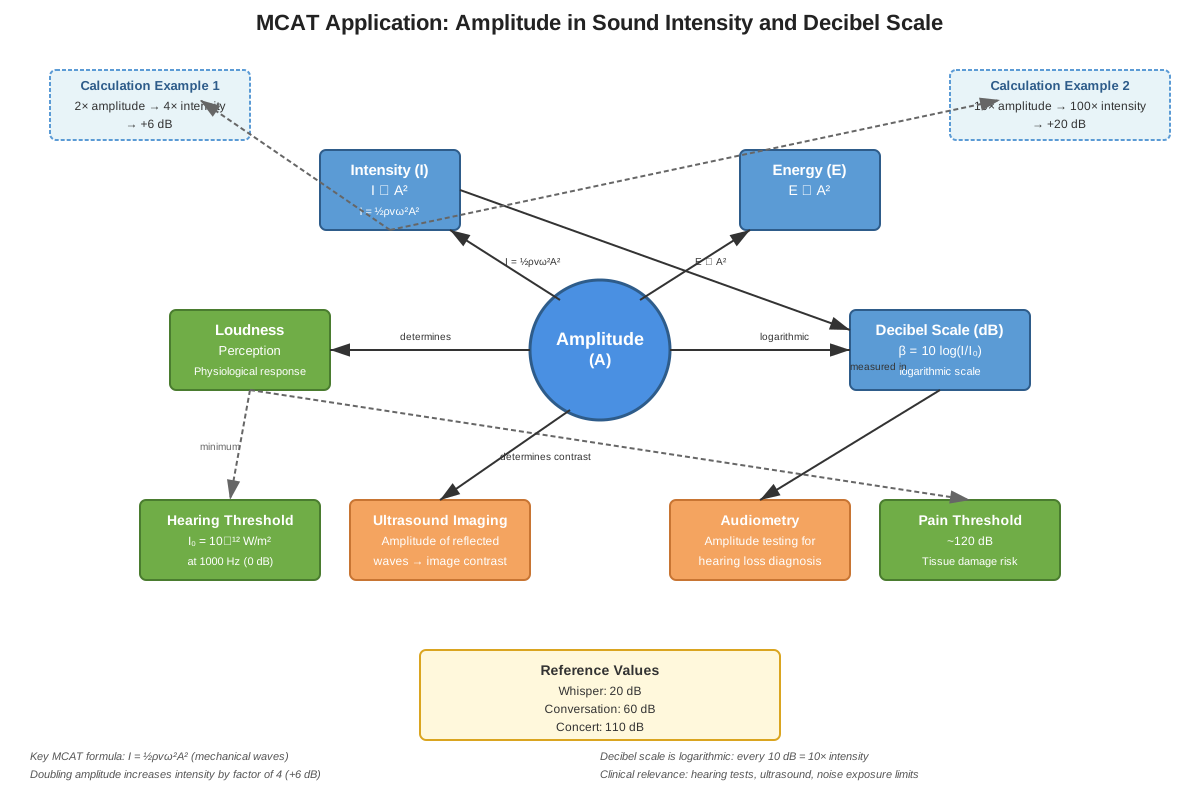
Amplitude directly impacts numerous medical technologies and physiological processes. In diagnostic ultrasound, the amplitude of reflected sound waves determines image contrast and tissue differentiation. Audiometry relies on amplitude measurements to assess hearing thresholds and diagnose hearing loss. Electrocardiography (ECG) and electroencephalography (EEG) interpret amplitude variations to identify cardiac arrhythmias and neurological conditions. Understanding amplitude helps medical professionals optimize imaging parameters, interpret diagnostic results, and explain treatment mechanisms to patients.
MCAT Exam Statistics
Amplitude appears in approximately 3-5% of physics questions on the MCAT, typically integrated into passages about sound, light, or oscillatory motion. Questions may be standalone discrete items testing definitions or calculation-based problems embedded in experimental passages. The topic frequently appears alongside intensity calculations, decibel scales, and interference patterns. Amplitude questions often serve as medium-difficulty discriminators that separate high-scoring students who understand energy relationships from those who merely memorize definitions.
Common Exam Contexts
MCAT passages featuring amplitude typically present scenarios involving: (1) acoustic experiments measuring sound intensity at varying distances, (2) optical interference patterns where amplitude affects brightness, (3) medical imaging technologies requiring interpretation of signal strength, (4) musical instrument physics exploring resonance and harmonics, and (5) oscillating systems like pendulums or springs where amplitude relates to energy. Recognizing these contexts helps students activate relevant knowledge quickly during the exam.
Core Concepts
Definition and Mathematical Representation
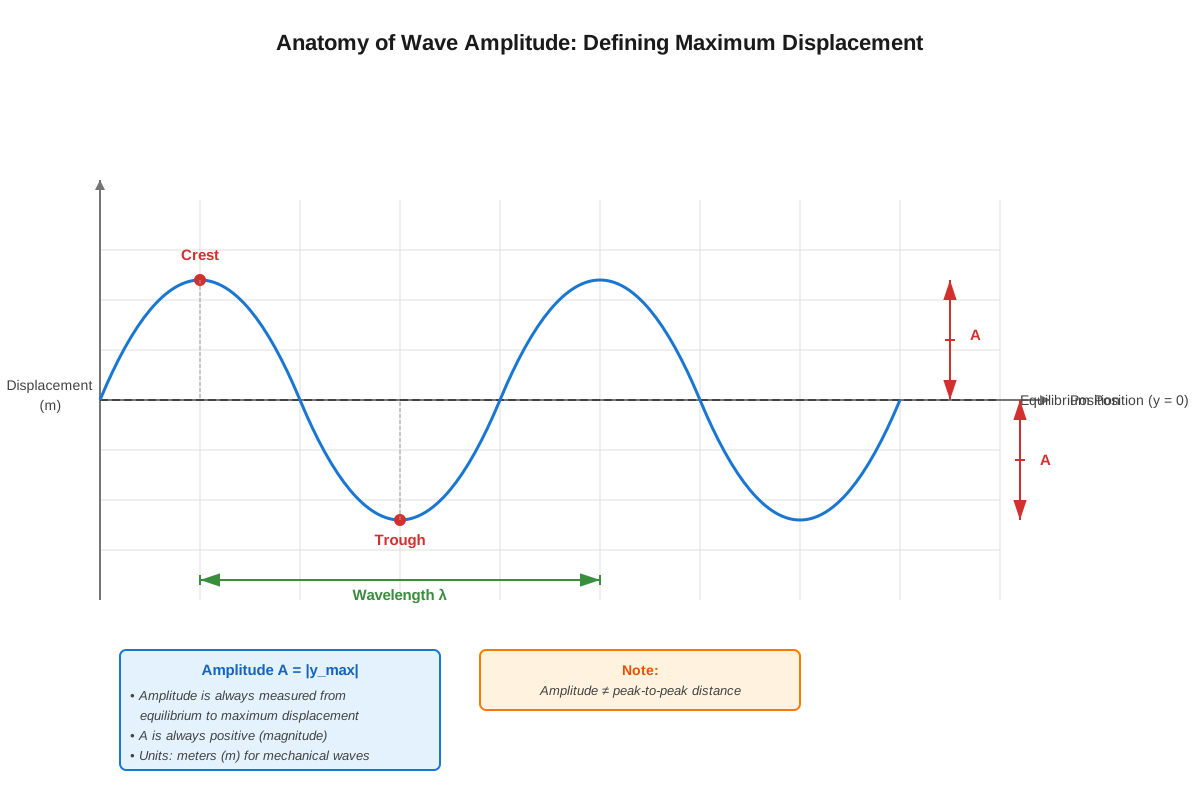
Amplitude (symbol: A) represents the maximum displacement of any point on a wave from its equilibrium position. For a sinusoidal wave described by the equation:
y(x,t) = A sin(kx - ωt + φ)The amplitude A is the coefficient that determines the wave's maximum value. Amplitude is always expressed as a positive scalar quantity with units of length (meters) for mechanical waves or appropriate units for other wave types (volts for electromagnetic fields, pascals for pressure waves).
The equilibrium position serves as the reference point—the position a particle would occupy if no wave were present. Amplitude measures the furthest distance a particle moves from this reference in either direction. For a wave on a string, this is the maximum vertical displacement; for a sound wave, it represents the maximum pressure deviation from atmospheric pressure.
Amplitude and Wave Energy
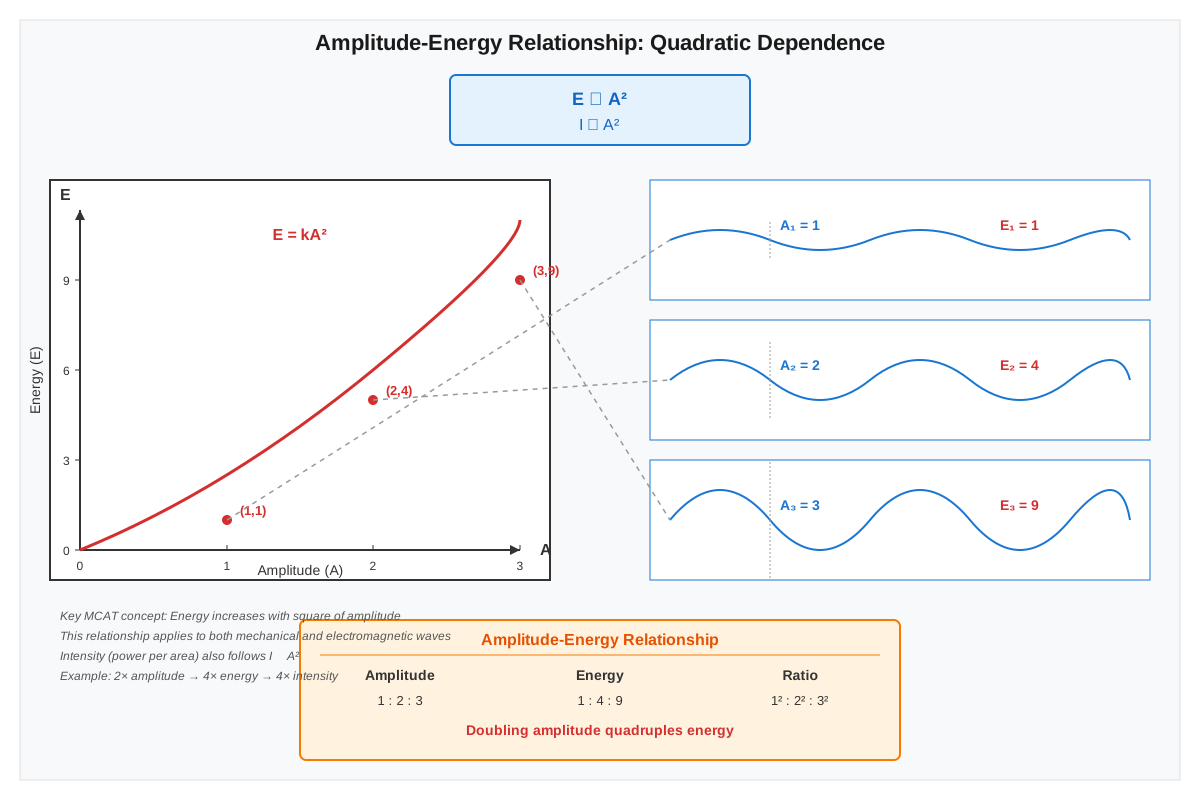
The energy carried by a wave is proportional to the square of its amplitude. This quadratic relationship is fundamental:
E ∝ A²For mechanical waves, this relationship emerges from energy considerations. A wave with twice the amplitude carries four times the energy. This principle applies across wave types: doubling the amplitude of a sound wave increases its energy by a factor of four, making it significantly louder.
The intensity (I) of a wave—defined as power per unit area—also follows this square relationship:
I ∝ A²For sound waves specifically:
I = (1/2)ρvω²A²where ρ is the medium density, v is wave speed, ω is angular frequency, and A is amplitude. This equation reveals that intensity depends on both amplitude and frequency, but the amplitude relationship is quadratic while frequency is also squared.
Amplitude in Different Wave Types
| Wave Type | Amplitude Represents | Observable Effect | Typical Units |
|---|---|---|---|
| Sound waves | Maximum pressure variation | Loudness | Pascals (Pa) |
| Light waves | Maximum electric/magnetic field strength | Brightness | Volts/meter (V/m) |
| Water waves | Maximum height above equilibrium | Wave height | Meters (m) |
| String waves | Maximum transverse displacement | Visible oscillation size | Meters (m) |
| Seismic waves | Maximum ground displacement | Earthquake intensity | Meters (m) |
Each wave type exhibits amplitude differently, but the underlying principle remains constant: amplitude quantifies the maximum disturbance from equilibrium.
Amplitude and the Decibel Scale
For sound waves, the decibel (dB) scale provides a logarithmic measure of intensity relative to a reference level. The relationship between intensity and decibels is:
β = 10 log₁₀(I/I₀)where β is the sound level in decibels, I is the intensity, and I₀ is the reference intensity (10⁻¹² W/m² for sound in air).
Since intensity is proportional to amplitude squared (I ∝ A²), the relationship between amplitude and decibels becomes:
β = 20 log₁₀(A/A₀)This means that doubling the amplitude increases the sound level by 6 dB (since 20 log₁₀(2) ≈ 6). This logarithmic relationship explains why our perception of loudness doesn't scale linearly with amplitude—our ears respond logarithmically to intensity changes.
Amplitude in Superposition and Interference
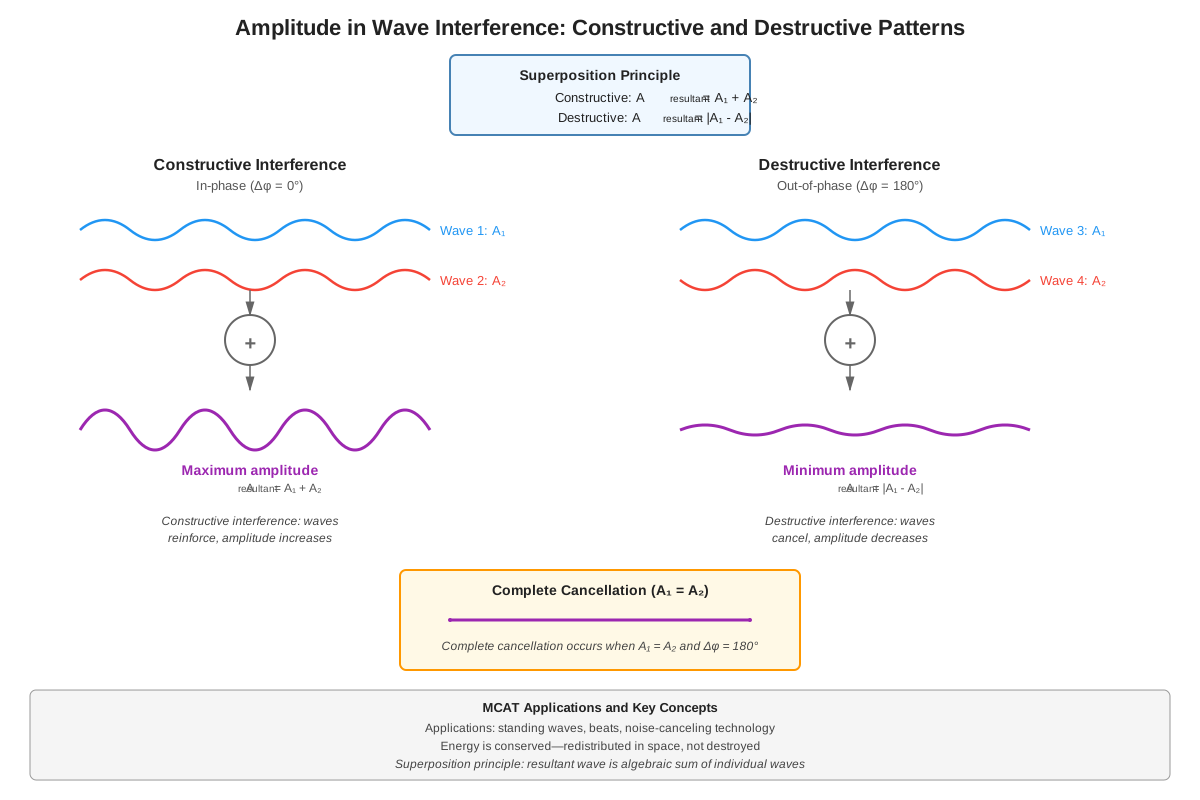
When two or more waves overlap, their amplitudes combine according to the principle of superposition. The resultant amplitude at any point equals the algebraic sum of individual wave amplitudes at that point.
Constructive interference occurs when waves combine in phase (crests align with crests), producing a resultant amplitude equal to the sum of individual amplitudes:
A_resultant = A₁ + A₂Destructive interference occurs when waves combine out of phase (crests align with troughs), potentially reducing or canceling amplitude:
A_resultant = |A₁ - A₂|Complete destructive interference (A_resultant = 0) occurs when two waves of equal amplitude meet exactly 180° out of phase. This principle underlies noise-canceling technology and explains interference patterns in light and sound experiments.
Amplitude Modulation and Damping
Amplitude modulation involves systematically varying a wave's amplitude to encode information—the basis of AM radio transmission. The carrier wave's amplitude changes according to the signal being transmitted, allowing information transfer while maintaining a constant frequency.
Damping describes the gradual decrease in amplitude over time due to energy dissipation. In real systems, friction, air resistance, or other dissipative forces convert wave energy to heat, causing amplitude to decay exponentially:
A(t) = A₀e^(-γt)where A₀ is initial amplitude, γ is the damping coefficient, and t is time. Understanding damping is crucial for interpreting oscillatory motion in biological systems, such as the decay of sound in the ear canal or the settling of a beating heart after exercise.
Concept Relationships
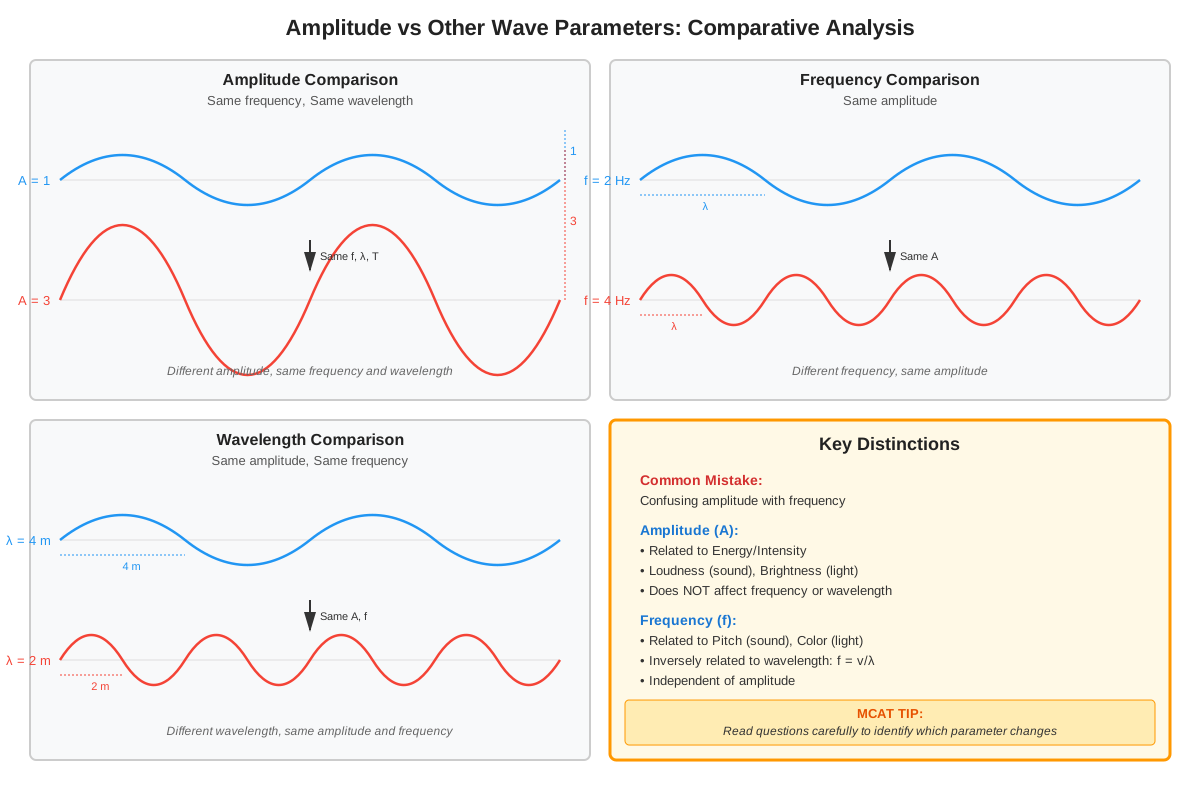
Amplitude connects to wave fundamentals through its role as one of four primary wave parameters (alongside wavelength, frequency, and wave speed). While wavelength and frequency determine the spatial and temporal characteristics of oscillation, amplitude quantifies the oscillation's magnitude. These properties are independent: changing amplitude doesn't affect frequency or wavelength in linear systems.
The relationship flows as: Wave disturbance → Amplitude definition → Energy content → Intensity → Observable effects (loudness, brightness). This chain explains why amplitude serves as the bridge between abstract wave mathematics and measurable physical phenomena.
Amplitude connects to energy and power through the quadratic relationship (E ∝ A²), which then links to intensity (power per unit area). This connection extends to the inverse square law for point sources, where intensity decreases with distance squared, affecting the amplitude of waves detected at various distances.
In interference phenomena, amplitude relationships determine whether constructive or destructive interference occurs, connecting to standing waves, beats, and diffraction patterns. The amplitude at any point in an interference pattern results from superposition of individual wave amplitudes.
For sound specifically, amplitude connects to the decibel scale, which then relates to human hearing perception and sound intensity level. This pathway is clinically relevant for understanding hearing damage thresholds and audiometric testing.
In oscillatory motion (springs, pendulums), amplitude relates to total mechanical energy and maximum velocity, connecting wave concepts to classical mechanics. The maximum kinetic energy occurs at equilibrium (zero displacement), while maximum potential energy occurs at maximum amplitude.
High-Yield Facts
⭐ Amplitude is the maximum displacement from equilibrium, always expressed as a positive value
⭐ Wave energy and intensity are proportional to the square of amplitude (E ∝ A², I ∝ A²)
⭐ Doubling amplitude increases energy by a factor of four and sound level by 6 dB
⭐ Amplitude is independent of frequency and wavelength in linear systems
⭐ In constructive interference, amplitudes add; in destructive interference, they subtract
- Amplitude has units of length (meters) for mechanical waves but varies by wave type
- The decibel scale is logarithmic: β = 10 log₁₀(I/I₀) = 20 log₁₀(A/A₀)
- Complete destructive interference requires equal amplitudes and 180° phase difference
- Damping causes exponential decay of amplitude over time: A(t) = A₀e^(-γt)
- For sound waves, amplitude relates to loudness; for light waves, to brightness
- Standing wave nodes have zero amplitude; antinodes have maximum amplitude (2A for equal incident waves)
- The amplitude of a driven oscillator is maximum at resonance frequency
Quick check — test yourself on Amplitude so far.
Try Flashcards →Common Misconceptions
Misconception: Amplitude and frequency are directly related—increasing one increases the other.
Correction: Amplitude and frequency are independent properties in linear systems. A wave can have any combination of amplitude and frequency. Changing how hard you pluck a guitar string (amplitude) doesn't change its pitch (frequency), which depends on string length, tension, and mass density.
Misconception: Amplitude is the distance from crest to trough.
Correction: Amplitude is the distance from equilibrium to either the crest or the trough—half the total crest-to-trough distance. The full crest-to-trough distance is 2A, where A is the amplitude.
Misconception: Doubling amplitude doubles the loudness or brightness.
Correction: Since intensity is proportional to amplitude squared, doubling amplitude increases intensity by a factor of four. However, perceived loudness follows a logarithmic scale (decibels), so doubling amplitude increases sound level by only 6 dB, which is perceived as noticeably but not dramatically louder.
Misconception: Amplitude decreases as a wave travels because energy spreads out.
Correction: For a plane wave in a non-dissipative medium, amplitude remains constant. Amplitude decreases with distance for spherical waves from point sources due to geometric spreading (inverse square law), not because the wave itself loses energy per unit area. In real media, damping also reduces amplitude.
Misconception: In destructive interference, energy is destroyed.
Correction: Energy is never destroyed, only redistributed. In destructive interference at one location, the energy appears as increased amplitude (constructive interference) at other locations. The total energy in the system remains constant, consistent with energy conservation.
Misconception: Amplitude always has units of meters.
Correction: While displacement amplitude has units of length, amplitude units depend on the quantity oscillating. Sound pressure amplitude uses pascals, electric field amplitude uses volts per meter, and current amplitude uses amperes. Always consider what physical quantity is oscillating.
Worked Examples
Example 1: Amplitude and Energy Relationship
Question: A sound wave has an amplitude of 2.0 × 10⁻⁵ m. If the amplitude is increased to 6.0 × 10⁻⁵ m while frequency and medium properties remain constant, by what factor does the intensity increase?
Solution:
Step 1: Recall that intensity is proportional to amplitude squared:
I ∝ A²Step 2: Set up the ratio of final to initial intensity:
I₂/I₁ = (A₂/A₁)²Step 3: Substitute the given values:
I₂/I₁ = (6.0 × 10⁻⁵ m / 2.0 × 10⁻⁵ m)²Step 4: Calculate:
I₂/I₁ = (3)² = 9Answer: The intensity increases by a factor of 9.
Connection to Learning Objectives: This problem directly applies the amplitude-energy relationship, demonstrating that tripling amplitude increases intensity ninefold. This quadratic relationship is essential for MCAT questions involving wave energy, sound intensity, and electromagnetic radiation intensity.
Example 2: Interference and Resultant Amplitude
Question: Two sound waves with amplitudes of 4.0 × 10⁻⁶ m and 3.0 × 10⁻⁶ m arrive at a point. What are the maximum and minimum possible amplitudes at this point?
Solution:
Step 1: Recognize this as a superposition problem. The resultant amplitude depends on the phase relationship between the waves.
Step 2: For maximum amplitude (constructive interference, waves in phase):
A_max = A₁ + A₂ = 4.0 × 10⁻⁶ m + 3.0 × 10⁻⁶ m = 7.0 × 10⁻⁶ mStep 3: For minimum amplitude (destructive interference, waves 180° out of phase):
A_min = |A₁ - A₂| = |4.0 × 10⁻⁶ m - 3.0 × 10⁻⁶ m| = 1.0 × 10⁻⁶ mStep 4: Note that complete cancellation (A = 0) is impossible because the amplitudes are unequal.
Answer: Maximum amplitude is 7.0 × 10⁻⁶ m; minimum amplitude is 1.0 × 10⁻⁶ m.
Connection to Learning Objectives: This example demonstrates superposition principles and common MCAT scenarios involving interference. Understanding that unequal amplitudes cannot completely cancel is crucial for avoiding misconceptions. This concept appears in passages about noise cancellation, acoustic phenomena, and optical interference patterns.
Example 3: Decibel Scale Application
Question: A speaker produces a sound with intensity I₁. If the amplitude of the sound wave is doubled, what is the change in sound level in decibels?
Solution:
Step 1: Recall the relationship between amplitude and intensity:
I ∝ A²Therefore, if amplitude doubles:
I₂ = (2A)² / A² × I₁ = 4I₁Step 2: Use the decibel formula for intensity ratio:
Δβ = 10 log₁₀(I₂/I₁)Step 3: Substitute I₂ = 4I₁:
Δβ = 10 log₁₀(4) = 10 × 0.602 ≈ 6.0 dBAlternatively, using the amplitude form directly:
Δβ = 20 log₁₀(A₂/A₁) = 20 log₁₀(2) = 20 × 0.301 ≈ 6.0 dBAnswer: The sound level increases by approximately 6 dB.
Connection to Learning Objectives: This problem integrates amplitude, intensity, and the logarithmic decibel scale—a high-yield combination for MCAT physics. Understanding that doubling amplitude yields a 6 dB increase is a frequently tested relationship that appears in passages about hearing, sound measurement, and acoustic technology.
Exam Strategy
Approaching MCAT Amplitude Questions
When encountering amplitude questions, first identify what type of wave is involved and what physical quantity is oscillating. Read carefully to distinguish amplitude from related terms like "peak-to-peak distance" (which equals 2A) or "intensity" (which relates to A²). Many MCAT questions test whether students confuse these related but distinct concepts.
Trigger Words and Phrases
Watch for these key phrases that signal amplitude-related content:
- "Maximum displacement" or "maximum deviation from equilibrium" → direct amplitude definition
- "Loudness increases" or "brightness increases" → likely involves amplitude changes
- "Energy of the wave" or "intensity" → remember the A² relationship
- "Waves interfere" or "superposition" → consider amplitude addition/subtraction
- "Decibel level" or "sound level" → connect to logarithmic amplitude relationship
- "Oscillation magnitude" → another way to describe amplitude
Process of Elimination Tips
When evaluating answer choices:
- Eliminate options that confuse amplitude with frequency or wavelength unless the question explicitly involves coupled systems
- Reject answers suggesting linear relationships between amplitude and energy/intensity—the relationship is quadratic
- Eliminate choices claiming amplitude changes with distance for plane waves in ideal media—this only occurs for spherical waves or in dissipative media
- Discard options suggesting energy destruction in interference—energy is conserved and redistributed
- Be suspicious of answers mixing up amplitude (A) and peak-to-peak distance (2A)
Time Allocation Advice
Amplitude questions typically require 60-90 seconds. Straightforward definition or calculation questions should take under 60 seconds. Problems involving multiple steps (e.g., amplitude → intensity → decibels) may require 90-120 seconds. If a passage presents amplitude data in graphs or tables, spend 30 seconds identifying the relationship before attempting questions. Don't get bogged down in complex calculations—MCAT amplitude problems usually involve simple ratios or logarithms that can be estimated.
Memory Techniques
Mnemonics
"A-SQUARED Energy": Remember that Amplitude relates to energy through SQUARED relationship (E ∝ A²). The mnemonic emphasizes the quadratic nature.
"Double A, Six dB": Doubling amplitude increases sound level by 6 dB. This rhyming phrase helps recall a frequently tested relationship.
"CREST to REST": Amplitude measures from the CREST (maximum) to REST (equilibrium), not crest to trough.
Visualization Strategies
Picture a child on a swing: the amplitude is how far the swing moves from the vertical (equilibrium) position to its highest point on either side. Pushing harder (more energy) increases amplitude—the swing goes higher. This concrete image helps remember that amplitude relates to displacement magnitude and energy input.
For interference, visualize two people shaking opposite ends of a rope: when both lift simultaneously (in phase), the rope's middle rises high (constructive interference, amplitudes add). When one lifts while the other lowers (out of phase), the middle barely moves (destructive interference, amplitudes subtract).
Acronym for Wave Properties
"AWFL" (pronounced "awful") helps remember the four independent wave properties:
- Amplitude
- Wavelength
- Frequency
- Length (or wave speed, v)
This reminds students that amplitude is one of several distinct wave characteristics that must be considered separately.
Summary
Amplitude represents the maximum displacement of a wave from its equilibrium position and serves as a fundamental descriptor of wave magnitude across all wave types. The critical relationship between amplitude and energy—specifically that energy and intensity are proportional to amplitude squared—underlies most MCAT applications of this concept. This quadratic relationship explains why doubling amplitude quadruples energy and increases sound level by 6 dB on the logarithmic decibel scale. Amplitude remains independent of frequency and wavelength in linear systems, though all three properties together fully characterize a wave. In superposition and interference phenomena, amplitudes combine algebraically, producing constructive interference when waves align in phase and destructive interference when out of phase. Understanding amplitude enables interpretation of sound loudness, light brightness, wave energy transfer, and numerous medical technologies including ultrasound and audiometry. For MCAT success, students must distinguish amplitude from related concepts, apply the A² energy relationship confidently, and recognize amplitude's role in interference patterns and the decibel scale.
Key Takeaways
- Amplitude (A) is the maximum displacement from equilibrium, measured as a positive scalar with appropriate units for the wave type
- Energy and intensity scale with the square of amplitude: E ∝ A² and I ∝ A²
- Doubling amplitude increases energy by a factor of four and sound level by 6 dB
- Amplitude, frequency, and wavelength are independent properties in linear wave systems
- In superposition, amplitudes add algebraically: constructive interference sums amplitudes, destructive interference subtracts them
- The decibel scale relates logarithmically to amplitude: β = 20 log₁₀(A/A₀)
- Amplitude determines observable wave effects: loudness for sound, brightness for light, and oscillation magnitude for mechanical waves
Related Topics
Wave Frequency and Period: Understanding how often a wave oscillates complements amplitude knowledge, as these properties together determine wave behavior and energy transfer rates. Mastering amplitude provides the foundation for analyzing how frequency and amplitude independently affect wave phenomena.
Wave Intensity and the Inverse Square Law: Building on the amplitude-intensity relationship (I ∝ A²), this topic explores how intensity decreases with distance from point sources, essential for understanding sound propagation and electromagnetic radiation in medical contexts.
Interference and Standing Waves: Amplitude superposition principles extend to create standing wave patterns with nodes (zero amplitude) and antinodes (maximum amplitude), crucial for understanding musical instruments and resonance phenomena.
Sound Level and the Decibel Scale: The logarithmic relationship between amplitude and decibels expands into comprehensive coverage of sound measurement, hearing thresholds, and acoustic safety—high-yield for MCAT passages involving audiology.
Doppler Effect: While primarily involving frequency shifts, the Doppler effect also affects perceived amplitude, connecting wave properties to relative motion scenarios common in MCAT physics passages.
Practice CTA
Now that you've mastered the fundamentals of amplitude and its relationships to wave energy, intensity, and interference, it's time to solidify your understanding through active practice. Attempt the practice questions and work through the flashcards to reinforce these high-yield concepts. Focus especially on problems involving the amplitude-energy relationship and decibel calculations, as these appear frequently on the MCAT. Remember: understanding amplitude isn't just about memorizing definitions—it's about recognizing how this fundamental property connects to observable phenomena and clinical applications. Your investment in mastering this topic will pay dividends across multiple physics passages on test day. Keep pushing forward!
Sign up free to keep reading
Create a free AnvayaPrep account to finish this MCAT guide on Amplitude — plus flashcards and practice questions.