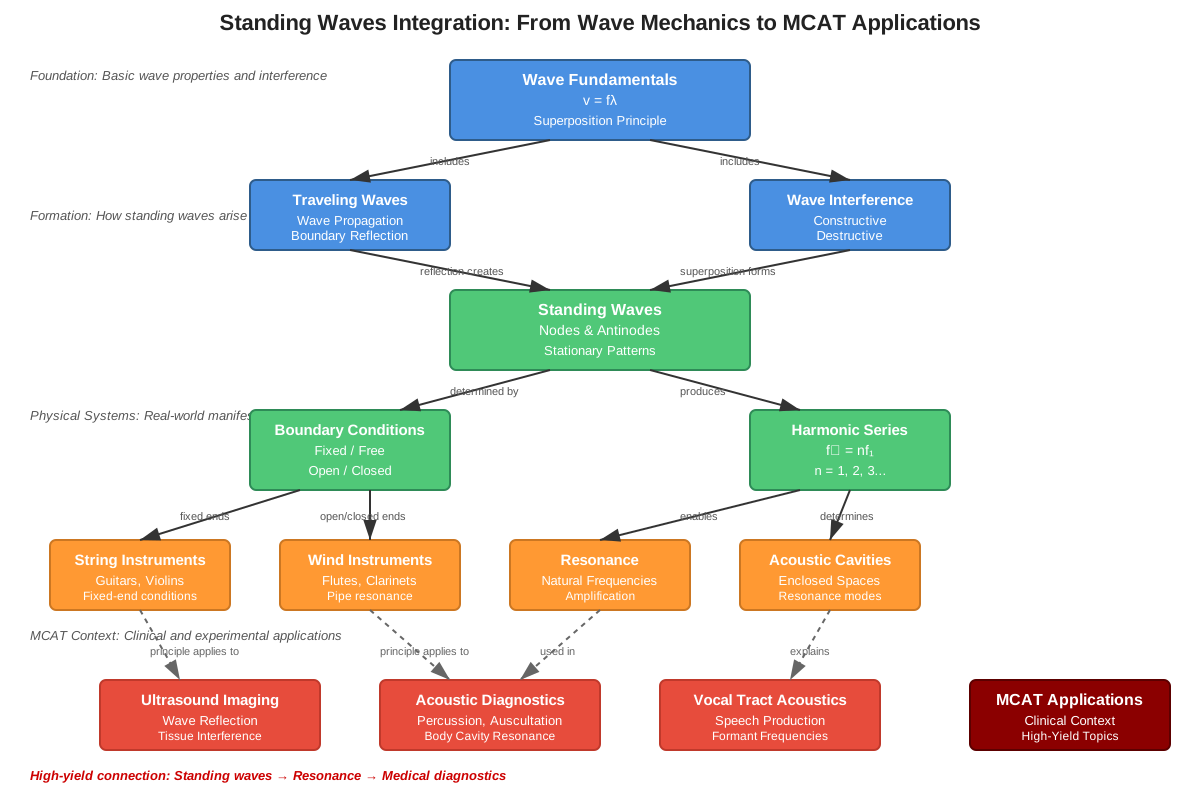
Overview
Standing waves represent a fundamental phenomenon in wave physics where two waves of identical frequency and amplitude traveling in opposite directions interfere to create a stationary pattern of nodes and antinodes. Unlike traveling waves that propagate energy through space, standing waves appear to oscillate in place, with specific points remaining completely stationary while others oscillate with maximum amplitude. This concept bridges the gap between basic wave mechanics and more complex applications in acoustics, musical instruments, and electromagnetic radiation.
For the MCAT, standing waves are essential because they appear frequently in Physics passages involving sound, musical instruments, and wave interference. The exam tests not only the mathematical relationships governing standing wave formation but also the conceptual understanding of how boundary conditions determine allowable wavelengths and frequencies. Questions often integrate standing waves with other topics in Waves and Sound, requiring students to apply multiple concepts simultaneously under time pressure.
Understanding standing waves Physics provides the foundation for analyzing resonance phenomena, harmonic series, and the behavior of waves in confined spaces—all of which have direct applications in medical imaging technologies, acoustic diagnostics, and understanding the physics of human speech and hearing. The mathematical framework developed here extends to quantum mechanics and electromagnetic theory, making this topic a critical stepping stone for comprehensive physics mastery on the MCAT.
Learning Objectives
- [ ] Define standing waves using accurate Physics terminology
- [ ] Explain why standing waves matters for the MCAT
- [ ] Apply standing waves to exam-style questions
- [ ] Identify common mistakes related to standing waves
- [ ] Connect standing waves to related Physics concepts
- [ ] Calculate wavelengths and frequencies for standing waves in strings and pipes with different boundary conditions
- [ ] Distinguish between nodes and antinodes and predict their locations for any harmonic
- [ ] Analyze the relationship between standing wave harmonics and resonance frequencies
Prerequisites
- Wave properties (wavelength, frequency, amplitude, velocity): Essential for understanding the mathematical relationships governing standing wave formation and calculating harmonic frequencies
- Wave interference (constructive and destructive): Standing waves arise from the superposition of two waves, requiring solid understanding of how waves combine
- Traveling waves and wave equations: Standing waves are formed by traveling waves reflecting at boundaries, so understanding wave propagation is fundamental
- Basic trigonometry: Wave equations involve sine and cosine functions that describe oscillatory motion
- Relationship between wave speed, frequency, and wavelength (v = fλ): This fundamental equation is used repeatedly in standing wave calculations
Why This Topic Matters
Standing waves MCAT questions appear regularly in the Chemical and Physical Foundations section, typically 2-4 times per exam. These questions often involve musical instruments (strings, wind instruments), resonance in tubes, or conceptual understanding of harmonic series. The MCAT favors questions that test conceptual understanding over pure calculation, particularly asking students to predict how changing one variable (string tension, tube length, boundary conditions) affects the standing wave pattern.
Clinically, standing wave principles underlie several medical applications. Ultrasound imaging relies on wave reflection and interference patterns. Acoustic resonance in body cavities affects diagnostic procedures. Understanding how standing waves form in confined spaces helps explain phenomena in respiratory physiology, where air column resonances affect breathing sounds used in physical examination. Otoacoustic emissions, used to screen newborn hearing, involve standing waves in the cochlea.
In exam passages, standing waves commonly appear in contexts involving: (1) musical instrument physics, requiring analysis of string or air column vibrations; (2) laboratory setups with vibrating strings or tuning forks; (3) conceptual questions about changing boundary conditions; (4) integrated problems combining standing waves with Doppler effect, beat frequencies, or sound intensity. The MCAT particularly tests the distinction between open and closed pipe harmonics, a high-yield concept that confuses many students.
Core Concepts
Formation of Standing Waves
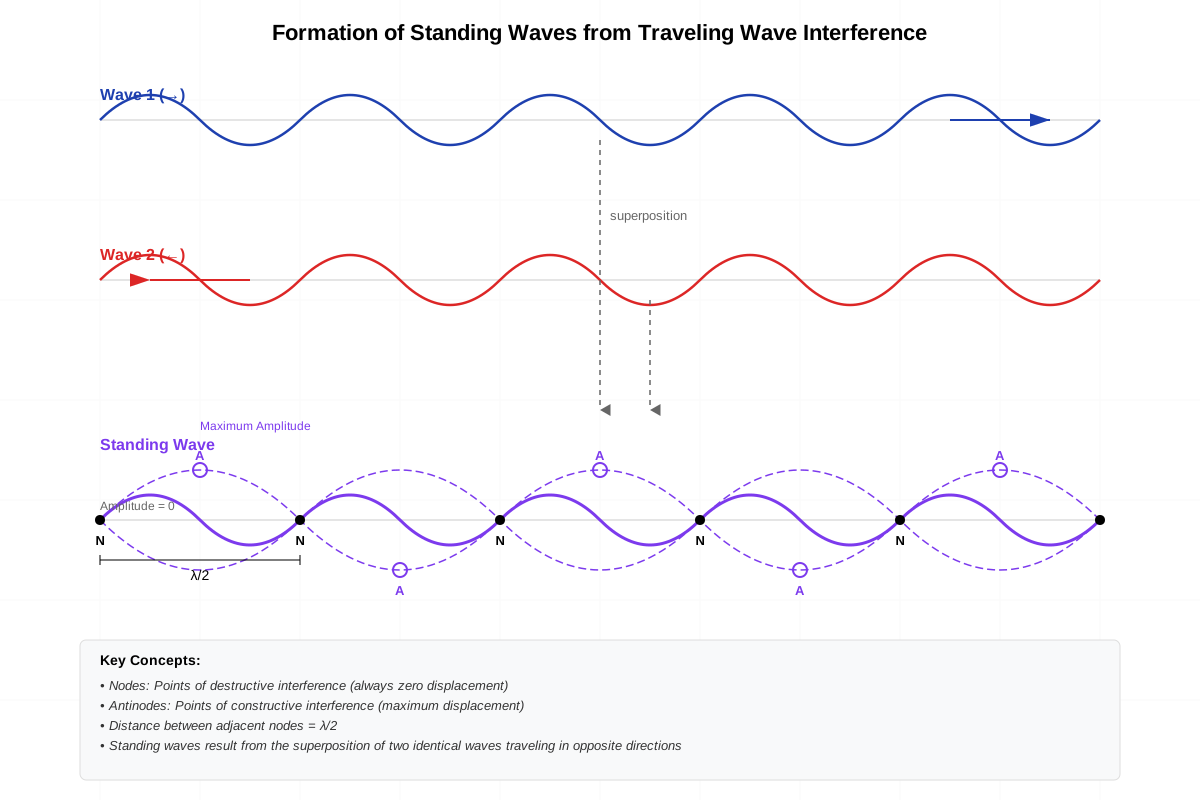
Standing waves form when two waves of identical frequency, amplitude, and wavelength travel in opposite directions through the same medium and interfere continuously. This typically occurs when a traveling wave reflects off a boundary and interferes with the incoming wave. The resulting pattern appears stationary in space, though the medium itself continues to oscillate. Unlike traveling waves that transport energy from one location to another, standing waves store energy in the oscillating medium.
The mathematical description combines two traveling waves:
y₁ = A sin(kx - ωt)  [wave traveling right]
y₂ = A sin(kx + ωt)  [wave traveling left]
Using the principle of superposition and trigonometric identities, these combine to form:
y = 2A sin(kx) cos(ωt)This equation reveals the standing wave's key characteristic: the spatial component sin(kx) and temporal component cos(ωt) are separated. The amplitude at any position x is fixed at 2A sin(kx), oscillating in time with cos(ωt).
Nodes and Antinodes
Nodes are positions along the standing wave where the amplitude is always zero—the medium never moves at these points. Nodes occur where sin(kx) = 0, which happens when kx = nπ, where n is an integer. Since k = 2π/λ, nodes are separated by λ/2 (half a wavelength).
Antinodes are positions where the amplitude reaches its maximum value of 2A. These occur where sin(kx) = ±1, which happens when kx = (n + 1/2)π. Antinodes are also separated by λ/2 and are located exactly halfway between adjacent nodes.
The distance between a node and the nearest antinode is always λ/4 (one-quarter wavelength). This relationship is crucial for solving MCAT problems involving standing wave patterns.
Standing Waves on Strings (Fixed-Fixed Boundary Conditions)
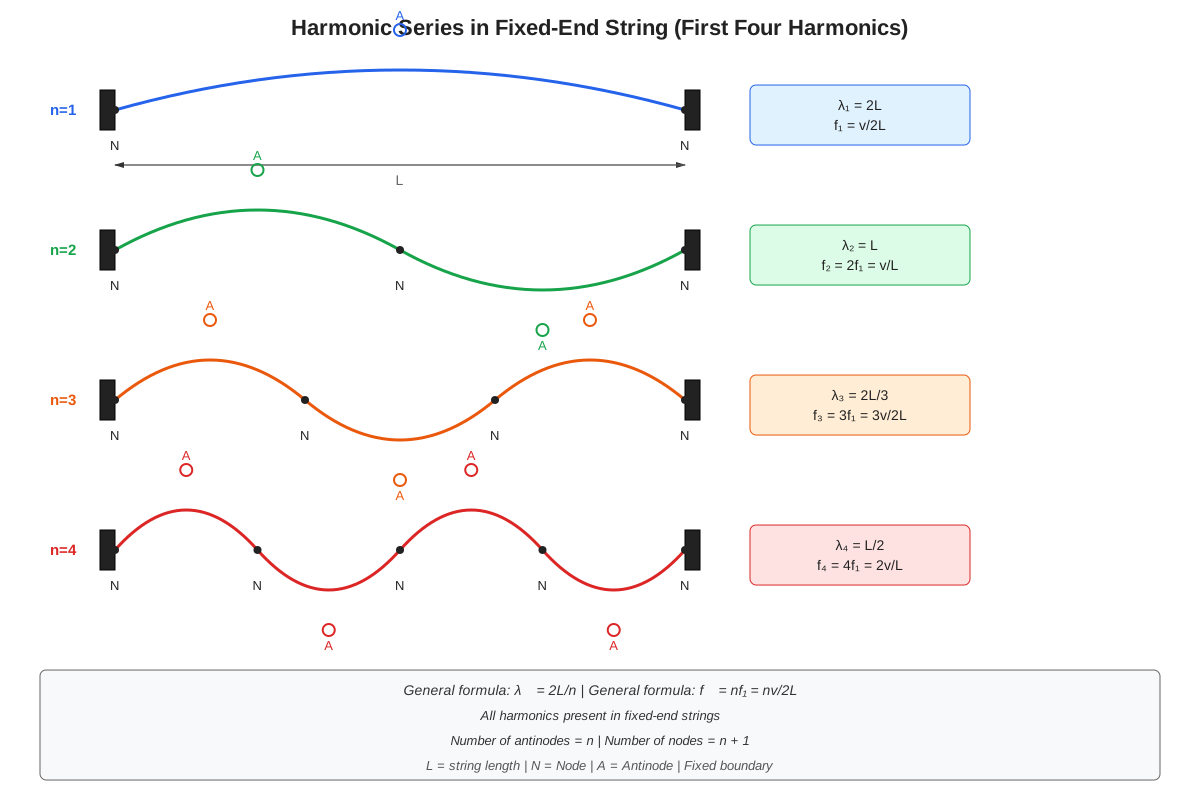
When a string is fixed at both ends (like a guitar string), both boundaries must be nodes. This constraint limits which wavelengths can form standing waves—only specific wavelengths that "fit" the string length L will produce stable patterns. These allowed wavelengths constitute the harmonic series.
For a string of length L fixed at both ends:
- The string length must equal an integer number of half-wavelengths: L = n(λ/2)
- Solving for wavelength: λₙ = 2L/n, where n = 1, 2, 3, ...
- The corresponding frequencies: fₙ = nv/2L = nf₁
The fundamental frequency (first harmonic, n=1) is f₁ = v/2L, representing the lowest possible frequency. The second harmonic (n=2) has frequency f₂ = 2f₁, the third harmonic f₃ = 3f₁, and so forth. All integer multiples of the fundamental frequency are present.
| Harmonic | Wavelength | Frequency | Number of Antinodes | Pattern Description |
|---|---|---|---|---|
| 1st (fundamental) | 2L | v/2L | 1 | Half wavelength fits |
| 2nd | L | v/L | 2 | One full wavelength fits |
| 3rd | 2L/3 | 3v/2L | 3 | 1.5 wavelengths fit |
| nth | 2L/n | nv/2L | n | n/2 wavelengths fit |
Standing Waves in Open Pipes (Open-Open Boundary Conditions)
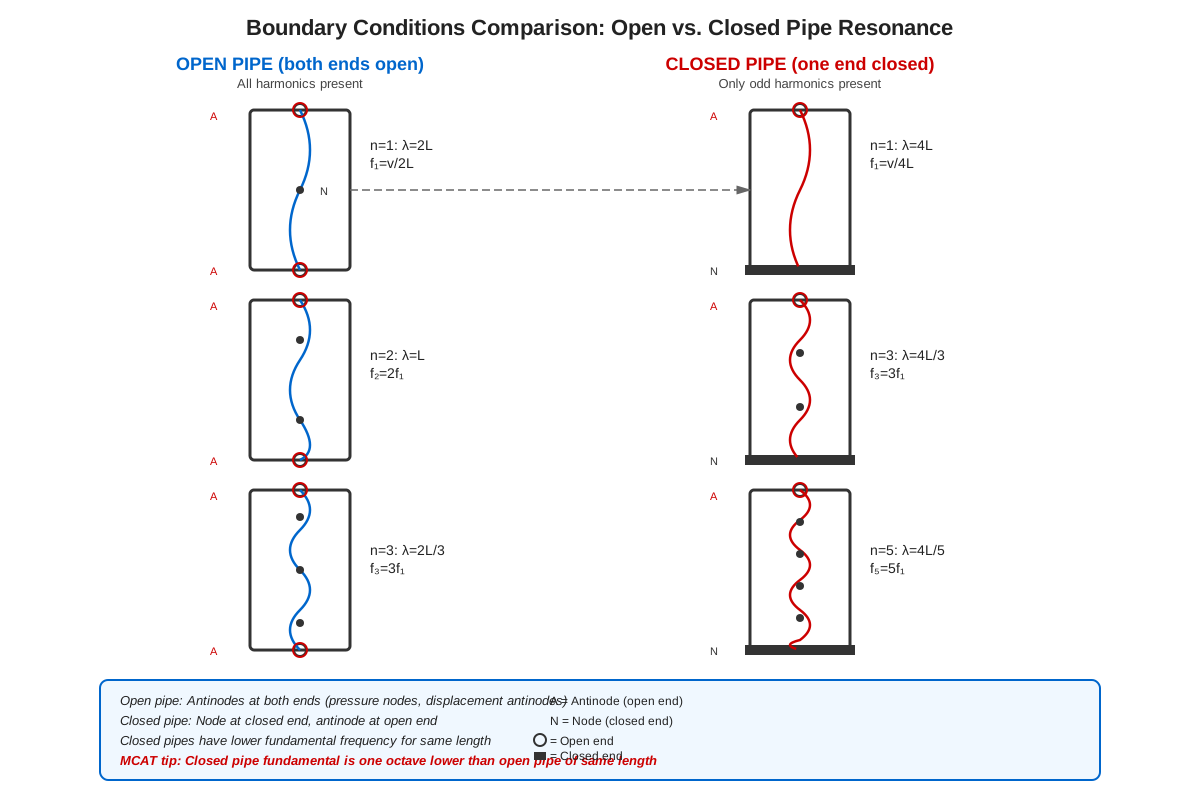
An open pipe (open at both ends, like a flute) has antinodes at both ends because the air is free to move at the openings. This boundary condition produces the same harmonic series as a fixed-fixed string.
For an open pipe of length L:
- L = n(λ/2), where n = 1, 2, 3, ...
- λₙ = 2L/n
- fₙ = nv/2L = nf₁
- All harmonics (all integer multiples of f₁) are present
The fundamental frequency has antinodes at both ends with a single node in the middle. Each successive harmonic adds one more node and one more antinode.
Standing Waves in Closed Pipes (Closed-Open Boundary Conditions)
A closed pipe (closed at one end, open at the other, like some organ pipes) must have a node at the closed end and an antinode at the open end. This asymmetric boundary condition produces a different harmonic series—only odd harmonics are present.
For a closed pipe of length L:
- L = (2n-1)(λ/4), where n = 1, 2, 3, ...
- λₙ = 4L/(2n-1)
- fₙ = (2n-1)v/4L = (2n-1)f₁
- Only odd harmonics present: f₁, 3f₁, 5f₁, 7f₁, ...
The fundamental frequency for a closed pipe is f₁ = v/4L, which is half the fundamental frequency of an open pipe of the same length. This means a closed pipe sounds an octave lower than an open pipe of equal length.
| Pipe Type | Boundary Conditions | Fundamental Wavelength | Fundamental Frequency | Harmonics Present |
|---|---|---|---|---|
| Open-open | Antinode-Antinode | 2L | v/2L | All (1, 2, 3, 4, ...) |
| Closed-open | Node-Antinode | 4L | v/4L | Odd only (1, 3, 5, 7, ...) |
Resonance and Standing Waves
Resonance occurs when a system is driven at one of its natural frequencies (the frequencies at which standing waves form). At resonance, energy transfer is maximally efficient, and amplitude increases dramatically. Musical instruments exploit resonance—the vibrating string or air column drives the instrument body at resonant frequencies, producing loud, sustained tones.
The quality of sound from an instrument depends on which harmonics are present and their relative amplitudes. The fundamental determines pitch, while the harmonic content (overtones) determines timbre or tone quality. Different instruments playing the same note sound different because they emphasize different harmonics.
Wave Speed in Strings
The velocity of waves on a string depends on the string's physical properties:
v = √(T/μ)where T is the tension force and μ is the linear mass density (mass per unit length, μ = m/L).
This relationship is crucial for MCAT problems because changing tension or mass density affects wave speed, which in turn affects all standing wave frequencies. Increasing tension increases wave speed and raises all frequencies. Increasing mass density decreases wave speed and lowers all frequencies.
Concept Relationships
Standing waves emerge from the more fundamental concept of wave interference. When two traveling waves of identical frequency move in opposite directions, their continuous superposition creates the standing wave pattern. The principle of superposition is therefore the foundation upon which standing wave analysis rests.
The formation of standing waves requires boundary conditions that cause wave reflection. These boundaries determine which wavelengths can exist as standing waves, creating the harmonic series. The specific boundary conditions (fixed-fixed, open-open, or closed-open) directly determine which harmonics are allowed.
Resonance represents the practical consequence of standing waves—systems respond most strongly at their natural frequencies, which are precisely the frequencies at which standing waves form. This connects standing waves to energy transfer and amplitude enhancement.
The mathematical framework flows as: Wave properties (v, f, λ) → Boundary conditions → Allowed wavelengths → Harmonic frequencies → Resonance phenomena
Standing waves connect to sound intensity because resonance affects amplitude, and intensity depends on amplitude squared. They relate to beats when two slightly different frequencies are present, preventing true standing wave formation. The Doppler effect can shift frequencies relative to resonant frequencies, affecting standing wave formation in moving systems.
For strings specifically: Tension and mass density → Wave speed → Harmonic frequencies, showing how mechanical properties determine acoustic properties.
Quick check — test yourself on Standing waves so far.
Try Flashcards →High-Yield Facts
⭐ Standing waves form when two waves of identical frequency and amplitude traveling in opposite directions interfere continuously, creating stationary nodes and antinodes
⭐ Nodes are separated by λ/2; antinodes are separated by λ/2; the distance from a node to the nearest antinode is λ/4
⭐ For strings fixed at both ends and open-open pipes: L = n(λ/2), giving fₙ = nv/2L with all harmonics present
⭐ For closed-open pipes: L = (2n-1)(λ/4), giving fₙ = (2n-1)v/4L with only odd harmonics present
⭐ A closed pipe has a fundamental frequency half that of an open pipe of the same length (sounds one octave lower)
- The fundamental frequency is the lowest frequency at which a standing wave can form and is also called the first harmonic
- Wave speed on a string is v = √(T/μ), where T is tension and μ is linear mass density
- Increasing string tension increases wave speed and raises all harmonic frequencies proportionally
- The number of antinodes equals the harmonic number (3rd harmonic has 3 antinodes)
- At resonance, energy transfer is maximally efficient and amplitude is maximized
- Standing waves do not transport energy along the medium; energy is stored in the oscillating medium
- The harmonic series for open-open systems includes all integer multiples of f₁: f₁, 2f₁, 3f₁, 4f₁...
- The harmonic series for closed-open systems includes only odd multiples of f₁: f₁, 3f₁, 5f₁, 7f₁...
Common Misconceptions
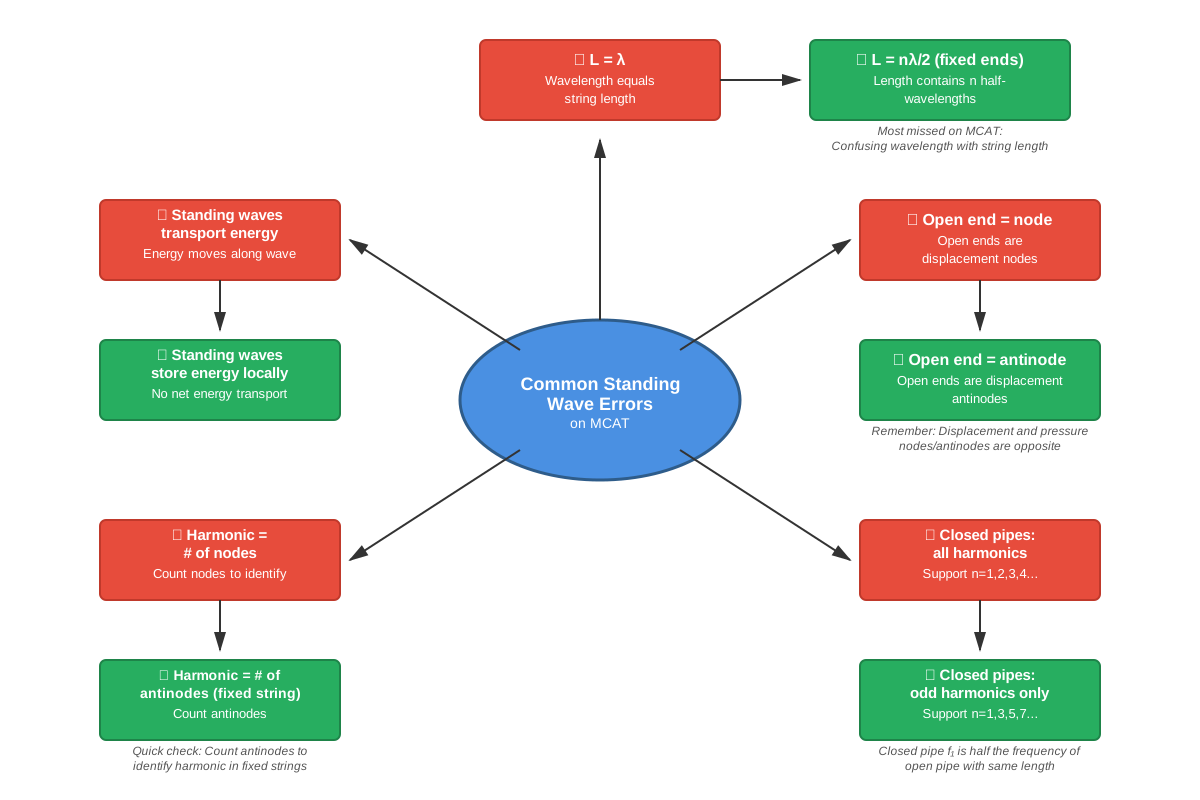
Misconception: Standing waves travel through the medium like regular waves.
Correction: Standing waves appear stationary in space. While the medium oscillates up and down (or back and forth), the pattern of nodes and antinodes does not move. Energy is stored in the oscillating medium rather than transported along it.
Misconception: Nodes and antinodes are separated by one full wavelength.
Correction: Both nodes and antinodes are separated by λ/2 (half a wavelength). The distance from a node to the nearest antinode is λ/4 (quarter wavelength). This is a frequently tested detail on the MCAT.
Misconception: All pipes produce the same harmonic series regardless of whether they're open or closed.
Correction: Open-open pipes produce all harmonics (1, 2, 3, 4...), while closed-open pipes produce only odd harmonics (1, 3, 5, 7...). This difference arises from different boundary conditions and is one of the highest-yield distinctions for the MCAT.
Misconception: The fundamental frequency of a closed pipe equals that of an open pipe of the same length.
Correction: A closed pipe's fundamental frequency is exactly half that of an open pipe of the same length (f₁,closed = v/4L versus f₁,open = v/2L). This means the closed pipe sounds one octave lower.
Misconception: Increasing the tension in a string decreases the frequency of standing waves.
Correction: Increasing tension increases wave speed (v = √(T/μ)), which increases all harmonic frequencies since f = v/λ. This is why tightening a guitar string raises its pitch.
Misconception: The amplitude at antinodes equals the amplitude of the original traveling waves.
Correction: The amplitude at antinodes equals twice the amplitude of each traveling wave (2A) due to constructive interference. This doubling is built into the standing wave equation.
Misconception: You can have any frequency standing wave in a confined system.
Correction: Only specific frequencies (the harmonic series) can form standing waves in a system with fixed boundaries. Other frequencies produce traveling waves that destructively interfere and die out quickly.
Worked Examples
Example 1: Guitar String Harmonics
Problem: A guitar string of length 0.64 m is fixed at both ends. When plucked, it vibrates at its fundamental frequency of 256 Hz. (a) What is the wave speed on the string? (b) What are the frequencies of the second and third harmonics? (c) If the string tension is quadrupled, what is the new fundamental frequency?
Solution:
(a) For a string fixed at both ends, the fundamental frequency is:
f₁ = v/2LSolving for wave speed:
v = 2Lf₁ = 2(0.64 m)(256 Hz) = 327.68 m/s ≈ 328 m/s(b) For fixed-fixed boundary conditions, all harmonics are present and are integer multiples of the fundamental:
f₂ = 2f₁ = 2(256 Hz) = 512 Hz
f₃ = 3f₁ = 3(256 Hz) = 768 Hz
(c) Wave speed on a string depends on tension: v = √(T/μ)
If tension is quadrupled: v_new = √(4T/μ) = 2√(T/μ) = 2v
Since frequency is proportional to wave speed (f = v/2L):
f₁,new = v_new/2L = 2v/2L = 2f₁ = 2(256 Hz) = 512 HzKey Concepts Applied: This problem integrates the harmonic series for fixed-fixed boundaries, the relationship between wave speed and frequency, and the effect of tension on wave speed. The MCAT commonly tests whether students recognize that quadrupling tension doubles wave speed (because of the square root relationship), which doubles all frequencies.
Example 2: Open vs. Closed Pipe Comparison
Problem: Two organ pipes have the same length of 0.85 m. Pipe A is open at both ends, while Pipe B is closed at one end and open at the other. The speed of sound in air is 340 m/s. (a) What is the fundamental frequency of each pipe? (b) What is the frequency of the third harmonic for each pipe? (c) Which pipe produces a lower-pitched sound at its fundamental frequency?
Solution:
(a) For Pipe A (open-open):
f₁,A = v/2L = 340 m/s / (2 × 0.85 m) = 340/1.7 = 200 HzFor Pipe B (closed-open):
f₁,B = v/4L = 340 m/s / (4 × 0.85 m) = 340/3.4 = 100 Hz(b) For Pipe A (all harmonics present):
f₃,A = 3f₁,A = 3(200 Hz) = 600 HzFor Pipe B (only odd harmonics present):
The "third harmonic" means the third member of the harmonic series, which for a closed pipe is the 5th multiple of the fundamental:
f₃,B = 5f₁,B = 5(100 Hz) = 500 HzNote: Some sources refer to this as the "third allowed harmonic" or "second overtone." The MCAT typically clarifies this in the question stem.
(c) Pipe B produces the lower-pitched sound. Its fundamental frequency (100 Hz) is exactly half that of Pipe A (200 Hz), meaning it sounds one octave lower. This demonstrates the critical principle that closing one end of a pipe lowers its fundamental frequency.
Key Concepts Applied: This problem tests the distinction between open and closed pipe harmonics, a high-yield MCAT topic. Students must remember that closed pipes have fundamentals at v/4L (not v/2L) and produce only odd harmonics. The comparison directly shows why instruments with different boundary conditions produce different timbres and pitches.
Exam Strategy
When approaching standing waves MCAT questions, first identify the boundary conditions: Are both ends fixed/open (symmetric), or is one end closed/fixed and the other open/free (asymmetric)? This immediately tells you whether all harmonics or only odd harmonics are present.
Trigger words to watch for:
- "Fixed at both ends" or "string" → use L = n(λ/2), all harmonics
- "Open at both ends" or "open pipe" → use L = n(λ/2), all harmonics
- "Closed at one end" or "closed pipe" → use L = (2n-1)(λ/4), odd harmonics only
- "Fundamental frequency" → n = 1, lowest frequency
- "First overtone" → second harmonic (n = 2) for symmetric, third harmonic (n = 3) for asymmetric
- "Resonance" → standing wave frequencies, maximum amplitude
Process of elimination tips:
- If a question asks about changing string tension and an answer suggests frequency decreases, eliminate it (increasing tension always increases frequency)
- If comparing open and closed pipes of equal length, the closed pipe always has the lower fundamental frequency
- If a question describes a standing wave pattern and asks for wavelength, count the number of antinodes or nodes and use the geometric relationships (nodes separated by λ/2)
- For "which harmonic" questions, count antinodes—the number of antinodes equals the harmonic number
Time allocation: Standing wave calculations are typically straightforward once you identify the boundary conditions. Spend 15-20 seconds identifying the system type, then apply the appropriate formula. Don't waste time deriving formulas—memorize the key relationships for fixed-fixed (L = n(λ/2)) and closed-open (L = (2n-1)(λ/4)) systems.
Exam Tip: If a passage describes a musical instrument, quickly categorize it: strings and open pipes use the same formulas (all harmonics), while closed pipes are unique (odd harmonics only). This categorization saves time and prevents formula confusion.
Memory Techniques
Mnemonic for boundary conditions and harmonics:
"Open Or Fixed For All" → Open-Open and Fixed-Fixed allow All harmonics
"Closed One Odd" → Closed-Open allows Odd harmonics only
Visualizing nodes and antinodes:
Picture a jump rope held by two people. The ends (where hands hold) never move—these are nodes. The middle whips up and down with maximum motion—this is an antinode. For the fundamental, there's one antinode in the middle. For the second harmonic, add one more antinode (now two antinodes with a node between them).
Remembering the λ/2 and λ/4 relationships:
"Half the wave fits in Fixed-Fixed" → L = n(λ/2)
"Quarter wave starts Closed-Open" → L = (2n-1)(λ/4)
For pipe frequency comparison:
"Closing Cuts frequency in half" → Closed pipe fundamental is half that of open pipe (same length)
Acronym for wave speed on strings:
"Tight Muscles" → v = √(T/μ), where T is Tension and μ (mu) is Mass density
Higher tension = faster waves = higher frequencies (like tight muscles move faster)
Summary
Standing waves represent a fundamental wave phenomenon where two identical waves traveling in opposite directions interfere to create a stationary pattern of nodes (zero amplitude) and antinodes (maximum amplitude). These patterns arise from boundary conditions that constrain which wavelengths can exist in a confined system, producing discrete harmonic series. For symmetric boundary conditions (fixed-fixed strings or open-open pipes), all integer harmonics are present with L = n(λ/2) and fₙ = nv/2L. For asymmetric boundary conditions (closed-open pipes), only odd harmonics exist with L = (2n-1)(λ/4) and fₙ = (2n-1)v/4L. The fundamental frequency represents the lowest possible frequency, with a closed pipe's fundamental being exactly half that of an open pipe of equal length. Wave speed on strings depends on tension and mass density (v = √(T/μ)), directly affecting all harmonic frequencies. Resonance occurs at standing wave frequencies, where energy transfer is maximally efficient. Understanding these principles enables analysis of musical instruments, acoustic systems, and wave behavior in confined spaces—all testable concepts on the MCAT.
Key Takeaways
- Standing waves form from interference of identical waves traveling in opposite directions, creating stationary patterns with nodes (zero amplitude) and antinodes (maximum amplitude) separated by λ/2
- Fixed-fixed strings and open-open pipes follow L = n(λ/2) with all harmonics present (fₙ = nv/2L)
- Closed-open pipes follow L = (2n-1)(λ/4) with only odd harmonics present (fₙ = (2n-1)v/4L)
- A closed pipe's fundamental frequency is half that of an open pipe of the same length, sounding one octave lower
- Wave speed on strings is v = √(T/μ); increasing tension increases wave speed and raises all frequencies
- The number of antinodes in a standing wave pattern equals the harmonic number
- Resonance occurs at standing wave frequencies, producing maximum amplitude and efficient energy transfer
Related Topics
Wave Interference and Superposition: Understanding how waves combine is essential for deriving standing wave equations and predicting amplitude patterns. Mastering standing waves provides concrete examples of interference principles.
Sound Intensity and Decibels: Standing waves affect amplitude, which determines intensity. Resonance can dramatically increase sound intensity at specific frequencies, connecting wave patterns to energy considerations.
Doppler Effect: When sources or observers move, frequencies shift relative to standing wave resonant frequencies, affecting whether standing waves form and how instruments sound to moving listeners.
Beats: When two frequencies are close but not identical, standing waves cannot form perfectly. Instead, beats occur—a phenomenon that contrasts with and illuminates standing wave requirements.
Electromagnetic Waves: Standing wave principles extend to electromagnetic radiation in cavities, lasers, and transmission lines, showing how mechanical wave concepts generalize to other wave types.
Practice CTA
Now that you've mastered the core concepts of standing waves, it's time to solidify your understanding through active practice. Attempt the practice questions to test your ability to identify boundary conditions, calculate harmonic frequencies, and distinguish between open and closed pipe systems. Use the flashcards to reinforce high-yield facts like the formulas for different boundary conditions and the relationship between tension and frequency. Remember: the MCAT rewards not just knowledge but the ability to apply concepts quickly under pressure. Each practice problem you solve builds the pattern recognition and problem-solving speed you need for test day success. You've got this!
Sign up free to keep reading
Create a free AnvayaPrep account to finish this MCAT guide on Standing waves — plus flashcards and practice questions.