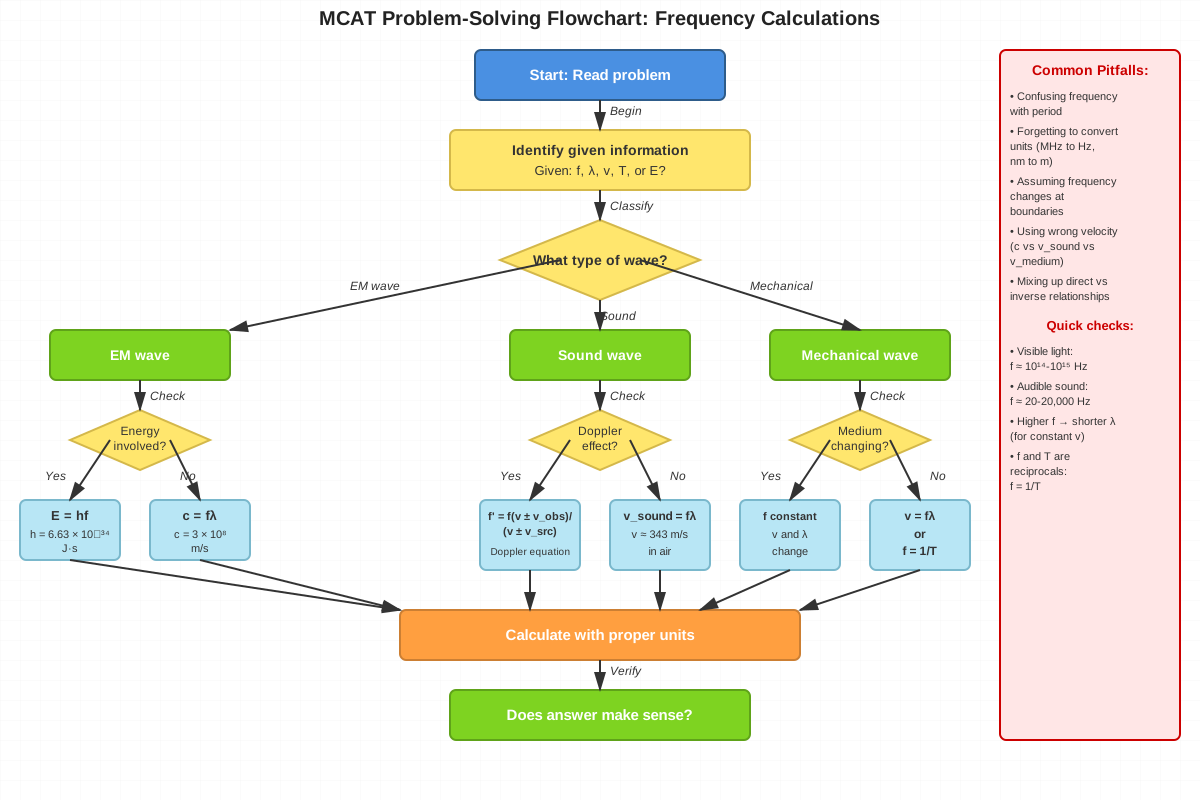
Overview
Frequency is a fundamental concept in Physics that describes how often a repeating event occurs per unit time. In the context of Waves and Sound, frequency represents the number of complete wave cycles that pass a fixed point in one second, measured in Hertz (Hz). This concept is essential for understanding everything from electromagnetic radiation and light to mechanical waves and sound perception. On the MCAT, frequency appears not only in physics passages but also in biological contexts such as hearing physiology, medical imaging technologies, and even neurological signal transmission.
Understanding frequency is critical for MCAT success because it serves as a bridge between multiple physics concepts including wavelength, period, energy, and wave speed. The MCAT frequently tests frequency in the context of the Doppler effect, resonance phenomena, electromagnetic spectrum problems, and sound intensity calculations. Students must be comfortable manipulating the relationship between frequency and other wave properties, as well as recognizing how frequency changes (or doesn't change) when waves transition between different media.
Mastery of frequency concepts enables students to tackle complex passage-based questions that integrate physics principles with biological applications. For instance, understanding how ultrasound frequency affects tissue penetration depth, how different light frequencies interact with photoreceptors in the eye, or how MRI machines utilize radiofrequency pulses all require solid foundational knowledge of frequency and its relationships to energy and wavelength. This topic typically appears in 3-5 questions per MCAT exam, making it a medium-yield but essential component of a comprehensive physics preparation strategy.
Learning Objectives
- [ ] Define Frequency using accurate Physics terminology
- [ ] Explain why Frequency matters for the MCAT
- [ ] Apply Frequency to exam-style questions
- [ ] Identify common mistakes related to Frequency
- [ ] Connect Frequency to related Physics concepts
- [ ] Calculate frequency given period, wavelength, or wave speed
- [ ] Predict how frequency changes when waves encounter different media
- [ ] Analyze the relationship between frequency and energy for electromagnetic radiation
- [ ] Distinguish between frequency and pitch in the context of sound waves
Prerequisites
- Basic algebra and unit conversion: Essential for manipulating frequency equations and converting between Hz, kHz, and MHz
- Understanding of periodic motion: Frequency describes repeating events, requiring familiarity with cycles and oscillations
- Wave fundamentals: Knowledge of what constitutes a wave, including crests, troughs, and wavelength
- Scientific notation: Frequency values span many orders of magnitude (Hz to THz), requiring comfort with exponential notation
- Basic energy concepts: Understanding that energy can be transferred by waves is necessary for connecting frequency to photon energy
Why This Topic Matters
Clinical and Real-World Significance
Frequency is fundamental to numerous medical technologies and diagnostic procedures. Ultrasound imaging relies on high-frequency sound waves (1-20 MHz) to visualize internal structures, with higher frequencies providing better resolution but less tissue penetration. Electroencephalography (EEG) measures brain wave frequencies to diagnose epilepsy and sleep disorders, categorizing brain activity into delta (0.5-4 Hz), theta (4-8 Hz), alpha (8-13 Hz), and beta (13-30 Hz) waves. Radiation therapy uses specific frequencies of electromagnetic radiation to target cancer cells, while MRI machines employ radiofrequency pulses to manipulate hydrogen nuclei for imaging.
MCAT Exam Statistics
Frequency-related questions appear in approximately 3-5 discrete questions or passage-based items per MCAT administration. These questions most commonly appear in the Chemical and Physical Foundations of Biological Systems section but can also emerge in passages discussing sensory physiology (hearing, vision) in the Biological and Biochemical Foundations section. Questions typically test the mathematical relationships between frequency, wavelength, and wave speed (40% of frequency questions), the Doppler effect (25%), electromagnetic spectrum properties (20%), and sound/hearing physiology (15%).
Common Exam Contexts
The MCAT presents frequency concepts through various passage types: experimental physics passages describing wave interference or resonance experiments, medical technology passages explaining ultrasound or spectroscopy, biological passages discussing auditory or visual perception, and standalone questions testing fundamental relationships. Students must recognize frequency in disguised forms—questions about "pitch" are testing frequency understanding, while "color of light" questions involve electromagnetic frequency. Passages often require students to integrate frequency with other concepts like intensity, energy, or the photoelectric effect.
Core Concepts
Definition and Units of Frequency
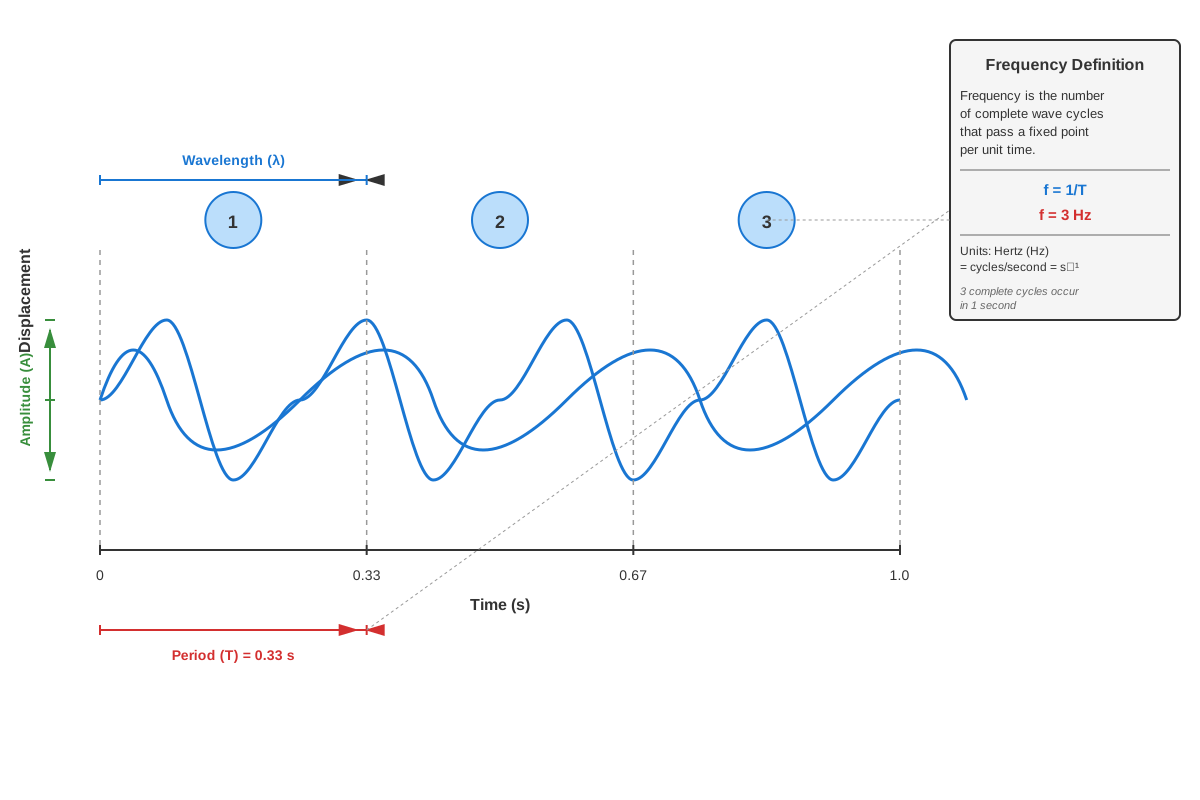
Frequency (symbol: f or ν) is defined as the number of complete cycles, oscillations, or waves that occur per unit time. The SI unit of frequency is the Hertz (Hz), where 1 Hz equals one cycle per second. Mathematically, frequency represents the reciprocal of the period (T), which is the time required for one complete cycle:
f = 1/TWhere:
- f = frequency (Hz or s⁻¹)
- T = period (seconds)
This inverse relationship means that high-frequency waves have short periods (many cycles occur quickly), while low-frequency waves have long periods (cycles occur slowly). For example, a wave with a period of 0.01 seconds has a frequency of 100 Hz, meaning 100 complete cycles occur each second.
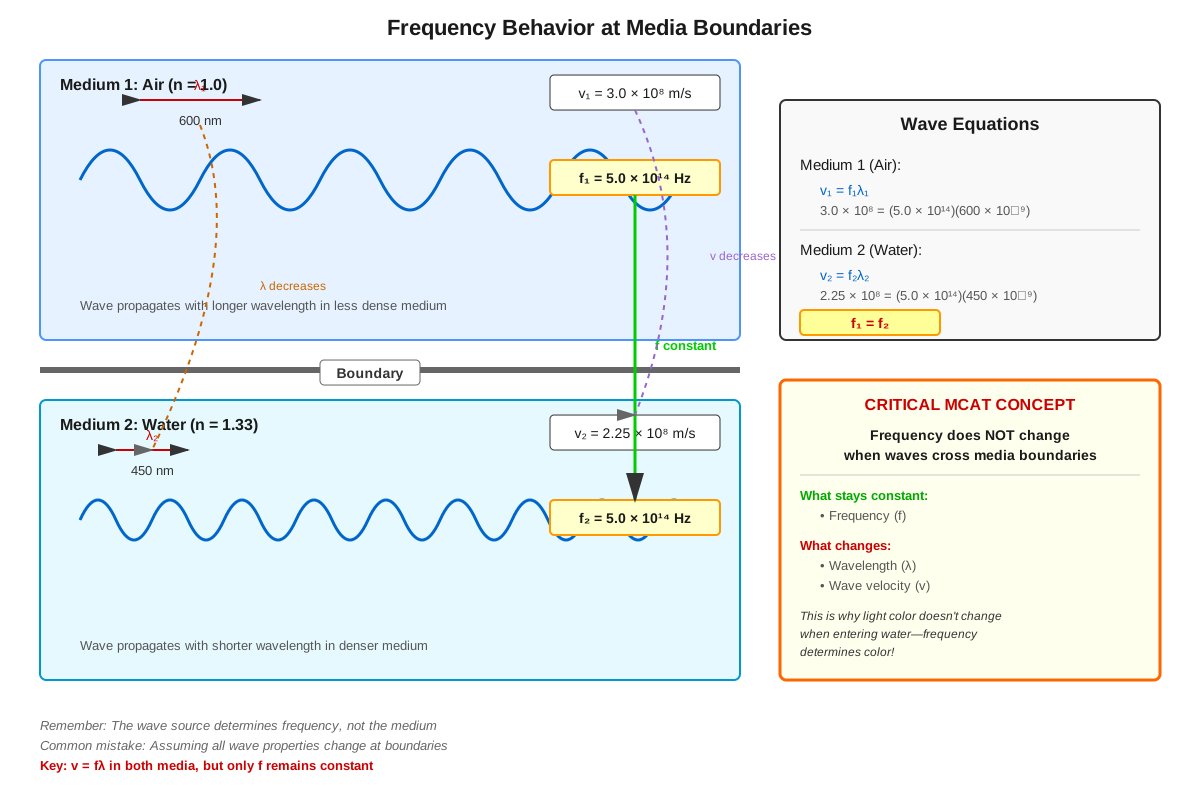
Frequency is an intrinsic property of the wave source and remains constant as a wave travels through different media. This distinguishes frequency from wavelength and wave speed, which can change when waves enter new materials. Understanding this invariance is crucial for MCAT questions involving refraction and the Doppler effect.
The Wave Equation and Frequency
The fundamental wave equation relates frequency to wavelength (λ) and wave speed (v):
v = fλWhere:
- v = wave speed (m/s)
- f = frequency (Hz)
- λ = wavelength (m)
This equation is among the most tested relationships on the MCAT Physics section. It reveals that for a constant wave speed, frequency and wavelength are inversely proportional—doubling the frequency halves the wavelength. This relationship applies to all wave types: mechanical waves (sound, water waves, seismic waves) and electromagnetic waves (light, radio waves, X-rays).
For electromagnetic waves traveling through a vacuum, the wave speed is the speed of light (c = 3.0 × 10⁸ m/s), yielding the specialized form:
c = fλThis equation allows calculation of photon wavelength from frequency or vice versa, essential for problems involving the electromagnetic spectrum, photoelectric effect, or spectroscopy.
Frequency and Energy Relationship
For electromagnetic radiation, frequency directly determines photon energy through Planck's equation:
E = hfWhere:
- E = photon energy (Joules)
- h = Planck's constant (6.626 × 10⁻³⁴ J·s)
- f = frequency (Hz)
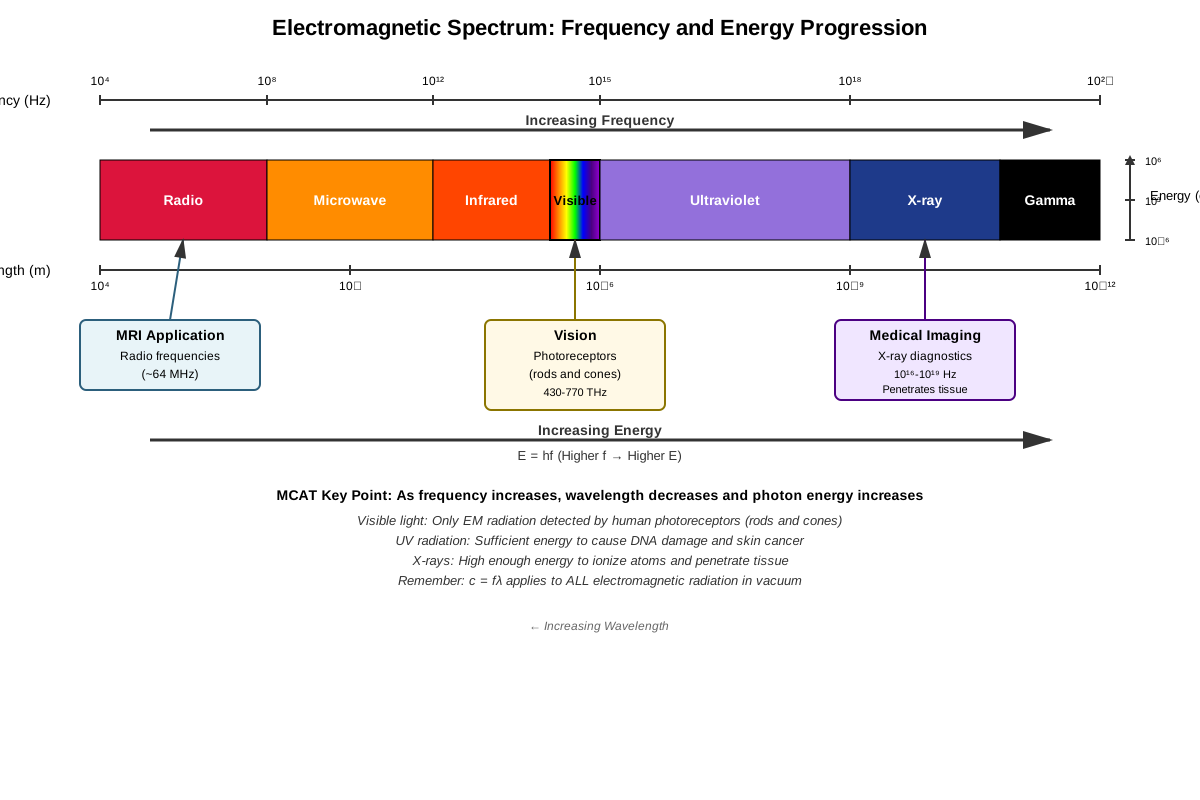
This relationship establishes that higher frequency electromagnetic radiation carries more energy per photon. Gamma rays (highest frequency) are more energetic and potentially more damaging to biological tissues than radio waves (lowest frequency). This concept appears in MCAT questions about UV radiation causing DNA damage, X-rays penetrating tissues, or the photoelectric effect where only sufficiently high-frequency light can eject electrons from metal surfaces.
Combining the wave equation with Planck's equation yields an alternative energy expression:
E = hc/λThis form shows that energy is inversely proportional to wavelength, another frequently tested relationship.
Frequency in Sound Waves
For sound waves, frequency determines the perceived pitch—the subjective quality of how "high" or "low" a sound seems. Higher frequency sound waves are perceived as higher pitched, while lower frequency waves sound lower pitched. The human audible range extends from approximately 20 Hz (very low bass) to 20,000 Hz or 20 kHz (very high treble), though this upper limit decreases with age.
Sound frequency is determined by the vibration rate of the source. A guitar string vibrating 440 times per second produces a sound wave with a frequency of 440 Hz (the musical note A above middle C). The frequency remains constant as the sound wave travels through different media (air, water, tissue), though the wavelength and speed change according to the wave equation.
Infrasound refers to frequencies below 20 Hz (inaudible to humans but detectable by some animals), while ultrasound describes frequencies above 20 kHz. Medical ultrasound typically operates between 1-20 MHz (megahertz), far beyond human hearing range. These high frequencies enable detailed imaging because shorter wavelengths (recall v = fλ) provide better spatial resolution.
Frequency Ranges and the Electromagnetic Spectrum
The electromagnetic spectrum spans an enormous frequency range, from radio waves at ~10⁴ Hz to gamma rays exceeding 10²⁰ Hz. Understanding the relative positions and properties of different regions is high-yield for the MCAT:
| Region | Frequency Range | Wavelength Range | Key Properties/Applications |
|---|---|---|---|
| Radio waves | < 3 × 10⁹ Hz | > 10 cm | Communication, MRI |
| Microwaves | 3 × 10⁹ - 3 × 10¹² Hz | 1 mm - 10 cm | Heating, radar |
| Infrared | 3 × 10¹² - 4 × 10¹⁴ Hz | 700 nm - 1 mm | Heat radiation, night vision |
| Visible light | 4 × 10¹⁴ - 7.5 × 10¹⁴ Hz | 400 - 700 nm | Human vision, photosynthesis |
| Ultraviolet | 7.5 × 10¹⁴ - 3 × 10¹⁶ Hz | 10 - 400 nm | Sterilization, vitamin D synthesis, DNA damage |
| X-rays | 3 × 10¹⁶ - 3 × 10¹⁹ Hz | 0.01 - 10 nm | Medical imaging, cancer therapy |
| Gamma rays | > 3 × 10¹⁹ Hz | < 0.01 nm | Nuclear medicine, radiation therapy |
Within visible light, frequency determines color perception: red light has the lowest frequency (~4.3 × 10¹⁴ Hz) and longest wavelength (~700 nm), while violet light has the highest frequency (~7.5 × 10¹⁴ Hz) and shortest wavelength (~400 nm). The mnemonic "ROY G BIV" (Red, Orange, Yellow, Green, Blue, Indigo, Violet) orders colors from lowest to highest frequency.
Frequency and Resonance
Resonance occurs when a system is driven at its natural frequency (or resonant frequency), resulting in maximum amplitude oscillations. Every object has natural frequencies at which it preferentially vibrates. When external forcing matches these frequencies, energy transfer becomes highly efficient, and vibration amplitude increases dramatically.
Musical instruments exploit resonance—a flute's air column resonates at specific frequencies determined by its length, producing distinct musical notes. In medicine, MRI machines use radiofrequency pulses matching the resonant frequency of hydrogen nuclei in a magnetic field to generate images. Resonance also explains why certain frequencies of sound can shatter glass or why bridges can collapse if wind or marching soldiers create oscillations at the bridge's natural frequency.
The Doppler Effect and Frequency Shifts
The Doppler effect describes the apparent frequency change when there is relative motion between a wave source and observer. When the source moves toward the observer (or observer toward source), the observed frequency increases (higher pitch for sound, blue shift for light). When moving apart, the observed frequency decreases (lower pitch, red shift).
For sound waves with source velocity much less than sound speed:
f_observed = f_source × (v_sound ± v_observer) / (v_sound ∓ v_source)Use the upper signs when source and observer approach each other, lower signs when separating. The Doppler effect enables medical applications like Doppler ultrasound for measuring blood flow velocity and astronomical observations of stellar motion through spectral line shifts.
Concept Relationships
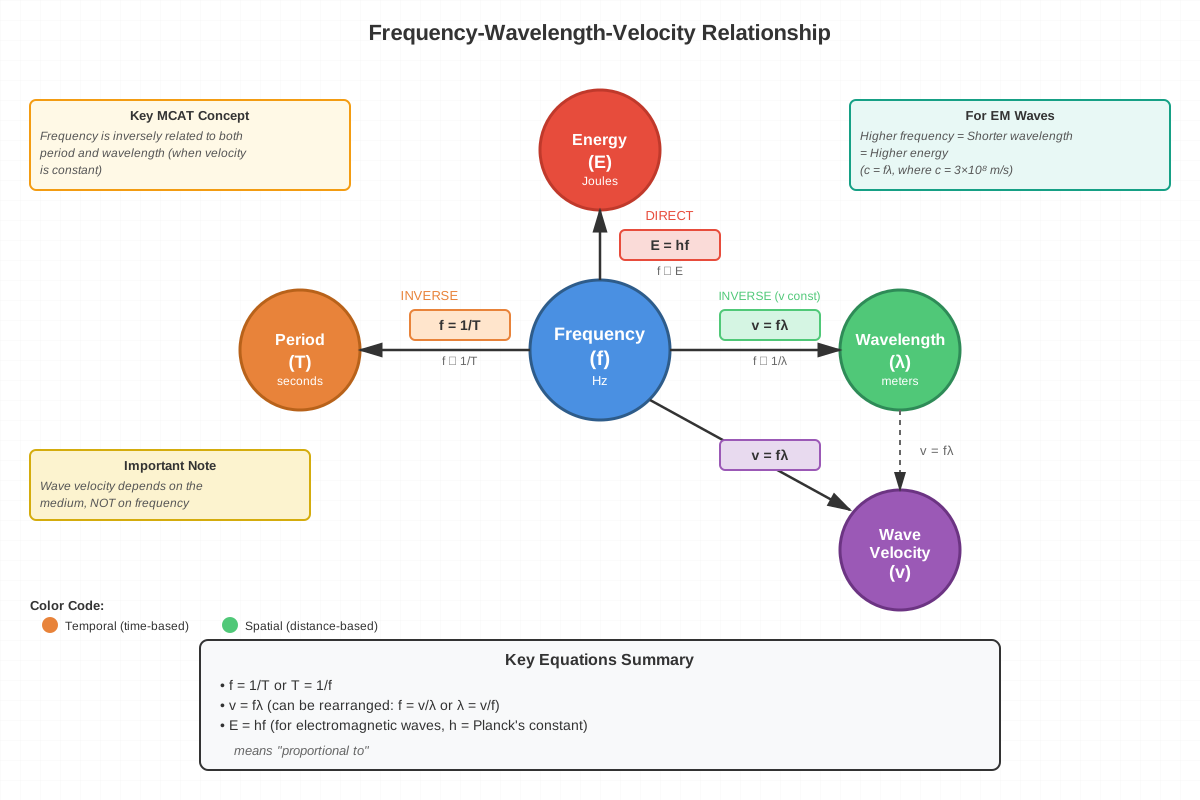
Frequency serves as a central hub connecting multiple physics concepts. The period-frequency relationship (f = 1/T) establishes that these are reciprocal properties—knowing one immediately determines the other. This relationship extends to any periodic phenomenon, from pendulum oscillations to alternating current.
The wave equation (v = fλ) connects frequency to wavelength and wave speed, forming a triad where any two quantities determine the third. This relationship is fundamental: when a wave enters a new medium, its speed changes (due to different medium properties), wavelength adjusts accordingly, but frequency remains constant because it's determined by the source.
Through Planck's equation (E = hf), frequency links to photon energy, establishing that electromagnetic radiation frequency directly determines its energy content. This connection is crucial for understanding the photoelectric effect, atomic transitions, and why different frequencies of light have different biological effects (UV causing sunburn, X-rays penetrating tissue).
Frequency connects to sound perception through pitch—the psychological correlate of physical frequency. This relationship bridges physics and biology, appearing in MCAT passages about auditory physiology, cochlear mechanics, and hearing loss.
The Doppler effect demonstrates how relative motion affects observed frequency, connecting kinematics concepts (velocity, relative motion) to wave properties. This relationship appears in both sound contexts (ambulance sirens) and electromagnetic contexts (astronomical red shift).
Resonance phenomena connect frequency to energy transfer efficiency and amplitude, explaining why systems respond differently to various driving frequencies. This concept links to mechanical oscillations, musical acoustics, and medical imaging technologies.
Textual relationship map:
- Wave Source → determines → Frequency → remains constant across media
- Frequency → reciprocal of → Period
- Frequency × Wavelength → equals → Wave Speed
- Frequency × Planck's constant → equals → Photon Energy
- Frequency → perceived as → Pitch (for sound)
- Frequency → shifts due to → Relative Motion (Doppler Effect)
- Driving Frequency = Natural Frequency → produces → Resonance
Quick check — test yourself on Frequency so far.
Try Flashcards →High-Yield Facts
⭐ Frequency is determined by the wave source and remains constant when waves travel through different media (wavelength and speed change, but frequency does not)
⭐ The wave equation v = fλ applies to all wave types and is the most commonly tested relationship in MCAT wave problems
⭐ For electromagnetic waves in vacuum: c = fλ, where c = 3.0 × 10⁸ m/s
⭐ Photon energy is directly proportional to frequency: E = hf, where h = 6.626 × 10⁻³⁴ J·s
⭐ Frequency and period are reciprocals: f = 1/T
- The human audible frequency range is approximately 20 Hz to 20,000 Hz (20 kHz)
- Higher frequency electromagnetic radiation (UV, X-rays, gamma rays) carries more energy per photon and can cause more biological damage
- In the visible spectrum, red light has the lowest frequency (~4.3 × 10¹⁴ Hz) and violet has the highest (~7.5 × 10¹⁴ Hz)
- Medical ultrasound uses frequencies between 1-20 MHz, well above the human audible range
- The Doppler effect causes observed frequency to increase when source and observer approach each other and decrease when they move apart
- Resonance occurs when driving frequency matches natural frequency, producing maximum amplitude oscillations
- Sound frequency determines perceived pitch (higher frequency = higher pitch)
Common Misconceptions
Misconception: Frequency changes when a wave enters a different medium.
Correction: Frequency remains constant across media boundaries because it's determined by the source. When light enters water from air, its speed and wavelength decrease, but frequency stays the same. This is why the color of light doesn't change when passing through different transparent materials.
Misconception: Higher frequency waves always travel faster than lower frequency waves.
Correction: Wave speed depends on the medium properties, not frequency. All electromagnetic waves travel at the same speed (c) in vacuum regardless of frequency. In a given medium, sound waves of different frequencies travel at essentially the same speed. The wave equation v = fλ shows that if speed is constant, higher frequency means shorter wavelength, not faster travel.
Misconception: Frequency and pitch are different properties.
Correction: Pitch is the perceptual/psychological correlate of the physical property frequency. When we say a sound has "high pitch," we mean it has high frequency. They describe the same phenomenon from different perspectives (objective physical vs. subjective perceptual).
Misconception: Increasing wave amplitude increases frequency.
Correction: Amplitude and frequency are independent properties. Amplitude relates to energy/intensity (louder sound, brighter light), while frequency relates to pitch/color. You can have high-amplitude low-frequency waves or low-amplitude high-frequency waves. Shouting (high amplitude) doesn't change the pitch (frequency) of your voice.
Misconception: The Doppler effect only applies to sound waves.
Correction: The Doppler effect applies to all wave types, including electromagnetic waves. Astronomical red shift (galaxies moving away show decreased frequency/increased wavelength) and blue shift (approaching objects show increased frequency/decreased wavelength) are Doppler effects for light. Doppler radar and police radar guns use electromagnetic wave frequency shifts to measure velocity.
Misconception: Resonance only occurs at one specific frequency.
Correction: While objects have a fundamental resonant frequency (lowest natural frequency), they also have multiple harmonic frequencies (integer multiples of the fundamental) at which resonance occurs. A guitar string resonates at its fundamental frequency and also at 2f, 3f, 4f, etc., producing overtones that give instruments their characteristic sound quality.
Worked Examples
Example 1: Electromagnetic Wave Properties
Question: A radio station broadcasts at a frequency of 98.5 MHz. What is the wavelength of these radio waves? If these waves enter a material where they travel at 2.0 × 10⁸ m/s, what is the new wavelength?
Solution:
Step 1: Identify known values and convert units
- Frequency: f = 98.5 MHz = 98.5 × 10⁶ Hz = 9.85 × 10⁷ Hz
- Speed in vacuum: c = 3.0 × 10⁸ m/s
- Speed in material: v = 2.0 × 10⁸ m/s
Step 2: Calculate wavelength in vacuum using c = fλ
λ = c/f = (3.0 × 10⁸ m/s) / (9.85 × 10⁷ Hz)
λ = 3.05 m
Step 3: Recognize that frequency remains constant when entering new medium
Step 4: Calculate new wavelength using v = fλ
λ_new = v/f = (2.0 × 10⁸ m/s) / (9.85 × 10⁷ Hz)
λ_new = 2.03 m
Key Insights: This problem tests understanding that frequency is source-determined and doesn't change between media (Learning Objective: Connect Frequency to related Physics concepts). The wavelength decreases proportionally to the speed decrease. The ratio of wavelengths equals the ratio of speeds: λ_new/λ_original = v/c = 2.0/3.0 ≈ 0.67.
Example 2: Sound Wave Frequency and Energy
Question: A tuning fork vibrates with a period of 2.27 × 10⁻³ seconds, producing a sound wave in air (speed of sound = 343 m/s). (a) What is the frequency of this sound? (b) What is the wavelength? (c) If a photon of electromagnetic radiation had this same frequency, what would be its energy?
Solution:
Part (a): Calculate frequency from period
f = 1/T = 1/(2.27 × 10⁻³ s) = 440 HzThis is the musical note A above middle C, a standard tuning reference.
Part (b): Calculate wavelength using wave equation
λ = v/f = 343 m/s / 440 Hz = 0.780 m = 78.0 cmPart (c): Calculate photon energy using Planck's equation
E = hf = (6.626 × 10⁻³⁴ J·s)(440 Hz)
E = 2.92 × 10⁻³¹ J
To convert to electron volts (sometimes useful for MCAT):
E = (2.92 × 10⁻³¹ J) / (1.6 × 10⁻¹⁹ J/eV) = 1.82 × 10⁻¹² eVKey Insights: This problem integrates multiple learning objectives: defining frequency (part a), applying the wave equation (part b), and connecting frequency to energy (part c). The extremely low photon energy for this frequency explains why radio waves (similar frequency range) are non-ionizing and generally safe for biological tissues. Note that the same frequency produces very different wavelengths for sound (0.78 m) versus electromagnetic waves in vacuum (6.8 × 10⁵ m), because wave speeds differ dramatically.
Exam Strategy
Approaching MCAT Frequency Questions
When encountering frequency problems on the MCAT, first identify what type of wave is involved (mechanical or electromagnetic) and what medium it's traveling through. This immediately tells you which wave speed to use: for electromagnetic waves in vacuum, always use c = 3.0 × 10⁸ m/s; for sound in air at room temperature, use approximately 340 m/s (the MCAT will provide specific values if needed).
Exam Tip: If a question asks what happens to frequency when a wave enters a new medium, the answer is always "frequency remains constant." This is one of the most commonly tested concepts and appears in both discrete questions and passages.
Trigger Words and Phrases
Watch for these terms that signal frequency concepts:
- "Pitch" → refers to frequency in sound contexts
- "Color" → refers to frequency in light contexts
- "Cycles per second" → direct definition of frequency (Hz)
- "Period" → use f = 1/T relationship
- "Doppler" or "relative motion" → frequency shift calculation
- "Resonance" or "natural frequency" → matching frequencies for maximum response
- "Photon energy" → use E = hf
- "Wavelength changes but..." → frequency stays constant
Process of Elimination Tips
For multiple choice questions about frequency:
- Eliminate answers where frequency changes between media unless the question explicitly involves the Doppler effect or a change in the source itself
- Check unit consistency: Frequency answers should be in Hz (or kHz, MHz, etc.). If an answer has units of meters or m/s, it cannot be frequency
- Use order-of-magnitude reasoning: Visible light frequencies are around 10¹⁴ Hz, audible sound is 10¹-10⁴ Hz, radio waves are 10⁶-10⁹ Hz. Eliminate answers that are orders of magnitude off
- For energy questions: Higher frequency always means higher energy for electromagnetic radiation. Eliminate any answer suggesting otherwise
Time Allocation
Frequency calculations are typically straightforward and should take 30-60 seconds for discrete questions. For passage-based questions, spend 15-20 seconds identifying the relevant equation (v = fλ, f = 1/T, or E = hf), then 30-45 seconds on calculation and unit conversion. If a question requires multiple steps (e.g., finding period, then frequency, then wavelength), allocate up to 90 seconds but consider flagging for review if you're running behind—these multi-step problems are good candidates to return to after completing easier questions.
Memory Techniques
Frequency Equation Mnemonic
"Very Fast Learners" → v = fλ (velocity = frequency × wavelength)
This mnemonic helps recall the wave equation, the most frequently tested relationship.
Electromagnetic Spectrum Order
"Raging Martians Invaded Venus Using X-ray Guns"
- Radio waves
- Microwaves
- Infrared
- Visible light
- Ultraviolet
- X-rays
- Gamma rays
This orders electromagnetic radiation from lowest to highest frequency (and lowest to highest energy).
Visible Light Color Order
"ROY G BIV" (Red, Orange, Yellow, Green, Blue, Indigo, Violet)
Orders visible light colors from lowest to highest frequency. Remember: Red has the Longest wavelength and Lowest frequency; Violet has the Shortest wavelength and Highest frequency.
Frequency vs. Period Relationship
"Frequent events have short Periods"
This helps remember the inverse relationship: f = 1/T. High frequency means short period (many cycles in a given time), low frequency means long period (few cycles in a given time).
Visualization Strategy
Picture a wave source (like a vibrating string) creating waves. The frequency is how fast the source vibrates—count how many complete up-down cycles it makes per second. This physical visualization helps distinguish frequency (source property, stays constant) from wavelength (distance property, changes with medium) and reinforces that frequency is source-determined.
Summary
Frequency is the number of wave cycles occurring per unit time, measured in Hertz (Hz), and represents a fundamental property of all wave phenomena tested on the MCAT. The reciprocal relationship between frequency and period (f = 1/T) provides one method for determining frequency, while the wave equation (v = fλ) connects frequency to wavelength and wave speed for all wave types. Critically, frequency remains constant when waves transition between media because it is determined solely by the source, whereas wavelength and speed adjust according to medium properties. For electromagnetic radiation, frequency directly determines photon energy through E = hf, establishing why high-frequency radiation (UV, X-rays, gamma rays) is more energetic and potentially more damaging than low-frequency radiation (radio, infrared). In sound waves, frequency corresponds to perceived pitch, with the human audible range spanning 20 Hz to 20 kHz. The Doppler effect describes apparent frequency changes due to relative motion between source and observer, while resonance occurs when driving frequency matches natural frequency. Mastery of these relationships and the ability to apply them in diverse contexts—from electromagnetic spectrum problems to medical imaging applications—is essential for MCAT success.
Key Takeaways
- Frequency (f) is measured in Hertz (Hz) and equals the number of cycles per second; it is the reciprocal of period (f = 1/T)
- The wave equation v = fλ applies universally to all waves and is the most frequently tested relationship on the MCAT
- Frequency remains constant when waves enter different media (source-determined property), while wavelength and speed change
- For electromagnetic waves, photon energy is directly proportional to frequency (E = hf), making high-frequency radiation more energetic
- In sound waves, frequency determines perceived pitch; higher frequency equals higher pitch
- The electromagnetic spectrum ranges from low-frequency radio waves to high-frequency gamma rays, with visible light occupying a narrow band around 10¹⁴ Hz
- The Doppler effect causes observed frequency to increase when source and observer approach and decrease when they separate
Related Topics
Wavelength and Wave Properties: Understanding wavelength complements frequency knowledge, as these properties are inversely related through the wave equation. Mastering frequency enables deeper exploration of wave interference, diffraction, and the relationship between wave properties and energy.
The Doppler Effect: Building on basic frequency concepts, the Doppler effect explains how relative motion affects observed frequency, with applications ranging from radar speed detection to astronomical observations of galactic motion.
Electromagnetic Spectrum and Photon Energy: Frequency serves as the foundation for understanding how different regions of the electromagnetic spectrum have distinct properties and biological effects based on their energy content.
Sound and Hearing Physiology: Frequency concepts connect directly to auditory perception, cochlear mechanics, and clinical applications like audiometry and hearing loss diagnosis.
Resonance and Standing Waves: Natural frequency and resonance phenomena build on fundamental frequency understanding, explaining musical instruments, MRI technology, and structural engineering considerations.
Wave Interference and Beats: When waves of different frequencies interact, beat frequency (the difference between the two frequencies) emerges, connecting frequency to interference patterns and acoustic phenomena.
Practice CTA
Now that you've mastered the fundamental concepts of frequency and its relationships to other wave properties, it's time to solidify your understanding through active practice. Attempt the practice questions and work through the flashcards to reinforce these high-yield concepts. Focus especially on problems requiring you to manipulate the wave equation and identify what happens to frequency in different scenarios—these skills will serve you well not only on frequency-specific questions but also on integrated passages that combine multiple physics concepts. Remember, frequency appears throughout the MCAT in both obvious and subtle ways, so developing automatic recognition of frequency relationships will significantly boost your confidence and speed on test day. You've got this!
Sign up free to keep reading
Create a free AnvayaPrep account to finish this MCAT guide on Frequency — plus flashcards and practice questions.