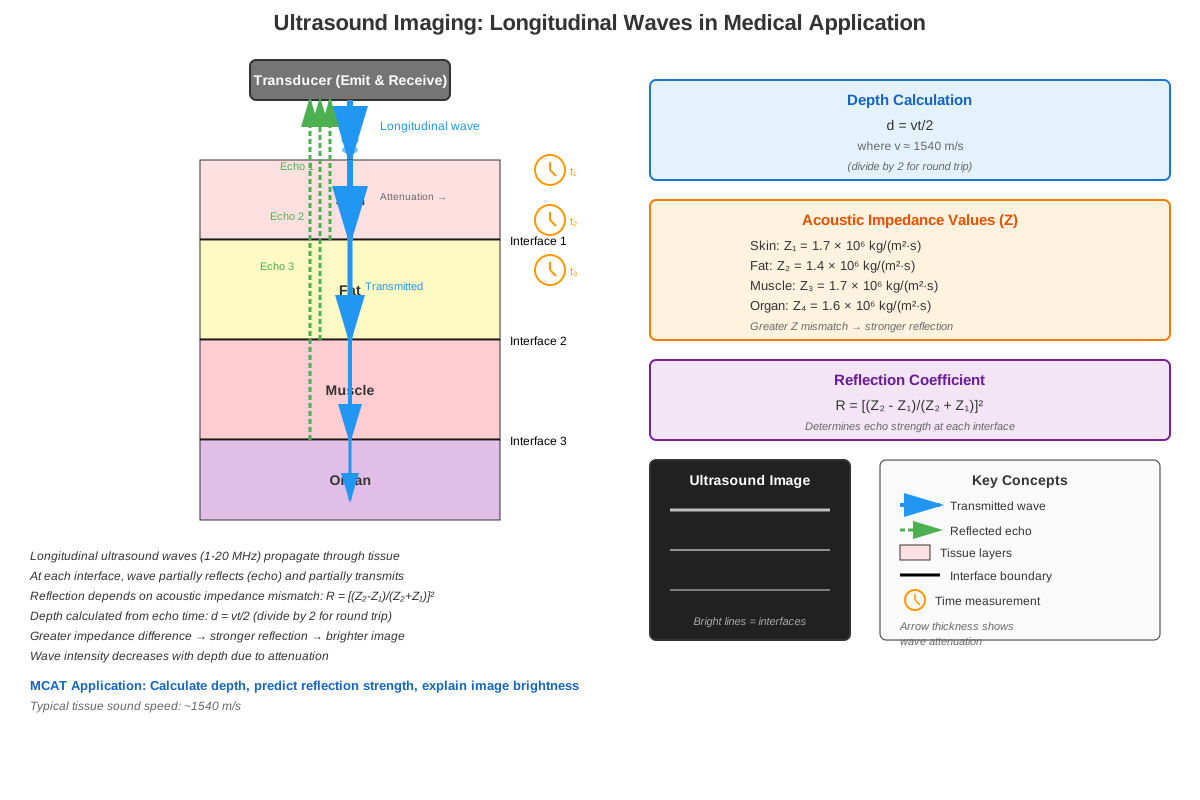
Overview
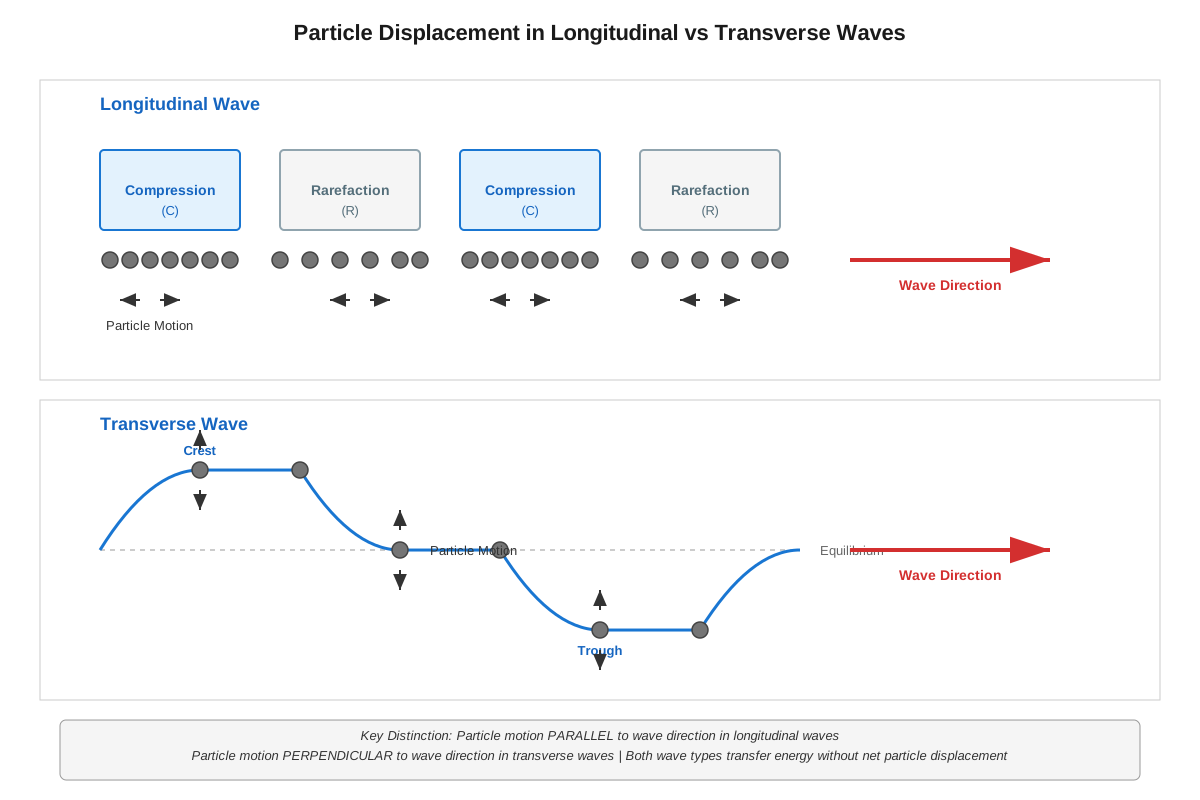
Longitudinal waves represent one of the two fundamental categories of mechanical wave motion, distinguished by the unique characteristic that particle displacement occurs parallel to the direction of wave propagation. Unlike transverse waves where particles oscillate perpendicular to wave travel, longitudinal waves create alternating regions of compression and rarefaction as they move through a medium. This wave type is essential for understanding sound propagation, ultrasound imaging, and various physiological phenomena that appear regularly on the MCAT.
For MCAT preparation, mastering longitudinal waves Physics concepts is critical because sound waves—the most clinically relevant example of longitudinal waves—appear frequently in both passage-based and discrete questions. The exam tests not only the mathematical relationships governing wave behavior but also the conceptual understanding of how energy transfers through different media. Questions often integrate longitudinal wave principles with topics like the Doppler effect, resonance, intensity calculations, and medical imaging technologies such as ultrasound.
Understanding longitudinal waves MCAT content connects directly to broader themes in Physics including energy transfer, oscillatory motion, and wave interference. Within the Waves and Sound unit, longitudinal waves serve as the foundation for analyzing acoustic phenomena in biological systems, from hearing mechanisms to diagnostic imaging. This topic bridges mechanical wave theory with practical medical applications, making it both conceptually important and clinically relevant for future physicians.
Learning Objectives
- [ ] Define Longitudinal waves using accurate Physics terminology
- [ ] Explain why Longitudinal waves matters for the MCAT
- [ ] Apply Longitudinal waves to exam-style questions
- [ ] Identify common mistakes related to Longitudinal waves
- [ ] Connect Longitudinal waves to related Physics concepts
- [ ] Distinguish between longitudinal and transverse wave characteristics in various media
- [ ] Calculate wave parameters (wavelength, frequency, speed) for longitudinal waves in different materials
- [ ] Analyze how longitudinal waves transfer energy through compression and rarefaction cycles
Prerequisites
- Basic wave properties: Understanding wavelength, frequency, period, and amplitude provides the foundation for analyzing any wave type, including longitudinal waves
- Simple harmonic motion: Particle oscillation in longitudinal waves follows SHM principles, making this background essential for understanding compression-rarefaction cycles
- States of matter: Longitudinal waves propagate differently through solids, liquids, and gases, requiring knowledge of molecular arrangements and intermolecular forces
- Energy and work concepts: Wave propagation involves energy transfer without net particle displacement, necessitating solid understanding of mechanical energy principles
- Vector components: Analyzing particle displacement parallel to wave direction requires comfort with vector decomposition and directional analysis
Why This Topic Matters
Clinical and Real-World Significance: Longitudinal waves underpin numerous medical diagnostic and therapeutic technologies. Ultrasound imaging relies entirely on longitudinal sound waves propagating through tissue, reflecting at interfaces, and returning to create diagnostic images. Echocardiography, obstetric ultrasound, and vascular studies all depend on understanding how longitudinal waves behave in biological media. Additionally, hearing and speech involve longitudinal sound wave generation, propagation, and detection—processes that connect directly to otolaryngology and audiology.
MCAT Exam Statistics: Longitudinal waves appear in approximately 15-20% of physics passages within the Chemical and Physical Foundations section. Questions typically test conceptual understanding of compression-rarefaction patterns, mathematical relationships between wave parameters, and applications to sound propagation. The topic frequently appears in passages describing medical imaging technologies, acoustic research, or physiological sound production and detection. Discrete questions often test the distinction between longitudinal and transverse waves or require calculations involving wave speed in different media.
Common Exam Presentations: The MCAT presents longitudinal waves through several recurring contexts: ultrasound imaging passages requiring analysis of wave reflection and transmission; hearing mechanism descriptions involving sound wave propagation through air and cochlear fluid; musical instrument passages exploring resonance and standing waves; and Doppler effect scenarios involving moving sound sources. Questions may ask students to identify which wave type can propagate through a given medium, calculate wavelength changes when waves enter new materials, or explain why certain phenomena (like polarization) cannot occur with longitudinal waves.
Core Concepts
Definition and Fundamental Characteristics
Longitudinal waves are mechanical waves in which particle displacement occurs parallel to the direction of wave propagation. As the wave travels through a medium, particles oscillate back and forth along the same axis as the wave's motion, creating alternating regions of high and low density. This distinguishes them fundamentally from transverse waves, where particle motion is perpendicular to wave travel.
The defining feature of longitudinal waves is the formation of compressions and rarefactions. A compression (or condensation) is a region where particles are pushed closer together than their equilibrium spacing, creating higher-than-normal density and pressure. A rarefaction is a region where particles are spread farther apart than equilibrium, resulting in lower density and pressure. These alternating regions propagate through the medium as the wave travels, but individual particles only oscillate around their equilibrium positions—they do not travel with the wave.
Particle Motion and Energy Transfer
In longitudinal wave propagation, each particle in the medium undergoes simple harmonic motion along the direction of wave travel. When a compression reaches a particle, it experiences a force pushing it in the direction of wave propagation. The particle accelerates, reaches maximum velocity, then decelerates as it enters a rarefaction region. The particle then reverses direction, moving backward before returning to its starting position, completing one oscillation cycle.
Energy transfer in longitudinal waves occurs through particle collisions and elastic interactions. When particles in a compression collide with neighboring particles, they transfer kinetic energy forward. The medium's elastic properties then restore particles toward equilibrium, converting kinetic energy to potential energy and back. This continuous energy exchange allows the wave to propagate while individual particles remain near their original positions. The energy transported by the wave is proportional to the square of both amplitude and frequency.
Mathematical Description
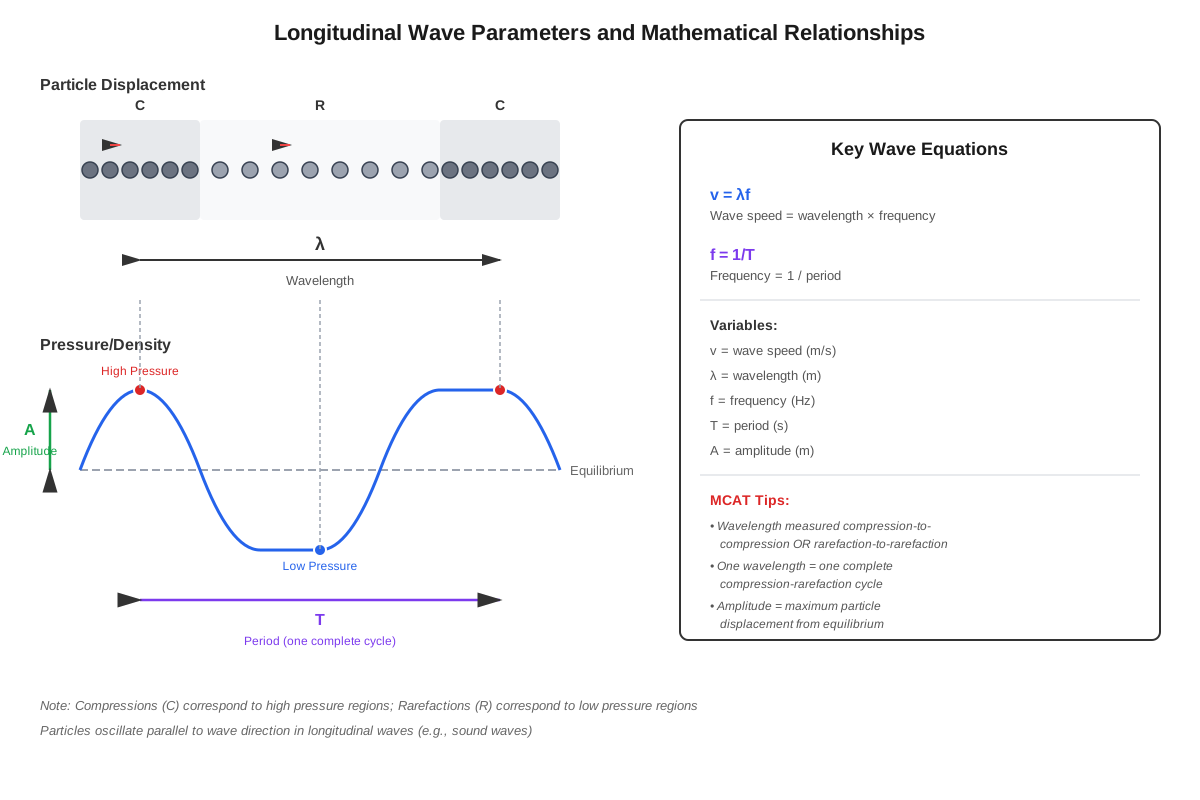
The fundamental wave equation applies to longitudinal waves just as it does to all wave types:
v = fλwhere v is wave speed, f is frequency, and λ (lambda) is wavelength. For longitudinal waves, wavelength represents the distance between successive compressions (or successive rarefactions), which equals the distance the wave travels during one complete particle oscillation cycle.
Wave speed in a medium depends on the medium's properties. For longitudinal waves in a fluid (liquid or gas):
v = √(B/ρ)where B is the bulk modulus (resistance to compression) and ρ (rho) is density. For longitudinal waves in a solid rod:
v = √(Y/ρ)where Y is Young's modulus (elastic modulus). These equations reveal that wave speed increases with medium stiffness (higher B or Y) and decreases with density.
Sound Waves as Longitudinal Waves
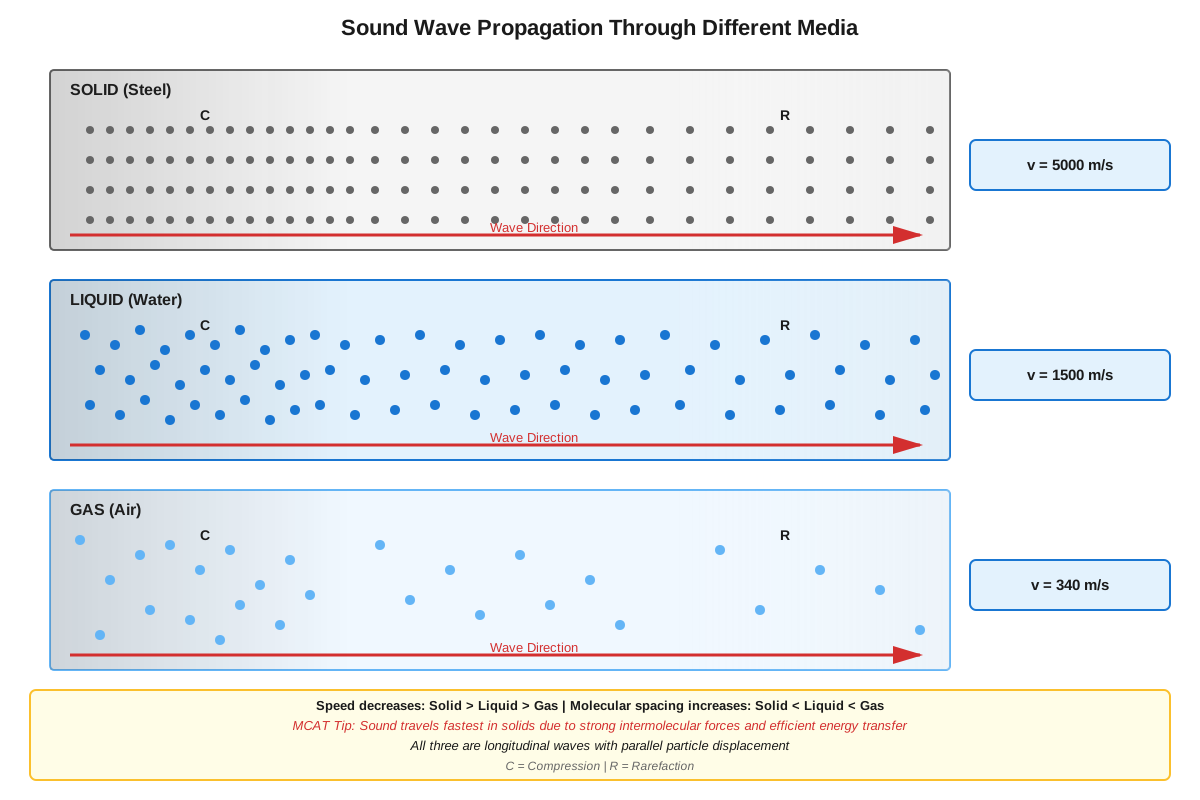
Sound waves are the most important example of longitudinal waves for MCAT purposes. Sound propagates through air, liquids, and solids as longitudinal pressure waves. In air at room temperature (20°C), sound travels at approximately 343 m/s. Sound travels faster in liquids (about 1500 m/s in water) and even faster in solids (about 5000 m/s in steel) because these media have greater bulk moduli despite higher densities.
The human audible frequency range extends from approximately 20 Hz to 20,000 Hz (20 kHz). Infrasound refers to frequencies below 20 Hz, while ultrasound describes frequencies above 20 kHz. Medical ultrasound typically operates between 2-15 MHz (megahertz), with higher frequencies providing better resolution but less tissue penetration. The relationship between frequency and wavelength means that higher-frequency ultrasound has shorter wavelengths, allowing detection of smaller structures.
Medium Requirements and Propagation
Longitudinal waves require a medium for propagation—they cannot travel through a vacuum. The medium must have particles that can be compressed and possess elastic properties to restore particles to equilibrium. This requirement explains why sound cannot propagate through space but travels readily through air, water, and biological tissues.
Different media support longitudinal wave propagation with varying efficiency:
| Medium Type | Longitudinal Wave Support | Typical Speed | Key Characteristics |
|---|---|---|---|
| Gases | Yes | Slowest (~340 m/s in air) | Large compressibility, low density |
| Liquids | Yes | Intermediate (~1500 m/s in water) | Moderate compressibility, higher density |
| Solids | Yes | Fastest (~5000 m/s in steel) | Low compressibility, high elastic modulus |
| Vacuum | No | N/A | No particles to compress |
Comparison with Transverse Waves
Understanding the distinction between longitudinal and transverse waves is high-yield for the MCAT:
| Property | Longitudinal Waves | Transverse Waves |
|---|---|---|
| Particle motion | Parallel to wave direction | Perpendicular to wave direction |
| Characteristic pattern | Compressions and rarefactions | Crests and troughs |
| Medium requirement | Gases, liquids, solids | Solids and surfaces (not bulk fluids) |
| Polarization | Cannot be polarized | Can be polarized |
| Example | Sound waves | Light waves, waves on strings |
The inability of longitudinal waves to be polarized stems from their particle motion being constrained to one dimension (along the propagation axis). Polarization requires oscillation in multiple perpendicular directions, which only occurs in transverse waves.
Intensity and Energy Considerations
Wave intensity (I) represents power per unit area and follows an inverse square law for waves spreading spherically from a point source:
I = P/(4πr²)where P is source power and r is distance from the source. For longitudinal waves, intensity relates to amplitude squared:
I ∝ A²The decibel scale quantifies sound intensity logarithmically:
β = 10 log(I/I₀)where β (beta) is intensity level in decibels (dB), I is intensity, and I₀ is the reference intensity (10⁻¹² W/m² for sound in air). This logarithmic scale accommodates the enormous range of human hearing, from the threshold of hearing to the threshold of pain.
Concept Relationships
Longitudinal waves connect to numerous physics concepts in an integrated network. The fundamental relationship begins with simple harmonic motion → which describes individual particle oscillation → leading to wave propagation through the medium. The medium's elastic properties (bulk modulus, Young's modulus) and density → determine wave speed → which combines with frequency to establish wavelength through the wave equation.
Within the topic itself, compressions and rarefactions → create pressure variations → which propagate as sound waves → carrying energy through the medium. The intensity of these waves → decreases with distance according to the inverse square law → and can be quantified using the decibel scale.
Longitudinal waves connect to prerequisite knowledge: states of matter → determine which media support longitudinal wave propagation → while intermolecular forces → influence wave speed through their effect on elastic moduli. Energy conservation principles → explain how waves transfer energy without net particle displacement.
Looking forward, longitudinal waves enable understanding of: Doppler effect (frequency shifts with relative motion), interference (superposition of waves creating constructive and destructive patterns), standing waves (resonance in bounded media), beats (interference between similar frequencies), and ultrasound imaging (medical application of high-frequency longitudinal waves). The relationship map flows: Longitudinal waves → Sound propagation → Doppler effect → Medical diagnostics (ultrasound, echocardiography).
High-Yield Facts
⭐ Longitudinal waves require a medium for propagation and cannot travel through a vacuum, unlike electromagnetic waves
⭐ In longitudinal waves, particle displacement is parallel to wave propagation direction, creating alternating compressions and rarefactions
⭐ Sound waves are longitudinal waves, with speed in air approximately 343 m/s at 20°C
⭐ Wave speed in a medium increases with stiffness (bulk modulus) and decreases with density: v = √(B/ρ)
⭐ Longitudinal waves cannot be polarized because particle motion is constrained to one dimension along the propagation axis
- Wavelength in longitudinal waves equals the distance between successive compressions or successive rarefactions
- Sound travels fastest in solids, intermediate in liquids, and slowest in gases due to differences in elastic moduli and density
- Medical ultrasound (2-15 MHz) uses high-frequency longitudinal waves for imaging, with higher frequencies providing better resolution but less penetration
- Intensity of longitudinal waves is proportional to amplitude squared and follows an inverse square law with distance from a point source
- The decibel scale is logarithmic: a 10 dB increase represents a 10-fold increase in intensity
- Human audible range spans 20 Hz to 20 kHz; frequencies below are infrasound, above are ultrasound
- Compressions correspond to regions of maximum pressure and density; rarefactions correspond to minimum pressure and density
- Energy in longitudinal waves transfers through particle collisions and elastic restoring forces without net particle displacement
Quick check — test yourself on Longitudinal waves so far.
Try Flashcards →Common Misconceptions
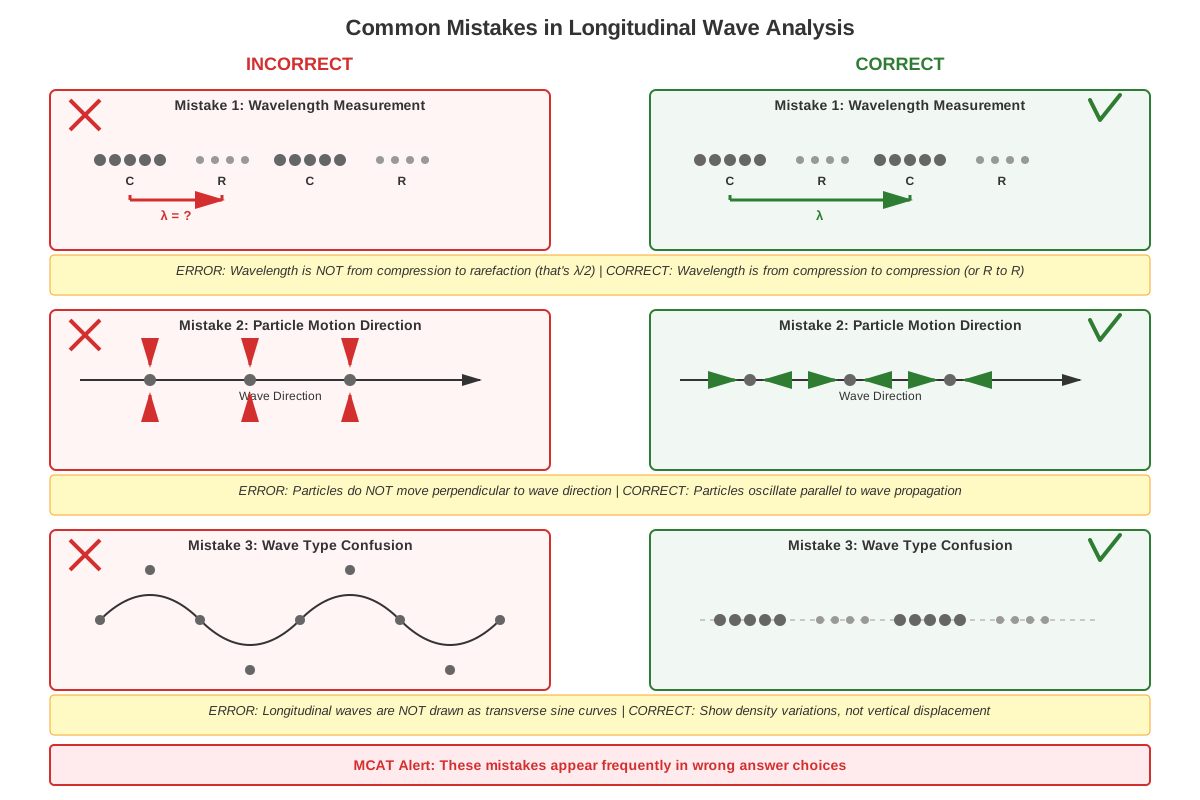
Misconception: Particles in a longitudinal wave travel with the wave from source to destination → Correction: Particles only oscillate around their equilibrium positions; the wave pattern (compression-rarefaction sequence) travels through the medium, but individual particles remain near their starting locations. Only energy and momentum transfer through the medium.
Misconception: Longitudinal waves can only travel through gases because sound travels through air → Correction: Longitudinal waves propagate through all three states of matter (gases, liquids, and solids). In fact, they travel faster through liquids and solids than through gases due to greater elastic moduli. Sound travels through water (used in sonar) and through bones and tissues (used in medical ultrasound).
Misconception: Wavelength in longitudinal waves is measured perpendicular to wave motion like in transverse waves → Correction: Wavelength in longitudinal waves is measured parallel to wave motion, representing the distance between successive compressions (or rarefactions). This distance equals how far the wave travels during one complete particle oscillation cycle.
Misconception: Higher amplitude longitudinal waves travel faster than lower amplitude waves in the same medium → Correction: Wave speed depends only on medium properties (elastic modulus and density), not on amplitude or frequency. Higher amplitude waves carry more energy and have greater intensity, but they travel at the same speed as lower amplitude waves in the same medium.
Misconception: Compressions and rarefactions are different types of waves → Correction: Compressions and rarefactions are complementary parts of the same longitudinal wave. A compression is a region of high pressure/density, while a rarefaction is a region of low pressure/density. They alternate as the wave propagates, with one wavelength encompassing one complete compression-rarefaction cycle.
Misconception: Since sound is a longitudinal wave, all longitudinal waves are sound waves → Correction: While all sound waves are longitudinal, not all longitudinal waves are sound. Sound specifically refers to longitudinal waves within or near the human audible frequency range (roughly 20 Hz to 20 kHz). Ultrasound (>20 kHz) and infrasound (<20 Hz) are longitudinal waves but not technically "sound" in the auditory sense. Additionally, seismic P-waves (primary waves) are longitudinal waves traveling through Earth's interior.
Misconception: Longitudinal waves can be polarized if the medium is oriented correctly → Correction: Longitudinal waves fundamentally cannot be polarized because particle oscillation occurs only along one axis (the propagation direction). Polarization requires oscillation in multiple perpendicular directions, which only occurs in transverse waves. This is a key distinguishing feature between wave types.
Worked Examples
Example 1: Calculating Wavelength and Wave Speed in Different Media
Problem: An ultrasound transducer generates 5.0 MHz longitudinal waves. The waves first travel through a water-based coupling gel (v = 1500 m/s) before entering soft tissue (v = 1540 m/s). Calculate: (a) the wavelength in the gel, (b) the wavelength in tissue, and (c) explain what happens to frequency as the wave enters tissue.
Solution:
(a) Wavelength in gel:
Using the wave equation v = fλ, we can solve for wavelength:
λ = v/f
First, convert frequency to Hz: f = 5.0 MHz = 5.0 × 10⁶ Hz
λ_gel = 1500 m/s ÷ (5.0 × 10⁶ Hz) = 3.0 × 10⁻⁴ m = 0.30 mm
(b) Wavelength in tissue:
λ_tissue = 1540 m/s ÷ (5.0 × 10⁶ Hz) = 3.08 × 10⁻⁴ m = 0.308 mm
(c) Frequency behavior:
Frequency remains constant at 5.0 MHz as the wave enters tissue. When waves cross a boundary between media, frequency is determined by the source and does not change. However, because wave speed increases slightly in tissue (1540 m/s vs. 1500 m/s), wavelength must increase proportionally to maintain the relationship v = fλ. This explains why wavelength increased from 0.30 mm to 0.308 mm.
Key Concepts Applied: This problem demonstrates that frequency is source-dependent and invariant across media boundaries, while wavelength adjusts proportionally to wave speed changes. This principle is critical for understanding ultrasound imaging, where waves traverse multiple tissue types with different acoustic properties.
Example 2: Comparing Wave Propagation in Different Media
Problem: A longitudinal wave pulse is generated simultaneously in three different media: air (v = 343 m/s), water (v = 1500 m/s), and steel (v = 5000 m/s). If the wave must travel 1.5 km in each medium, calculate the time required in each case and explain the physical basis for the speed differences.
Solution:
Using the relationship: time = distance/speed
Air:
t_air = 1500 m ÷ 343 m/s = 4.37 s
Water:
t_water = 1500 m ÷ 1500 m/s = 1.00 s
Steel:
t_steel = 1500 m ÷ 5000 m/s = 0.30 s
Physical Explanation:
The dramatic speed differences reflect the relationship v = √(B/ρ), where B is bulk modulus (or Young's modulus for solids) and ρ is density.
Steel has the fastest propagation because its Young's modulus is extremely high (approximately 200 GPa), meaning it strongly resists deformation. Although steel is dense (ρ ≈ 7800 kg/m³), the enormous elastic modulus dominates the equation, resulting in very high wave speed. Particles in steel are tightly bound and efficiently transfer compression forces.
Water has intermediate speed because its bulk modulus (approximately 2.2 GPa) is much lower than steel's, but still substantially higher than air's. Water's higher density (1000 kg/m³) partially offsets its greater compressibility compared to steel.
Air has the slowest propagation because gases are highly compressible (very low bulk modulus, approximately 142 kPa) despite low density (1.2 kg/m³). The weak intermolecular forces in gases mean compressions propagate slowly from particle to particle.
Key Concepts Applied: This problem illustrates how medium properties determine longitudinal wave speed and demonstrates the practical importance of these differences in applications like sonar (water), structural testing (solids), and acoustic communication (air).
Exam Strategy
Approaching MCAT Questions on Longitudinal Waves:
Begin by identifying whether the question asks about conceptual understanding (wave characteristics, medium requirements, particle motion) or quantitative calculations (wave speed, wavelength, frequency relationships). For conceptual questions, immediately recall the defining feature: particle motion parallel to wave propagation. For calculations, write down v = fλ and identify which variables are given and which must be found.
Trigger Words and Phrases:
- "Sound wave" → automatically think longitudinal wave, compressions/rarefactions, requires medium
- "Ultrasound imaging" → high-frequency longitudinal waves, wavelength calculations, tissue interfaces
- "Cannot propagate through" → consider medium requirements; longitudinal waves need particles
- "Particle displacement direction" → distinguish longitudinal (parallel) from transverse (perpendicular)
- "Polarization" → longitudinal waves cannot be polarized; this distinguishes them from transverse
- "Bulk modulus" or "Young's modulus" → wave speed calculation using v = √(elastic modulus/density)
- "Compression and rarefaction" → definitional characteristic of longitudinal waves
Process-of-Elimination Tips:
When answer choices include both longitudinal and transverse wave characteristics, eliminate options suggesting longitudinal waves can: (1) travel through vacuum, (2) be polarized, or (3) have particle motion perpendicular to propagation. If a question asks which media support longitudinal waves, eliminate "vacuum" but keep all states of matter (solid, liquid, gas).
For calculation questions, eliminate answers with incorrect units or unreasonable magnitudes. Sound speed in air should be around 340 m/s (not 3400 or 34 m/s). Ultrasound frequencies should be in MHz range (10⁶ Hz), not kHz or Hz.
Time Allocation:
Discrete questions on longitudinal waves should take 60-90 seconds. Quickly identify the concept being tested, apply the relevant equation or principle, and select the answer. Passage-based questions may require 90-120 seconds, as you'll need to extract information from the passage, integrate it with your knowledge, and potentially perform calculations. If a calculation becomes complex, check whether estimation or unit analysis can eliminate wrong answers more quickly than complete calculation.
Exam Tip: If a passage describes medical imaging or acoustic phenomena, expect questions testing longitudinal wave fundamentals, wave speed in different tissues, and frequency-wavelength relationships. Always check whether frequency or wavelength changes when waves cross medium boundaries (frequency stays constant, wavelength changes).
Memory Techniques
Mnemonic for Longitudinal Wave Characteristics - "CLAP":
- Compressions and rarefactions (defining pattern)
- Longitudinal particle motion (parallel to propagation)
- All states of matter (can propagate through solids, liquids, gases)
- Polarization impossible (distinguishes from transverse)
Mnemonic for Wave Speed in Different Media - "Solids Lead, Gases Lag":
Longitudinal waves travel fastest in Solids, intermediate in Liquids, slowest in Gases. The phrase reminds you that "solid" materials "lead" in wave speed due to high elastic moduli.
Visualization Strategy for Compressions and Rarefactions:
Picture a Slinky toy being pushed and pulled along its length. When you push one end, coils compress together (compression), and this compressed region travels down the Slinky. When you pull, coils spread apart (rarefaction), and this stretched region travels. The Slinky itself doesn't travel to the other end—only the compression/rarefaction pattern moves. This concrete image helps remember that particles oscillate in place while the wave pattern propagates.
Acronym for Sound Wave Speed Factors - "BED":
Wave speed depends on:
- Bulk modulus (or Young's modulus) - in numerator, increases speed
- Elastic properties (related to B)
- Density - in denominator, decreases speed
Memory Hook for Polarization:
"Longitudinal waves are one-dimensional in particle motion (only forward-back), so they cannot be polarized. Transverse waves are two-dimensional in particle motion (can oscillate in multiple perpendicular directions), so they can be polarized." The dimensional difference provides the memory anchor.
Summary
Longitudinal waves represent a fundamental wave type characterized by particle displacement parallel to wave propagation direction, creating alternating compressions (high pressure/density regions) and rarefactions (low pressure/density regions). These waves require a medium for propagation and cannot travel through a vacuum, distinguishing them from electromagnetic waves. Sound waves exemplify longitudinal waves, traveling at approximately 343 m/s in air, faster in liquids (~1500 m/s in water), and fastest in solids (~5000 m/s in steel) due to the relationship between wave speed, elastic modulus, and density. The wave equation v = fλ governs all longitudinal wave behavior, with frequency remaining constant across medium boundaries while wavelength adjusts proportionally to speed changes. Longitudinal waves cannot be polarized because particle motion is constrained to one dimension along the propagation axis. For MCAT purposes, understanding longitudinal waves is essential for analyzing sound propagation, ultrasound imaging, hearing mechanisms, and acoustic phenomena in biological systems. Key applications include medical ultrasound (2-15 MHz), which uses high-frequency longitudinal waves for diagnostic imaging, with higher frequencies providing better resolution but less tissue penetration.
Key Takeaways
- Longitudinal waves feature particle displacement parallel to wave propagation, creating compressions and rarefactions as the defining wave pattern
- Sound waves are longitudinal waves requiring a medium; they cannot propagate through a vacuum but travel through all states of matter
- Wave speed increases with medium stiffness (elastic modulus) and decreases with density, following v = √(B/ρ) or v = √(Y/ρ)
- Longitudinal waves cannot be polarized because particle oscillation occurs only along the propagation axis, distinguishing them fundamentally from transverse waves
- The wave equation v = fλ applies universally; frequency remains constant across medium boundaries while wavelength adjusts to accommodate speed changes
- Medical ultrasound exemplifies high-frequency longitudinal waves (2-15 MHz) used for diagnostic imaging, with clinical relevance for MCAT passages
- Intensity follows an inverse square law with distance and is proportional to amplitude squared, quantified logarithmically using the decibel scale
Related Topics
Doppler Effect: Building on longitudinal wave fundamentals, the Doppler effect describes frequency shifts when sources or observers move relative to the medium. This topic is essential for understanding blood flow measurements in medical ultrasound and appears frequently in MCAT passages involving moving sound sources.
Wave Interference and Superposition: Understanding how longitudinal waves combine when they overlap enables analysis of constructive and destructive interference, beats, and standing waves. This connects directly to resonance phenomena in musical instruments and acoustic cavities.
Standing Waves and Resonance: When longitudinal waves reflect within bounded media, standing wave patterns emerge at specific resonant frequencies. This topic is crucial for understanding musical instruments, vocal tract acoustics, and ultrasound resonance imaging.
Ultrasound Imaging Physics: Advanced application of longitudinal waves in medical diagnostics, including reflection coefficients, acoustic impedance, and image formation. Mastering basic longitudinal wave concepts enables understanding of this clinically relevant technology.
Intensity and Decibel Scale: Deeper exploration of energy transport in longitudinal waves, logarithmic intensity scales, and hearing physiology. This extends the intensity concepts introduced in longitudinal wave fundamentals.
Practice CTA
Now that you've mastered the core concepts of longitudinal waves, it's time to solidify your understanding through active practice. Attempt the practice questions and flashcards designed specifically for this topic—they'll challenge you to apply these principles in MCAT-style scenarios and help identify any remaining knowledge gaps. Remember, understanding longitudinal waves opens the door to mastering sound propagation, ultrasound imaging, and numerous other high-yield physics topics. The concepts you've learned here will appear repeatedly throughout your MCAT preparation, so invest the time now to achieve true mastery. You've built a strong foundation—now reinforce it through deliberate practice!
Sign up free to keep reading
Create a free AnvayaPrep account to finish this MCAT guide on Longitudinal waves — plus flashcards and practice questions.