Overview
Wave properties form a foundational pillar of Physics tested on the MCAT, appearing in both the Chemical and Physical Foundations of Biological Systems section and occasionally in passages involving biological phenomena. Understanding wave behavior is essential because waves represent a fundamental mechanism of energy transfer throughout nature—from the propagation of sound through tissues during ultrasound imaging to the transmission of light enabling vision. Mastery of wave properties Physics concepts allows test-takers to analyze diverse scenarios involving mechanical waves, electromagnetic radiation, and the interface between physics and biological systems.
The MCAT consistently tests wave properties through both discrete questions and passage-based items, often embedding these concepts within clinical contexts such as medical imaging, hearing physiology, or optical instruments. Questions may require students to calculate wave parameters, predict wave behavior at boundaries, or explain phenomena like interference and resonance. The wave properties MCAT content bridges multiple physics domains, connecting kinematics, energy, and periodic motion while serving as prerequisite knowledge for understanding sound, light, and even quantum phenomena.
Within the broader Waves and Sound unit, wave properties provide the mathematical and conceptual framework for analyzing all wave phenomena. These principles apply universally to mechanical waves (requiring a medium) and electromagnetic waves (propagating through vacuum), making them high-yield for exam preparation. The relationships between wavelength, frequency, velocity, amplitude, and energy appear repeatedly across MCAT questions, and facility with these concepts enables rapid problem-solving under time pressure.
Learning Objectives
- [ ] Define wave properties using accurate Physics terminology
- [ ] Explain why wave properties matters for the MCAT
- [ ] Apply wave properties to exam-style questions
- [ ] Identify common mistakes related to wave properties
- [ ] Connect wave properties to related Physics concepts
- [ ] Calculate wave parameters (wavelength, frequency, period, velocity) given partial information
- [ ] Distinguish between transverse and longitudinal waves and predict their behavior in different media
- [ ] Analyze the relationship between wave energy and amplitude, and apply this to biological contexts
Prerequisites
- Basic algebra and equation manipulation: Essential for solving wave equations and rearranging formulas to isolate variables
- Understanding of periodic motion: Wave properties build directly on concepts of period, frequency, and oscillation
- Vector components and directionality: Necessary for understanding wave propagation direction and particle displacement
- Energy concepts: Wave energy transfer and intensity calculations require familiarity with power and energy relationships
- Trigonometric functions: Sine and cosine functions describe wave displacement mathematically
Why This Topic Matters
Wave properties appear in approximately 3-5% of MCAT Physics questions, making them a medium-yield but essential topic. The concepts tested are highly predictable, meaning thorough preparation yields reliable points on test day. Clinical applications abound: ultrasound imaging relies on reflection and transmission of mechanical waves through tissues of different densities; pulse oximetry uses light wave absorption properties; and hearing depends on sound wave propagation through air, bone, and fluid-filled chambers.
The MCAT frequently presents wave properties within experimental passages describing novel imaging techniques, acoustic phenomena in biological systems, or optical instruments. Questions typically ask students to calculate wave parameters from given data, predict how waves behave when transitioning between media, or explain observed phenomena using wave principles. Discrete questions often test the mathematical relationships between frequency, wavelength, and velocity, or ask students to compare wave types.
Understanding wave properties also provides the foundation for higher-yield topics including the Doppler effect, standing waves, resonance, interference patterns, and the electromagnetic spectrum. Students who master basic wave properties can approach these advanced topics with confidence, recognizing them as applications of fundamental principles rather than entirely new material.
Core Concepts
Fundamental Wave Characteristics
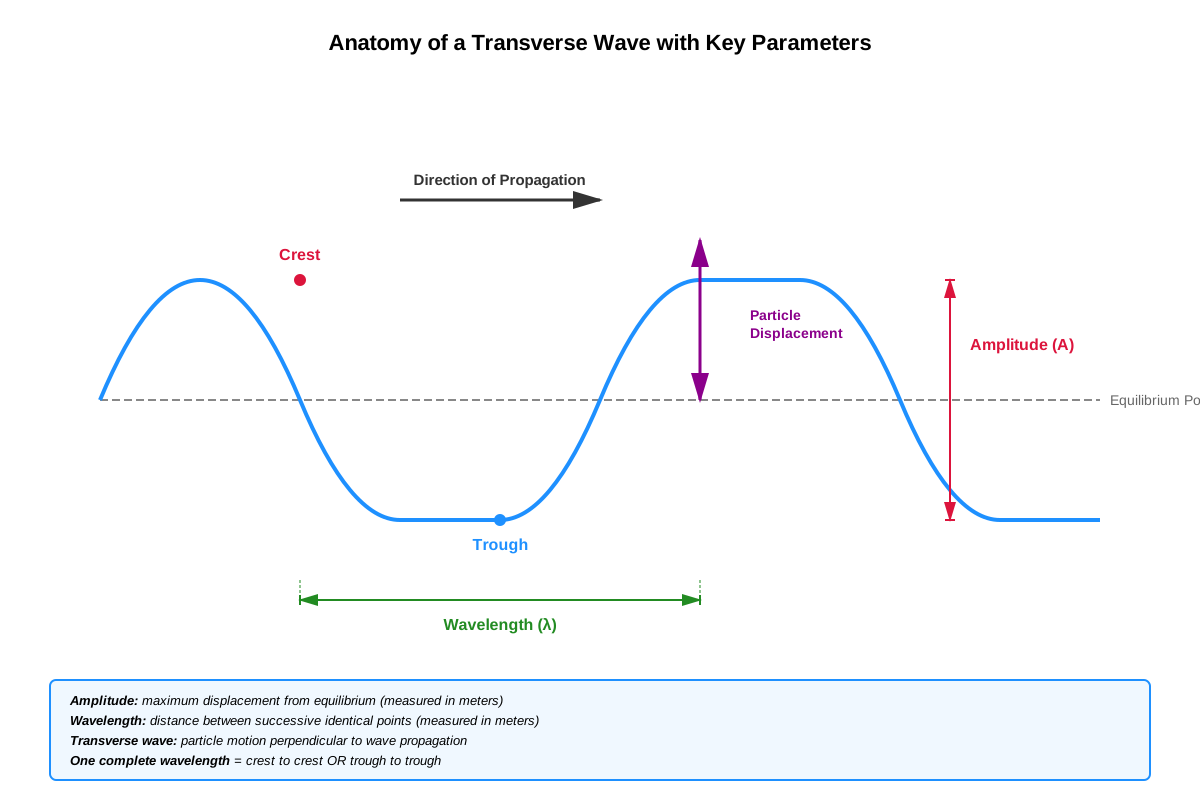
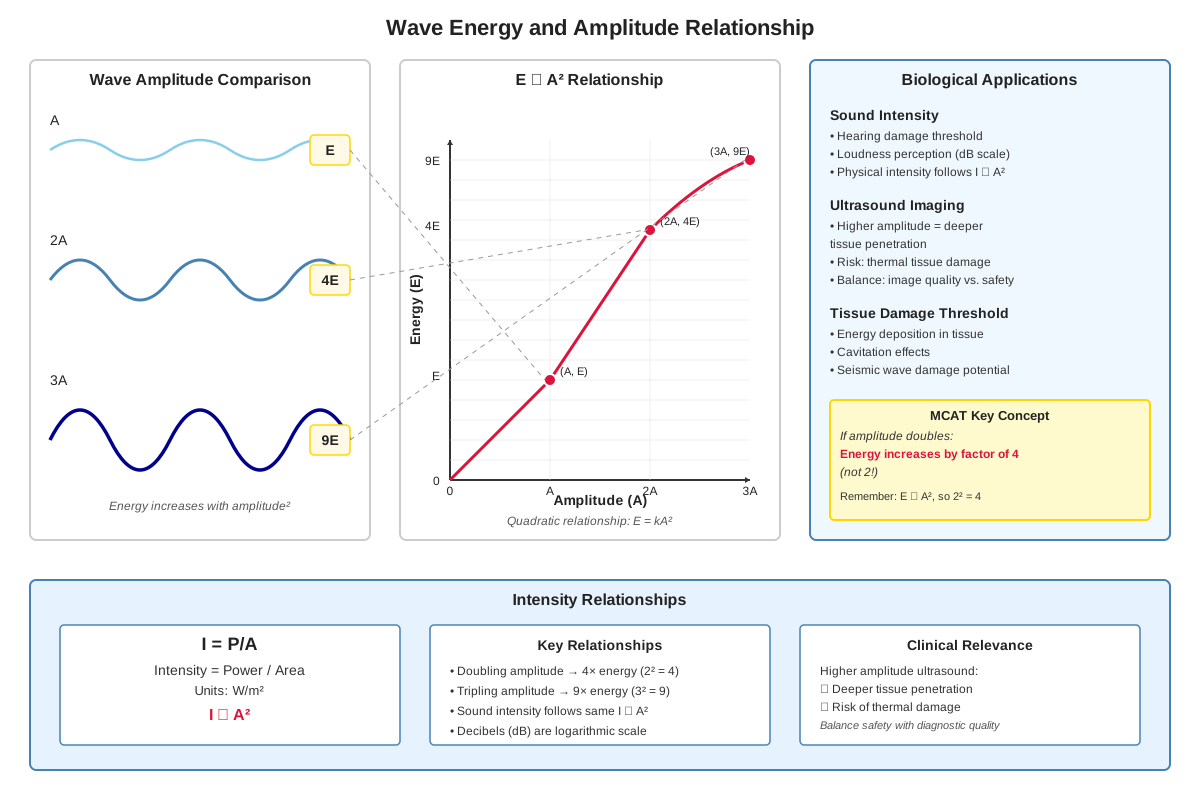
A wave is a disturbance that transfers energy through space or a medium without transferring matter. All waves share common properties that describe their behavior and allow quantitative analysis. The amplitude (A) represents the maximum displacement of a wave from its equilibrium position, measured in meters for mechanical waves. Amplitude directly relates to wave energy—doubling amplitude quadruples the energy carried by the wave, following an E ∝ A² relationship. This principle explains why loud sounds (large amplitude) can damage hearing structures while soft sounds cannot.
The wavelength (λ, lambda) measures the distance between consecutive corresponding points on a wave, such as crest to crest or compression to compression, always expressed in meters. Wavelength determines many wave behaviors, including diffraction patterns and the ability of waves to bend around obstacles. The frequency (f) counts the number of complete wave cycles passing a fixed point per unit time, measured in Hertz (Hz) or cycles per second. Frequency remains constant when waves transition between media, a crucial fact for MCAT problem-solving.
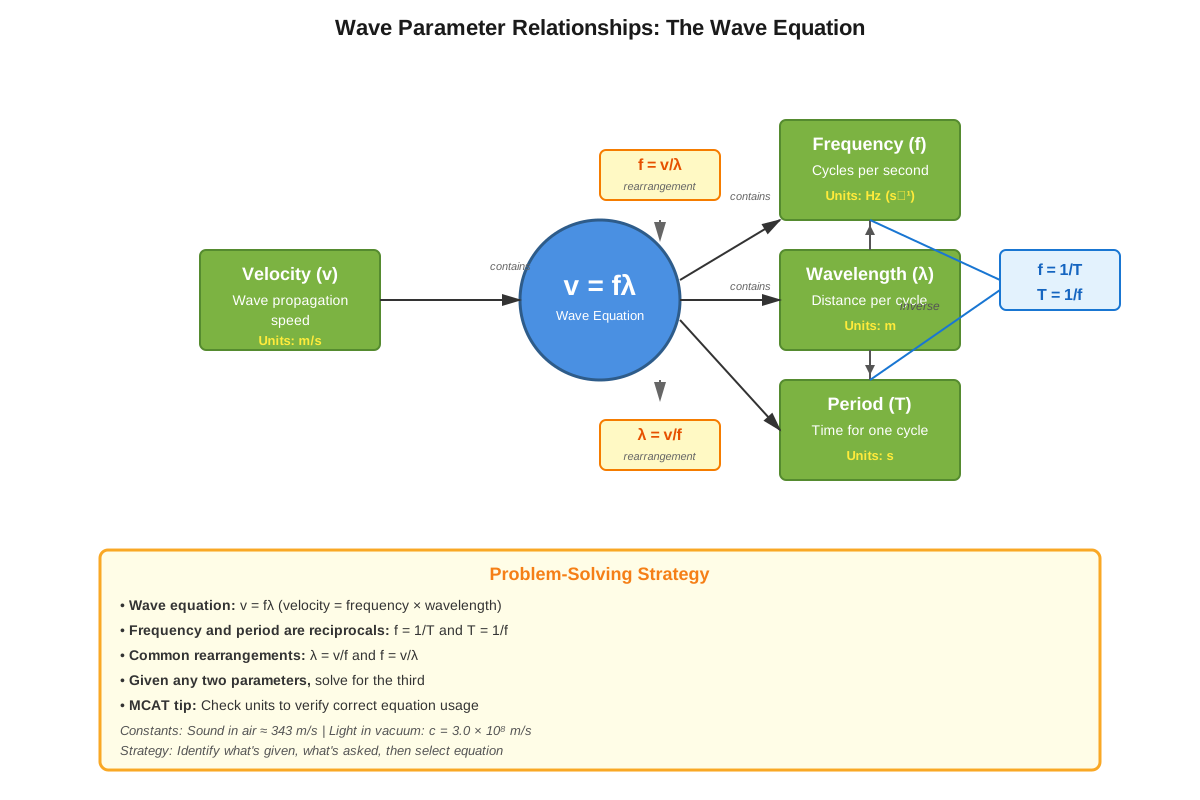
The period (T) represents the time required for one complete wave cycle, measured in seconds. Period and frequency are mathematical reciprocals: T = 1/f and f = 1/T. This relationship allows rapid conversion between time-based and cycle-based descriptions of wave motion.
Wave Velocity and the Universal Wave Equation
The wave velocity (v) describes how quickly a wave disturbance propagates through space, measured in meters per second. The fundamental wave equation relates velocity, frequency, and wavelength:
v = fλThis equation is among the most tested relationships on the MCAT and applies to all wave types. When a wave enters a new medium, its velocity changes due to different medium properties, wavelength adjusts accordingly, but frequency remains constant. For example, light entering water from air slows down (velocity decreases), causing wavelength to decrease while frequency stays the same.
For mechanical waves in specific media, velocity depends on medium properties. In strings or ropes, velocity relates to tension (F_T) and linear mass density (μ):
v = √(F_T/μ)For sound waves in gases, velocity depends on temperature and molecular properties. For sound in air at room temperature, v ≈ 343 m/s, a value worth memorizing for rapid MCAT calculations.
Transverse vs. Longitudinal Waves
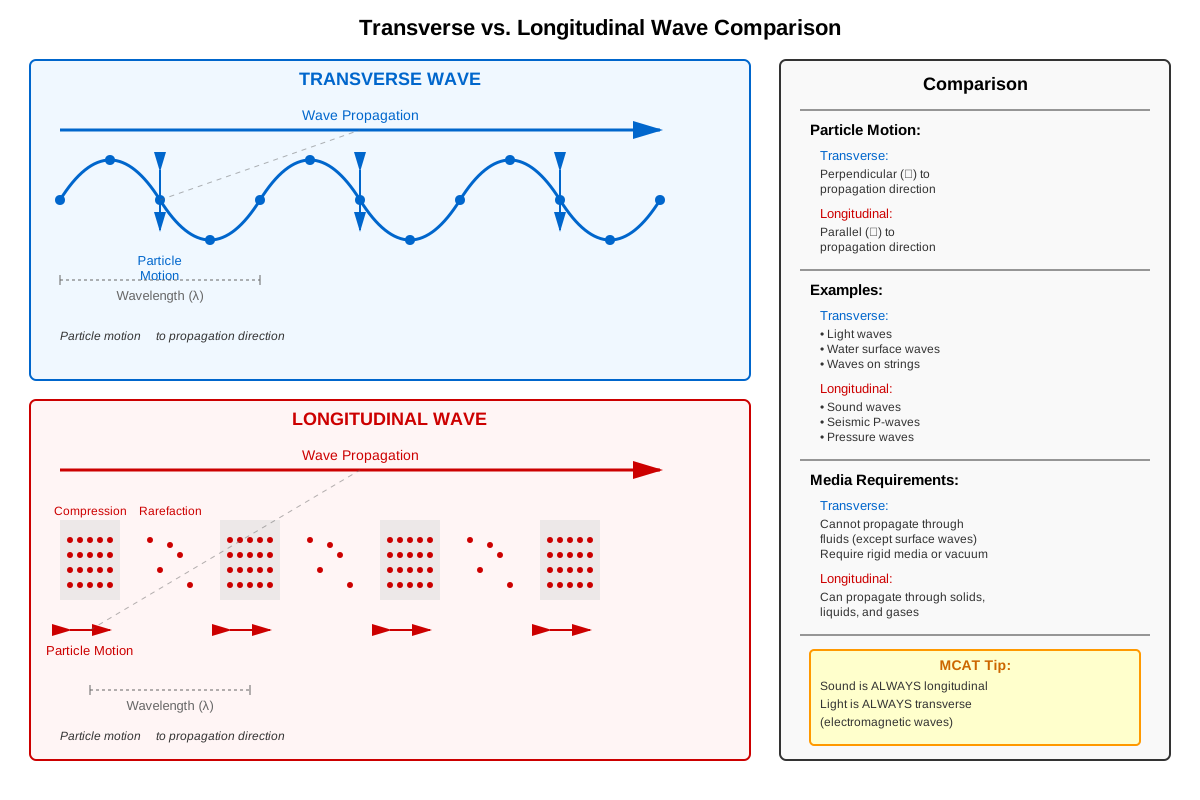
Transverse waves feature particle displacement perpendicular to the direction of wave propagation. Examples include waves on strings, electromagnetic radiation, and secondary seismic waves. Transverse waves exhibit crests (maximum positive displacement) and troughs (maximum negative displacement). These waves can be polarized because their oscillations occur in specific planes perpendicular to propagation direction.
Longitudinal waves feature particle displacement parallel to propagation direction, creating alternating regions of compression (particles closer together) and rarefaction (particles farther apart). Sound waves exemplify longitudinal waves, as do primary seismic waves. Longitudinal waves cannot be polarized because particles oscillate along the same axis as wave travel.
| Property | Transverse Waves | Longitudinal Waves |
|---|---|---|
| Particle motion | Perpendicular to propagation | Parallel to propagation |
| Can travel through vacuum | Yes (EM waves only) | No (require medium) |
| Can be polarized | Yes | No |
| Examples | Light, string waves, S-waves | Sound, P-waves, compression waves |
| Visual features | Crests and troughs | Compressions and rarefactions |
Wave Energy and Intensity
Wave energy depends on both amplitude and frequency. For mechanical waves, the energy transmitted is proportional to the square of amplitude (E ∝ A²) and the square of frequency (E ∝ f²). This means high-frequency, large-amplitude waves carry substantially more energy than low-frequency, small-amplitude waves.
Intensity (I) measures power per unit area, expressed in W/m². For waves spreading uniformly in three dimensions from a point source, intensity follows an inverse square law:
I = P/(4πr²)where P is source power and r is distance from source. This relationship explains why sounds become quieter with distance and why light dims as you move away from a source. For MCAT purposes, remember that doubling distance from a point source reduces intensity to one-quarter its original value.
Phase and Phase Difference
Phase describes a wave's position within its cycle at a specific time and location, typically measured in degrees (0° to 360°) or radians (0 to 2π). Two waves are in phase when their crests and troughs align (phase difference = 0° or multiples of 360°), resulting in constructive interference. Waves are out of phase when crests of one align with troughs of another (phase difference = 180° or odd multiples), causing destructive interference.
Phase relationships determine interference patterns, standing wave formation, and beat frequencies—all testable MCAT concepts. Understanding phase allows prediction of whether waves will reinforce or cancel when they overlap.
Wave Behavior at Boundaries
When waves encounter boundaries between different media, several behaviors occur simultaneously. Reflection occurs when waves bounce back from a boundary, with the angle of incidence equaling the angle of reflection. Transmission involves waves passing into the new medium, typically with changed velocity and wavelength but constant frequency.
Refraction describes the bending of waves when entering a new medium at an angle, caused by velocity changes. Waves entering a slower medium bend toward the normal (perpendicular to boundary), while waves entering a faster medium bend away from the normal.
The principle of superposition states that when multiple waves overlap, the resultant displacement equals the algebraic sum of individual displacements. This principle underlies interference phenomena and explains how waves can pass through each other unchanged.
Concept Relationships
Wave properties form an interconnected web of relationships essential for MCAT problem-solving. The fundamental wave equation (v = fλ) serves as the central hub, connecting velocity, frequency, and wavelength. This equation links to period through the frequency-period reciprocal relationship (f = 1/T), allowing students to calculate any wave parameter given two others.
Amplitude connects to energy through the quadratic relationship (E ∝ A²), which then relates to intensity through the definition I = P/A (power per area). Intensity further connects to distance through the inverse square law, creating a chain: amplitude → energy → intensity → distance relationships.
Wave type (transverse vs. longitudinal) determines possible behaviors: transverse waves can be polarized and include electromagnetic radiation, connecting to optics topics; longitudinal waves include sound, connecting to acoustics and hearing physiology. Both wave types obey the same mathematical relationships but differ in particle motion and medium requirements.
Phase relationships connect to interference phenomena: in-phase waves (phase difference = 0°) → constructive interference → increased amplitude; out-of-phase waves (phase difference = 180°) → destructive interference → decreased amplitude. These interference concepts extend to standing waves, beats, and diffraction patterns.
Boundary behavior (reflection, transmission, refraction) connects to medium properties, which determine wave velocity. Velocity changes at boundaries cause wavelength changes (via v = fλ with constant f), which produce refraction. This chain of relationships appears frequently in MCAT passages about medical imaging or fiber optics.
Relationship Map:
Wave equation (v = fλ) → connects all basic parameters → enables calculation of unknowns → applies to boundary behavior (constant f, changing v and λ) → explains refraction → relates to Snell's law (advanced topic) → connects to optical instruments and lenses
Quick check — test yourself on Wave properties so far.
Try Flashcards →High-Yield Facts
⭐ The wave equation v = fλ applies to all wave types and is the most frequently tested relationship on the MCAT
⭐ Frequency remains constant when waves cross boundaries between media; velocity and wavelength change
⭐ Wave energy is proportional to the square of amplitude: E ∝ A², meaning doubling amplitude quadruples energy
⭐ Intensity from a point source follows the inverse square law: doubling distance reduces intensity to 1/4
⭐ Transverse waves have perpendicular particle motion and can be polarized; longitudinal waves have parallel particle motion and cannot be polarized
- Period and frequency are reciprocals: T = 1/f and f = 1/T
- Sound velocity in air at room temperature is approximately 343 m/s (useful for rapid calculations)
- Electromagnetic waves travel at c = 3.0 × 10⁸ m/s in vacuum
- Wave velocity in a string depends on tension and linear mass density: v = √(F_T/μ)
- The principle of superposition states that overlapping waves add algebraically
- Waves transfer energy without transferring matter
- In-phase waves (phase difference = 0° or 360°) interfere constructively; out-of-phase waves (phase difference = 180°) interfere destructively
Common Misconceptions
Misconception: Waves transport matter from one location to another as they propagate.
Correction: Waves transfer energy through a medium, but the medium particles oscillate around equilibrium positions without net displacement. A wave on water moves energy across the surface, but water molecules move up and down, not horizontally with the wave.
Misconception: Higher frequency waves always travel faster than lower frequency waves.
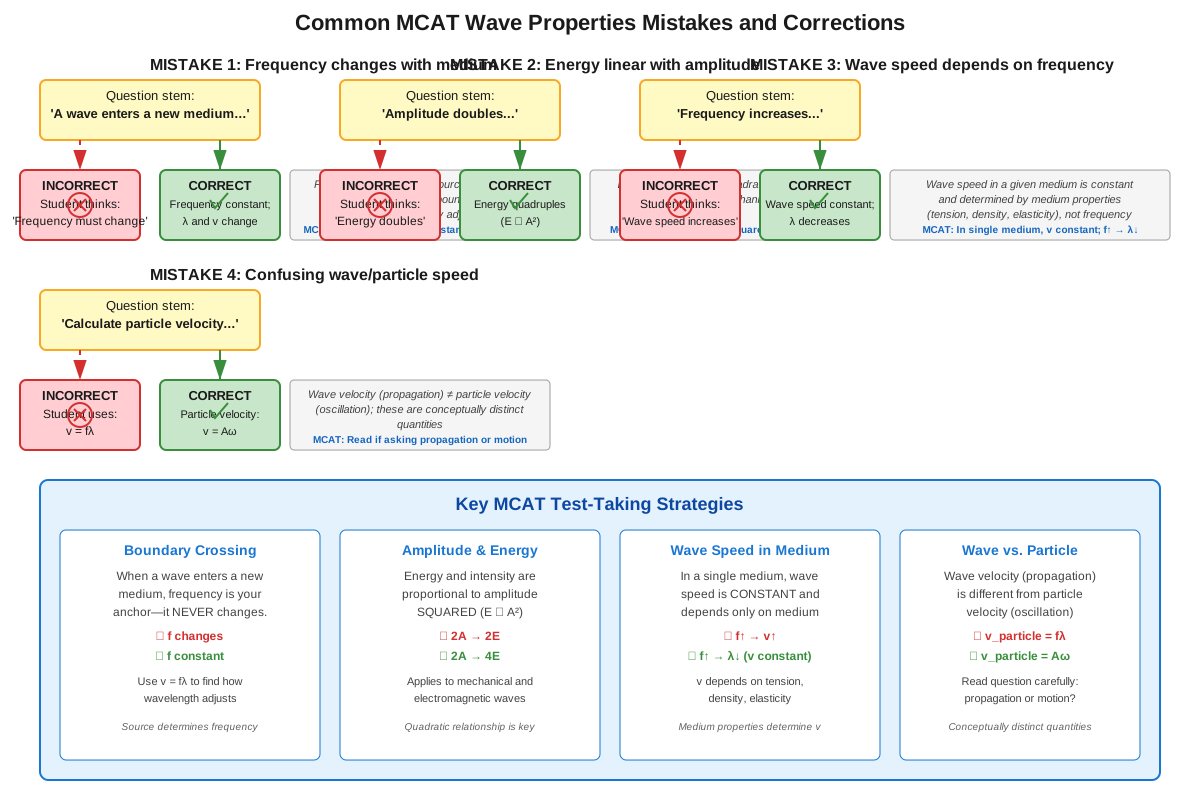
Correction: Wave velocity depends on medium properties, not frequency. In the same medium, all frequencies travel at the same speed. The wave equation v = fλ shows that if velocity is constant, higher frequency means shorter wavelength, not faster travel.
Misconception: Amplitude and wavelength are the same thing.
Correction: Amplitude measures maximum displacement from equilibrium (vertical distance on a wave graph), while wavelength measures the distance between consecutive corresponding points (horizontal distance). They are independent properties—waves can have large amplitude with short wavelength or vice versa.
Misconception: When waves enter a new medium, all wave properties change.
Correction: Frequency remains constant across boundaries; only velocity and wavelength change. This occurs because the wave source determines frequency, which doesn't change just because the wave enters a different medium. The relationship v = fλ requires that if f stays constant and v changes, λ must change proportionally.
Misconception: Intensity and amplitude are the same concept.
Correction: Amplitude measures maximum displacement (in meters), while intensity measures power per unit area (in W/m²). Intensity is proportional to amplitude squared (I ∝ A²), so they're related but distinct. Doubling amplitude increases intensity by a factor of four.
Misconception: All waves require a medium for propagation.
Correction: Mechanical waves (sound, water waves, seismic waves) require a medium, but electromagnetic waves (light, radio waves, X-rays) can propagate through vacuum. This distinction is crucial for understanding why sound cannot travel through space but light can.
Worked Examples
Example 1: Calculating Wave Parameters
Problem: A wave on a string has a frequency of 120 Hz and travels at 24 m/s. Calculate (a) the wavelength, (b) the period, and (c) the new wavelength if the wave enters a section of string where it travels at 18 m/s.
Solution:
(a) Using the wave equation v = fλ:
λ = v/f = 24 m/s / 120 Hz = 0.20 m = 20 cm(b) Period is the reciprocal of frequency:
T = 1/f = 1/120 Hz = 0.0083 s = 8.3 ms(c) When the wave enters the new section, frequency remains constant at 120 Hz, but velocity changes to 18 m/s:
λ_new = v_new/f = 18 m/s / 120 Hz = 0.15 m = 15 cmKey Insights: This problem demonstrates the fundamental wave equation application and the crucial principle that frequency stays constant across boundaries. The wavelength decreased proportionally to the velocity decrease (both reduced by 25%). This type of calculation appears frequently on the MCAT, often embedded in passages about sound waves in different tissues or light in different media.
Example 2: Wave Energy and Intensity
Problem: An ultrasound transducer produces waves with amplitude 2.0 mm. If the amplitude is increased to 6.0 mm while frequency remains constant, by what factor does the wave energy increase? If the transducer acts as a point source with power 0.50 W, what is the intensity at a distance of 5.0 cm from the source?
Solution:
For the energy change, recall that E ∝ A²:
E_new/E_original = (A_new/A_original)² = (6.0 mm / 2.0 mm)² = 3² = 9The energy increases by a factor of 9.
For intensity at distance r = 5.0 cm = 0.050 m:
I = P/(4πr²) = 0.50 W / (4π × (0.050 m)²)
I = 0.50 / (4π × 0.0025) = 0.50 / 0.0314
I ≈ 15.9 W/m²
Key Insights: The quadratic relationship between amplitude and energy is high-yield for the MCAT. Tripling amplitude causes a nine-fold energy increase, not a three-fold increase. The intensity calculation demonstrates the inverse square law—if the distance doubled to 10 cm, intensity would decrease to one-quarter (approximately 4.0 W/m²). These relationships appear in questions about medical imaging, sound perception, and radiation exposure.
Exam Strategy
When approaching wave properties MCAT questions, first identify what type of wave is described (mechanical vs. electromagnetic, transverse vs. longitudinal) as this determines which principles apply. Immediately write down the wave equation v = fλ and note which variables are given and which must be found. Most wave problems reduce to algebraic manipulation of this fundamental relationship.
Trigger words to watch for include: "enters a new medium" (signals that frequency stays constant but velocity and wavelength change), "intensity at a distance" (inverse square law), "amplitude increases" (consider energy relationship E ∝ A²), "in phase" or "out of phase" (interference concepts), and "transverse" or "longitudinal" (determines possible behaviors like polarization).
For process of elimination, eliminate answer choices with incorrect units first—wavelength must be in meters, frequency in Hz, velocity in m/s, intensity in W/m². Next, eliminate choices that violate the principle that frequency remains constant across boundaries. If a question asks about energy changes, eliminate any answer suggesting linear relationships with amplitude (energy depends on A², not A).
Time allocation: Straightforward wave equation problems should take 30-45 seconds. More complex problems involving multiple steps (like calculating intensity after finding power from energy data) may require 60-90 seconds. If a problem requires more than two minutes, flag it and return later—these questions often involve concepts beyond basic wave properties.
When passages describe experimental setups with waves, quickly identify the independent variable (what researchers changed) and dependent variable (what they measured). Wave properties questions in passages often ask you to predict how changing one parameter affects others, which requires understanding the mathematical relationships rather than memorizing facts.
Memory Techniques
"Very Fast Lamborghinis" - Remember the wave equation: Velocity = Frequency × Lambda (wavelength)
"FIAT" - Frequency Is Always The same (when waves cross boundaries)
"A-Squared Energy" - Visualize the letter "A" with a small "2" superscript to remember E ∝ A² (energy proportional to amplitude squared)
"TRANSverse = TRANSfer perpendicular" - The "trans" prefix (meaning across) reminds you that particle motion is across/perpendicular to wave direction
"LONGitudinal = aLONG the direction" - The "long" within longitudinal reminds you that particle motion is along the propagation direction
Inverse Square Law visualization: Picture a sphere expanding from a point source. As radius doubles, surface area quadruples (A = 4πr²), so intensity (power spread over that area) becomes one-quarter. Visualize the same amount of light spreading over four times the area.
Phase relationships: Hold your hands in front of you with fingers pointing up (in phase = constructive = both up). Now flip one hand upside down (out of phase = destructive = one up, one down). This physical gesture helps remember interference patterns.
Summary
Wave properties constitute essential Physics knowledge for MCAT success, providing the mathematical and conceptual framework for analyzing energy transfer through oscillating disturbances. The fundamental wave equation v = fλ connects velocity, frequency, and wavelength and applies universally to all wave types. Understanding that frequency remains constant when waves cross boundaries while velocity and wavelength adjust proportionally enables solving most MCAT wave problems. Amplitude relates to energy through a quadratic relationship (E ∝ A²), and intensity follows an inverse square law with distance from point sources. Distinguishing transverse waves (perpendicular particle motion, can be polarized) from longitudinal waves (parallel particle motion, cannot be polarized) allows prediction of wave behavior in different contexts. These principles appear throughout the MCAT in contexts ranging from medical imaging to sound perception, making thorough mastery of wave properties a high-return investment of study time.
Key Takeaways
- The wave equation v = fλ is the most important relationship; memorize it and practice applying it in various contexts
- Frequency stays constant across boundaries; velocity and wavelength change proportionally when waves enter new media
- Wave energy is proportional to amplitude squared (E ∝ A²), so doubling amplitude quadruples energy
- Intensity from point sources follows the inverse square law: I = P/(4πr²)
- Transverse waves have perpendicular particle motion and can be polarized; longitudinal waves have parallel motion and cannot be polarized
- Period and frequency are reciprocals (T = 1/f); this allows rapid conversion between time-based and cycle-based descriptions
- The principle of superposition explains interference: waves add algebraically when they overlap
Related Topics
Sound waves and acoustics: Wave properties provide the foundation for understanding sound intensity, pitch (frequency), loudness (amplitude), and the Doppler effect. Mastering basic wave concepts makes acoustic phenomena straightforward applications rather than new material.
Electromagnetic spectrum: The wave properties of electromagnetic radiation (light, X-rays, radio waves) follow the same mathematical relationships as mechanical waves, with the universal constant c = 3.0 × 10⁸ m/s replacing medium-dependent velocity.
Interference and standing waves: Phase relationships and the superposition principle extend to create interference patterns and standing waves, which appear in questions about musical instruments, resonance, and wave behavior in confined spaces.
Optics and light: Reflection, refraction, and transmission of light waves at boundaries apply wave properties to explain lenses, mirrors, and optical instruments frequently tested on the MCAT.
Doppler effect: Understanding frequency and wavelength relationships enables analysis of how relative motion between source and observer affects perceived wave properties, with applications to blood flow measurement and astronomical observations.
Practice CTA
Now that you've mastered the fundamental concepts of wave properties, reinforce your understanding by working through practice questions and flashcards. Focus especially on problems requiring application of the wave equation in different contexts and scenarios involving waves crossing boundaries between media. The more you practice identifying which wave property remains constant and which change in different situations, the more automatic these problem-solving skills will become. Remember that wave properties appear throughout the Physics section—time invested in mastering these fundamentals pays dividends across multiple question types. Challenge yourself with timed practice to build both accuracy and speed, essential skills for MCAT success!
Sign up free to keep reading
Create a free AnvayaPrep account to finish this MCAT guide on Wave properties — plus flashcards and practice questions.