Overview
Dream theories represent a critical intersection of cognition and consciousness within Psychology, exploring the purpose, mechanisms, and meanings behind the mental experiences that occur during sleep. For the MCAT, understanding dream theories is essential because they illuminate fundamental debates about consciousness, memory consolidation, emotional processing, and the relationship between brain activity and subjective experience. The major theoretical frameworks—ranging from psychoanalytic interpretations to modern neurocognitive models—reflect broader themes in psychological science about the nature of the unconscious mind, the function of altered states of consciousness, and how the brain processes information when external sensory input is minimized.
Dream theories matter for MCAT Psychology because they frequently appear in passages discussing sleep stages, memory formation, emotional regulation, and consciousness. Questions may ask students to distinguish between competing theoretical explanations for why dreams occur, apply specific theories to clinical scenarios, or analyze research findings through different theoretical lenses. The topic bridges multiple domains: biological psychology (REM sleep and brain activation), cognitive psychology (memory and problem-solving), and social psychology (cultural influences on dream interpretation). Understanding these theories requires integrating knowledge about neural mechanisms, psychological processes, and the scientific method itself.
The study of dream theories also exemplifies how psychology has evolved from purely interpretive frameworks to empirically testable hypotheses. This progression—from Freud's psychoanalytic theory to Hobson and McCarley's activation-synthesis hypothesis to contemporary threat-simulation and memory consolidation models—demonstrates the maturation of psychological science and provides excellent material for MCAT passages that assess critical thinking about research methodology, theory evaluation, and the integration of biological and psychological perspectives on human behavior.
Learning Objectives
- [ ] Define dream theories using accurate Psychology terminology
- [ ] Explain why dream theories matters for the MCAT
- [ ] Apply dream theories to exam-style questions
- [ ] Identify common mistakes related to dream theories
- [ ] Connect dream theories to related Psychology concepts
- [ ] Compare and contrast at least four major dream theories including their underlying assumptions
- [ ] Analyze how different dream theories reflect broader debates about consciousness and the unconscious mind
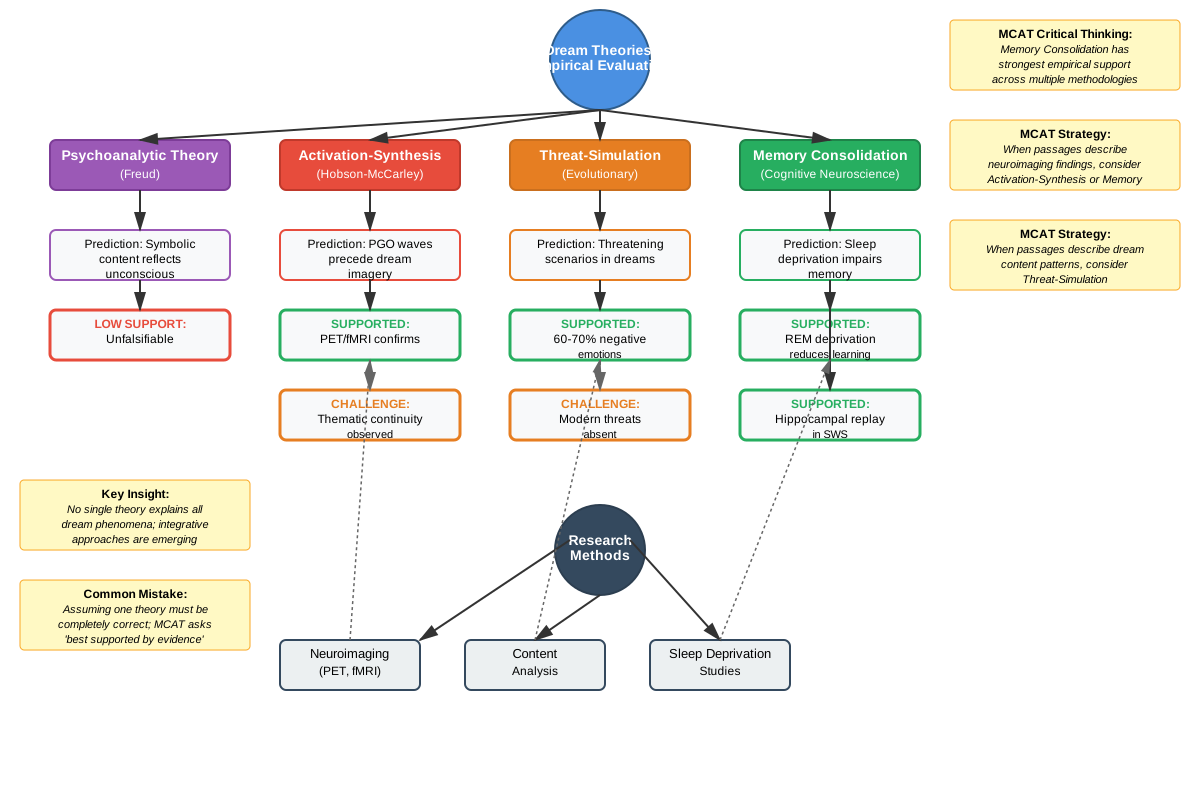
- [ ] Evaluate the empirical support for competing dream theories and identify testable predictions from each framework
Prerequisites
- Sleep stages and architecture: Dream theories specifically address mental activity during REM and NREM sleep, requiring understanding of sleep cycle progression and characteristics
- Brain structure and function: Theories reference specific neural regions (limbic system, prefrontal cortex, brainstem) and their roles in emotion, memory, and executive function
- Memory systems: Several theories propose dreams serve memory consolidation functions, necessitating knowledge of declarative, procedural, and emotional memory
- Consciousness concepts: Dream theories attempt to explain an altered state of consciousness, building on foundational understanding of awareness, attention, and subjective experience
- Psychoanalytic concepts: Freud's theory introduced terms like unconscious, repression, and wish fulfillment that appear across multiple dream theories
Why This Topic Matters
Clinical and Real-World Significance: Dream theories have practical applications in psychotherapy, trauma treatment, and understanding mental health conditions. Nightmares and disturbed dreaming patterns characterize PTSD, depression, and anxiety disorders. Therapists using different theoretical orientations approach dream content differently—psychodynamic therapists may interpret symbolic meanings, while cognitive-behavioral therapists focus on emotional processing and threat rehearsal. Understanding dream theories helps clinicians conceptualize sleep disturbances and design appropriate interventions.
MCAT Exam Statistics: Dream theories appear in approximately 3-5% of Psychology/Sociology section passages, typically integrated with questions about consciousness, sleep, memory, or research methodology. Questions most commonly ask students to: (1) identify which theory best explains a described phenomenon, (2) distinguish between theories based on their core assumptions, (3) evaluate research findings that support or challenge specific theories, or (4) apply theoretical frameworks to novel scenarios. The topic frequently appears in passages that present experimental data about sleep and cognition, requiring students to interpret findings through different theoretical lenses.
Common Exam Contexts: MCAT passages featuring dream theories often present research studies examining dream content across different populations, neuroimaging data showing brain activation during REM sleep, or clinical cases involving sleep disorders. Questions may embed dream theories within broader discussions of consciousness, asking students to recognize how different theories conceptualize the relationship between conscious and unconscious processes. The topic also appears in passages about memory consolidation, emotional regulation, and evolutionary psychology, requiring students to connect dream theories to these related domains.
Core Concepts
Psychoanalytic Theory (Freud)
Sigmund Freud's psychoanalytic theory represents the first comprehensive psychological framework for understanding dreams, proposed in his 1900 work "The Interpretation of Dreams." Freud conceptualized dreams as the "royal road to the unconscious," arguing they provide access to repressed wishes, conflicts, and desires that cannot be expressed during waking consciousness due to social constraints and psychological defenses.
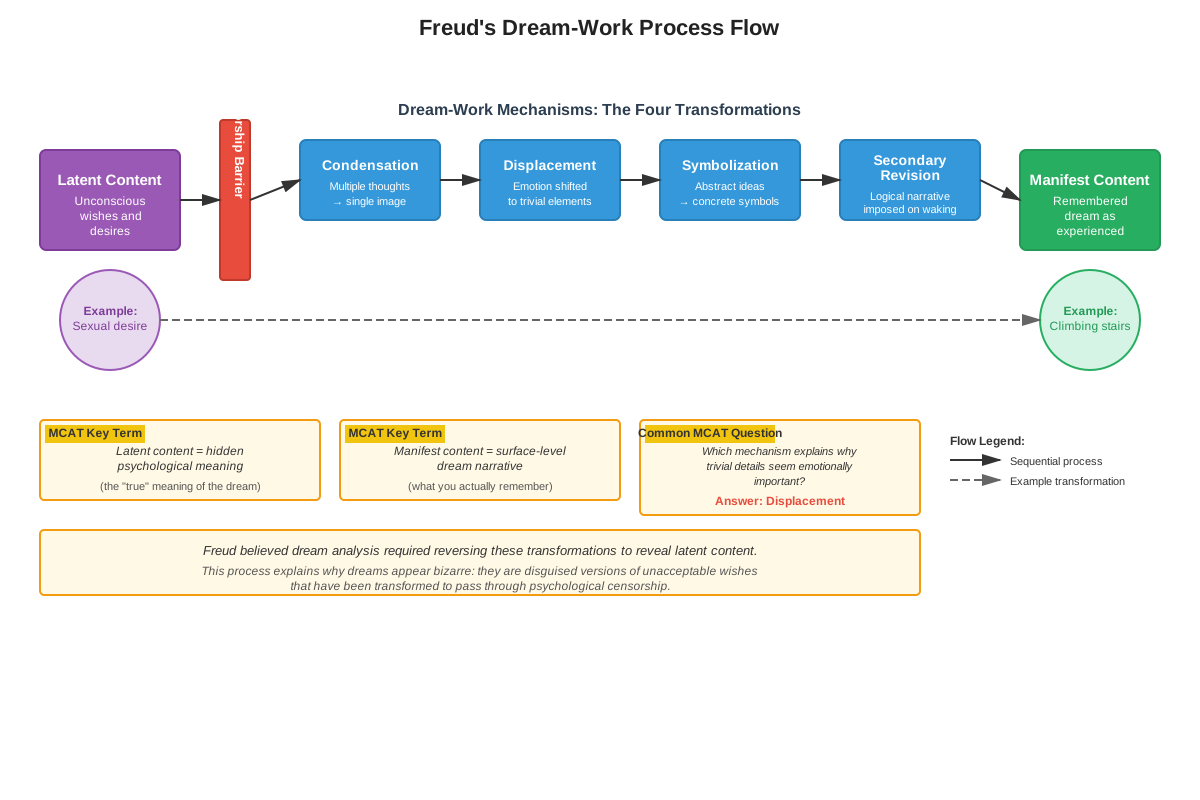
According to Freud, dreams serve as wish fulfillment—they allow the unconscious mind to express forbidden or anxiety-provoking desires in disguised form. The theory distinguishes between manifest content (the literal, remembered narrative of the dream) and latent content (the hidden, symbolic meaning representing unconscious wishes). The transformation from latent to manifest content occurs through dream work, which includes several mechanisms:
- Condensation: Multiple ideas, people, or concepts combine into single dream images
- Displacement: Emotional significance shifts from important to trivial elements, disguising true concerns
- Symbolization: Abstract ideas or taboo wishes represent themselves through concrete symbols
- Secondary revision: The mind organizes fragmented dream elements into a more coherent narrative upon waking
Freud proposed that dreams protect sleep by allowing partial expression of unconscious material that would otherwise create anxiety and cause awakening. The censor mechanism permits only sufficiently disguised content to reach consciousness, maintaining the boundary between acceptable and unacceptable thoughts.
MCAT Relevance: Questions may present dream content and ask which element represents manifest versus latent content, or which defense mechanism the dream work exemplifies. Understanding that Freud viewed dreams as meaningful, symbolic, and motivated by unconscious wishes distinguishes this theory from biological approaches.
Activation-Synthesis Hypothesis (Hobson & McCarley)
The activation-synthesis hypothesis, proposed by J. Allan Hobson and Robert McCarley in 1977, represents a neurobiological challenge to psychoanalytic dream theory. This model argues that dreams result from the brain's attempt to make sense of random neural activity during REM sleep, rather than expressing meaningful unconscious content.
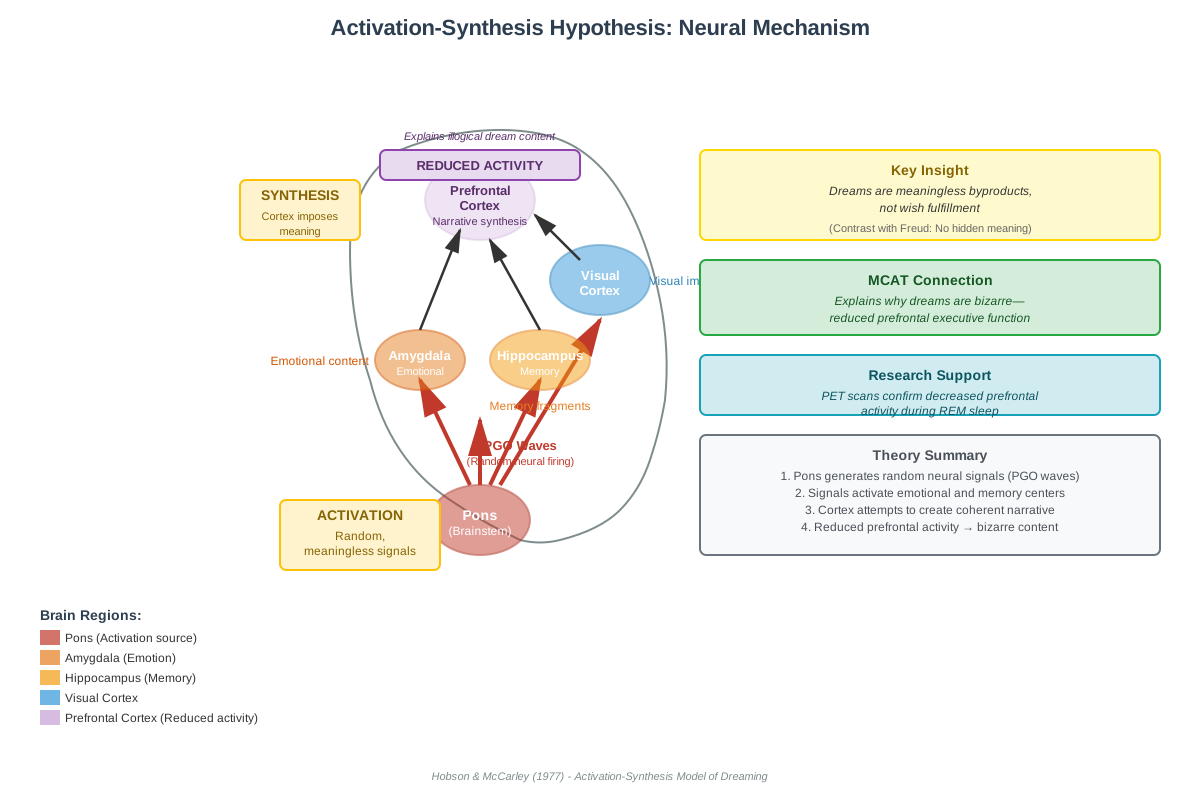
During REM sleep, the pons (part of the brainstem) generates random electrical signals that activate various brain regions, particularly the limbic system (emotion), visual cortex (imagery), and motor cortex (movement sensations). Simultaneously, the prefrontal cortex—responsible for logical thinking, planning, and reality testing—shows decreased activity. The synthesis component refers to the cortex's attempt to create a coherent narrative from these random activations, drawing on memories and experiences to construct a story that makes sense of the disparate neural signals.
Key features of this theory include:
- Dreams are physiologically determined rather than psychologically motivated
- Dream bizarreness results from random activation patterns and reduced executive function
- Emotional content reflects limbic system activation rather than repressed wishes
- The theory is testable through neuroimaging and electrophysiological studies
The activation-synthesis hypothesis explains common dream characteristics: sudden scene changes (shifting activation patterns), impossible events (lack of prefrontal reality monitoring), intense emotions (limbic activation), and vivid visual imagery (occipital lobe stimulation). Unlike Freud's theory, this model suggests dreams have no inherent meaning—they are epiphenomena, byproducts of neural processes serving other functions.
MCAT Relevance: This theory frequently appears in passages presenting neuroimaging data or discussing the relationship between brain activity and consciousness. Questions may ask students to identify predictions that distinguish activation-synthesis from psychoanalytic theory, or to explain why certain brain regions' activity patterns produce specific dream characteristics.
Cognitive Problem-Solving Theory
Cognitive problem-solving theory proposes that dreams serve an adaptive function by allowing the mind to work through current concerns, process emotional experiences, and explore solutions to waking-life challenges. This framework, associated with researchers like Rosalind Cartwright, views dreams as continuous with waking thought processes rather than fundamentally different or meaningless.
According to this theory, dreams:
- Reflect current concerns and preoccupations from waking life
- Allow emotional processing of recent experiences, particularly stressful or unresolved situations
- Facilitate creative problem-solving by exploring scenarios and solutions without real-world constraints
- Help integrate new information with existing knowledge structures
Research supporting this theory demonstrates that dream content correlates with waking concerns, individuals experiencing major life transitions show related dream themes, and some people report solving problems or gaining insights through dreams. The theory explains why students might dream about exams, why relationship conflicts appear in dream narratives, and why creative individuals sometimes report breakthrough ideas emerging from dreams.
Unlike activation-synthesis, this theory attributes meaning to dreams, but unlike psychoanalysis, the meaning is relatively transparent rather than heavily disguised. Dreams address current adaptive challenges rather than expressing repressed childhood wishes. The theory emphasizes continuity between waking and dreaming cognition while acknowledging that reduced prefrontal activity during sleep allows more associative, less constrained thinking.
MCAT Relevance: Questions may present scenarios where dream content clearly relates to waking concerns and ask which theory best explains this pattern. Understanding that this theory emphasizes current problems rather than unconscious wishes or random activation helps distinguish it from competing frameworks.
Threat Simulation Theory
Threat simulation theory, proposed by Antti Revonsuo, offers an evolutionary perspective on dream function. This theory argues that dreams evolved as a biological defense mechanism that allows organisms to rehearse responses to threatening situations in a safe environment, enhancing survival and reproductive success.
The theory proposes that the dream-production system:
- Selectively simulates threatening events more frequently than their actual occurrence in waking life
- Provides realistic rehearsal of perception and avoidance of threats
- Activates and maintains threat-avoidance neural circuits that might otherwise deteriorate without regular use
- Confers adaptive advantage by improving threat recognition and response skills
Evidence supporting this theory includes cross-cultural studies showing that threatening content appears in dreams more frequently than in waking life, children's dreams contain more threats than adults' (when threats were more prevalent in ancestral environments), and individuals who have experienced trauma show increased threat-related dreaming. The theory explains the prevalence of chase dreams, falling dreams, and scenarios involving danger or conflict.
Threat simulation theory differs from other frameworks by emphasizing evolutionary function rather than individual psychological meaning (Freud), neural byproducts (activation-synthesis), or current problem-solving (cognitive theory). It predicts that dream content should over-represent ancestral threats (predators, interpersonal aggression, environmental dangers) rather than modern concerns (financial problems, technology failures).
MCAT Relevance: This theory frequently appears in passages discussing evolutionary psychology or comparing functional versus non-functional explanations for psychological phenomena. Questions may ask students to identify which theory predicts specific patterns of dream content or to evaluate whether research findings support adaptive versus epiphenomenal views of dreaming.
Information Processing and Memory Consolidation Theory
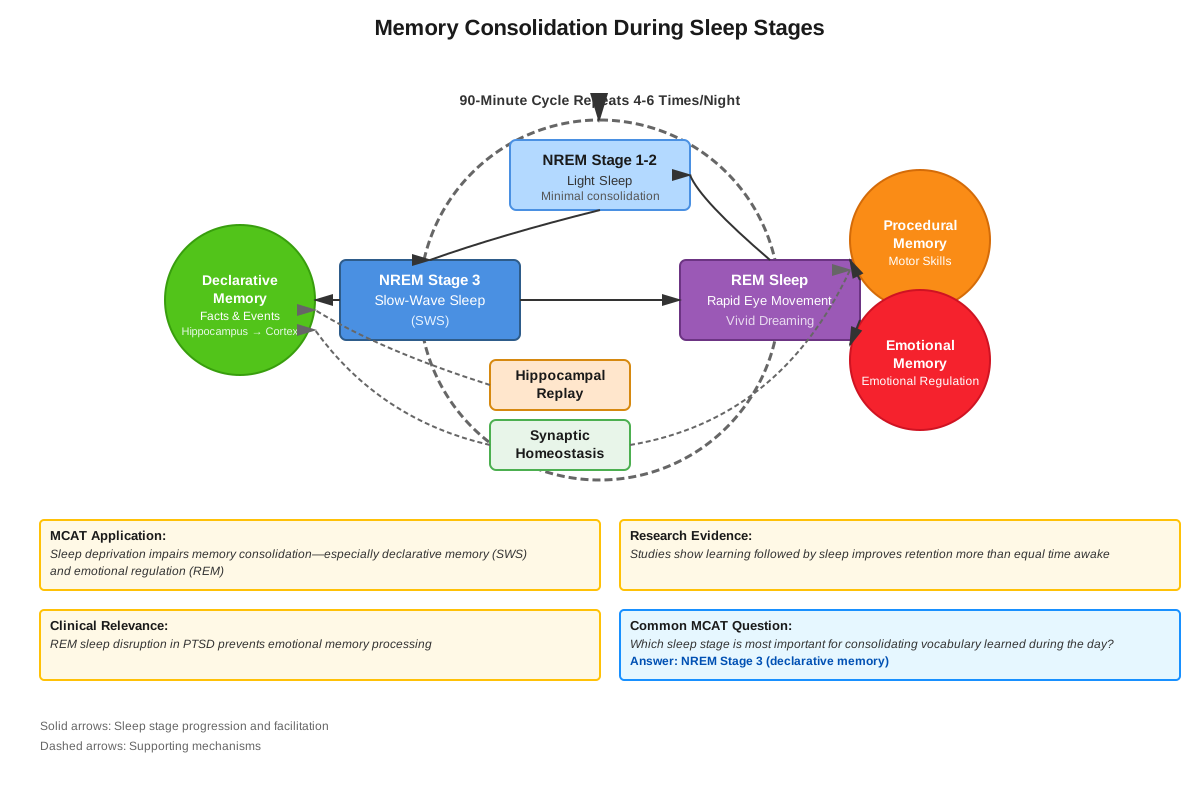
Information processing theory conceptualizes dreams as part of the brain's memory consolidation process, helping transfer information from short-term to long-term storage and integrating new experiences with existing knowledge structures. This framework draws on cognitive neuroscience research demonstrating that sleep, particularly REM sleep, plays crucial roles in memory formation.
According to this theory, dreams:
- Reflect the reactivation and reorganization of recently encoded memories
- Facilitate consolidation of declarative (facts and events) and procedural (skills) memories
- Help integrate new information with existing schemas and knowledge networks
- Support emotional memory processing, potentially reducing the emotional intensity of experiences
Research evidence includes studies showing that REM sleep deprivation impairs memory consolidation, neuroimaging reveals reactivation of brain regions engaged during learning when subjects dream about related content, and dream content often incorporates elements from recent experiences (the "day residue" effect). The theory explains why students might dream about material they studied, why learning new skills correlates with increased REM sleep, and why sleep improves memory retention.
This theory shares with activation-synthesis the emphasis on neural processes but attributes functional significance to dreams rather than viewing them as meaningless byproducts. It shares with cognitive problem-solving theory the view that dreams serve adaptive purposes but focuses specifically on memory rather than broader problem-solving. The theory integrates well with neuroscience findings about sleep stages and memory systems.
MCAT Relevance: This theory frequently appears in passages discussing memory, learning, or sleep physiology. Questions may present research showing correlations between dream content and memory performance, asking students to identify which theory best explains the findings or to predict outcomes based on different theoretical frameworks.
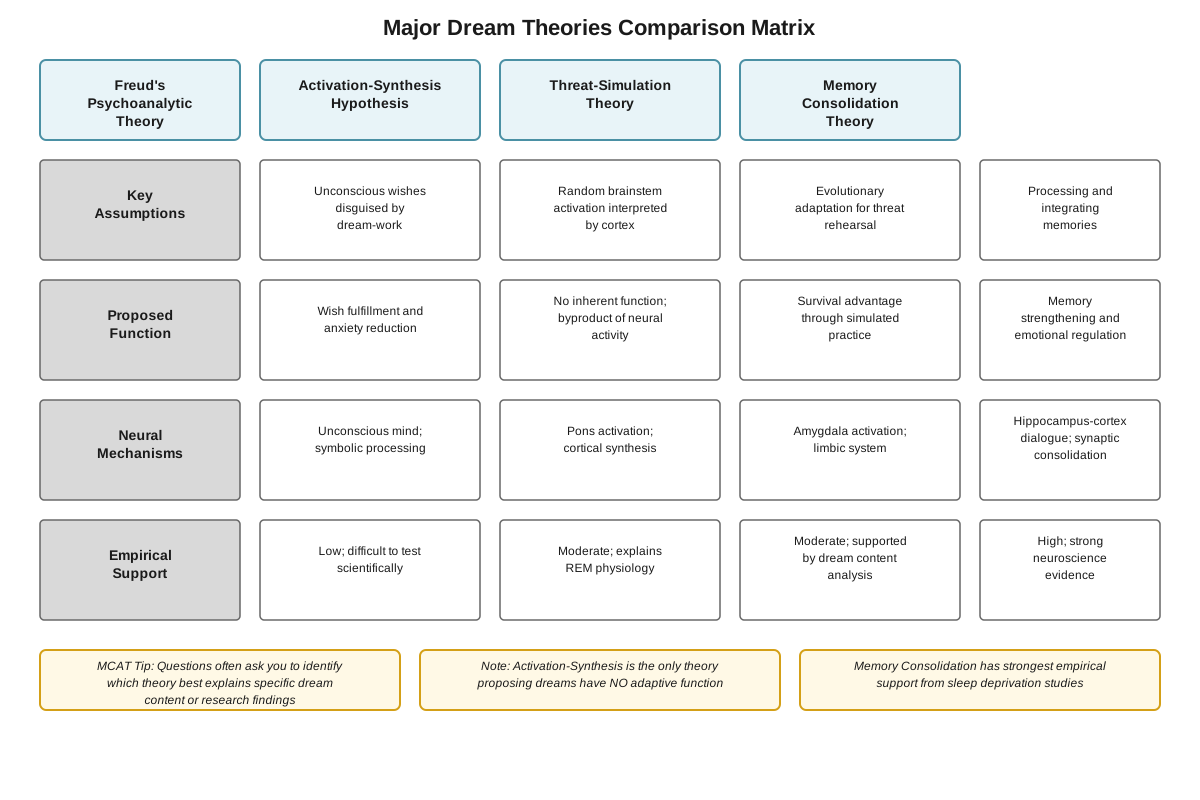
Comparison of Major Dream Theories
| Theory | Primary Function | Mechanism | Dream Meaning | Key Brain Regions | Testability |
|---|---|---|---|---|---|
| Psychoanalytic | Wish fulfillment; protect sleep | Unconscious desires disguised through dream work | Symbolic; requires interpretation | Not specified (pre-neuroscience) | Low; subjective interpretation |
| Activation-Synthesis | None (epiphenomenon) | Random brainstem activation; cortical synthesis | No inherent meaning | Pons, limbic system, cortex | High; neuroimaging predictions |
| Cognitive Problem-Solving | Process emotions; solve problems | Continued cognitive processing during sleep | Transparent; reflects current concerns | Prefrontal cortex, limbic system | Moderate; content analysis |
| Threat Simulation | Rehearse threat responses | Evolutionary adaptation for survival | Functional; practice scenarios | Amygdala, motor cortex | Moderate; cross-cultural studies |
| Memory Consolidation | Strengthen and integrate memories | Reactivation and reorganization of neural traces | Reflects learning and memory processes | Hippocampus, cortex | High; sleep and memory studies |
Concept Relationships
The various dream theories represent different levels of analysis and explanatory frameworks within Psychology, each emphasizing distinct aspects of the dreaming phenomenon. Understanding their relationships helps clarify how they complement or compete with one another.
Psychoanalytic theory → historically influenced → Cognitive problem-solving theory: Both attribute meaning to dreams and view them as addressing psychological concerns, but cognitive theory focuses on current, conscious concerns rather than repressed unconscious wishes. The evolution from psychoanalytic to cognitive approaches reflects psychology's broader shift toward empirically testable hypotheses.
Activation-synthesis hypothesis → challenged → Psychoanalytic theory: Hobson and McCarley explicitly proposed their neurobiological model as an alternative to Freud's psychological interpretation, arguing that dreams result from bottom-up neural processes rather than top-down psychological motivations. This represents the biological versus psychological explanation debate.
Memory consolidation theory → integrates with → Activation-synthesis hypothesis: Both emphasize neural mechanisms during REM sleep, but memory consolidation attributes functional significance to the activation patterns that activation-synthesis views as random. Modern neuroscience suggests the "random" activation may actually reflect systematic memory reactivation.
Threat simulation theory → shares functional perspective with → Cognitive problem-solving theory and Memory consolidation theory: All three propose that dreams serve adaptive purposes, but they differ in the specific function emphasized (threat rehearsal versus current problem-solving versus memory integration). These theories are not mutually exclusive—dreams might serve multiple functions.
The theories connect to broader cognition and consciousness concepts: they address how consciousness operates in altered states, how the brain generates subjective experience, and the relationship between neural activity and mental content. They relate to memory through discussions of consolidation and emotional processing, to emotion through explanations of dream affect, and to evolutionary psychology through functional versus non-functional debates.
Understanding these relationships helps students recognize that MCAT questions may ask them to identify which theory best explains specific findings, but also to recognize that multiple theories might partially explain different aspects of dreaming. The theories exist on a continuum from purely psychological (psychoanalytic) to purely biological (activation-synthesis), with intermediate positions acknowledging both neural mechanisms and psychological functions.
Quick check — test yourself on Dream theories so far.
Try Flashcards →High-Yield Facts
⭐ Freud's psychoanalytic theory distinguishes between manifest content (literal dream narrative) and latent content (hidden symbolic meaning), with dream work transforming unconscious wishes into acceptable forms through condensation, displacement, and symbolization.
⭐ Activation-synthesis hypothesis proposes that dreams result from the cortex attempting to synthesize random neural signals generated by the pons during REM sleep, with reduced prefrontal activity explaining dream bizarreness and lack of logical coherence.
⭐ Cognitive problem-solving theory views dreams as continuous with waking thought, serving to process current emotional concerns and work through adaptive challenges rather than expressing repressed wishes or resulting from random activation.
⭐ Threat simulation theory proposes an evolutionary function for dreams, arguing they allow rehearsal of threat perception and avoidance responses, predicting that threatening content should appear more frequently in dreams than in waking life.
⭐ Memory consolidation theory suggests dreams reflect the reactivation and reorganization of recently encoded memories during sleep, supporting the transfer of information from short-term to long-term storage.
- Psychoanalytic theory is the only major framework that emphasizes heavily disguised, symbolic content requiring expert interpretation to reveal true meaning.
- Activation-synthesis is the most reductionist biological theory, viewing dreams as epiphenomena without inherent psychological meaning or adaptive function.
- The "day residue" phenomenon—incorporation of recent experiences into dreams—supports both memory consolidation and cognitive problem-solving theories but challenges purely random activation models.
- REM sleep shows high activity in limbic (emotional) regions and low activity in prefrontal (executive function) regions, explaining emotional intensity and logical inconsistency in dreams across multiple theoretical frameworks.
- Cross-cultural universality of certain dream themes (falling, being chased, flying) supports evolutionary theories like threat simulation while challenging purely cultural or individual psychological interpretations.
- Modern neuroscience research increasingly supports hybrid models that acknowledge both neural mechanisms (activation patterns) and functional significance (memory consolidation, emotional processing).
- Dream recall varies significantly across individuals and correlates with REM sleep awakening, meaning most dreams are forgotten and reported content may not represent typical dream experience.
- Lucid dreaming—awareness during dreams that one is dreaming—challenges theories that emphasize lack of metacognitive awareness and has been used experimentally to test dream theories.
Common Misconceptions
Misconception: All dreams occur during REM sleep and NREM sleep involves no mental activity.
Correction: While dreams are more frequent, vivid, and bizarre during REM sleep, mental activity occurs throughout all sleep stages. NREM dreams tend to be more thought-like, less visual, and more realistic than REM dreams. This distinction matters for understanding when different types of cognitive processing occur during sleep.
Misconception: Activation-synthesis hypothesis claims dreams are completely random and meaningless.
Correction: The theory proposes that the initial neural activation is random, but the synthesis process draws on personal memories, experiences, and concerns to construct the narrative. The content reflects the individual's knowledge base even if the activation pattern is random, so dreams are not entirely meaningless even in this framework.
Misconception: Freud's theory requires that all dreams represent sexual or aggressive wishes.
Correction: While Freud emphasized sexual and aggressive drives as primary unconscious motivations, his theory encompasses any wish or desire that creates anxiety or conflicts with conscious values. The theory's core claim is that dreams fulfill wishes through disguised expression, not that all wishes are specifically sexual or aggressive.
Misconception: Dream theories are mutually exclusive—only one can be correct.
Correction: Dreams are complex phenomena that may serve multiple functions simultaneously. Memory consolidation, emotional processing, and neural activation patterns can all occur during the same dream. Modern approaches often integrate insights from multiple theories rather than treating them as competing explanations.
Misconception: Threat simulation theory predicts that all dreams should contain threatening content.
Correction: The theory proposes that threatening content appears more frequently in dreams than its base rate in waking life, not that every dream contains threats. The theory allows for variation in dream content while predicting a statistical over-representation of threat-related scenarios.
Misconception: If you can identify what a dream "means," that validates psychoanalytic theory.
Correction: Finding apparent connections between dream content and waking concerns does not specifically support psychoanalytic theory over cognitive problem-solving theory. The key distinction is whether the meaning is heavily disguised and symbolic (psychoanalytic) or relatively transparent and continuous with waking thought (cognitive). Confirmation bias can lead people to find meaningful patterns in any ambiguous content.
Misconception: Memory consolidation theory suggests we should remember everything we dream about to improve learning.
Correction: The theory proposes that the neural reactivation and consolidation processes during sleep improve memory, not that conscious recall of dream content is necessary for memory benefits. The consolidation occurs at the neural level regardless of whether the dream is remembered upon waking.
Worked Examples
Example 1: Distinguishing Theories Based on Dream Content
Scenario: A medical student preparing for board exams reports a dream in which she is taking an exam but the questions are written in an unknown language, the exam room keeps changing locations, and she feels intense anxiety. When she tries to write answers, her pen produces only scribbles. She wakes feeling stressed about her upcoming exam.
Question: Which dream theory best explains both the bizarre elements and the clear connection to her waking concerns?
Analysis:
Step 1: Identify key features
- Clear connection to waking concern (upcoming exam)
- Bizarre, impossible elements (changing rooms, unreadable questions)
- Intense emotion (anxiety)
- Lack of logical coherence
Step 2: Evaluate each theory
Psychoanalytic theory: Would interpret the exam as symbolic of something else (perhaps fear of exposure or judgment), with the inability to write representing repressed wishes or conflicts. However, the connection to her actual exam seems too direct and transparent for heavily disguised latent content. The manifest content clearly relates to her conscious concern.
Activation-synthesis hypothesis: Could explain the bizarre elements (changing rooms, impossible writing) as resulting from random neural activation and reduced prefrontal activity. However, this theory struggles to explain why the dream specifically incorporates exam-related content when she has an exam approaching—the theory predicts more random content selection.
Cognitive problem-solving theory: Best explains this dream. The content directly reflects her current concern (the exam), the bizarre elements result from reduced executive function during sleep (consistent with all theories), and the dream allows emotional processing of her anxiety. The dream is continuous with her waking preoccupation and serves to process the associated stress.
Threat simulation theory: Could partially explain the anxiety and threat elements (fear of failure), but the specific content (exam in unknown language) seems more related to current concerns than evolutionary threats.
Memory consolidation theory: Might explain incorporation of study material but doesn't specifically address why the dream takes the form of an anxiety-provoking exam scenario.
Answer: Cognitive problem-solving theory best explains this dream because it accounts for both the transparent connection to waking concerns and the emotional processing function, while acknowledging that reduced prefrontal activity during sleep produces bizarre elements.
Key Learning Point: When dream content clearly and directly relates to current waking concerns without requiring symbolic interpretation, cognitive problem-solving theory typically provides the best explanation. The presence of bizarre elements doesn't distinguish between theories—all acknowledge that dreams are often illogical—but the transparency of meaning does.
Example 2: Evaluating Research Evidence
Scenario: Researchers conduct a study where participants learn a complex spatial navigation task, then are either allowed to sleep normally or kept awake for an equivalent period. Those who slept show significantly better task performance the next day. Participants who slept and reported dreaming about the task show the greatest improvement. Brain imaging during REM sleep reveals reactivation of the same hippocampal regions engaged during initial learning.
Question: Which dream theory does this evidence most strongly support, and what alternative explanations should be considered?
Analysis:
Step 1: Identify key findings
- Sleep improves memory consolidation for learned task
- Dreaming about the task correlates with greater improvement
- Neural reactivation during sleep matches learning-related activation
Step 2: Evaluate theoretical fit
Memory consolidation theory: This evidence strongly supports this theory. The neural reactivation during sleep, the improvement in task performance after sleep, and the correlation between task-related dream content and performance gains all align with predictions that dreams reflect memory consolidation processes. The hippocampal reactivation specifically supports the neural mechanism proposed by this theory.
Activation-synthesis hypothesis: Struggles to explain why "random" activation would specifically reactivate task-relevant neural patterns and why this would correlate with improved performance. The systematic relationship between dream content and learning contradicts the randomness assumption.
Cognitive problem-solving theory: Could partially explain the findings if the task posed a problem that participants continued working on during sleep. However, the specific neural reactivation pattern and the focus on memory rather than problem-solving per se makes memory consolidation theory more precise.
Psychoanalytic theory: Offers no clear explanation for why spatial navigation task learning would improve after sleep or why neural reactivation would occur. The theory doesn't address memory consolidation mechanisms.
Threat simulation theory: Doesn't apply unless the navigation task involved threat-related content, which isn't specified.
Step 3: Consider alternative explanations and limitations
- Correlation between dream reports and performance doesn't prove causation—both might result from stronger initial encoding
- Only participants who spontaneously awakened during REM could report dreams, potentially biasing the sample
- The neural reactivation might serve functions beyond memory consolidation (e.g., maintaining neural circuits)
- The study doesn't rule out that multiple processes occur simultaneously during sleep
Answer: The evidence most strongly supports memory consolidation theory, particularly the neural reactivation findings and the correlation between task-related dreams and performance improvement. However, researchers should acknowledge that correlation doesn't prove the dreams themselves cause better memory—both might reflect underlying consolidation processes. The findings challenge activation-synthesis's randomness assumption but don't completely rule out that dreams serve multiple functions simultaneously.
Key Learning Point: When evaluating research evidence for dream theories, look for specific predictions each theory makes and assess which theory best explains the full pattern of findings. Neural mechanism data (brain imaging) often provides stronger evidence than dream content analysis alone because it's less subject to interpretation bias. Remember that supporting one theory doesn't necessarily disprove others—dreams may serve multiple functions.
Exam Strategy
Approaching MCAT Questions on Dream Theories:
- Identify the question type: Is it asking you to (a) identify which theory best explains a phenomenon, (b) distinguish between theories, (c) evaluate evidence, or (d) apply a theory to a novel scenario?
- Look for key distinguishing features:
- Symbolic, disguised content → Psychoanalytic theory
- Random, bizarre elements with no meaning → Activation-synthesis
- Transparent connection to current concerns → Cognitive problem-solving
- Threat or danger content → Threat simulation
- Memory or learning context → Memory consolidation
- Watch for trigger words and phrases:
- "Unconscious wishes," "latent content," "symbolic meaning" → Psychoanalytic
- "Random neural activation," "brainstem," "no inherent meaning" → Activation-synthesis
- "Current concerns," "emotional processing," "problem-solving" → Cognitive
- "Evolutionary function," "threat rehearsal," "adaptive advantage" → Threat simulation
- "Memory consolidation," "neural reactivation," "learning" → Information processing
- Process of elimination strategy:
- Eliminate psychoanalytic theory if content is transparent rather than symbolic
- Eliminate activation-synthesis if systematic patterns or functions are demonstrated
- Eliminate threat simulation if content doesn't involve danger or threats
- Eliminate memory consolidation if the scenario doesn't involve learning or memory
- Common trap answers:
- Questions may present bizarre dream content and offer activation-synthesis as an answer, but if the content also shows systematic patterns related to waking concerns, cognitive problem-solving may be better
- Don't assume that finding any meaning in a dream automatically supports psychoanalytic theory—cognitive theory also attributes meaning but without heavy symbolism
- Evidence that dreams correlate with waking life doesn't distinguish between psychoanalytic (unconscious conflicts) and cognitive (current concerns) theories—look for whether interpretation is needed
- Time allocation: Dream theory questions typically require 60-90 seconds. Spend 20-30 seconds identifying key features of the scenario, 20-30 seconds evaluating which theory best fits, and 20-30 seconds eliminating wrong answers and confirming your choice.
Exam Tip: If a passage presents research data, focus on what the data actually show rather than what researchers claim. MCAT questions often ask you to identify which theory the data best support, which may differ from the researchers' stated theoretical framework.
Exam Tip: When multiple theories seem plausible, choose the one that explains the most features of the scenario with the fewest additional assumptions. The MCAT rewards parsimony and evidence-based reasoning.
Memory Techniques
MNEMONIC for Major Dream Theories - "FACT-P":
- Freud (Psychoanalytic) - Fulfills wishes through Fantasy
- Activation-synthesis - Attempts to make sense of Activation
- Cognitive problem-solving - Current Concerns and Challenges
- Threat simulation - Training for Threats
- Processing (Memory consolidation) - Preserves and Processes information
VISUALIZATION for Distinguishing Theories:
Imagine five different people watching the same dream on a screen:
- Freud (wearing Victorian clothing) looks beneath the screen for hidden meanings, using a magnifying glass to find symbols
- Hobson (wearing a lab coat) points to random electrical wires behind the screen, showing how they create the images
- Cartwright (holding a puzzle) sees the dreamer working through current life problems on the screen
- Revonsuo (dressed as a warrior) watches the dreamer practice fighting threats and escaping danger
- Memory researcher (holding a filing cabinet) sees the dreamer organizing and storing information from the day
ACRONYM for Psychoanalytic Dream Work - "CDSS":
- Condensation - Combining multiple elements
- Displacement - Shifting emotional significance
- Symbolization - Representing abstract ideas concretely
- Secondary revision - Organizing into coherent narrative
MEMORY PALACE for Theory Features:
Create a mental walk through a house:
- Entrance hall (Psychoanalytic): Dark, mysterious, with hidden doors and symbolic artwork
- Basement (Activation-synthesis): Electrical panel with random wiring, mechanical and biological
- Study (Cognitive problem-solving): Desk covered with current projects and problems being worked on
- Training room (Threat simulation): Obstacle course with dangers to practice avoiding
- Library (Memory consolidation): Books being filed and organized, recent experiences being catalogued
Summary
Dream theories represent diverse explanatory frameworks for understanding the purpose, mechanisms, and meanings of mental experiences during sleep, ranging from psychoanalytic interpretations emphasizing unconscious wish fulfillment to neurobiological models focusing on random activation patterns to functional theories proposing adaptive roles in memory consolidation, emotional processing, and threat rehearsal. For the MCAT, students must distinguish between these theories based on their core assumptions, predictions, and the types of evidence that support or challenge each framework. Freud's psychoanalytic theory emphasizes symbolic, disguised expression of unconscious wishes through dream work mechanisms; activation-synthesis proposes that dreams result from cortical attempts to synthesize random brainstem activation during REM sleep; cognitive problem-solving theory views dreams as continuous with waking thought, processing current concerns and emotions; threat simulation theory offers an evolutionary perspective, arguing dreams allow rehearsal of threat responses; and memory consolidation theory suggests dreams reflect neural reactivation supporting learning and memory integration. Understanding these theories requires recognizing how they reflect broader debates in psychology about consciousness, the relationship between brain and mind, and the balance between biological mechanisms and psychological functions. MCAT questions typically ask students to identify which theory best explains specific phenomena, distinguish between theories based on key features, or evaluate research evidence through different theoretical lenses.
Key Takeaways
- Dream theories span a continuum from purely psychological (psychoanalytic) to purely biological (activation-synthesis) explanations, with intermediate positions acknowledging both neural mechanisms and adaptive functions
- Psychoanalytic theory uniquely emphasizes heavily disguised, symbolic content requiring interpretation, distinguishing manifest from latent content through dream work mechanisms
- Activation-synthesis hypothesis proposes dreams are epiphenomena resulting from random neural activation, explaining bizarreness through reduced prefrontal activity but struggling to account for systematic content patterns
- Cognitive problem-solving and memory consolidation theories both attribute functional significance to dreams but differ in emphasis (current concerns versus learning consolidation), and both are supported by research showing connections between dream content and waking experiences
- Threat simulation theory offers an evolutionary perspective predicting over-representation of threatening content, distinguishing itself by emphasizing ancestral rather than current adaptive challenges
- MCAT questions require distinguishing theories based on key features: symbolic versus transparent meaning, random versus systematic patterns, and presence or absence of adaptive functions
- Modern neuroscience increasingly supports hybrid models acknowledging that dreams may serve multiple functions simultaneously, with different theories capturing different aspects of the complex phenomenon of dreaming
Related Topics
Sleep Stages and Architecture: Understanding REM and NREM sleep characteristics, sleep cycle progression, and neural correlates of different sleep stages provides essential context for dream theories, particularly activation-synthesis and memory consolidation frameworks. Mastering dream theories enables deeper understanding of why different types of mental activity occur during different sleep stages.
Memory Systems and Consolidation: Knowledge of declarative, procedural, and emotional memory systems connects directly to memory consolidation theory and explains why different types of learning may benefit from different sleep stages. Dream theories provide specific hypotheses about how sleep supports memory formation.
Consciousness and Altered States: Dream theories exemplify broader questions about the nature of consciousness, awareness, and subjective experience. Understanding these theories prepares students for questions about other altered states (meditation, hypnosis, drug-induced states) and the neural correlates of consciousness.
Psychoanalytic Theory and Defense Mechanisms: Freud's dream theory connects to broader psychoanalytic concepts including the unconscious, repression, and psychological defenses. Mastering dream theory provides concrete examples of how psychoanalytic concepts apply to specific phenomena.
Evolutionary Psychology: Threat simulation theory exemplifies evolutionary approaches to psychological phenomena, connecting to broader questions about adaptive functions of behavior and mental processes. Understanding this theory prepares students for evolutionary explanations of emotion, cognition, and social behavior.
Research Methods and Theory Evaluation: Dream theories provide excellent examples of how psychological science evaluates competing explanations, designs studies to test predictions, and integrates findings across levels of analysis. This topic develops critical thinking skills applicable throughout the MCAT Psychology section.
Practice CTA
Now that you've mastered the core concepts of dream theories, it's time to test your understanding and reinforce your learning. Complete the practice questions to apply these theories to MCAT-style scenarios, and use the flashcards to ensure rapid recall of key distinctions between frameworks. Remember that dream theories frequently appear in passages integrating multiple psychology concepts, so practice identifying trigger words and distinguishing between theories under time pressure. Your ability to quickly recognize which theory best explains a given phenomenon will serve you well not only on direct dream theory questions but also on broader passages about consciousness, memory, and cognition. You've built a strong foundation—now solidify it through active practice and application!
Sign up free to keep reading
Create a free AnvayaPrep account to finish this MCAT guide on Dream theories — plus flashcards and practice questions.